“Loving Vincent” van Gogh

LovingVincent_1200x675


Watched this film on Amazon last night and it is quite something.  I enjoyed it as a novelty, and as a bonus, I feel like I am caught up to speed on the latest van Gogh scholarship.  I mean, I didn’t know that scholars are now thinking that his death was an accident, not a suicide.

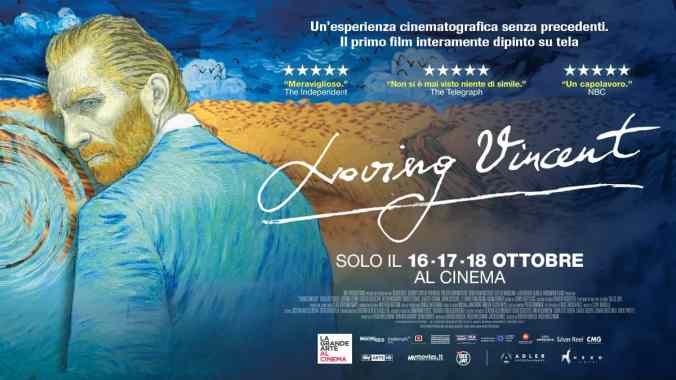
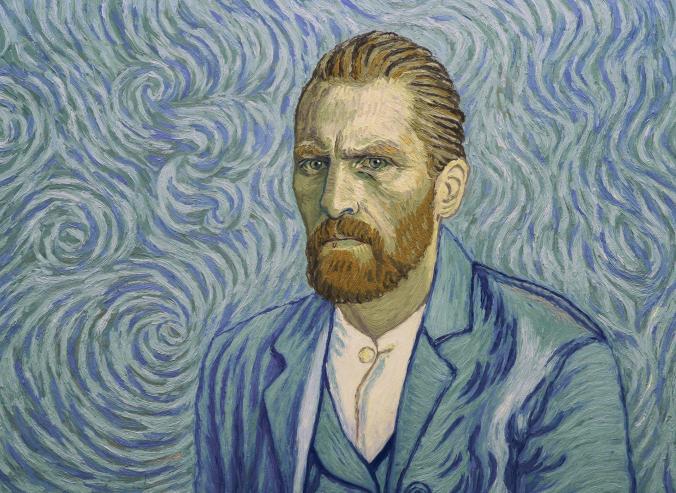
The film is unique in that it was created by more than 100 artists who painted every frame.  It is very interesting to watch van Gogh’s brushstrokes and swirls seemingly come to life throughout the film.
sc-mov-loving-vincent-rev-1011-20171010

Loving Vincent has been nominated for Best Animated Feature Film in the 2018 Academy Awards.


If you want more info on how the film was created, here’s a great link.  The text below comes from the Chicago article.

https://www.chicagoreader.com/chicago/loving-vincent-van-gogh-dorota-kobiela-hugh-welchman/Content?oid=32696545

Tampering with an artist’s memory can be dangerous business: In 2011, Gregory White Smith and Steven Naifeh published Van Gogh: The Life, an acclaimed biography arguing, among other things, that the Dutch painter’s gunshot death in July 1890, in the French town of Auvers-sur-Oise, was no suicide, as scholars had agreed for years, but homicide at the hands of a local bully.

The blowback from Van Gogh fans and art historians was severe. “Many [of these scholars] had done years of research and writing that was deeply embedded in the old narrative,” the authors explained in a Vanity Fair article three years after the book appeared.

“They didn’t just disagree with our new reading; they were enraged by it. . . . [One] specialist, with whom we shared a stage at the opening of a Van Gogh exhibition in Denver, was so choked with indignation that he refused even to discuss the subject when the audience raised it.”

Everyone knows that Van Gogh killed himself in despair, because—well, why? Because it was in that Irving Stone novel, Lust for Life, and the Hollywood movie that Vincente Minnelli made out of it? Loving Vincent, the first Van Gogh biopic since the homicide theory surfaced, dives into the mystery surrounding the painter’s death. This extraordinary animation, created by a team of 115 artists who hand-painted every one of its 65,000 frames, brings to life many of the people Van Gogh painted during his last years in France—foremost among them young Armand Roulin, whose family befriended Van Gogh during his year-long stay in Arles. One year after the artist’s death, Armand is recruited by his father, Joseph, to track down Van Gogh’s brother, Theo, and place in his hands an unsent letter from Vincent that has just turned up. Armand’s journey leads him to Paris, where he learns that Theo has died too, and then to nearby Auvers, where he questions the townspeople about Vincent and, from their variously colored memories, tries to reconstruct how and why the artist died.
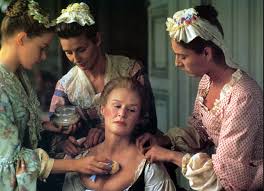
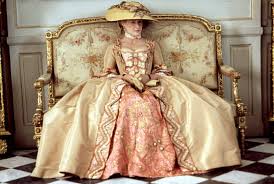
 

I came for the actors, stayed for the costumes, and was appalled by the story.


images-4

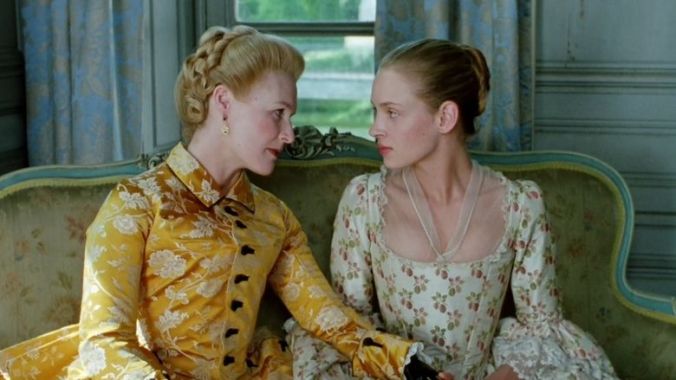
Somehow, when the film Dangerous Liaisons came out in 1988, I missed it.  That was a busy year for me, and so were the ones preceding and following, so I understand how it happened, but I’m glad to finally catch up today.  I didn’t even know I didn’t even know!

images-5

I’d missed it all these years, not even knowing that 3 women powerhouses Uma Thurman, Glenn Close, and Michelle Pfeiffer, appeared together in this gorgeously produced movie. John Malkovich is in it too, of course, but it is the women who run this show.

Dangerous-Liaisons-images-ecf6e6d7-c8e2-45eb-bb07-7fa3a3a832c

Watching the film is like entering a painting by François Boucher.  It is lavish and ravishing. As I watched the story unfold, I felt, like the aunt in the film says, “that it is remarkable how little things change.”


Frances McDormond

I couldn’t sleep last night and wanted something to lull me to lala land.  Boy, did I pick the wrong movie!

I was reading the NYTimes about the Oscar nominations for this year and one thing led to another and I started reading about one of my fav actors, Frances McDormand.  I’ve been a fan of hers since Fargo.

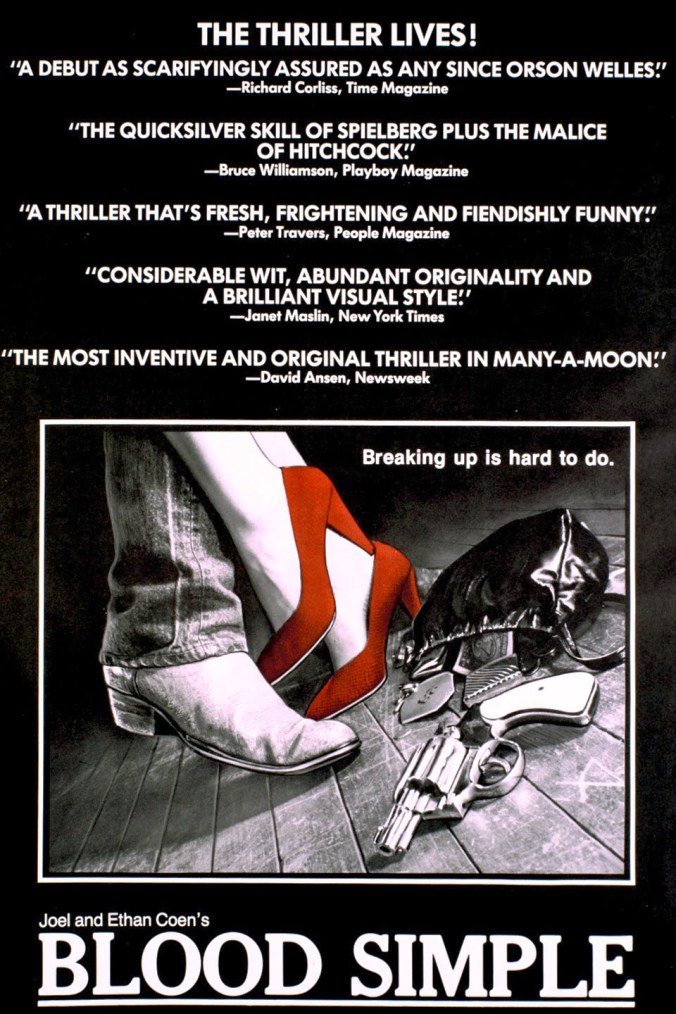
Reading about her career, I ran across her first film, Blood Simple.  I found it online and watched an hour before I had to shut off my computer.  The movie woke me up big time!

I finished watching it today and can’t recommend it highly enough!  McDormand is amazing in it, and the film is first-rate, all around.

I don’t, however, recommend watching it when you are planning to go to sleep soon.  It will keep you riveted!

p8584_p_v8_aa


From Wiki:

Blood Simple is a 1984 American neo-noir crime film written, edited, produced, and directed by Joel and Ethan Coen. It was the directorial debut of the Coens and the first major film of cinematographer Barry Sonnenfeld, who later became a noted director, as well as the feature film debut of Joel Coen’s wife Frances McDormand, who subsequently starred in many of his features.

The film’s title derives from the Dashiell Hammett novel Red Harvest (1929), in which the term “blood simple” describes the addled, fearful mindset of people after a prolonged immersion in violent situations.[3]

The Coen brothers strike again!

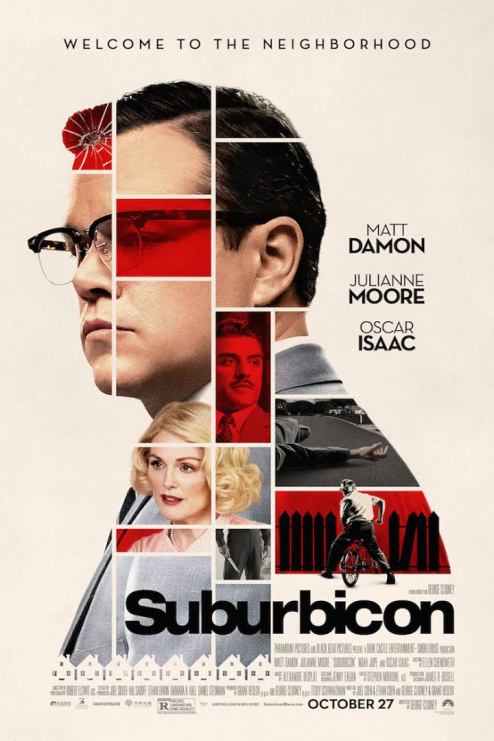
Suburbicon is an excellent 2017 American crime thriller black comedy film directed by George Clooney and co-written by Clooney, Joel Coen, Ethan Coen, and Grant Heslov. The film stars Matt Damon, Julianne Moore, Noah Jupe, and Oscar Isaac, and follows a mild-mannered father who must face his demons after a so-called home invasion …

images-3

Come for the funny/dark content, stay for a recreation of the 1950s!

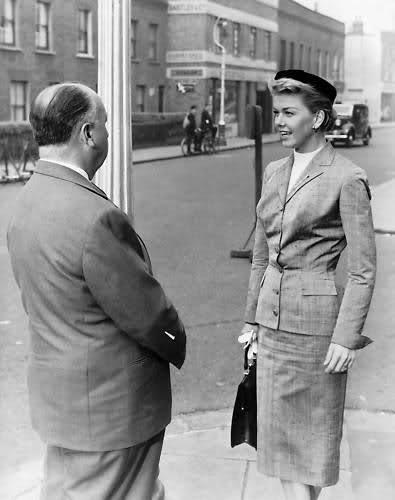
Doris Day and Edith Head, and oh yeah, Alred Hitchcock and Jimmie Stewart

These principals all came together in The Man Who Knew Too Much.

They created movie magic at its finest.  Time travel back to 1956. American surgeon, Dr. McKenna (Jimmie Stewart) takes his wife (Doris Day) and young son to visit Morocco, for he had been there, serving in North Africa during WWII.  They literally stumble into all kinds of espionage and trouble in Marrakesh, and their son is kidnapped in the process.

Alfred Hitchcock directed this classic film and Edith Head made this sketch of a beautiful suit for Doris Day to wear in the critical parts of the movie.


25594219_1980496865532539_9193128303828862380_n

2819623_orig

The suit seen above, without the stole, was realized in gray silk and Miss Day wears the suit throughout the second half of the film, during which she is seen in Albert Hall in London, as well as in the Embassy of some unspecified but critical country.  Her kidnapped son had been taken to London and she and Mr. Stewart are there to find him.

I loved the movie and highly recommend it.  Here are the lead actors and the director:

Jimmy-Stewart-Alfred-Hitchcock-and-Doris-Day-at-the-premiere-of-The-Man-Who-Knew-Too-Much-1956


And here is the poster advertising the film.

2098544_orig


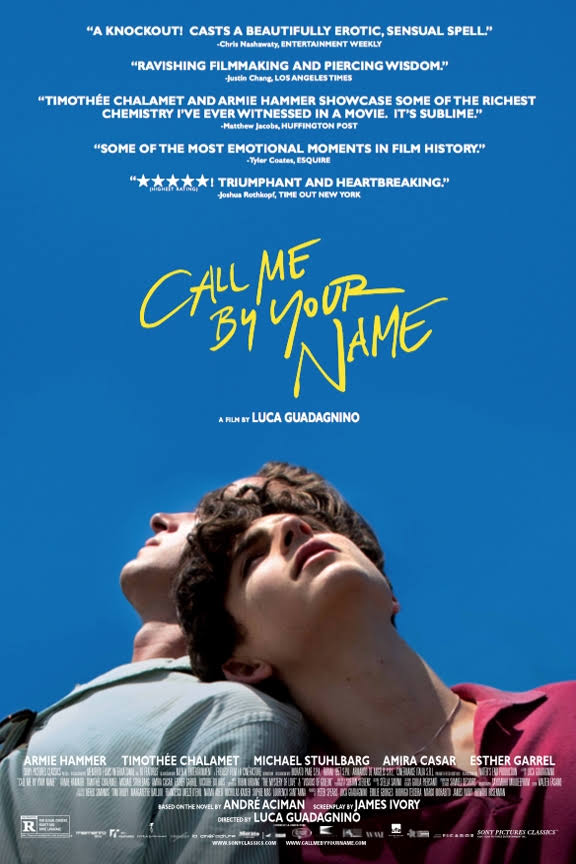
Call me by your name, and I’ll call you by mine.

images (1)

Catching up on movies during the holidays, I loved this one.  Maybe it is because it is set in Italy, maybe because it is set during my own youth and coming of age, maybe its because I have a beautiful son like the one in the film, maybe because I have spent my life searching out and writing about art like the father in the film, maybe it is because I was in breath-taking Sirmione last summer on Lake Garda where the ancient sculpture is dredged up from, maybe it is because I liked the affectionate relationship between the mother/son, maybe because I’ve met charismatic men who can do anything like the protagonist, or maybe for the collective wisdom of the parents; for whatever combination of reasons, this movie moved me.  Catch it if you can.

A Room with a View, still ravishing after all these years.

https://youtu.be/cyQ4vkTwc4E


The ravishing film, of course, was based upon the book of the same title by E.M. Forster.  The book is a lovely read, but honestly, I think Where Angels Fear to Tread by the same author and on the same period is far better.


In 1985, A Room with a View was nominated for eight Academy Awards, including Best Picture and Best Director.  The film won three awards, for Jhabvala’s adaptation of Forster’s novel, for Best Costume and for Best Production Design.
A Room With a View was also voted Best Film of the year by the Critic’s Circle Film Section of Great Britain, the British Academy of Film and Television Arts, the National Board of Review in the United States and in Italy, where the film won the Donatello Prize  for Best Foreign Language Picture and Best Director.
US director James Ivory awarded with the 'Fiorino d'Oro', Florence, Italy - 05 Oct 2017
22196188_1699375533430051_2633005952246625126_n22196209_1699375550096716_7345193732756508899_n

What if?

What if you woke up today in Florence and decided you wanted to live in a fantasy world?

Let’s say you thought to yourself  “wouldn’t it be cool if I could go into a Renaissance palace in the center of Florence, and be a welcome guest?”

And, further, wouldn’t it be groovy if, when you were in that Renaissance palace, as a welcome guest, you could sit down for a while on a very comfortable, velvet covered chair, and enjoy a glass of nice local wine, while something amazing entertains you.

And, to increase the fantasy, what if this entire experience was air-conditioned, while Florence sizzles in the heat of the summer outside?

And what if I told you that this is actually not a fantasy, but something you could truly experience?!  How fast would you beat it there?


red_cinema_odeon

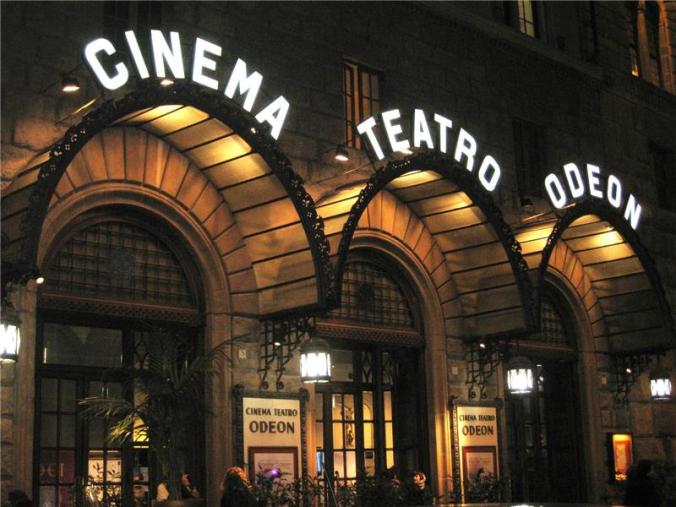
One of my favorite places in Florence ticks all of the boxes above.  I love going to this place!

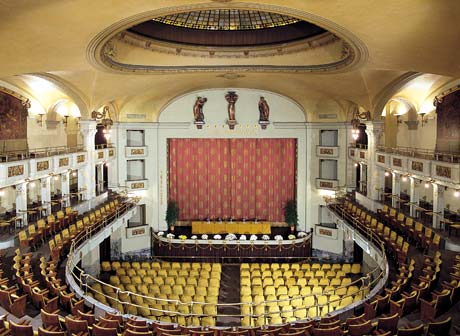
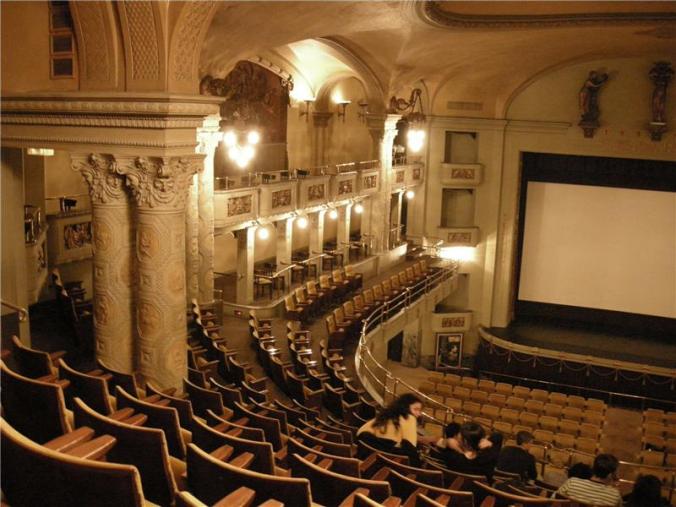
The classic art nouveau/deco interior is gilded and gorgeous and makes an average evening at the movies feel like an elegant affair!  And an added bonus is, it has air conditioning!  A great place to pass a summer evening in broiling Florence.

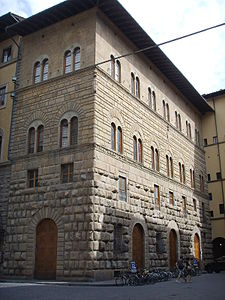
So, let’s start with the building, which is the Palazzo Stozzino, constructed in 1450s and 60s.  Here t’is!

Palazzo_dello_strozzino_01

Work on the palace began in 1457. None other than Filippo Brunelleschi is thought to have designed it, but several other architects, among them Michelozzo, also had a hand in the edifice. The façade is attributed to Michelozzo, at least in the lower part, with its rusticated stone facing. Higher floors have been changed during various periods of renovation; they were changed a lot in the 19th century. 

Inside the Renaissance palace was a courtyard surrounded by an elegant porch with columns; it is thought Michelozzo designed the cortile and that it was built around 1460. The Palazzo Strozzino took its name after the larger Palazzo Strozzi.

The entire area around the palazzi Strozzi and Strozzini was changed during the 1860s, when Florence became the capitol of Italy.  Many buildings were razed.  Fortunately, these two palaces were spared.

The story goes that it was the suggestion of a famous Italian actress, Eleonora Duse, to transform the Strozzino into a cinema. Apparently the people who owned the palace in the 1920s were considering turning the building into a luxury hotel.  Duse is said to have convinced them into building this stately cinema instead. 

At any rate, it was somehow decided to create a cinema in the Strozzino’s courtyard. The Cinema Teatro Savoia was designed by noted architect Marcello Piacentini in 1920 and finished in 1922; the theatre was lavishly inaugurated in December of 1922.

2odeon


red_cinema_odeon_france_firenze

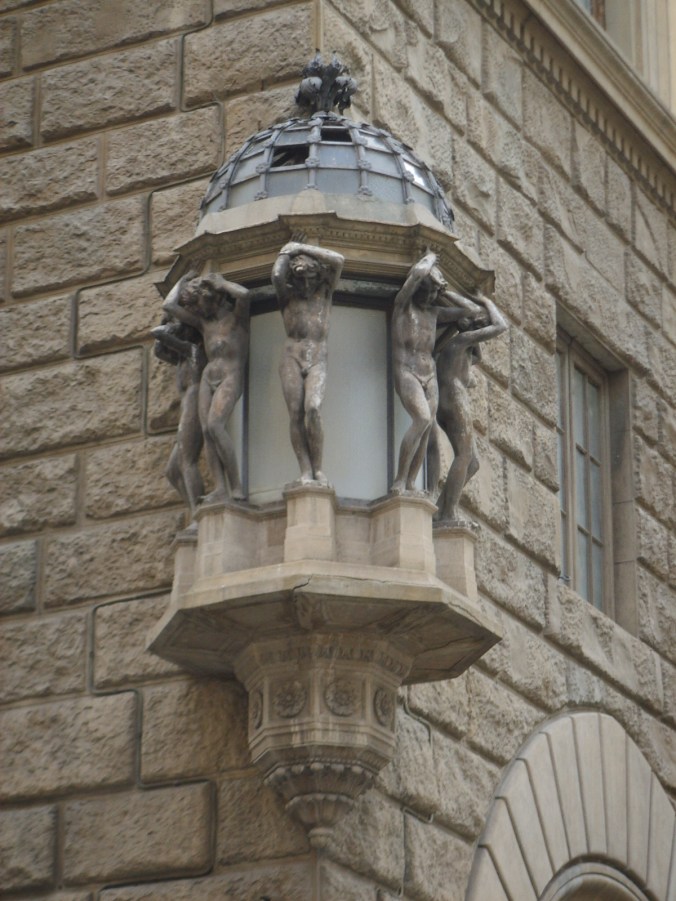
At the same time, two of the palace’s facades were redesigned, and a circular temple-shaped lantern was placed on a corner with bronze nude efibici, by the sculptor Marescalchi. 

Palazzo_dello_strozzini,_edicola

Inside the cinema, the sculptor Giovanni Gronchi created the lacunars and stucco plaques, and sculptor Antonio Maraini designed the three Muses in gilded and polychromed wood on the boccascena.  Other specialized artists and firms created the elaborate decorative interior.

800px-Cinema_odeon_firenze_00


red_cinema_odeon_france_firenze

The theatre was later re-named Cinema Teatro Odeon, and it is now operated by the Cinehall Group. It remains a first-run single screen cinema. Many films are shown in their original language version (with Italian sub-titles).

The Odeon has long been a preferred meeting point for members of Florentine cultural and artistic life.  Guests such as Louis Armstrong and Ella Fitzgerald visited the theatre, as have directors and actors of Italian neorealist cinema, as well as contemporary artists such as Isabelle Adjani, Angelica Houston, Bernando Bertolucci, Kenneth Branagh, Roberto Benigni, Nanni Moretti and Paolo Sorrentino.

The prestigious and elegant spaces of the Cinema Odeon Theater include  a large open room, with a stage holding the movie screen, and has a total capacity of 594 seats, divided into the large stall (with 334 seats) and stylish balcony (seats 260).

Fortunately for us, the Odeon still maintains the harmony and beauty of its original art deco/nouveau style; its tapestries, statues, and colored glass skylight are admired by its many visitors.

The original furnishings of the grand room were red velvet; the furnishings were renewed in 1987 and replaced with yellow gold velvet. Theoriginal wooden chairs remain in the balconies. 
On Via dei Sassetti a plaque reads: "Built in the MCMXXII on behal of S.A. Toscano Immobiliare Sindacato - Restored in the MCMXXXVIII".

The Odeon Cinema is a vibrant cultural centre, often hosting cinema
festivals. One of the leading is “50 Giorni di Cinema Internazionale”, which takes place in winter, showcasing movies and directors from
diverse cultures.

In addition to the entertainment venues and offices of the German Management, the building houses the Departmental Department of Tobacco Growth and the Department of Economic Development of the City of Florence, and in the basement a historic disco, the Yab.

Palazzo Strozzi: an incredible, historic building now repurposed as a superb exhibition space

The Palazzo Strozzi is a superb example of Renaissance civil noble residential architecture in the historic center of Florence.  And it has been repurposed to delightful service of the modern world.

220px-Palazzo_Strozzi_2


Today the palace is used for temporary international expositions, like the one I viewed yesterday, devoted to Bill Viola.


banner-pg2-ing


Before looking at the exhibition, let’s discuss the incredible building:

Filippo Strozzi the Elder (1428 – 1491), the banker and statesman, commissioned the structure after his return to Florence in November of 1466.

Stile_di_niccolò_fiorentino,_filippo_strozzi_(1426-91),_1489,_recto

As a major Medici rival, Strozzi wanted to build the most magnificent home in the city to assert his family’s prominence.  The palace may as well have been intended as a political statement of his own status.  Based on the wishes of Strozzi himself, the palazzo would be built to look like a small fortress in the heart of the city.

The palace was begun in 1489 and designed by Benedetto da Maiano.

250px-Palazzo_Strozzi_03

The Strozzi palace was clearly inspired by the Palazzo Medici, with its rusticated stone exterior, but it is much larger and has more harmonious proportions than its predecessor.  Whereas the Palazzo Medici was sited on a corner lot and thus has only two main sides, the Stozzi is surrounded on all four sides by streets. The Strozzi palace faces the historical  and fashionable Via de’ Tornabuoni, as well as the Piazza Strozzi and on Via Strozzi. The building thus required three imposing entranceways, each flanked by rectangular windows. The Strozzi family’s coat of arms is found in the upper floors.

The siting of the Strozzi in the center major streets provided the challenge of how to integrate a cross-axis in keeping with the Renaissance desire for strict internal symmetry.  As a result, the ground plan of Palazzo Strozzi is rigorously symmetrical on its two axes.

The Strozzi family acquired a great number of buildings in this area were acquired during the 70s and demolished them all to to provide enough space for his new home.

The original architect, Benedetto da Maiano, died in 1497; Simone del Pollaiolo (il Cronaca) took over and was responsible for the completion of the palace. Pollaiolo died in Florence in 1508, but is credited with the design and finish of the central courtyard or cortile, surrounded by an arcade inspired by Michelozzo.

The external facade is adnorned with splendid torch holders, flag holders and rings to tie horses made by Niccolò di Nofri, an iron-worker known as il Caparra.

Unfortunately, Filippo Strozzi died in 1491, long before the construction’s completion in 1538.  Strozzi’s children were the first to live in the palazzo, moving in around 1505.  Ironically, Duke Cosimo I de’ Medici confiscated the palazzo in the same year, not returning it to the Strozzi family until thirty years later.

The palazzo remained the seat of the Strozzi family. Although the family lived in Rome for centuries, the palazzo was returned to its original splendour in the mid-1800s with the Princess Antonietta, and then with Prince Piero, who, from 1886 to 1889, had the building renovated by architect Pietro Berti.  In 1937 the family sold the building to the Istituto Nazionale delle Assicurazioni, and many changes were made to the edifice.  It was later given to the city of Florence in 1999. It is now home to the Institute of Humanist Studies and to the Fondazione Palazzo Strozzi.

Since July 2006, the Fondazione Palazzo Strozzi has been able to create a rich and innovative calendar of events and exhibits, in these areas of the building: Piano Nobile, la Strozzina and Il Cortile.

The Gabinetto G.P. Viesseux and the Renaissance Studies Institute both have also occupied the building since 1940.  Here also is the seat of the Istituto Nazionale del Rinascimento and the noted Gabinetto Vieusseux, with a library and reading room.

Today the palace is used for temporary international expositions like the now-annual antique show, founded as the Biennale dell’Antiquariato in 1959, fashion shows and other cultural and artistic events.


Allora, on to Bill Viola and his video art.

In the exhibition “Electric Renaissance,” Viola seems to have taken certain Renaissance masterpieces and created video dialogues with them.  I would say he is tremendously fortunate to have been able to borrow the original Italian artworks and, even if you don’t love Viola’s work, you will be rewarded with a small, select group of historic masterworks.  For example:

Here’s his dialogue between his video of 3 contemporary women greeting each other, in relationship to Pontormo’s

IMG_3759


IMG_3758  IMG_3757


Other installations stand on their own.  This screen is about 200 feet long by 15 feet high.

IMG_3761


IMG_3766IMG_3767IMG_3768IMG_3769IMG_3770IMG_3771