Florence’s tiny little wine windows

One of the hundreds of interesting things you see when walking around the city of Florence are these small windows, measuring about 12 inches wide by 15 inches tall, cut into the masonry of some major palazzi.  There are hundreds of them in Florence.

The buchette del vino (“small holes [for] wine”) were added to the buildings by entrepreneurial families who produced wine on their country estates and thought to themselves, “why not sell some in Florence on a glass by glass, or a refilled bottle by bottle, basis?”

Screen Shot 2019-09-11 at 10.39.21

Together, these windows form a collection of Renaissance-era vestiges of a once-popular and admirably no-fuss form of wine sales.

Without exception, I have never seen one of these windows open.  They are usually boarded up, sometimes in quite decorative ways.

Screen Shot 2019-09-11 at 10.39.49

But now, an organization is working to preserve—and help reopen—the city’s “wine windows.”

“These small architectural features are a very special commercial and social phenomenon unique to Florence and Tuscany,” Matteo Faglia, a founding member of the Associazione Culturale Buchette del Vino, told Unfiltered via email. “Although they are a minor cultural patrimony, nevertheless, they are an integral part of the richest area of the world in terms of works of art and monuments—Tuscany.”

The buchette first came into vogue in the 16th century, when wealthy Florentines began to expand into landowning—notably, owning vineyards—in the Tuscan countryside. The aristocrats’ new zeal for selling wine was matched only by that for avoiding paying taxes on selling wine, so they devised the simplest model for wine retail they could: on-demand, to-go, literally hand-sold through a hole in the wall of their residences.

It was convenient for drinkers, too: Knock on the window with your empty bottle, and the server, a cantiniere, would answer; upon receiving the bottle and payment, he would return with a full bottle of wine. Buchette eventually became popular enough that nearly every Florentine family with vineyards and a palace in Florence had a wine window, and soon the trend spread to nearby Tuscan towns like Siena and Pisa.

The windows stayed open for the next three centuries, but by the beginning of the 20th century, more social wine tavernas had spread throughout the city, with better-quality wine, better company and equally easy access to a flask.

By 2015, most Florentines had lost track of their wine windows, if not vandalized them. That year, the Associazione was founded, with a mission to identify, map and preserve the buchette—nearly 300 catalogued so far.

And this summer provided a new boost to their work: One restaurant has cracked open its buchetta anew for business. Babae is the first restaurant to re-embrace the old tradition, filling glasses for passersby through their buchetta for a few hours each evening.

It’s a welcome development to the lovers of wine windows. “Although the ways of selling wine have obviously changed since the wine windows were fully active … this small gesture, which highlights a niche of Florentine history, is very welcome,” said Faglia, “to help to keep alive this antique and unique way of selling one of Tuscany’s most important agricultural and commercial products: its wine.”

This new association even has a Facebook page: https://www.facebook.com/buchettedelvino/

http://buchettedelvino.org/home%20eng/index.html

https://www.winespectator.com/articles/florence-s-forgotten-renaissance-wine-windows-are-open-again-for-business

Some good news, after all

If you read my post entitled Sad and true, the anti-reforms in Italy’s art world  

I have some good news for you.  Things have changed for the better!!

https://news.artnet.com/art-world/relief-for-foreign-museum-directors-italy-1643938?utm_content=bufferce988&utm_medium=social&utm_source=facebook.com&utm_campaign=news&fbclid=IwAR2zboN8u3al5HL-n7vwxCNbn2_1xjcY58j0ApiWSm_9W189QE-fSgwdYTY


Emporio Duilio 48, Firenze

The “Emporio Duilio 48,” was founded in Florence (in the current Coin department store building, in Via de ‘Calzaiuoli) in 1902.  The sales formula was, everything was under the price of 48 cents.

It is a fascinating story about early 20th-century Florence, with the tragedy of WWII a part of it.

51826034_758135531252169_7445370969197117440_n51593797_758135557918833_2250192757182169088_n

The creator of the formula “all at 48 cents” was Joseph (Giuseppe) Siebzehner who was born in Vienna in 1863 and died in the Milan-Auschwitz route in the train departed on 29 January 1944 from platform 21).  He was a Jewish merchant of a large Polish family, originally from Kańczuga (south-eastern Poland), married to Amalia Koretz (born in Plzeň on 15 March 1871 and dead in Auschwitz), daughter of Ferdinando.

The Siebzehner, already active in trade in Vienna at the end of 1800, took over the commercial activity called Grande Emporio Duilio and founded in Florence in 1888 by the Papalini brothers, who in turn had taken over the renowned Bazar Bonajuti, founded in 1834 by the architect (son of merchant) Telemaco Bonajuti.

The expansion of the Florentine headquarters in 1907 gave rise to the new name Emporio Duilio 48. This was soon joined by the two more stores in Montecatini and Viareggio; the latter was initially located in a bench where today stands the renowned shoe store Gabrielli, next to Magazzini 48.

It seems that after 1911 there were also 2 stores in Bologna, named simply: Emporio Duilio.

It’s clear that Giuseppe Siebzehner was a cutting-edge merchant, ahead of his time in Italy.

In fact, from the family archive (owned today by Count Federico di Valvasone and the last descendant, Riccardo Francalancia Vivanti Siebzehner), it emerges that Giuseppe already had two exclusive contracts at the end of the 19th century.

One with a comasco producer of festoons, lights of paper and decorations for the holidays.

The other, even more important, was with the great Bolognese blacksmith, Giordani, who built prams, tricycles, and especially bicycles for which he became a famous producer after WWI.

Even more avant-garde, Joseph was the first to produce a product catalog with mail order, a forerunner of today’s online shopping phenomenon.

The activity later passed into the hands of Giuseppe’s sons: Giorgio Vivanti Siebzehner (born in Florence, 1895 and died in Florence, 1952), lawyer and author of the Dictionary of the Divine Comedy and his brother Federico (born in Florence, 1900 and died in Florence in 1978), an electronic engineer who was among the first in Italy to conduct extensive experiments on ceramic resistance at the Italian Ceramics Society – Verbano. He, was awarded the honor of Knight to Merit of the Italian Republic in 1956.

Over time, the Francalancia Vivanti Siebzehner heirs of Valvasone and Bemporad took over the property until the commercial activity was sold to Coin Department store in 1988. The Viareggino building was instead ceded to the Fontana family in the 1990s. They later opened the Liberty Store, one of the most famous record and video games stores in the city.


Sad and true, the anti-reforms in Italy’s art world

https://www.telegraph.co.uk/news/2019/08/22/director-florence-museum-home-michelangelos-david-forced-italys/?fbclid=IwAR0VBbAXxL02sU8ye1FYAl8aL-ioU3lh5xhR0t8DkPeQxebVbk4qUAwWEwg


Screen Shot 2019-08-29 at 19.40.04

Sadly, the reforms that allowed even foreign art world personnel to guide Italian public museums have been repealed. You can read about it here:

Screen Shot 2019-08-29 at 19.41.45

https://www.ft.com/content/61380d42-c33b-11e9-a8e9-296ca66511c9?sharetype=blocked&fbclid=IwAR2aJOQH_BnAQRoeT849n6zEwKkJ0J1KH1gQdEMsos4s7bJMk4qoqw67RgA

Was Villa Palmieri the setting for Boccacio’s Decameron?

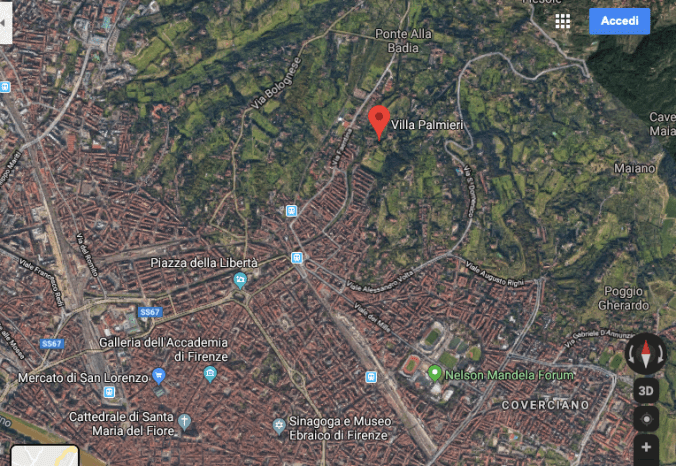
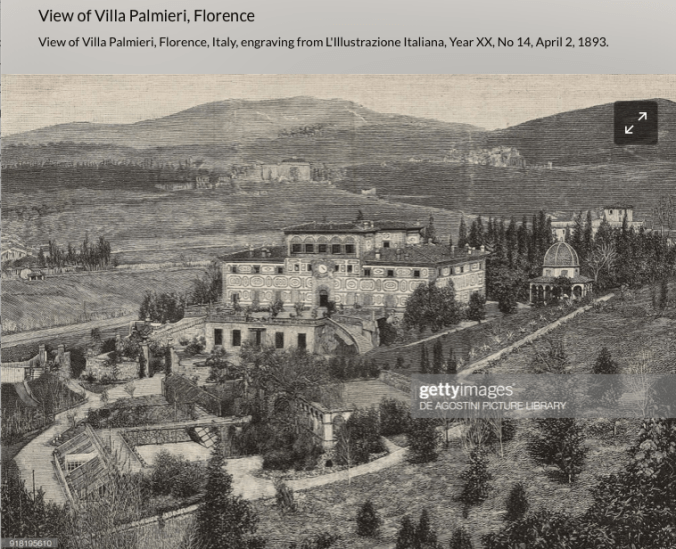
In Boccaccio’s literary masterpiece, The Decameron, three young Florentine nobles and 10 of their friends (the Decamerone) take refuge from the Black Plague in a villa outside Florence.  It is believed that the actual location for the story was the Villa Palmieri, which still stands today in the village of San Domenico, near Florence.

Screen Shot 2019-08-28 at 10.33.20

Screen Shot 2019-08-26 at 13.02.22

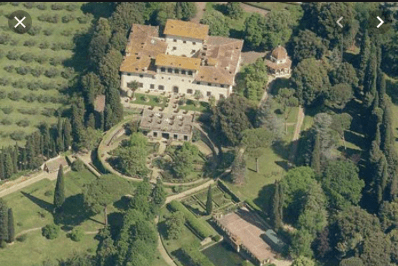
An aerial view of the Villa today.

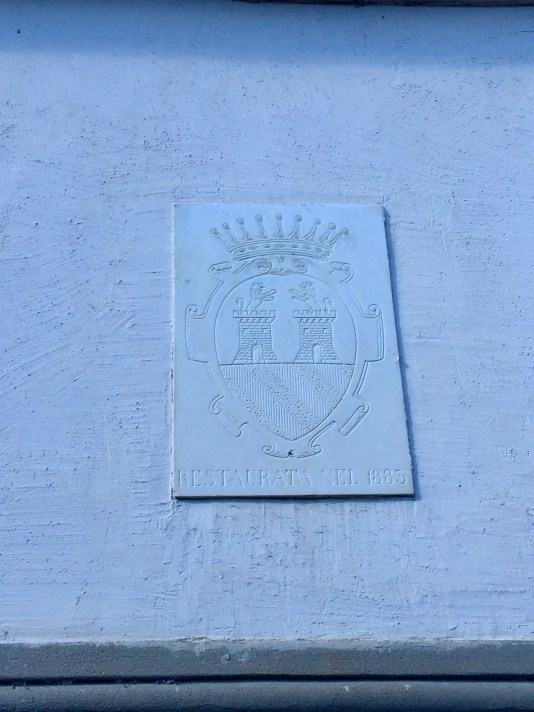
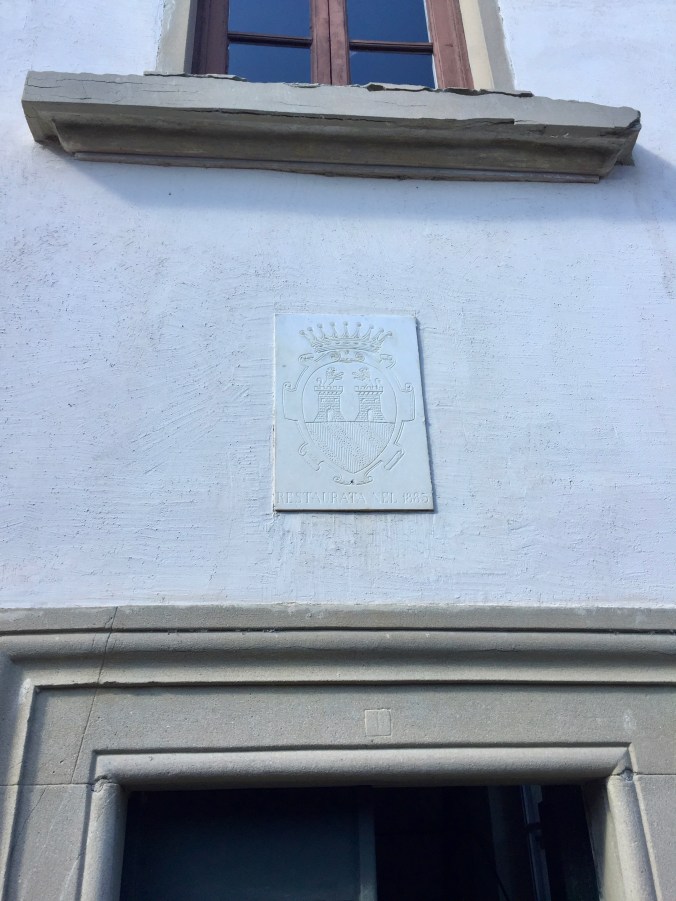
The history of the villa is fascinating. We know that it was in existence at the end of the 14th century, when it was owned by the Fini family. They sold it in 1454 to the noted humanist scholar Matteo di Marco Palmieri, whose name it still bears. Palmieri was a Medici family friend.

One of the descendants, Palmiero Palmieri, restructured the gardens in 1697, sweeping away all vestiges of the earlier arrangements to create a south-facing terrace, an arcaded loggia of five bays, and the symmetrically paired curved stairs (tenaglia) that lead to the lemon garden in the lower level. The lemon garden survives, though postwar renovation stripped the baroque décor from the villa’s stuccoed façade.

In the later 18th century, the house was acquired by a newly ennobled 3rd Earl Cowper.

By 1840, the villa was the home of French novelist, Alexandre Dumas. Dumas describes the villa in his book of Florentine travel essays, La Villa Palmieri (Paris, 1843): “It was in this house that Boccaccio wrote his Decameron. I thought its name would bring me happiness, and set up my office in the same room in which, four hundred and ninety-three years earlier, Boccaccio had established his.”

In 1873 the villa was purchased by James Ludovic Lindsay, 26th Earl of Crawford who recreated part of the grounds in the fashionable English naturalistic landscape manner of parkland dotted with specimen trees.  Lindsay also had plantings of exotic, tender plants that could not be grown in the open in England. His commissions included also the scenic basin of the Fountain of Three Faces and a little chapel in neo-Baroque manner to one side of the villa.

Queen Victoria chose Villa Palmieri as her vacation locale several times in the late 19th century, and the Villa and the Queen will be the subject of another post coming soon.

From 1907-1925, the villa was owned by Chicago industrialist James Ellsworth.

The Villetta, an outbuilding formerly part of the extensive Villa Palmieri grounds, was purchased in 1927 by Myron Taylor, the American ambassador to the Holy see, who recreated a Beaux-Arts version of an Italian terraced garden and named it Villa Schifanoia.

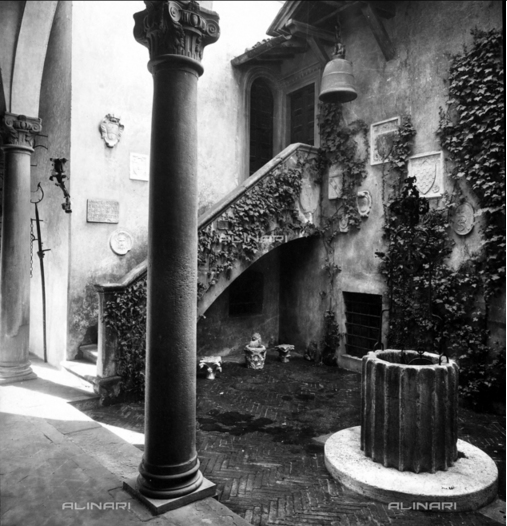
Below, a detail of the villa, photographed c. 1930

Screen Shot 2019-08-28 at 11.57.04

BGA-F-023722-0000
Veduta del cortile di Villa Palmieri, a Firenze.
Credito fotografico obbligatorio:
Archivi Alinari, Firenze
AVVERTENZA:
Autorizzazione obbligatoria per utilizzi non editoriali: rivolgersi ad Archivi Alinari
Data dell’opera: 1697 ca.
Periodo e stile: Tardo Barocco
Collocazione: Firenze
Fotografo: Brogi, Giacomo
Data dello scatto: 1920 – 1930 ca.
Luogo dello scatto: Firenze, Villa Palmieri
Collezione: Archivi Alinari-archivio Brogi, Firenze

During the WWII the villa became a military garrison and some parts, including the baroque decorations on the façade, were destroyed.

The current owners, the Benellis, restored it.

fullsizeoutput_563

fullsizeoutput_5cb

“Unlike the Gamberaia, ” Georgina Masson observed in her book Italian Gardens, “Villa Palmieri has suffered from having been a ‘show-place’ and the alterations of many owners to suit the fashions of their day, so that little of its original character remains.”

Today the oldest remaining parts of Villa Palmieri are the oval geometric garden of lemons which are set out in warm weather ranged round the central circular basin, itself framed in quadrant spandrels, all framed in clipped low boxwood hedging, following an 18th-century engraving of this garden space by Giuseppe Zocchi.

The upper terrace is supported on the vaults of the limonaia, glazed in the 19th century, where the lemon trees were protected from the very occasional hard frost. Some labels on trees record three visits of Queen Victoria to Villa Palmieri, in 1888, 1893 and 1894. I’m writing a post about the Queen and the villa soon.

*****************************

So, was this villa really the setting for Boccaccio’s Decameron?

In fact, we don’t know.

Describing the Third Day in the Decameron, Boccacio mentioned a paradisiacal garden on the outskirts of Florence where the young people met. From the description, it seems that the garden faces south towards Florence, therefore it would be on the slopes of Fiesole.

There are not many villas of 14-century origin in that area and so scholars believe Boccacio’s setting is almost certainly Villa Palmieri.  At that time, the villa was already endowed with large farms, meadows and water sources described by Boccaccio.

The complication is that in the neighborhood of the Palmieri, there were several annexed buildings, which in turn later became villas, and any of them were as likely to have been the setting described by Boccaccio as Palmieri itself.

Among these are the Villa Benelli from the name of the family that lives there, or Villa Schifanoia, which was once included among the properties of Villa Palmieri.

Boccacio’s description of the fictional villa in Fiesole, where his young people retreated from the Black Death raging in Florence to tell stories, is too general to identify any one villa securely.  You can judge for yourself:

To see this garden, its handsome ordering, the plants, and the fountain

with rivulets issuing from it, was so pleasing to each lady and the

three young men that all began to affirm that,

if Paradise could be made on earth,

they couldn’t conceive a form other

than that of this garden that might be given it.

Screen Shot 2019-08-27 at 12.28.24

Regardless, it is an historic and highly interesting site and I recommend visiting it whenever you have the chance. It is on the outskirts of Florence and an easy bus or cab ride from the center.

Screen Shot 2019-08-27 at 12.30.35


Information Sources: Jones, Ted. Florence and Tuscany: A Literary Guide for Travellers (The I.B.Tauris Literary Guides for Travellers) (p. 44). I.B.Tauris. Kindle Edition and English and Italian versions on Wikipedia.

https://www.elledecor.com/it/lifestyle/a28033941/sfilata-givenchy-firenze-primavera-estate-2020-villa-palmieri/


For Dante, all was finally forgiven

In June 2008, seven centuries after Dante’s banishment, the city council of Florence passed a motion rescinding his sentence.  It was one further ploy aimed at the repatriation of his remains, but it was no more successful than the previous attempts, and Dante’s remains still lie in a modest tomb beside the fifth-century Church of San Francesco in Ravenna.

Jones, Ted. Florence and Tuscany: A Literary Guide for Travellers (The I.B.Tauris Literary Guides for Travellers) (p. 37). I.B.Tauris. Kindle Edition.

August 4, 1944: Florence, Italy and Anne Frank in Amsterdam

As the Allied Forces entered Florence in the early hours of August 4, 1944,  the brigade Sinigaglia, the division Arno, and the brigade Lanciotto were enthusiastically welcomed into the Oltrarno district. The Allies allowed the partisans to keep their weapons; the Florentine men then started a roundup, searching for the German snipers that were firing at the unarmed populace. These snipers wanted to terrify the population and to slow the progression of the Allies, particularly in the districts of San Frediano, Conventino, and San Niccolò.

Meanwhile, the Nazis were still on the right or north side of the Arno. The military base of the partisans, the CTLN (Comitato Toscano di Liberazione Nazionale, Tuscan Comitate of National Liberation), was installed in the society Larderello, in Piazza Strozzi n. 2.

At first, the command of the third zone in via Roma n. 4, led by the Partito d’Azione, acted as the connection center. In order to follow both the Germans and Allied movements, a sentry was stationed atop the Cupola del Duomo. The personnel stationed there included a deputy commander, a political commissar, and a chief from the first commander corps.

As for the Florentines, on August 4, only a few of them attempted to leave home. But the following day, without food or water, women and boys started to queue in front of the town’s water fountains and doorways with available wells, as well as in front of the bakeries. The few peddlers selling fruit and vegetables were extremely busy.

To be continued.

Sources:

http://diariodiunfiorentino.altervista.org/liberation-florence-11-august-1944/?doing_wp_cron=1564842755.6783099174499511718750

http://diariodiunfiorentino.altervista.org/the-insurrection-of-florence/?doing_wp_cron=1564846863.0551791191101074218750


Meanwhile, in Amsterdam, a place also occupied by the Nazis, on August 4, 1944, after 25 months in hiding, Anne Frank and the seven others in their secret hiding place were discovered by the Gestapo. The German secret state police had learned about the hiding place from an anonymous tipster, who has never been definitively identified.

After their arrest, the Frank family and their fellow Jewish associates, were sent by the Gestapo to Westerbork, a holding camp in the northern Netherlands. From there, in September 1944, the group was transported by freight train to the Auschwitz-Birkenau extermination and concentration camp complex in German-occupied Poland. Anne and her sister, Margot Frank, were spared immediate death in the Auschwitz gas chambers and instead were sent to Bergen-Belsen, a concentration camp in northern Germany.

In February 1945, the Frank sisters died of typhus at Bergen-Belsen; their bodies were thrown into a mass grave.

Several weeks later, on April 15, 1945, British forces liberated the camp.

https://www.history.com/topics/world-war-ii/anne-frank-1

Busatti, it’s got what it takes

There’s a revered business association in Italy called the UISI, or the Unione Imprese Storiche Italiane, which in English means: the association of Italian Historical Businesses.

In order to become a member of this august group, a company must have been in business for over 150 years and owned by the same family that started the business originally.  This association was begun in Florence and only includes as members businesses that represent the great tradition and history for which Italy is known.

I only recently learned of this association when I visited a great textile store in the Oltrarno section of Florence.  There are no signs announcing this shop; you must be in the know to find it.

It isn’t hidden, au contraire, it is located smack dab between a very famous little artistic studio of the street artist, Clet, and the ancient church of San Nicola.

Check it out online and visit it if you are in the market for some fine Italian textiles: towels, sheets, draperies, and some ceramics.


Sizzling summer in Florence

L’estate e’ arrivata!!!  Summer has arrived!  Big time!  Florence is sizzling, even earlier this year that the last 2!

fullsizeoutput_1186

The thermostat rarely dips below 90, even at night, it seems.

6BFF897A-0968-4277-BB69-ABFF735157DF

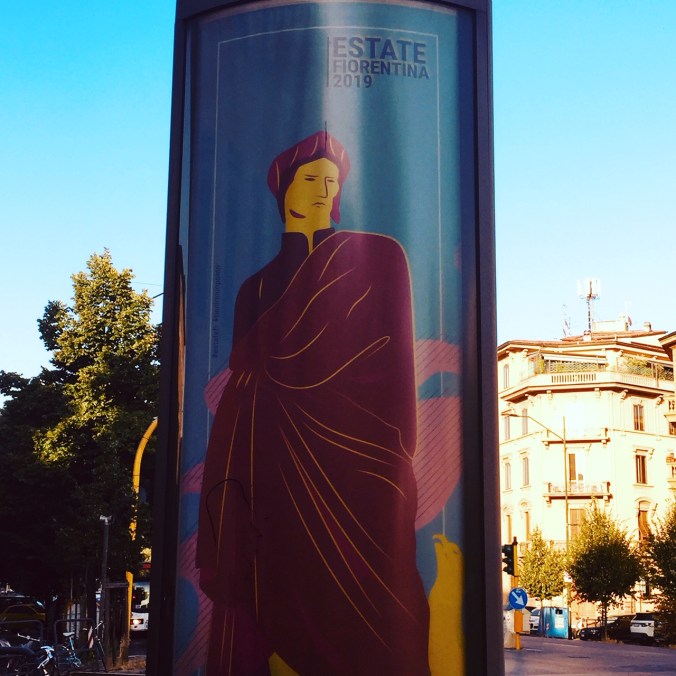
The city of Florence prepared these great posters of Estate Fiorentina 2019! I think Dante is going to want to drop that red cloak, or maybe he just finished swimming in the Arno and is using the coat as a beach towel?  That makes perfect sense to my heat-fried brain!

But, in Florence, you can always cool off with these summertime fruits (candies)!  Have a great summer, wherever you are!

07C33BF2-193D-4BEE-A58F-CCCDD81555B8IMG_9452IMG_9453


P.S. I’m not a fan of hot summer weather.  I’m planning another getaway next month.  Here’s a hint: fullsizeoutput_1187


I’m praying London’s weather stays like this!!