http://www.theflorentine.net/video/2016/11/jane-fortune-receives-fiorino-doro/
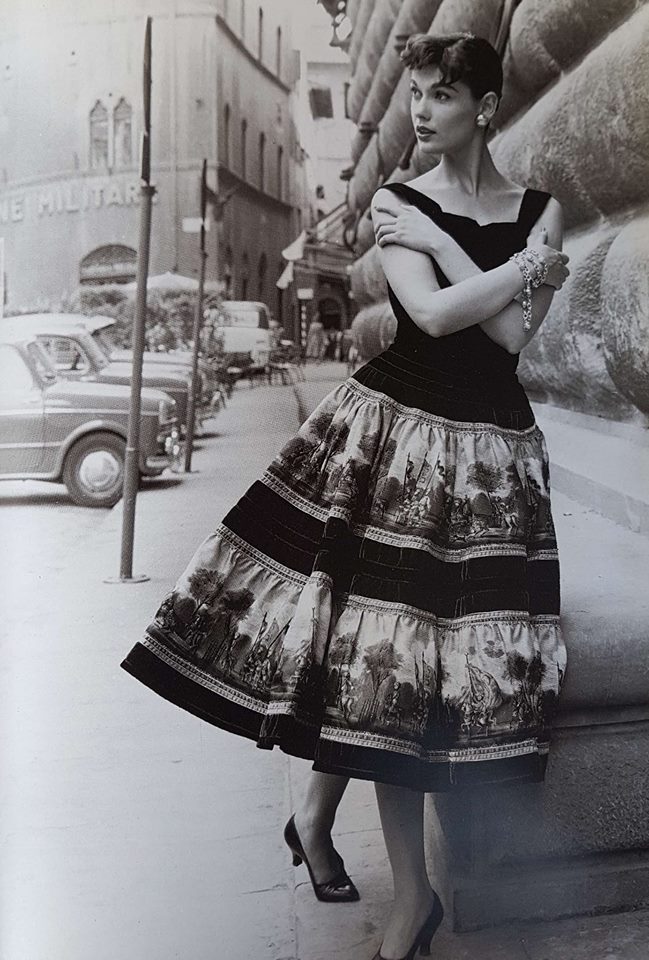
Photo taken by the Palazzo Strozzi.
The Fortezza da basso is a key Florentine monument, but it is almost always overlooked because, let’s face it, it ain’t pretty. Loving the history of Florence, I jumped at a recent opportunity to tour the inside of the fortress. I’ll talk about that below.
The fort’s purpose was not to enchant or entertain, as were so many key monuments built from the medieval period moving forward. The fort’s purpose was to protect the city by blocking and intimidating any evil-doers who might be planning to take Florence in a coup of some sort. And this meant both from without and from within the city.

The fort served these functions well, and Florence was never attacked after it was built. Of course, the fort wasn’t the only reason Florence was left alone. But the huge benefit of that fact is that the fort is largely intact for us to study and admire.
Today the imposing fort has a much softer, more elegant use; I’ll talk about that later.
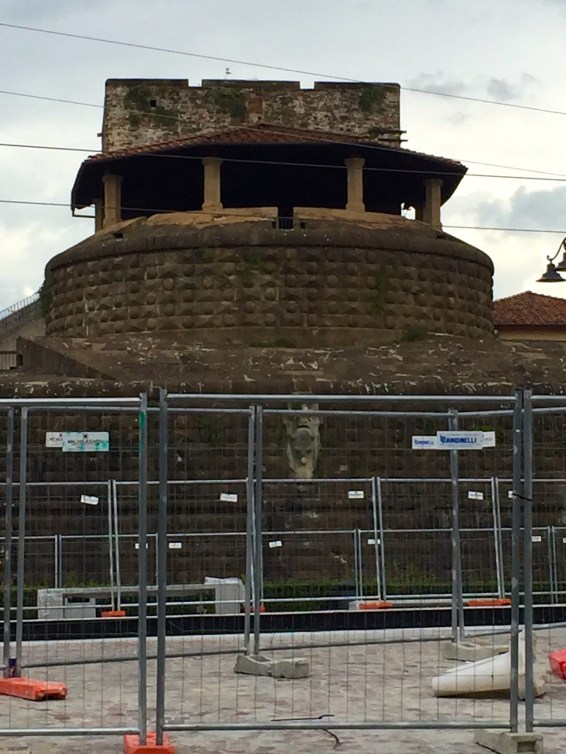
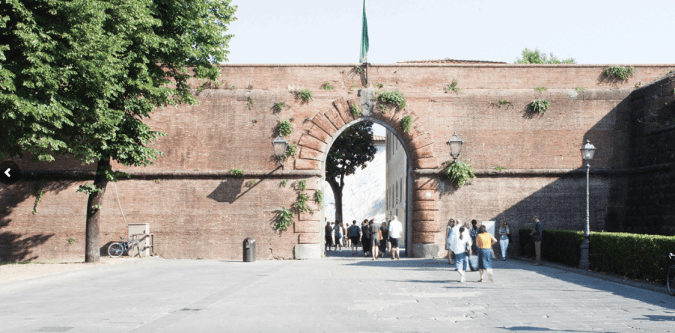
In the following picture, you see one of the fort’s 5 entrances, the Porta Sta. Maria Novella, which is where I entered to begin my guided tour.
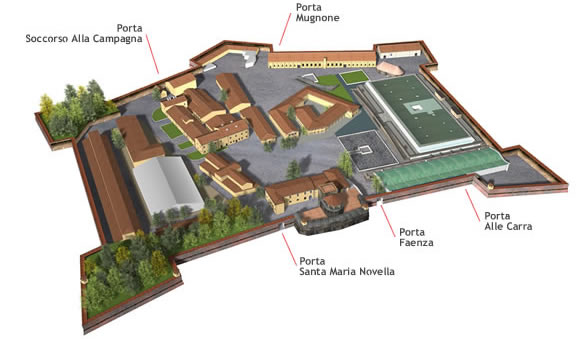
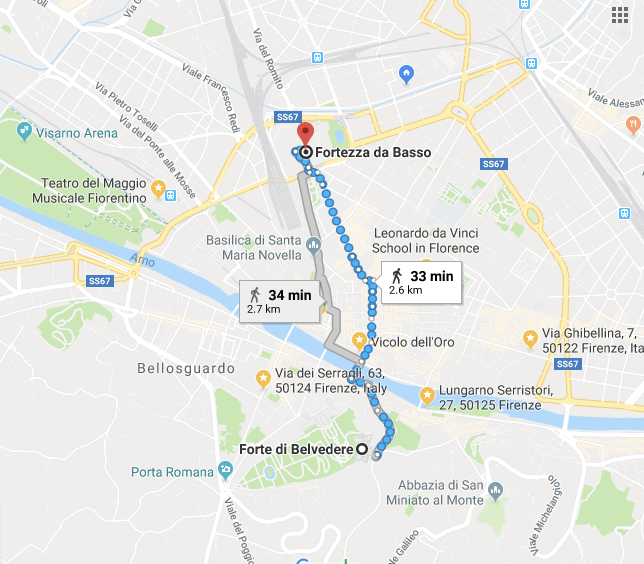
The official name is Fortezza di San Giovanni Battista (Saint John the Baptist, who was/is the patron saint of Florence). The more common name, Fortezza da basso, means in English “the fortress from below,” which indicates that the fort has a counterpart higher up. And, indeed it does: the Forte di Belvedere (fort with a beautiful view) sits high up on a hill to the south of Florence. You can see the location and relationship of both forts here:
The fort is a very impressive military construction with tall, thick and strong walls, dominated by a gloomy, massive tower. The tower here is not like those that are found on other major Florentine buildings. Towers were usually quite tall, and the fort’s tower is relatively short and squat.
The Fortezza appears like a cyclopic building with powerful bastions bristling with turrets, and full of narrow walkways, parapet walks and secret passages. The massive, extensive walls surrounding the fort are occasionally relieved with projecting stone ashlars, some of which are accented with round discs.
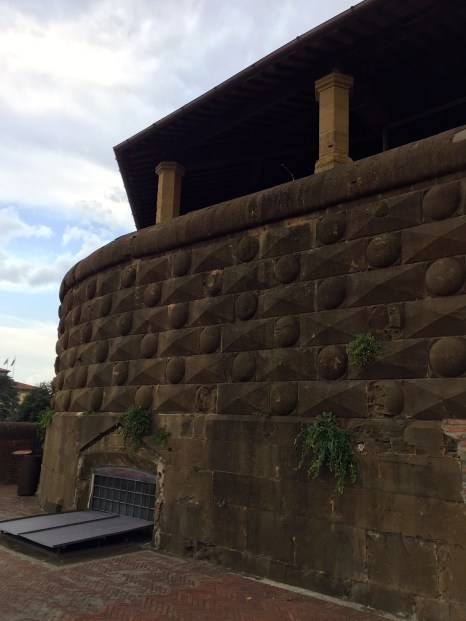
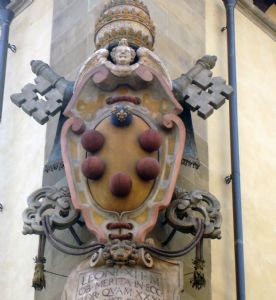
It is theorized that these discs might be a reference to the Medici coat-of-arms, with the 5 balls.
The sophisticated military construction of the fort is a splendid example of the celebrated fortresses built by the Sangallo family. Florence’s Fortezza da Basso was built in record time in 1534, after the return to power in Florence of the Medici family after the dramatic seige of 1529-30.
The Fortezza was designed by Antonio da Sangallo the younger, with the help of Pierfranceco da Viterbo, for Alessandro de’ Medici, the Duke of Florence. And, while it might not be the most beautiful structure in Florence, it is the largest historical monument in the city.
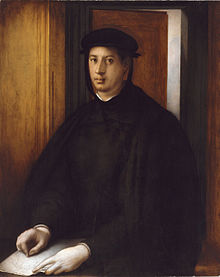 Duke Alessandro de’ Medici
The Fortress, which was inserted into the 14th-century walls of Florence, was built under the growing threat of turbulent political upheavals. It was one of the very first Italian “citadels” and seems rather to have been built as a protection against the city’s inhabitants than from its external enemies.
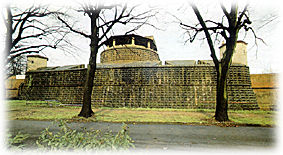
Here are some of my pictures from within the walls of the fortress and leading up to the watch tower on the south side of the former military base:
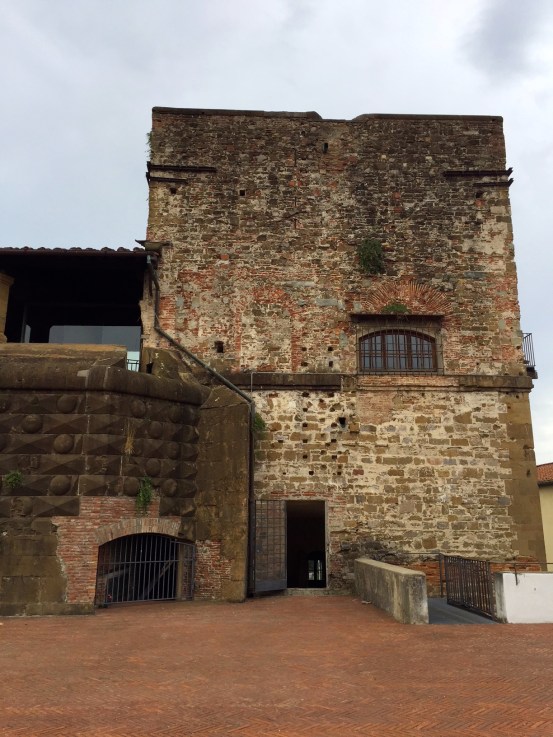

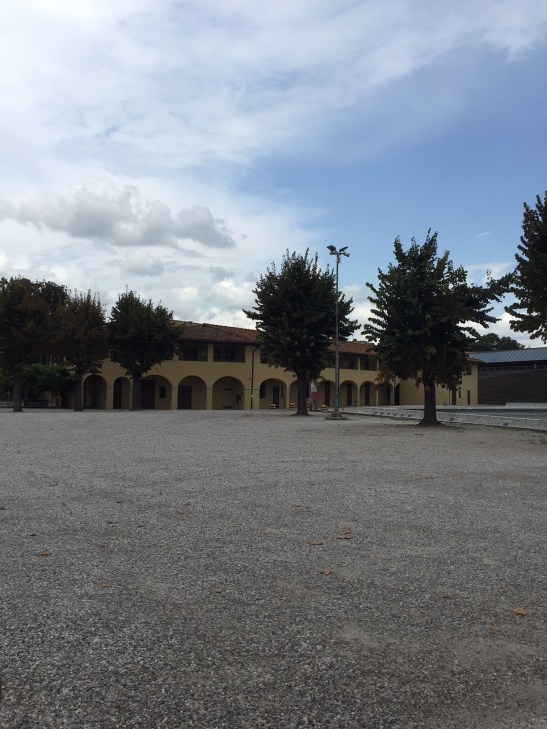
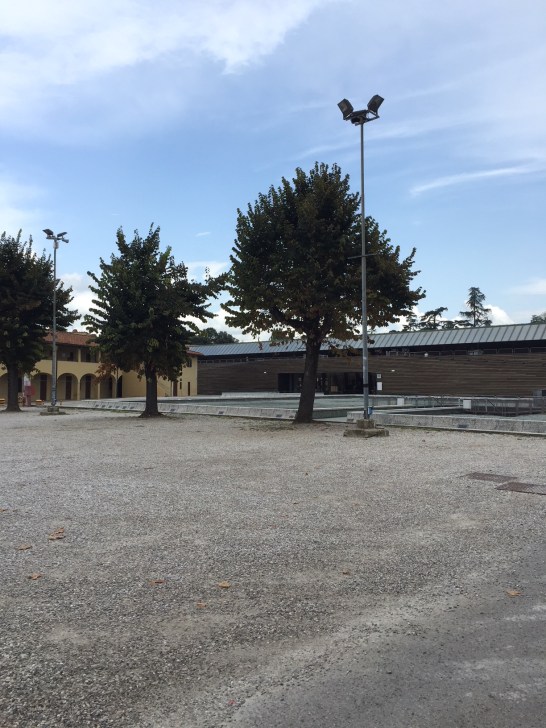
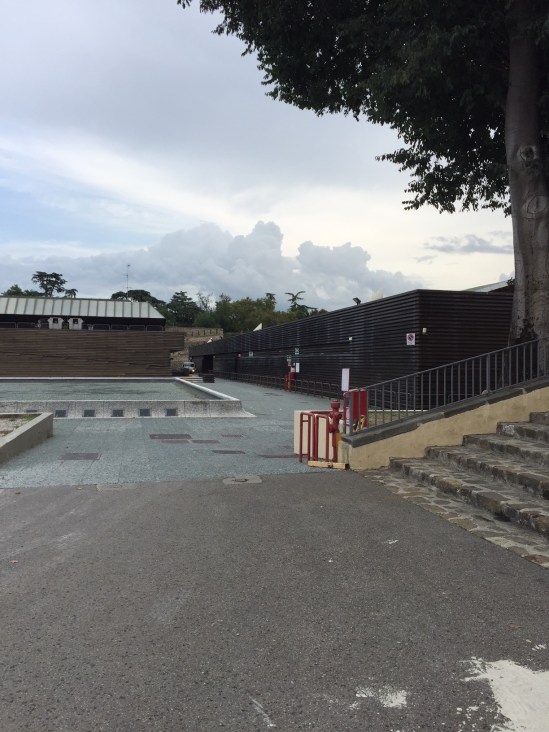
Below are the stairs that lead up to the watch tower:

The next 3 pictures are taken from inside the tower:
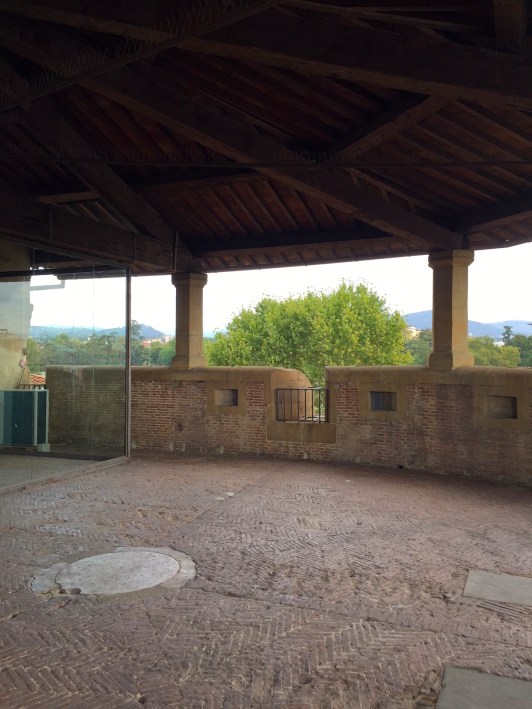

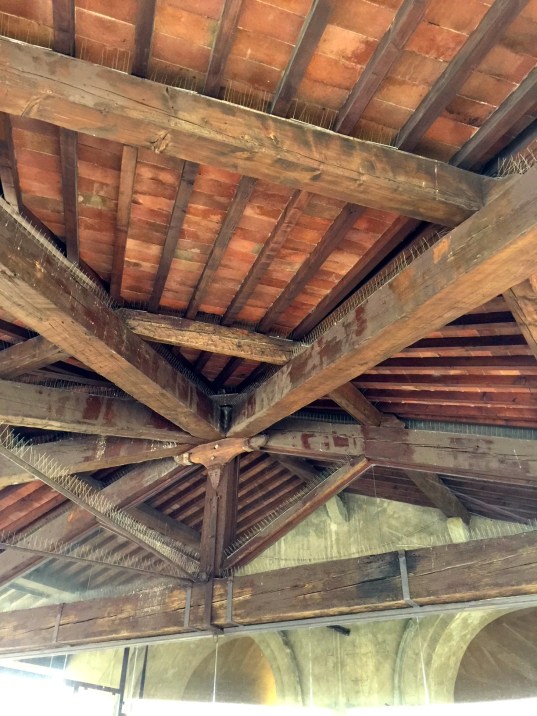
And here are the views of Florence as seen from inside the watch tower:
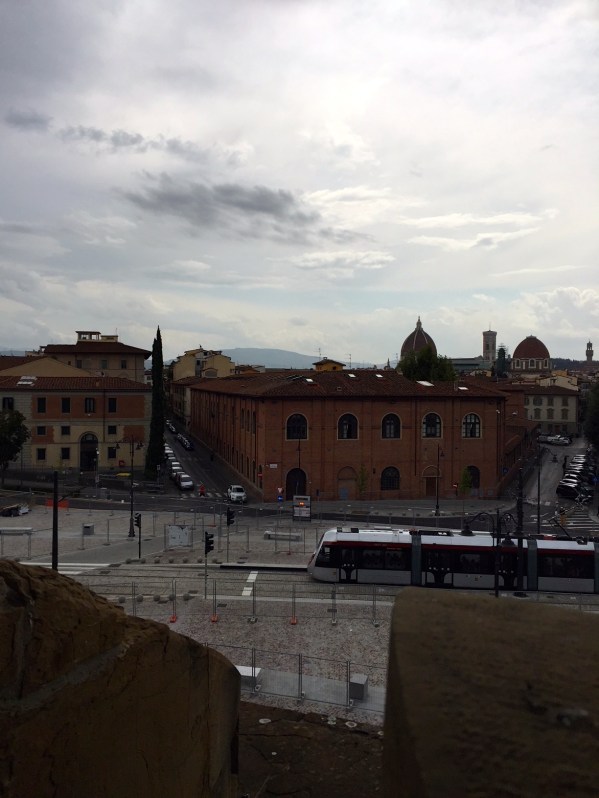


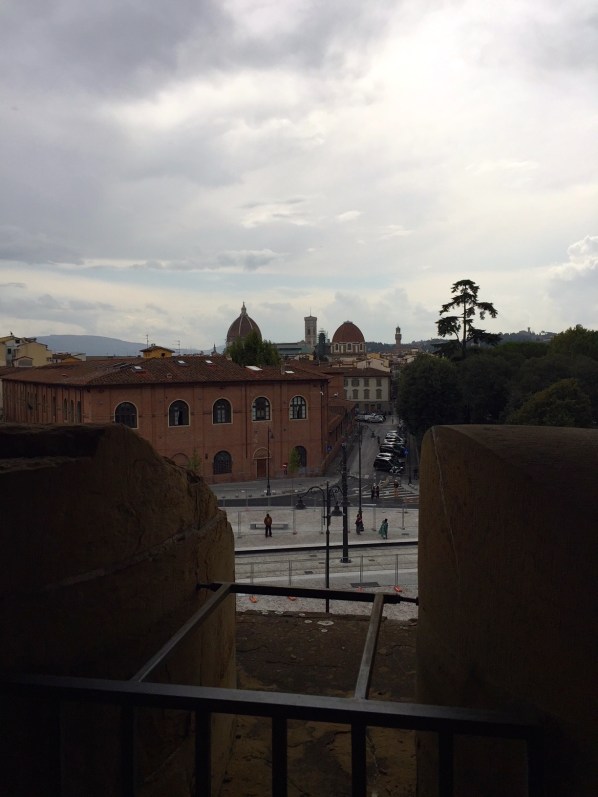
Once again, I was struck by just how small the city really is. It is so obvious from way up high (not that this tower is that tall); the domes of San Lorenzo and the Duomo seem just a stone’s throw away.
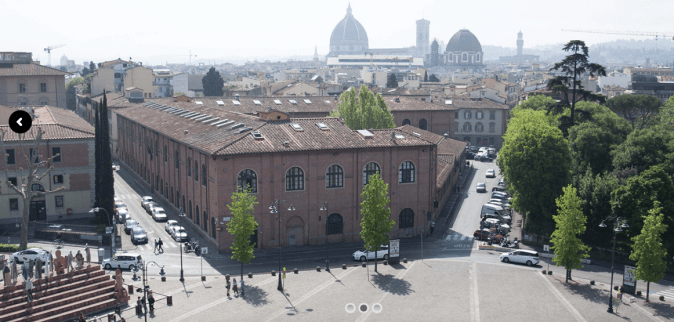
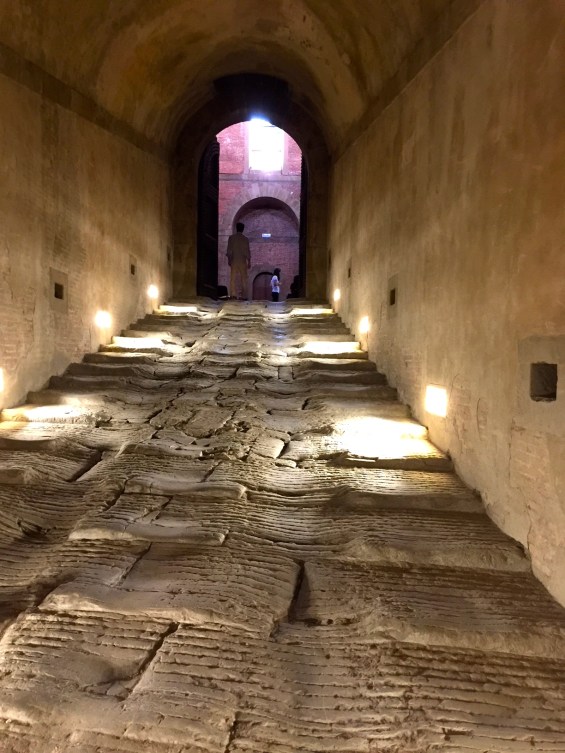
The guided tour of the tower was an incredible treat, but perhaps even more amazing was the fact that we also got to go under the fortifications of the south wall. This Florentine fortress has its secrets and its curiosities. The most important ‘mystery’, yet to be verified and fully discovered, is a gallery which allegedly runs along the perimeter. There is also the tunnel in a state of partial abandonment, which was used by defenders to counter enemy attacks. Legend has it that there is a secret passage from the gallery of Fortezza da Basso that crosses the city underground and leads to the Forte di Belvedere. Who knows, but I find that idea to be ludicrous.
As a part of my guided tour, we got to visit the tunnels below. This is an amazing fact; almost no one in the general public has seen this area. Here are my photos from our tour down below:
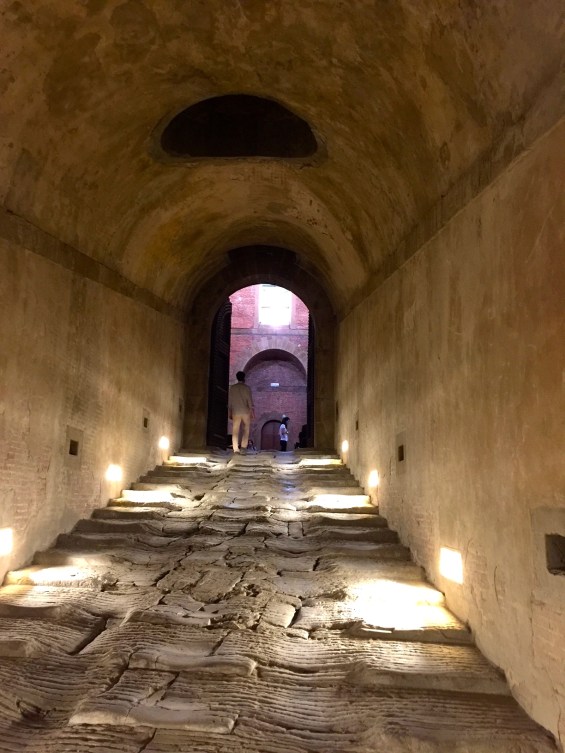
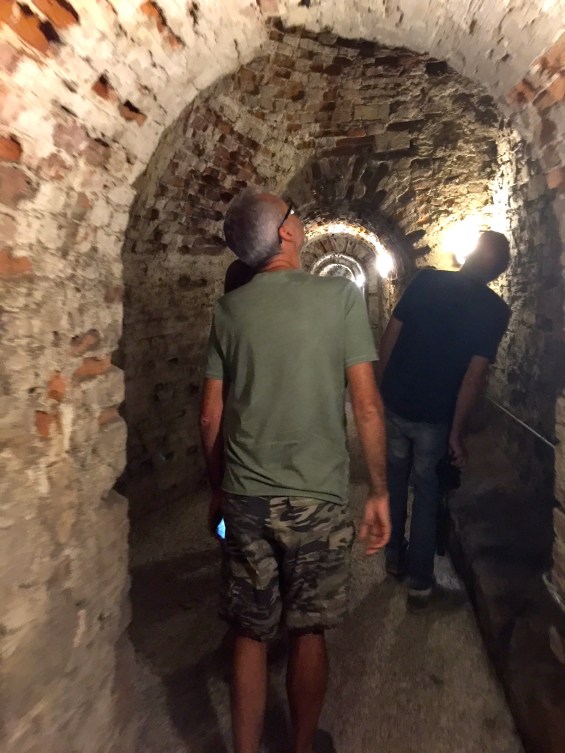

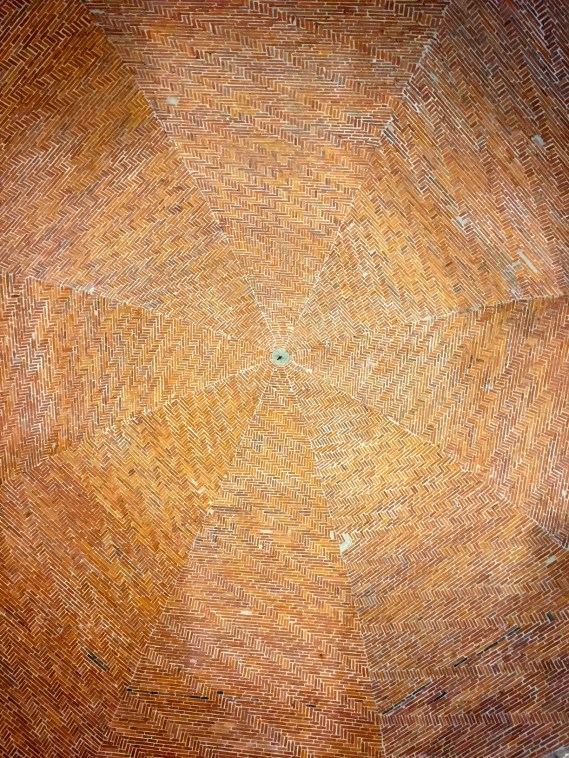
The next 2 pix are looking up from the tunnel to light shafts:

Another interesting curiosity about the fortress has to do with the later Grand Duke, Pietro Leopoldo, who knew about the American scientist, Benjamin Franklin, and his theories. This duke and Franklin were contemporaries. Franklin’s studies made a huge contribution to the study of meteorology and electricity, and his invention of the lightning rod was noted by the duke. Not surprisingly, the Grand Duke wanted to protect his buildings in Europe, and in particular those with major stores of gunpowder. So he used Franklin’s recommendations and installed lightening rods.
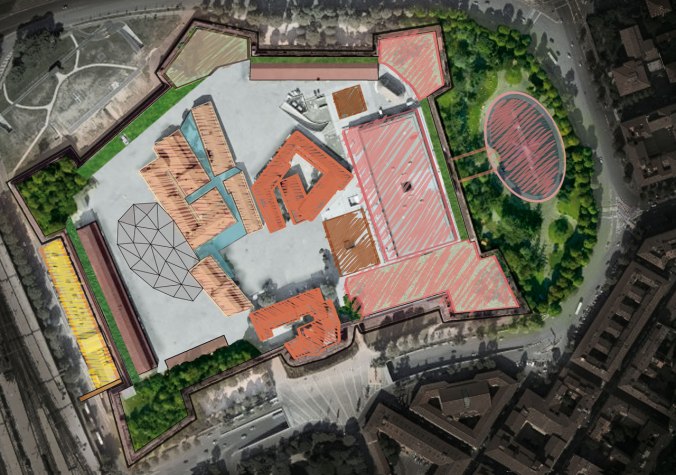
Since 1967, Fortezza da Basso has been used as an exhibition center and, as such, it hosts a large number of Florence trade shows and conferences. The former military base is spread out over about 100,000 square meters, and about half of them are covered.
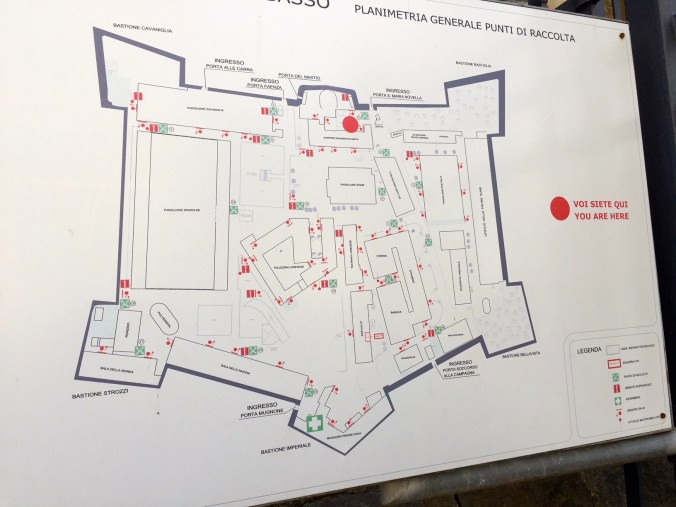
Nowadays the Fortress is used for all of the most important Florentine exhibitions and fairs (from Pitti Immagine to the International Exchange of Congress Tourism, Florence Gift Mart to Eurocamper, the International Exhibition of Crafts to Prato Expo, etc.).
Built on three floors, the modern pavilion that is usually used for these events was designed by architect Pierluigi Spadolini and inaugurated in 1977. Standing in the center of the great square inside the Fortress, the Pavilion is surrounded by ancient buildings that are gradually being restored: the Theatrino Lorenese, the Palazzo delle Nazioni, the Arsenal. Also, ever since the 1966 flood, the large buildings on the southern side have hosted the restoration Laboratories of the Opificio delle Pietre Dure.
From a vintage set of postcards showing landmark architecture in Firenze, as if each structure was on a waterfront. The postcards date to sometime before the postwar period:
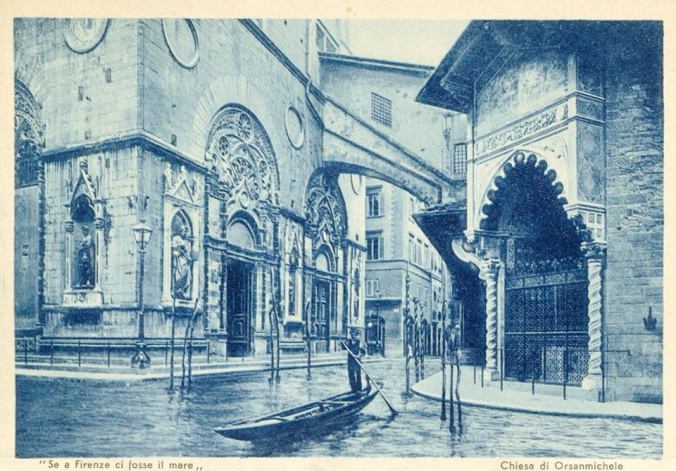
Landmarks named include, above, the church of Orsanmichele
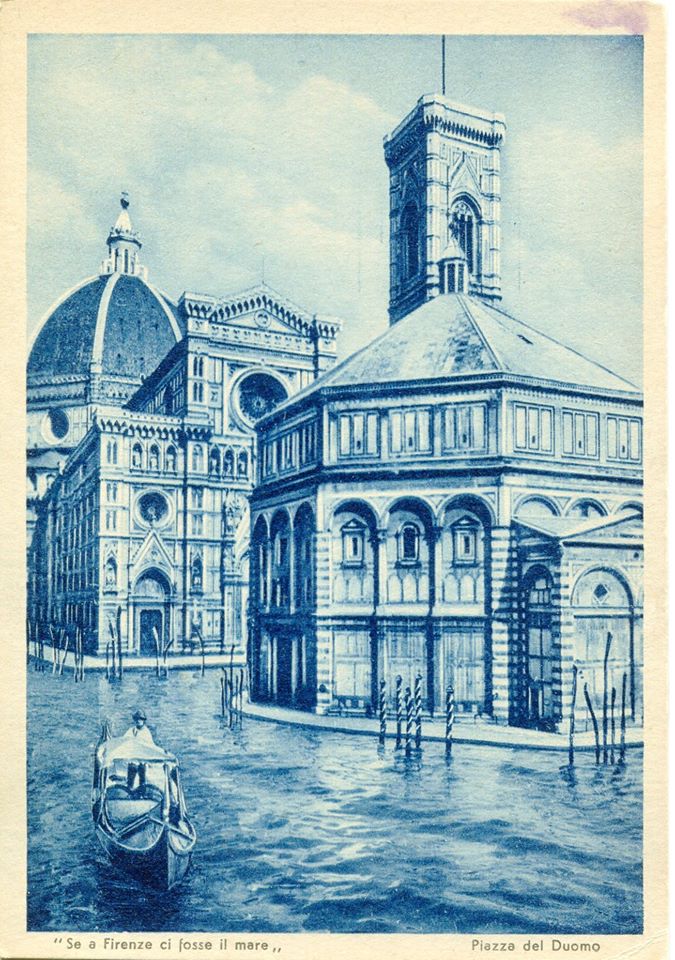
Piazza del Duomo
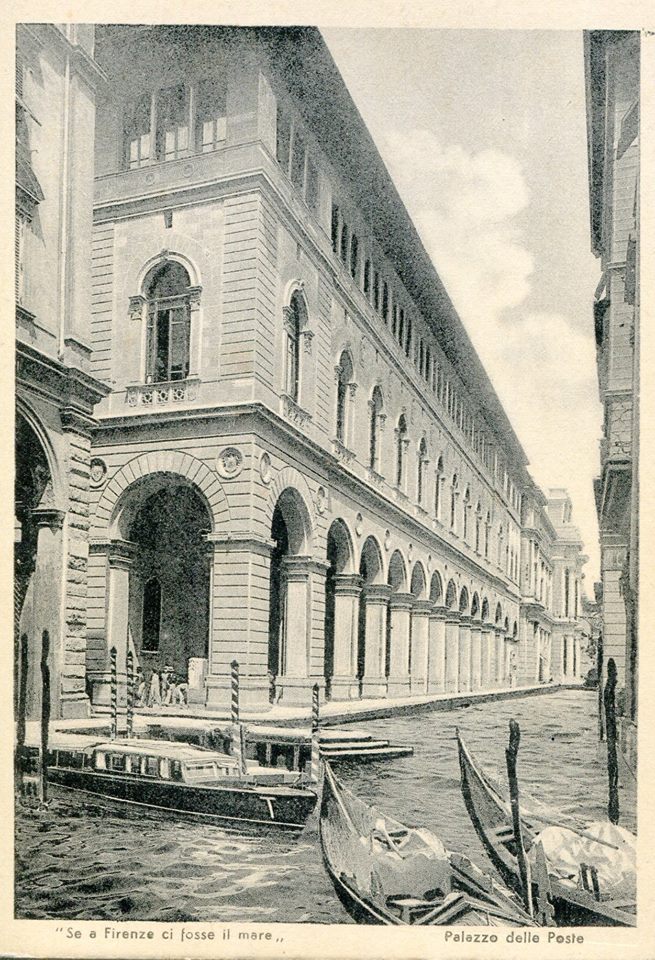
Above, the Palazzo delle Poste, the modern post office building
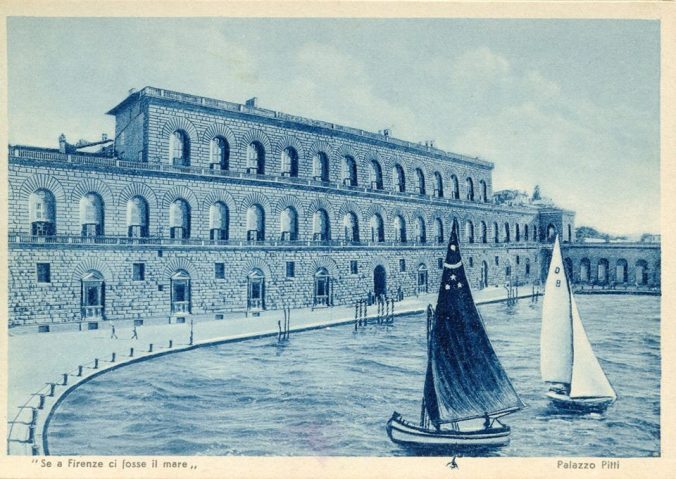
The Palazzo Pitti
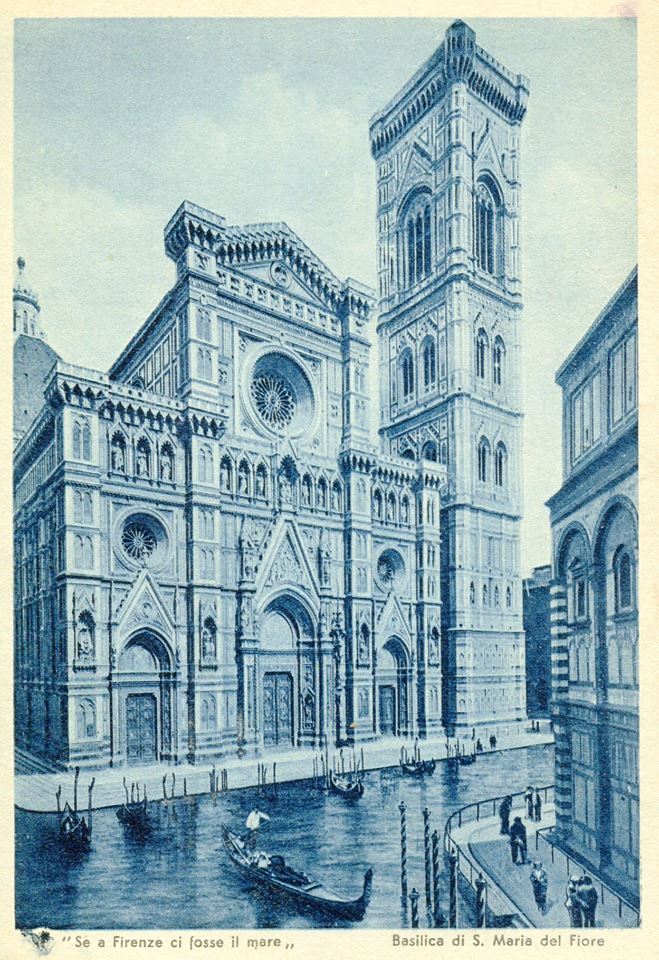
The Duomo, aka, Santa Maria del Fiore
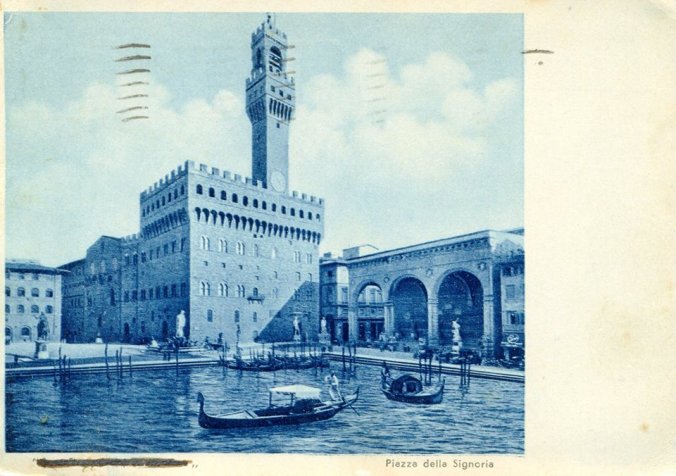
The Piazza della Signoria
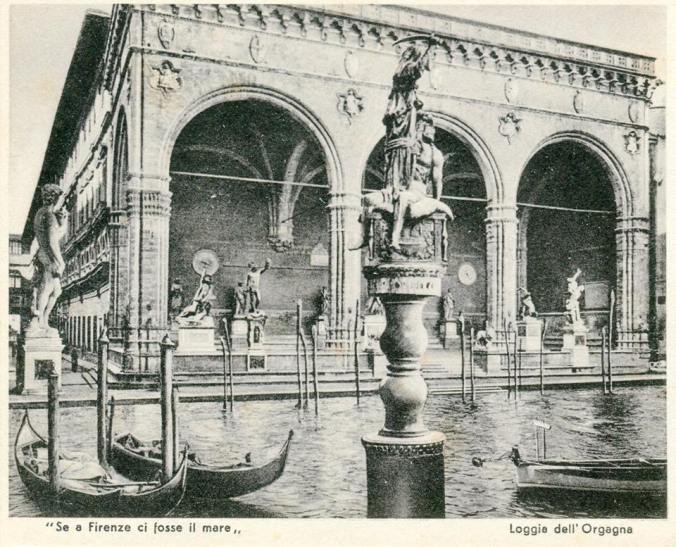
Above the Loggia dell’Orcagna (misspelled on the postcard as loggia dell’Orgagna); aka Loggia dei Lanzi
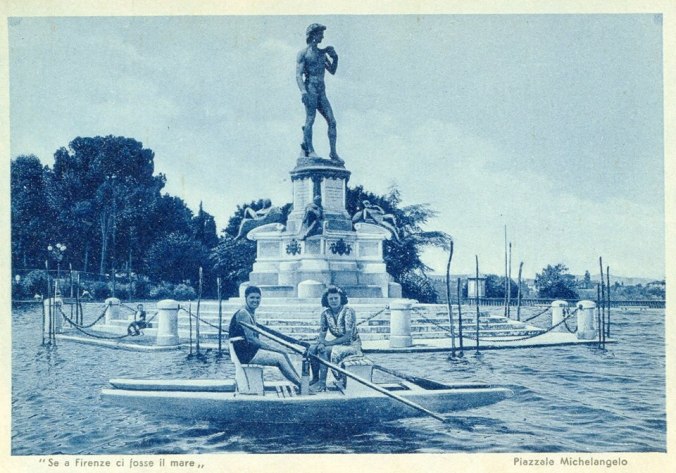
The Piazzale Michelangelo
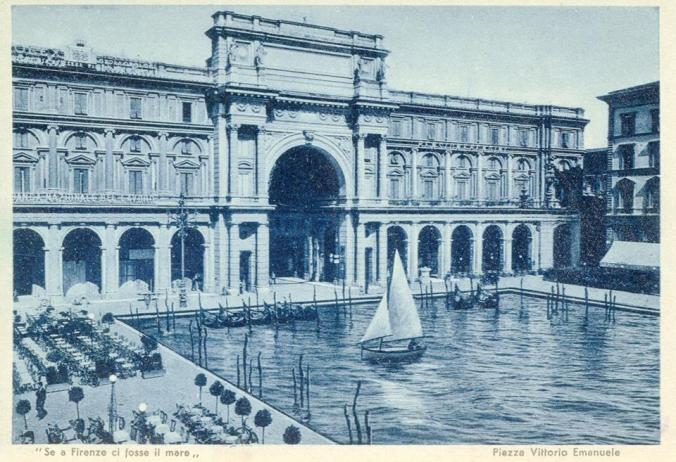
The Piazza Vittorio Emanuele, name changed to Piazza della Repubblica sometime after WWII.
This lovely, wistful song is a hymn to a Florence that is no longer. It is sung by Riccardo Marasco and known as Firenze Bottegaia.
A rough translation in English goes like this:
Florence Bottegaia (Riccardo Marasco)
Antique shops,
artisan shops,
shops where you only find things done here.
Silversmiths’ shops
of things today or yesterday
created by the same people who made the city.
Shops where the old ones
they revealed to the boys
secrets inherited from an ancient civilization,
shops of a time that are now no longer ..
I had known her too.
Da Gilli a good coffee ‘between mirrors lights and brass,
the cream in Via Monalda sucked with cialdoni.
The Donnini krapfen,
the famous Dorè.
Emma woman treats, two teas with the ladyfingers
“no thanks tonight I would just like two cream puffs”
in piazza da Revoire there is hot chocolate
but there is no more to cuddle the mandola of Mafaldo.
Florence shop
when I was a child
and already I was proud of being born a Florentine.
Florence shop
what time it is not anymore
you have betrayed those who owe you more.
Capecchiacci disappeared
buttons, strings and laces,
expert in skins and great master in making holes.
He closed Calderai
delicious cold cuts,
caviar mascarpone
the ragù in the volavàn.
Disappeared Bruzzichelli
the palace is also wobbling
for a new shoe you can find yourself in the afterlife.
Where was the Bottegone there is now a bar among many,
I had known you too.
The Corso bookshop sold a little faith,
Balboni in Vigna Nuova churned maddalene.
The old Settepassi is now a Milanese.
The craftsman is evicted,
San Frediano is evicted,
your ills Florence tell me who will evict them?
The most glorious ones are evicted,
history is also evicted.
If it is necessary to evict the old one of su ma ‘.
Florence shop
when you were a child
and you went around proud of being Florentine.
Florence shop
what time it is not anymore
you have betrayed those who owe you more.
Onion fast food,
ties at the old bridge,
where the fontanella pours drugs into the bucket.
Take advantage of the bad
there is a thousand vucumprà
that vendon paccottiglia scattered here and there.
Armani, Valentino
Versace then Trussardi
I’m here to tell us in chorus
“Florentine you were late”.
Florence that was dressing
the spirit and the mind
now he dresses you from the war down.
They are overseas copies of those shops that
they sold originality with genius;
we are the double of the fifth avenue.
Throw everything to the nettle
if one engages in it
it is not necessary then Pegna showed it to us.
Florence shop
for us you were a blazon,
and who knows why you look like a curse.
Florence shop
when I was a child
and already I was proud of being born a Florentine.
Florence shop
on the diamonds of the tu:
if others have betrayed you
I love you even more.
Florence shop
I’m no longer a child
as long as I walk around
I’ll be alone
Florentine.
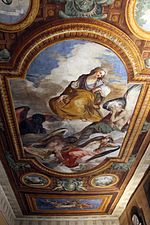
I recently visited, on a lovely parcel of land just outside of beautiful Firenze, a once-magnificent villa known as Villa la Quiete. Located upon the Castello hill, at the foot of the Monte Morello, this villa is considered to be among the most important settings of its kind. It takes its name from a fresco by Giovanni da San Giovanni entitled, La Quiete, which dominates the winds (see below).
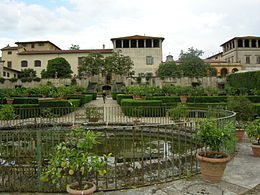
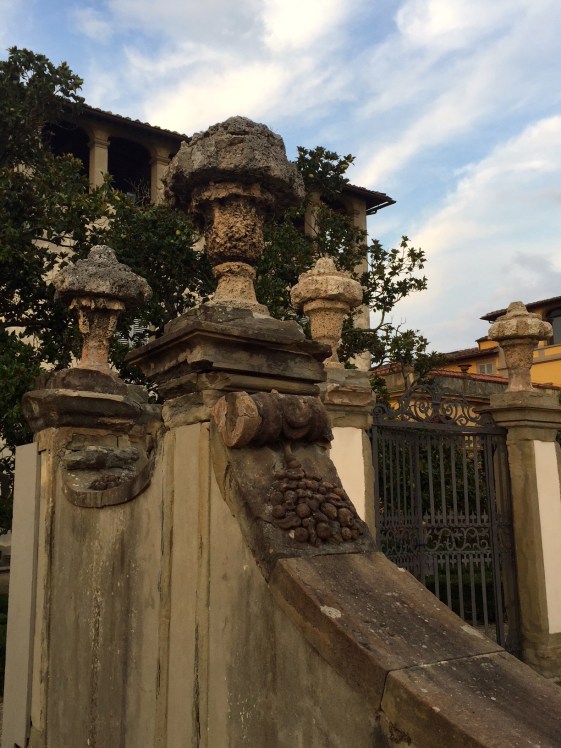
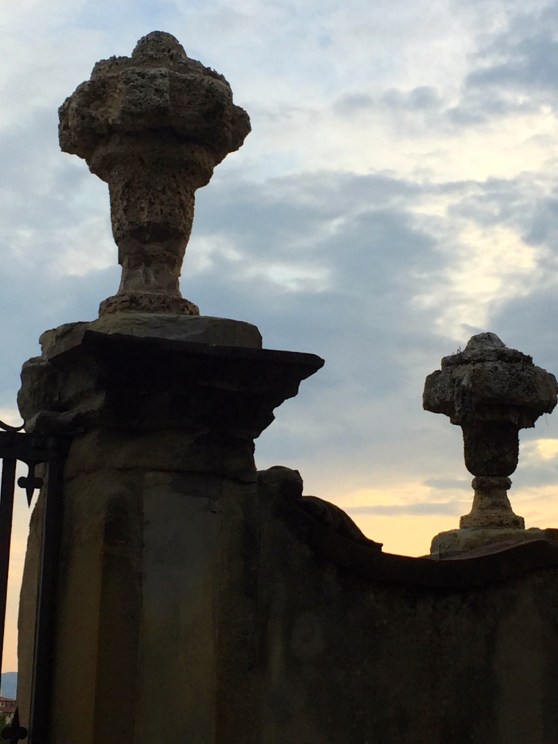
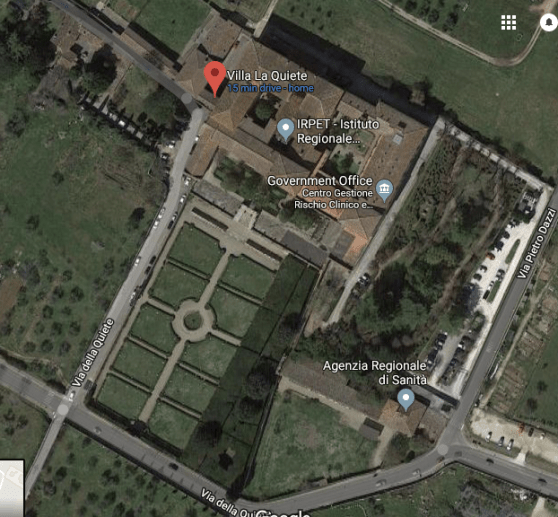
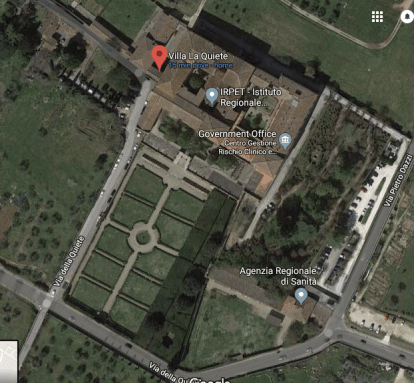
The Medici family particularly loved this area and owned some of its most beautiful residences, including the Villa di Careggi, Villa di Castello, and the Villa della Petraia. You can locate Villa la Quiete on these 2 Google Earth slides below and, in the last one, also locate the 3 Medici villas just mentioned.
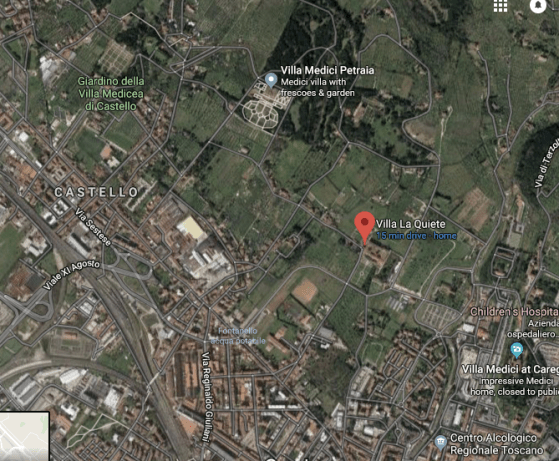
This parcel of land has lots of history, naturally. In 1438 it was given by the Florentine Republic to the condottiere Niccola da Tolentino, for his military services. In 1453 the Medici acquired the land, and later Cosimo I passed it to the commander of the Order of Santo Stefano.
In 1627 the property was again acquired by a Medici, this time by Cristina di Lorena. She had the palazzo rebuilt, and had a suspended passage constructed (a small variant of the Vasari Corridor), connecting the villa to a nearby Camaldolese monastery. Cristina also commissioned the painting of la quiete che pacifica i venti, by Giovanni da San Giovanni in 1632.
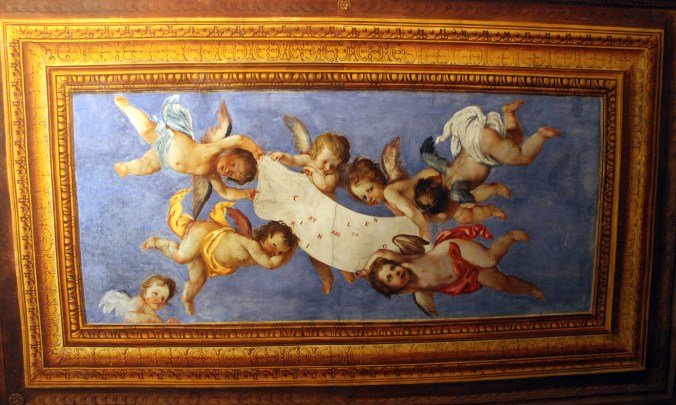
Cristina’s name even appears in another fresco, by Giovanni da San Giovani. in which curious anagram masquerading as a hymn inscribed on a scroll supported by putti in flight.
The villa has, thereafter, been known as Villa la Quiete.
The complex was bequeathed to Cristina’s grandson, the Grand Duke Ferdinando II. Later on, in 1650, the villa was sold to Eleonora Ramirez de Montalvo, who dedicated it as a country retreat for a congregation she founded, the Montalves. At that time the villa was called Istituto della Quiete.
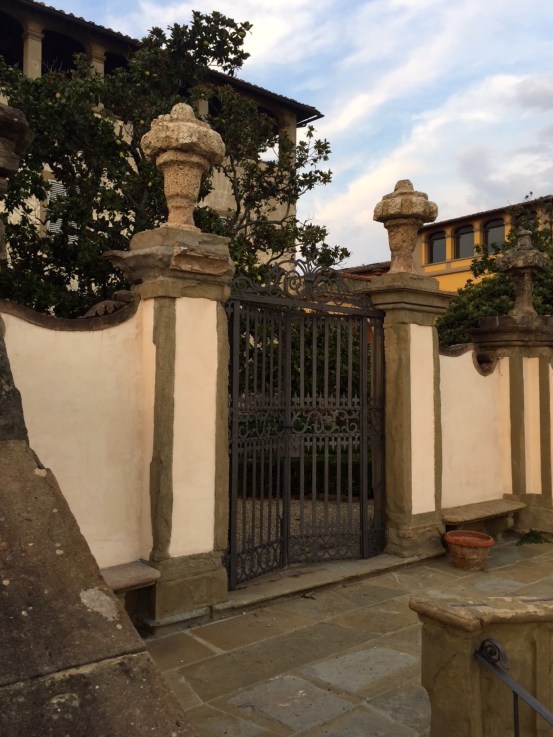
After Eleonora’s death, her friend the Grand Duchess Vittoria della Rovere administered the Institute, and sponsored the construction of the Montalve church, completed in 1688.
Anna Maria Luisa de’ Medici, the last descendant of the Medici family, resided in the villa between 1720 and 1730 and she furnished it with objects from the Palazzo Vecchio and Palazzo Pitti.
Anna Maria had the villa renovated and redecorated and she installed a beautiful grand garden, bringing water to it by a pipe to the nearby Fonte delle Lepricine.
The director of this new, vast garden was the botanist Sebastiano Rapi, who just happened to be the person in charge of the Giardino Boboli. Rapi, with the support of Anna Maria, brought the best botanical and fruit species from the various Medici villas.
Even today, the specimen magnolia trees they selected still grow in a courtyard connecting the garden to the palazzo.
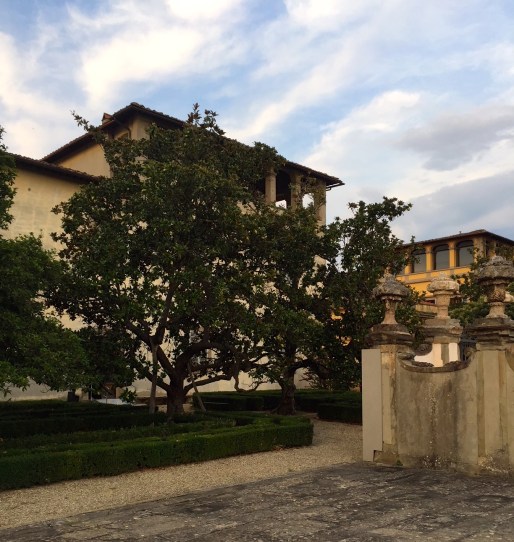
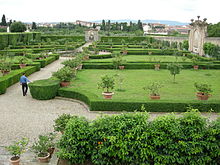
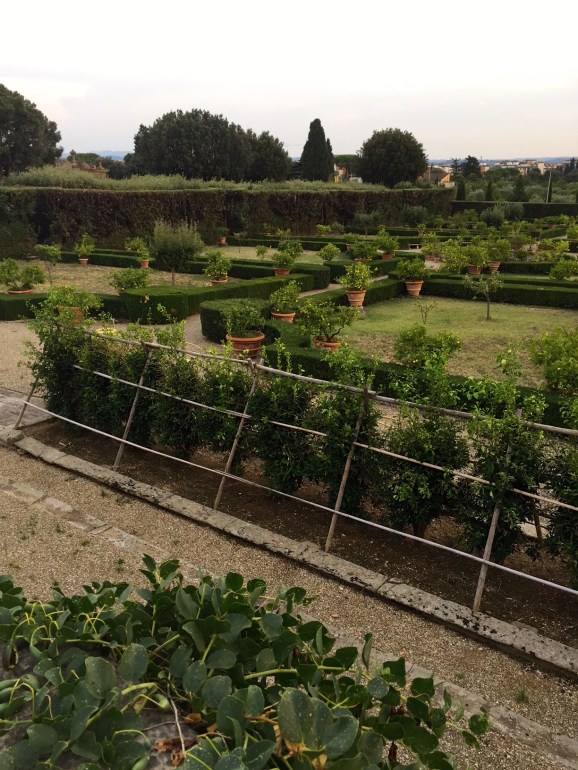
The garden today remains one of the rare examples of an 18th-century garden, with no changes in the plantings, other than refreshing them. You can see the layout of the formal, rectangular gardens, lined with pots of lemon trees, in the Google slide:
The secular order of Montalve, dedicated to the education of girls of good family, only had to abandon their church of San Jacopo di Ripoli in 1886, and they brought their numerous furnishings and works of art with them to the Villa la Quiete.
It was only in 1937 that the order became religious. The villa complex remained for a long time the seat of the education institute, ending only in 1992. The last pupil graduated in 2001.
In February 1992 the villa, together with the entire real estate of the Conservatory of the Montalve alla Quiete, passed University of Florence. A small part of the villa has been used by the University for the Center for Culture for Foreigners and Polo offices.
It is possible to visit the villa, as I did, only by appointment and in the months of July and August on Tuesday and Thursday evenings. To arrange a visit, contact the Ufficio Servizi Didattico Divulgativi, Sistema Museale D’Ateneo, tel 055-2756444 or by email to edumsn@unifi.it.
In a few days I will be writing a post about the artworks located in the villa.

MFV-S-V00096-0028
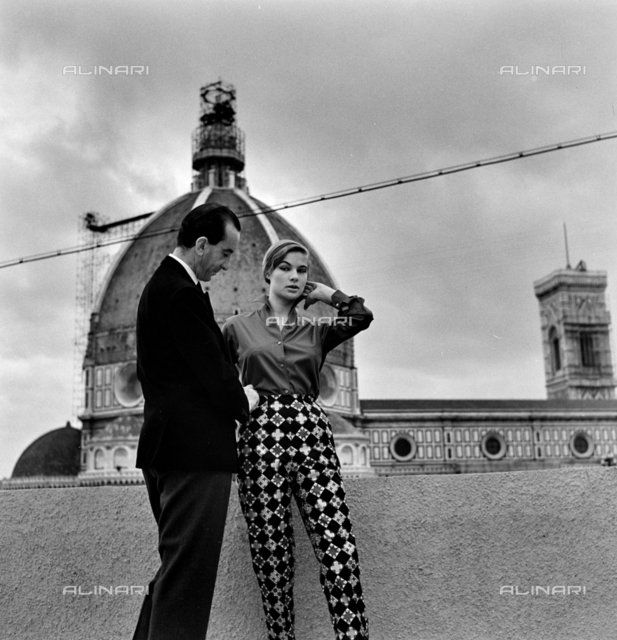

The brand-maker and stylist Emilio Pucci with a model on the terrace of Palazzo Pucci in Florence
Mandatory photo credit:
Fosco Maraini/Gabinetto Vieusseux Property©Fratelli Alinari
WARNING:
Permission must be required for non editorial use. Please contact Alinari Archives
Artist:
Florence
Photographer:
Image date:
1955
Place of photography
Florence, Palazzo Pucci
Personaggio:
Pucci Emilio
Collection:
Fosco Maraini/Gabinetto Vieusseux Property©Fratelli Alinari

TOP-S-000137-7826
The designer Emilio Pucci creation of the 1965-1966 collection. Model wears a wool dress coat-colored geranium characterized by a drawing in a herringbone pattern and the front buttons. The hat, reminiscent of a helmet, is matched to the dress
Mandatory photo credit:
TopFoto / Alinari Archives
WARNING:
Permission must be required for non editorial use. Please contact Alinari Archives
Image date:
06/08/1965
Place of photography
Florence
Collection:
TopFoto / Al

TOP-S-000137-7823
Stylist creation Emilio Pucci Spring-Summer collection of 1965. The model is wearing a violet suit with short single-breasted jacket with three buttons and three-quarter sleeves. The knee-length skirt with faux pockets on the sides
Mandatory photo credit:
TopFoto / Alinari Archives
WARNING:
Permission must be required for non editorial use. Please contact Alinari Archives
Image date:
25/01/1965
Place of photography
Florence
Collection:
TopFoto /

TOP-S-000137-7825
The designer Emilio Pucci creation of the autumn-winter collection 1965. The model is wearing a “ghost style dress” down to his feet with pyramid line. And ‘it meshes green-red bicolor and ocean and has a cross-neckline
Mandatory photo credit:
TopFoto / Alinari Archives
WARNING:
Permission must be required for non editorial use. Please contact Alinari Archives
Image date:
06/08/1965
Place of photography
Florence
Collection:
TopFoto /

TOP-F-085952-0000
A creation of the fashion designer Emilio Pucci in Florence of the autumn-winter collection of 1965. The model is wearing a cream-colored wool skirt to the knee and a short jacket with reversible barrel neck cream and beige, a hat with a rounded chin. In the background the dome of Florence Cathedral
Mandatory photo credit:
2000 / TopFoto / Alinari Archives
WARNING:
Permission must be required for non editorial use. Please contact Alinari Archives
Image date:
05/08/1965
Place of photography
Florence
Collection:
TopFoto / Alinari Archives

TOP-F-964291-0000
Parade of swimsuits of the fashion designer Emilio Pucci in Florence on November 11, 1968
Mandatory photo credit:
2005 / TopFoto / Alinari Archives
WARNING:
Permission must be required for non editorial use. Please contact Alinari Archives
Image date:
11/11/1968
Place of photography
Florence
Collection:
TopFoto / Alinari Archives

TOP-F-964459-0000
Creation of the fashion designer Emilio Pucci of the winter collection of 1965. The model is wearing a fancy dress printed velvet knee-deep with matching stockings. The dress is yellow, periwinkle and black
Mandatory photo credit:
2005 / TopFoto / Alinari Archives
WARNING:
Permission must be required for non editorial use. Please contact Alinari Archives
Image date:
05/08/1965
Place of photography
Florence
Collection:
TopFoto / Alina

TOP-F-964292-0000
Creation of the fashion designer Emilio Pucci Spring Summer collection 1965. The model is wearing a patterned shirt with “batwing sleeves” and a straw hat
Mandatory photo credit:
2006 / TopFoto / Alinari Archives
WARNING:
Permission must be required for non editorial use. Please contact Alinari Archives
Image date:
1965
Place of photography
Florence
Collection:
TopFoto / Alinari Archives

TOP-F-011607-0000
Emilio Pucci in his fashion shop before attempting to make a name in politics, Florence
Mandatory photo credit:
1999 / TopFoto / Alinari Archives
WARNING:
Permission must be required for non editorial use. Please contact Alinari Archives
Image date:
1963
Place of photography
Florence
Personaggio:
Pucci Emilio
Collection:
TopFoto / Alinari Archives

TOP-F-964458-0000
Colorful Pyjama outfit from collection of Emilio Pucci, worn by Sandra Bernloher
Mandatory photo credit:
2005 / TopFoto / Alinari Archives
WARNING:
Permission must be required for non editorial use. Please contact Alinari Archives
Artist:
Location:
Pisa
Image date:
21/07/1965
Place of photography
Pisa
Collection:
TopFoto / Alinari Archives

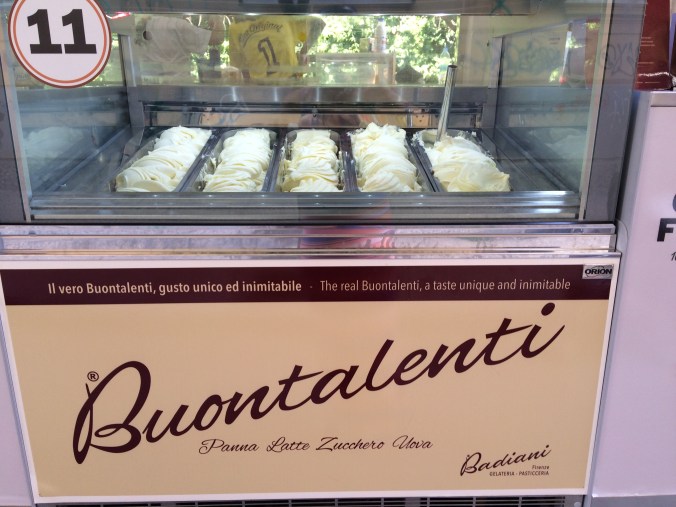
At the end of the 1960s, a contest was announced to commemorate the Florentine architect Bernardo Buontalenti, who is known to have invented the ice cream known as “gelato.”
Gelateria Badiani won a prize with a simple yet unique flavor, indeed called Buontalenti. Since then, this special cream based flavor has conquered the palate of Florentines and all good gelato lovers.
Despite many imitation attempts, Badiani’s gelateria is the only home of the real Buontalenti. And, it is still the most sought after flavor.
It’s been said that the first to make true gelato, creamy and frozen as we know it today were the Florentines in 15th century.
It allegedly happened like this: during the mid 1500s, Cosimo I de’ Medici, elegant Lord of Tuscany, designated Bernardo Buontalenti to organize special festivities. The Lord intended to astonish a delegation of the King of Spain for political reasons, to support of Cosimo’s intention to incorporate Siena in the dukedom.
Bernardo Buontalenti, architect and creative figure, directed shows and fireworks and set up a program of festivities like no one ever before. He arranged sumptuous banquets, at the end of which he served a frozen cream to which he had added a very precious spice that was coming from the newly discovered Americas: sugar.

The Spanish delegation was enthusiastic with great satisfaction of the Grand Duke, who had to hire a number of cooks who could continuously prepare gelato.
However, it was thanks to Caterina de’ Medici, then Queen of France, that gelato spread across Europe beginning during the second half of the century. Since then the Queen summoned Florentine pastry chefs who had learned that art and she always served gelato to her guests, kings and diplomats, who then returned to their homelands with the recipe.

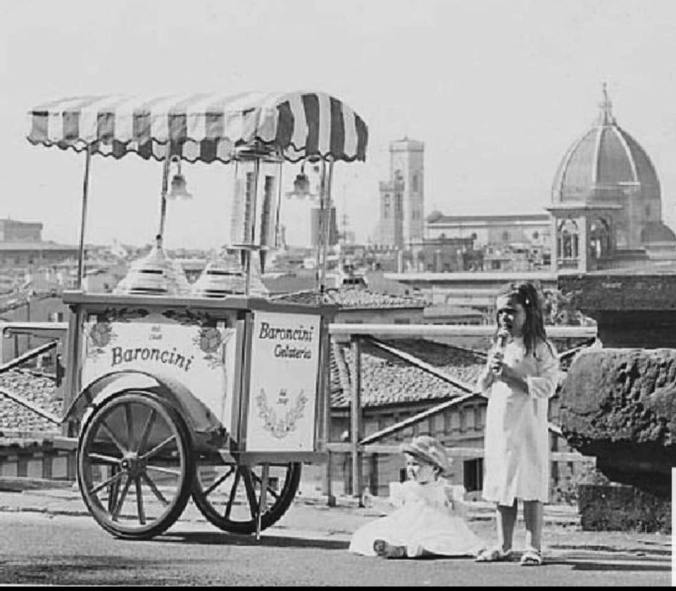
And, just for fun, here’s a vintage photo showing the ever popular combination of children and gelato, especially in Florence!
 get back, lauretta!
You must be logged in to post a comment.