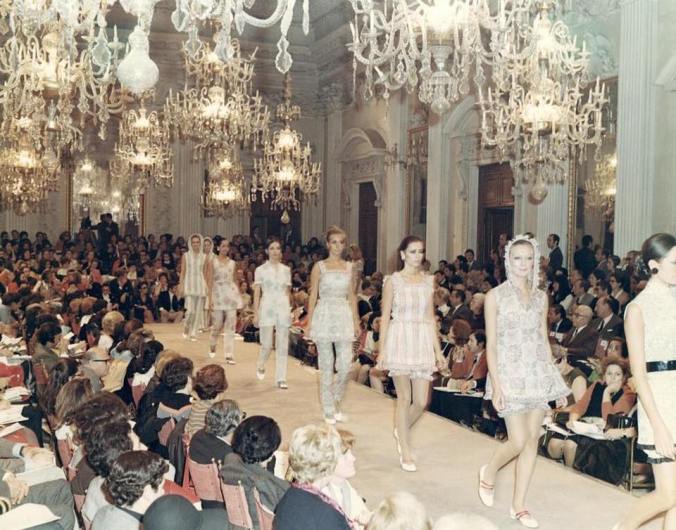
The Sala Bianca in the Palazzo Pitti, with its gorgeous crystal chandeliers and elegant proportions, was the site chosen in 1952 by Giovanni Battista Giorgini for the fashion shows he launched. The elegant salon offered a perfect backdrop for a that showcased emerging Italian fashion designers. Along with his shows, Giorgini introduced the ” Made in Italy ” merchandising concept.
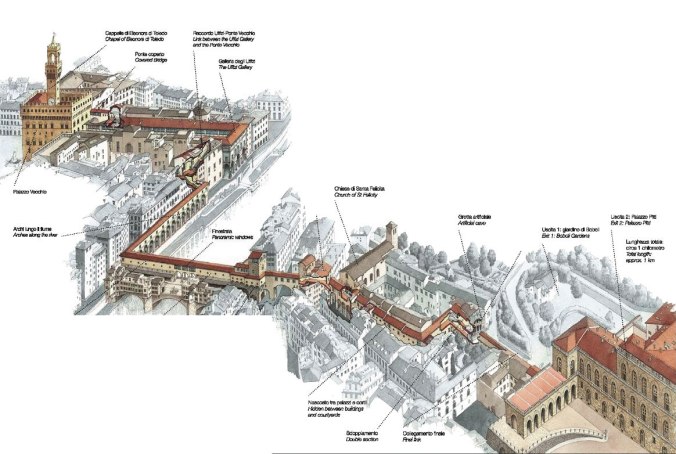
You can find plenty online about this amazing passageway that connected the Medici from their Palazzo Pitti all the way to Palazzo Vecchio above the city of Florence. It’s tricky finding good pictures that show how the corridor connects, but the following drawing recently came to my attention and its a good one:
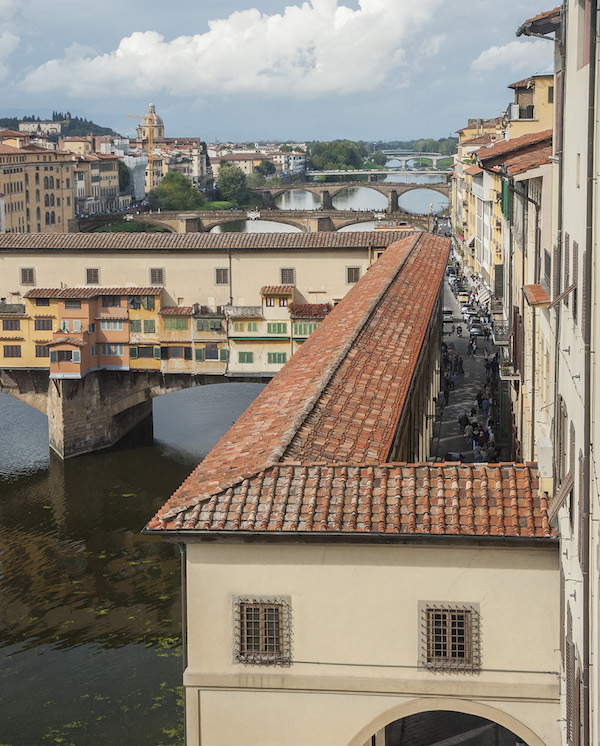
Here’s how an actual part of the corridor appears from the Uffizi:
A vintage advertisement for the shop of Fratelli Iandelli on Via Ricasoli. On the left they list milk, cream, butter and siero (serum?). On the right, we learn they sold ice! Interesting!
Today’s issue of The Florentine carried the following news item. Before reading the article, just consider for a moment: how many hospitals do you know that:
Are over 700 years old?
Is the place where Leonardo allegedly performed dissections?
Have guided tours of their basements?
Have an underground passageway to a convent?
I know the answer is none! It is mind blowing to consider all of this! (I was lucky enough to walk by this hospital 2x a day for almost 10 months; my Italian language school is across the street. It was comforting to know that when I truly lost my mind [because learning another language is molto difficile!], I was not too far from medical treatment. :-) )
Santa Maria Nuova Hospital to restore its basements
Oldest hospital in Florence celebrates 730th anniversary
Editorial Staff
JUNE 19, 2018 – 11:42
The oldest hospital in Florence, Santa Maria Nuova, has launched a fundraising campaign during its 730th year.
Santa Maria Nuova Hospital, photo credit @labuccia66 via Instagram
On June 21, the Santa Maria Nuova Foundation has organized an invitation-only fundraising dinner with the sole purpose of restoring the hospital’s basements.
The subterranean zone of the historic building is home to “Leonardo’s basins”, supposed to be where Da Vinci dissected human cadavers, although records bear no proof of this having occurred, and the underground passageway that the oblate nuns, the hospital’s former nurses, used to reach the wards from the nearby convent.
One of “Leonardo’s basins” at Florence’s Santa Maria Nuova Hospital
On June 23, the hospital will be opening its doors to the public with a book presentation scheduled at 11am, free guided tours at 7pm (meet outside the hospital entrance at 6:50pm) and a classical concert at 9pm in the church of Sant’Egidio.
“We are delighted to welcome Florentines to celebrate the city’s oldest hospital, which is 730 years old this year,” announced Giancarlo Landini, president of the Santa Maria Nuova Foundation. “It’s an opportunity to remember the history of this extraordinary place of care and help, which was founded in 1288 by Folco Portinari, the father of Beatrice immortalized by Dante, and who thanks to the generosity of benefactors was able to receive important works of art.
We also celebrate today’s Santa Maria Nuova, showing how we have reached this restoration and we will look to the future, considering how to make the most of our artistic and historic heritage, starting with the restoration and renewal of the former crypt of the church of Sant’Egidio and the hospital’s basements, the reason why the foundation has organized the fundraising dinner on June 21.”
At the press presentation, Tuscany’s health councillor Stefania Saccardi commented, “In recent years, the regional health unit has modernized the hospital while protecting its historic value. Now, through the hospital’s foundation, the time has come to restore its basements.”
A new film, Le memorie di Giorgio Vasari, premiered at the Bari International Film Festival in April of this year. Vasari, the painter, architect, and historian of art, was an eclectic figure of the Italian Renaissance. I got to see the film today at the best movie theater in the world, the Odeon in Florence’s historic center. It was a feast for the eyes!
Luca Verdone directed the film and captured, together with the cinematographer, Gianluca Gallucci, the deep, rich, saturated colors of the Italian world in which Vasari lived. The story is told in first person, with Vasari himself telling us rather idiosyncratic events in Vasari’s life and the works of art he created using the stylistic themes and content he learned from his masters, Michelangelo and Andrea Del Sarto.
Vasari's greatest fame today is not so much linked to his works as tohis treatise, The Lives of the most excellent Italian painters, sculptors and architects, from Cimabue to the present time, published in  1550 and reissued with additions in 1568. A treatise "of a technical and historical-critical nature on the 3 major arts (architecture, sculpture and painting) was a milestone in the study of the life and    works of the more than 160 artists included.

Luca Verdone has brought to life the story of an important artist anddesigner, one who has never before been brought to the big screen.
If Vasari isn’t playing at a theater near you, you can learn about him in these two fine BBC documentaries.



 get back, lauretta!
You must be logged in to post a comment.