Show a little courtesy, per favore!

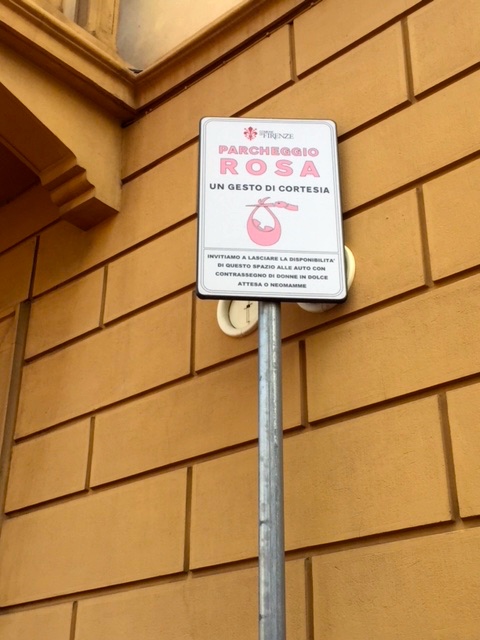
Saw this sign on the street the other day and thought it was interesting and entertaining. It points out that this place on the street, which just happens to be near a major supermarket, is a spot for “Pink Parking,” un gesto di cortesia (a courteous gesture). It’s obviously meant to call on the public’s morality and generosity to save this space for pregnant women.


IMG_9532

I can promise you that in the many times I’ve walked by it, there is never a space saved for a pregnant woman.  Too bad!

Lorenzo de’ Medici’s sculpture garden

Lorenzo de' Medici and His Artists in the Sculpture Garden


Ottavio Vannini – Michelangelo Showing Lorenzo il Magnifico the Head of a Faun, surrounded by the other sculpture students


Young Michelangelo Carving a Faun's Head


Young Michelangelo Carving a Faun’s head by Emilio Zocchi


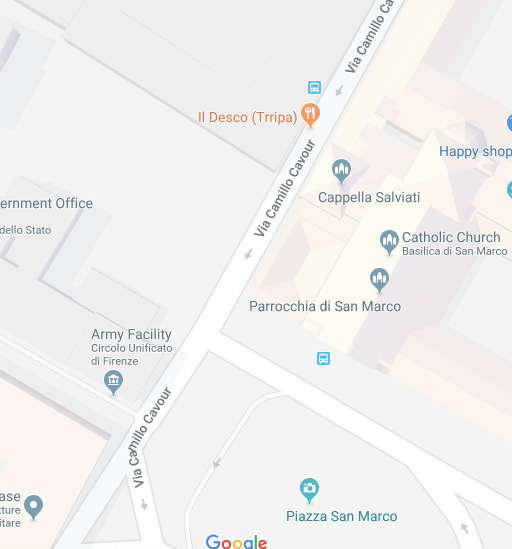
The Piazza San Marco on the former Via Larga, which is now Via Camillo Cavour, was where Lorenzo de’ Medici’s Sculpture Garden was situated in Florence. In the map below, you can get a sense of where the garden was in relationship to Piazza San Marco. The sculpture garden would have been where the words “Army Facility” show below.


Screen Shot 2018-05-29 at 6.34.27 PM


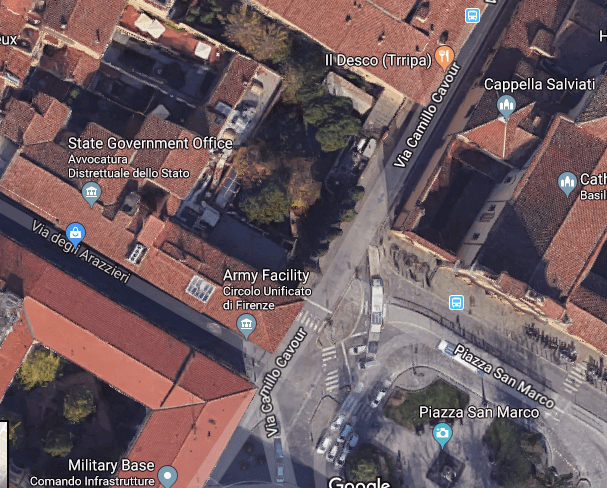
The Google map showing a satellite view, gives an even better sense of this former garden area.  Think away the Army building to the south end of the space, where Via Cavour and Via degli Arazzieri intersect, and you can see that there is still garden area in the site of the former Medici garden.

Screen Shot 2018-05-29 at 6.37.12 PM


Created with the hopes of becoming a great educational institution for studying art, Lorenzo de’ Medici curated a garden full of antique sculptures for artists to come and sketch as part of their artistic practice. Lorenzo also added sleeping and dining quarters so that students could easily live among the work they were studying. Francesco Granacci and Bertoldo di Giovanni are two of the many people to enter through its doors.

The most famous story of Michelangelo’s time in the Garden surrounds Michelangelo’s Faun statue. When Lorenzo saw this statue, he jokingly told Michelangelo that he looked too perfect to be an old faun. Michelangelo than took his drill and knocked out one of the teeth in the mouth of the Faun.

He showed his subtraction to Lorenzo who gained much amusement and pleasure from Michelangelo’s ability to listen and act on his critique.  Although the Faun statue has not been found, the two works of Michelangelo’s attributed to this time period are the Battle of the Centaurs and the Madonna of the Stairs. 


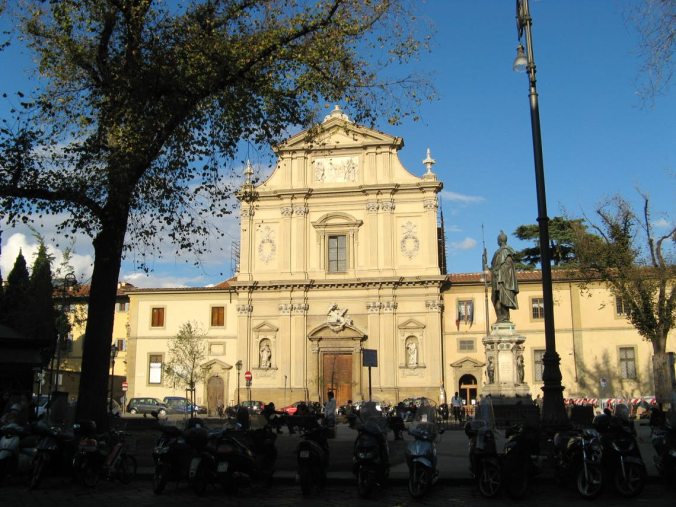
San Marco, Firenze

The monastery of San Marco, which stood just two blocks north of the Palazzo Medici, had been founded in the thirteenth century. However, it had been completely renovated and considerably expanded by Lorenzo the Magnificent’s grandfather, Cosimo de’ Medici in the 1450s.

san-marco

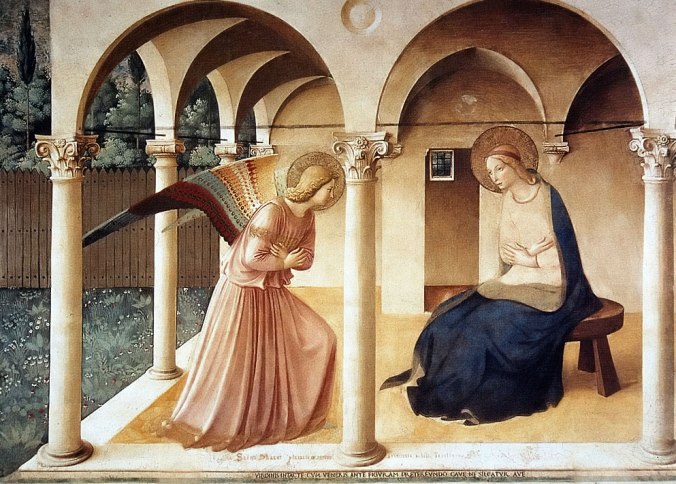
Cosimo had used his favourite architect Michelozzo Michelozzi, and incorporated the work of the resident monk Fra Angelico, one of the great early Renaissance artists.

annunciazione

Michelozzi would be responsible for some of the finest early Renaissance architecture in Florence, including the renovation of the Palazzo della Signoria and the design of the Medici villa at Careggi.

For his part, Fra Angelico’s ethereal paintings would heavily influence Michelangelo, whose depiction of God’s finger passing on life to Adam in the Sistine Chapel was directly inspired by the artist-monk.

The work of Fra Angelico and Michelozzi came together at San Marco in the delightful shaded San Antonio cloister, whose delicate pillars and colourful frescoes enclosed a tranquil green garden in the midst of the monastery.

Cosimo de’ Medici had undertaken the renovation of San Marco late in his life, intending it as absolution for the sin of usury, which had enabled him to accumulate his fortune as a banker. Yet there had also been a less manifest reason for Cosimo’s benevolence, one that explained why in particular he chose to lavish his wealth on San Marco, rather than other similarly prestigious monasteries in the city.

Before the 1433 coup which had removed Cosimo from power in Florence, almost costing him his life, he had managed in the nick of time to transfer secretly to San Marco a large quantity of the funds held in the Medici bank in Florence.

After Cosimo’s banishment into exile, his enemies had raided all Medici premises, as well as those of known supporters, but had been unable to discover the whereabouts of these funds, which had been held on trust, without a word, by the monks at San Marco.

In consequence, Cosimo had spared no expense on the rebuilding of San Marco, which eventually cost 30,000 florins – an unprecedented sum at the time.

The monastery had been furnished with a library, together with many hundreds of religious manuscripts, intended for public use – the first lending library in Europe.

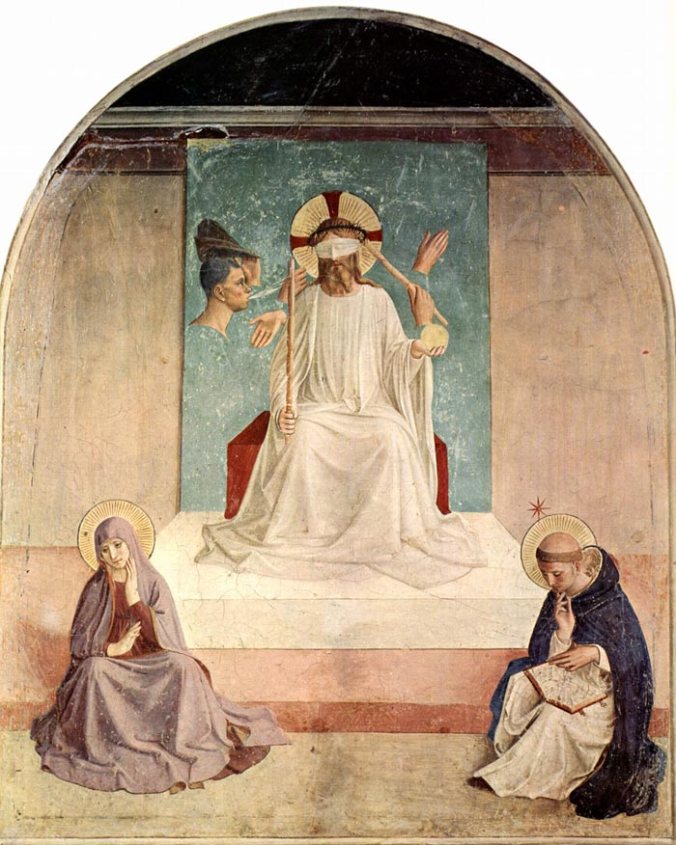
Instead of the usual communal dormitory, each monk was assigned his own cell, many of which contained frescoes painted by Fra Angelico and his assistants. These were mainly portrayals of angels and biblical scenes.

mockingofchrist700

A special double cell, sumptuously frescoed, had been created for Cosimo’s personal use, to which he would often retire for periods of contemplation.

However, he had taken a more active role in the creation of the gardens across the street from San Marco: as a man who delighted in retiring to the countryside, he had done his best to create a pastoral space here within the walls of the city. These gardens would in turn become a favourite spot of Lorenzo the Magnificent, who began decorating the shady spaces with pieces of ancient classical sculpture.

.

Strathern, Paul. Death in Florence: The Medici, Savonarola, and the Battle for the Soul of a Renaissance City, Pegasus. Kindle Edition.

\

Lucrezia de Medici

The major influence on the young Lorenzo (de Medici) would undoubtedly be his mother, Lucrezia, an intelligent and resilient woman in an age when females for the most part had little opportunity to assert themselves beyond the restricted domestic sphere.

Lucrezia came from an old and distinguished Florentine family, the Tornabuoni, and although her arranged marriage to a Medici was undoubtedly contracted for political reasons, she appears from her extant letters to have been genuinely fond of her husband, worrying over his health and betraying her concern that he should not ‘give way to melancholy’.

Yet these letters are not the only evidence of her writing, for Lucrezia de’ Medici was also a talented poet and hymnist. Although the conventional religiosity of her verse is of little modern interest, such piety did not stifle the warmth of her sympathetic personality.

Her verse appears to have been the outlet for a wider creative sensibility, which was used to some effect in guiding her husband’s discriminating patronage of such leading early Renaissance figures as the architect Michelozzi, who had designed the groundbreaking Palazzo Medici; the sculptor Donatello, whose innovative realistic sculptures included the first free-standing nude since classical times; and the troubled artist Fra Filippo Lippi, whose colourful larger-than-life portraits echoed his own larger-than-life personality.

All three of these artists Lucrezia came to regard as personal friends. The Medici were amongst the first patrons to recognise that artists were now becoming something more than mere craftsmen, and the family did their best to accommodate the increasingly difficult temperaments and wayward behaviour of these emergent genius-figures.

Lucrezia was also known to have influenced  would be she who persuaded Piero to allow certain members of the Strozzi family to return from the banishment they had suffered for opposing Cosimo. This would prove a particularly astute move.

Of similar impact was Lucrezia’s formative influence upon the youthful Lorenzo, who quickly began displaying precocious brilliance in a variety of fields, ranging from classical literature to horseback-riding. He was also said to have had an exceptional singing voice, accompanying himself on the lyre.*

Strathern, Paul. Death in Florence: The Medici, Savonarola, and the Battle for the Soul of a Renaissance City, Pegasus. Kindle Edition.


Let’s say you are very sick during the Renaissance…

and you are one of the leading lights of the period.  What would your doctor recommend for you?

images

Well, if you were Lorenzo the Magnificent, this remedy was tried:

By this stage Lorenzo was being attended by the celebrated Lazaro da Ticino ‘a very creative physician’, who had arrived from Milan. According to Poliziano: ‘in order not to leave any method untested, he tried a highly expensive remedy which involved grinding pearls and precious stones of all sorts’. This was a traditional remedy deriving from classical times, which almost certainly arrived in Europe from China, where such concoctions were thought to be ingredients of the fabled ‘elixir of life’.

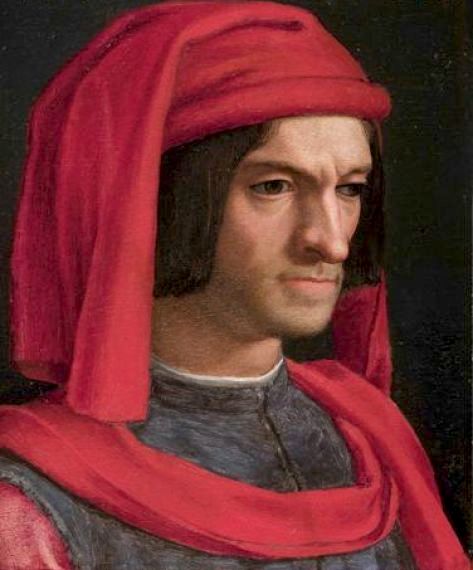
Lorenzo_il_Magnifico

Unfortunately, it didn’t work, and Lorenzo died within a week.

Strathern, Paul. Death in Florence: The Medici, Savonarola, and the Battle for the Soul of a Renaissance City  Pegasus. Kindle Edition.

Un concerto in Fiesole

On a recent beautiful weekend, I had the chance to visit Villa Salviati, a gorgeous locale in the hills outside of Florence.  Singers from a Florentine operatic school performed in the main building’s cortile.  It was so beautiful and here’s a sample.


Villa Salviati

VillaSalviati

Villa Salviati is home to the Historical Archives of the European Union, a unique resource for researchers at the EUI and far beyond.

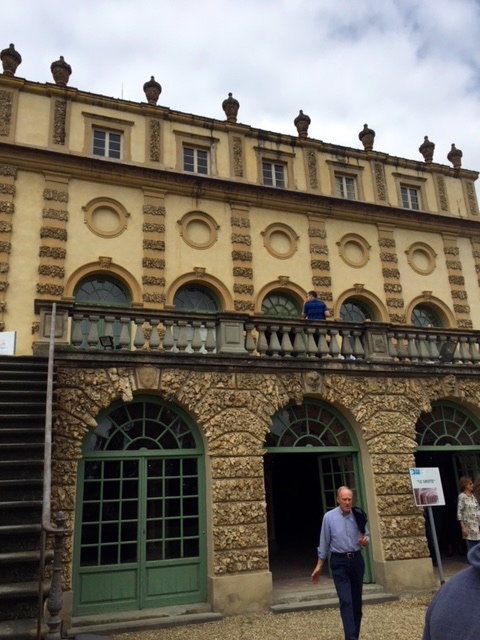
By housing the European Union archives, the long international tradition of this villa is continued. Over the centuries this villa had Italian, French, Swedish and American owners.

The estate has naturally strong ties to Florence as well, as the original owners, the Salviati family, wealthy wool merchants and bankers, were in the 15th century closely connected to the Medici that held great power and influence in the city.

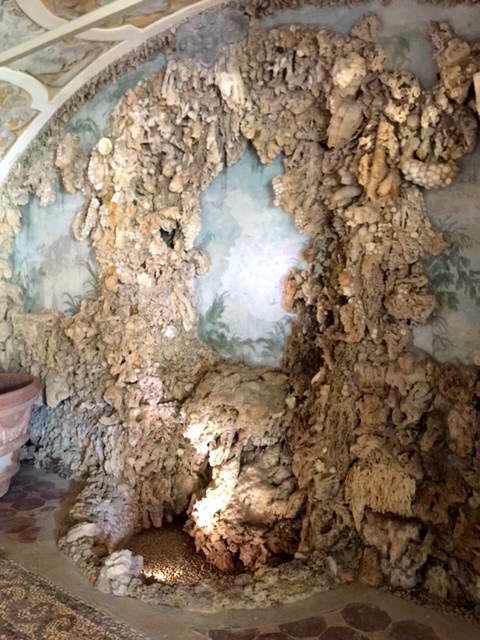
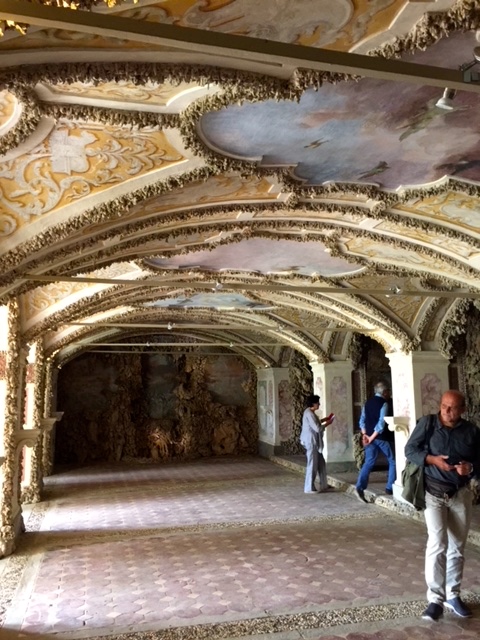
The Salviati family’s fortune grew and they went on to add grottos to the site which still stand today. The grottos are made up of frescoes and elaborate stonework that hark back to an era of affluence.

https://www.eui.eu/ServicesAndAdmin/LogisticsService/EUICampus/VillaSalviati

Villa Salviati

IMG_8979

A couple of weekends ago, I had the pleasure of visiting a famous villa in Fiesole, the Villa Saliviati.

IMG_8980

IMG_8978

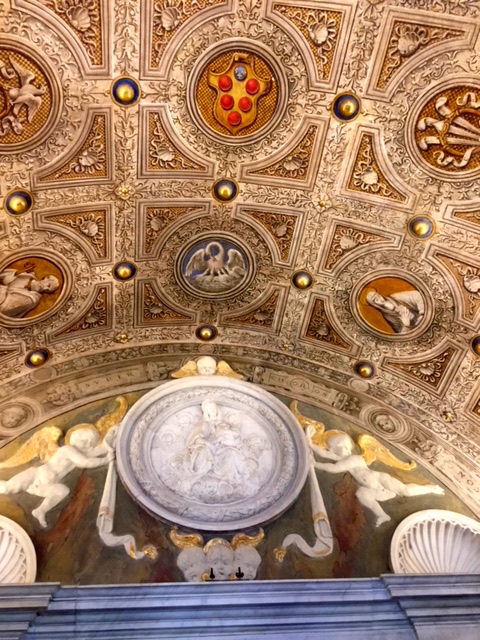
Of course the villa has its own (gorgeous) chapel; here is a detail of the ceiling:

IMG_8965


And the villa also has a grotto:

IMG_8972IMG_8973


There is a lot of interesting interior detailing:

IMG_8971


So, now you’ve seen my pictures, let’s get some info from Wiki on the Villa:
From Wikipedia, the free encyclopedia.

History [ edit | wikitesto change ]

In the 14th century, the castle of the Montegonzi was built on this property land already belonged to the Del Palagio. In 1445, Arcangelo Montegonzi sold it to Alamanno Salviati , the man who introduced the cultivation of salamanna and jasmine grapesin Tuscany.


Alamanno commissioned Mielcozzian workers to reduce the castle to a villa, with a garden and woods . In 1490, the nephews of Alamanno, dividing their uncle’s assets, and gave the villa to Jacopo, who was related to Lorenzo de ‘Medici.


In 1493, new, considerable renovations were undertaken, to which perhaps Giuliano da Sangallo took part and which lasted about a decade.


Giovan Francesco Rustici also took part in the works. Between 1522 and 1526 he created for the villa a series of terracotta roundels with mythological subjects (such as Apollo and Marsyas or Jupiter and Bellerophon ).

Today the Villa’s  Limonaia is the the headquarters of the Historical Archives of the European Union.

In 1529, the house was sacked by the anti-cult faction and between 1568 and 1583 Alamanno di Jacopo Salviati and his son Jacopo further enlarged and embellished the villa, with the gardens ( 15701579 ) and the buildings that border the northern border and create a scenic backdrop connected to the villa.

New Year’s eve, 1638, was an event to remember. That evening, in this villa, the severed head of the lover of Caterina Canacci, was brought to the villa, hidden under the linen that the wife of Salviati, Veronica Cybo, sent him weekly.

The villa then passed to the AldobrandiniBorghese and on December 30th 1844 it was bought “with a closed gate” (ie with all the furnishings) from the Englishman Arturo Vansittard.

Then came the tenor Giovanni Matteo De Candia aka Mario, who lived there with his wife, the soprano Giulia Grisi , the Swedish banker Gustave Hagerman and finally, in 1901, the Turri.

The grotto: 

During the WWII, the grotto was used as the post of an allied command: Lensi Orlandi recounted the memory of nocturnal visits of “kind and rich Florentine, often mature matrons”, who “crossed the threshold of those rooms to give honor to the admired winners” [2 ] .

There followed a long semi-abandonment, in which the villa was not accessible even to scholars (he visited Lensi-Orlandi in 1950, but could not Harold Acton in 1973 ).

In 2000 the monumental complex, together with its gardens, was purchased by the Italian Government to be destined for the European University Institute , which made it the seat of the Historical Archives of the European Union ; one can mention, among the various documents contained in them, the personal papers of the founding fathers, such as Alcide De Gasperi , Paul-Henri Spaak , Altiero Spinelli and Ernesto Rossi .

The end of the renovations took place in October 2009 and on December 17, 2009 the President of the Republic Giorgio Napolitanoinaugurated the Historical Archives of the European Union .

This villa was in communication with Villa Emilia (which was higher up) – which in ancient times was a convent of Cistercian nuns suppressed in 1453 – through an underground gallery : hence the other name with which the villa is known, “del Ponte at the Badia “.
Architecture [ edit | wikitesto change ]

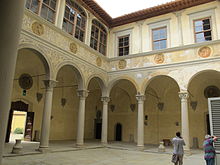
The courtyard

The main body of the villa reveals its military origins, especially in the two crenellated turrets, in the corner, and in the crowning with the walkway on corbels , very similar, for example, to that of the villa of Careggi . It is made up of two adjacent buildings, but with similar architectural features: the east one is more massive and tall, the west one is of smaller volume and height.

The building is arranged around the central courtyard, portico on three sides with columns in pietra serena with Corinthian capitals ;the entablature towards the inside is decorated with graffito friezes, with the rounds of the Rustici inserted into this strip in correspondence with the round arches.

The interiors are often covered by vaulted , barrel and cross vaults .

Gardens [ edit | wikitesto change ]

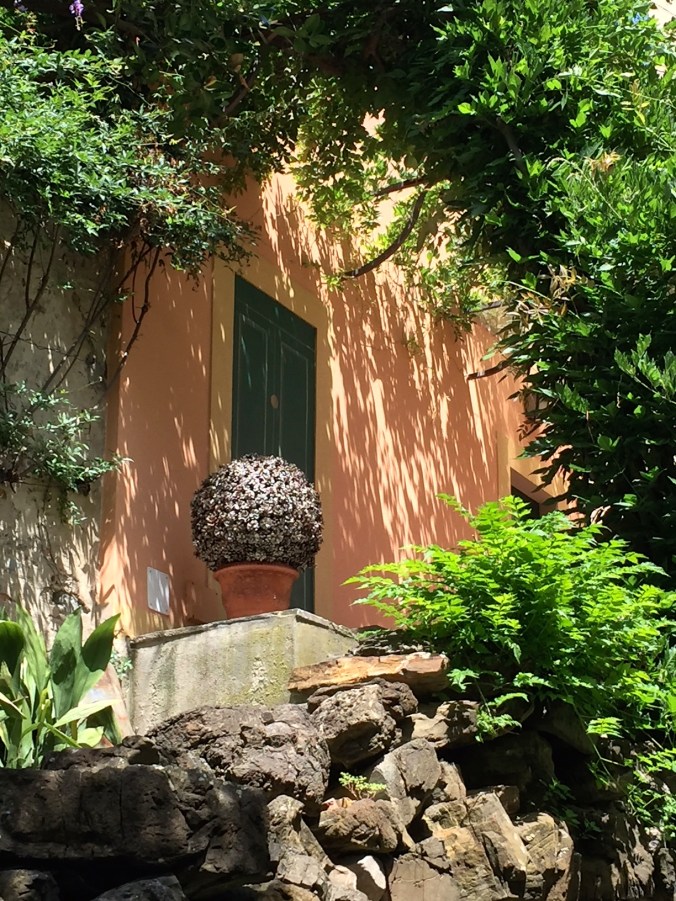
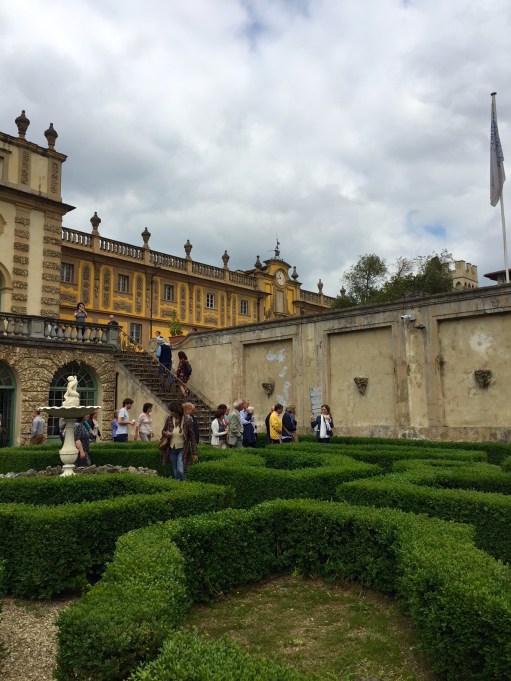
The gardens

You get to the south facing of the villa through a long cypress avenue that once led to the Via Faentina and that after the construction of the railway was modified, creating a passage on it.

The Italian garden , in front of the villa, is built on three terraces at different levels and, although it is being restored, it is made up of geometric flower beds in boxwood with flowery essences. The property is then surrounded by a large English park , where there are, among other things, a bamboo grove, two ponds and, scattered here and there, various items of furniture, such as statues, temples, caves, fountains, pavilions and more.

Villa Salviati , or villa of the Ponte alla Badia , is located along the homonymous street near via Bolognese in Florence , [1]