Graffiti

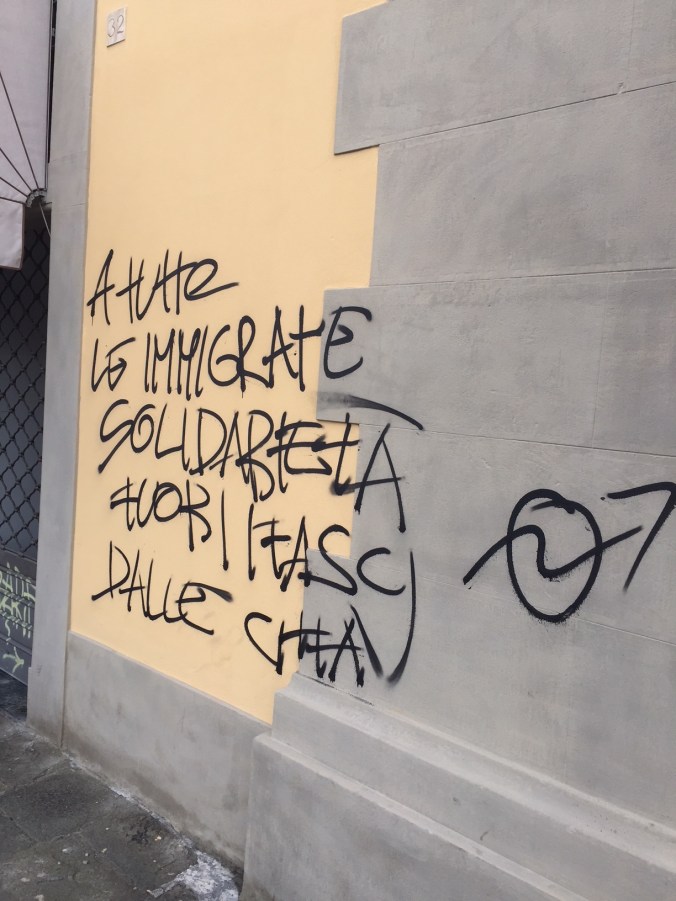
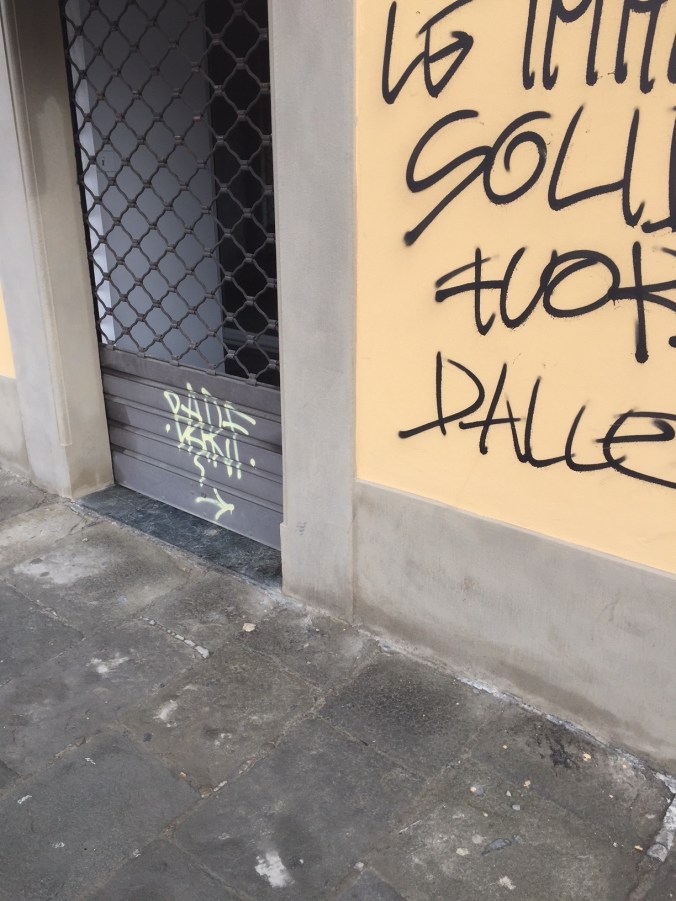
Small signs warning graffiti creators not to paint anything appear on many exterior walls in Florence.  Typically, the creators seem to obey the signs.  But, right on a major Lungarno street (street along the Arno river), someone could not help themselves and painted–in a beautiful graphic style, I might add–words that both support immigrants and denounces Fascism.

Immigration is a huge issue in Italy.  A week or so ago an immigrant was shot dead on the street that I walk on at least weekly and sometimes several times a week.  I happened to be walking down this street shortly after the murder.  Carabinieri and police were everywhere.  I didn’t find out until later that a man in his 60s was planning to commit suicide, but lacked the nerve, so he walked outside and shot the first person he saw.  At least that’s what I read.

There was a march last Sunday in support of immigrants.  It is such a sad story, all these displaced people from the middle east and northern Africa, whose lives are ripped apart by endless civil wars.

Despite the fact that this graffiti is forbidden, I can’t help but admire the creator who felt compelled to state his/her support for the downtrodden.  And, in such a beautiful style.


IMG_8326IMG_8325IMG_8324

Capodanno a Firenze

Last night there were fireworks in Florence.  Something was definitely up!

images

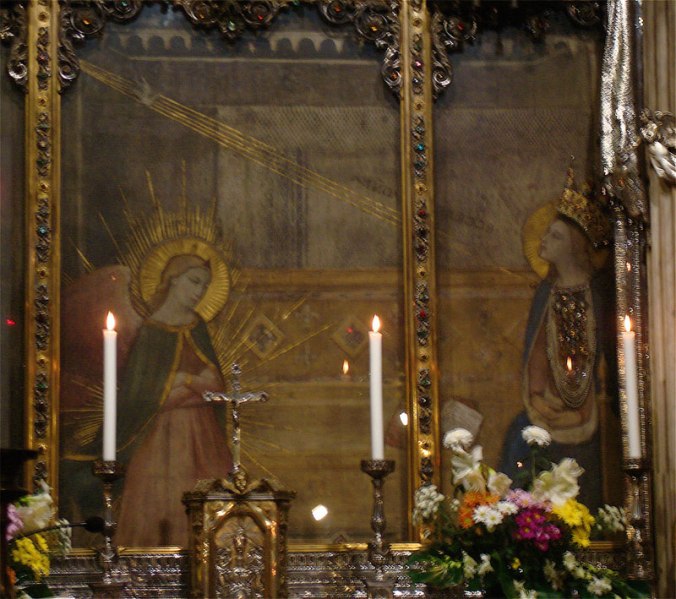
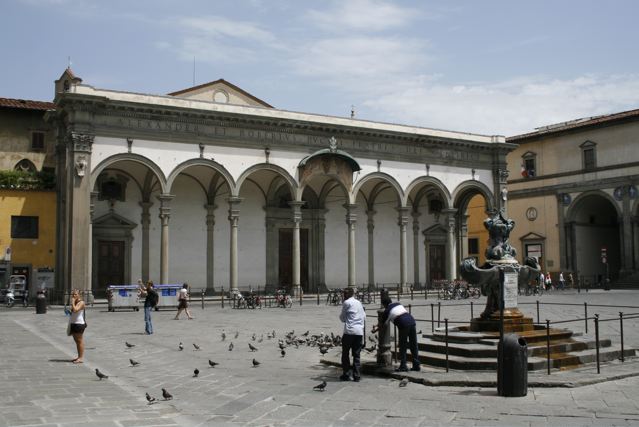
And that’s because today, March 25, is the date marking the beginning of the new year according to Florentine tradition. The city commemorates the occasion with a major parade which begins at the Palazzo Vecchio and makes a pilgrimage to the Santissima Annunziata. That church is important because of it houses a medieval fresco of  the Annunciation, which is believed (by some people at least!) to have been partially painted by angels.

The fresco and the church of Santissima Annunziata (the Most Holy Annunciation) has always been the centerpiece of the Florence’s New Year festivities in late March. The fresco can still be viewed on the inner wall to the left of the entrance.

annunciation

The story goes that the artist commissioned to paint the Annunciation fell asleep after completing all but the face of the Virgin Mary. Upon his awakening, he found a completed, beautiful blonde Madonna – angelic masters had finished the fresco for him.

From 1250 to 1750, the people of Florence gathered in the church of SS Annunziata to welcome the arrival of spring and to officially celebrate the Annunciation, or the moment   when the Angel Gabriel told Mary that she would be the mother of Christ. March 25 of course is exactly 9 months before Christmas, when the Christ child was born.

santissima-annunziata-church-florence2

In order to celebrate the event, the municipality of Firenze organizes a parade with traditional costumes, music and flag-wavers. The historical procession (called the corteo storico) of the Florentine Republic,  starts around 2:45 pm at the palace of the Palagio di Parte Guelfa, heading toward the Basilica SS. Annunziata.

900x400-02

Florentines were so devoted to the Madonna that until 1750, they refused to accept the Gregorian calendar year that begins on January 1. This devotion remains a part of the culture and was celebrated again today.


Inexpensive paper helped fuel the Renaissance.

A plentiful supply of paper – just as much as the study of ancient sculpture or single-point perspective – was among the factors that led to what we call the Renaissance. It allowed artists to think and work in different ways, a transformation as significant as the Internet and computer technology have been in the early twenty-first century.

Not, of course, that paper itself was a new material in the fifteenth century. On the contrary, it had first been made in China a millennium and a half previously; but the recent availability of paper was a knock-on effect of another innovation: the invention of moveable type by Johann Gutenberg of Mainz.

By 1450 Gutenberg had set up a commercial printing press, and by the 1460s presses began to be established in Italy. As soon as that happened, there was a greater demand for paper, so more paper mills were built.

The main alternative for drawing had been vellum – scraped and burnished calf-, sheep- or goat-skin – which was luxurious and labour intensive to prepare. The price list of a Florentine stationer’s from the 1470s lists vellum as fourteen times more expensive than paper.

Paper, however, was still quite a costly material. That was why artists often used both sides of a sheet; it was too valuable to waste.

So, after Ghirlandaio had used a piece of paper to work out the composition of The Visitation, one of the frescoes for the Tornabuoni Chapel, in a flurry of rapid pen strokes – establishing the positions of the figures, jotting down the background architecture – the paper was then turned over and used as a cartoon for a piece of classical moulding framing the scenes.

A series of holes was then pricked through, following the lines of the egg and dart and palmette motifs, and charcoal or black chalk dust forced through them to transfer the lines to the wall.

Always acutely cost-conscious, Michelangelo was an especially assiduous recycler of used paper, sometimes searching through the litter in his studio for a useable scrap and coming up with a sheet he had drawn on years before but which still retained some blank space.

As a result, Michelangelo’s drawings, even more than those of, say, Leonardo, are palimpsests on which one may find jostling each other sketches and studies for various projects side by side with drafts of poems, stray remarks or quotations that seem to have drifted through his mind, lists of expenses and other items that are apparently not by Michelangelo at all. His correction of another apprentice’s attempt to copy those

Gayford, Martin. Michelangelo: His Epic Life (Kindle Locations 1045-1054). Penguin Books Ltd. Kindle Edition.