And it is bellisimo!


And it is bellisimo!
Wow! I’ve seen some live performances and heard some music in my life, but last Saturday in Florence was very special.

The Opera di Firenze mounted a true spectaclo. One of the finest orchestras in Italy, the sonorous Orchestra del Maggio Musicale Fiorentino, is directed by Ivan Ciampa (my Italian teacher says the Florentine orchestra is second only to that of La Scala in Milano. My teacher has never led me astray) provided the rich, beautiful music, while the company performed the libretto.
La Bohème, the opera in four acts composed by Giacomo Puccini.


The world premier of this beloved opera was in 1896 in Turin, conducted by none other than Arturo Toscanini.


(btw, in 1946, 50 years after the opera’s premiere, Toscanini conducted a performance of it on radio with the NBC Symphony Orchestra; this performance was eventually released on records and on compact disc and is the only recording of a Puccini opera by its original conductor.)
La bohème went on to become part of the standard Italian opera repertory and is one of the most frequently performed operas worldwide.

The opera this fall in Florence was directed by Bruno Ravella and the stage sets were designed by Tiziano Santi. Santi’s scenes tend to suggest rather than literally depict the French environments with a system of small, open and slightly distorted stage boxes.
The story unfolds in a traditional way, and for me, the most captivating moments were in the large choral scenes suggesting Paris’s Latin Quarter in the 1840s. The opera choir is sensational and delights the audience through their singing and choreography. A favorite scene is when Musetta sings of her romances on a swing like a cabaret performer. One stark but moving scene is between the two lovers in their duet “O soave fanciulla.” They stand on the proscenium in front of a dark mesh-looking screen, on which are projected snowflakes. The young people seem distanced from the rest of the world, caught up in their isolated sphere.
Also surprising and delightful is the projection of light to resemble a carpet of flowers which accompanies “Sì, mi chiamano Mimì.”
The cast is composed of many young performers.

Benjamim Chou reprises the role of Marcello; according to the same critic above, who wrote that Chou’s Italian accent is not perfect. Angela Nisi plays Musetta. Goran Jurić takes the part of Colline and Andrea Vincenzo Bonsignore provides Schaunard. William Hernandez plays Benoit and Alessandro Calamai is Alcindoro. Carlo Messeri reprises Parpignol.
Matteo Lippi performs Rodolfo and opposite him shines the key role of Mimi, reprised by Maria Mudryak. Of her superb performance, an Italian critic wrote (I’ve translated it):
The young soprano draws a flurry of flattery and fragile, in line
with tradition, through a voice with a burning stamp, which is
intensified especially in the centers
and in the acute register. Such voice material allows the interpreter
to face the part with the right glance and an enviable security.
Shee only misses a variety of accents and phrasing to make the character really
remarkable.
I guess the talented soprano should practice her Italian; kinda like me! The only thing, alas, that she and I have in common.

At 23, soprano Maria Mudryak’s singing career has already brought her to the world’s great stages, to sing some of the most enviable roles in the operatic repertoire. Her training started early, with a move to Italy at the age of 10; she soon joined the children’s chorus of the Teatro alla Scala, and was later accepted into the Conservatory Giuseppe Verdi in Milan at just 14. She made her professional debut as Susanna in Le nozze di Figaro in Genova, and has since filled her seasons with performances of Adina (L’elisir d’amore), Musetta (La bohème), Marie (La fille du régiment) and Violetta (La traviata).
Here you can get a sense of Mudryak (n.b. the videos are not from Florence’s La bohème).


Al termine della recita il pubblico elargisce grandi ed entusiastici applausi a tutti gli interpreti e al direttore.
Teatro del Maggio – Passione Puccini
LA BOHÈME
Opera in quattro quadri di Giuseppe Giacosa e Luigi Illica
Musica di Giacomo Puccini
Mimì Maria Mudryak
Musetta Angela Nisi
Rodolfo Matteo Lippi
Marcello Benjamin Cho
Schaunard Andrea Vincenzo Bonsignore
Colline Goran Jurić
Benoit William Hernandez
Alcindoro Alessandro Calamai
Parpignol Carlo Messeri
Sergente dei doganieri Vito Luciano Roberti
Un doganiere Nicolò Ayroldi
Orchestra, Coro e Coro delle voci bianche del Maggio Musicale Fiorentino
Direttore Francesco Ivan Ciampa
Maestro del coro e del coro delle voci bianche Lorenzo Fratini
Regia Bruno Ravella
Scene Tiziano Santi
Costumi Angela Giulia Toso
Luci D. M. Wood
Nuovo allestimento del Teatro del Maggio Musicale Fiorentino
And, just for fun:

Yesterday I had the great pleasure of attending a performance of La Boheme at Florence’s ultra modern opera house. It was a fabulous experience!

Soon I’ll post about the performance, but for now I want to focus on the building itself.

Unusual for an Italian city, the new opera house complex includes green space.


 ‘
‘
Florence is, of course, the city where opera was born in 1597 and where opera has been performed in numerous venues including, for many years, a functional but ungainly theater called the Teatro Comunale. When Matteo Renzi was mayor of Florence from 2009 to 2014, among his projects was this new opera house and concert hall, not far from the Teatro Comunale.
Renzi, who became prime minister of Italy at the age of 39, was an audacious and controversial leader, but there is no denying that he effectively set the national discussion on a new course.
Before Renzi became Prime Minister, some laws were passed that tried to reform arts funding and administration in Italy. These laws require, in exchange for federal money, more administrative control from Rome of some of the fondazioni—the entities that run the 14 important theaters in Italy that present opera.

The New Florence Opera House, is one of the most innovative in all of Europe. After years of deliberating the need to provide Florence, and its renowned opera festival Maggio Musicale Fiorentino, with a modern venue, at last this new complex took shape.
The complex is comprised of three large and spacious halls: the opera hall, built with special walls that direct soundwaves towards the audience without echoing; the concert hall which holds 1000 seats; and the spectacular rooftop amphitheater, which offers 2000 outdoor seats with an captivating panoramic view of the city.

With its stark, modern structure and cutting-edge technologies, the new opera house is one of the most modern opera houses in the world, uniting modernity and antiquity, vision and tradition, in the city that gave birth to the first opera in the 1600s.


For this reason the opera house is open and accessible to the public during daytime hours. The bookshop and café will be always open and families can go for a walk, wander among the fountains, or meet with friends on the grounds.
The project was undertaken by the Presidenza del Consiglio dei Ministri with funds made available (150 million Euro grant) for the celebration of the 150th anniversary (in 2011) of the unification of Italy and with contributions from the Regione Toscana and the city of Florence. A 255 million Euro public investment partially financed the ambitious project of the New Florence Opera House which represents.
The theater also boasts one of the most technologically advanced scene-changing mechanisms in the world that enables rapid scenography changes so as to allow even multiple and simultaneous performances in the same day, increasing the theater’s potential.
Credits
Presidenza del Consiglio di Ministri
Executive Officer Dr. Elisabetta Fabbri (Architect)
Project Manager Dr. Giacomo Parenti (Engineer)
Director of Works Dr. Giorgio Caselli (Architect)
Contractors A.T. I : S.A.C Spa e I.G.I.T Spa
Project Coordinator Dr. Angelo Reale (Engineer)
Executor Co-ordinator of the project and its operative phases Dr. Angela Ranieri (Engineer)
Design
Architects Studio A.B.D.R – Roma
Structural Design Italingegneria – Roma
Systems Design Enetec – Roma
Consultants
Acoustics Müller – BBM Monaco
Stagecraft Biobyte
In Florence, I believe, one of the problems is that despite the city’s history with opera, it is not widely popular with local people and with the millions of visitors who come here for days of intensive touring of museums full of the masterpieces. And with the old and new theaters slightly out of the heart of tourist traffic, no one walks past them as part of a stay here.
Construction on the new theater (based on designs by Paolo Desderi) began in 2009 and it was inaugurated on December 21, 2011 so that it could be said to have opened in the year of the 150th anniversary of the Unification of Italy. It was quickly closed after one concert as it was nowhere near complete. It has had a couple of more “openings” and its official one was on May 10, 2014.
Let’s say you are one of the major sculptors of Renaissance Italy, and that you live in Florence. Where would you want to have your studio?
How about, right on the piazza around il duomo? Non e’ male!
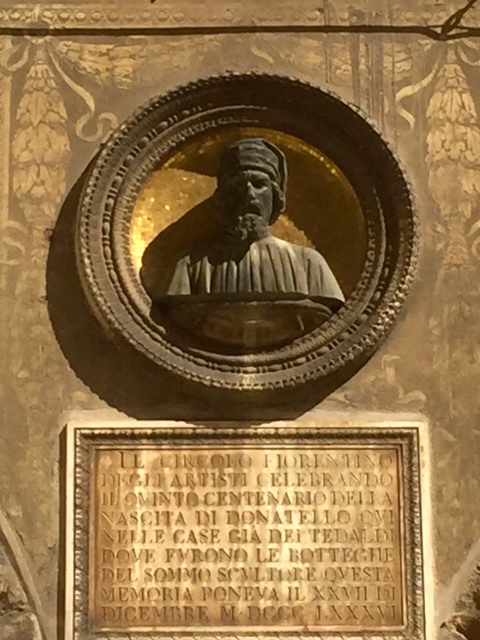
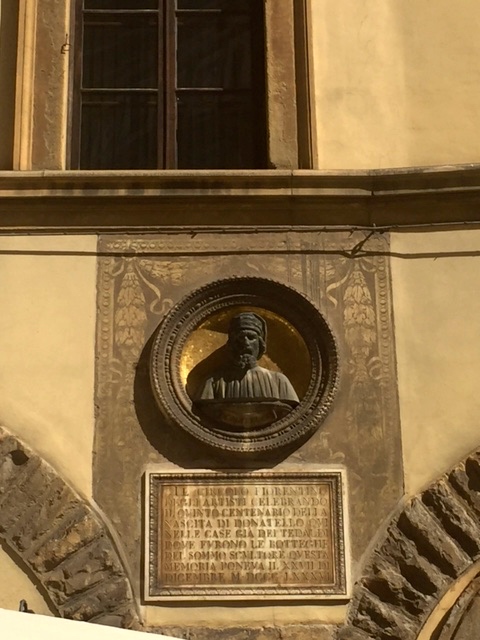

Using the map above, you will find the bust of Donatello and the plaque recording his studio location about where the P in “Panini Toscani.” You can find Panini Toscani words on the upper right side of the map.

We know some, but not enough, about Donatello (c.1386-1466). He was apparently born in Florence and grew up with the Martelli family, where it is hypothesized that he received early training from a goldsmith, before training and working in the studio of the famous metalworker and sculptor, Lorenzo Ghiberti.
There is very little known about his life as he was growing up; however, Vasari tells us a few stories which give insight to the generous and proud man that he was. Vasari, in his “Life of the Artists” where he wrote biographies of other artists, enjoys playing with the name Donato which is a variation on the Italian verb “to donate”. Several pieces of Donatello’s artwork were donated to those whom he held in high esteem.
It is possible to see many pieces of Donatello’s works throughout Florence – but be aware that several pieces available on display outdoors are expert copies since the originals have been moved indoors for safe keeping.
The map below shows the spots in Florence where you can find major Donatello works.

Both the Museo of the Opera del Duomo and the Bargello have extensive works by Donatello. It is so easy to forget that many pieces were made for a specific setting, like the facade of a church or an altar. Once they’re in a museum, even if the work is beautiful on its own, you sense that if viewed in its original position, the work of art would seem different.
If you decide to go outside of Florence and still want to see works he had a part in, here’s a short list to guide you:
In the San Matteo National Museum in Pisa, you can view the Reliquary of San Rossore, statue, gilded bronze. Via San Matteo in Soarta 1 (Pisa)
At the Villa Guinigi in Lucca, (also known as “pleasure palace” but which is now a national museum), you can admire Madonna and Child relief in tile. Piazza della Magione (ex Manifattura Tabacchi), Lucca
Inside the impressive Cathedral in the center of the historic part of Arezzo, you can admire the baptismal font with a bas-relief marble carving of the Baptism of Christ.
Between the Baptistery of San Giovanni, the Cathedral of Siena and the Museum dedicated to the artwork from the Duomo, you will find several works of art dating from the time Donatello worked in Siena.
I’m so happy I found pickles (not quite dill, not quite sweet, but better than nothing) here. Of all the things I miss, I never expected it to be dill pickles. But, not to worry; they’re available!

This box on the street spoke to me: do not upset!!

Today’s lesson: how to boss people around (ha ha) with imperativo!

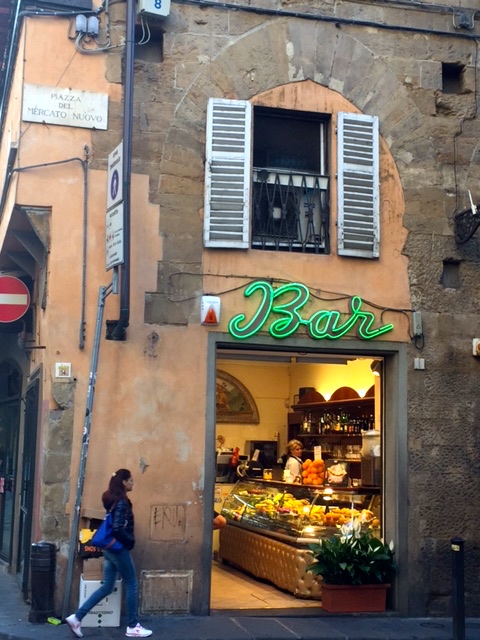
The photo below encapsulates my favorite kind of view in Florence. I love the bars with every good kind of coffee, pastries, sandwiches and all kinds of treats. Humble or ritzy, I love them all!
I noticed this spritely gentleman in the Mercato Nuovo. His face looks like JFK.

And finally, today’s fruits at Mercato San Ambrogio.

I love that Italians sell and buy pesche settembrine. September peaches. What could be better than that!


I have always been afraid to drive in Italy!! Not because, as is generally known, Italians ignore rules and regulations; not because the signs measure kilometers and not miles; not because I don’t the directions to where I’m going….but because I have never been sure I could find my way out of and then back in to the city! Whether the city be Roma or Firenze or wherever.
I could always picture myself going around and around some round-about, not being able to get off; or, driving wrong way both up and down one way streets in the historic center.
So, it is not with a little pride that I share with you that I not only rented a car myself last weekend, an adorable Fiat Cinquecento, as seen below:
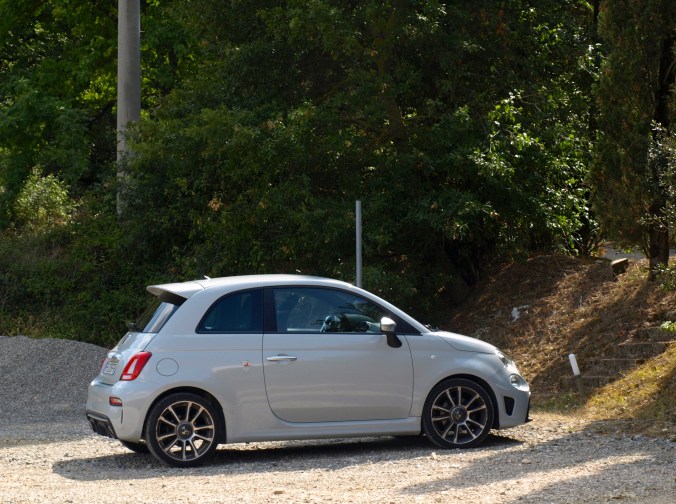
But I successfully drove it out of Florence, through Tuscany, to the area around Val d’Orcia in the south of the region, then back through Tuscany and into Florence!! Woo hoo! I got the car back to the rental agency in the center of Florence, with nary a scratch or bump! I am a very proud driver!
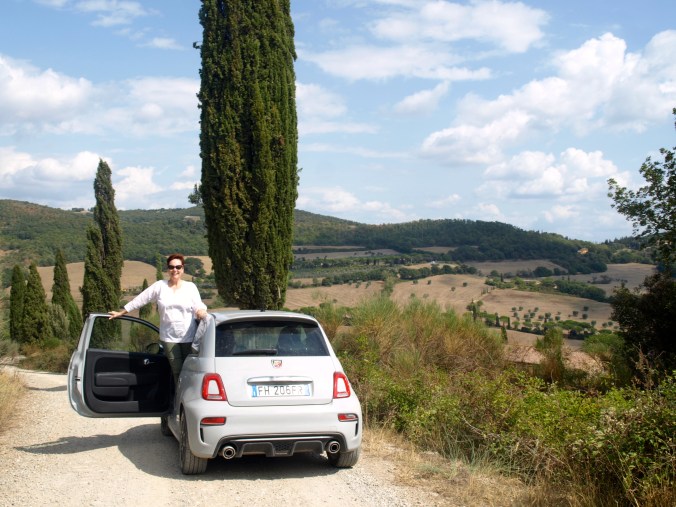
I think you can see my pride above. Ad below.
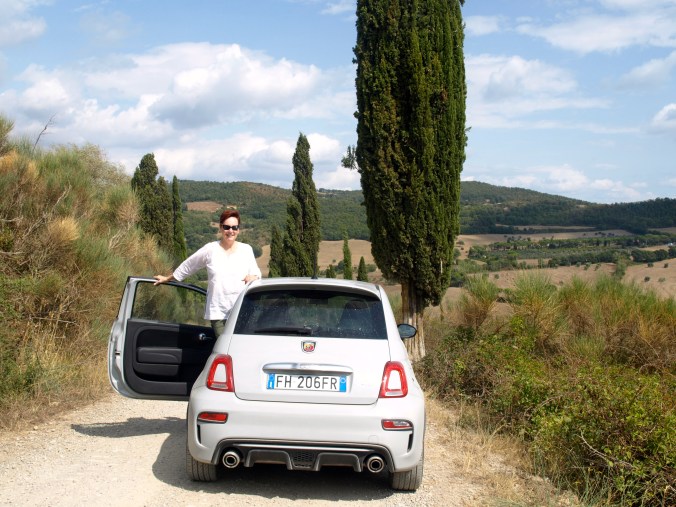

And, not for nothing, this winding road, the most iconic in Italy, is one of the places I drove on Saturday!
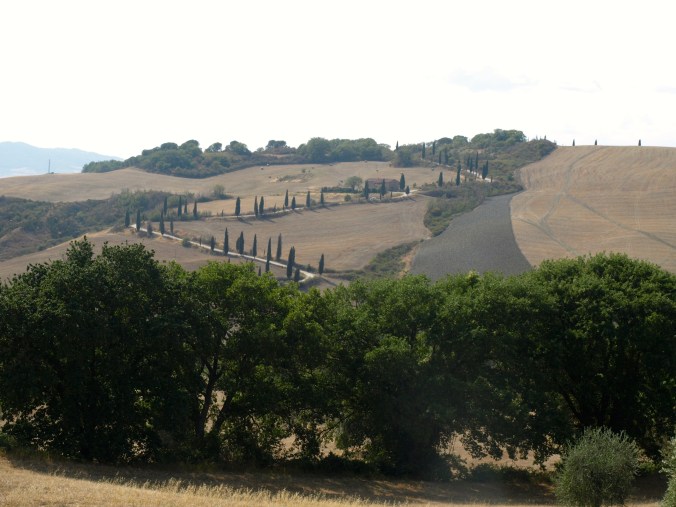
OLYMPUS DIGITAL CAMERA
I will happily share with you that part of my confidence came from the fact that I had an Italian friend with me. My friend made sure I made it out of and back in to Florence in one piece. Next time, I’ll do it myself! Face your fears, people!
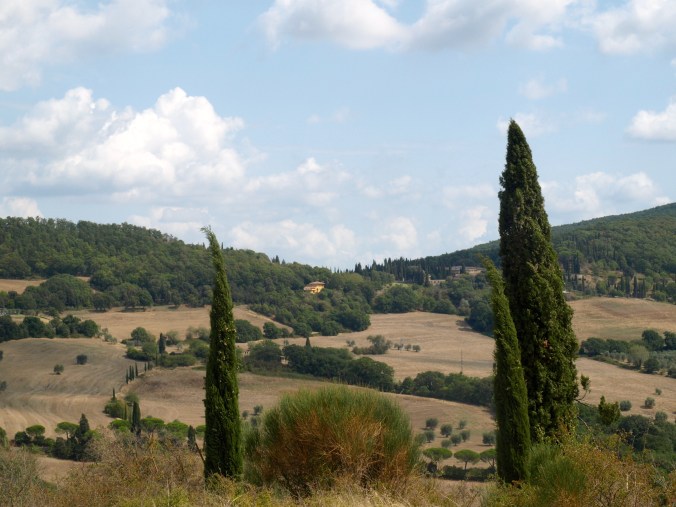
The real deal.


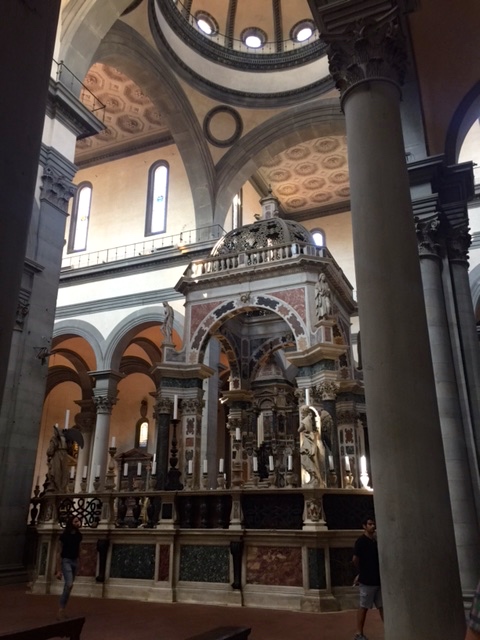
Brunelleschi, Michelangelo and many other important artists have major works within this Renaissance architectural masterpiece in the Oltrarno that is so easy to miss. The church’s facade is so unimposing, it is almost invisible.
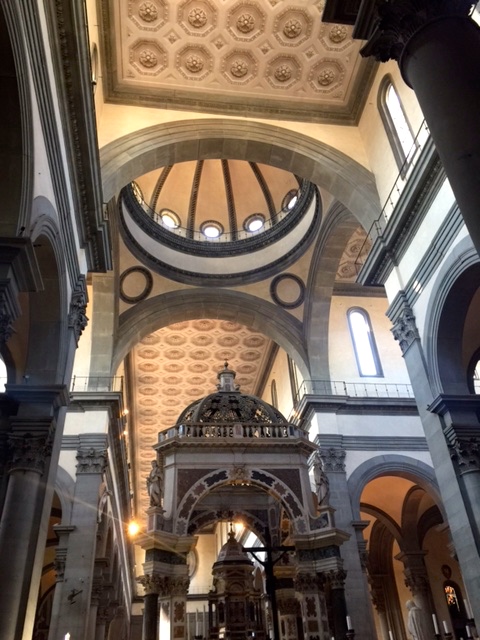
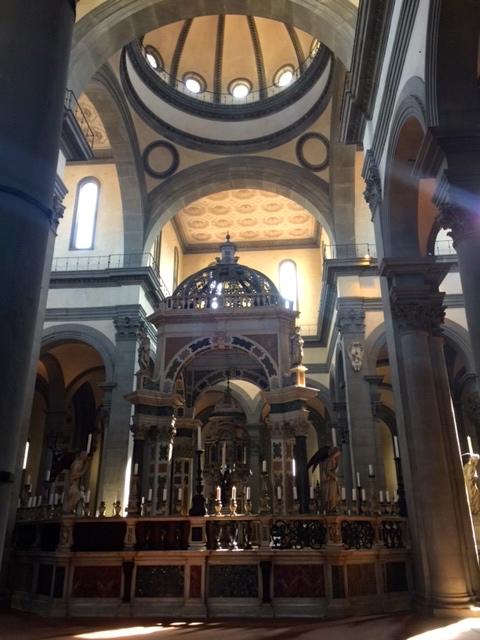
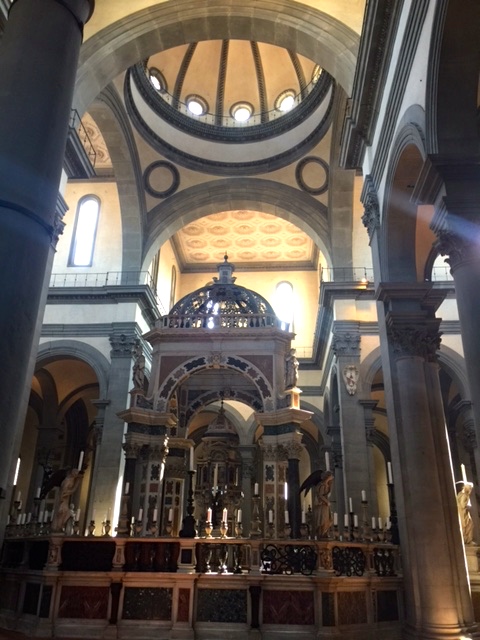
But step inside and behold: Brunelleschi’s lovely basilica.

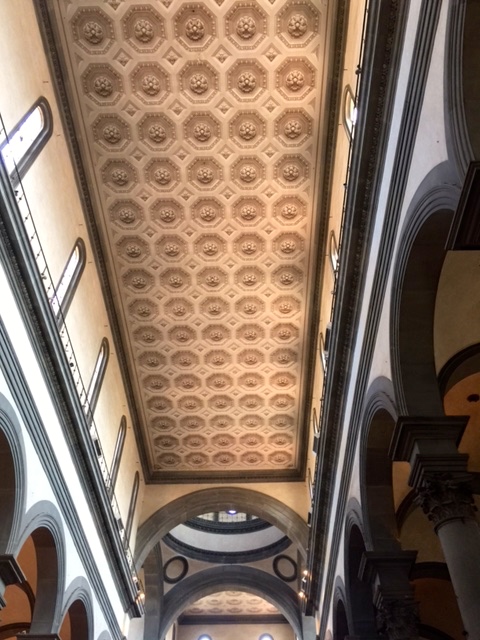
Brunelleschi began designs for this interior as early as 1428. The first pillars to the building were delivered in 1446, ten days before his death. After his death, his plans for the church were carried on by his followers Antonio Manetti, Giovanni da Gaiole, and Salvi d’Andrea; the latter was also responsible for the construction of the cupola.
Unlike the Basilica of San Lorenzo, where Brunelleschi’s ideas were thwarted, his designs were carried through here with some degree of fidelity, at least in the ground plan and up to the level of the arcades.
The Latin cross plan was realized and the contrast between the nave and the transept, that caused such difficulty at S. Lorenzo, was here also avoided. The side chapels, in the form of niches, all the same size and 40 in number, run along the entire perimeter of the basilica.
Brunelleschi’s facade was never built and left blank. In 1489, a columned vestibule and octagonal sacristy, designed by Simone del Pollaiolo, known as Il Cronaca, and Giuliano da Sangallo respectively, were built to the left of the building. A door was opened up in a chapel to make the connection to the church.
Dominating the interior of the basilica is a Baroque baldachin with polychrome marbles, by Giovanni Battista Caccini and Gherardo Silvani, and placed over the high altar in 1601.
The church remained undecorated until the 18th century, when the walls were plastered. The inner façade is by Salvi d’Andrea, and has still the original glass window with the Pentecost designed by Pietro Perugino. The bell tower (1503) was designed by Bacio d’Agnolo.
The exterior of the building was restored in 1977-78.

The Augustinians had begun building the church and the convent in 1252. It was originally dedicated to Mary, All Saints and the Holy Spirit, changing by the end of the century to Mary, the Holy Spirit and Matthew.
The churches and convents of various mendicant orders were constructed with the financial support of the commune; the same is true for Santo Spirito beginning in 1267, and then again from 1292 to 1301.
The convent of S. Spirito became a center of scholarly activities and was recognized as Studium Generale of the Augustinian order in 1284. The first Rule and Constitutions of the Augustinians were approved in 1287 by the general chapter of the order that was held in Florence.

Santo Spirito was associated with the early humanism in Florence. One of the groups, led by Bocaccio, gathered there in 1360s and 1370s. Upon his death in 1375, Bocaccio bequeathed his library to the convent.
In the 1380s and early 1390s another circle of humanists met daily in the cell of Luigi Marsili (1342–94). Marsili had studied philosophy and theology at the Universities of Padua and Paris. He came into contact with Petrarch at Padua in 1370 and later became a friend of Bocaccio. This group included Coluccio Salutati (1331-1406), Chancellor of Florence from 1375. He soon became the central figure of the circle.
The most important of Salutati disciples was Leonardo Bruni (1370-1444), a future Chancellor of Florence. Another member of the circle was Niccolo de’ Niccoli, a humanist and an associate of Cosimo de Medici.

It was after the Florentine victory over the Milanese in 1397 during the second Milan war on the feast day of Saint Augustine (28 August), that the Florentine signoria decided to rebuild this church to honor the saint, and placing it under the patronage of the city.
Despite this decision, nothing much happened until 1434, when the operai retained the services of Filippo Brunelleschi. Work on the new church progressed slowly until March 1471. During the Descend of the Holy Spirit sacra rappresentazione organized by the laudese in honor of the visit of Galeazzo Maria Sforza the old church caught fire and was heavily damaged, together with parts of the convent.

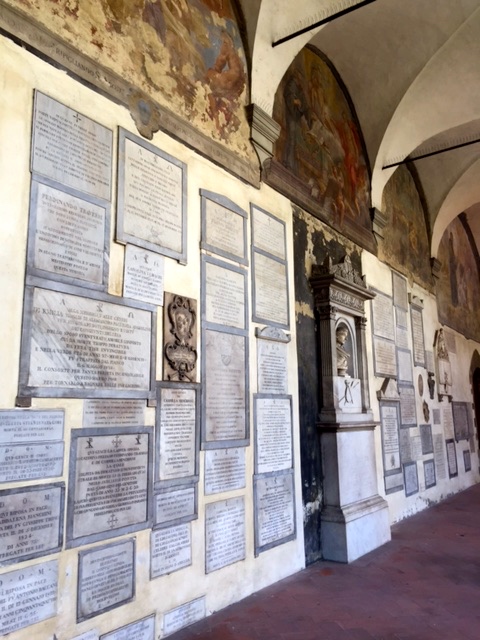
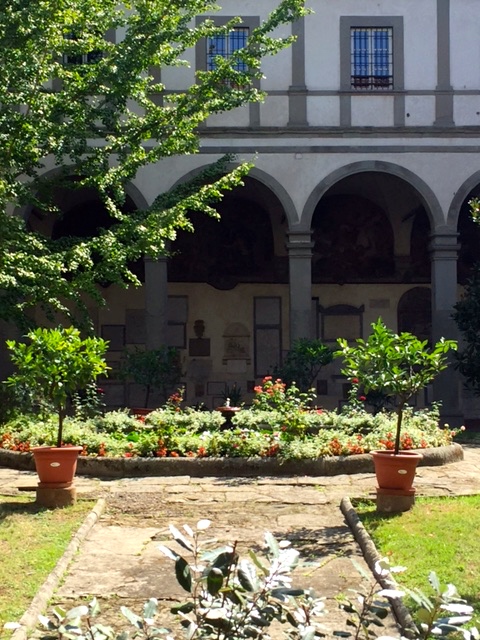
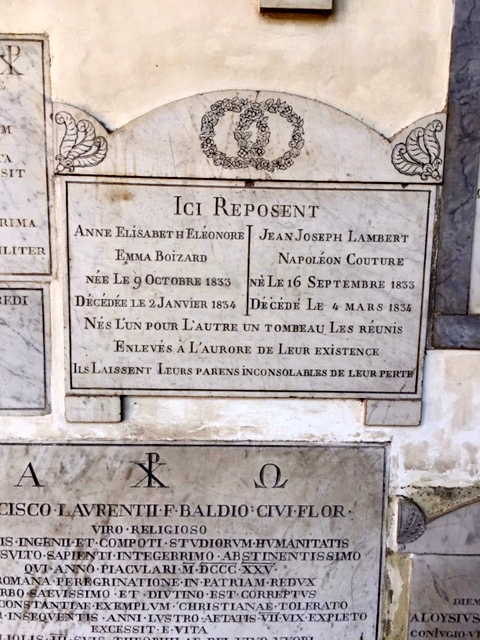
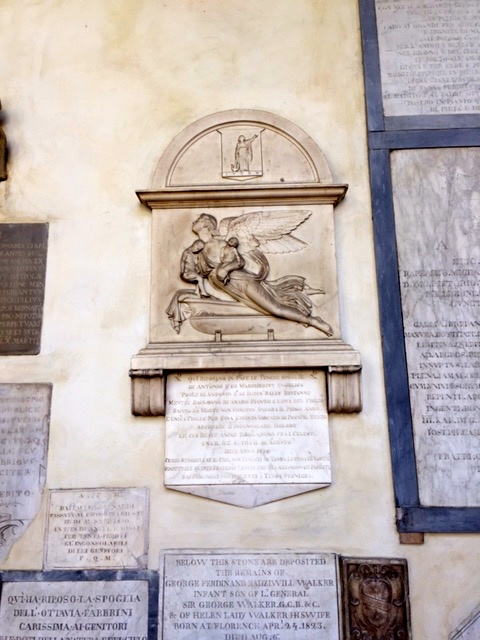
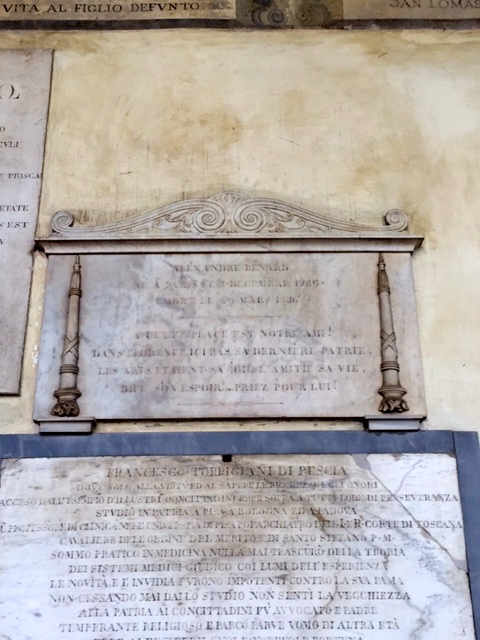
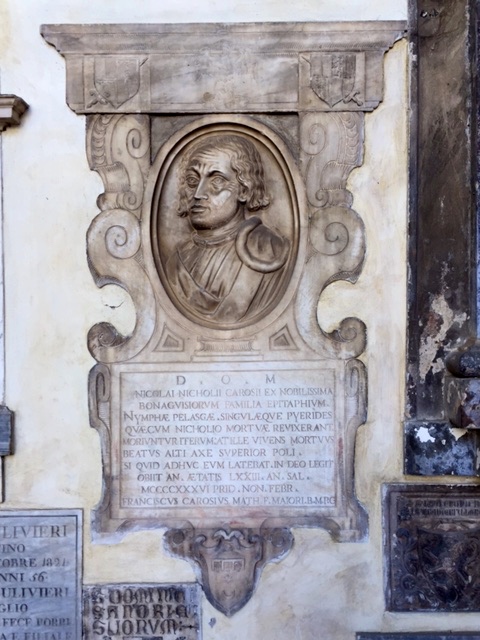
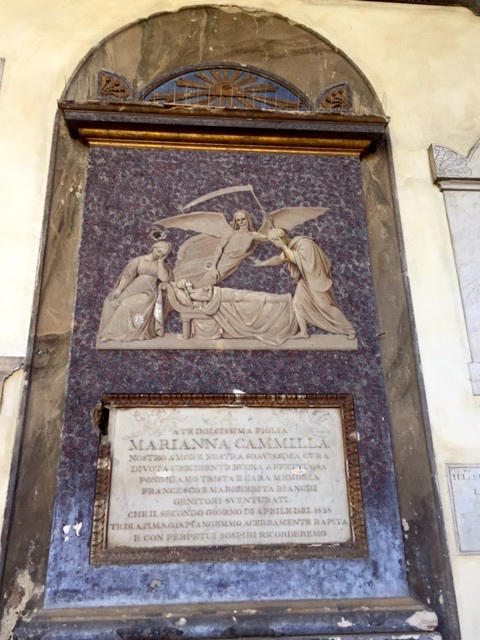
The walls of the cloister to the left of the basilica are lined with tombstones from all nationalities and eras.

The convent attached to Santo Spirito has two cloisters; they are known as the Chiostro dei Morti (cloister of the dead) and Chiostro Grande (Grand Cloister). The former takes its name from the great number of tombstone decorating its walls, and was built c. 1600 by Alfonso Parigi. The latter was constructed in 1564-1569 by Bartolomeo Ammannati in a classicistic style.
The former convent also contains the great refectory (Cenacolo di Santo Spirito) with a large fresco portraying the Crucifixion over a fragmentary Last Supper, both attributed to Andrea Orcagna (1360–1365). It is one of the rare examples of Late Gothic Art which can still be seen in Florence.
The room also boasts a collection of sculptures from the 11th-15th centuries, including two low reliefs by Donatello, a high relief by Jacopo della Quercia (Madonna with Child) and two marble sculptures by Tino da Camaino (1320–1322).
The central courtyard of the cloister is lovely and green.


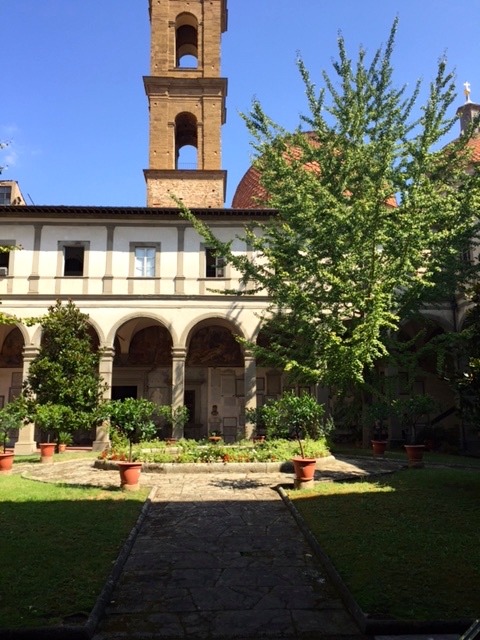
The bellower, as seen from within the cloister.
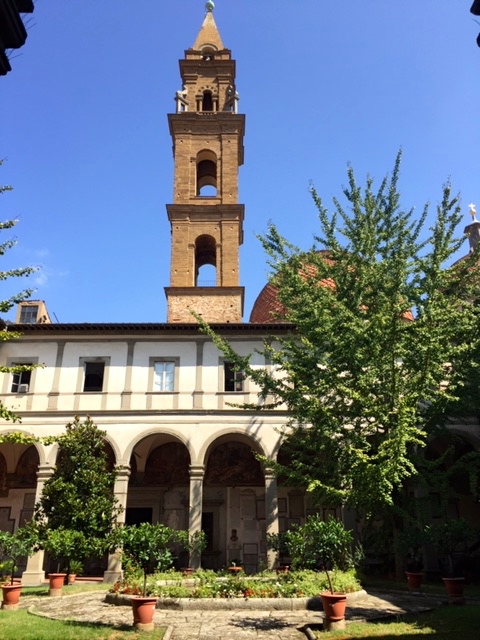
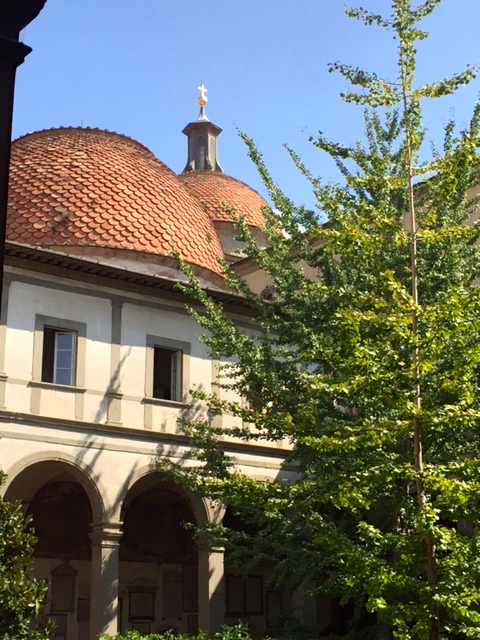
A fountain graces the center of the garden within the cloister.
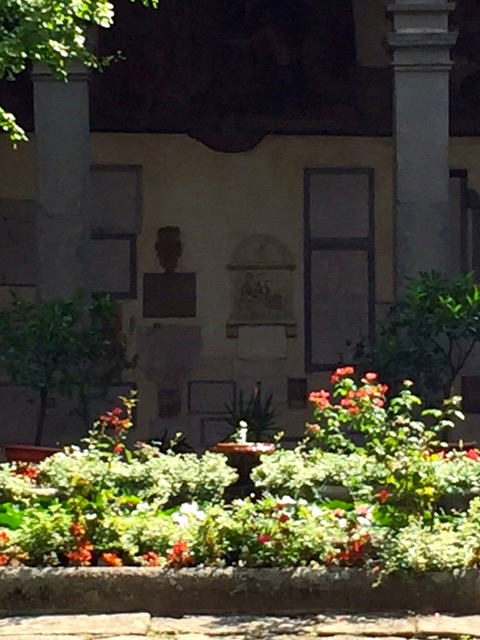
One of the hundreds of tombstones within the cloister walls.
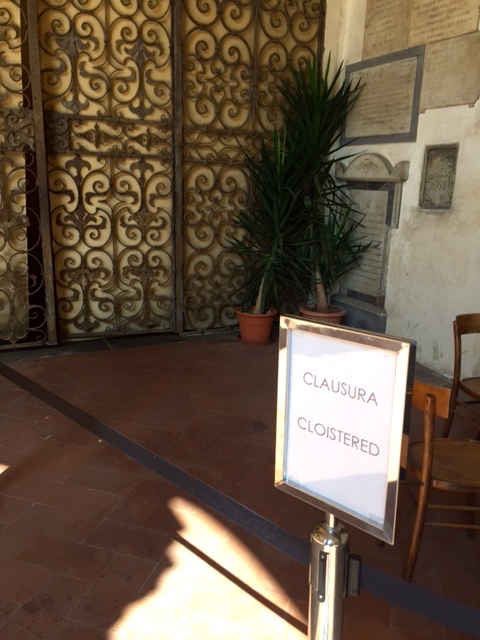

The young Michelangelo was allowed was allowed to make anatomical studies of the corpses coming from the convent’s hospital; in exchange, he sculpted this wooden crucifix, which was originally placed over the basilica’s high altar. Today the crucifix is in the octagonal sacristy that can be reached from the west aisle of the church.
Frescoes Crucifixion and The Last Supper were painted by Andrea Orcagna and his workshop in the 1360s.


 get back, lauretta!
You must be logged in to post a comment.