If you’ve ever been to Italy, you know there are a lot of churches! And, Florence is no slacker when it comes to houses of worship. Florence has a lot of churches!
Near the Lungarno Acciaiuoli, about which I will soon be posting, there is a tiny piazza or city square, with the evocative name of Piazza del Limbo. Not only is the small square a beguiling place to wander around, but it is purportedly the home of the oldest religious building in the city: the Chiesa dei Santissimi Apostoli.
The chiesa was built in the 11th century and, though it was remodelled in the 15th and 16th centuries, is one of the few in the city to have maintained its High Middle Ages features.
Tradition says that it was Michelangelo himself who convinced Bindo Altoviti, who planned to raise the ground level, not to rebuild, but to preserve the church.
The church faces the Piazza del Limbo–named because it housed a cemetery for children who died before having been baptized. It is adjacent to the Palazzo Borgherini-Rosselli del Turco.

A slab on the façade attributes the foundation to Charlemagne and his paladin Roland in the year 800. A paladin is any of the twelve peers of Charlemagne’s court, of whom the Count Palatine was the chief. A paladin is a knight renowned for heroism and chivalry. But scholars assign the church to the 11th century. A small bell tower was added by Baccio d’Agnolo in the 16th century.
The simple façade, in Romanesque style, has a portal attributed to Benedetto da Rovezzano. The tabernacle by Giovanni della Robbia and the tomb of Oddo Altoviti.
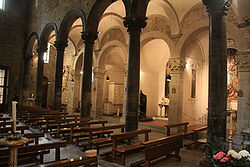
Interior of Santi Apostoli
The church’s layout is the typical basilican plan, with a nave, two aisles, and a semicircular apse, still shows Palaeo-Christian influences. It has green marble columns that come from Prato, with capitals taken from ancient Roman remains. The Corinthian capitals may well have been taken from the Roman baths that existed in the area.
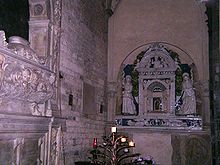
The richly decorated wooden ceiling was added in 1333. Noteworthy is the pavement, with a mosaic from the original edifice which was later restored with the contributions of outstanding Florentine families (Acciaioli, Altoviti and others). The apse area appears to be Romanesque, with undecorated stones visible. The side chapels are from the 16th century.
On the left of the apse are a polychrome terracotta tabernacle by Giovanni della Robbia. To right of the entrance is the tomb with the bust of Anna Ubaldi, mother of the Gran Priore del Bene. The bust was sculpted by Giovanni Battista Foggini. The 2nd chapel on the right, chapel of San Bartolomeo was completed in the 16th century. The right wall has a stucco depicting San Paolo, and on the left wall the sepulchral monument of Piero del Bene (1530).
At the end of the nave above the door that leads to the Canon’s hall is the sepulchral monument of Bindi di Stoldo Altoviti (Bindo Altoviti) (1570) with a statue of Faith and two putti by followers of Bartolomeo Ammannati. In the apse, is the monument of Antonio Altoviti and busts of both Charlemagne and Antonio Altoviti by Giovanni Caccini. In the left nave is the monument to Oddo Altoviti (1507-1510 by Benedetto da Rovezzano.
The 4th chapel on the left has an altarpiece with the Adoration of the Shepherds and, on the wall, Archangel Raphael with Tobias and St Andrew Apostle (c. 1560 by Maso da San Friano). The 3rd chapel on the left contains the image of Archangel Michael defeating Lucifer (16th century by Alessandro Fei). The 2nd chapel has frescoes depicting the Glory of San Giovanni di Chantal by Matteo Bonechi. The first chapel has a Madonna, Child and Angels, a copy of a Paolo Schiavo originally on the facade of church.
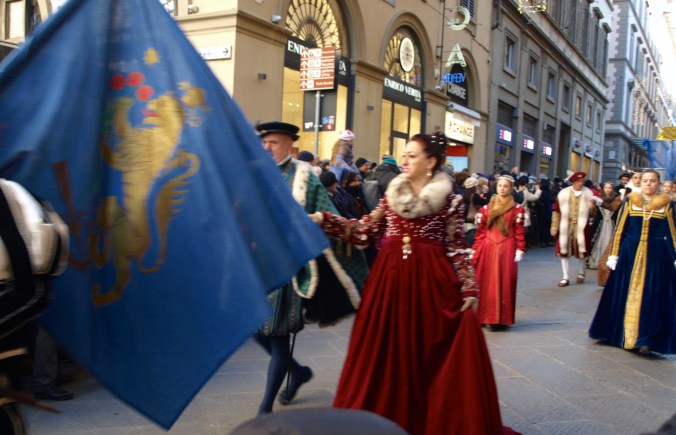
The church houses three flints (Pietre del Santo Sepolcro) putatively from the Holy Sepulchre in Jerusalem. According to tradition, these flints were used to light the lamps of the tomb when Jesus was buried. Legend holds that they were given in 1101 to Pazzino dei Pazzi, who was among the first Christians to scale the walls of Jerusalem, leading to the capture of that city during the First Crusade.
From then on, the Pazzi included a flaming cup in their coat of arms. The flints are linked to the ceremony of Lo Scoppio del Carro and the lighting of fireworks from the Portafuoco after a celebratory mass.













 get back, lauretta!
You must be logged in to post a comment.