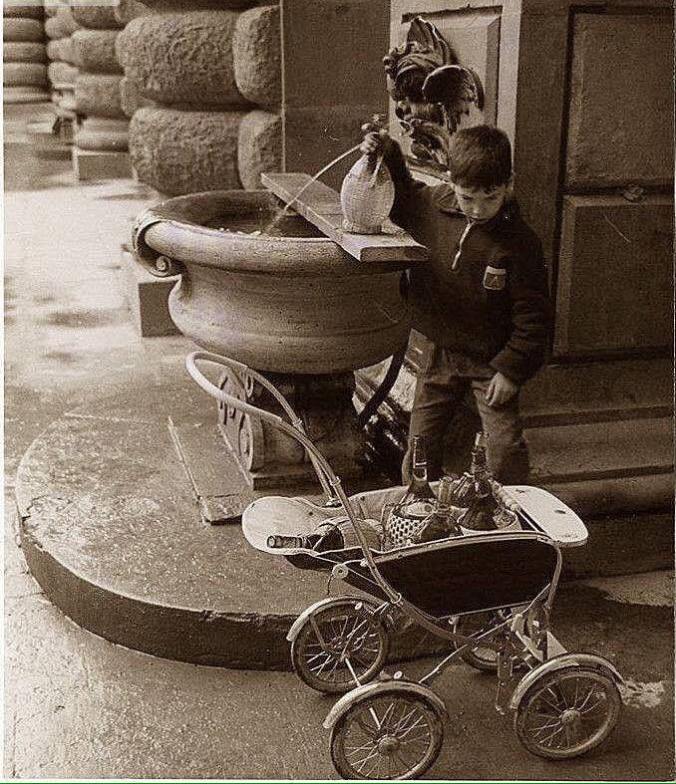
Alluvione 66, il bambino prende l’acqua dalla fontanella di Palazzo Pitti.
After the flood of 1966, a young boy fetches water from the fountain at Palazzo Pitti.
Alluvione 66, il bambino prende l’acqua dalla fontanella di Palazzo Pitti.
After the flood of 1966, a young boy fetches water from the fountain at Palazzo Pitti.
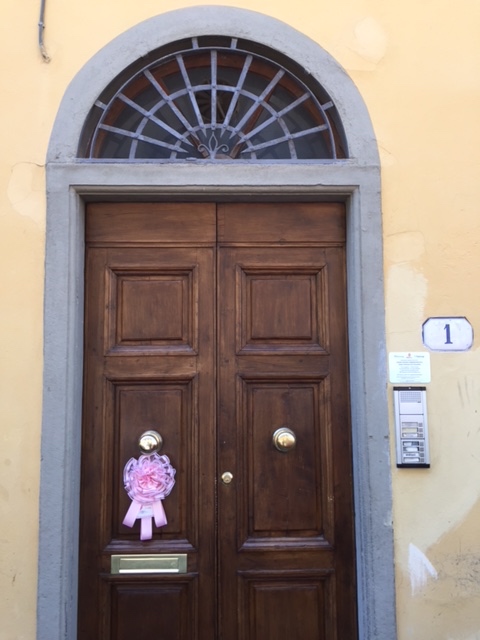
This is how Italians announce the birth of a baby. Pink for girls, light blue for boys. A sweet custom.

60 years ago, someone made this snapshot in Florence. I imagine it was hot then, and it is hot today. If you can’t get to “il mare“, you can always cool off in the Arno river!
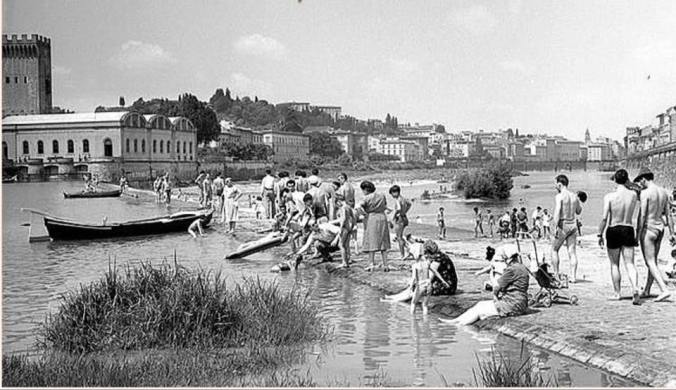
La spiaggia dei fiorentini fono agli anni 60-70. A sinistra la fabbrica dell’acqua smantellata negli anni 60.
The morning wind spreads its fresh smell.
We must get up and take that in,
that wind that lets us live.
Breathe before it’s gone.
—Rumi
The Japanese [have a] notion of wabi-sabi, of seeing beauty in simple, earthy things that are imperfect and fleeting: the remains of a graffitied wall revealing large old stones beneath it; green tendrils peeking over walls. “Wabi-sabi is a beauty of things imperfect, impermanent and incomplete,” writes the designer and writer Leonard Koren in his meditation on the subject. Wabi-sabi, he says, can spring from “a sad-beautiful feeling,” a kind of melancholy: “The mournful quarks and caws of seagulls and crows. The forlorn bellowing of foghorns.”
Orhan Pamuk used the Turkish word huzun to describe his city’s communal melancholy in his novel Istanbul, just as his fellow countryman Ahmet Hamdi Tanpinar did more than half a century earlier in A Mind at Peace. Huzun is a feeling, a heartache, as Pamuk puts it; something he said could be seen in Istanbul in an ancient clock tower, an old postcard seller, a fisherman heading out to sea, neglected mosques, “everything being broken, worn out, past its prime.” I made my way up ever more stairs, with
Rosenbloom, Stephanie. Alone Time: Four Seasons, Four Cities, and the Pleasures of Solitude, Penguin Publishing Group. Kindle Edition.
It’s a constant effort and the city does a good job. Street sweepers sweep the streets continually.
A couple days ago, while walking through the Piazza della Signoria, I spied the newest assistant. Here she is:

She has her work cut out for her!
Walking alone in a city that’s not my own, I think of what Virginia Woolf wished for the women in Cambridge who came to hear her speak in 1928. “By hook or by crook, I hope that you will possess yourselves of money enough to travel and to idle,” she said, “to contemplate the future or the past of the world, to dream over books and loiter at street corners and let the line of thought dip deep in the stream.”
Rosenbloom, Stephanie. Alone Time: Four Seasons, Four Cities, and the Pleasures of Solitude (pp. 59-60). Penguin Publishing Group. Kindle Edition.
[People who are] super-encounterers not only get excited about encountering information, Erdelez wrote, they may also be more sensitive than others to noticing information in their environment. Think of them as good detectives.
In fact, the origins of the word “serendipity” are tied to the detective story. In 1754, when Horace Walpole, a British politician, was writing to his friend and distant cousin about his tendency to find whatever he wanted “wherever I dip for it,” he called it “Serendipity.”
It was a word he said he coined after a fairy tale called “The Travels and Adventures of Three Princes of Serendip.” “As their Highnesses travelled,” Walpole wrote, “they were always making discoveries, by accidents and sagacity, of things which they were not in quest of.” (This was not really how the fairy tale went, but it was nonetheless Walpole’s recounting of it.)
Thus the origins of the word “serendipity” lie in clues, “keen observations,” and “Sherlock Holmesian insights,” as the sociologist Robert K. Merton and Elinor Barber, a research associate, put it in The Travels and Adventures of Serendipity, a deep dive into the word’s etymology.
Rosenbloom, Stephanie. Alone Time: Four Seasons, Four Cities, and the Pleasures of Solitude, Penguin Publishing Group. Kindle Edition.
As the writer Alice B. Toklas said, the French bring to the table “the same appreciation, respect, intelligence and lively interest that they have for the other arts, for painting, for literature and for the theatre.” This history of thoughtfully prepared meals and passion for terroir, the combination of earth and climate that distinguishes a wine, has made Paris an ideal place to practice the art of savoring.
Rosenbloom, Stephanie. Alone Time: Four Seasons, Four Cities, and the Pleasures of Solitude (p. 40). Penguin Publishing Group. Kindle Edition.
There’s only one very good life, and that’s the life that you know you want, and you make it yourself. —Diana Vreeland
 get back, lauretta!
You must be logged in to post a comment.