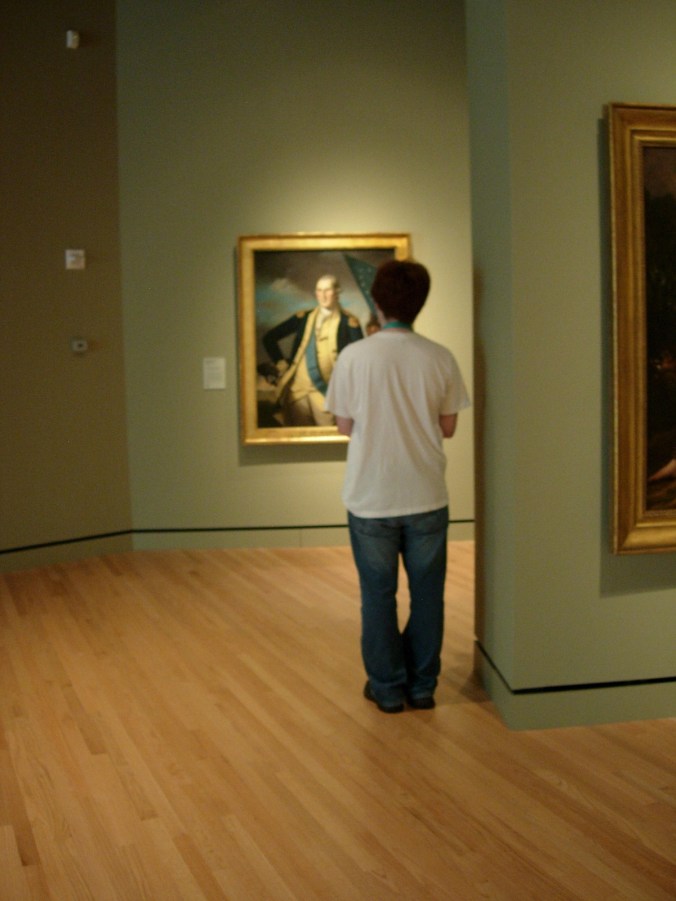
Happy Birthday George Washington! You don’t look a day over 243!


That’s my boy standing in front of Peale’s portrait of GW.  We were visiting the Crystal Bridges American Art Museum in Arkansas, which is a pretty place if you ever get the chance.

DSCN1443Title: George Washington
Artist: Charles Willson Peale, 1741 – 1827
Date: ca. 1780-1782
Medium: Oil on canvas
Dimensions: 50 x 40 in. (127 x 101.6 cm) Framed: 57 3/4 × 48 1/4 × 3 1/4 in.
Credit Line: Crystal Bridges Museum of American Art, Bentonville, Arkansas, 2010.70
Label Text: George Washington posed for Peale an unparalleled seven times. The artist had been an officer in the Continental Army under Washington and crossed the Delaware River with him during the New Jersey campaigns in the winter of 1777-78. Peale portrays Washington as a relaxed yet powerful military leader wearing the blue sash of commander-in-chief of the Continental Army. Although Washington leans against a cannon, at momentary rest, his body fills the foreground and he looks out at the viewer with a commanding gaze. The left background depicts Yorktown, Virginia, where Washington defeated the British in one of the last major battles of the American Revolution. The original owner of this painting, François-Jean de Beauvoir, the Chevalier de Chastellux, was part of the French military force that helped Washington achieve victory in Virginia.


Will you be my Valentine?

Didn’t you love the parties held at school when we were children?  What fun they were.  Trading Valentines with your classmates.  It was an annual celebration I loved.  Plus it enlivened the winter!  I’ve always loved the “conversation” candies of the season.  It has been fun to watch their messages evolve over the decades.

So, here is my Valentine to my readers.  I hope you have a wonderful day filled with chocolate, flowers, and professions of love!

IMG_6609IMG_6600

IMG_6602

IMG_6606IMG_6604IMG_6605IMG_6607IMG_6603IMG_6611

Let them eat cake

Sometimes, I just need a slice of cake.

And when that happens, I bake one.  I like to bake, I usually have the ingredients on hand, and I prefer my own baking to any cake I can buy, even from premier bakeries.  What can I say?  I’m fussy about cake.

So, I got the yen for cake recently and yesterday I pulled out my well-worn edition of Joy of Cooking and looked up the pound cake recipe.

IMG_6483.JPG

I was yearning for a simple, classic, all-American cake.

As I perused the ingredients, so I wouldn’t start mixing only to discover I was missing a key element, I ran across these words:

IMG_6506

You may add brandy or “8 drops of rose water” to the batter.

And then it hit me: I happen to have a brand new bottle of Italian rose water on hand.  It was obviously time to break it out!

IMG_6487

So, along with 2 cups of butter (no substitutes, Joy of Cooking demands!) and 9 eggs, I was off to the races.

And this is my first baking post.  I feel like Dorie Greenspan. Sort of.

IMG_6485IMG_6486

IMG_6489.JPG

Nine eggs!  This cake is rich and nutritious (if you don’t count the 2 cups of sugar).

IMG_6491

No, I am definitely not Dorie Greenspan.  I am very messy.

IMG_6493

But I got the batter made and put into these cute little green and white paper bundt pans I happen to have in my baking stash.

IMG_6494

And filling those little suckers took some time, let me tell you.

IMG_6496

But I got them in the oven and baked them for an hour at 325 degrees F.


IMG_6498

And yowza, did my house smell great!

IMG_6499

The little bundt cakes turned out just great!

And yes, one of them is missing in the photograph above.

And no, I don’t know what happened to it.  You are getting rather personal, don’t you think?

IMG_6500

Well, okay, I cut into it.  I had to check the crumb.  Dorie would, wouldn’t she?

IMG_6505

I’m not Mary Berry (the baker from England), but this cake is good!

And featured in today’s breakfast with some Fortnum and Mason Darjeeling tea I just happened to get for Christmas.  Not a bad way to start the week!

IMG_6502IMG_6504

Here’s my recipe:

 Classic pound cake with Italian rose water, modified from Joy of Cooking

2 C butter, softened

2 C sugar

9 room temp eggs

4 C flour (I used all-purpose flour; I find cake flour too prissy and don’t like the texture it produces)

1/2 t cream of tartar

1 t salt

1 T vanilla

1 t almond extract

1 T rose water (8 drops were impossible to detect in the batter)

Cream the butter until it is light and airy.  Add the sugar slowly. Add the eggs, one at a time. Add the flavorings.  Add the salt and cream of tartar. Add the flour slowly.

Pour into prepared (buttered and floured) pans (loaf is the usual shape used) and bake at 325 degrees F for about an hour, depending on the size of your pan.  Keep your eye on the baking cakes, you don’t want to overbake and dry the cakes out.

The recipe makes a lot of batter, so depending on your pans, you’ll need a few.

Happy baking!

La Befana is her name and gifts for children are her game.

Just as in the USA, where Santa Claus brings gifts for good children on Christmas Eve…

images-5

Italy has a similar tradition.  Only the gifts arrive on Epiphany Eve, which is January 5.  And instead of Santa Claus, the gifts are delivered by an old and ugly woman who rides a broom.  La Befana is her name.


images-6


In popular folklore La Befana visits all the children of Italy on the eve of the Feast of the Epiphany to fill their shoes with candy and presents if they have been good good, or a lump of coal (or dark candy) if they have been bad.

Here’s a fun video to give you the flavor of the celebration:


I love one of the stories about La Befana and how she happens to be in the habit of delivering gifts to children on Epiphany Eve.

According to Italian folklore, La Befena was visited by the three Magi as they made their way to see the Christ Child.  They even invited her to go with them, but she said she couldn’t go because she had too much work to do.  Her work was house cleaning, especially sweeping the floors.

Later La Befana was filled with regret when she realized the magnitude of the event she had missed with her protestations of busy-ness (there is a lesson here all you busy people).  Her response was to bring candy and sweets to all the good children and she does this once a year as a sort of penance for having missed the big event of seeing the baby Jesus with the Magi.

Italian families will often leave out a small glass of wine and a few treats for La Befana to eat before she leaves their home, having dropped off her gifts for the children in the house.

La Befana is usually portrayed as an old lady riding a broomstick through the air wearing a black shawl and is covered in soot because she enters the children’s houses through the chimney. She is often smiling and carries a bag or hamper filled with candy, gifts, or both.

I do hope La Befana leaves you a little something on Epiphany Eve, especially if Santa Claus forgot you for some reason!

Buona Befana a tutti!


Childhood recollections. Part 4.

Part 4 of “Blunt in engrained in me.”

Back at the farmhouse, we had a clever little outbuilding that was actually a primitive shower constructed in the early 20th-century. It had a huge metal barrel attached to the top and simple gravity allowed you to be showered with the warm water flowing through a shower head when you pulled a chain inside. The only time of year this little outfit was used was during harvest. At the beginning of the season, it was my job to unlock and spiff up the shower building and then, every morning during harvest, one of my daily chores was to fill the barrel with well water from the garden hose. By mid-afternoon the water would be very warm indeed from solar power.

I was smart and took a long, luxurious shower around 4 p.m., long before the men returned home for showers and supper at sundown, usually sometime between 8 and 9 p.m. Then I topped off the barrel water with the hose and nobody was the wiser. I could have bathed in the house in the bathroom, but I found the little wooden outbuilding with the homemade shower irresistible. It was warm and cosy inside, with very clean unpolished wood, and it smelled of soap, wet warm wood and warmed South Dakota well water. What could be better than that? If we had added a little bench to sit on and lined the building with cedar and added some little river stones, we could have called the building a spa. For sure it was spare and Zen like! Darn it! I missed the opportunity to sell faux-spa treatments to these harvesters! I could have made a fortune. But, when I was 12, 13, and 14, I had never heard of a spa or Zen. And not only that, my men would have said, “huh? a what?” because they wouldn’t have known what a spa was either, let alone a “faux-spa in the tradition of Zen!” They would have had me committed to a lunatic asylum for heat stroke.

After my own afternoon spa treatment, I went back indoors to get in my mother’s way and snatch some samples of the food she was preparing for supper for all these men. She would have pies going into and coming out of the oven and cuts of the finest roasted beef I have ever eaten in my whole entire lifetime from the cattle she and my dad had raised, slaughtered and stocked in our deep freezer. In addition, my mom would whip up excellent mashed potatoes with gravy made from the juices of the roasted beef, pots of green beans cooked with bacon, vessels of corn on the cob which she would cook at the last minute, and slices of fresh tomatoes and cucumbers that we had picked that afternoon from our garden. Plus there were gallons of more iced tea brewing. No meal at our house was complete without bread and butter. Don’t forget we were growing wheat, so we always ate bread! Thanks Egypt!

Loaf of bread
I set the table for my mom and then we awaited the arrival of our harvest crew. She might lie down for a power nap or to read a book, because she still had a very long day and evening ahead of her with serving and then cleaning up, and I would entertain myself in my bedroom with my dolls, maybe making them lilac-leaf pocketbooks, or reading one of my favorite books from a series about a girl my age in upstate New York who was smart and loved to solve mysteries.

trixiebleden

Other young girls I knew liked Nancy Drew books, but Trixie Belden was my absolute favorite character. I still have those childhood books in my Seattle apartment today. On days when I need a little hit of home, I take one down and devour it and I might even whip up a 1-2-3 cake. Miss Belden had a lot of spunk and ingenuity, just like me. She was a younger version of Scarlett O’Hara, is how I would best describe her. All three of us were the can-do kind of females that I most admire.

Eventually the men started arriving at our farm in trucks and would take turns cleaning off the wheat dust and grime in the outdoor shower, and then, squeaky clean —so clean their skin shined— they dressed and amused themselves by playing endless practical jokes on each other, wrestling one another in the grass, or took turns hitting a baseball with my bat on our gravel driveway. Finally my mother would announce that supper was ready and everybody swarmed to the table. These hearty feasts on a late, dark, summer evening, with the fans working overtime to cool off the hot kitchen, and the outdoor sounds of cicadas thrumming their mating calls and crickets chirping around the house foundation, and the indoor sounds of laughter and the high spirits of young men from Oklahoma and Kansas created a very special atmosphere. These nights were something very special and the meals were as festive as any holiday dinner. These fun-loving, outgoing guys adored my mom for keeping them happily filled with her good home cooked simple fare. Me, they just affectionately teased, and I honestly could not have been happier!

feast

Truth to tell, these harvest dinners were our holidays and I loved them. The picture above is just a random shot from the internet, but our house was never more lively and full of happy sounds than over these great meals. After eating and all manner of male hi jinx, the boys would go back outdoors to sleep on cots set up in the quonset hut that my mom and I had prepared for them during the day with fresh sheets, blankets and pillows. Do you remember the feel and scent of bed linens that have been washed and then dried on an outdoor clothesline? There is absolutely nothing I love more than that feeling you get when you crawl between two crisp sheets laundered in this way. The stiff linens and the fresh fragrance cannot be achieved in any other method. Trust me, I have tried.

Washing-Clothes

I actually enjoyed looking after all these rowdy guys; it was the highlight of my year of farm life. Make no mistake: I wouldn’t have enjoyed providing the home care of cooking and housekeeping much longer or on a smaller scale (i.e. I had no interest in being a farmer’s wife and living on a farm—I longed for the big city life with bright lights and endless activities), but the fact that I was the honorary little sister and the only girl in the bunch made me feel really happy and well looked after. I knew that nothing bad could happen to me with all these great men around, even though these were the years that we also watched for (and seriously believed we spotted) UFOs, as well as seeing a bunch of great scary movies at the Pierre drive-in theatre (it was always so sad for me to see the annual fall sign appear on the marquee: “Closed for the season, reason: freezin’ “) such as The Fly and its ilk.  My 17 year old brother, Gary Jones, and his sweet, beautiful girlfriend, Cheryl Hageman, took me to the drive in theater to see The Fly the summer I was 12 and I was so scared they worried that my parents would be furious.  They weren’t.  I don’t think my fears caused by movies even registered on my folks’ radar.

fly-1958-poster-3

Then there was the televised episodes of that black-and-white masterpiece, The Twilight Zone (do-do-do-do, do-do-do-do). Oouuu! spine chilling!

twilightzone

Decades later I would try to explain to my son, when he was around 10 and asked me, that I don’t know why, but people love to be scared by movies and television shows. Why is that, I still wonder?

I would squeal like a little girl while watching all these horror flicks and shows (I actually was one, so I can say that. But, this isn’t an expression that people should use to derisively describe scared men; then it is sexist and condescending toward the female gender and of that I can never approve. I will talk you down anytime you try to say anything like that in my earshot. Trixie Belden, Scarlett O’Hara, Gloria Steinhem, Cheryl Sandberg and I just cannot abide anyone who thinks our gender is less than the male gender. In fact, we know that we are superior in all the ways that matter!) and cover my eyes with my hands, then peek through my fingers.

I can remember one drive-in movie my mother took me, Sandy Small and Jeannie Bourke to; in that black-and-white low-budget film, menacing ivy vines started growing around a small house and even a kid knew that the oblivious people inside were in trouble. Get out, people, get out, we screamed! Sure enough, the vines eventually took over the building and trapped the poor people inside. How could they ever get out now, when every time they hacked an opening through the vine it would grow ever bigger like metastasizing cancer cells. We jumped, we screamed, we giggled and had a blast! There wasn’t much of a plot, but truthfully, a plot would have been superfluous.

drive in movies

We had the soft warm evening, each other’s company, and my sweet patient mother as our chauffeur and supplier of funds for popcorn, sodas and lots of delicious candy. She later took us all back to our farmhouse and we girls toddled off to bed and fell fast asleep, all three of us in one double bed. Whatever in the world could be better than a summer night like that? Life could be so very, very good.

I can fondly remember making trips with my dad in the cabin of his truck filled with the harvested wheat to the town’s grain elevators and train stop, where Pat Junkman ran the show.  The one in Blunt looked something like this photo.

grain-elevator

It was fun to line up with the other trucks and wait our turn at uploading the wheat into waiting train cars. Normally in Blunt you didn’t have to line up for anything, because there weren’t very many of us to start with (353 to be exact)! The elevator was cooler than anywhere else around me, because it was in the shade, and I loved the earthy smell of the wheat kernels. It was fun to run your hands through the wheat gathered in the truck bed; it felt soft and cool and poured through your hands like water. Then my dad would listen to the radio and scan newspapers for the price being paid per bushel on the commodities markets. At the time I didn’t understand the importance of all this, but in my 20s in Seattle my stockbroker employer sent me to school to get my Series 7 license so I could place buy and sell orders for stocks and puts and calls for commodities for our customers, and so I came to realize that the prices my dad was studying determined how well my he and mom would be repaid for all their hard work and tremendous planning. So many steps are involved in being a successful farmer. I always wish the world understood that better.

When people say to me that I am blunt, what they mean is that I am very frank, that I am not afraid to tell the unvarnished truth about things. It is true. I’m very honest. I don’t mince words, but clearly state what I believe to be true or false. When I lived on the East Coast for a large part of my professional career, working in some of our nation’s finest art museums as a curator, I would always just be me and, when I liked an idea a colleague had, I said so. When I didn’t like something, I also said so. My frank expressions would cause people to take notice of me. Most people won’t express what they really think in the real world, especially if it is negative. They hedge and try to be politically correct at all times. If they don’t like a concept or idea they will use a hundred words to tell you that instead of simply saying “no, I don’t like it.” What a waste of time!

I admire the transparent language quality in some of the wonderful people I’ve been privileged to know in South Dakota and I think this quality has a lot to do with small-town values in a can-do American past. Often when I am speaking with my friends from Blunt and Pierre, I notice these almost breath-taking moments of pure, unadulterated truth in which they will express some crystal clear ideas, simply stated, with very little elaboration. When I hear these expressions I understand how I sound to other people and it makes me proud. For example, one of my mother’s old girlfriends might say to me, in casual conversation, that this past winter in Pierre really got on her nerves, because it seemed like it would never end. I am sure that is exactly right. Why elaborate with unnecessary verbiage. Why not just state the truth, simply and clearly? We speak, then we get on with our business. I find that just makes life easier. Or, how about this, there is a very old shop on Missouri Street in Pierre that sells flowers and plants. It’s name: The Pierre Flower Shop & Greenhouses. Love that! No “Best Buds”, no “Fleurish”, no “Bella Fiori” (which is, by the way, grammatically incorrect in Italian). The Pierre Flower Shop & Greenhouses. Done. You know what you will find there and that is all you need to know.

pierre flower shop

I feel very fortunate that I had the opportunity to grow up in a community where I acquired the ability to notice what was happening around me and was taught to comment on it in a simple, straightforward manner. I absorbed this talent from the people around me every day. When people say I am like a “breath of fresh air”, which actually happens pretty often, I simply say thanks, but I can’t take any credit; it just all came from Blunt.

DSCN0270

Childhood recollections. Part 3.

Part 3.  “Blunt is engrained in me.”

My own family became involved with Blunt in the early 1950s before I was born, when my mother and father, Linda and Ray Dimmick who moved to SD from Kansas and Oklahoma respectively, purchased our farm with its farmhouse, big red barn with a hay loft, and a lot of other outbuildings including a chicken coop. They bought the pastureland up behind our farmhouse and corrals for the ranching component of their new endeavor, where they raised cattle, sheep and pigs. They also purchased many surrounding pastures and cultivated fields, where they grew mainly wheat, but also alfalfa, maize (not corn but maize) and barley. Once in a while my dad would also plant corn, but mainly he was a wheat farmer, growing the agricultural mainstay of mankind on planet earth from the beginning of civilization.

wheatfields

This is exactly how our SD wheatfields looked.

The cereal grain of wheat was originally grown in the Levant region within the Fertile Crescent of the Middle East, and was a key factor enabling the emergence of city-based societies because it was one of the first crops that could be easily cultivated on a large scale and had the additional advantage of long-term storage without degradation. Globally, wheat is the leading source of vegetable protein in human food, having a higher protein content than other major cereals, corn or rice. Wheat growing techniques reached Greece and India by 6500 BCE, and by 6000 BCE it was grown as well in Egypt. It was, in fact, early Egyptians who discovered that yeast could make ground wheat flour and water expand, thus inventing the bread eaten around the globe today. The Egyptians developed several types of ovens, taking bread-baking into one of the first large-scale food productions in the world. Wheat growing technology spread throughout Europe and England and even reached China by 2000 BCE. Skipping forward a couple of millennia, Europeans brought wheat seeds and knowledge with them as they made their presence felt across the continent they named North America. All of this leads up to my family and me living in smack dab in the middle of North America’s “bread basket”.

wheat production across world

100 meridian 2

My family’s farm was situated almost exactly on top of the 100th Meridian.

It is highly unlikely that my parents had the same level of interest in the history of wheat production that I have, because they were a bit busy with the concerns of keeping a complicated enterprise flourishing and because I am trained as an historian and love to get to the bottom of things, to solve puzzles, to understand complexities. Nevertheless, this much I can say for certain: from early spring, as soon as the earth could be worked, the days for both of my forks revolved around preparing the fields for planting, sowing the wheat, and then watching the weather reports and fixating on spring rains (or even snows). My mom could and did drive a tractor as well as any man and, as a matter of fact, I think she enjoyed doing so. There is a lot of instant gratification in working a field; you can observe in a glance what you have already accomplished and what is left to do.

stock-photo-woman-driving-a-tractor-91899857

This vintage picture above is not of my mother, but it gives you a sense of how she must have felt.  Driving a tractor in a dirty field was the kind of activity women took on during WWII.  My mother was nothing if not game for new adventures.  I get a lot of my own spunk from her.
In a good year, all would go well and by early summer, the wheat was knee high. By August, if the wheat plants hadn’t been shredded by hail storms, desiccated by the lack of rain, or ruined by a plague of grasshoppers, everything in our household centered on harvest preparation. My dad and his brother-in-law in Oklahoma purchased an expensive combine together and, after the Oklahoma harvest in early summer, my Uncle Dan Venosdel and his sons and other hired hands moved the combine slowly northward on a giant truck bed, stopping to harvest wheat for farmers across Kansas and Nebraska, moving ever northward, following the graduated ripening of wheat from south to north across the bread-basket of the United States. Many phone conversations between my dad and my uncle helped my uncle get the combine to Blunt just in time to harvest our crops.

When I was 11, my Uncle Dan patiently taught me to drive a pick-up truck on the country roads outside Alva, Oklahoma, where my dad’s extended family had settled. I would pop the clutch and lurch along the road at the beginning, giggling in embarrassment as my endlessly patient uncle told me over and over how to manage the clutch and get the gear shift into third not fifth gear, driving by the section of property which would someday be mine, and had been staked by a female ancestor back in the 1880s Oklahoma Land Rush. I spent many happy summers with my cousins and aunt and uncle and other extended family in Oklahoma and I also liked knowing how to drive a pick-up with the gear shift. When I had that mastered, I found driving a car with an automatic transmission to be a piece of cake, chocolate cake specifically.

Back in South Dakota, with my newly acquired ability to drive, I was able to help move equipment from one field to the next and I thought that was so much fun. I was the only one of my friends who knew how to drive. It is also legal in both Oklahoma and South Dakota for kids to drive without a driver’s license when they are assisting in the family’s farming operations.

My mother spent hours planning menus and shopping for food and then cooking huge meals for all these harvesters, frying up to ten chickens in the morning for the noontime picnics with potato salad and pickles that she had canned the season before from cucumbers we grew in our garden. Some summers my mother’s mother, Edna Humphries, would be with us and she, an excellent baker, loved to create some of her masterpieces for these men. She made killer cinnamon rolls with a caramel glaze and a rhubarb sauce with sweet dumplings, that I sometimes dream about from rhubarb grown in our garden and chopped up and frozen each spring. My grandma was a superb baker and never used a recipe. Sometimes these two bossy women, my mom and grandma, would even let me get into the kitchen to bake several chocolate cakes from a no-fail recipe my mom had, although she typically preferred to be in the kitchen alone so she could make hay while the sun was shining, so to speak.

  •  cold chocolate snacking cake 2

But I made many successful “Chocolate 1-2-3” cakes and the guys ate them up like candy. Here’s the recipe for the easy to make, easy to love, chocolate cake I made for my merry little band of men, time after time. It takes no time to whip up, the ingredients are simple and easy to have on hand. Once you have this recipe in your repertoire, you will never use a box mix again:

“““““““““““““““““““““““““““““““`
Linda Dimmick’s Chocolate 1-2-3 Cake

1 1/4 C flour 1 C water
1/3 C unsweetened cocoa powder 1/3 C vegetable oil
1 C sugar 1 tablespoon vanilla extract
1 teaspoon salt & 3/4 teaspoon of baking soda 1 tablespoon cider vinegar
Put all the dry ingredients into the pan (9 x 13 inches) in which you will be baking the cake. Mix it all together. Make 3 wells in the in the dry mixture and add the water to one well, the vegetable oil in another well, and the vanilla extract and vinegar in the 3rd well. Stir slowly with a fork in small circles and make sure you get all the corners. If you don’t stir this mixture really well, you will be sorry when you bite into a piece of cake with a lump of flour or baking soda. Bake in a preheated 350 degree oven for 30 minutes. Insert a cake tester in
center of cake and if it comes out clean, the cake is done. Cool and cut, after sprinkling with powdered sugar to make the cake look extra attractive. Keep in mind that you consume your food first with your eyes, so keep it pretty people! If you have some lilac blooms or leaves, decorate the plate with those too. Why not? You only live once!

“““““““““““““““““““““““““““““““`

My mother and I would load up all of the food, dishes, and cutlery in her car trunk and take it to the men in the fields, with gallons of iced tea or lemonade and water, as well as water for washing hands and faces and towels to dry off with. This was simple fare, easy to eat outdoors, while sitting on the bare earth in the shade of my mother’s car. As everybody from Blunt knows, August can be hot and these men would be thirsty and covered with a fine layer of pulverized straw from harvesting wheat.

After the men had eaten, relaxed and laughed for a while, they would sometimes insist on taking me, my mother, and/or even my grandmother for a ride on the combine with them as they harvested a row or two, but it was too hot, dirty, noisy and uncomfortable for us to enjoy. My mom and I would load the car back up and head off for home. We still had a lot more work to do before our day was done.

Childhood recollections; Part 2

Here continues part 2 of my essay entitled “Blunt is engrained in me.”  Part 1 was posted on Oct. 9, 2014.  I was discussing lilacs and their presence at the Mentor Graham Historic Site in Blunt, SD.

Sophie Anderson 1823 –1903, The Time Of The Lilac

sophie_anderson_gallery_1

If you want to completely refresh your lilac shrubs and get them to perform as newly planted shrubs with smaller more flexible branches and a fuller canopy, you may cut all of the stems back to about 12 inches above the earth. It will take the shrubs a few years to recover, but when they do they will completely refreshed.

Thinning inside, competing branch from dwarf lilac.                   images

I didn’t learn that technique from my Master Gardener training, but rather from living in an historic house built in 1795 in Milton, Massachusetts, just outside of Boston. I was privileged to live in that saltbox house for three years in the late 1980s and to be good friends with its owner, Polly Wakefield, whose ancestors came to North America on the Mayflower. Polly was my very own Yankee, a breed apart.  I love the photograph below of Polly in her great outdoors on her estate.

image674-03

With no children of her own, Polly left her vast estate in a charitable trust.              Mary Binney Wakefield

Polly was the last in a long line of “gentlemen farmers”, or, as in her case, a “gentlewoman farmer”, and all the property she inherited was maintained as a land preserve just outside Boston. She was a important member of the very prestigious Massachusetts Horticultural Society and I met her through my research and writing of an article on her ancestor’s tomb in Mt. Auburn Cemetery in Cambridge, MA. I was working as a curator at the Museum of Fine Arts in Boston, and when Polly and I met and came to know one another, we were instantly fast friends. She was old enough to be my mother or grandmother and I was her honorary daughter and my husband was her honorary son-in-law. Polly taught me a lot about horticulture, especially trees and shrubs.

ask-julie-controlling-lilac-sucker-growth-1

But, looking back in time, lilacs figure into one of my favorite memories as a girl in South Dakota. A girlfriend taught me how to make a doll’s pocketbook from a pliable lilac leaf: make a vertical cut along the central vein toward the end of the leaf with your thumbnail, roll the leaf starting at the end opposite the stem, and insert the stem in the slot you made. Other leaves can also be used, but none so well as the humble lilac leaf. These little purses were so sweet and my dolls loved having them. Well, I loved for my dolls to have them, is what I mean!

lilac leaf

Language-of-Flowers

Lilacs symbolized love in the erudite 19th-century language of flowers (which you can Google for more information). But this next fact is going to blow your mind: Walt Whitman, one of the most influential poets in the canon of American literature, wrote a poem entitled “When Lilacs Last in the Dooryard Bloom’d,” which is actually an elegy about the assassination of President Lincoln.

3dd8164aa22b1529a8d59df865c65368

Whitman Drum taps

During the Civil War, Whitman worked in Washington D.C., where he saw up close and personal many of the wounded veterans returning from battle for care. That experience and the unimaginable horror of the assassination of Lincoln on April 14, 1865 led Whitman to write a collection of poems, Drum-Taps (published 1865), in which “When Lilacs Last in the Dooryard Bloom’d” was first published. In the poem, Whitman mourns Lincoln’s death and uses lilacs as a reference to the president. So, we must wonder, did Mentor Graham himself have lilacs planted around his Blunt home in memory of his illustrious student, or is it just a coincidence? I’ve read that Graham and Whitman were both on the podium when Lincoln was inaugurated, so there may indeed be a tie in. These are the kinds of facts that ignite my mind and imagination. It is also possible, of course, that someone planted the lilacs in the Graham yard simply because they provide privacy and are a hardy shrub. Either explanation is logical. One is more evocative, however.

Here is a segment from Whitman’s poem

1

When lilacs last in the dooryard bloom’d,
And the great star early droop’d in the western sky in the night,
I mourn’d, and yet shall mourn with ever-returning spring.
Ever-returning spring, trinity sure to me you bring,
Lilac blooming perennial and drooping star in the west,
And thought of him I love.
2
O powerful western fallen star!
O shades of night—O moody, tearful night!
O great star disappear’d—O the black murk that hides the star!
O cruel hands that hold me powerless—O helpless soul of me!
O harsh surrounding cloud that will not free my soul.
3
In the dooryard fronting an old farm-house near the white-wash’d palings,
Stands the lilac-bush tall-growing with heart-shaped leaves of rich green,
With many a pointed blossom rising delicate, with the perfume strong I love,
With every leaf a miracle—and from this bush in the dooryard,
With delicate-color’d blossoms and heart-shaped leaves of rich green,
A sprig with its flower I break.
4
In the swamp in secluded recesses,
A shy and hidden bird is warbling a song.
Solitary the thrush,
The hermit withdrawn to himself, avoiding the settlements,
Sings by himself a song.
Song of the bleeding throat,
Death’s outlet song of life, (for well dear brother I know,
If thou wast not granted to sing thou would’st surely die.)
5
Over the breast of the spring, the land, amid cities,
Amid lanes and through old woods, where lately the violets peep’d from the ground, spotting the gray debris,
Amid the grass in the fields each side of the lanes, passing the endless grass,
Passing the yellow-spear’d wheat, every grain from its shroud in the dark-brown fields uprisen,
Passing the apple-tree blows of white and pink in the orchards,
Carrying a corpse to where it shall rest in the grave,
Night and day journeys a coffin.
6
Coffin that passes through lanes and streets,
Through day and night with the great cloud darkening the land,
With the pomp of the inloop’d flags with the cities draped in black,
With the show of the States themselves as of crape-veil’d women standing,
With processions long and winding and the flambeaus of the night,
With the countless torches lit, with the silent sea of faces and the unbared heads,
With the waiting depot, the arriving coffin, and the sombre faces,
With dirges through the night, with the thousand voices rising strong and solemn,
With all the mournful voices of the dirges pour’d around the coffin,
The dim-lit churches and the shuddering organs—where amid these you journey,
With the tolling tolling bells’ perpetual clang,
Here, coffin that slowly passes,
I give you my sprig of lilac.
7
(Nor for you, for one alone,
Blossoms and branches green to coffins all I bring,
For fresh as the morning, thus would I chant a song for you O sane and sacred death.
All over bouquets of roses,
O death, I cover you over with roses and early lilies,
But mostly and now the lilac that blooms the first,
Copious I break, I break the sprigs from the bushes,
With loaded arms I come, pouring for you,
For you and the coffins all of you O death.)

If you would like to read the  poem in its entirety, you may find it on the web here: http://www.poetryfoundation.org/poem/174748

lincoln2

ww0034as

Whitman’s recollections of Lincoln were obviously prized during his lifetime.

The authoritative book, Walt Whitman: An Encyclopedia (R.W. French, J.R. LeMaster and Donald D. Kummings, eds., New York: Garland Publishing, 1998) opines about Whitman’s poem and how, in his mind, the lilac symbolized Lincoln :
While the assassination of President Lincoln is the occasion of “When Lilacs Last in the Dooryard Bloom’d,” the subject, in the manner of elegy, is both other and broader than its occasion. “Lilacs” turns out to be not just about the death of Abraham Lincoln, but about death itself; in section 7, just after the poet has placed a sprig of lilac on the coffin, the poem makes a pointed transition: “Nor for you, for one alone,” the poet chants, “Blossoms and branches green to coffins all I bring.” Significantly, Lincoln is never mentioned by name in “Lilacs,” nor does the poem relate the circumstances of his death; indeed, the absence of the historical Lincoln in the poem is one of its more striking features. Historical considerations give way to universal significance. The fact of assassination, for example, is not mentioned, for, while all people die, assassination is the fate of only a few.  http://www.whitmanarchive.org/criticism/current/encyclopedia/entry_67.html

Childhood recollections; Part 1

Over the next few days, I am going to post an essay I wrote for publication this past summer.  It covers some happy memories of my life as a child on a farm in South Dakota in the 1960s.  I will break it into parts because it is too long for one post, and here is part 1.  The essay is entitled “Blunt is ingrained in me.”

100 meridian

Throughout my lifetime in the great big world outside of the tiny little village of Blunt, SD, people will often say to me that I am very blunt in the way I speak. When that happens, I smile broadly and say “That’s because I grew up in Blunt!” They look confused and I elaborate: “I grew up on a farm and ranch just three miles from a little town on the Great Plains named Blunt, founded as a train stop in the 19th century on a new railroad system that was linking all of the new state of South Dakota with the market city of Chicago, thus enabling South Dakota farmers to ship their agricultural products to points east.” It is all true: my little hometown, where I lived for seven highly formative years, from the end of my 2nd grade year of school through my 9th grade year, was actually founded in 1881 as a stop on the Chicago and North Western Railway, which was headquartered in Chicago and ranged as far west as Wyoming and covered a bunch of mid-western states including Iowa, Michigan, Wisconsin and more. The newly laid track covered more than 5000 miles by the turn of the 20th century.

chicago line

In the map below you can see the train line cutting across the state of South Dakota from east to west.  Blunt is not shown on the map, but it is on the line, 21 miles east of Pierre.  Pierre is the state capitol.

chicago-and-north-western-railway-map

As every school child at the Blunt Elementary School is taught, our newly-founded little town was named after railroad engineer John Ellsworth Blunt (whom you can see in this picture: https://secure.flickr.com/photos/126134142@N06/14895925826/in/set-72157646054551889/), but our small community’s greatest claim to fame is that Abraham Lincoln’s former Illinois schoolteacher William Mentor Graham (1800-1886), retired here in 1883 at age 83 on the homestead of his son, Harry Lincoln Graham. Sadly Graham passed in 1886 (according to sources on the internet he passed in 1886, but the bronze plaque in Blunt states that he died in 1885); he was buried in Blunt although his remains were later translated to a cemetery in Illinois.

grahammentor4                     Mentor G

But the quaint little Blunt cottage with a few gingerbread architectural details in which Mr. Graham resided is still standing and is the town’s most visited tourist site. The Mentor Graham house was opened to the public in 1950 by the South Dakota Historical Society. In 1987 sponsorship of the house was turned over to the city of Blunt and it was listed on the National Register of Historic Places. Unfortunately, the house is not open now for visitors as it has maintenance issues, but I never visit Blunt without stopping to see the outside of this charming frame structure, which transports me in my mind’s eye back to Blunt’s heydays in the late 19th and early 20th century.

DSCN0272

    DSCN0273

DSCN0275

DSCN0274

Old-fashioned lilac shrubs, with lavender-hued blossoms,bloom in the yard around the Graham house in June and, for me, a simple wooden structure covered with white-painted clapboards surrounded by blooming lilacs in warm weather is about as good as life gets. I adore the color and fragrance of lilacs and I love the fact that the lilac shrub, with its almost unbelievably tiny delicate blossoms, is about as tough a perennial plant as any that can be found, taking the punishing South Dakota winters in its stride and stretching its lifespan to 100 years or more.

images

lilacs 2

Each small flower has a four-lobed corolla and corolla tube; lilac blossoms are bisexual, with fertile stamens and stigma in each flower. Where I live today in Seattle, springtime is a riot of colors with azaleas, rhododendron, and daphnes, just to name a few. Lilacs grow here too, but they don’t get much attention since they are rather subtle compared to the colors and scents of other blooming shrubs. But, in central South Dakota, the lilac is prized for its hardiness, beauty, and fragrance. We even had some at the farmhouse I lived in for the seven years of my young life; I assume the shrubs had been there since the house was built in 1918. They required no care, luckily, because neither of my parents had time to devote to domestic horticulture, and the lilacs never failed to bloom, year after year.
As an adult, I learned much about the art of horticulture by becoming a Master Gardener through the Colorado State University and Denver Botanic Gardens combined program and I actually enjoy pruning a lilac shrub to produce the maximum number of flowers in the following season. The main thing to remember is “prune after bloom”.

300x198xlilac-pruning8                1b

(To be continued.  What possible symbolism did the humble lilac shrub have for Graham?)