
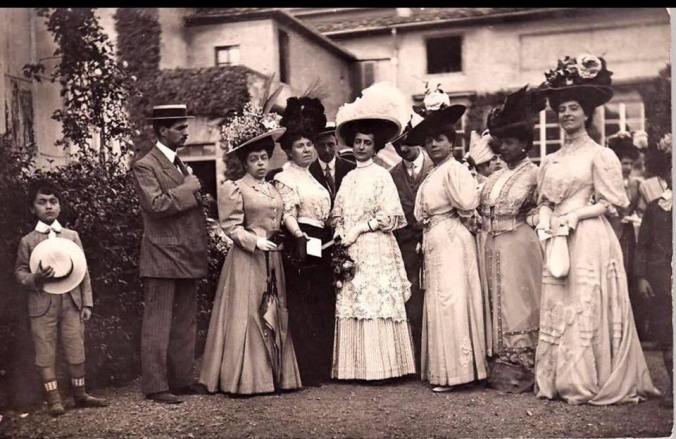
Passeggiando di festa alle Cascine, inizio 900.
Passeggiando di festa alle Cascine, inizio 900.

Panorama da San Miniato, quanto gli alberi erano ancora bassi e si poteva osservare meglio il panorama. View of Florence from San Miniato, when the trees were still low and you could better see the panorama.
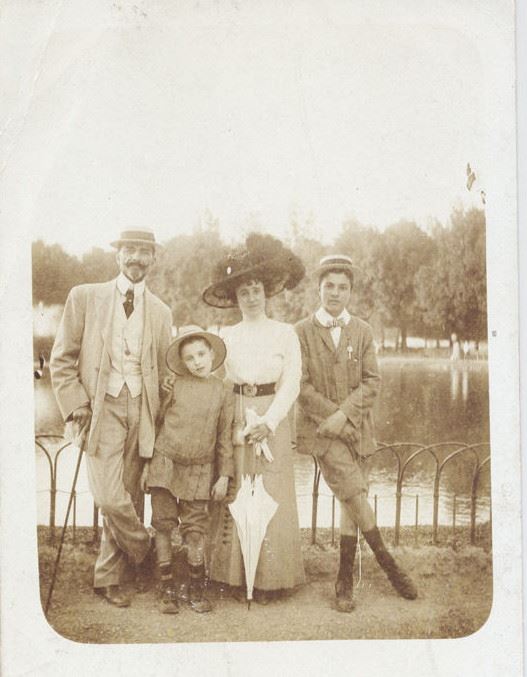
Giardini della Fortezza. Famiglia in posa per una foto ricordo. Anno 1910. Gardens of the Fortezza di Basso, a family posing for a picture in 1910.
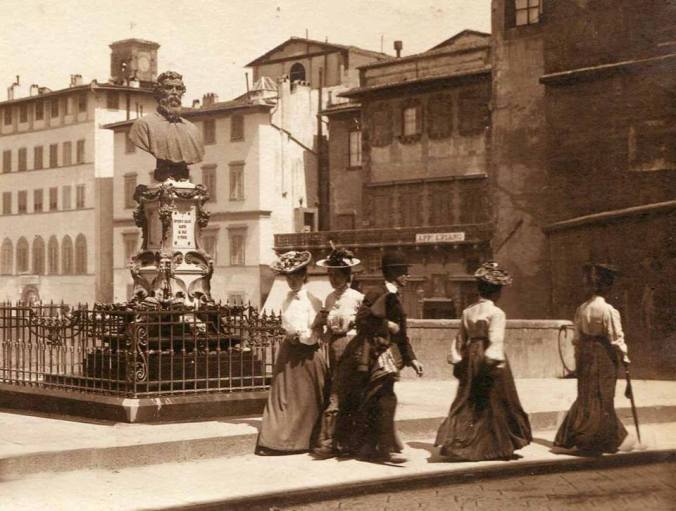
Lo struscio sul Ponte Vecchio. Strolling on the Ponte Vecchio.
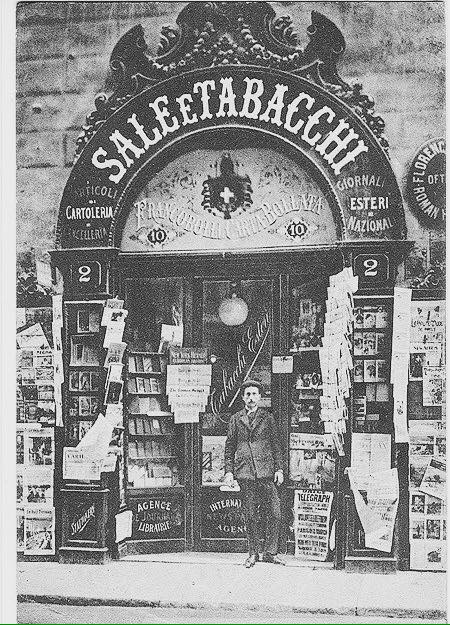
Borgo Ognissanti, negozio Sale e Tabacchi del 1910.
In the 1st C. AD, Christian converts began to invade Florentia. The Christians were persecuted—thrown to lions in the amphitheater—on and off throughout the third century A.D. But by 313 a bishop was living safely in Florence; it’s likely that the first Christian cathedral was built around this time too.
The Church of San Salvador was the name of the edifice, and its location was quite near if not directly under what is now the Cathedral of Santa Maria del Fiore in the Piazza del Duomo.
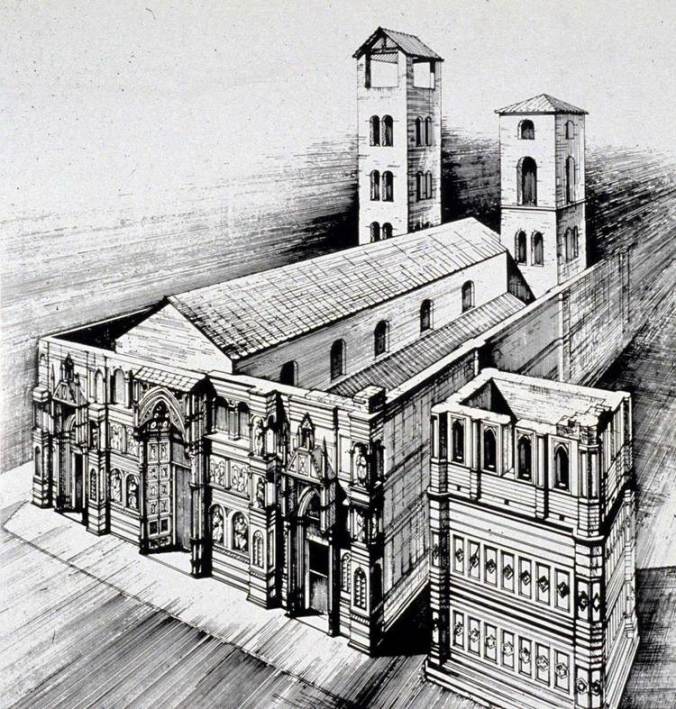
Sandwiched between the first cathedral and the last was Santa Reparata, a church named for a twelve-year-old female martyr. The young saint was said to have appeared in the middle of a 5th-century battle between a host of Vandals and Goths and the citizens of Fiesole.
Santa Reparata suddenly arrived on the spot with a bloodred banner and a lily in her hand. Miraculously, following close behind her was the Roman general Stilicho with a fresh legion of troops. The barbarians fought a losing battle, and the Florentines built a new cathedral in remembrance of the girl’s military assistance.
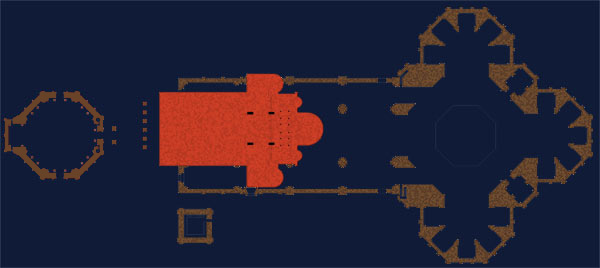
You can read more about the church of Santa Reparata, which would rebuilt as il Duomo later on here: https://operaduomo.firenze.it/blog/posts/la-nuova-musealizzazione-di-santa-reparata
Holler, Anne. Florencewalks: Four Intimate Walking Tours of Florence’s Most Historic and Enchanting Neighborhoods (Kindle Locations 57-65). Henry Holt and Co.. Kindle Edition.
Here’s an aerial photo of Florence’s Piazza Beccaria, taken sometime between 1945 and 1980.
The photo can be dated because on the left we see the home of the G.I.L. (Gioventù Italiana Littorio) and, on the other side of the avenue, the Alhambra theater. Both structures were demolished in order to build the Archivio di Stati, constructed in 1980.
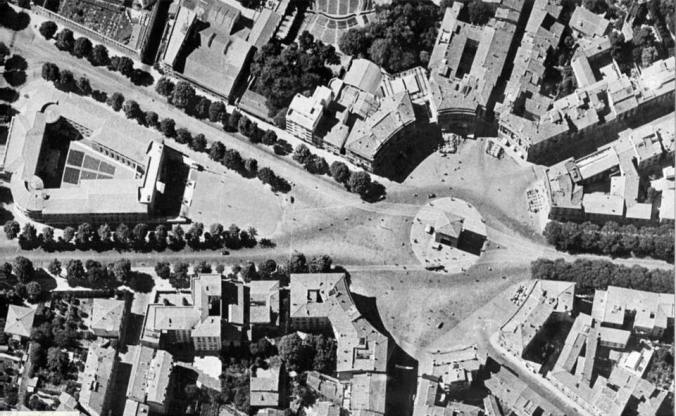
The Gioventù Italiana del Littorio (Italian Youth of the Lictor) was the consolidated youth movement of the National Fascist Party of Italy, established in 1937 to supervise and influence the minds of the young. The GIL was in particular established to counteract the influence of the Catholic church. You can read more about the organization and the building in Florence here:
https://it.wikipedia.org/wiki/Casa_della_Gioventù_Italiana_del_Littorio.
The Teatro Alhambra was built in 1889 and demolished in 1961. Here are a couple of vintage photos of the theater:
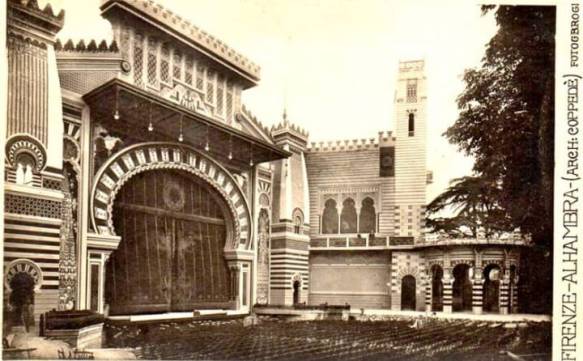
Il famoso teatro, al suo posto ora c’è il palazzo del giornale La Nazione.
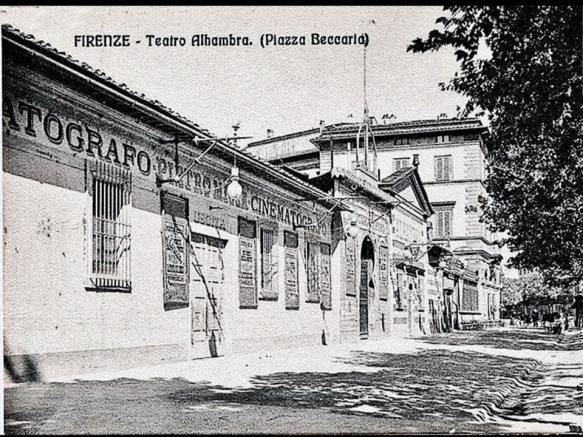
And here’s a program from the Alhambra:

ALHAMBRA. Programma. Lunedì 2 giugno 1890.
More on Alhambra theater here: http://www.chnt.at/wp-content/uploads/eBook_CHNT19_Bardi.pdf
That was exactly my goal recently, longing to go back, even just for a couple of hours, to a simpler time when better men were President of the USA and the world seemed full of possibilities.
That’s a lot to ask of a film, but I found one when I stumbled upon It Started in Naples. Starring Clark Gable and Sophia Loren, and set in gorgeous southern Italy, what could be better?

Gable is perfect for his role in the movie and Loren is, well, Loren. Thanks to the advancement of women that has happened in the past 60 years, the silly woman Loren plays is a thing of the past. I must admit I cringed a few times with the actions and words required for her part.

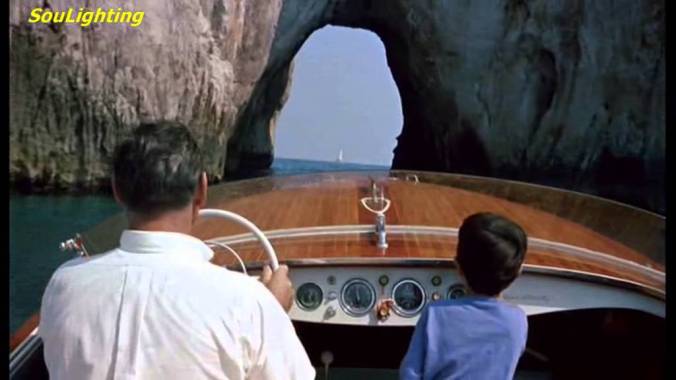
I am able to overlook those weaknesses for the chance to travel, vicariously, to Naples and environs. The child actor steals the show, as does the scenery.

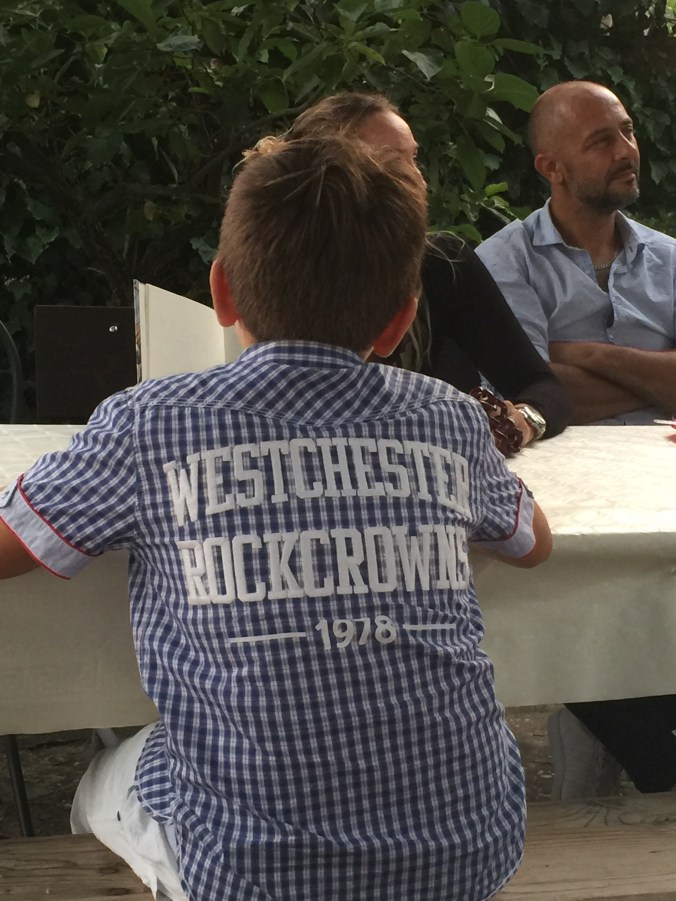 The young man was reading, yes reading, at a party last night! Not texting or playing games on a cellphone, but READING! In 2018 people! Amazing!
In the historic center of Florence, a street is never, ever, merely a street. Here a street carries history, a record of events, and was, more than likely, also the home to some important person(s) from the past.
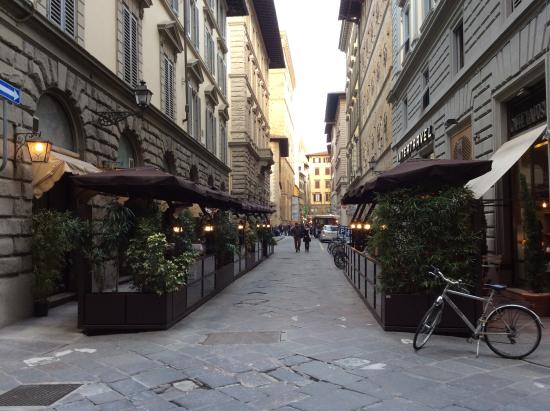
The Via Ricasoli in Florence is short, and runs between the Piazza del Duomo to Piazza San Marco. It’s a short street, but a critical one, connecting, as it does, two very important religious centers. It’s prime property, no matter how you describe it. As we say in the USA, “location, location, location.”
.jpg&xid=17259,15700021,15700124,15700149,15700168,15700186,15700191,15700201,15700208&usg=ALkJrhjXzhq8F7l95CxG2X_HhQMSXnY7zg) Plan of the city of Florence in 1847, here it is called via del Cocomero
Plan of the city of Florence in 1847, here it is called via del Cocomero
The via is one of a series of streets that were laid out by Arnolfo di Cambio (c. 1240 – 1310) in the early 14th century, when Firenze was encircled with a new set of walls, to encompass its ever expanding urban development. This series of streets run more or less perpendicular to the Arno River, which was always a “north star” (more correctly it was a south star) for the city’s planners. Via Cavour, Via dei Servi, and others were among the contributions by the city planners.
The via takes its present name from the Ricasoli family. They owned the most important palazzo on the street, in Piazza Goldini. The palazzo of Ricasoli sits here. Bettino Ricasoli was an important 19th-century Florentine politician.
But, at least until 1847, the street was called Via del Cocomero (street of the watermelon; I can only guess there was once a mercato here). And, the ancient Teatro Niccolini, located at the beginning of the street headed to the Piazza del Duomo, was originally called il Teatro del Cocomero.
At the intersection of Via Ricasoli and the Via dei Pucci is the Tabernacle of the Five Lamps, one of the most showy architectural features of its kind in Florence (for great info on Florence’s tabernacles, see http://www.theflorentine.net/art-culture/2006/10/unforgettable-places-and-special-works-of-art-2/). At Via Ricasoli 30, a plaque commemorates the architect Pasquale Puccianti, who died here in 1858. Another signs recalls the residence here of a railway engineer and senator, Giovanni Morandini.
Further north on Via Ricasoli stands the rear of the modern Teatro della Compagnia. At Via Ricasoli 40-42 stands the Palazzo Gerini, which fused two earlier noble palaces, one by Bernardo Buontalenti and the other by Gherardo Silvani.
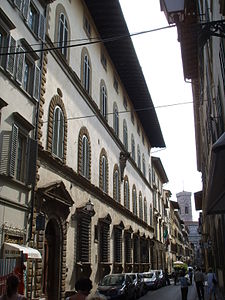 Palazzo Gerini
At the intersection of Via Ricasoli with Via degli Alfani, a sort of small square (piazza) is formed, on which the Luigi Cherubini Conservatory stands today. Further north of the intersection is a spot which always seems to be swarmed with visitors. That’s because the entrance to the Accademia Gallery is located here, in a building that was formerly the hospital of San Matteo.
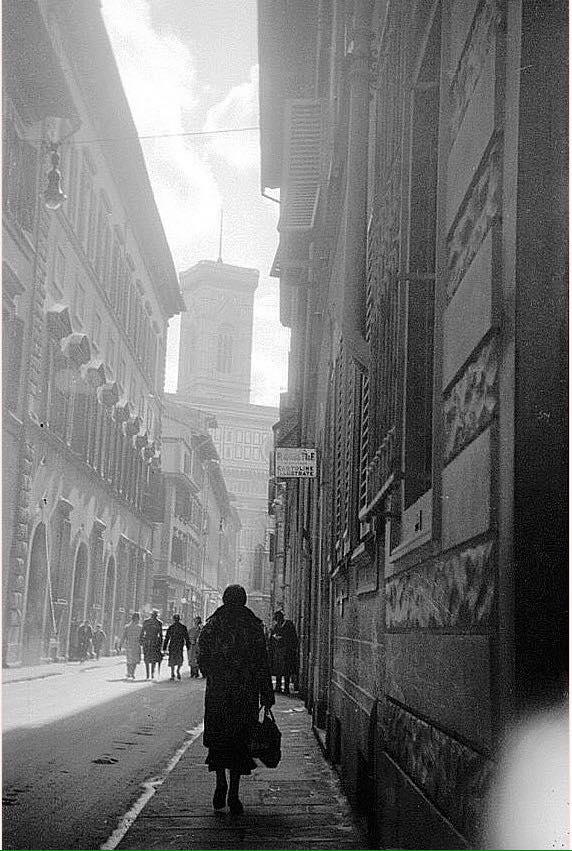
The hazy photo above was taken on Via Ricasoli around 1935. It looks just about the same today, except for the clothing worn. The stylish donna is headed south on Via Ricasoli, towards il Duomo.
Oh, the history this street has seen. Difficult, but intriguing, to imagine.
addendum: just ran into some further info on this street of watermelon:
In the Darkest Ages of Florence, fruit orchards stretched out behind the city walls and over via Ricasoli. In medieval days this thoroughfare was called via del Cocomero, the “Street of the Watermelon.”
It was also the address of the thirteenth-century painter Cimabue and his apprentice Giotto, who took over his master’s house and studio when he died in 1302.
As Florence changed from a provincial river town into a medieval urban commercial center, this street and those around it were plowed up and transformed into artisans’ workshops.
The streets closest to the Duomo resounded with the sounds of hammering and tapping and hissing of forges and bellows. Via Ricasoli was also the casket-making center of the town. A block north of here, at the intersection with via de’ Pucci, were the workrooms of the tinkers and coppersmiths.
Holler, Anne. Florencewalks: Four Intimate Walking Tours of Florence’s Most Historic and Enchanting Neighborhoods (Kindle Locations 1075-1080). Henry Holt and Co.. Kindle Edition.
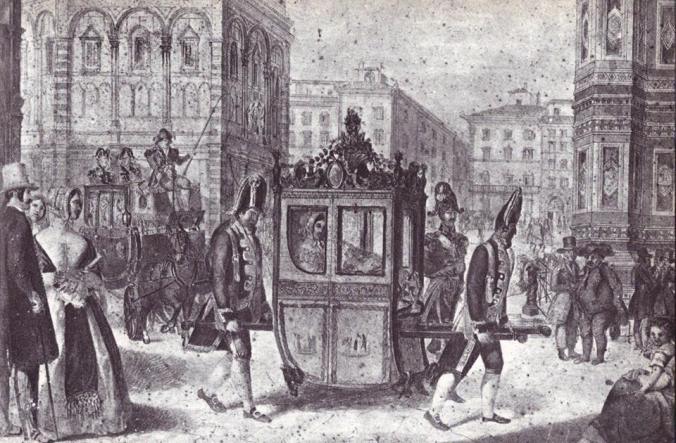
An artwork showing an aristocrat taking a child to the Florence baptistry for baptism; by Francesco Pieraccini (flourished 1823 – after 1851)
Sometimes my posts are just too long, so I save a bit for later. I’ve posted twice recently about the palazzo and the grounds of the Villa Medici a Fiesole.
The bits I’ve saved from this garden are


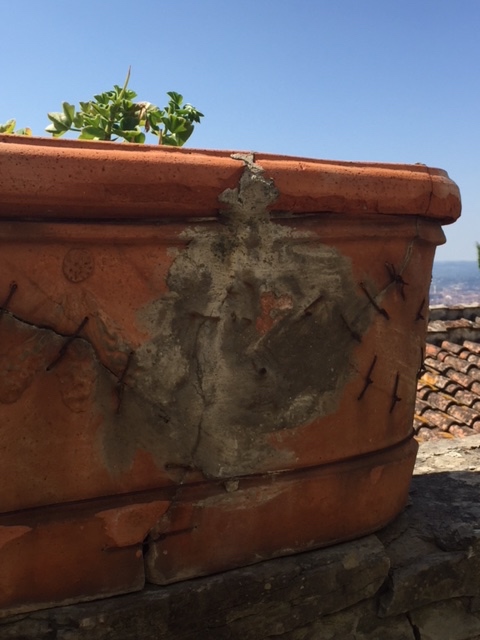
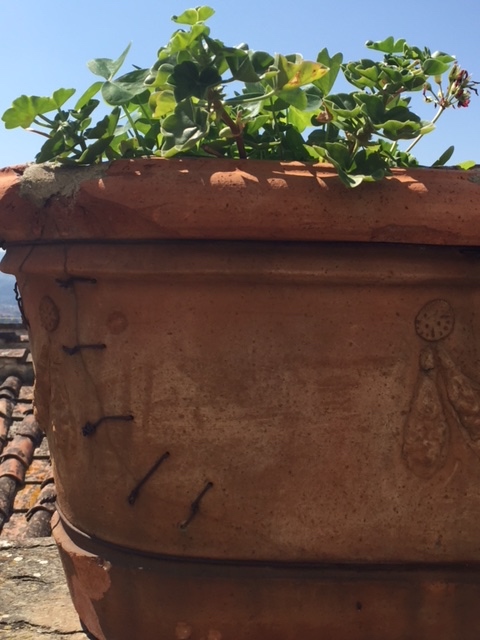
2. How to mend a valuable terracotta pot
3. How to make a broom. Yes, I know we buy ours, but have you ever thought about how they made brooms in the olden days? Well, I’m about to show you!
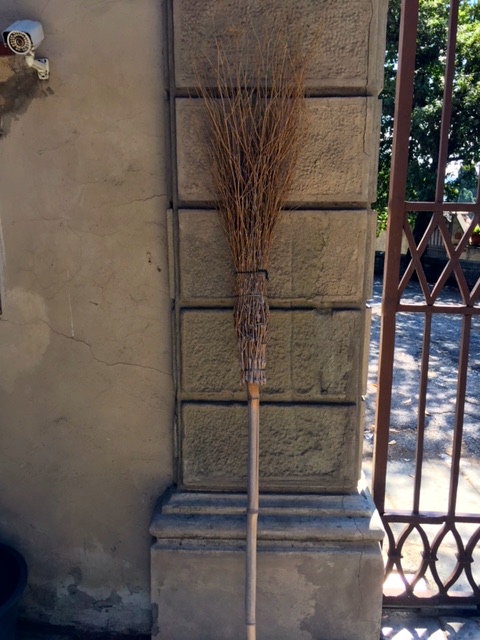
You tie a bunch of branches of twigs around a longer and straighter stick. Or, nowadays, a pole.
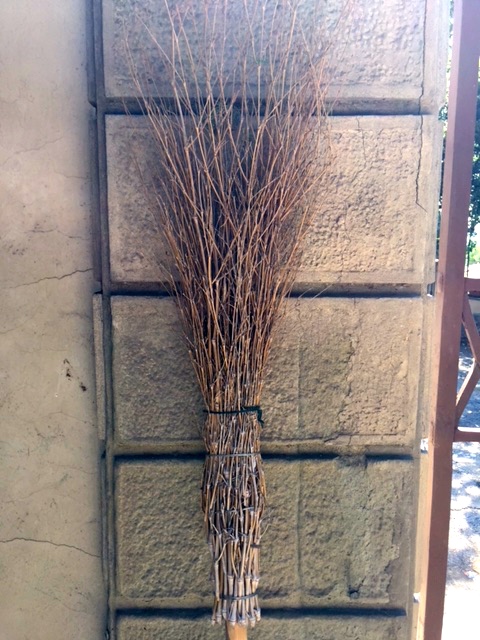
You’re welcome!! :-)
 get back, lauretta!
You must be logged in to post a comment.