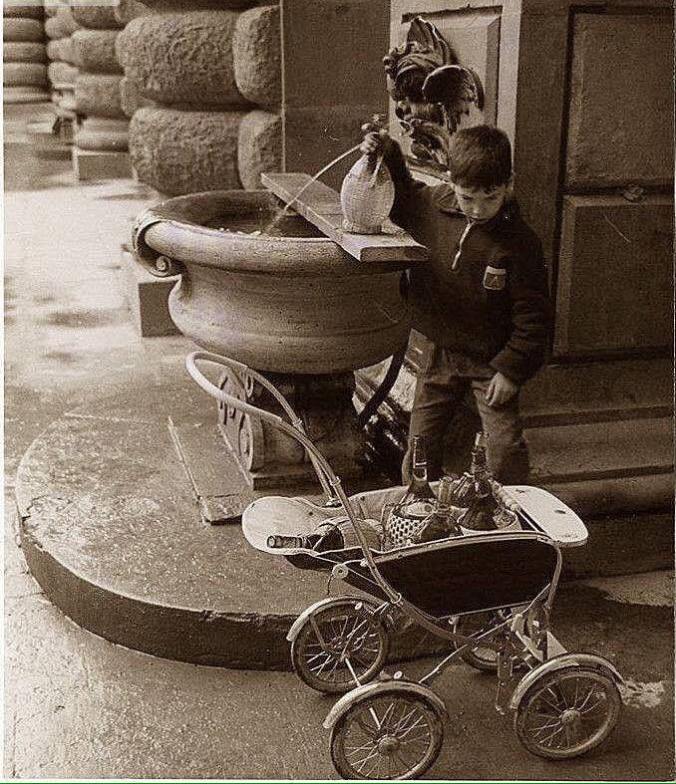
Alluvione 66, il bambino prende l’acqua dalla fontanella di Palazzo Pitti.
After the flood of 1966, a young boy fetches water from the fountain at Palazzo Pitti.
Alluvione 66, il bambino prende l’acqua dalla fontanella di Palazzo Pitti.
After the flood of 1966, a young boy fetches water from the fountain at Palazzo Pitti.
Above and underground in Orvieto
This past week I have been very lucky to have a very dear friend visiting, and so I’ve been playing a bit more tourist than I normally do in Italy. We wanted to get out of Florence a bit, so we headed to nearby Orvieto, somewhere I have never been, and only about two hours on the regional (slow) train. Orvieto is located on a (very tall) hill, so we took the funicular from the bottom of the hill where the train dropped us off to the old town, and then headed straight for the main piazza del Duomo. We picked up tickets for our main interest first, and while we waited headed into the Duomo. Orvieto’s Duomo is pretty low-key overall, but the chapels are what are most noticeable and they are much more ornate than the rest of the empty-feeling church.

The church is similar in feel to the Duomo in Siena, but as previously noted the chapels here are what are incredibly ornate. One chapel in particular was created for a piece of bloody cloth from when the wafer began to drip with the actual blood of Christ to convince a doubting priest. The cloth and host were taken to the pope, a miracle was declared and the chapel was built where the cloth is enshrined to this day. The majority of the frescos in that chapel were done by Luca Signorelli, and are said to have influenced Michelangelo’s frescos in the Sistine Chapel. The influence is obvious; Signorelli’s figures are incredibly muscular.
After viewing the church we headed from the beautiful city aboveground to under the ground, to the main attraction of Orvieto and what we were most excited to see: the Orvieto underground. During the time of the Etruscans thousands of man-made caves were dug out of the hillside and they are spread throughout the city. I tried to find an example of the map that you can see there, but was unsuccessful, but imagine a small Italian town city map: now draw thousands of red circles all over it and you’ll have an idea of how many caves there were and the reach of them. We took a guided tour in English, and were able to get some backstory on the caves and see them up close and personal.
The caves look pretty much like you would expect– they are caves after all– but what is perhaps most surprising is the temperature drop after you descend even just one level down into the caves. It is so much cooler there, and it is no surprise that the Etruscans used the caves for things such as olive oil making. Below you can see an ancient olive oil press. The straining mat is modern, but something similar would have been used to press the oil out of the olives and prevent pieces of the olives from joining the oil.
 The caves were incredibly extensive; we felt we had seen so much, but in reality we only covered two tiny circles on the map of thousands. At one point our guide pointed out that while it seemed we had covered a lot of ground, it had all been vertical, and there certainly were a lot of stairs– this was not a tour for those who can’t do stairs– or the claustrophobic! The caves were quite spacious, but the tiny staircases and passages between them, not so much.

Many of the rooms in the caves were studded with holes, as you can see in the photograph above. For a long time they believed that these holes had a different purpose, but now archeologists are pretty certain that they were used to raise pigeons, which are actually a pretty common food in Orvieto, one of the things the city is known for (the others being ceramics, Orvieto classico wine from Trebbiano grapes, and olive oil). The pigeons were self-maintaining, because they would fly out the window that was ever-present to eat, and also bring back food for their young. Unlike other animals such as rabbits, people did not have to put in as much effort to raise them.
After some time the caves reached their final hurrah when the people of Orvieto were forbidden from digging out any more caves due to the instability of the area; landslides, thanks to the instability caused by the caves were increasing and there was fear that the entire city might disappear. Now there are spikes driven through the hill to protect the city, but the caves are now an archeological and historical site as opposed to a functional one.
Orvieto, being a hill town, had beautiful views, and we spent the rest of the afternoon wandering and enjoying them before heading back to Florence on the train. Below you can see a convent (I believe) from the hillside where we entered the underground caves.
 Orvieto was sacked by the Romans, but the city withstood their attacks for two years thanks to its prime hilltop position: easy to defend. There are walls around the city as well, and facing the train station you can climb atop for the best view of the valley below.
 Sometimes living in Florence it’s easy to forget that Italy isn’t really a land of cities. I’m lucky enough to have a view of the hills from my balcony, but visiting a small hill town is a good reminder of what Italian life is really like for most people– in the past, and in the present.

05/08/2014 · · in Escapes, Europe, Off the Beaten Track, Out & About. ·
This is how Italians announce the birth of a baby. Pink for girls, light blue for boys. A sweet custom.
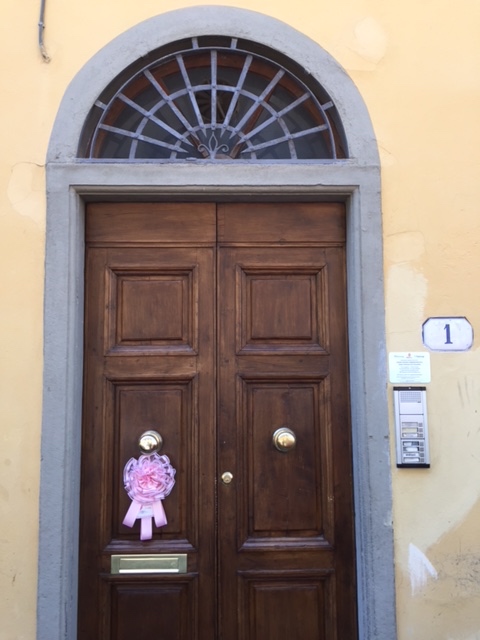

60 years ago, someone made this snapshot in Florence. I imagine it was hot then, and it is hot today. If you can’t get to “il mare“, you can always cool off in the Arno river!
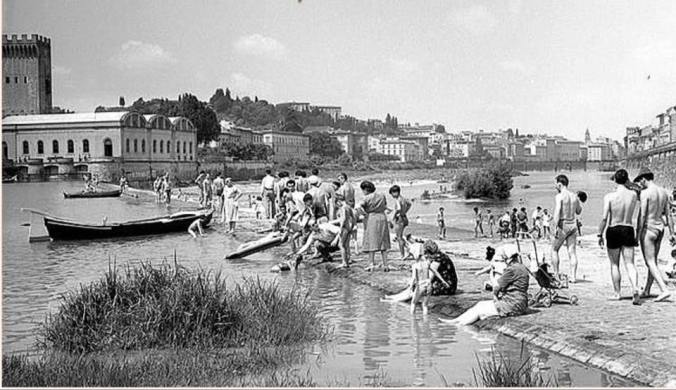
La spiaggia dei fiorentini fono agli anni 60-70. A sinistra la fabbrica dell’acqua smantellata negli anni 60.
From works of art and architecture, to products like olive oil and nutella, Italy’s strong cultural heritage means that it is full of things that are iconic and unequivocally Italian.
Although there are a few cars that fall under this category (Ferrari, Maserati, Alfa Romeo) my personal favorite is the Fiat.
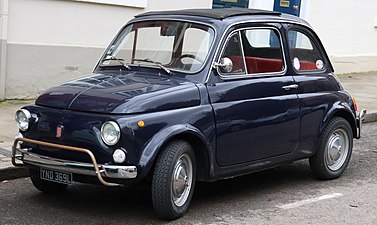
Not just any Fiat of course, but the Fiat 500. From the 1950′s to 1970′s, the cinquecento (five hundred) was produced and marketed as a cheap practical town car.
At about ten feet long, it makes the mini cooper look like a full-size sedan – seriously – I saw one here the other day and thought “WOW, that is huge,” which surprised me seeing as how it was the “cute little car” that I wanted in college. But I digress.
http://allafiorentina.com/florence/classic-italian-style-the-fiat-500/#.VEyVx77yQ21
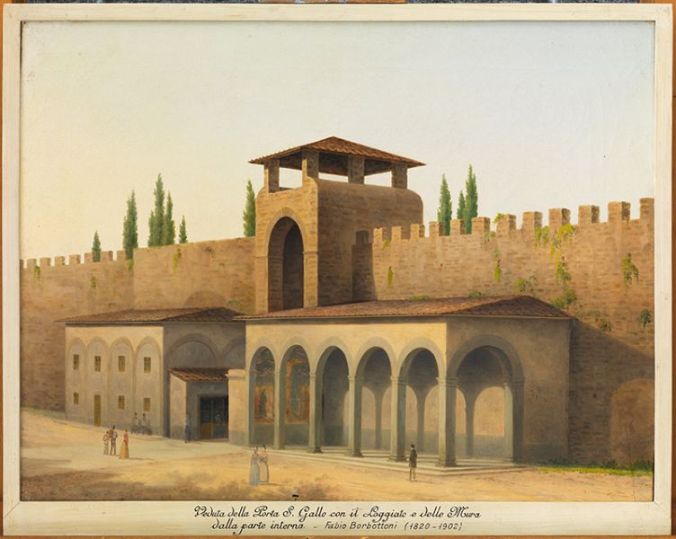
Una fantastica Porta a Prato acquerellata, inizi 900, Firenze. Watercolor by Fabio Borbottoni (1820-1920)
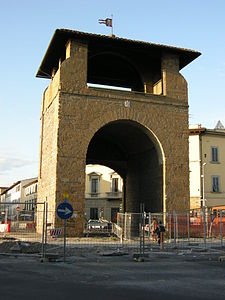
How it looks today:
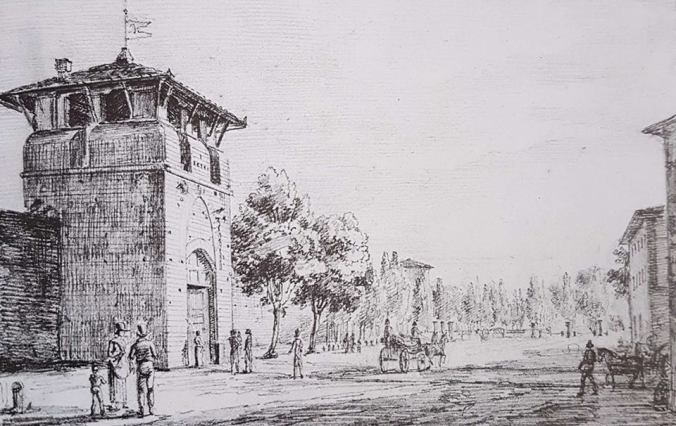
Giuseppe Gherardi. Porta al Prato. Disegno del 1826
Today’s issue of The Florentine carried the following news item. Before reading the article, just consider for a moment: how many hospitals do you know that:
I know the answer is none! It is mind blowing to consider all of this! (I was lucky enough to walk by this hospital 2x a day for almost 10 months; my Italian language school is across the street. It was comforting to know that when I truly lost my mind [because learning another language is molto difficile!], I was not too far from medical treatment. :-) )
The oldest hospital in Florence, Santa Maria Nuova, has launched a fundraising campaign during its 730th year.

On June 21, the Santa Maria Nuova Foundation has organized an invitation-only fundraising dinner with the sole purpose of restoring the hospital’s basements.
The subterranean zone of the historic building is home to “Leonardo’s basins”, supposed to be where Da Vinci dissected human cadavers, although records bear no proof of this having occurred, and the underground passageway that the oblate nuns, the hospital’s former nurses, used to reach the wards from the nearby convent.

On June 23, the hospital will be opening its doors to the public with a book presentation scheduled at 11am, free guided tours at 7pm (meet outside the hospital entrance at 6:50pm) and a classical concert at 9pm in the church of Sant’Egidio.
“We are delighted to welcome Florentines to celebrate the city’s oldest hospital, which is 730 years old this year,” announced Giancarlo Landini, president of the Santa Maria Nuova Foundation. “It’s an opportunity to remember the history of this extraordinary place of care and help, which was founded in 1288 by Folco Portinari, the father of Beatrice immortalized by Dante, and who thanks to the generosity of benefactors was able to receive important works of art.
We also celebrate today’s Santa Maria Nuova, showing how we have reached this restoration and we will look to the future, considering how to make the most of our artistic and historic heritage, starting with the restoration and renewal of the former crypt of the church of Sant’Egidio and the hospital’s basements, the reason why the foundation has organized the fundraising dinner on June 21.”
At the press presentation, Tuscany’s health councillor Stefania Saccardi commented, “In recent years, the regional health unit has modernized the hospital while protecting its historic value. Now, through the hospital’s foundation, the time has come to restore its basements.”
Summer is upon us and that means the Sienese Palio will again be run in July and August. If you’d like to know more about the palio, Netflix has a very good (and beautiful) film devoted to it.
Here’s the info:
https://www.imdb.com/title/tt3669520/videoplayer/vi2283058457?ref_=tt_pv_vi_aiv_1
 get back, lauretta!
You must be logged in to post a comment.