Purely Tuscan words: mesticheria

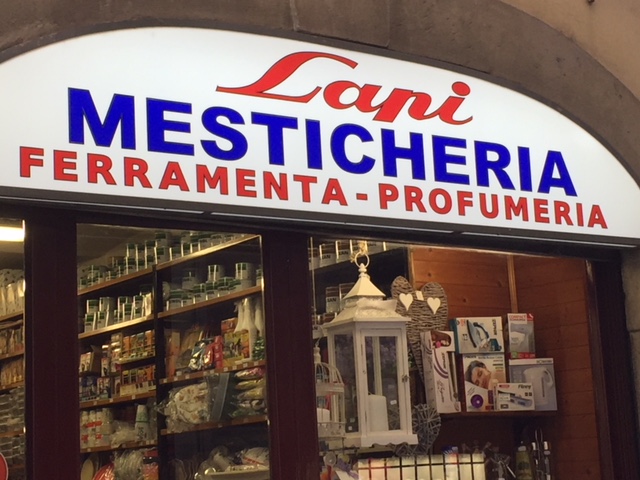
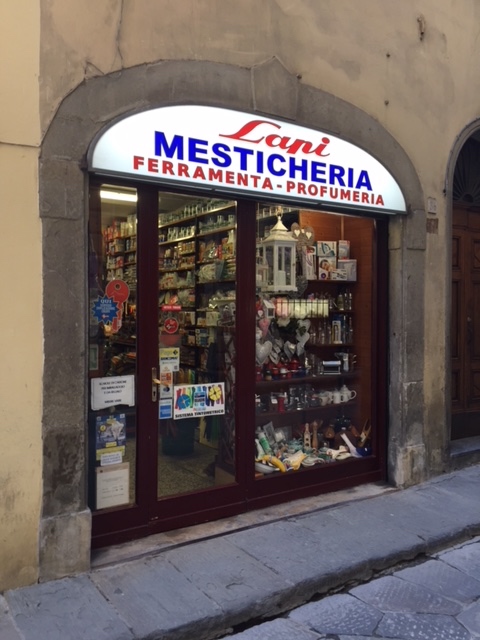
I posted about this great shop recently, and want to dig in a little deeper on the roots of such a business in Florence.  Let’s focus for a minute on just exactly what kind of “paint store” is being advertised here and in a few other Florentine businesses.
IMG_8292

From Wiktionary (https://it.wiktionary.org/wiki/mesticheria) we learn that the word mesticheria in italiano is a feminine singular noun and means the following:

Sostantivo

mesticheria f sing

  1. termine prettamente toscano, indica una bottega dove si vende l’occorrente per dipingere o verniciare, e piccoli utensili per la manutenzione della casa (è molto frequente però trovarci le cose più svariate, come prodotti di giardinaggio o prodotti tessili)   A rough English translation: a purely Tuscan work indicating a shop wherein one can buy paints and small tools needed to maintain a home.
IMG_8291

mesticherìa s. f. [der. di mestica], region. – Bottega di colori già preparati, di vernici e di tutto ciò che occorre a pittori, verniciatori, imbianchini, e sim.  Rough English translation:  Shop selling prepared colors, paints, and all that is needed for both. http://www.treccani.it/vocabolario/mesticheria/

The latter definition speaks more clearly of the ancestry of these Tuscan shops: for a flourishing fresco tradition to exist and develop, extensive site preparations are necessary.  In order to prepare for a fresco, certain agents are needed to make the colored paints adhere to and chemically interact with the plastered wall below them.

I recently had a conversation with Jeremy Boudreau, the head of the art history department at the British Institute in Florence, and he said that only in Florence does one find this kind of shop, or a meticheria, selling the materials needed to create frescoes.

My guess, though, is that if you walked into one of these shops, they would be hard pressed to provide you with the materials needed to prepare a surface for the art of fresco.  It has been a while, I would imagine, since the likes of Giotto or Michelangelo needed paint supplies for this specific art form!

And, again…call me crazy, but I wonder where artists and their assistants purchased these materials in say Padua or Roma?  Did someone have to go to Florence to buy artistic materials for frescoes?!
Call me crazy, but…

do you find it entertaining, as I do, that in Florence there is at least one shop that sells paint, hardware and perfume?!

IMG_8291

This great shop is on Borgo Santi Apostli, one of my favorite antique streets in Florence.  When I walk along the road, I think crazy stuff like “Dante walked this street a few centuries ago” and I feel amazingly fortunate to be living my dream.

But,  then I encounter a store like this and just the concept of a shop that sells hardware and perfume makes me joyful!  Would Dante have found it funny?

IMG_8292

Things I’ve learned

…in the past 18 or so months.  As anybody who reads my blog knows, it is not a how-to blog.  There are many expats living in Italy who blog about the ins and outs of living here.  I usually avoid the subject, but I’m in the process of moving from what is called a transitory lease to a long-term lease, which could involve a stay of up to 8 years or longer.

To say it has been a learning process would be like saying a a flower seed will grow a flower.  It can happen, but it might not depending on infinite variables. I’m not sure that is a good example, but my brain is currently cooked.

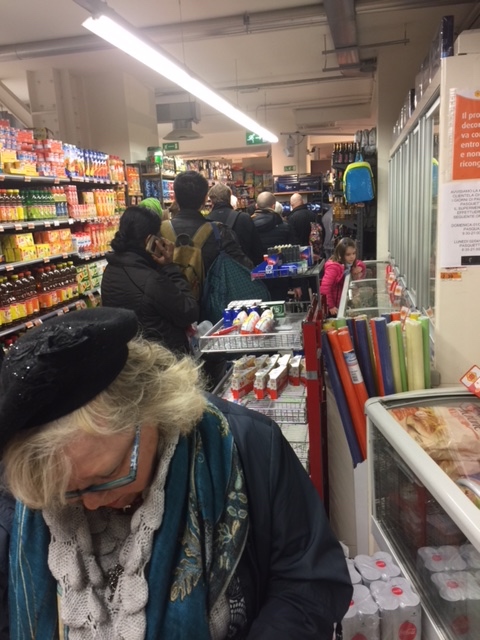
So, it set me to thinking about the many small things that go on here, such as waiting in line this morning to buy your milk, eggs and bread (which you thought would be a quick trip, but it isn’t because there are 10+ people in line before you. You have the luck to be behind an older signora who has 2x the normal amount of shopping in her cart and she keeps dropping pieces of paper that she can’t bend over far enough to retrieve and so you have to do it):

IMG_8521


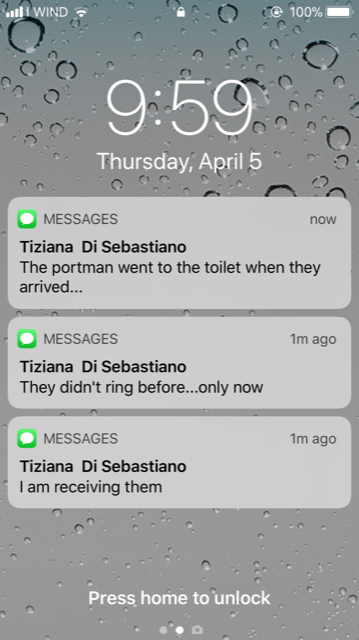
Or the fact that you thought your were covered for the furniture delivery that was set up for this morning.  The doorman works during the hours you planned the delivery and he knew about the delivery and so you didn’t worry.

That is, until you got several angry phone calls in Italian from the delivery man who couldn’t get into the building.  So you sent an SOS text to the landlord who you happened to know was in your apartment at that moment.  The delivery man got in, in the end, and you received this text from the landlord:

IMG_8519

There are more, many more, and I may be writing about them soon.  But right now I am taking some Advil and taking a nap in my old short-term but beautiful apartment. :-)


See Naples and die

“See Naples and die” are the famous words first spoken by Johann Wolfgang von Goethe in his Italian Journey (1786–88).

In this breath-taking episode of the PBS show, Dream of Italy, you will make pizza in Naples, hear why Naples coffee is the best in the world (hint: the expert thinks it has to do with the water and air of Naples), see the famous Neapolitan hand-made creche figures, and have a up close look at the magnificently dangerous Mt. Vesuvius.  You’ll learn about American grape stock providing Europe with a unblemished basis for wine production and how to make limoncello from the glorious limone that grow in this blessed region.

Divertiti!


Capodanno a Firenze

Last night there were fireworks in Florence.  Something was definitely up!

images

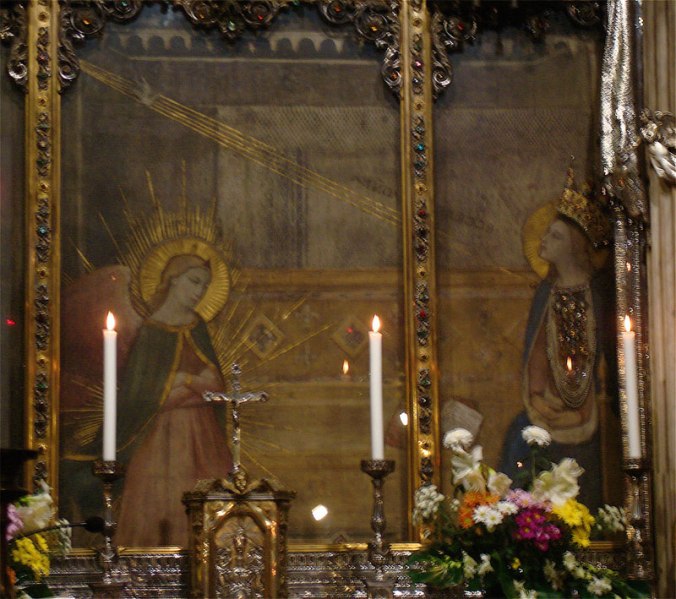
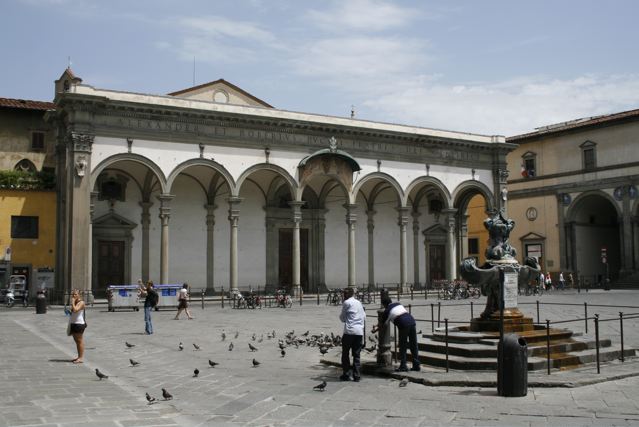
And that’s because today, March 25, is the date marking the beginning of the new year according to Florentine tradition. The city commemorates the occasion with a major parade which begins at the Palazzo Vecchio and makes a pilgrimage to the Santissima Annunziata. That church is important because of it houses a medieval fresco of  the Annunciation, which is believed (by some people at least!) to have been partially painted by angels.

The fresco and the church of Santissima Annunziata (the Most Holy Annunciation) has always been the centerpiece of the Florence’s New Year festivities in late March. The fresco can still be viewed on the inner wall to the left of the entrance.

annunciation

The story goes that the artist commissioned to paint the Annunciation fell asleep after completing all but the face of the Virgin Mary. Upon his awakening, he found a completed, beautiful blonde Madonna – angelic masters had finished the fresco for him.

From 1250 to 1750, the people of Florence gathered in the church of SS Annunziata to welcome the arrival of spring and to officially celebrate the Annunciation, or the moment   when the Angel Gabriel told Mary that she would be the mother of Christ. March 25 of course is exactly 9 months before Christmas, when the Christ child was born.

santissima-annunziata-church-florence2

In order to celebrate the event, the municipality of Firenze organizes a parade with traditional costumes, music and flag-wavers. The historical procession (called the corteo storico) of the Florentine Republic,  starts around 2:45 pm at the palace of the Palagio di Parte Guelfa, heading toward the Basilica SS. Annunziata.

900x400-02

Florentines were so devoted to the Madonna that until 1750, they refused to accept the Gregorian calendar year that begins on January 1. This devotion remains a part of the culture and was celebrated again today.