Here’s a breakdown of how the higher education system works here, following graduation from liceo or high school:
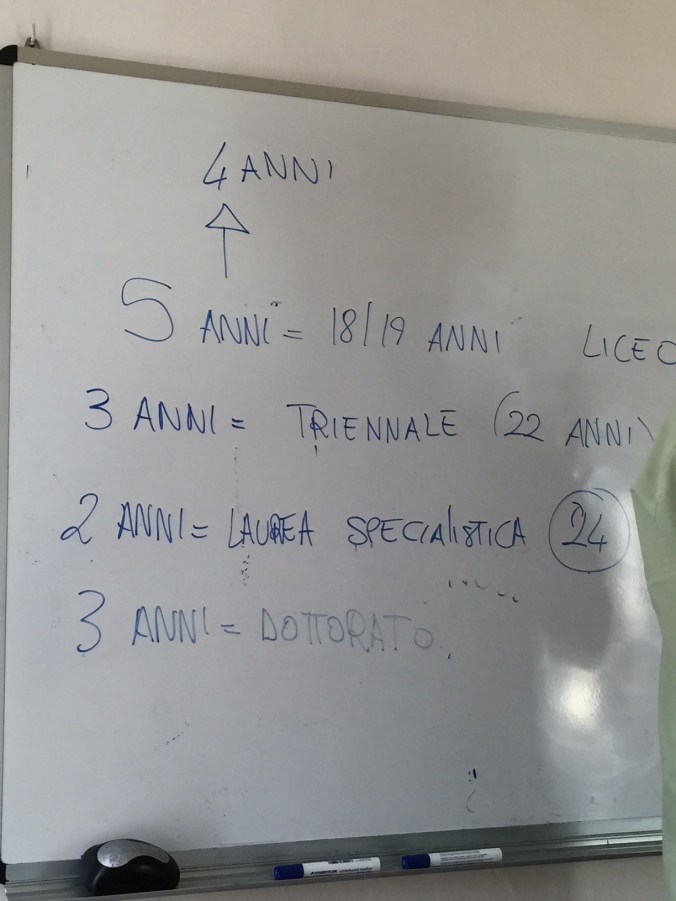
Here’s a breakdown of how the higher education system works here, following graduation from liceo or high school:
Pro forma nel Italia!


T’is the season for beautiful, succulent persimmons. Known here as cachi. As lovely to look at as they are tasty to eat.


When you graduate from college in Italy, you are laureate. An Italian custom I find completely charming is the habit of the graduate wearing a laurel wreath to mark the occasion.

Today I spotted this happy fellow, who clearly just graduated. I followed him for a few steps:

And then I asked him to pose for a picture. Unfortunately, I caught him in an awkward pose, because he is a very handsome young man!
Auguri!

A lot of non-Italians have heard of la bella figura. Far fewer understand what it really means.

In the case of English speakers, this may be because neither of the words corresponds exactly with an English equivalent. In Britain and the United States, beauty is thought of as something almost entirely separate from virtue.
But in Italy the two concepts overlap. Bello (bella in the feminine) translates as “beautiful,” “pretty” or “handsome.” But it also means “nice,” “fine”— and “good.”* A good deed is una bell’azione.
As for figura, it covers a range of meaning that extends from “picture” to the impression made on others.
Perhaps “image” is the nearest English equivalent, except that figura has more to do with the way you appear to others than the effect you wish to project.
Fare una bella figura is to make a positive impression, though not necessarily in a visual way. The shop assistant who wrapped that present will probably have told you, for example, that by turning up with a large box of fruit jellies or a bottle of vintage malt whiskey, you will fare una bella figura (though it goes without saying that you will make an even better impression on your hosts if your gift has been exquisitely wrapped; in fact, you would fare una brutta figura were you to turn up at the door with your gift, however pricy, wrapped in nothing but a paper bag).
In several respects, figura is close to Far Eastern concepts of “face.” And since Italians generally agree on the need to avoid losing face, they are prepared, in the same way as Chinese or Japanese, to go to great lengths to ensure that others do not do so.
A chief executive who has utterly mishandled the running of a firm will not usually be openly berated at the annual general meeting and denounced in excoriating fashion in the financial media. It will be quietly agreed between all concerned that he is not up to the job, at which point he will be got rid of in the most discreet manner possible and in a way that allows him to keep his dignity and reputation.
Dread of facendo una brutta figura— a losing face— is omnipresent in Italian society. It explains why there are so few laundromats, and why the few that do exist are used mostly by poor immigrants and foreign students. It is why Italians put on tanning lotion before they get to the beach or pool.
It is why town and city councils arrange for their best-looking cops to direct the traffic in the main square.
And why Italians above a certain social standing are reluctant to travel on public transport.
Bella figura is also why Italians of both sexes will endure remarkable discomfort in the interest of keeping up appearances. Throughout the rest of the Mediterranean, from Spain to Israel, male workers cope with the summer heat by changing into short-sleeved shirts sometime around June. But in Italy that would be to run the risk of being thought, like Almirante, “vaguely obscene.”
So, even as the temperatures climb into the high nineties in late July, the sort of Italians who wear a suit or jacket and trousers to work remain stubbornly— and willingly— imprisoned in shirts that allow them to shoot their cuffs. Look down and you will probably see that they are also wearing heavy leather shoes (because they keep their shape) and long socks (because one of the worst sartorial gaffes you can commit in Italy is to reveal an expanse of flesh between sock top and trouser hem).
The women, meanwhile, will very likely be wearing clinging tops and figure-hugging skirts or trousers. Like the men, they cannot be comfortable. But they feel they are facendo una bella figura, and that matters more than mere comfort.

The same need for the approval of others would seem to lie behind the boom in demand for plastic surgery. The international statistics in this area are unusually patchy, but figures taken from a report compiled for the International Society of Aesthetic Plastic Surgeons (ISAPS) and based on statistics for 2010 indicate that Italians are exceptionally ready to submit themselves to cosmetic procedures of all kinds.
In a cross section of twenty-five countries, Italy was second, behind Greece, for the number of plastic surgeons per hundred thousand inhabitants and third, behind South Korea and Greece, for the number of procedures— surgical and nonsurgical— relative to the population.
The number of cosmetic procedures carried out in Italy in 2010 was proportionately more than 30 percent higher than in the United States. France, Spain and Germany all lagged behind Italy while the figure for Britain was barely a quarter of that for Italy. What makes these figures all the more striking is that they refer to a country widely regarded as having an unusually high proportion of good-looking men and women.
Hooper, John. The Italians (pp. 85-87). Penguin Publishing Group. Kindle Edition.

Pasta has long been a part of Italian cuisine, but only quite recently acquired the dominant, pervasive role it plays now.
The oldest form is thought to be lasagna, which is known to have been cooked in ancient Rome, though not quite in the way it is today.
Dried pasta seems to have been invented quite separately, in North Africa, as expedition food for desert caravans. It was probably brought to Sicily by the island’s Muslim conquerors. In a codex published in 1154, a Moroccan geographer and botanist known as al-Idrisi described a thriving pasta manufacturing industry near Palermo, which exported its products to Muslim and Christian countries alike. Among them was a stringlike pasta then known by the name itrija.
Dried pasta had the same advantages for seafarers as it did for camel drivers, so it is hardly surprising that it next appears in Genoa.
It is mentioned in a document written in 1279, and production of vermicelli, which was to remain a Genoese specialty, had begun by the fourteenth century.
The consumption of pasta continued nevertheless to be associated with Sicilians until in the 18th century the nickname of mangiamaccheroni gradually came to be bestowed on the Neapolitans. By 1785, Naples had 280 pasta shops.
Hooper, John. The Italians (pp. 99-100). Penguin Publishing Group. Kindle Edition.
Gustala ghiacciata! = Enjoy it iced.

It’s autumn, obviously, so what do you expect in the bakery here?
How about

And if that doesn’t float your boat, how about

Delizioso!
The time and care expended by shop assistants in Italy on the wrapping of gifts can be astonishing.

The cost of the purchase is irrelevant. The same care will be taken in wrapping a discounted paperback book or a pair of diamond earrings.

Blithely indifferent to the queue building up behind you, the assistant will patiently fold over corners to form perfect isosceles triangles, use different-colored (but always exquisitely contrasting) wrapping paper to create diagonal stripes across the package, and then tie it with a length of ribbon that is made to end in delicate spirals.
The finished package will then be handed to you with aplomb.
Hooper, John. The Italians (pp. 77-78). Penguin Publishing Group. Kindle Edition.

If Pirandello is the archetypal Italian writer, then opera— packed with searing emotion expressed without reserve— is the quintessential Italian art form. Its origins, in the late sixteenth century, are exclusively Italian.
It grew out of the discussions and experiments of the Camerata, a group of Florentine writers, musicians and intellectuals whose main aim was to revive the blend of words and music that was known to have existed in classical Greek drama.
An Italian, Jacopo Peri, composed the earliest recorded opera, Dafne, which was first performed in 1598. And it was in an Italian city, Venice, that the first public opera house, the Teatro San Cassiano, was opened in 1637.
Hooper, John. The Italians (p. 66). Penguin Publishing Group. Kindle Edition.
 get back, lauretta!
You must be logged in to post a comment.