No Easter bonnets to speak of on view in the shops of Florence, but the fabulous children’s clothing stores have their finery on display.
From TAF, always my favorite!


Next up: Anichini!


No Easter bonnets to speak of on view in the shops of Florence, but the fabulous children’s clothing stores have their finery on display.
From TAF, always my favorite!
Next up: Anichini!
The store windows all over the city are decked out in Easter finery!


It definitely isn’t always beautiful.

There are the unavoidable trips to the Questura, or police station, for Visa issues. Ick.

But, I’ve always believed that anything worth having is worth making extreme effort to obtain.

The Questura isn’t that bad, really. :-)
A chic men’s shop in Florence has this great window currently, juxtaposing high men’s fashion from the Renaissance with a cool outfit for today.


In 1343 Florence was subdivided into 4 quartieri, after the expulsion of the Duke of Athens and at the same time as the building of the city’s surrounding walls.

Each quartieri was named for the major house of worship in its district: Santa Maria Novella, Santa Croce, San Giovanni, and Santo Spirito. Each district has its own color: SMN is red; Santa Croce is blue; San Giovanni is green; and Santo Spirito is white.

From the 15th century on, a rugged game of calcio was played between the quartieri in the Piazza de Santa Croce. It is believed that this game, the forerunner of both rugby and soccer, originated in this Piazza. Calcio is outside of my area of interest, so I’ll leave it at that!
People from North Africa and the Near East first used the word paradisi to describe their intimate garden spaces filled with the sound of running water and the perfume of beautiful flowering plants and trees, a shady sanctuary cut off from the harsh landscape outside by high walls.
On the outskirts of Palermo the first orange and lemon trees brought to Italy by the Arabs were planted in gardens. The beauty of these gardens was celebrated in a genre of poetry called the rawdiya, or ‘garden poem’, in which oranges and lemons were often mentioned.
Abu al-Hasan Ali, an Islamic poet still living in Sicily under Norman rule at the end of the eleventh century, described oranges as pure gold that had rained on to the earth and been fashioned there into glowing spheres.
Abd ar-Rahman, another Sicilian-Arabic poet, wrote:
The oranges of the island are like blazing fire
Among the emerald boughs
And the lemons are like the pale faces of lovers
Who have spent the night crying.
The wonderful Islamic gardens disappeared long ago, although Sicilian citrus groves commemorate their presence by being known still as giardini or even paradisi on the island’s east coast, names that retain the echo of their Arabic associations with beauty, intimacy and succour, of the oasis in an arid desert landscape.
Attlee, Helena (2015-01-05). The Land Where Lemons Grow: The Story of Italy and Its Citrus Fruit (Kindle Locations 797-808). Countryman Press. Kindle Edition.

A spray of mimosa to mark the day. All hail to all women everywhere!

When walking through the Piazza del Duomo, most visitors walk right past a white marble column on a base of three stairs, just to the north of the Baptistry. The column is topped with bronze and capped by a cross.
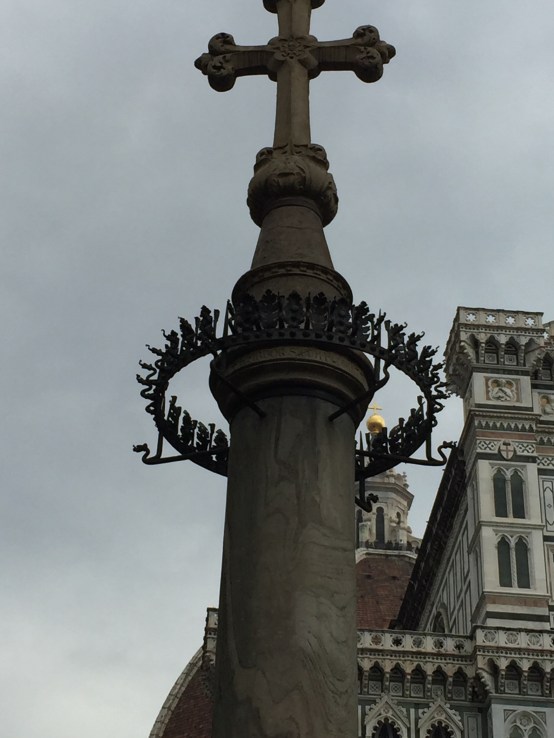
Overwhelmed by the magnificence of the other monuments in the square, few people give the column more than a passing glance.
But, once upon a time, a miracle supposedly took place on this very hallowed spot.
I first noticed this column myself, although I’ve walked through this piazza at least a zillion times, last January 27th. It was the flowers that attracted my attention. Red and white bedding plants surrounded the base.

I thought it was just a post-Christmas attempt to liven the place up. Boy, was I wrong. I suspect pretty much everything I take for granted in Florence has a deeper significance. It is my mission to uncover some of them. Mission accepted!
It turns out that every year on January 27, Florentines commemorate the anniversary of a particular miracle by decorating the base of the column with flowers and greenery.

The miracle was this: supposedly in 429 CE (although some scholars say it was much later, probably in the ninth century), the relics of the much loved and venerated first bishop of Florence, San Zanobi (337-417 CE), were transferred from the Church of San Lorenzo where he had been buried, to the new cathedral, the Church of Santa Reparata (the remains of which can still be seen today under the Duomo).
As the procession moved from borgo San Lorenzo into what was then the open field of Piazza San Giovanni, the bier brushed against the leafless winter branches of an elm tree. At that mere touch, the tree is said to have burst into bloom. Hence, the bronze relief on the column represents a tree in full leaf. Above it, the now fairly indecipherable Gothic script recounts the wondrous story.
So, who was Zenobius? Born into a noble Florentine family, Zenobius was the first in his family to become a Christian. Once ordained as a priest, his fame as a preacher soon spread. Pope Damasus I (366-86 CE) called him to Rome and, among other missions, sent him to Constantinople.
After the pope died, Zenobius returned to Florence and was made the city’s first bishop. He evangelised the city and surroundings, including Scandicci (he was named its patron saint in 1983). Renowned for his great humility and charity, he was known as the Apostle of Florence.
He is also said to have performed many miracles, including one in which he resurrected the dead child of a French pilgrim. This event is recorded on a plaque in Latin on the wall of Palazzo Valori-Altoviti in borgo degli Albizi, where the miracle is said to have occurred.
The saint’s relics now rest inside the Duomo in an urn inside a silver shrine, a masterpiece made by Lorenzo Ghiberti, the sculptor responsible for the ‘Gates.’
It is uncertain whether the trunk of the famous reblooming tree was used to make the cross currently found in the Church of San Giovannino dei Cavalieri in via San Gallo or whether the Maestro del Bigallo used it for his painting of Saint Zenobius with saints Eugene and Crescentius, today housed at the Museo dell’Opera del Duomo. Not surprisingly, many other artists depicted episodes from the life of the saint, including Sandro Botticelli, whose paintings of Zenobius grace the walls of the National Gallery in London and the Metropolitan Museum of Art in New York.
The original marble column was destroyed by the flood in 1333 and replaced in 1334; the inscription was added in 1375. In 1501, the cross fell to the ground and shattered. The replacement column has benefited from public policy since the area surrounding the Duomo was made into a pedestrian zone in October 2009.
In May 2012, the landmark was restored through the Florence I Care (FLIC) project, a public-private partnership to preserve not only the cultural heritage of Florence but also some of its important buildings. The restoration, paid for by a private company, took three months and cost 20,000 euro. It required a series of delicate operations to remove the effects of centuries of exposure to soot and smog.
After you find the column, look up above the central doorway of the Duomo.

You will see a statue of an elderly man with a beard, dressed in bishop’s vestments and mitre and holding a crook. That is San Zanobi, seemingly keeping an eye on his column.
Not that they were looking down before.
But now, when I look up, I see this beauty. It’s my ceiling!
Très belle! Even though it’s Italian.


I am way, way, way late on posting this topic! Bafana visits Italian children on the evening of 5 January. This is the main day for gift giving and presents are brought for children by La Befana, a kindly old witch who fill children’s stockings in the night with sweets or i dolciumi if they have been good or with coal or il carbone if they have been bad.
I was prompted to finally get this posted because of this very cool poster I saw at random in Venice last Sunday. I love it!


I actually had a close encounter with Befana myself in early January, and here it is. I’m the one in the fur hat:
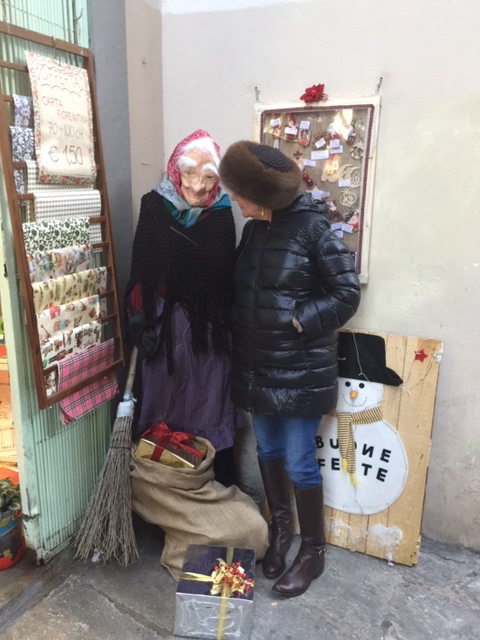
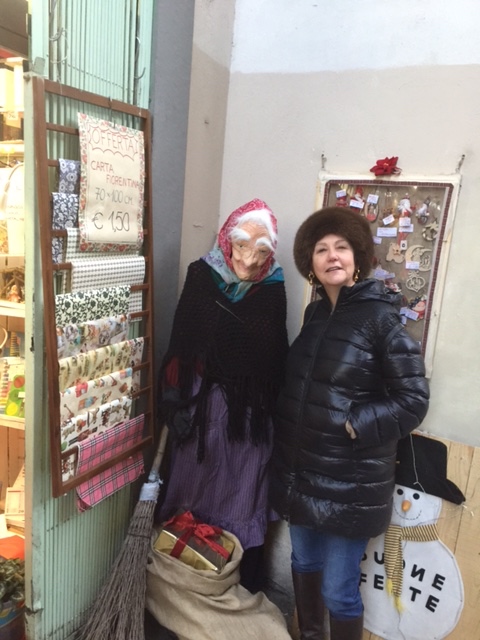
And, btw, she gave me some candy and no coal!
 get back, lauretta!
You must be logged in to post a comment.