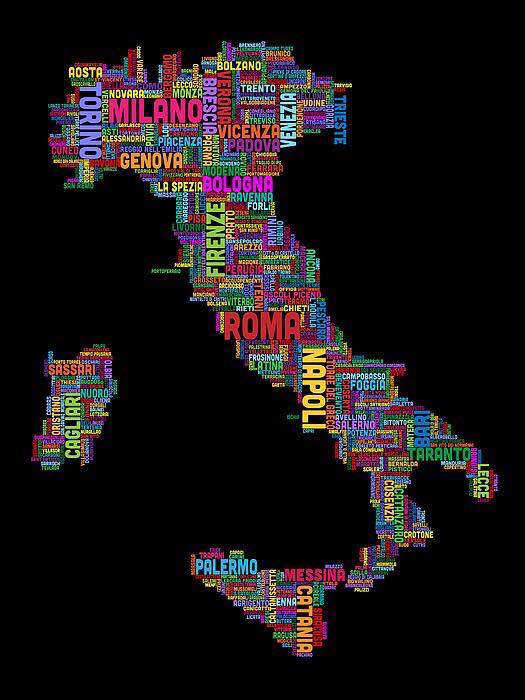
Italy
Palma Bucarelli
Palma Bucarelli (1910 – 1998) was an Italian arts administrator, the director of the Galleria Nazionale d’Arte Moderna (GNAM) in Rome from 1942 to 1975.

Early life
Palma Bucarelli was born in Rome. She earned a degree in art history at the Sapienza University of Rome.[1]
Career
As a young art historian she worked at the Galleria Borghese and in Naples. During her thirty-three years as head of the Italian National Gallery of Modern Art, Bucarelli was responsible for protecting the gallery’s collections from damage while it was closed during World War II; she arranged to place paintings and sculptures in historic buildings including the Palazzo Farnese and Castel Sant’Angelo.[2] She was one of the Italian delegates to the First International Congress of Art Critics, held in 1948 in Paris.[3]

After the war, she oversaw such events as exhibitions of works by Pablo Picasso (1953), Piet Mondrian (1956), Jackson Pollock (1958), Mark Rothko (1962), and the Gruppo di Via Brunetti (1968). She defended controversial works such as Piero Manzoni‘s ‘”Merda d’Artista” and Alberto Burri‘s “Sacco Grande” (1954).[1] Her strong support for abstract and avant-garde works made international headlines in 1959, when she was accused of a bias against figurative art in a public debate.[4] In 1961 she was in the United States, where she gave a lecture in Sarasota, Florida[5] and attended the opening of a major exhibit on Futurism at the Detroit Institute of Arts.[6]
Personal life
Palma Bucarelli married her longtime partner, journalist Paolo Monelli, in 1963. She died in Rome in 1998, from pancreatic cancer, aged 88 years. Her personal collection of art was donated to the National Gallery. Her famously elegant wardrobe was donated to the Boncompagni Ludovisi Decorative Art Museum in Rome. A street near the GNAM was renamed in her memory.[2] The Gallery mounted a show about her influence, “Palma Bucarelli: Il museo come avanguardia”, in 2009.[7]

References
- ^ Jump up to: a b Lucia Livia Mannella, “Palma Bucarelli” Vogue Italia Encyclo.
- ^ Jump up to: a b “Palma Bucarelli” Dictionary of Art Historians.
- Jump up ^ Denys Sutton, “The First International Congress of Art Critics” College Art Journal 8(2)(Winter 1948): 130.
- Jump up ^ Paul Hofmann, “Art Impartiality Pledged by Italy” New York Times (March 7, 1959): 43.
- Jump up ^ “Italian Art Expert’s Talk is Tonight” Tampa Bay Times (9 November 1961): 13. via Newspapers.com

- Jump up ^ Kathie Norman, “VIPs Impressed” Detroit Free Press (17 October 1961): 17. via Newspapers.com
- Jump up ^ Laura Larcan, “Un Direttore di nome Palma Bucarelli, la Guggenheim di Roma” la Repubblica (26 June 2009).
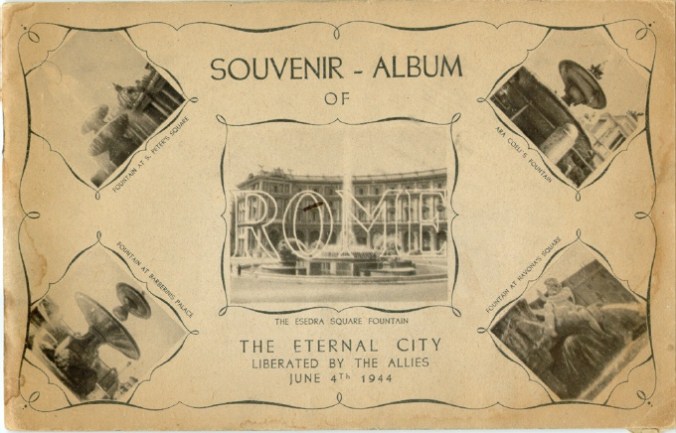
Souvenirs of Allies-Liberated Rome and Ancona

“Betta getta Vespa,” the history of the Vespa in 10 pictures

The Italian brand of scooter, the iconic Vespa, is manufactured by Piaggio. The name means wasp in Italian. The Vespa has evolved from a single model motor scooter manufactured in 1946 by Piaggio & Co. to a full line of scooters and one of seven companies today owned by Piaggio.
From their inception, Vespa scooters have been known for their painted, pressed steel unibody which combines a complete cowling for the engine (enclosing the engine mechanism and concealing dirt or grease), a flat floorboard (providing foot protection), and a prominent front fairing (providing wind protection) into a structural unit.
Post World War II Italy, in light of its agreement to cessation of war activities with the Allies, had its aircraft industry severely restricted in both capability and capacity.
Piaggio emerged from the conflict with its Pontedera fighter plane plant demolished by bombing. Italy’s crippled economy and the disastrous state of the roads did not assist in the re-development of the automobile markets. Enrico Piaggio, the son of Piaggio’s founder Rinaldo Piaggio, decided to leave the aeronautical field in order to address Italy’s urgent need for a modern and affordable mode of transportation for the masses.
A masterpiece was born!
An early Vespa poster above.

The UK is Vespa’s second largest market, see above.
For more on Vespa, see:
Unpredictable Florentine weather

We all grew up saying that “April showers bring May flowers.” And they do!
But, this year it is raining well into May as well. The weather has been very unsettled. Cold and raining one day, warm and clear the next. However, I am not complaining. The hot summer temperatures can wait as long as possible to arrive. When they hit, they are not unsettled in the valley that surrounds lovely Firenze. They arrive and stay, well past their welcome.
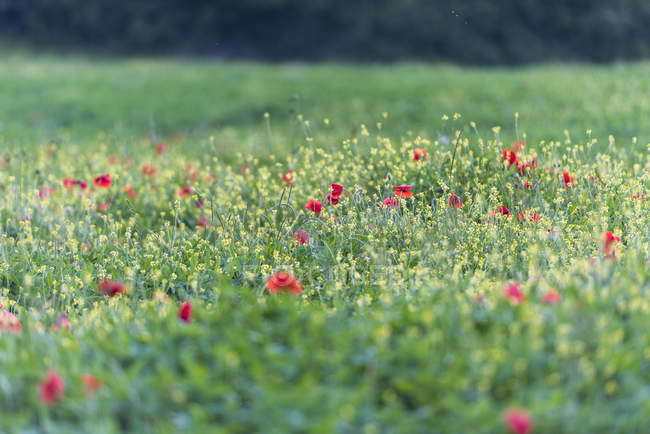
But, all this rain has the fields and hills around Florence alive with flowers! Yes, we do have flowers! Bright red poppies are everywhere, they grow wild and are a welcome sign that the fields are not being sprayed with pesticides or herbicides. On the train from Rome to Florence, this view below is a constant right now.
The grape vines are looking incredible, maybe this will be a great year for wine production.
However, the olive oil forecast is not as great. Local olive oil makers are already are warning that it looks like there will be little no oil this year. The olive trees should already be blossoming and they aren’t.

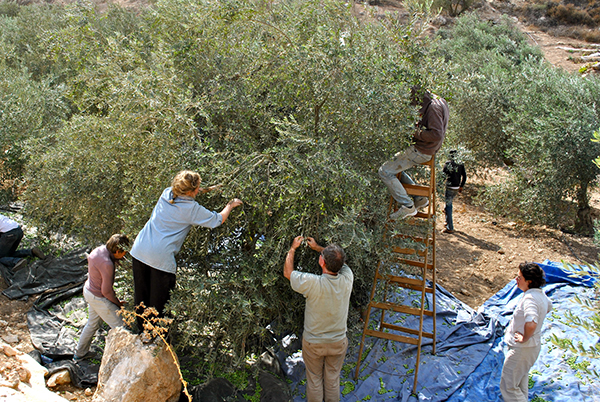
Maybe it will just be a late harvest. Olive harvest in the past was done in late November and through December. But, recently, due to the changes in the weather conditions, harvest now happens earlier.
Last weekend, was another religious holiday in Tuscany. It was Ascension Sunday which falls 43 days after Easter is often celebrated with flowers. Some towns decorate streets with designs created with petals, and others have large celebrations where you can buy lovely plants. Plus, great food and drink accompanies any holiday!
If you want to learn more about this moveable feast, then here you go:
The Ascension of Our Lord, which celebrates the day on which the risen Christ, in the sight of His apostles, ascended bodily into Heaven (Luke 24:51; Mark 16:19; Acts 1:9-11), is a moveable feast. When is Ascension?
How Is the Date of Ascension Determined?
Like the dates of most other moveable feasts, the date of the Ascension depends on the date of Easter. Ascension Thursday always falls 40 days after Easter (counting both Easter and Ascension Thursday), but since the date of Easter changes every year, the date of Ascension does as well.
Ascension Thursday Versus Ascension Sunday
Determining the date of Ascension is also complicated by the fact that, in many dioceses the celebration of Ascension has been transferred from Ascension Thursday (40 days after Easter) to the following Sunday (43 days after Easter).
Since Ascension is a Holy Day of Obligation, it is important for Catholics to know on which date Ascension will be celebrated in their particular diocese.
(See Is Ascension a Holy Day of Obligation? to find out which ecclesiastical provinces continue to celebrate Ascension on Ascension Thursday, and which have transferred the celebration to the following Sunday.)
https://www.thoughtco.com/when-is-ascension-541611
Good advice from Dante
Dante, the Divine Comedy: “Consider your origins: you were not made to live as brutes, but to follow virtue and knowledge.”
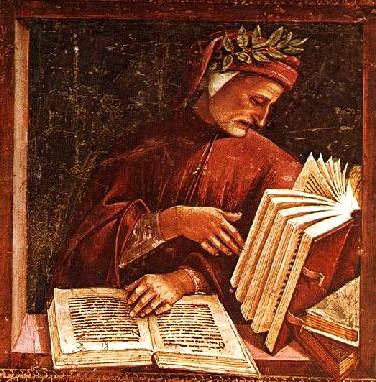
Florence was literally carved out of the surrounding rocky hills
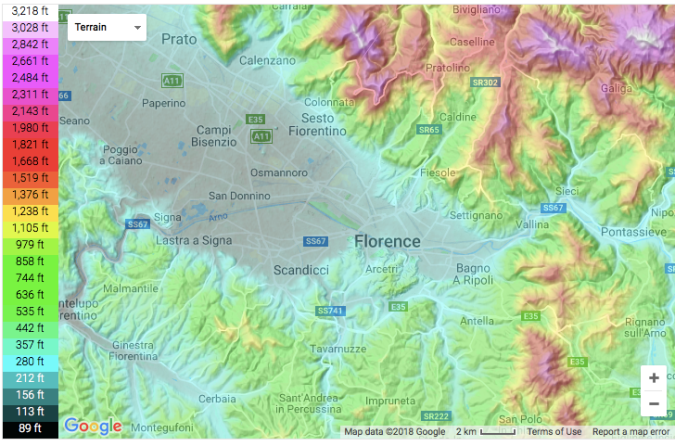
Quarries and their role in the construction of Florence
An itinerary through Tuscany’s ‘cave’
The Florentine, SEPTEMBER 8, 2006
Has it ever occurred to you that the stony city of Florence was literally carved out of the surrounding hills? It’s quite true. Countless local quarries provided the blocks of stone for the walls of medieval and Renaissance churches and palaces, and for the columns and architectural ornaments to decorate them. Pietraforte, a kind of light brown limestone, came from quarries at Costa San Giorgio, in the Boboli hill between Santa Felicità and Porta Romana, at Bellosguardo, and around Marignolle and Le Campore, all south of the Arno. To the north, the hills of Fiesole, Maiano and Settignano provided the blueish-grey sandstone pietra serena.
In the 13th century, load after load of pietraforte was hauled over the Arno to the outskirts of Florence to construct the enormous basilicas of Santa Maria Novella and Santa Croce. Even the piers inside these two churches are of pietraforte. Look at Palazzo Vecchio, the Log-gia dei Lanzi, the Bargello and Orsanmichele, and you are looking at pieces of the southern hills transformed into architecture. The gigantic blocks of rustication that you see on the façades of the 15th-century Palazzo Medici were cut out of pietraforte quarries. Filippo Strozzi, whose palace rivals that of the Medici in size, had endless loads of stone brought from quarries at Boboli and Marignolle. It is said that between November 1495 and March 1497, Strozzi’s heavily-laden carts rattled over the Arno more than a thousand times. At Palazzo Pitti, the builders had it much easier, since their source (the Boboli hill) was right behind the palace. In fact, Palazzo Pitti sits on the hollowed out part of one of these quarries.
If pietraforte was used mainly for the construction of walls, pietra serena was used above all for columns, stairs, doors and windows. The oldest of these quarries, dating back to Etruscan times, were at Monte Ceceri in Fiesole, and they continued to be worked during the Roman and early medieval periods. The demand for pietra serena was so high that in the 13th century new quarries had to be opened further east, around Vincigliata and Settignano. By the 15th century, when Brunelleschi’s architectural style boosted the popularity of pietra serena to unprecedented heights, it was also being extracted at Golfolina, west of Florence.
Brunelleschi chose quarries that would provide enormous blocks of pietra serena from which he could cut entire column shafts. He quarried the stone for the loggia of the Ospedale degli Innocenti at Trassinaia, near Vincigliata. The columns for San Lorenzo came from a site nearby, still known as the Cava delle Colonne.
http://www.theflorentine.net/art-culture/2006/09/quarries-near-florence/
Lauretta’s song
Lauretta makes a final plea to her father with “O mio babbino caro” (Oh, my dear papa), in Puccini’s Gianni Schicchi. Performed today in Fiesole in a Renaissance villa. Magical.
The quarries of Settignano, where Michelangelo lived
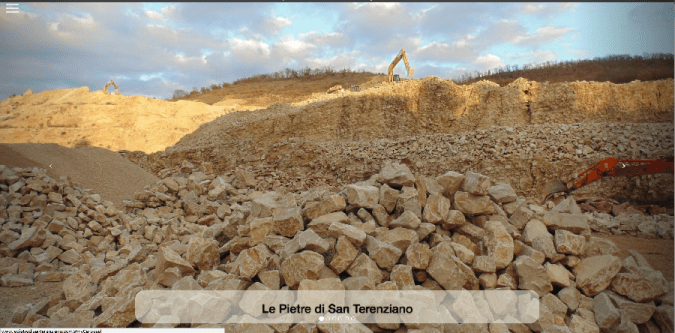
The Settignano quarries yielded macigno, a fine-grained grey sandstone that was much prized in Florence. It is a gravely beautiful material in a range of dark-greenish and bluish greys, fine enough to carve in crisp detail and with a quality of simultaneously absorbing and reflecting the light, producing a paradoxical impression of dark luminosity.
This is the material that Brunelleschi used for the columns and capitals of his buildings. Michelangelo would employ it in the same way in his projects at San Lorenzo in Florence.
The Florentines, being interested in this stone enough to make fine distinctions, gave names to the differing grades, the finest type being pietra del fossato, and the others including pietra serena and pietra forte.
Michelangelo, who had immense sensitivity to stone, went further than these broad categories. He knew that each quarry, every stratum, would produce material of subtly differing character. The contract for the stairs and two doors of the library Michelangelo was building at San Lorenzo in the 1520s stipulated that the pietra serena supplied should be of the same ‘colour and flavour’ (‘ colore et sapore’) as in the sample. ‘Flavour’ is a wonderful word to use of stone: bringing out its sensuous character as if it were actually edible.
When he designed buildings in Rome, Michelangelo was attentive to the qualities of the local material, travertine, a limestone noted for the pits and troughs in its surface – as different in its flavour and colour from Florentine sandstone as roast beef is from pâté de foie gras. His use of travertine for the walls of St Peter’s and the palaces on the Capitoline Hill made the most of its rugged nature.
For sculpture he used only the finest type of pure white marble, known as statuario, found particularly in certain quarries above Carrara. Even this sculptor’s marble, according to the sculptor and goldsmith Benvenuto Cellini, came in at least five or six grades, the first having a ‘very coarse grain’ and the softest, which he describes almost like flesh, ‘the most cohesive, the most beautiful and the tenderest marble in the world to work from’.
Michelangelo was renowned for his ability to discern the quality of a potential piece while it was still in the rockface. When he was engaged from 1516 onwards on large construction projects at San Lorenzo in Florence which involved the quarrying, transport, dressing and carving of huge amounts of both marble and macigno, a majority of the masons he employed were from Settignano.
Gayford, Martin. Michelangelo: His Epic Life (Kindle Locations 803-811). Penguin Books Ltd. Kindle Edition.
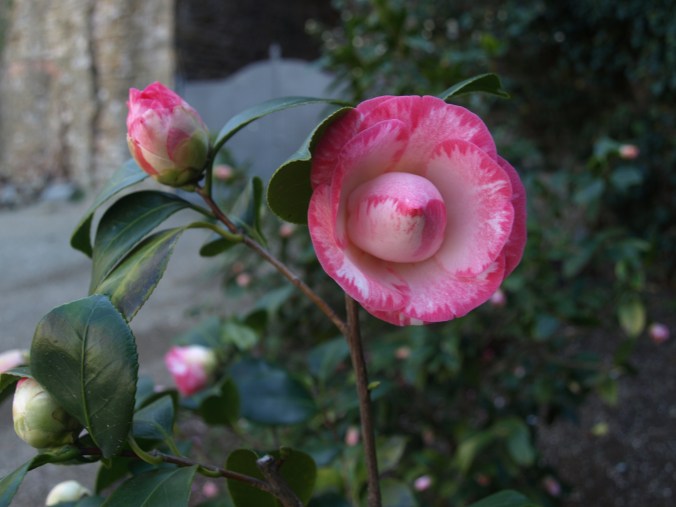
Spring equal camellias
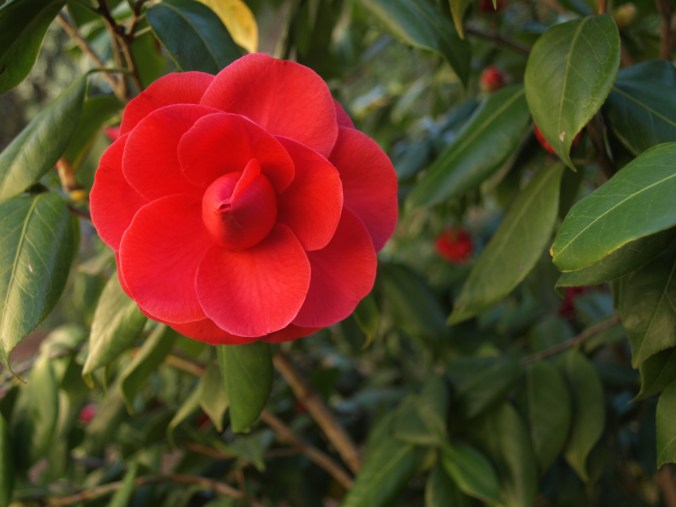
Are you a fan of camellias? I am.
Discover the Gardens in Italy where you can admire them!
OLYMPUS DIGITAL CAMERA

OLYMPUS DIGITAL CAMERA

OLYMPUS DIGITAL CAMERA

OLYMPUS DIGITAL CAMERA

OLYMPUS DIGITAL CAMERA
OLYMPUS DIGITAL CAMERA

OLYMPUS DIGITAL CAMERA
Today, beautiful specimens of Camellias can be admired in many gardens. Between Italy and the Canton of Ticino, from the first weeks of March and throughout April, it is possible to get lost among the colors and the scents of the Camellias in bloom. In Switzerland, in Locarno, a few miles from Lugano, is the Parco delle Camelie, inaugurated in 2005, to fascinate you with its 850 varieties of camellias cataloged, to which are added 70 still unidentified camellias , planted at the southern end of public paths, and 130 double camellias, which form a dividing hedge and are used primarily to provide cut flowers for the annual show held in spring.
In Tuscany the wonderful Viale delle Camelie of the Giardino della Villa Reale di Malia (Capannori, LU) is waiting to give you an unforgettable walk, while in Florence in spring the flowering of the camellia grove of the Giardino Bardini , placed behind the wonderful belvedere on the city.
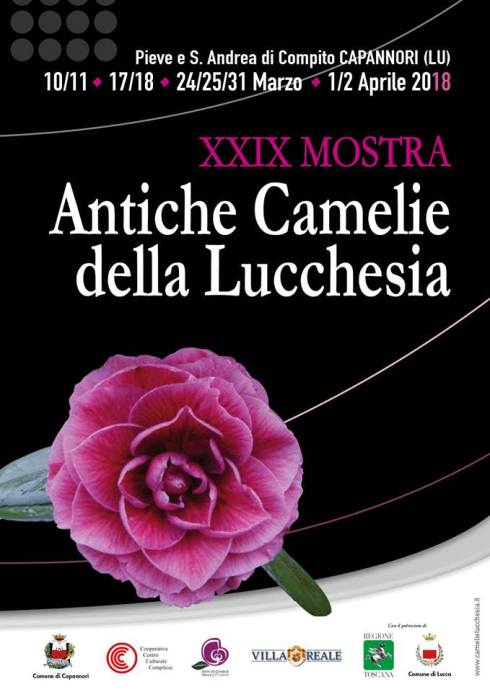
You can find more info here: http://www.grandigiardini.it/lang_EN/articoli-scheda.php?id=77
 get back, lauretta!
You must be logged in to post a comment.