The long history of dried pasta in Italy


images-2

Pasta has long been a part of Italian cuisine, but only quite recently acquired the dominant, pervasive role it plays now.

The oldest form is thought to be lasagna, which is known to have been cooked in ancient Rome, though not quite in the way it is today.

Dried pasta seems to have been invented quite separately, in North Africa, as expedition food for desert caravans. It was probably brought to Sicily by the island’s Muslim conquerors. In a codex published in 1154, a Moroccan geographer and botanist known as al-Idrisi described a thriving pasta manufacturing industry near Palermo, which exported its products to Muslim and Christian countries alike. Among them was a stringlike pasta then known by the name itrija.

Dried pasta had the same advantages for seafarers as it did for camel drivers, so it is hardly surprising that it next appears in Genoa.

It is mentioned in a document written in 1279, and production of vermicelli, which was to remain a Genoese specialty, had begun by the fourteenth century.

The consumption of pasta continued nevertheless to be associated with Sicilians until in the 18th century the nickname of mangiamaccheroni gradually came to be bestowed on the Neapolitans. By 1785, Naples had 280 pasta shops.


Hooper, John. The Italians (pp. 99-100). Penguin Publishing Group. Kindle Edition.


Wrapping purchases

The time and care expended by shop assistants in Italy on the wrapping of gifts can be astonishing.

GetImage.ashx

The cost of the purchase is irrelevant. The same care will be taken in wrapping a discounted paperback book or a pair of diamond earrings.

26057_XXX_v1

Blithely indifferent to the queue building up behind you, the assistant will patiently fold over corners to form perfect isosceles triangles, use different-colored (but always exquisitely contrasting) wrapping paper to create diagonal stripes across the package, and then tie it with a length of ribbon that is made to end in delicate spirals.

The finished package will then be handed to you with aplomb.

Hooper, John. The Italians (pp. 77-78). Penguin Publishing Group. Kindle Edition.

Sheer enthusiasm for beauty

IMG_5731IMG_5734IMG_5639

That is another reason for the importance of what is visible: the sheer enthusiasm for beauty that infuses life in Italy. Unless they go back to classical times, Italians cannot take pride in a glorious imperial past. Even the Venetian Empire was pretty small beer when compared with the empires of Spain and Portugal, or more recently those of Britain and France. There were moments when the states of central and northern Italy were richer than any in Europe.

IMG_5576


And from Galileo Galilei to Enrico Fermi, Italians have more than held their own in the area of scientific discovery. But their truly outstanding contributions to mankind have been in the arts, and particularly the visual arts.

Historically, Italians have stood out in anything that has to do with what is visible, be it the art of the Renaissance or modern car design.

The areas in which they have excelled include painting, architecture, sculpture, cinema and of course opera, which gives visual expression to music.

As for fashion, they have been setting international trends since Shakespeare had York in Richard II cite Report of fashions in proud Italy, Whose manners still our tardy apish nation Limps after in base imitation . . .

Hooper, John. The Italians (p. 76). Penguin Publishing Group. Kindle Edition.

Sirmione del Garda, Italy; from Roman ruins to the villa owned by Maria Callas

I sometimes feel as though I have run out of superlatives.  I think I’ve used all of the big words that I know so many times in describing this miraculous land, that there’s nothing left.

And then there is Sirmione del Garda.  I guess I’ll just start from scratch and use them all over again!

Lake_Garda_-_View_from_Monte_Baldo

First, a map.  Lake Garda, located in northern Italy (in the province of Brescia, in Lombardy) is the largest of the lakes in Italy and has a very peculiar, vertical shape.

170px-Lago_di_Garda_venti    Lake_Garda_Sirmione_map


And then, at the middle of the southern end of lake is a peninsula of land, also essentially vertical.  At the north end of the peninsula is the charming village of Sirmione.


data=blKwDyaKGKrSac2mGBnnETVHgqS6zKAjeYJJfsxJPvoTz1-a9Dx3h_38yASb4v0icifDUNnkOdyB0VerNyCLRFSTEDEQJHvGBuTk67VARVV0QXSuqARWY1VOH68b7OONAVZJhaKmkHxz0V8jSmtUWrZKo13tEhi_r4oIS0rrWjfIfeagFPwSW


Sirmione is one of the most popular towns of all on the beautiful Lake Garda, with thousands of visitors flooding in each day to view the picturesque peninsula. Amazingly to me, it may not be the best known place to stay for a lake holiday in Italy, but with its castle and Roman ruins, not to mention its contemporary little village, it should be, because its got something for everyone.

We know that Sirmione has been settled since the Stone Age, with early finds showing that there probably was a small village of fishermen living in houses on stilts along the banks of Lake Garda.

Starting from the 1st C. BC, this area became a favorite resort for rich families coming from Verona, then the main Roman city in NE Italy.  The poet Catullus praised the beauties of Sirmione and spoke of a villa he had there.

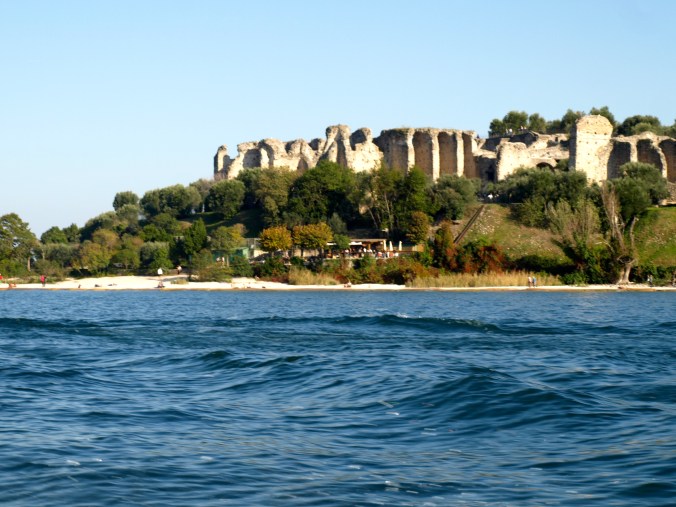
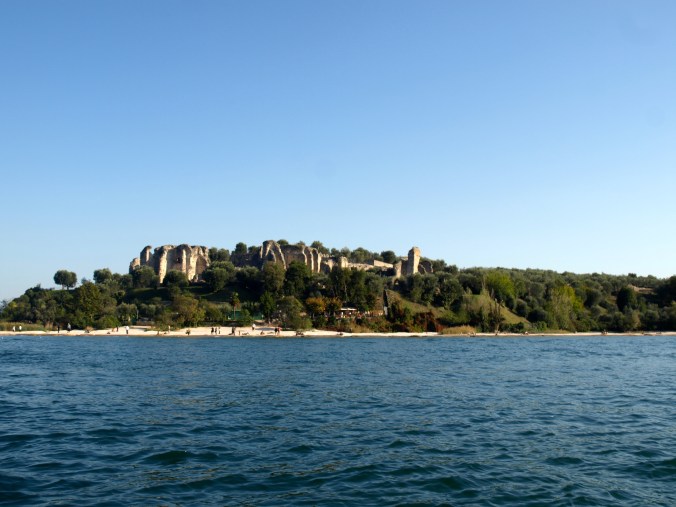
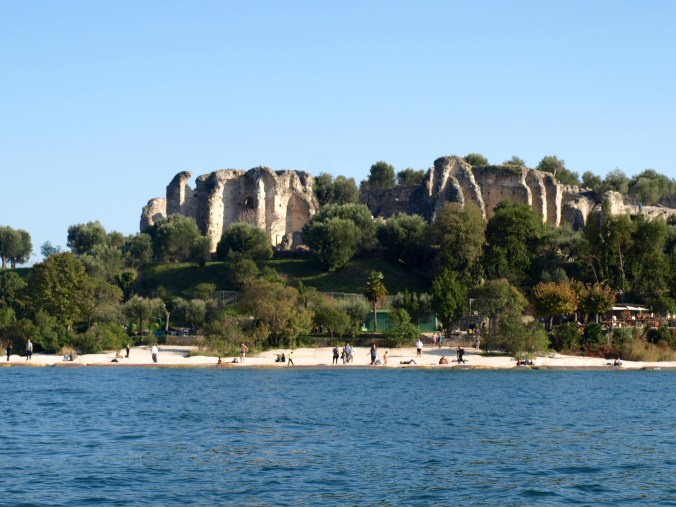
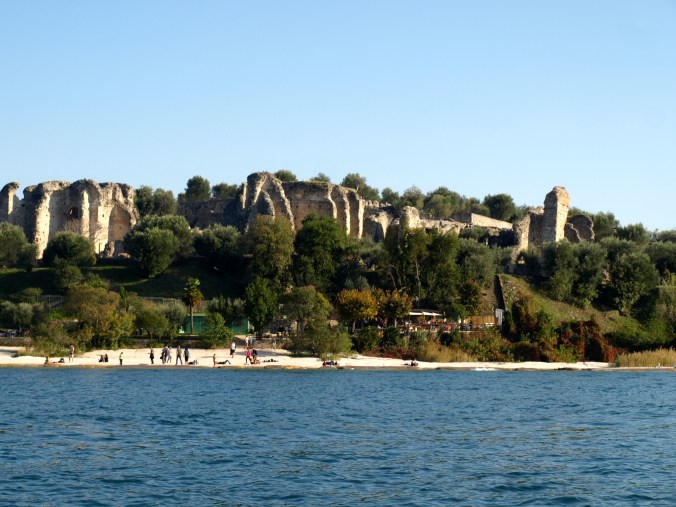
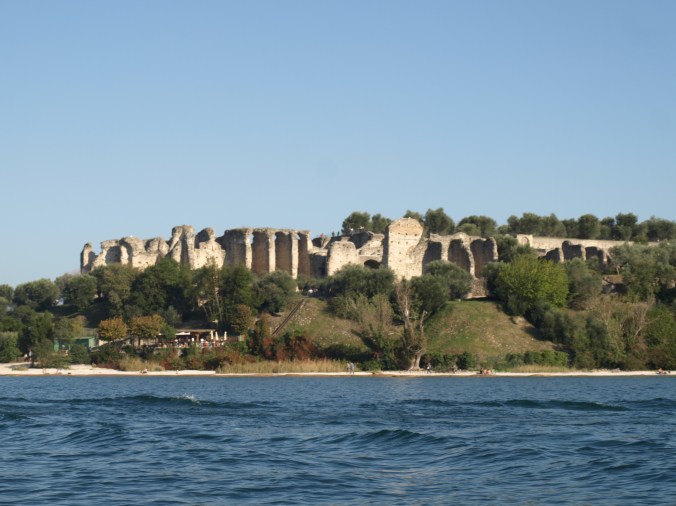
Rich Romans, for example, built holiday villas on the end of the peninsula, and one still exists: the so-called Grotte di Catullo.  On the furthest point of the peninsula are these extant ruins of a patrician Roman villa.  It was no doubt constructed for some rich family and includes a 3-story building, dating to c. 150 AD.

Although this extensive ruin goes by the popular name of the “Grotto of Catullus,”  it is neither a grotto nor was Catullus still living (he died in 54 BC) when the villa was built.  Today there’s a small museum at the site. The ruins are the most striking example of a Roman private edifice discovered in northern Italy, and had a rectangular plan and measured 167 x 105 m.
OLYMPUS DIGITAL CAMERA


OLYMPUS DIGITAL CAMERA


OLYMPUS DIGITAL CAMERA


OLYMPUS DIGITAL CAMERA


OLYMPUS DIGITAL CAMERA


Moving forward in time, by around the year 1000, Sirmione was probably a free comune, but fell into the hands of the Scaliger by the early 13th century.

Since the town occupies such an important strategic point, the penisula was continually engulfed in the always turbulent (and sometimes hideous) history of northern Italy.  It was invaded numerous times after the fall of the Roman Empire, was subject to the conflicts involved in the expansion of the Lombards,  and was the site of the intricate struggles between the Guelphs and the Ghibellines in the Middle Ages).

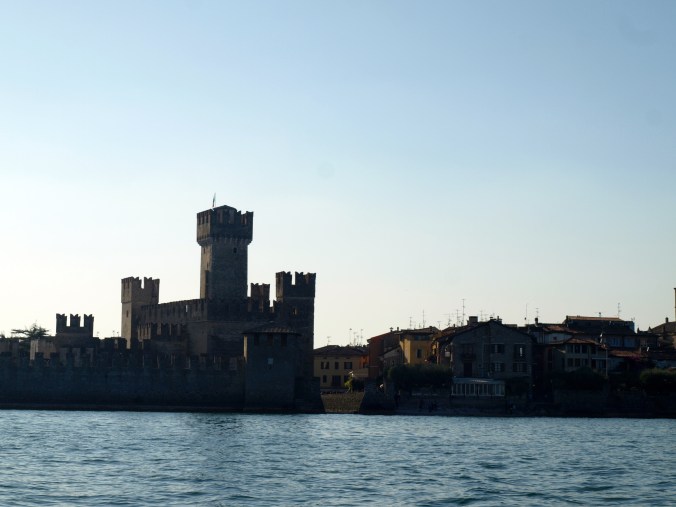
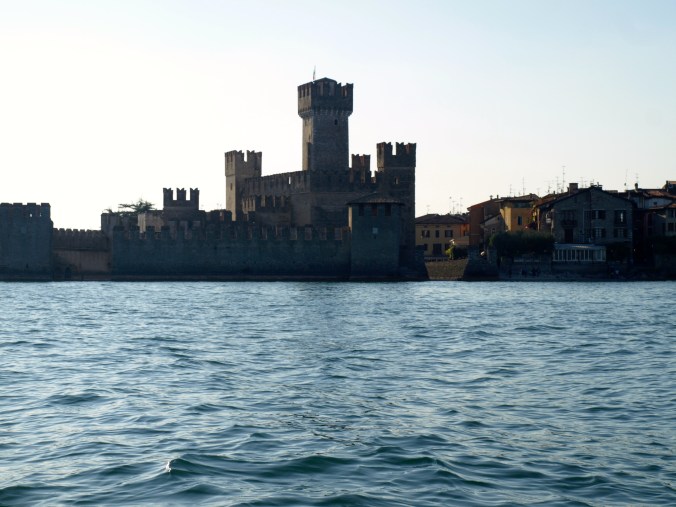
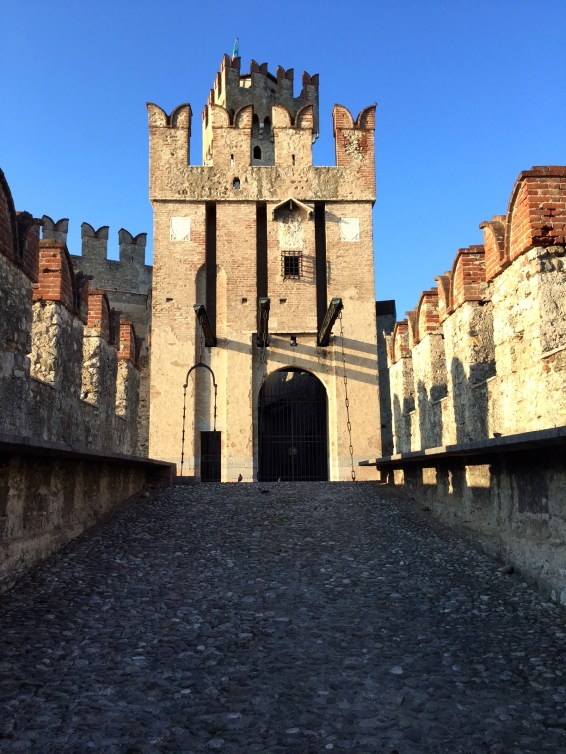
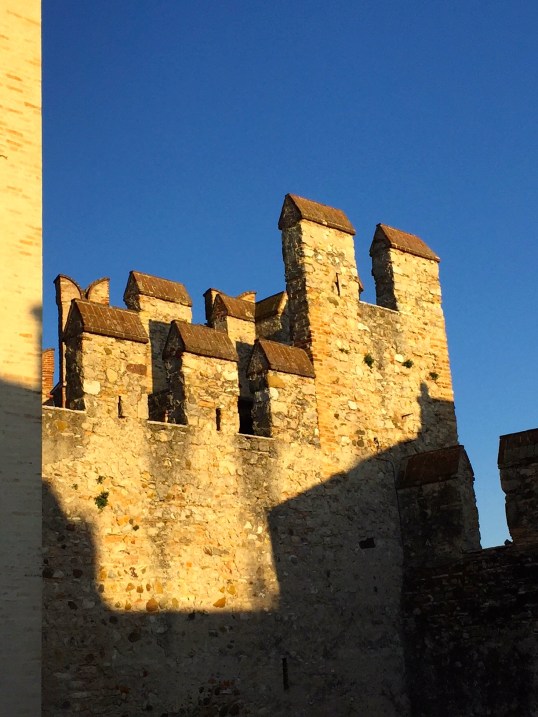
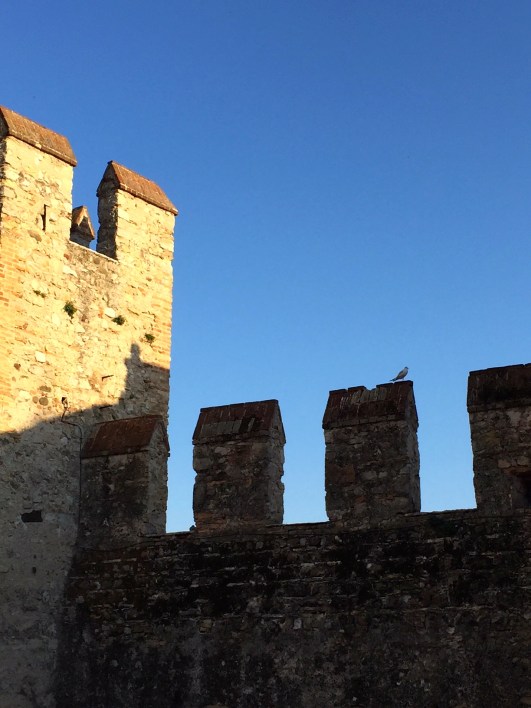
The last of those struggles left Sirmione with its major landmark: the Scaliger Castle (its proper name is the Rocca Scaligera.)
IMG_5758

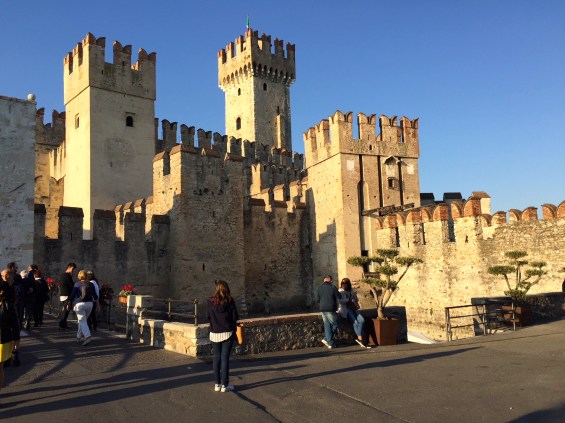
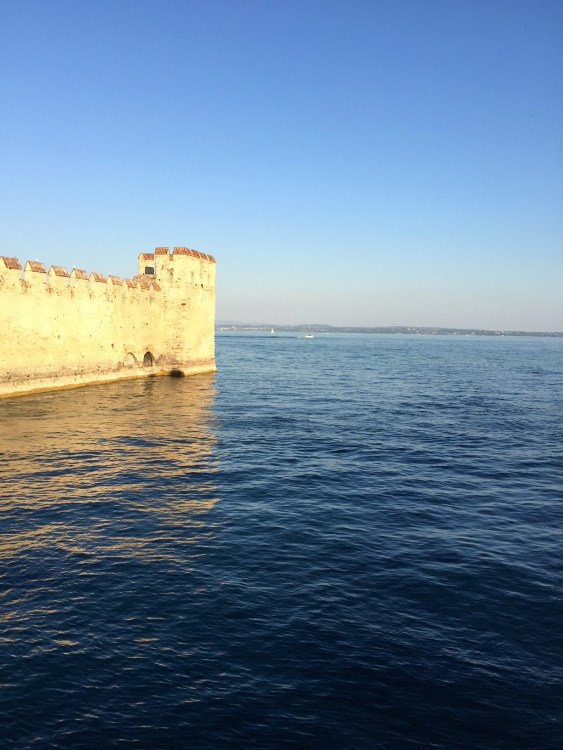
The Scaliger Castle is surrounded by water–as if in Venice– and was built in the late 12th century as part of the defensive network surrounding nearby Verona.  By this time, Sirmione was home to the so-called heretical Cathars, who were to be driven out during the Guelph/Ghibelline struggle.  In fact, 2,000 of the Cathars were burned at the stake in the Arena in Verona.
IMG_5756


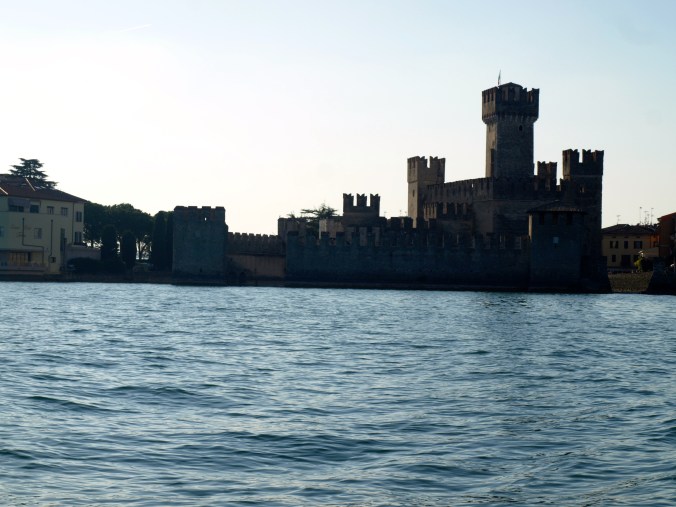
The Scaliger castle provides a rare example of medieval port fortification, and was used by the Scaliger fleet.  The complex was started in 1277 by Mastino della Scala.

The walls on the inside were finished with plaster with graffiti, simulating blocks of stone.

The castle stands at a strategic place at the entrance to the peninsula. It is surrounded by a moat and it can only be entered by two drawbridges. The castle was established mainly as a protection against enemies, but also against the locals.

The main room houses a small museum with local finds from the Roman era and a few medieval artifacts.
 

IMG_5760


Below are shots of the  extensive castle complex taken from the lake:
OLYMPUS DIGITAL CAMERA


OLYMPUS DIGITAL CAMERA


OLYMPUS DIGITAL CAMERA


The castle was maintained and extended as the Veronese sought to safeguard the area from its Milanese rivals.  Later Sirmione was under the control of the Venetian inland empire from 1405 until the end of the 18th century.  It was acquired by the Habsburg Empire in 1797.  It became a part of the Kingdom of Italy in 1860.

In the castle complex, we have the typical Ghibelline swallowtail merlons and the curtain-walls (with three corner towers) in pebbles alternating with two horizontal bands of brick courses.
IMG_5752


Although its strategic position in the southern end of the lake, and the defensive qualities of the peninsula, meant that it was of military importance over the years. But the beauty of the setting also meant that it was – and still is – a popular place for recreational destination. After the fall of the Venetian Republic, Sirmione was more sedate and its fortunate citizens were able to concentrate their focus on the fruit orchards, olive groves, and lake fisheries.
IMG_5753

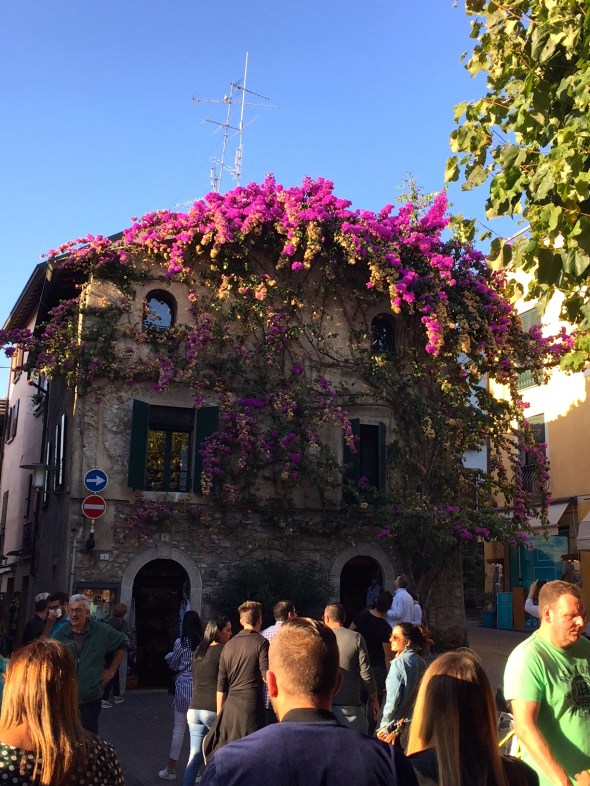
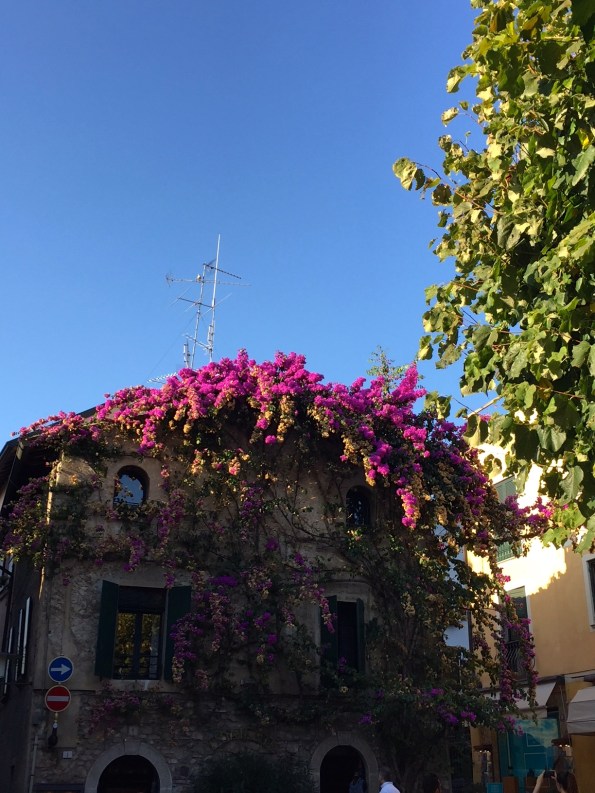
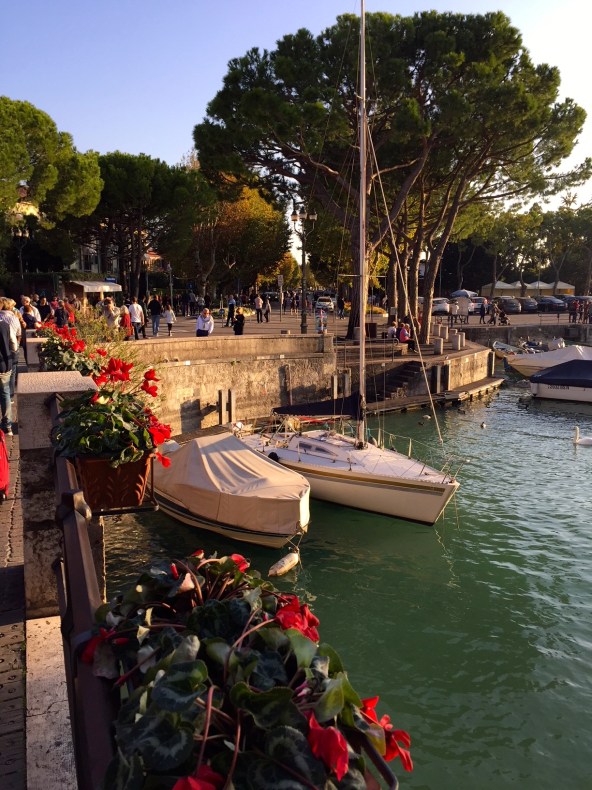
Here are just a few pictures of the pleasures of the amazingly picturesque village itself:
IMG_5754


IMG_5733

IMG_5734


IMG_5735


IMG_5736


IMG_5738


IMG_5739


IMG_5740


IMG_5741


As if Sirmione wasn’t already blessed enough with an amazing location, it also has thermal baths. The town is famous for these thermal springs.  The Terme di Catullo uses the water that bubbles out of Lake Garda on the northeast shoreline area.

In the late 19th-century, a diver managed to insert a metal pipe into a rock near the underwater hot-springs, and this allowed the diversion of the naturally heated water to the northern end of the peninsula.  At that time, it was also discovered that the Roman Period inhabitants had already discovered and diverted (also through metal pipes) the thermal springs, and in fact, the so-called Grotto of Catullus may have been a bathhouse, not a villa. At any rate, the thermal water, which is mineral rich and naturally heated to 70 degrees Centigrade when it leaves the underwater rock, is now used for health treatments in two of the thermal baths and spas on the peninsula.

If you look hard, you can see the bubbles coming up through the water.  I was on a boat and we were hovering over the underwater hot springs:

OLYMPUS DIGITAL CAMERA


And finally for today, the Villa owned by Marie Callas:

images-2

images-3

What are you waiting for?  Go to Sirmione!


Pleasantly normal life

Life, in other words, is returning pleasantly to normal. And in many respects, normal life in Italy— at least in the way it has evolved in recent decades— is decidedly pleasant. There is the beauty of the cities and the countryside, the elegance of the clothes and, of course, the sunshine.

1441038249_rsz_4932112571_f02d285005_zOLYMPUS DIGITAL CAMERAIMG_5407

Hooper, John. The Italians (p. 94). Penguin Publishing Group. Kindle Edition.

Autogrill shopping trips

It is well documented that I love spending time (and money!) in Italian grocery stores.  No doubt about it.

But, you should see the Autogrills!  Auto grills are the amazing coffee bars, cafeterias, and, of course, gas pumps, that are situated along the autostrade in Italy.  I never, ever miss the opportunity to wander through one of these amazing places, not ever!

Last night I was returning to Florence from a trip to the Verona area, and stopped at an autogrill that was almost unbelievable (in its greatness.)  It was late and I was tired and so, unfortunately, I didn’t take as many pictures as I normally would have.

But, I did snap a couple of pics.  The following one shows the “honey section” of the autogrill.  The autogrill has a honey section!!  A big one!!


IMG_5769IMG_5772


You can click on the “watch on Facebook” words below to see the vanilla gelato machine, in the autogrill!, at work.  It was one of only 8 flavors available, of freshly made ice cream late on a Sunday evening.  What the hey?  Too cool for school.


I can’t wait to get back to another autogrill!

It’s a girl!

Here’s how you announce the birth of a child in Italy.  Pink for a girl, ovviamente, and blue for a boy.


IMG_5632IMG_5633

Translation of the handwritten notice: “Children know things that the major part of humanity has forgotten.”  A lovely sentiment, indeed.


IMG_5634

Benvenuta, Giulia!  Welcome to the world.  Lucky you, to be born in Florence!

All babies are welcomed into Italy because the country has one of the lowest birthrates in the world!

Easily entertained.

(From the sublime [Room with a View, yesterday’s post] to the ridiculous [frozen spinach}:)


I’ve said it before and I’ll say it again:  I am endlessly fascinated by Italian grocery stores!

Look at this cool product in the frozen section.

IMG_5603


It’s for those cooking moments when you want to add some healthy greens to the pot of minestrone you are whipping up, etc.  I can think of endless uses for these frozen cubes of spinach!  Add to smoothies, stir into sauces,…the options are many!

IMG_5604

Absolutely ingenious!

Italy’s immense appeal

I often think Italy is too popular for her own good.  When I pass through the piazza del Duomo in the middle of the day, on a nice day I can barely move through from the sheer numbers of tourists.  The trash trucks and street washers (a type of vehicle) travel up and down the streets all of time, picking up after the people.

On the flip side, Italy reacts in general to the immense tourist population by constantly opening new sites to appeal to them.  As someone who has visited Italy a lot over the past 30 years, I am constantly amazed when I learn new archaeological sites, for example, are newly available to be visited.  As below.