Lauretta makes a final plea to her father with “O mio babbino caro” (Oh, my dear papa), in Puccini’s Gianni Schicchi. Performed today in Fiesole in a Renaissance villa. Magical.
Lauretta makes a final plea to her father with “O mio babbino caro” (Oh, my dear papa), in Puccini’s Gianni Schicchi. Performed today in Fiesole in a Renaissance villa. Magical.
 Amici Della Musica
Founded in 1920, the Amici della Musica or Friends of Music is one of the oldest and most prestigious concert groups in Florence. The group presents some of the best works and performers on the international scene. And its home is the beautiful Teatro della Pergola, Florence’s oldest theater built in in 1656, so you can enjoy a wonderful Florentine evening from boxes once maintained for the private entertainment of the city’s aristocracy and social elite.
There is surely also much scope, now that Italian performers have become experts in this field, for further exploration of the Baroque repertoire, not to mention the grandsopéras of Meyerbeer, which were staged for the first time in Italy at the Pergola in the mid-nineteenth century and have been absent from the Maggio Musicale since the 1971 production of L’Africaine with Jessye Norman. The neglect of the French repertoire in general has been one of the weaknesses of operatic programming in Florence. It is hoped that the galvanizing presence of the new general manager will succeed in breaking down this barrier, too. 
For more, see http://amicimusicafirenze.it
I’d say SI to that! I was lucky enough to attend the production of Bizet’s Carmen at Maggio Musicale Fiorentino in Florence tonight, and I’m a believer!


Opera in Florence has often functioned most successfully when pursuing the intellectual curiosity of a cultivated elite rather than the lowest common denominator of popular taste.
In 1933, when conductor Vittorio Gui initiated Italy’s first large-scale festival, the Maggio Musicale Fiorentino, he conceived it in terms of a cultural mission: reviving forgotten masterworks (such as Spontini’s La Vestale, starring Rosa Ponselle in her only Italian performances) and revisiting the standard repertory with a teasing touch of sophistication (De Chirico’s provocatively modernistic sets for Bellini’s I Puritani).
Two years later, Rossini’s Mosè and Rameau’s Castor et Pollux were staged, and for three decades Florence became one of the few places in the world where Baroque opera and rare works by Rossini got a hearing with any regularity.
It was in this city that Renata Tebaldi had a chance to sing Rossini’s Assedio di Corinto (1949) and Spontini’s Olimpia (1950), and it was here alone that Maria Callas could be heard as Haydn’s Euridice (1951) and Rossini’s Armida (1952).
From that same period, Bruno Bartoletti — who has himself enjoyed an incomparably long and decidedly fruitful association with the festival — recalls the revelatory musical cogency of Dimitri Mitropoulos’s conducting in Puccini’s La Fanciulla del West (1954). And Bartoletti himself was protagonist — as conductor of Berg’s Wozzeckand Shostakovich’s The Nose — of the innovative 1964 Maggio Musicale, devoted to Expressionism.
Since then, Florence has continued to attract some of the world’s greatest musicians. Riccardo Muti was principal conductor here from 1968 to 1980, and since taking over in 1985, Zubin Mehta has upheld the highest standards of orchestral playing; but the festival has undeniably lost its cutting edge.
One of the reasons is that Gui’s highly individual mission has by now become standard strategy for many music festivals worldwide, making it difficult for the Maggio Musicale to stand out amid the competition. Another reason is that increasingly cumbersome productions have made it arduous to stage two or more operas simultaneously.
In spite of intermittent use of the intimate seventeenth-century Teatro della Pergola, as well as the much larger Teatro Comunale (an acoustically problematic venue, first opened in 1862), it has seldom been possible in recent decades to see at least two operas on consecutive nights — for most visitors, the principal appeal of any festival experience.


I took a stroll on a recent Saturday to have a better look at the actual Teatro Maggio in Florence. There were no performances this particular weekend; I just wanted to have a good look at the joint.


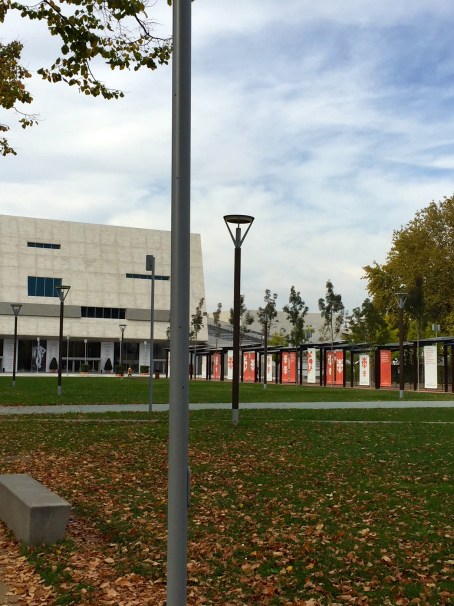


This building is so modern it feels almost out of place in Florence!


 get back, lauretta!
You must be logged in to post a comment.