Inexpensive paper helped fuel the Renaissance.

A plentiful supply of paper – just as much as the study of ancient sculpture or single-point perspective – was among the factors that led to what we call the Renaissance. It allowed artists to think and work in different ways, a transformation as significant as the Internet and computer technology have been in the early twenty-first century.

Not, of course, that paper itself was a new material in the fifteenth century. On the contrary, it had first been made in China a millennium and a half previously; but the recent availability of paper was a knock-on effect of another innovation: the invention of moveable type by Johann Gutenberg of Mainz.

By 1450 Gutenberg had set up a commercial printing press, and by the 1460s presses began to be established in Italy. As soon as that happened, there was a greater demand for paper, so more paper mills were built.

The main alternative for drawing had been vellum – scraped and burnished calf-, sheep- or goat-skin – which was luxurious and labour intensive to prepare. The price list of a Florentine stationer’s from the 1470s lists vellum as fourteen times more expensive than paper.

Paper, however, was still quite a costly material. That was why artists often used both sides of a sheet; it was too valuable to waste.

So, after Ghirlandaio had used a piece of paper to work out the composition of The Visitation, one of the frescoes for the Tornabuoni Chapel, in a flurry of rapid pen strokes – establishing the positions of the figures, jotting down the background architecture – the paper was then turned over and used as a cartoon for a piece of classical moulding framing the scenes.

A series of holes was then pricked through, following the lines of the egg and dart and palmette motifs, and charcoal or black chalk dust forced through them to transfer the lines to the wall.

Always acutely cost-conscious, Michelangelo was an especially assiduous recycler of used paper, sometimes searching through the litter in his studio for a useable scrap and coming up with a sheet he had drawn on years before but which still retained some blank space.

As a result, Michelangelo’s drawings, even more than those of, say, Leonardo, are palimpsests on which one may find jostling each other sketches and studies for various projects side by side with drafts of poems, stray remarks or quotations that seem to have drifted through his mind, lists of expenses and other items that are apparently not by Michelangelo at all. His correction of another apprentice’s attempt to copy those

Gayford, Martin. Michelangelo: His Epic Life (Kindle Locations 1045-1054). Penguin Books Ltd. Kindle Edition.

Yesterday, Museo di Novecento, Florence

IMG_8168

Florence and the twentieth century: a stormy relationship between love and hate, rich in avant-garde art, and full of controversy. The city of the Renaissance during this period is represented in the Museo Novecento (20th Century Museum), which opened in 2014, in Piazza Santa Maria Novella.
IMG_8169IMG_8171

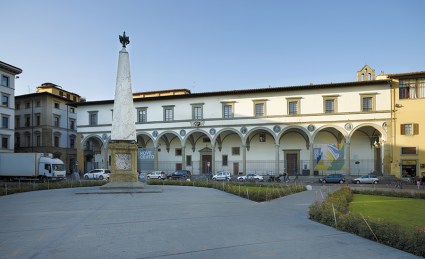
The museum is housed in the Hospital of St. Paul, which was founded at the beginning of the 13th century as an area of ​​refuge for pilgrims and the poor.

Ex-Hospital of San Paolo in Firenze, piazza Santa Maria Novella

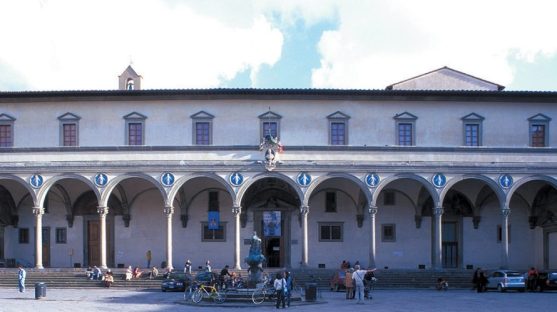
The building was expanded in the later 15th century. The construction of the front porch was assigned to Florentine architect Michelozzo, although for a long time it was thought that it was actually built by Filippo Brunelleschi, because of its similarity to his famous Loggia of the Hospital of the Innocents in Piazza Santissima Annunziata, seen below:
832-land_0-loggiato_panoramica2


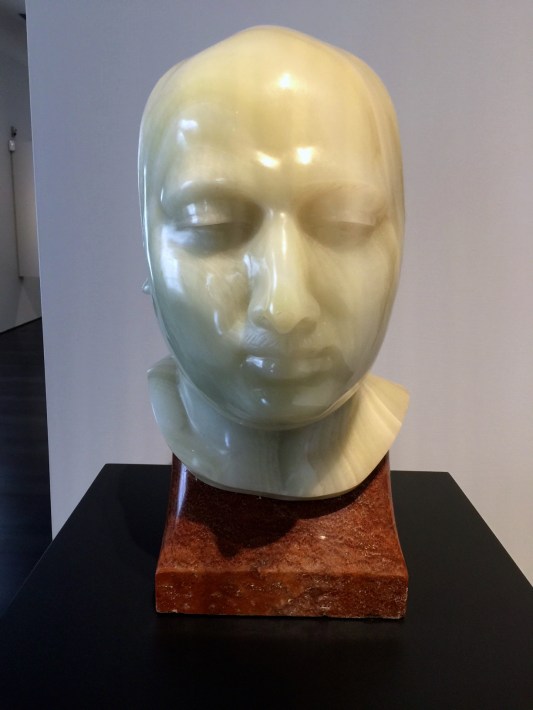
The museum houses an interesting collection of 20th century art.
IMG_8172

In 1588, under Grand Duke Ferdinand I, the Hospital of St. Paul became a place to accommodate convalescents who came from hospitals in Florence.

In 1780 the building’s function was altered by Leopold Lorraine as a place to provide education for poor girls, and therefore became known as the Leopoldine Schools. After World War II it was converted into a school. Now, after a long restoration, the complex houses the 20th Century Museum in Florence.
Museo-Novecento-Avatar-01

After the Arno River’s devastating flood in 1966, much of Florence’s artistic heritage was damaged. The art critic Carlo Ludovico Ragghianti launched an appeal to artists from all over the world to endow the city with their works of art. Two hundred artists responded to the call.

At the time the art was donated to the city, there was no real home for them. Many works of art remained behind closed doors in municipal depositories for years awaiting a suitable location. These works are thus considered the first original nucleus of the Museum.
IMG_8160


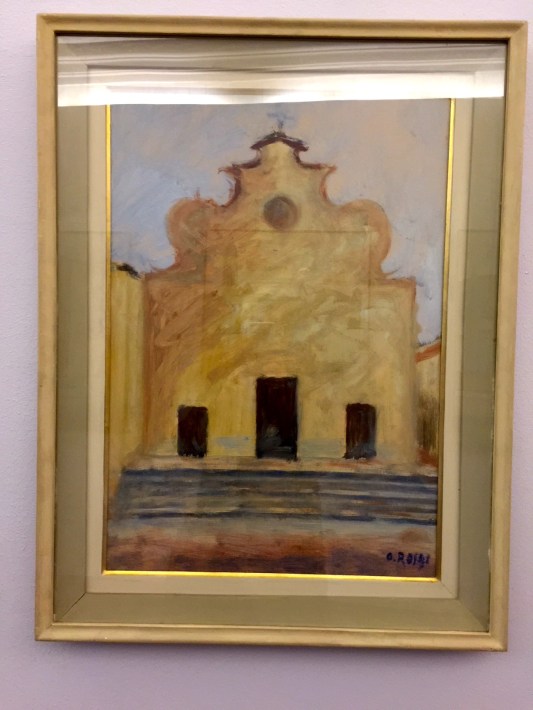
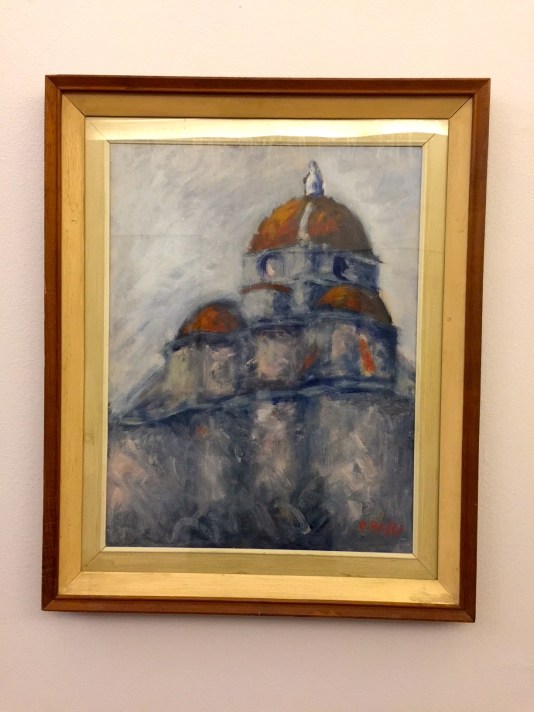
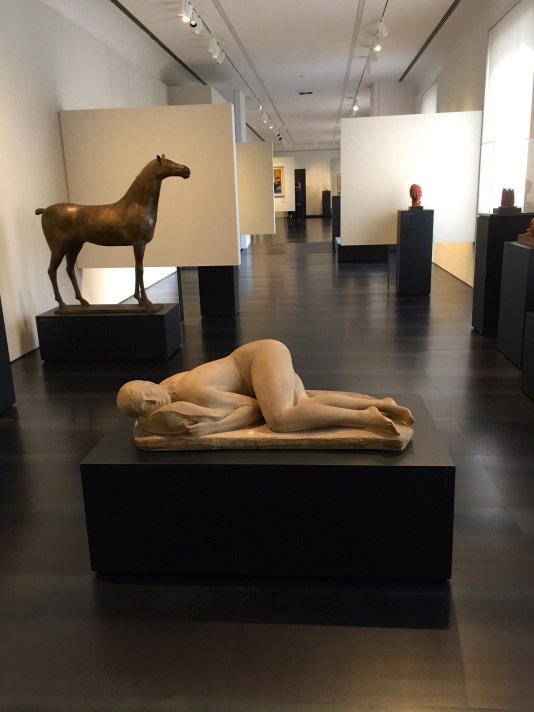
Today the halls of the Museum contains paintings and sculptures, art films, the works of the Maggio Musicale Fiorentino, and displays devoted to electronic music. Among the artists on display permanently are De Chirico, Morandi, Emilio Vedova and Guttuso, Ottone Rosai, as well as Florentine sculptors such as Antonio Catelani, Daniela Di Lorenzo and Carlo Guaita.

When I was at the museum yesterday, I took pictures of some of the most interesting (to me) artworks.  For example, I enjoyed these images of Florentine landmarks:
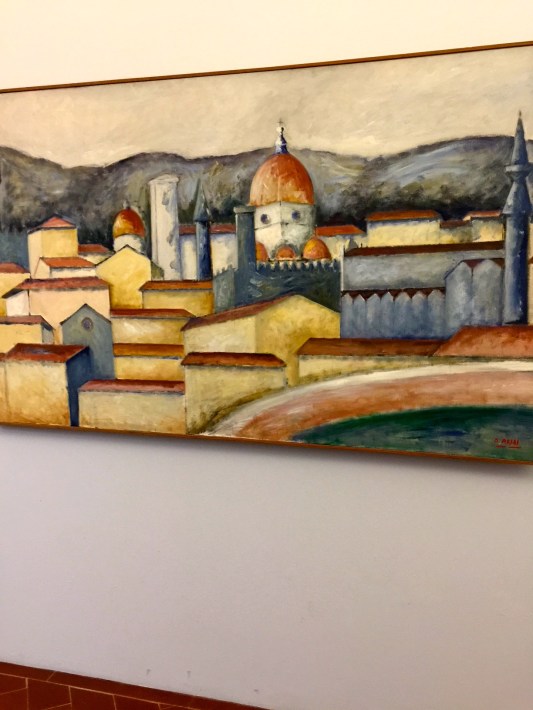
IMG_8165IMG_8166IMG_8167


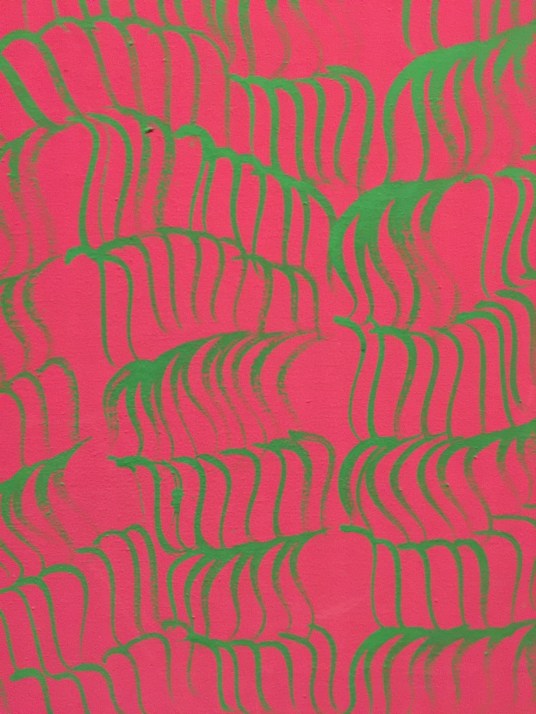
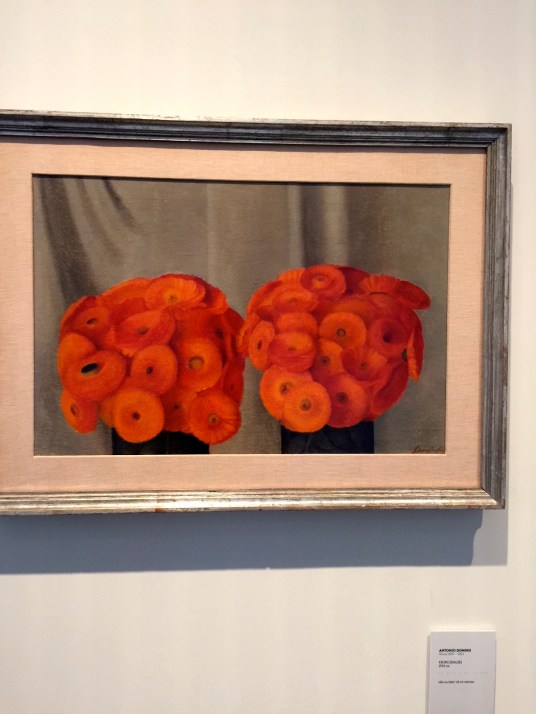
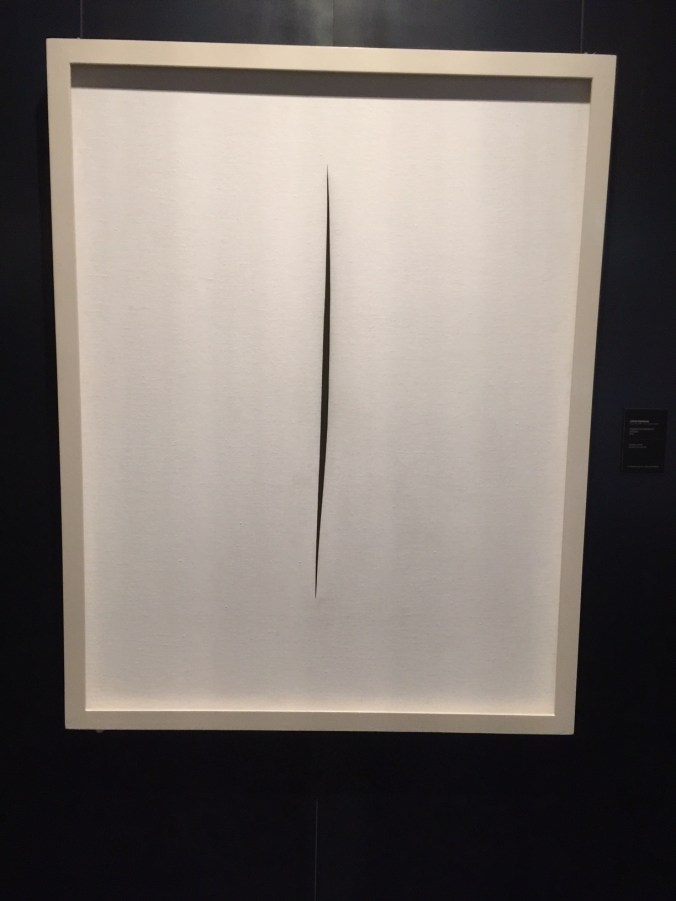
And was stopped in my tracks upon encountering this painting.  It felt so fresh in comparison to all the other works in the museum.
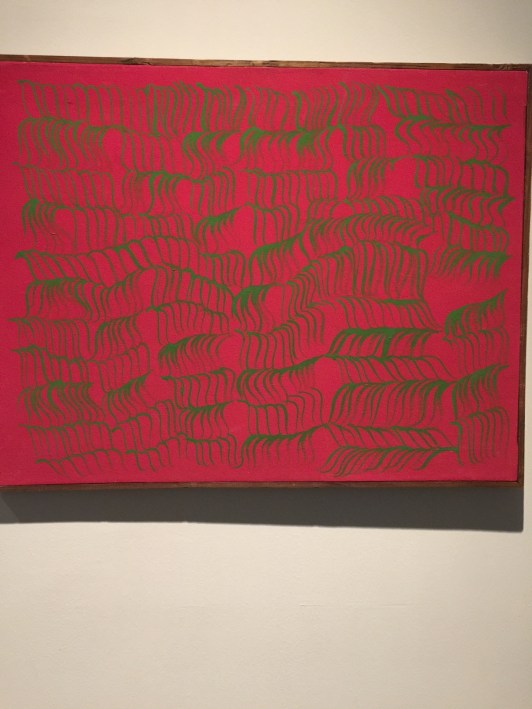
IMG_8158

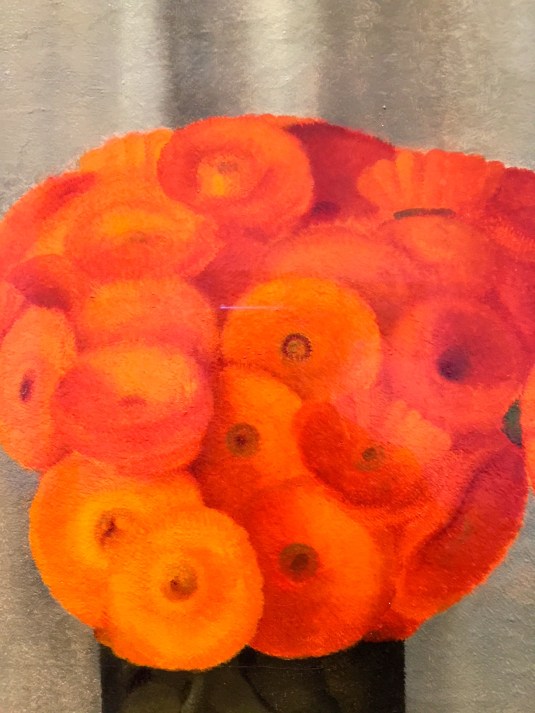
Here’s a close-up:

IMG_8159

If you are visiting Florence and need a break from Renaissance madonnas, you might find some relief at the Museo Novecento.
The virtues of a painting, according to Leonardo


aHR0cDovL3d3dy5saXZlc2NpZW5jZS5jb20vaW1hZ2VzL2kvMDAwLzAxNi82NDIvb3JpZ2luYWwvbW9uYS1saXNhLmpwZw==

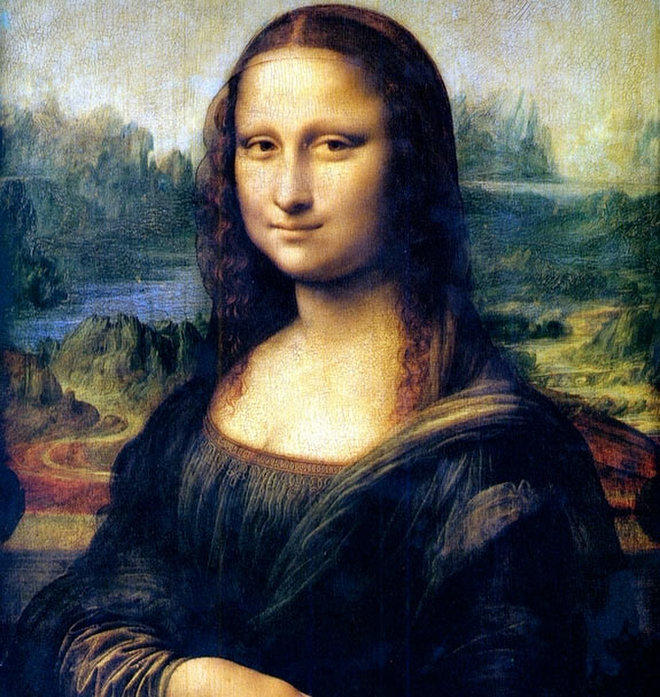
The Mona Lisa was, when finally completed, a supreme demonstration of what, in Leonardo’s view, painting could do: create misty distances, delicate colours, soft naturalism, convey the mysteries of human emotion through facial expression and, in the vast landscape behind Lisa, provide a mirror of the cosmos: ‘sea and land, plants and animals, grasses and flowers, all enveloped in light and shade’.

Gayford, Martin. Michelangelo: His Epic Life (p. 187). Penguin Books Ltd. Kindle Edition.

Would you be surprised to know that Leonardo was a snob?

He was, when it came to his assessment of the forms of art, from highest to lowest.

For example, among the different varieties of sculpture, Leonardo believed stone-carving (which is what Michelangelo preferred as his medium) to be the lowest form: messy, unpleasantly physical, plebeian (a snobbish view that echoes Lodovico Buonarroti’s): The sculptor in creating his work [he wrote] does so by the strength of his arm and the strokes of his hammer by which he cuts away the marble or other stone in which his subject is enclosed – a most mechanical exercise often accompanied by much perspiration which mingling with grit turns into mud. His face is smeared all over with marble powder so that he looks like a baker, and he is covered with a snow-storm of chips, and his house is dirty and filled with flakes and dust of stone.

hqdefault

How different is the painter’s lot. ‘The painter’ – for whom, read Leonardo himself – ‘sits in front of his work at perfect ease. He is well dressed and moves a very light brush dipped in delicate colour.’

images-4

It is easy to imagine him discoursing with complete confidence on such matters while Michelangelo, wearing sober black, stood – in a phrase from one of his earliest poems – ‘burning in the shadows’ with irritation.


Gayford, Martin. Michelangelo: His Epic Life (pp. 183-185). Penguin Books Ltd. Kindle Edition.