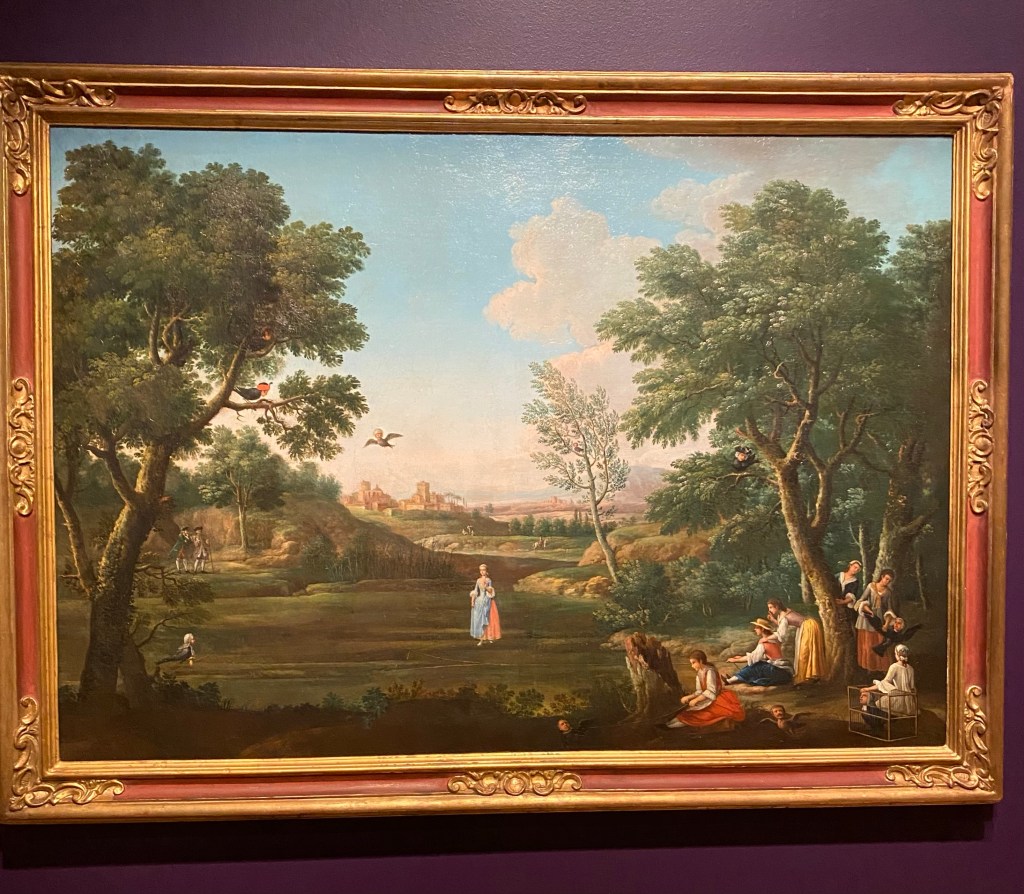
The painting is one of a pair illustrating an allegory of male naiveté and the slyness of women. “Civetta” is the Italian word for “screech-owl” but is also used informally to describe a flirtatious woman, or coquette. In the painting male birds are caught in traps set by women using an attractive woman as bait.
Personally I know from my years of living in Florence that a coquettish woman is colloquially called a Civetta in Italy. Perhaps this began as referring to flirtation with large eyes? Whatever it was, that’s the slang.
I’ve never seen a depiction of a game in which owls had men’s heads, but I remembered this 2 part sculptural group in Florence called Il Gioco della Civetta. It still doesn’t seem to be the same game being played in the painting, but until I can get back to Italy, it will remain a mystery to me.
The sculptural group of the The Owl Game (Gioco della Civetta) is located in the Boboli Gardens and consists of two white marble statues depicting two young men while playing. The aim of this game was to take the hat off to the other player who, in order to try to escape, had to bend over continuously (in Italian ‘fare civetta’). Therefore, one character is outstretched to grab the hat, while the other is attempting to deftly dodge the opponent’s move. The jacket of one of the two players is unbuttoned, precisely because of the abrupt movement that he makes by throwing himself backwards, and both figures are supported by tree stumps.
The Owl Game was originally commissioned to a sculptor known as ‘Matteo scultore’ in 1618 and its execution, which lasted for several years, was completed by different artists. The modelling was probably done by Orazio Mochi, who took inspiration from Giambologna’s Uccellatori. The statues were then sculpted by Romolo Ferrucci del Tadda, who left the group unfinished at his death, missing one figure. After various assignments, the work was finally completed by Bartolomeo Rossi in 1622. Unfortunately, The Owl Game in stone deteriorated quickly and got destroyed.
In 1775, Grand Duke Peter Leopold entrusted sculptor Giovanni Battista Capezzuoli with the task of remaking the work and the artist decided to sculpt it out of white marble instead of bigia stone. From the panel of the Giuochi rusticali (Rustic games) made by Vascellini in 1788, the group appeared to be consisting of three figures, while only two figures have survived to present days. When looking at the 18th-century replica, it is no longer possible to distinguish the hands of the various sculptors who worked on the original group in stone: Pizzorusso (1989) attributes the original of the figure on the left to Bartolomeo Rossi and the one on the right to Romolo Ferrucci del Tadda. The realisation in marble of the original group diluted the stylistic features of previous artists. The copyist was inspired by 16th-century representations of ‘peasants’, relying on the narrative and playful style that was typical of 17th-century genre painting.
At least I can easily visit the Japanese section of the Denver Art Museum without a lot of time or expense. This museum had the good fortune of having a talented Japanese curator for decades, and he built an important collection here in Denver. I taught the subject of Japanese art history at a local university many years ago and I always love tripping to Japan in Denver, or anywhere!
These were not my best attempts at photography or videography that day. Oh well, you can’t win them all!
I made a new friend at the Denver Art Museum recently. This fairly recent acquisition delighted me!
This is why I love the history of art! I can time travel and see what St. Peter’s looked like around 1855. I’ve stood on the Janiculum Hill in Rome many times and gazed at St. Peter’s from this vantage point. It looks oh, so different nowadays!
Born near Edinburgh, Roberts came to be known as the “Scottish Canaletto” after the 18-century Italian cityscape painter famed for his precise representations of cities and their buildings. For over two decades Roberts traveled through Europe, North Africa, and the Middle East painting and architectural and topographical subjects. He painted this picture following a visit to Italy in 1853, the final stop of his travels before returning to London. For over a century such works had been enormously popular among British collectors as mementos of their Italian sojourns. In an inscription by Roberts he informs us that the work was a gift to the wife of his friend Joseph Arden, “…A Souvenir / of her Visit to Rome.”
Another old friend from the Denver Art Museum is this lovely still-life by Berthe Morisot.
Born in 1841, Berthe Morisot wanted to become a professional artist, which countered the societal expectations of her upper middle-class family. If paint she must, she was expected to take up painting as a hobby and not as a professional career. Morisot persisted and not only became a well-known artist but also developed a radical style. She identified strongly with the aesthetic principles of the Impressionists, a group of young artists who, in the early 1870s, began to challenge the status quo of what constituted excellence in the art of painting. Impressionist paintings are characterized by an emphasis on the play of light, loose brushstrokes, and “modern” scenes of everyday events taking place in urban or country settings.
Morisot was a central member of the Impressionists and her home was a meeting place for intellectuals and artists. Morisot’s connection with these painters, particularly Edouard Manet, allowed for the exchange of artistic ideas, comparison, and criticism. She exhibited in seven of the eight Impressionist exhibitions and, even though she was not financially dependent on sales, her work fetched prices similar to (or higher than) many other well-known members of the group such as Monet and Renoir.
Morisot, who is perhaps more well-known for her landscapes and images of women, painted relatively few still lifes (Soup Tureen and Apple is one of only four from the 1870s).
The Impressionists liked to paint subjects from modern life, but during Morisot’s formative years throughout the 1860s, women couldn’t wander the streets alone or paint in cafes. Given this handicap, she compensated during her early career by selecting subjects close at hand for her as a woman, such as intimate domestic scenes or other still-life paintings. The objects in this painting probably came from her home. She chose to arrange them on a shiny table top, which offered the added dimension of reflections on the surface. The covered goblet allowed her to demonstrate her skill in representing a challenging subject like clear glass.
Like many other Impressionists, Morisot worked quickly and in a sketchy style suited to her aim, which was to “capture something transient.” Looking at Morisot’s pearly colors and light brushstrokes, many art critics assumed that her working process was as delicate as her finished paintings, even likening it to the scattering of flower petals. But Morisot herself described painting as being “engaged in a pitched battle,” and her mother claimed that when Morisot was working she had “an anxious, unhappy, almost fierce look.”
I’ve always admired this fine painting in Denver by the important Impressionist, Morisot. The icy shades with pale blues and light green make this work soothing for me to look at.
I’ve been haunting the Denver Art Museum lately, reacquainting myself with old friends. And by friends I mean works of art that I used to be in charge of. That was a long time ago, but I’m happy to find that my old friends still are looking great!
Among many friends, this stunning example of 19th century American art by Thomas Cole is and was always one of my favorites. He was an English born, self-taught painter. Both Cole and I had/have a thing for Italy.
In this painting, The Dream of Arcadia from about 1838, Cole drew his inspiration from Greece. The art museum’s website supplies this information:
The theme of Thomas Cole’s Dream of Arcadia is man’s relationship to unspoiled nature. Cole felt that the American wilderness was beginning to disappear as a result of the industrialization of the nation. In this painting, Cole harks back to the land of Arcadia, a rustic, secluded area of ancient Greece. The people who lived in Arcadia led simple, happy lives, in harmony with nature. Cole creates an idyllic image of an unblemished landscape—one where people frolic in the trees, sheep roam the hillside, and children play in the gentle river.
I’ll be posting other old friends from the museum over the next weeks. I’m so happy to see them again!
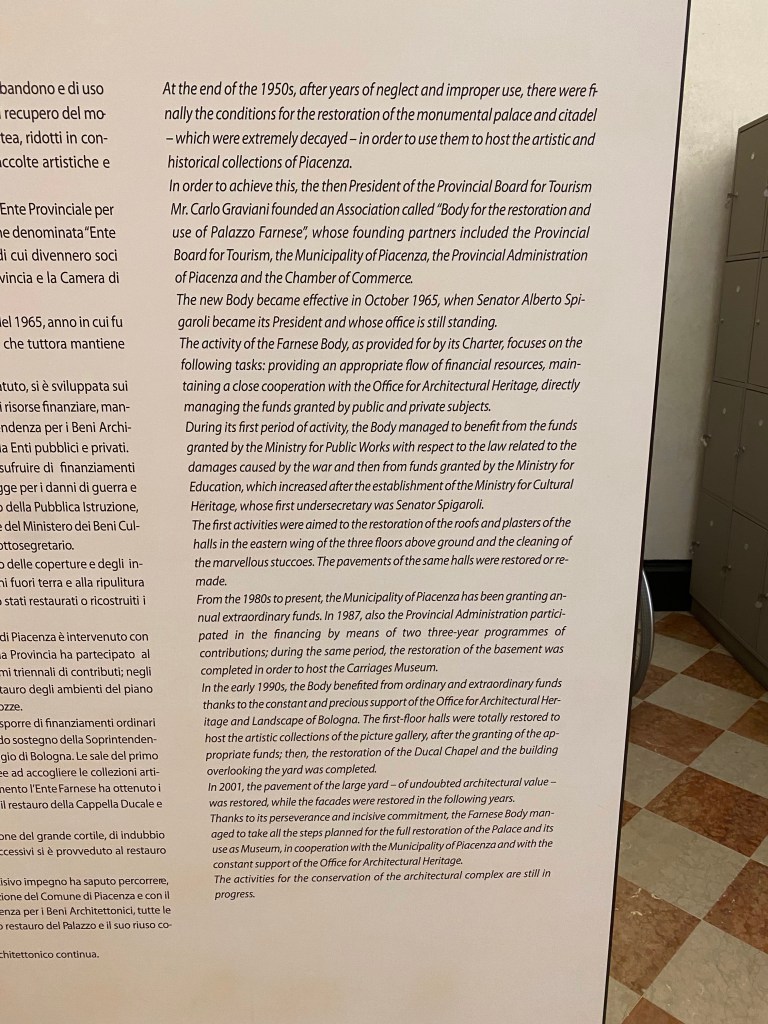
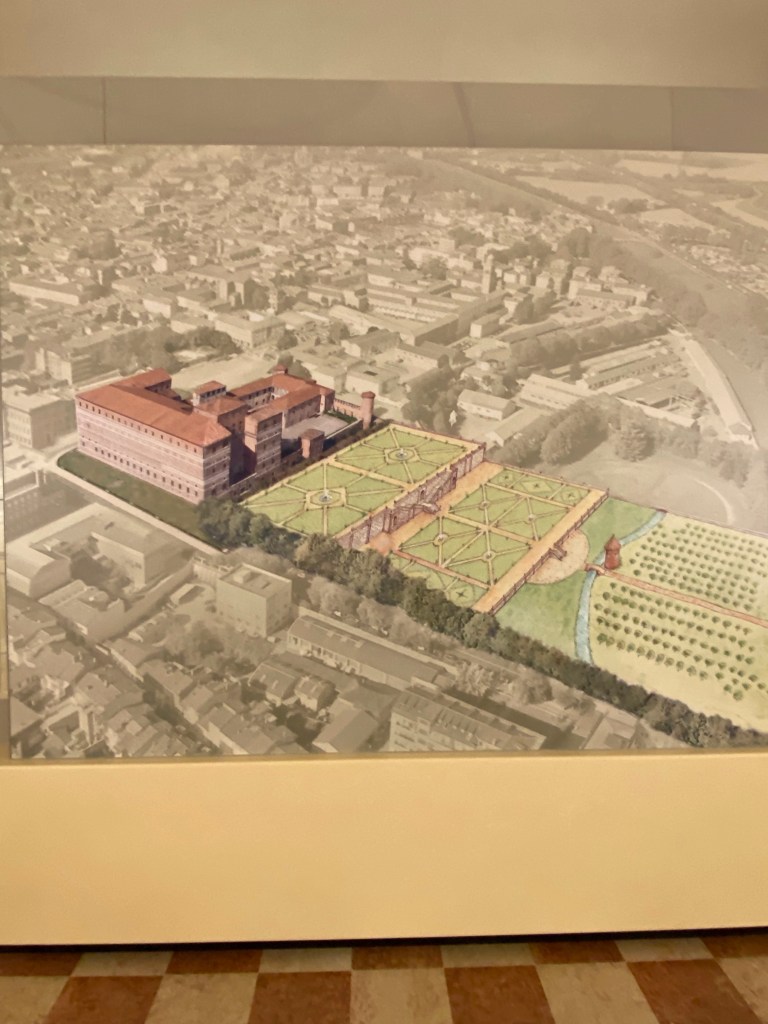
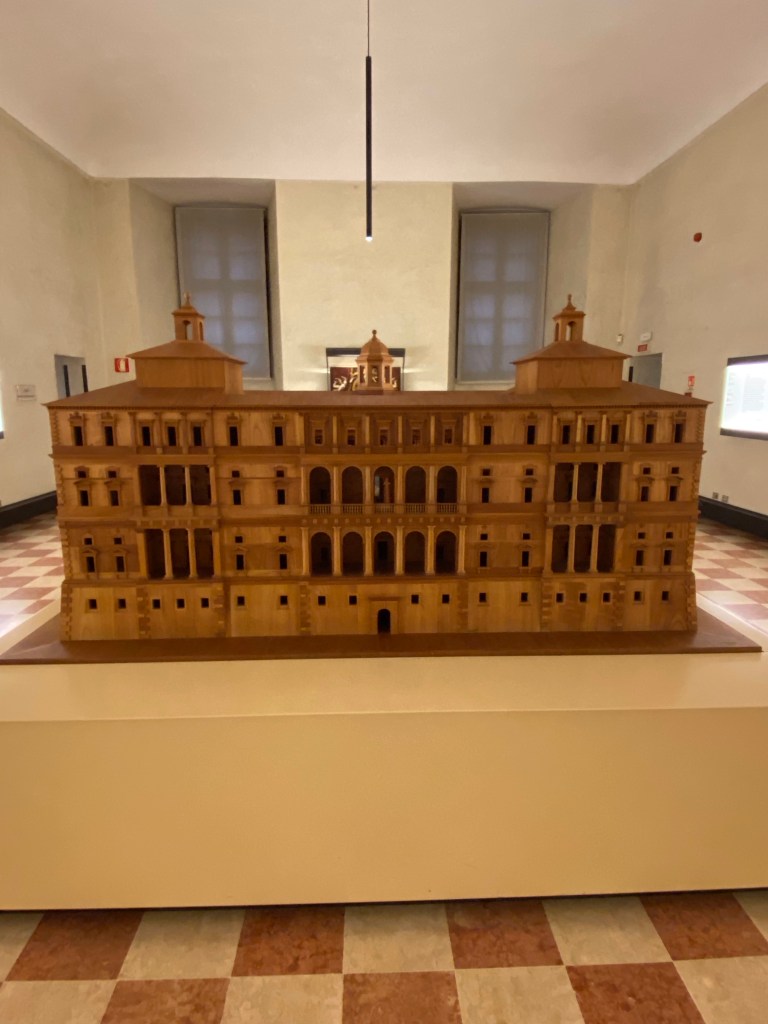
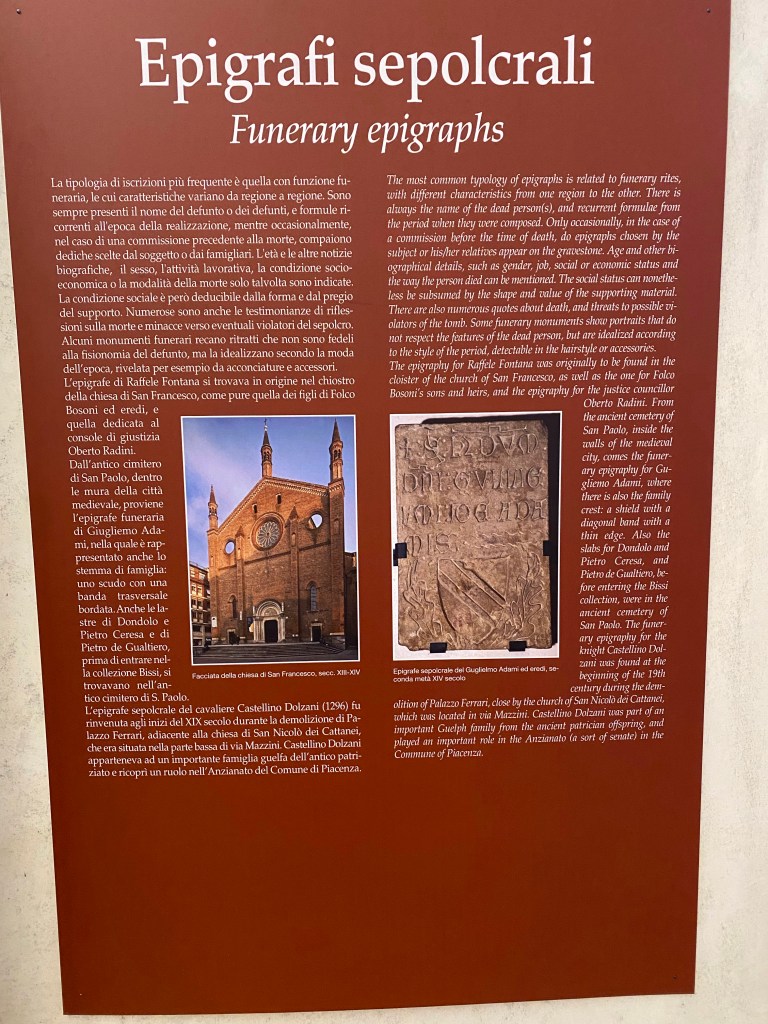
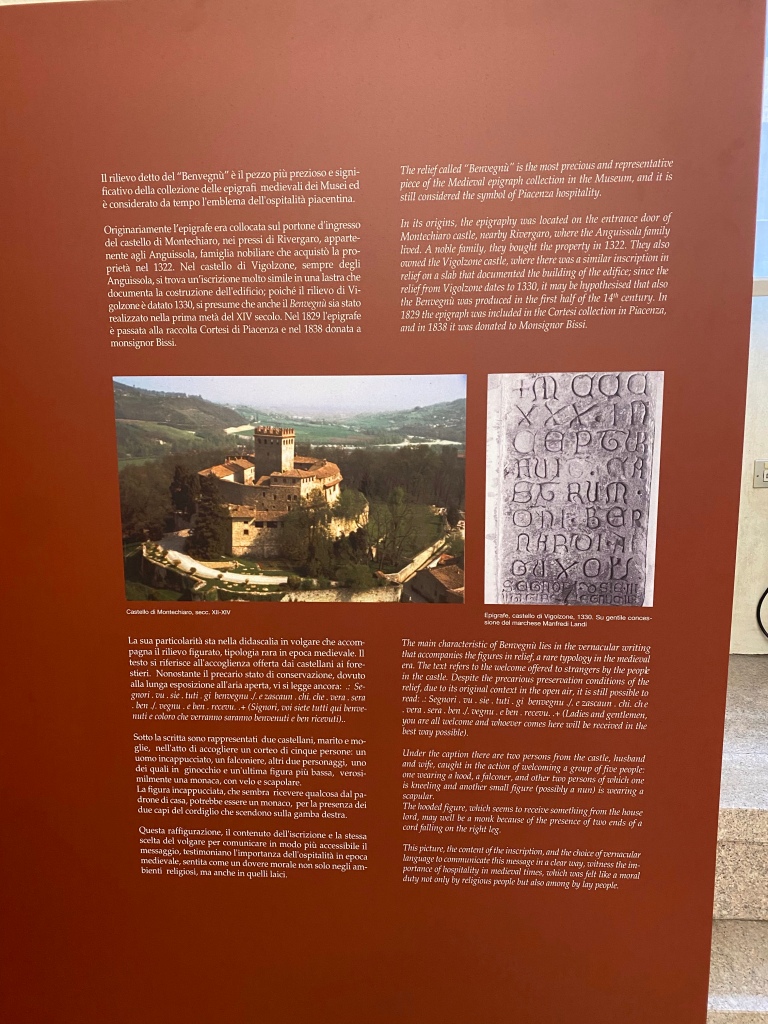
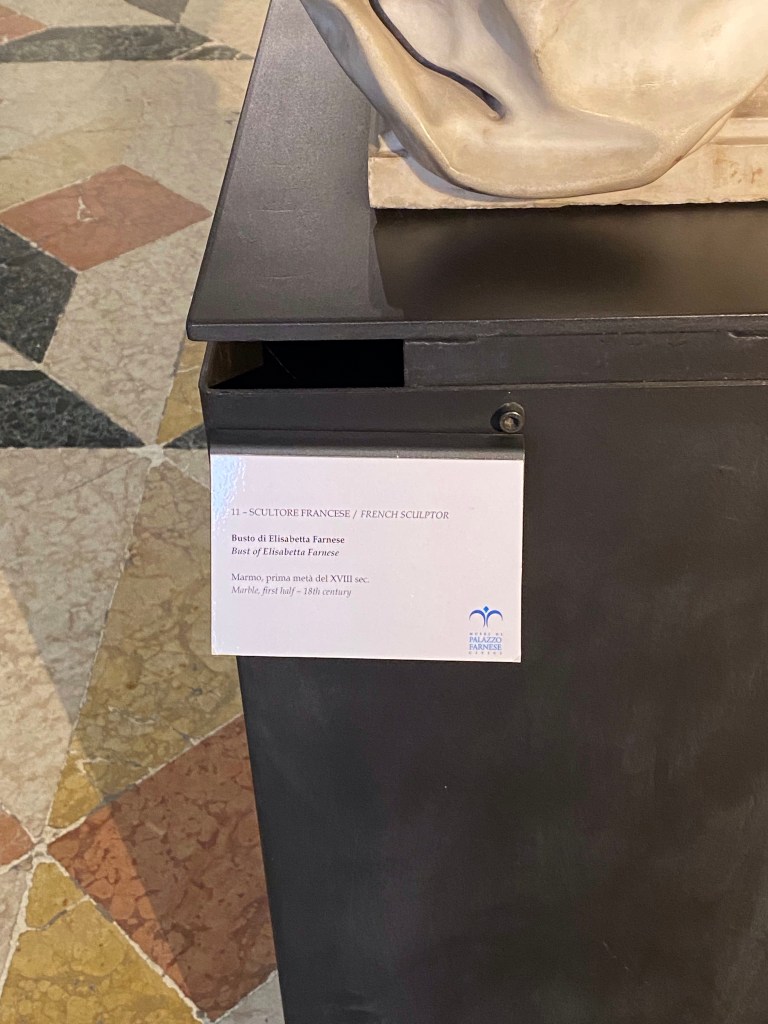
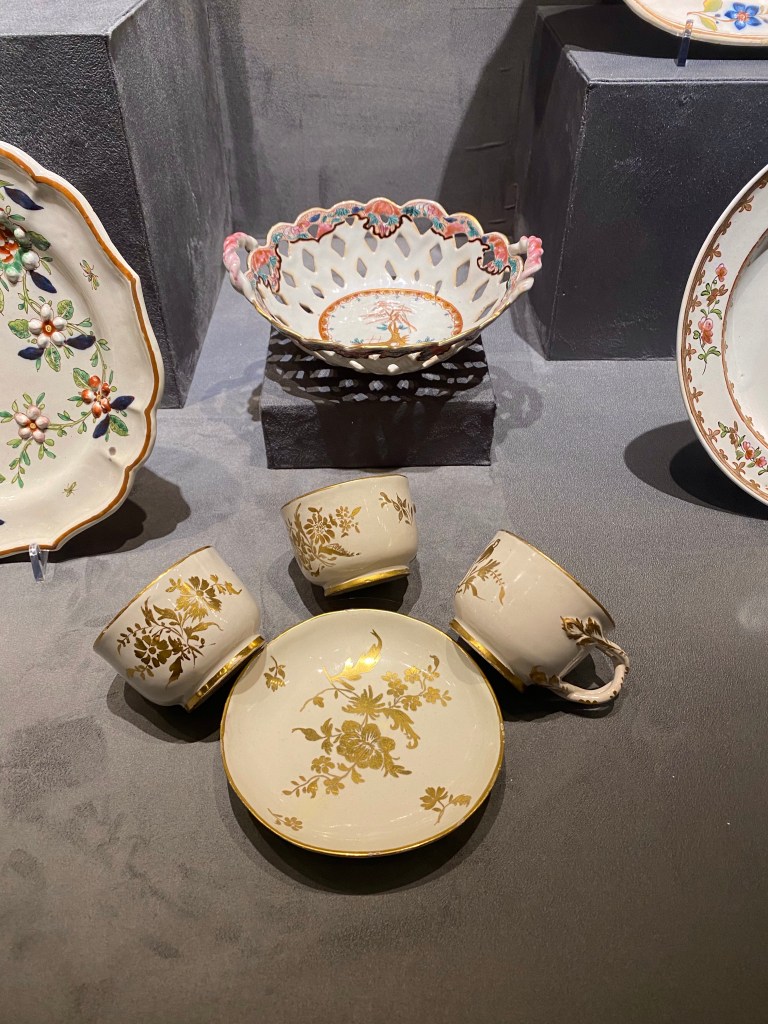
As I look back on my travel to Piacenza exactly 2 years ago, I am filled with longing to return. There is still so much left to explore. Soon, self, I promise!
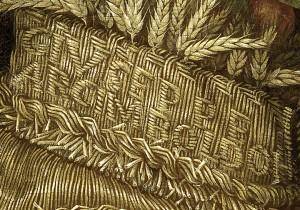
The Artist’s “Signature”: The artist’s name is woven into the wheat on Summer’s collar. The date 1572 can be found on his shoulder.
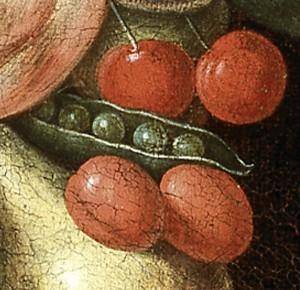
Arcimboldo painted each piece of fruit realistically and arranged them to form an actual human face, imitating skin and musculature, all the while creating a character with personality. A row of peas in a pod make for perfectly spaced teeth, while ripe cherries form plump lips. A round peach creates the perfect rosy cheek and a cucumber imitates a bumpy weathered nose.
Depicting the season’s harvest: The painting of Summer includes realistically portrayed green grapes, plums, mulberries, melon, hazelnuts, assorted pears, cherries, peaches, corn, garlic bulbs, onions, pea pods, eggplant, various squashes, cucumber, artichokes, and wheat.
The profile format of this painting was probably inspired by portrait heads of Roman emperors, known to Renaissance artists as depicted on Roman coinage. By using the same format in his portraits, Arcimboldo associated Emperor Rudolph II—to whom these works were linked—with a powerful Roman emperor.
Giuseppe Arcimboldo was born to a distinguished family in Milan, Italy, and began working as an artist at the Milan Cathedral, creating stained glass, fabrics, and paintings. His father, a painter, probably provided his early training. As the official artist and Master of Festivals for three successive German Emperors, Arcimboldo designed costumes, stage settings, chariots, and other diversions for courtly events and ceremonies. He was also in charge of making acquisitions for the royal cabinet of curiosities, which included art, antiques, curios, oddities of nature, and exotic animals and birds. He engineered creative water works, and even dreamed up a “color-piano” that was played by court musicians. He was perfect for the job and was richly rewarded for his inventiveness.
Arcimboldo was best known for his fantastical “composite head” paintings. These were portraits composed of objects such as fruit, flowers, books, or even a plate of meat. During his time, he acquired international fame and the public reacted to his paintings much the way we do today: with admiration, humor, and fascination. Summer belongs to a set of four paintings that depict the four seasons of the year. Arcimboldo and his workshop painted numerous copies of this set, as did many imitators of the master.
WHAT INSPIRED IT Arcimboldo, a master of allegory, painted each portrait in the Four Seasons series using vegetation associated with that time of year. While his paintings amused and fascinated wealthy courtiers with their apparent whimsy, they also appealed to the intellect. For this set, Arcimboldo suggested that each season corresponds to a stage of human life: Spring stands for youth; Winter, old age; and Summer shows a man in his prime. The series also carried a specific political message—the paintings were meant to symbolically glorify the Emperor. As an Emperor ruled over human affairs, he could also be said to run the greater world, including the seasons. The harmonious combinations of fruit and vegetables reflect the harmony that exists under the Emperor’s rule. Each head also wears something that can be seen as a wreath or a crown. Because of the underlying political messages, these paintings were the perfect, flattering gift for the German Emperors to give to other courts.
WHAT INSPIRED IT Arcimboldo, a master of allegory, painted each portrait in the Four Seasons series using vegetation associated with that time of year. While his paintings amused and fascinated wealthy courtiers with their apparent whimsy, they also appealed to the intellect. For this set, Arcimboldo suggested that each season corresponds to a stage of human life: Spring stands for youth; Winter, old age; and Summer shows a man in his prime. The series also carried a specific political message—the paintings were meant to symbolically glorify the Emperor. As an Emperor ruled over human affairs, he could also be said to run the greater world, including the seasons. The harmonious combinations of fruit and vegetables reflect the harmony that exists under the Emperor’s rule. Each head also wears something that can be seen as a wreath or a crown. Because of the underlying political messages, these paintings were the perfect, flattering gift for the German Emperors to give to other courts.
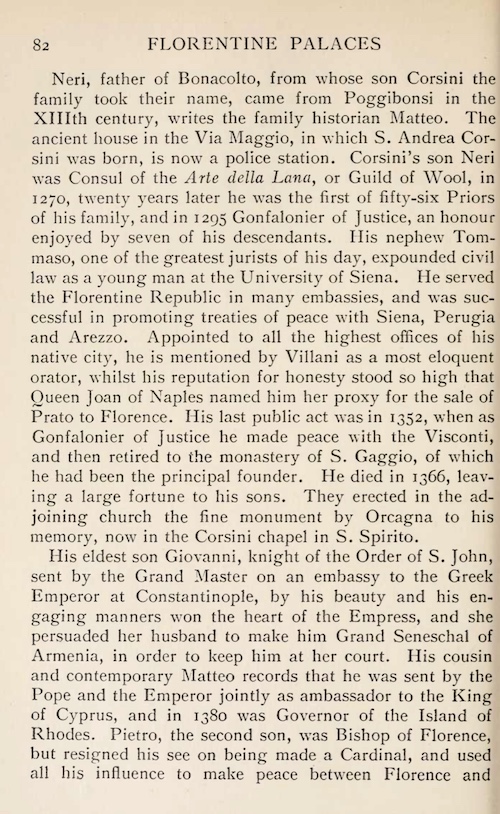
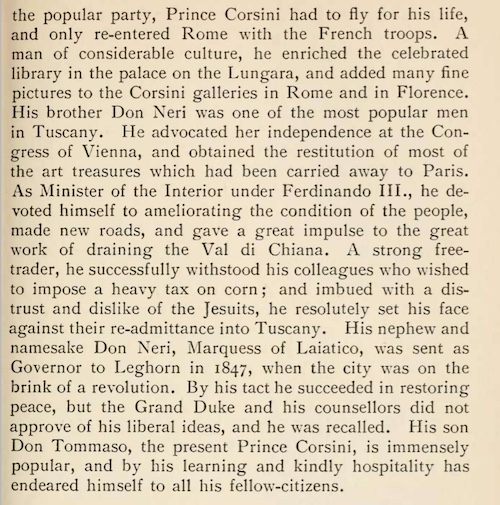
Originally, the magnificent Palazzo Corsini began as a casino (a small house surrounded by a large garden) that extended to the banks of the Arno River where Lungarno Corsini is located. The casino belonged to the Ardinghelli family, then to the Medici, and finally to the Corsini: in 1649 the wife of the Marchese Filippo Corsini, Maria Maddalena Macchiavelli, purchased the palace from the Grand Duke Ferdinando II de’ Medici. Today it is in the hands of the Corsini descendants: Miari Fulcis and Sanminiatelli.
The Palazzo today appears as a late Baroque building; one sees Baroque details throughout, from the roofs decorated with statues and terracotta vases – a novelty for Renaissance Florence – and the main, U-shaped courtyard that opens towards the riverbank. The two men responsible for the way the Palazzo Corsini looks today were Bartolomeo Corsini (1622-1685), the son of Filippo Corsini and Maria Maddalena Macchiavelli and, Filippo son of Bartolomeo’s son (1647-1705) who expanded the portion of the Palazzo that extends towards Ponte S. Trinita.
The construction continued non-stop for 50 years. The magnificent interior decorations, which were completed between 1692 and 1700, belong to one of the finest and most intense moments in Florentine painting.
The family commissioned several artists to decorate the noble apartment on the first floor, that includes Galleria Aurora, the Salone, the ballroom and other important rooms; the outstanding painters include Anton Domenico Gabbiani, Alessandro Gherardini and Pier Dandini.
Let’s start at the GROUND FLOOR: consisting of the Summer Apartments and Halls of the Nymph. The decorative scheme here reveals the most romantic and decadent side of the Palazzo with the impressive frescoes and of the evocative grotto built by architect Antonio Ferri.
One level up, the main floor: from the lower floor one reaches the “noble” floor through the imposing grand staircase. From the hallway open the doors to rooms and rooms filled with beautiful frescoes and stuccoes, perfectly preserved. The coup de gras is the majestic Throne Room (320 square meters) where you can feel the ambience of noble antiquity.
Una cornice sfarzosa che si affaccia direttamente sul Lungarni e una vista intrigante. A magnificent setting overlooking the Lungarni and an intriguing sight.
The Throne RoomView from across the Arno
The Palazzo from the Arno River
Few among the private palaces of Florence are as gorgeous as the splendid Palazzo Corsini, also called “al Parione” and belonged to the famous Corsini family, in the 17th century the richest and most important of all Florence after the Medici. An ascent that culminated in 1740 with the election of Lorenzo Corsini to the papal throne with the name of Clemente XII.
With such prerequisites, it is not surprising that the building with its grandiose façade overlooking the Arno is an architectural masterpiece rich in precious jewels and a collection of paintings, the Galleria Corsini, which can be considered the most important private art collection in Florence. His style (the villla was built at the turn of two centuries, between 1656 and 1737, with at least fifty years of uninterrupted work) is that of a flourishing and decided baroque: each element is stunning scenery and decoration, with a grand façade to the front, from the terrace to the attics with balustrades, until reaching the perfect expression of the “marvelous” in the large helical staircase attributed to Gherardo Silvani.
The building is divided into three main bodies that surround a large courtyard, and among the first things that jump to the eyes there is the obvious asymmetry between the two side parts; according to the original project, in fact, the left wing had to be as big as the right one (ie about twice the current size). Also worthy of note is the crowning of the roof, with the terracotta crater vases and the balustrade decorated with stone statues, following suggestions similar to those that animated the classic “Italian gardens” destined to be famous throughout Europe.
The interiors of Palazzo Corsini at the Parione show once again the best and most fascinating insights of the baroque period, with a great work of stuccos and decorations; Particularly striking is the artificial grotto on the ground floor, designed by Antonio Maria Ferri, an artist who was also the architect in charge of permanently closing the villa’s works; to him the merit for today’s appearance of Palazzo Corsini. In addition to the Silvani helical staircase there is also a monumental staircase made by Ferri that culminates in the staircase of Pope Clement XII.
The rooms of the building are full of original decorations, with frescoes, stuccoes and decorations: especially the Salone del Trono and the Ballroom stand out, truly immense rooms (the Salone del Trono measures about 320 square meters) with rich frescoes on the ceilings, columns , eighteenth-century busts.
On the first floor, Galleria Corsini is a precious casket that holds masterpieces of timeless artists, especially relating to the seventeenth and eighteenth centuries Italian but not disdaining the Renaissance, with a prevalence of Roman, Neapolitan and Bolognese schools: among the exhibited painters, Rubens, Beato Angelico, Caravaggio, Van Dyck, Murillo, Filippo Lippi, Luca Signorelli, the Pontormo, Salvator Rosa, Luca Giordano, Gentileschi, and Giovanni Bellini. The Corsini Gallery also hosts bronzes and furniture from the eighteenth century.
Below is a history of the Palazzo Corsini from the 1905 book “Florentine Palaces, And Their Stories” by Janet Ross – some of the scholarship from that day may have changed since!
PALAZZO CORSINI: MONUMENTAL STAIRCASES AND PRIVATE COLLECTIONS
The Corsini become a wealthy Florentine family in 1500: Palazzo Corsini, also known as the Parione, located on Lungarno Corsini, is still a family home. The building is the result of the acquisition and merger of many historic houses built by different architects: Alfonso Parigi the Younger, Ferdinando Tacca, Pierfrancesco Silvani – author of the beautiful spiral staircase, and Antonio Maria Ferri – who finished the project by drawing the current frame. In addition to the spiral staircase made by Silvani and the monumental one by Ferri, the interior of several rooms of Palazzo Corsini and its halls are filled with frescoes, decorations and period furnishings. The Corsini Gallery, inside the building, is the most important private art collection of Florence, with works dating back to the 1600s and1700s, both by Italian and European Renaissance artists.




















 get back, lauretta!
You must be logged in to post a comment.