

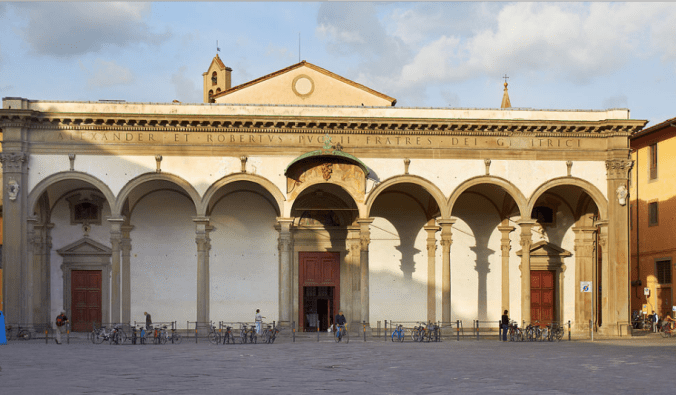
The Basilica of the Most Holy Annunciation is a Renaissance-style, Roman Catholic minor basilica in Florence. It is considered the mother church of the Servite Order and is located at the northeastern side of the Piazza Santissima Annunziata, near the city center. The church was founded in 1250 by the seven original members of the Servite Order. Founded to fulfill a vow thanking the Virgin Mary for saving the city after the siege by Enrico IV, the Servite Order was organized.
The church houses a painting with a very interesting history. In 1252, a painting of the Annunciation was begun by a friar Bartolomeo, having been commissioned by the Servite monks. It is said he despaired about being able to paint a virgin with a beautiful enough face, and fell asleep, only to find the painting completed. He attributed this miracle to to an angel, and it gave the church –and the piazza within which it sits– their names. Most Holy Annunciation.
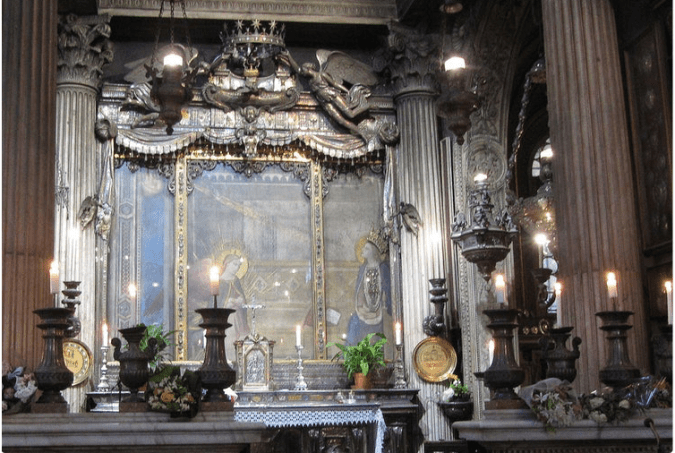
The painting now housed in the church, acquired increasing veneration, becoming the object of devotion and prayer for the people of Florence. It drew pilgrims from all over who would often leave votives at the church in the form of wax, plaster and wood sculptures, some of which were life-size and included the nobleman and his horse. As the church grew in importance, so did the size and grandeur of the church. What you can admire today, is years of reconstructions and additions to beautify the church.
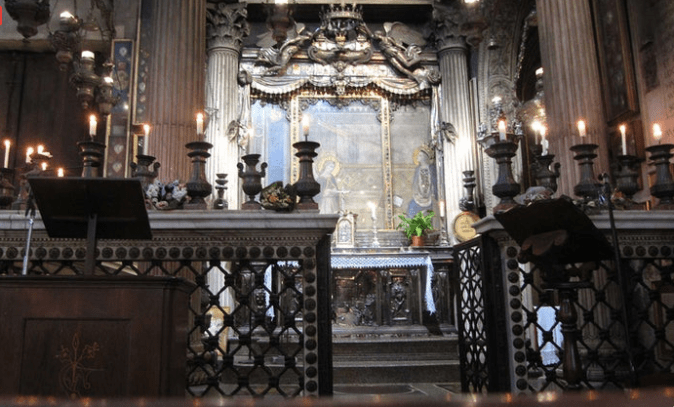
In order to properly house the miraculous painting, in 1444 the Gonzaga family from Mantua financed a specially built structure, the tribune.
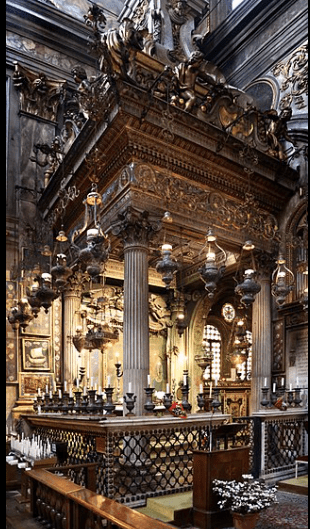
The huge chapel on the left side. In 1447 the friars of Servi di Maria, with the help of Piero di Cosimo dei Medici, decided to create a “temple” based on the design of Michelozzo to preserve the painting of the Virgin. It is rich with marble from Carrara, bronze designs, ceramics (most probably from the della Robbia workshop) and many other intricate pieces of art. The enhancement around the painting clearly demonstrates how the miracle was revered by the people.
Initially Michelozzo, who was the brother of the Servite prior, was commissioned to build it, but since Ludovico III Gonzaga had a special admiration for Leon Battista Alberti, this latter architect was given the commission in 1469. Alberti’s designs were constricted by the pre-existing foundations. Construction was completed in 1481, after Alberti’s death. Though the structure was refurbished in Baroque-style in the seventeenth century, the basic scheme of a domed circular space flanked by altar niches is still evident.
In the transept to the left of the altar, you can follow the signs for the Sacristy and examine the altar and the dome from up close including the artwork of greats like Giambologna restored and open to the public to admire.
The facade of the church was added in 1601 by the architect Giovanni Battista Caccini, imitating the Renaissance-style of Brunelleschi’s facade of the Foundling Hospital, which stands on the eastern side of the piazza. The building across from the Foundling Hospital, designed by Sangallo the Elder, was also given a Brunelleschian facade in the 1520s.

Pilgrims who came to the church to venerate the miraculous painting often left wax votive offerings, many of them life-size models of the donor (sometimes complete with horses). In 1516, a special atrium was built to house these figures, the Chiostrino dei Voti. By the late 18th century, there were some six hundred of these images and they had become one of the city’s great tourist attractions. In 1786, however, they were all melted down to make candles.
Pope Alexander VI, in appreciation for the survival of Rome after French occupation, paid homage and gifted a silver effigy to the church.
The Florentine brides traditionally visit the shrine to leave their bouquets.
If you look carefully, you will notice on the corners of the church, underneath the portico, and in the vaulted ceilings the symbol of the Pucci family, a black head on a white background.

These images were added in the late 1400’s because the Pucci family provided the funds for renovating the church. There are three arches to each side (three for each of the two brothers) and the arch in the middle is marked with the symbol of the church.
Designed by Michelozzi, the donation is signed on the strip above the columns and if you look underneath the marble steps before the front door you will see that this too bears the attribution to the beneficiary, Roberto Pucci.
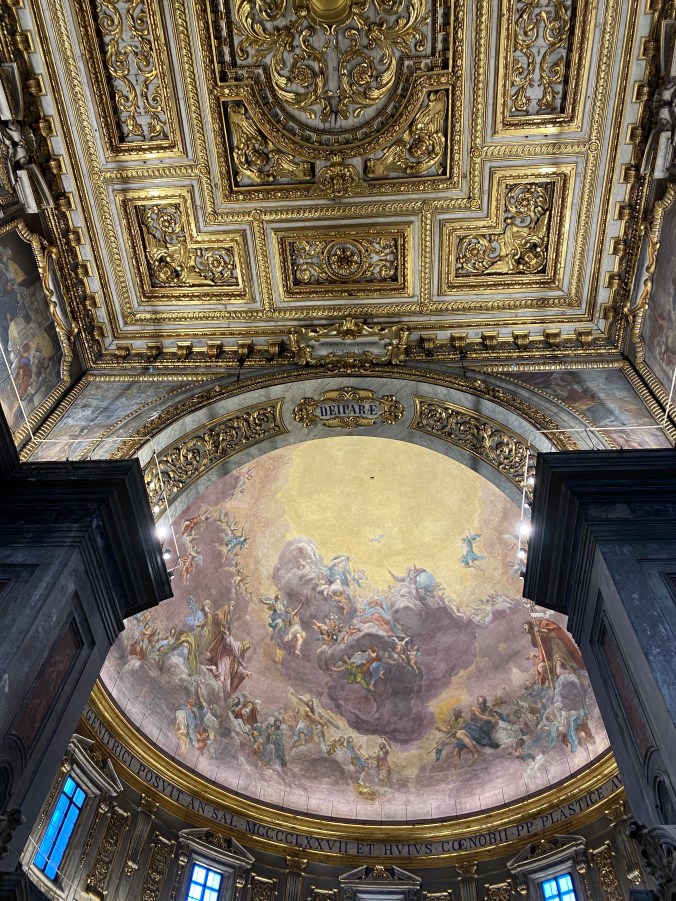
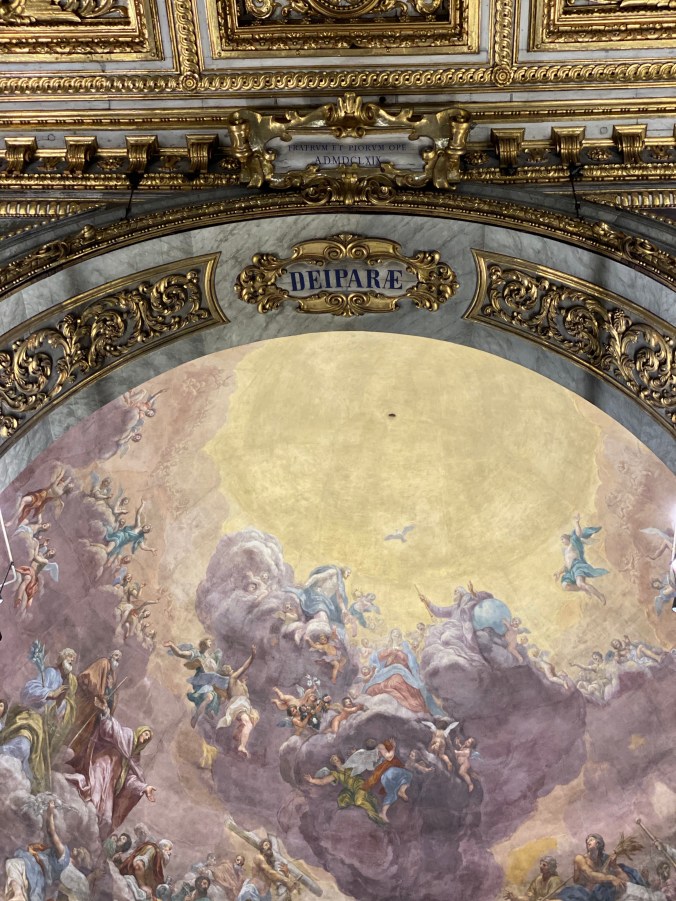
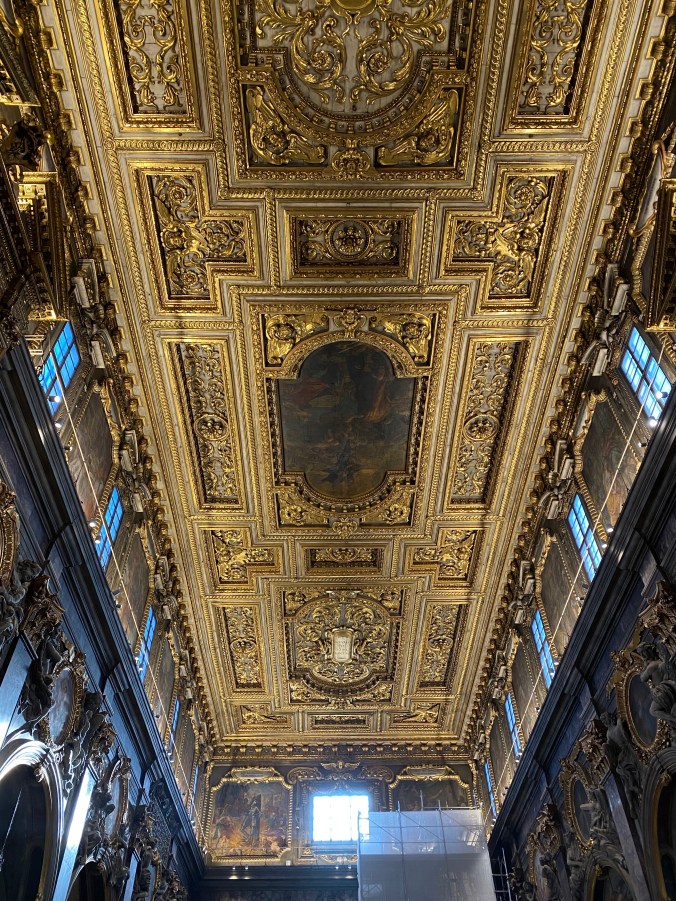
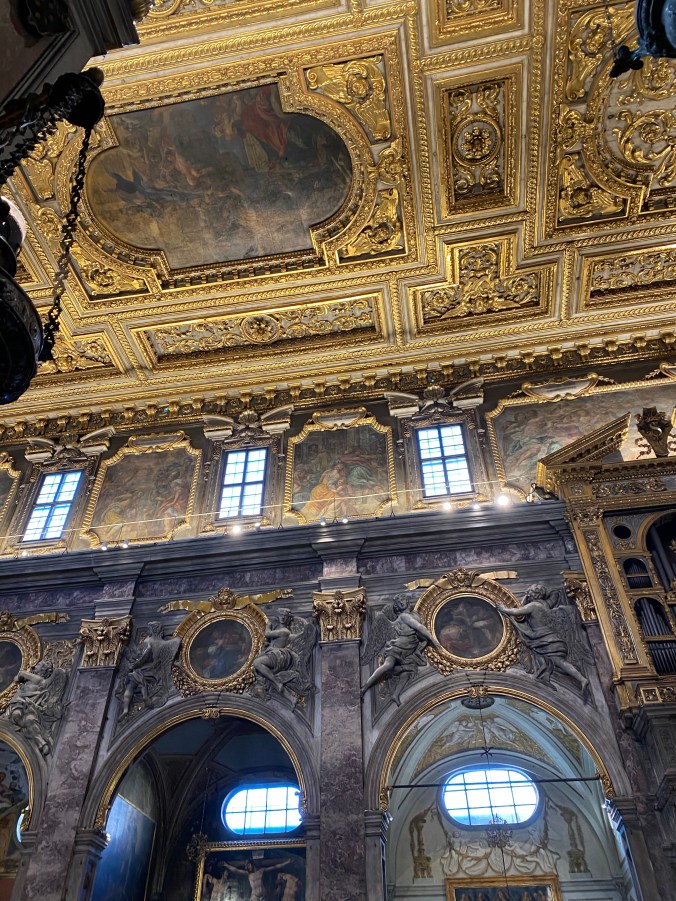
The Baroque decoration of the church interior was begun in 1644, when Pietro Giambelli frescoed the ceiling with an Assumption as a centerpiece based on designs by Baldassare Franceschini.
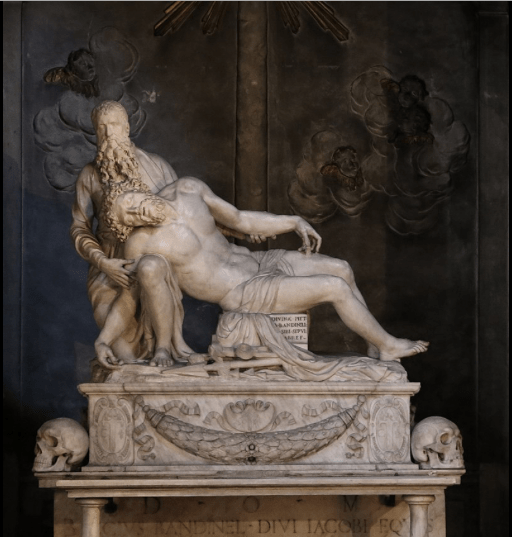
The 1st chapel to right contains a Madonna in Glory by Jacopo da Empoli, with walls frescoed by Matteo Rosselli. The 5th chapel on the right contains a Monument to Orlando de’ Medici (1456) by Bernardo Rossellino. The right transept has a small side chapel has a Pietà (1559) by Baccio Bandinelli and graces his tomb:
The chapel-surrounded tribune or choir, known as the Rotonda, was designed in turn by Michelozzo and Alberti between 1444–76. Notable among the chapels is the fifth (aligned to nave axis), which has a crucifix (1594–8) by Giambologna for his tomb, with statues of the “Active and Contemplative Lives” by his pupil Francavilla, saints and angels by Pietro Tacca, and murals by Bernardino Poccetti. The next chapel has a Resurrection (1548–52) by Bronzino with a statue of St Roch attributed to Veit Stoss. The next chapel has a Madonna with Saints by a follower of Perugino.
In the sixth chapel to the left of the nave is a SS Ignatius, Erasmus and Blaise by Raffaellino del Garbo; the next chapel has one of the panels of Annunziata Altarpiece (1507) by Perugino, once at the high altar of the church (the Deposition, begun by Filippino Lippi, is now at the Gallerie dell’Accademia, while other panels are divided between other collections in the world). The altarpiece of the next chapel has a Trinity with Saint Jerome and two saints (c. 1455) by Andrea del Castagno, who also painted the mural of The Vision of St. Julian in the next chapel, called the Feroni chapel. This chapel was elaborately decorated in a baroque fashion by Gianbattista Foggini in 1692. The first chapel just to the left of the entrance has a tabernacle of the Annunciation (1448–52) by Michelozzo and the sculptor Pagno di Lapo Portigiani .
The organ (1628) is the oldest in Florence and the second oldest in Italy. The church contains the tomb of the Italian writer Maria Valtorta. A memorial was erected in the church to the painter Giovanna Tacconi Messini by her husband after her death.
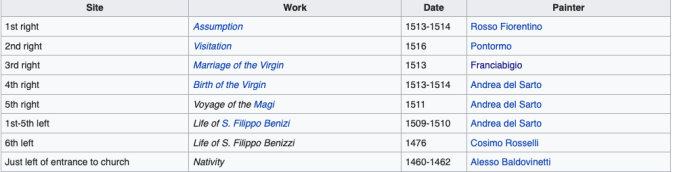
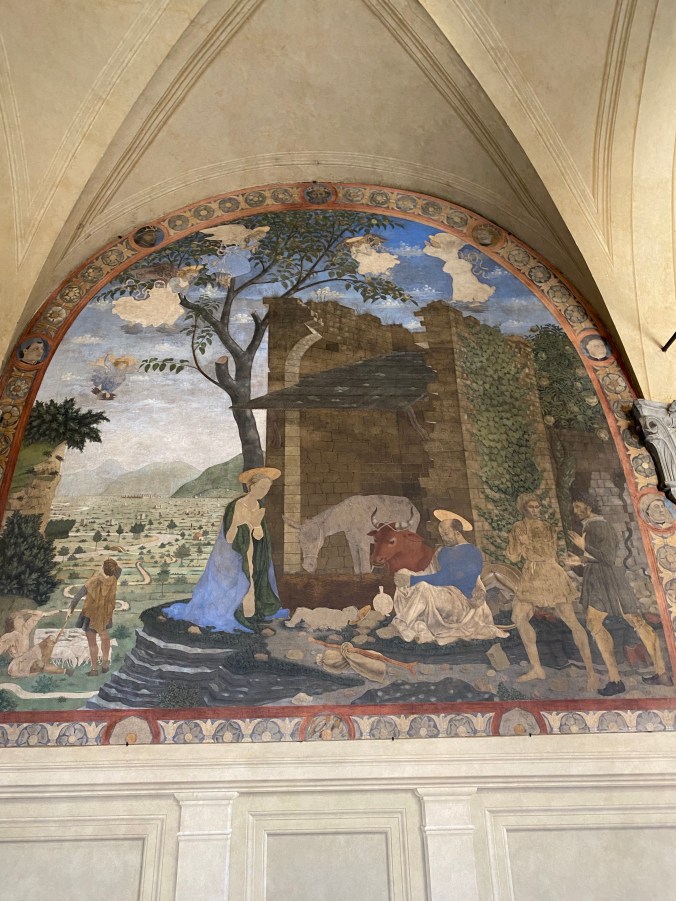
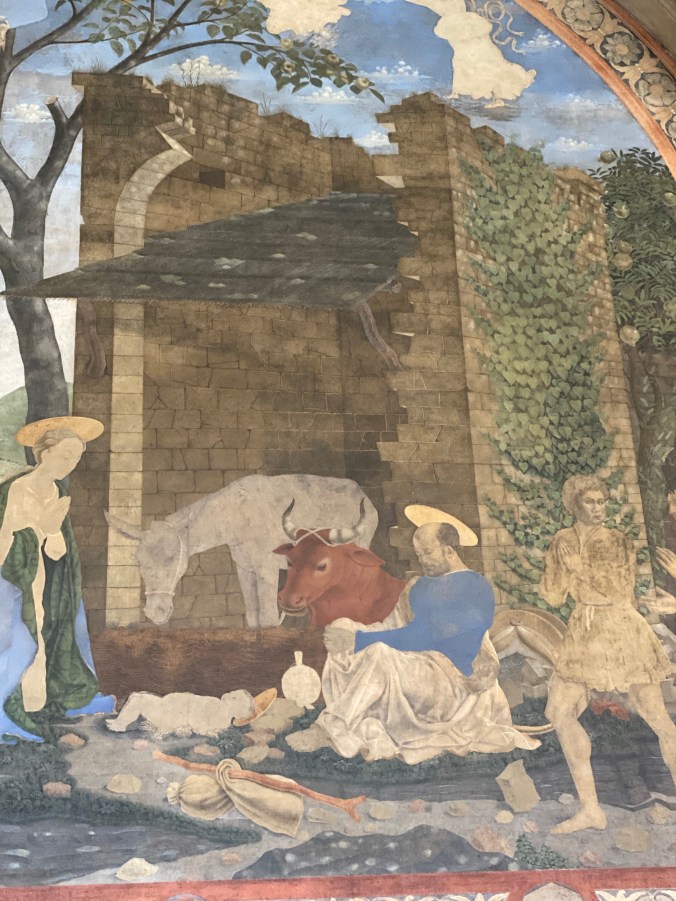
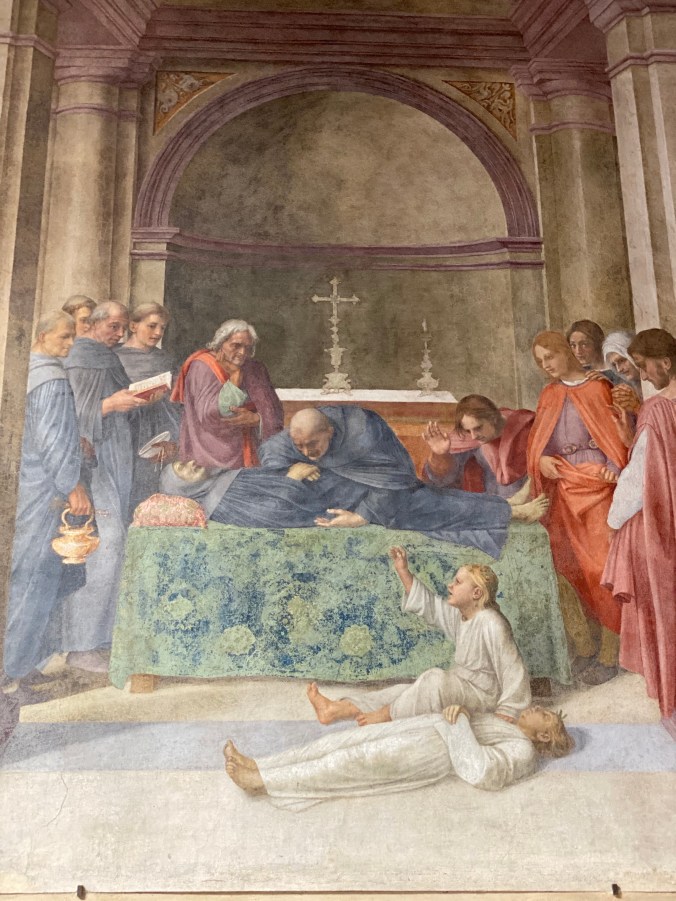
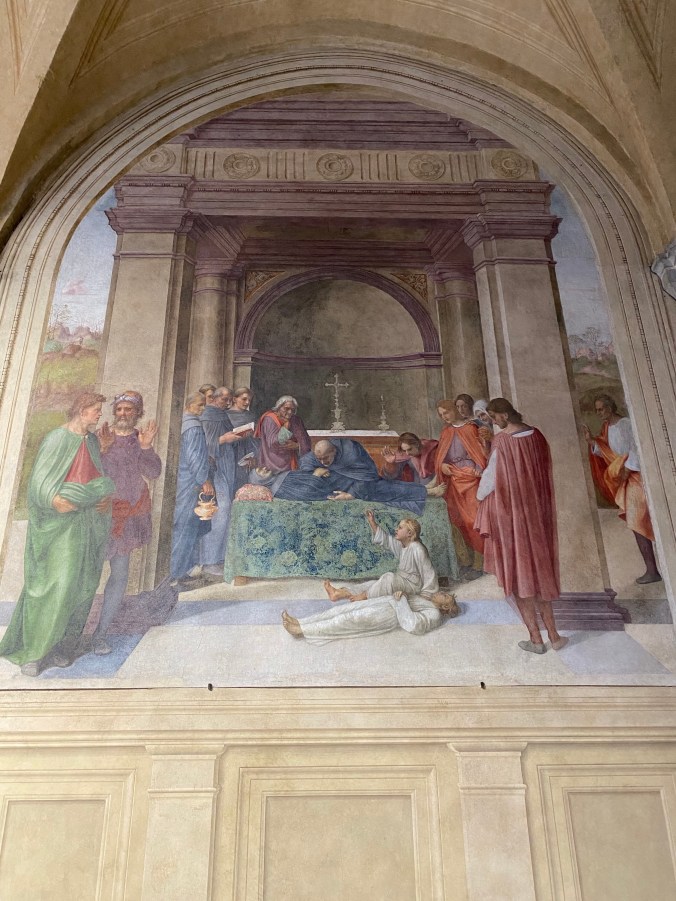
The Chiostrino dei Voti was designed by Michelozzo. Baldovinetti painted the first lunette in the chiostro in c. 1460. In about 1476, Rosselli began a cycle dedicated to the then Blessed Filippo Benizzi, fifth Prior General of the Servites, which was then completed (1509-1510) by Andrea del Sarto. Here is a chart, noting what painter painted which image.
The Porta Santa: To the left of the Portico is the door to the Oratorio di S. Sebastiano, erected by the Pucci family in 1452. This gives access to one of the two doors opened for the Jubilee in Florence, the other being at the Duomo.
Another cloister, known as the Chiostri dei Morti, contains the famous Madonna del Sacco (1525) by Andrea del Sarto. The Cappella di San Luca, which opens off it, has belonged to the artists confraternity or the Accademia delle Arti del Disegno since 1565. Many artists are buried in its vault, including Benvenuto Cellini, Pontormo, Franciabigio, Giovanni Angelo Montorsoli and Lorenzo Bartolini. Inside is Pontormo’s Holy Family (c. 1514) painted for church of St. Ruffillo and murals by Alessandro Allori: Trinity; Vasari: St. Luke paints Madonna; and Santi di Tito: Solomon directs the construction of the temple of Jerusalem. The ten large stucco figures were sculpted by Vincenzo Danti, Montorsoli and others.
The Cloister Grande
Across from the entrance to the Sacristy, behind the rich red curtain is the doorway which will lead you to a quiet little oasis within the church, which is known as the Cloister Grande or “dei Morti.” Though reworked several times over the years, it still reveals a pleasing and harmonious image.
There are 25 “lunette” which have been painted by several different artists. Looking back over the entrance you will see a sarcophagus with the Falconieri family logo, the two falcons, and a ladder, this is the same family who gave the church Saint Giuliana (preserved in glass by the altar) and her uncle, one of the founding seven saints, Alessio Falconieri. The Cappella di San Luca, which opens off the cloister, belongs to the Accademia delle Arti del Disegno and many artists are buried within its vault: Cellini, Pontormo, and others.
Most part of the Cloister of SS. Annunziata is today the seat of Istituto Geografico Militare (IGM). In 2007, in the west part of the cloister occupied by the Istituto, the group found a monumental stair by Michelozzo, previously hidden, an Annunciation attributed to Paolo Uccello[citation needed], and some ‘Grottesche’ frescoes by Morto da Feltre[citation needed].
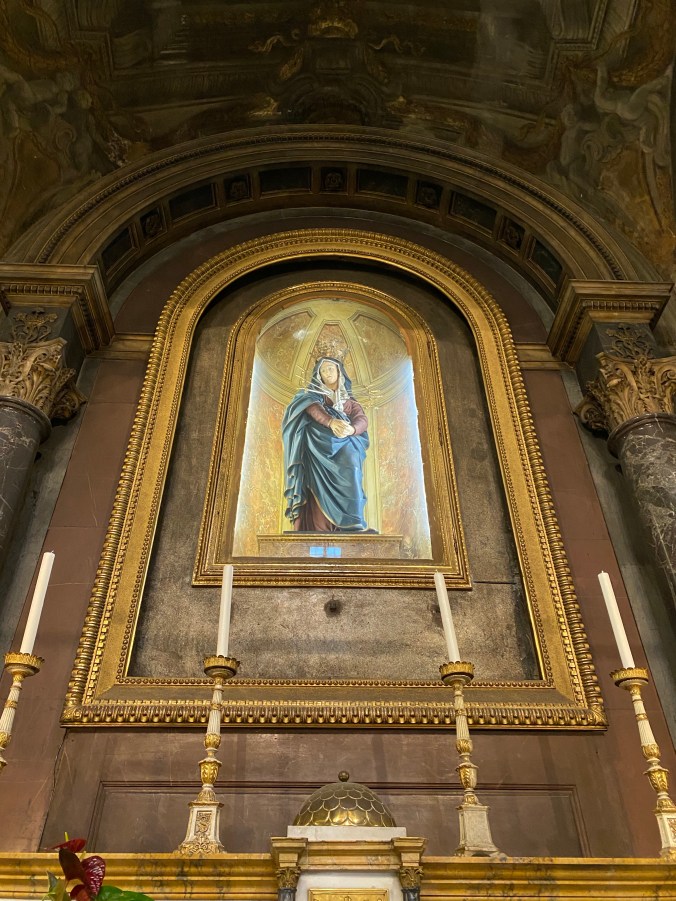
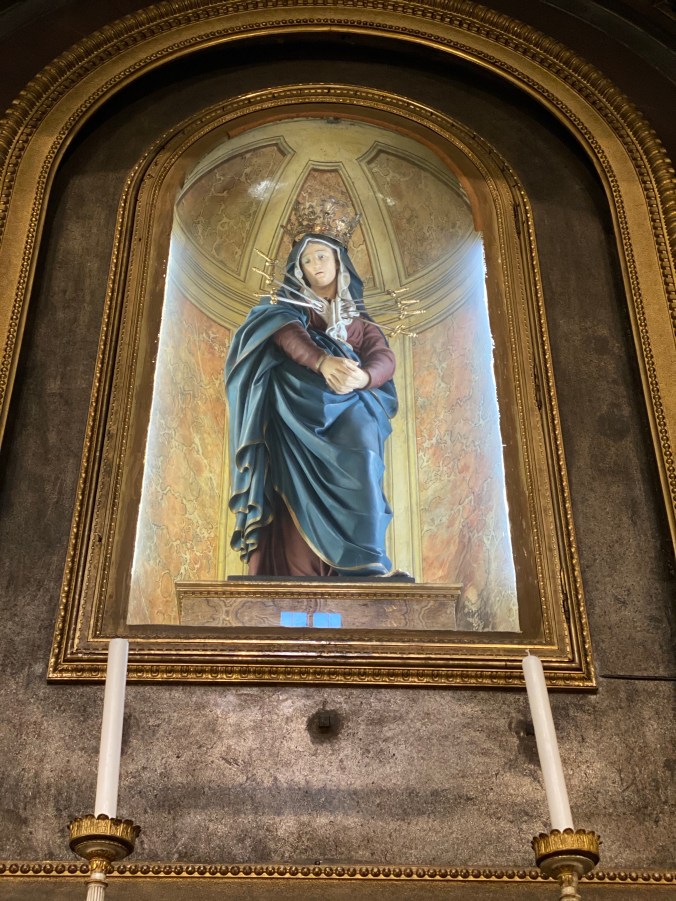
And now, here are some random pictures of this elegant, richly decorated basilica.



Paris and its infinite treasures! The Musée Picasso is just one example.
First, the building!


There was a wonderful exhibition on Edgar Degas at the Musee d’Orsay when I was there recently. Here are some of the works that caught my eye:


I had a copy of the print below hanging in my childhood bedroom. I know and love this beautiful work as well as I know my own hands.


Below, I wonder…little dreamers? And, if so, dreaming of being a ballerina or a painter?


What a glorious place in Paris!
What a glorious winter afternoon! January 2020. So glad I came to Paris, despite the record breaking long strikes of the Metro system and other things.


What a glorious city!






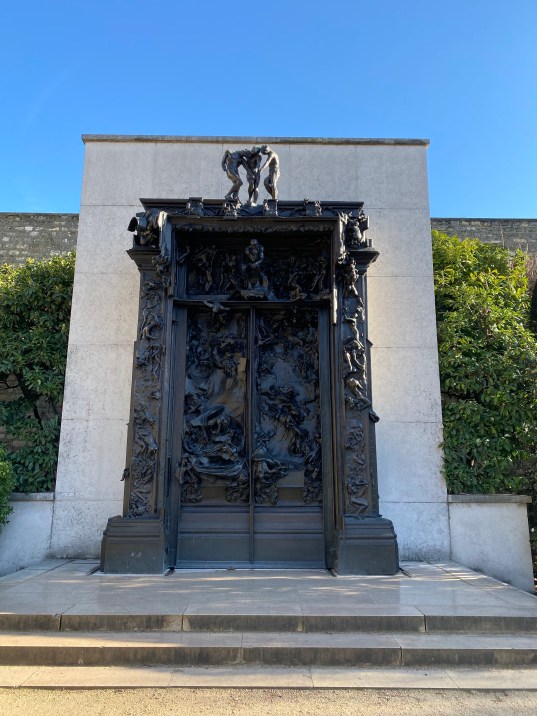
The Gates of Hell:


The Burghers of Calais:


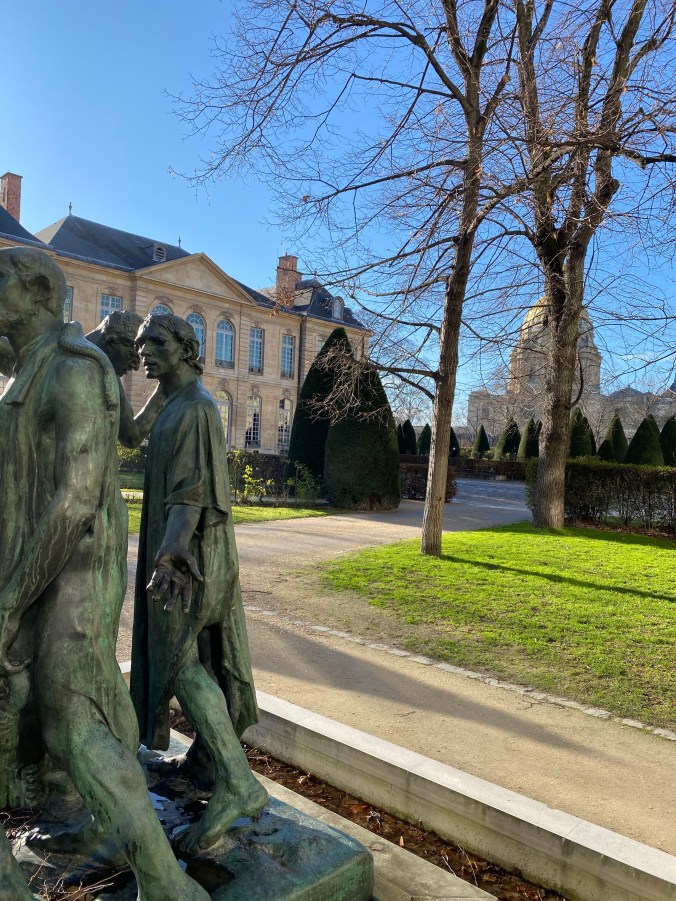


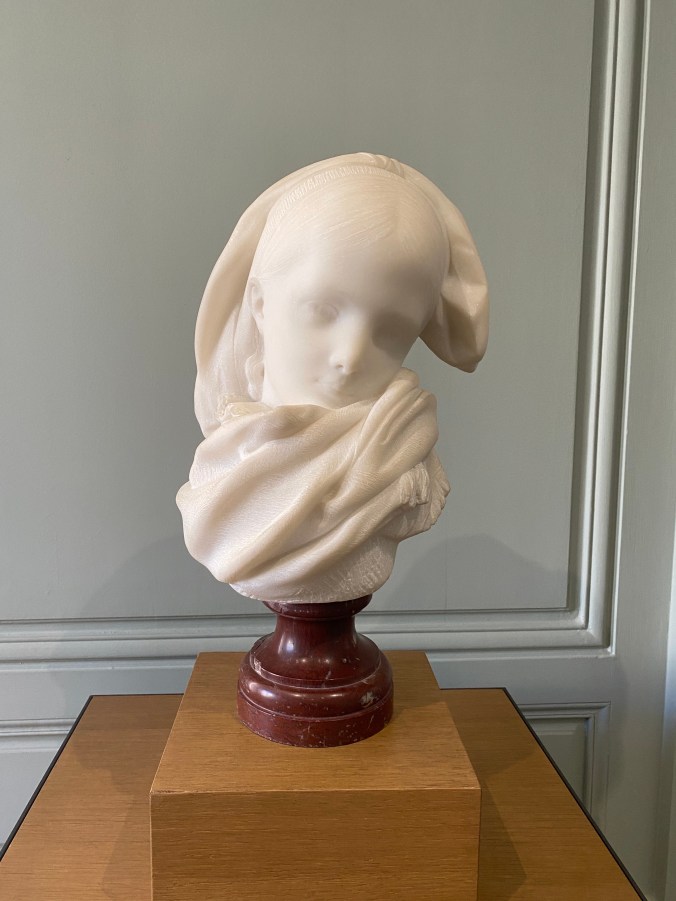


The Musée Rodin was opened in 1919, primarily dedicated to the works of the French sculptor Auguste Rodin. It has two sites: the Hôtel Biron and surrounding grounds in central Paris, as well as just outside Paris at Rodin’s old home, the Villa des Brillants at Meudon, Hauts-de-Seine. The collection includes 6,600 sculptures, 8,000 drawings, 8,000 old photographs and 7,000 objets d’art. The museum receives 700,000 visitors annually.
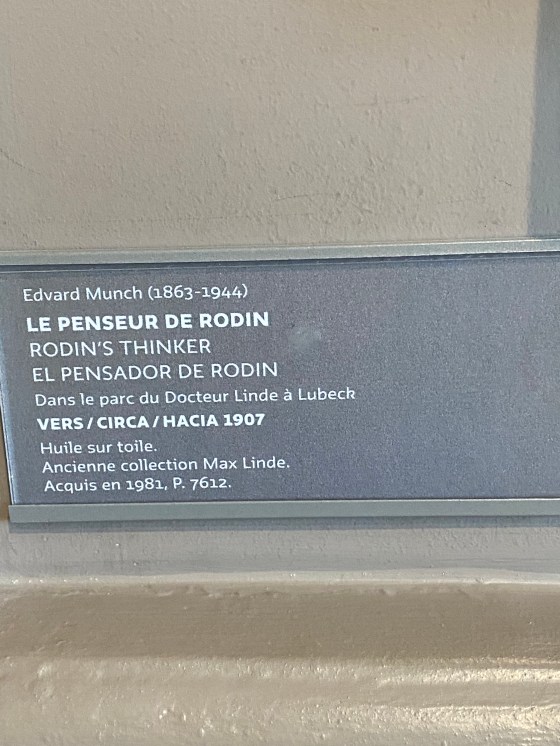
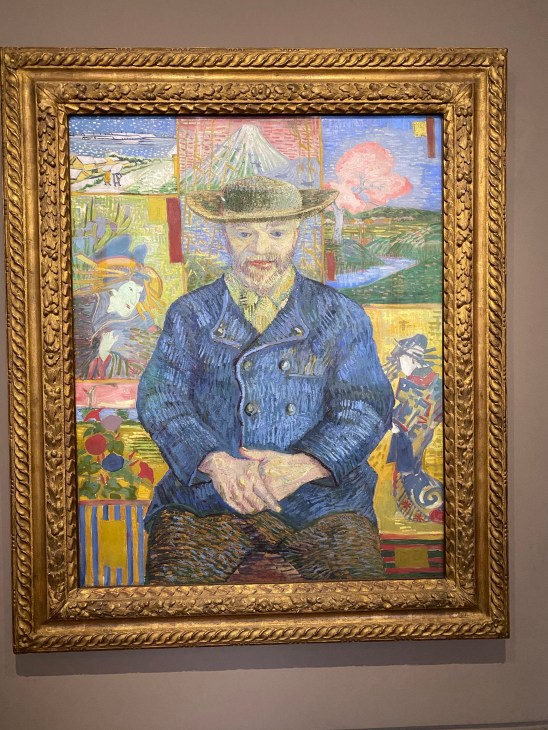
From 1908, while living in the Villa des Brillants, Rodin used the Hôtel Biron as his workshop. He subsequently donated his entire collection of sculptures – along with paintings that he owned by Vincent van Gogh, Claude Monet and Pierre-Auguste Renoir to the French State on the condition that they turn the buildings into a museum dedicated to his works.
The Musée Rodin contains most of Rodin’s significant creations. Many of his sculptures are displayed in the museum’s extensive garden. The museum includes a room dedicated to the works of Camille Claudel and one of her two castings of The Mature Age.
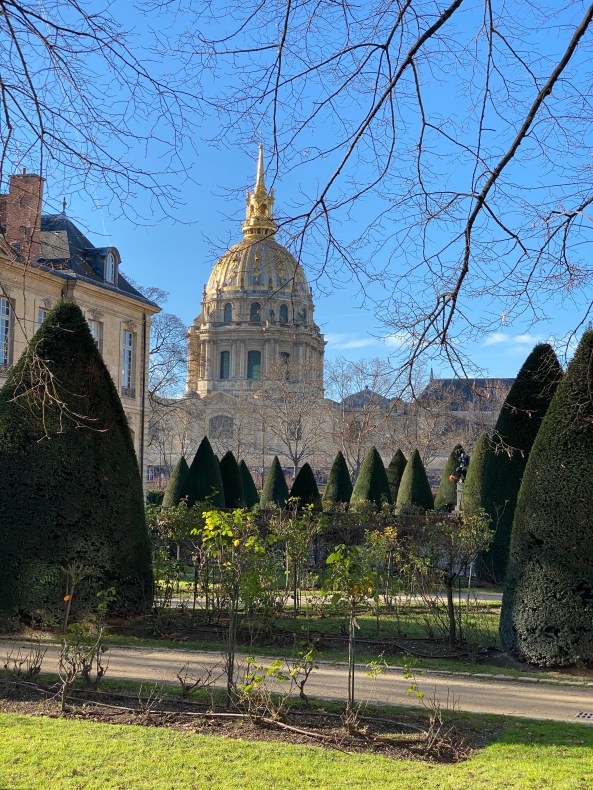
The gardens around the museum building contain many of the famous sculptures in natural settings. Behind the museum building are a small lake and casual restaurant. Additionally, the nearby Métro stop, Varenne, features some of Rodin’s sculptures on the platform.
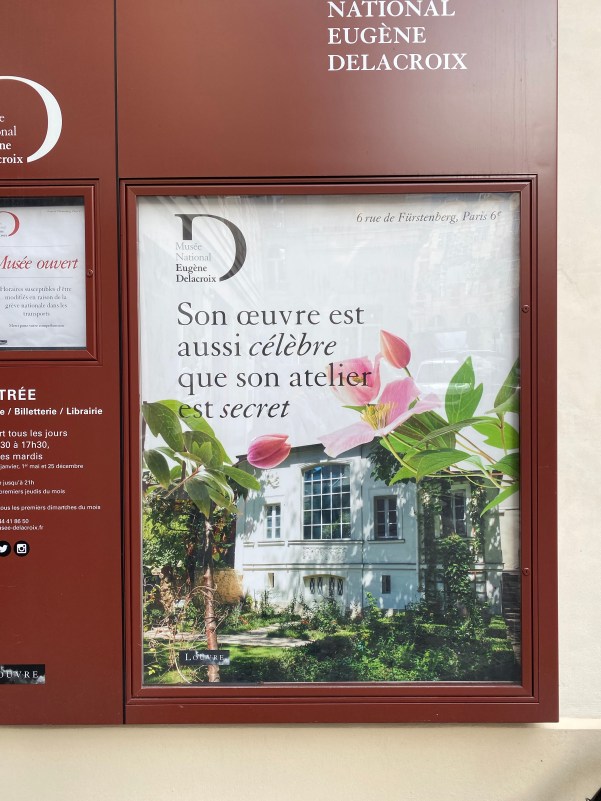
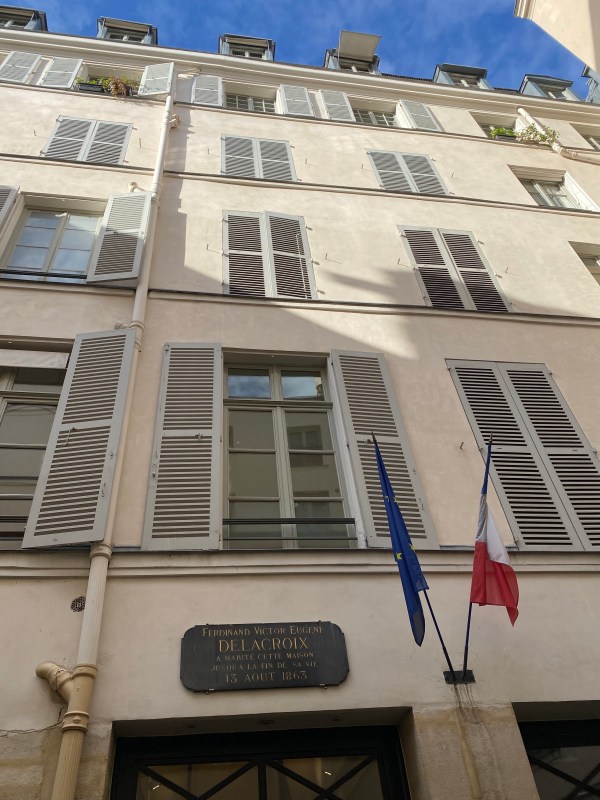
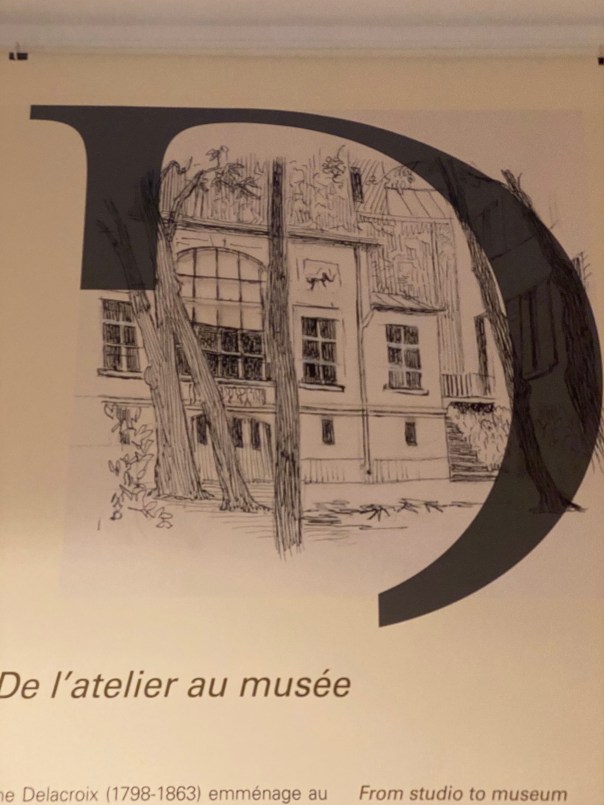
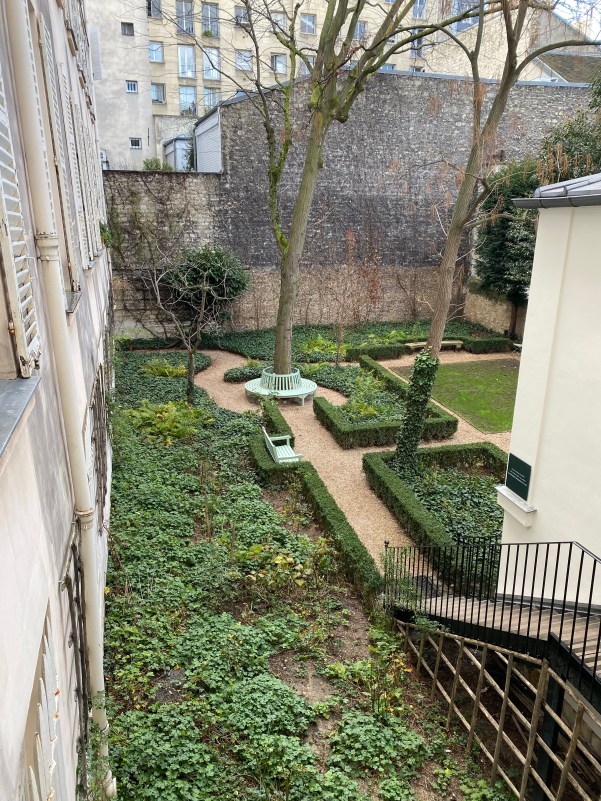
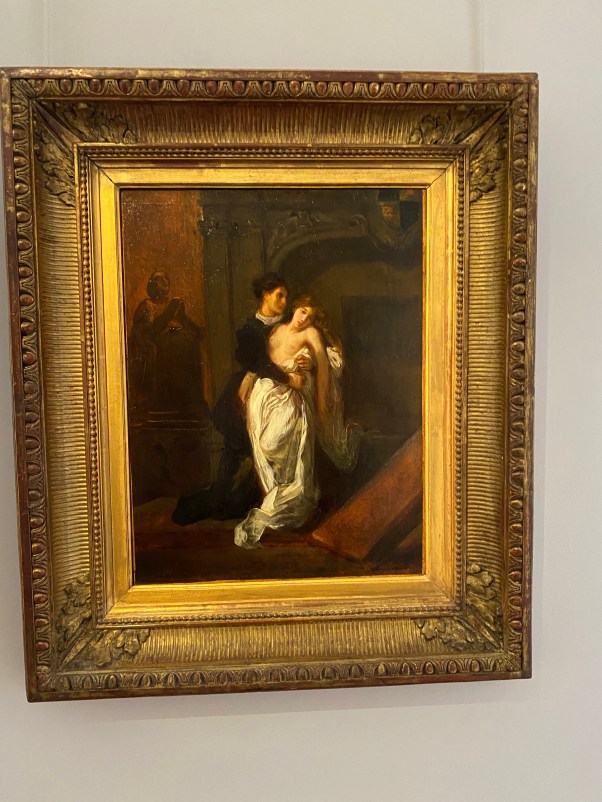
For a long time I have wanted to visit this small, but excellent museum. Last week I got my chance. I enjoyed it a lot and the lovely hidden garden was a delight to discover! This left bank artist home is well worth a visit.



 get back, lauretta!
You must be logged in to post a comment.