Rome
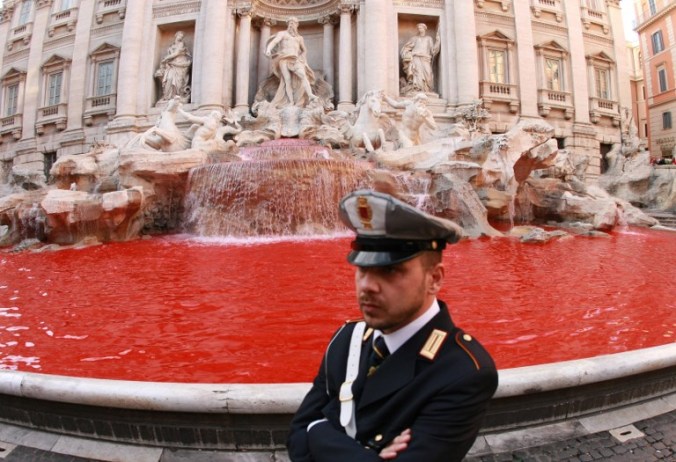
The red Trevi Fountain, Rome
The Egyptian pyramid in Rome
Italy’s immense appeal
I often think Italy is too popular for her own good. When I pass through the piazza del Duomo in the middle of the day, on a nice day I can barely move through from the sheer numbers of tourists. The trash trucks and street washers (a type of vehicle) travel up and down the streets all of time, picking up after the people.
On the flip side, Italy reacts in general to the immense tourist population by constantly opening new sites to appeal to them. As someone who has visited Italy a lot over the past 30 years, I am constantly amazed when I learn new archaeological sites, for example, are newly available to be visited. As below.
Nota bene.
ROME, ITALY
Santa Maria della Concezione Crypts
“Quello che voi siete noi eravamo; quello che noi siamo voi sarete.”
“That which you are, we were; that which we are, you will be.”

On the Via Veneto in Rome is a small church, Santa Maria della Concezione, attached to which is a crypt of Capuchin monks. The burial ground consists of a few small chapels, the pilasters, arches, and vaults profusely decorated with the bones of four thousand exhumed monks that were brought to the church in 1631.

Ah, Roma…
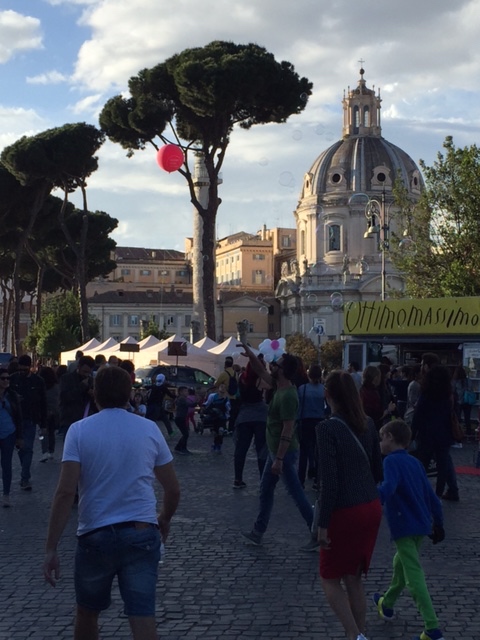
Imagine being three thousand years old. Suppose by some mysterious process you had managed to avoid the limitations of mortality, and year after year you keep going, adding more and more experiences to your life story until you have no choice but to repeat them because you have exhausted all possibilities.
You are the very essence of what it means to be human. You have had more than your share of victories and defeats, triumphs and tragedies, moments of glory and those of abjection, times when you wish you had never been born and times when you want to go on forever. You have loved and lost, have abandoned and been left behind, been rich and poor, skinny and fat, lived high on the hog and been forced to scramble for a few morsels of stale bread. You have seen it all, done it all, regretted it all, and then gone back and done it all again.
You are la città eterna, Rome, the Eternal City.
Epstein, Alan. As the Romans Do: The Delights, Dramas, And Daily Diversio (p. 1). HarperCollins. Kindle Edition.
Italy for me, summed up in one picture

Palazzo Farnese, Roma
The French Embassy: I made a quick trip to Rome this past week to visit the Palazzo Farnese, a reservation made several months ago. You have to reserve early and provide lots of personal information if you want to pay a visit to the French Embassy in Italy!
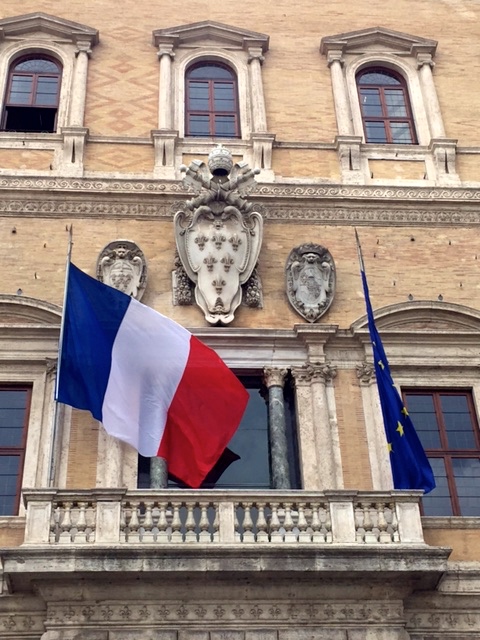
Today the Palazzo is owned by the Italian Republic. In 1936 an arrangement was made with the French to house their embassy for 99 years at the high cost of $1.00 per annum. The Italians have a similar arrangement in Paris.
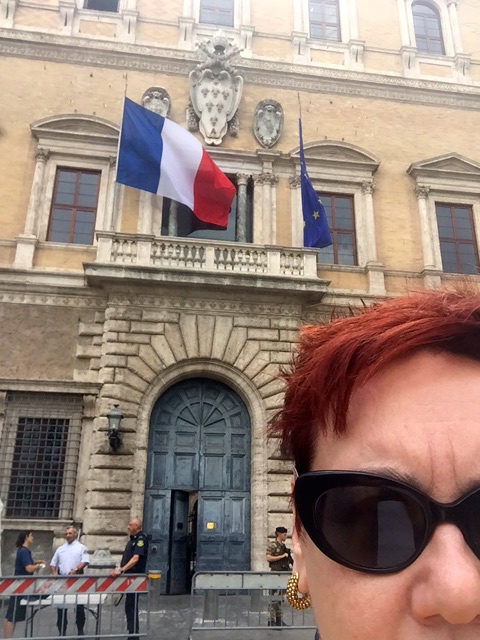
See those men behind me? They are there to make sure only authorized people enter the Embassy. Trust me, they do a good job! Even with my reservation, I almost wasn’t let in (it seems they needed my actual passport, not just a photocopy that serves me in 99.9% of cases….ummmm… I won’t be making that mistake again).
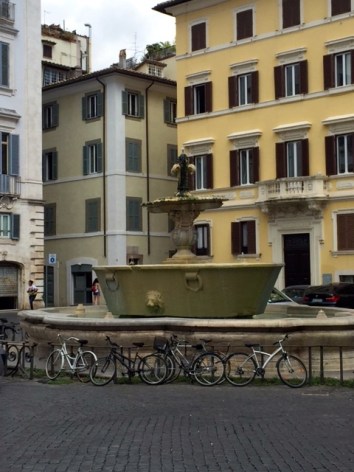
This pair of matching fountains stand symmetrically in front of the Palazzo.
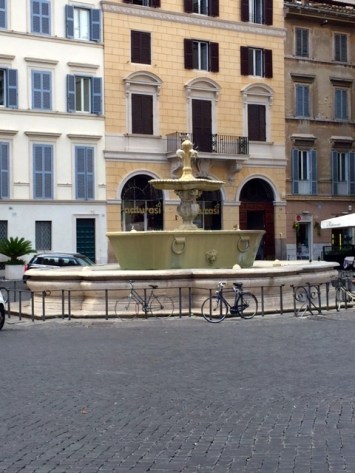
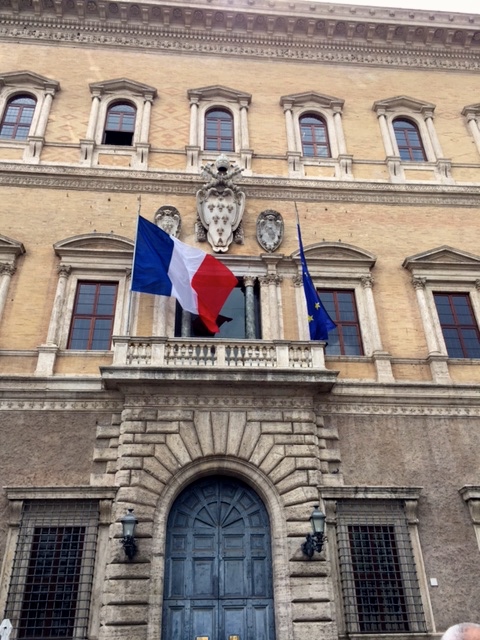
I was there as an art lover, of course, scheduled to take a tour in Italian of the many beautiful objets that adorn the fabulous palace. Chief among them being the fabulous frescoes by Carracci!
But, before moving to the frescoes, let’s look at the incredible building!
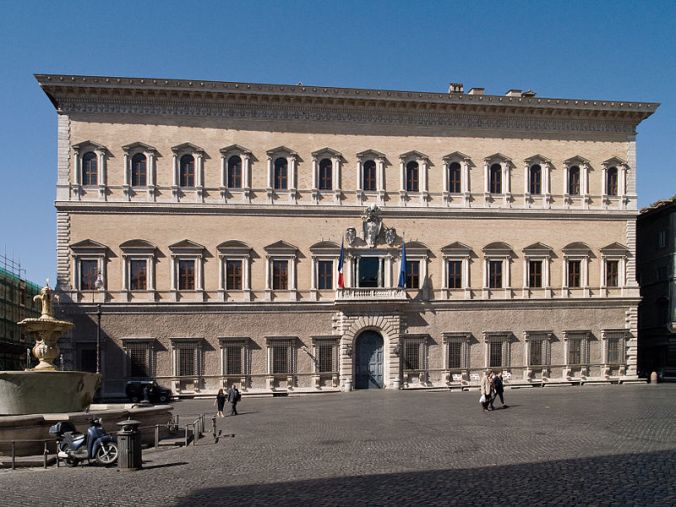
Above is an overview of this very important Renaissance palazzo, located in a prime area of central Rome. First designed in 1517 for the Farnese family, the building expanded in size and conception to designs by Antonio da Sangallo the Younger when Alessandro Farnese became Pope Paul III in 1534.
The palazzo’s construction involved some of the most prominent Italian architects of the 16th century, including Michelangelo, Jacopo Barozzi da Vignola and Giacomo della Porta.
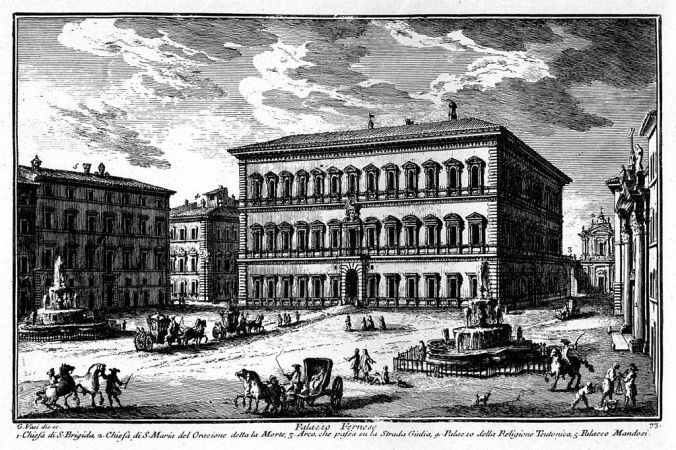
Above is an engraving of the Palazzo with the two matching fountains.
Let’s talk frescoes!
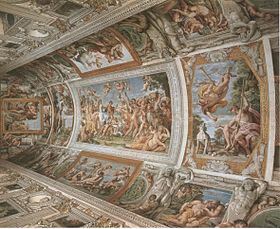
Several of the palazzo’s main salons were painted with elaborate allegorical programs including the Hercules cycle in the Sala d’Ercole or the Hercules Room; the “Sala del Mappamondo” or The Room of Maps; and the well known The Loves of the Gods (1597–1608) by the Bolognese painter Annibale Carracci.
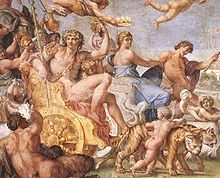
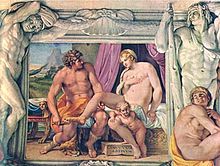
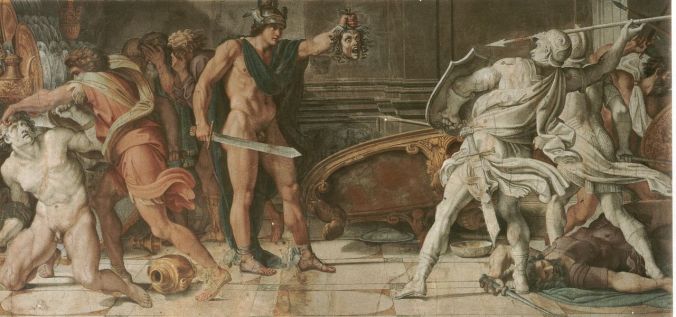

In 1595, Annibale and Agostino Carracci had traveled to Rome to begin decorating the Palazzo with stories of Hercules, appropriate since the it housed the famous Greco-Roman antique sculpture of the hyper muscular the so-called Farnese Hercules.
Annibale developed hundreds of preparatory sketches for the major work, wherein he led a team painting frescoes on the ceiling of the grand salon with the secular quadri riportati of The Loves of the Gods.
Although the ceiling is riotously rich in illusionistic elements, the narratives are framed in the restrained classicism of High Renaissance decoration, drawing inspiration from, yet more immediate and intimate, than Michelangelo’s Sistine Ceiling as well as Raphael’s Vatican Logge and Villa Farnesina frescoes.
Throughout the 17th and 18th centuries, the Farnese Ceiling was considered the unrivaled masterpiece of fresco painting for its age. They were not only seen as a pattern book of heroic figure design, but also as a model of technical procedure; Annibale’s hundreds of preparatory drawings for the ceiling became a fundamental step in composing any ambitious history painting.
The lucky French, to occupy this magnificent building!
How Italian treasures survived WWII
De Rinaldis informed Cott that most of the works of art in Rome had been safely stored in the Vatican….the Vatican [itself] possessed one of the greatest collections of art in the world. [During the early 1940s, however, it housed as well] the temporary addition of works from the Brera Picture Gallery in Milan, Accademia in Venice, Borghese Gallery in Rome, Museo Nazionale in Naples, the holdings of dozens of less prominent museums, and many priceless riches from the nation’s churches, it now had few, if any, rivals anywhere on earth. Joining its remarkable collection were—to name just a few—the Caravaggios from Santa Maria del Popolo and San Luigi dei Francesi, and oversize canvases by Titian, Veronese, Tintoretto, and Tiepolo from Venice. Never before or again would the results of such creative genius be gathered in one place.
Edsel, Robert M.. Saving Italy: The Race to Rescue a Nation’s Treasures from the Nazis (p. 138). W. W. Norton & Company. Kindle Edition.
 get back, lauretta!
You must be logged in to post a comment.