Lorenzo de’ Medici’s sculpture garden

Lorenzo de' Medici and His Artists in the Sculpture Garden


Ottavio Vannini – Michelangelo Showing Lorenzo il Magnifico the Head of a Faun, surrounded by the other sculpture students


Young Michelangelo Carving a Faun's Head


Young Michelangelo Carving a Faun’s head by Emilio Zocchi


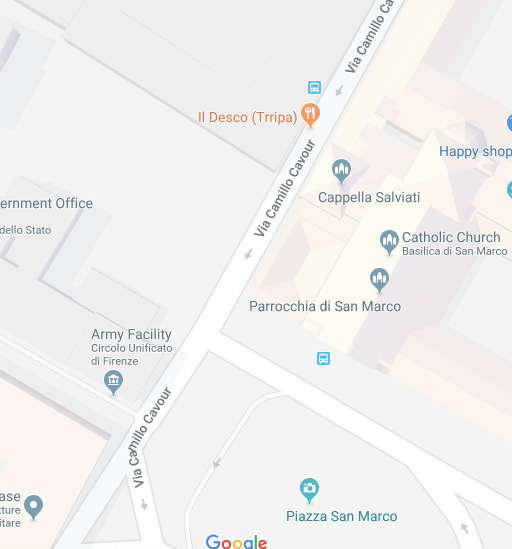
The Piazza San Marco on the former Via Larga, which is now Via Camillo Cavour, was where Lorenzo de’ Medici’s Sculpture Garden was situated in Florence. In the map below, you can get a sense of where the garden was in relationship to Piazza San Marco. The sculpture garden would have been where the words “Army Facility” show below.


Screen Shot 2018-05-29 at 6.34.27 PM


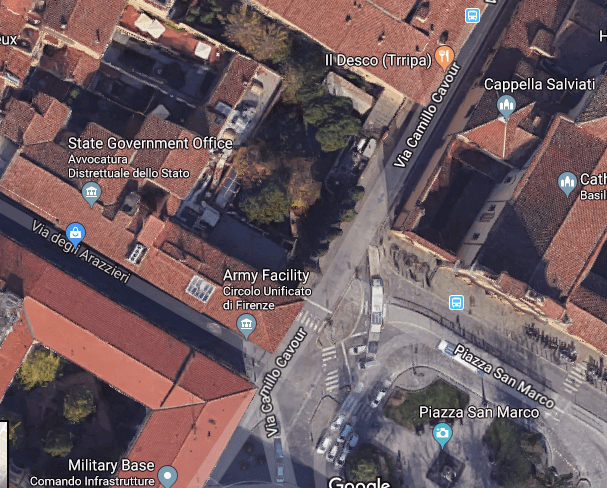
The Google map showing a satellite view, gives an even better sense of this former garden area.  Think away the Army building to the south end of the space, where Via Cavour and Via degli Arazzieri intersect, and you can see that there is still garden area in the site of the former Medici garden.

Screen Shot 2018-05-29 at 6.37.12 PM


Created with the hopes of becoming a great educational institution for studying art, Lorenzo de’ Medici curated a garden full of antique sculptures for artists to come and sketch as part of their artistic practice. Lorenzo also added sleeping and dining quarters so that students could easily live among the work they were studying. Francesco Granacci and Bertoldo di Giovanni are two of the many people to enter through its doors.

The most famous story of Michelangelo’s time in the Garden surrounds Michelangelo’s Faun statue. When Lorenzo saw this statue, he jokingly told Michelangelo that he looked too perfect to be an old faun. Michelangelo than took his drill and knocked out one of the teeth in the mouth of the Faun.

He showed his subtraction to Lorenzo who gained much amusement and pleasure from Michelangelo’s ability to listen and act on his critique.  Although the Faun statue has not been found, the two works of Michelangelo’s attributed to this time period are the Battle of the Centaurs and the Madonna of the Stairs. 


Palma Bucarelli

Palma Bucarelli (1910 –  1998) was an Italian arts administrator, the director of the Galleria Nazionale d’Arte Moderna (GNAM) in Rome from 1942 to 1975.
853cde6a-e421-11e3-8e3e-8f5de4ddd12f

Early life

Palma Bucarelli was born in Rome. She earned a degree in art history at the Sapienza University of Rome.[1]

Career

As a young art historian she worked at the Galleria Borghese and in Naples. During her thirty-three years as head of the Italian National Gallery of Modern Art, Bucarelli was responsible for protecting the gallery’s collections from damage while it was closed during World War II; she arranged to place paintings and sculptures in historic buildings including the Palazzo Farnese and Castel Sant’Angelo.[2] She was one of the Italian delegates to the First International Congress of Art Critics, held in 1948 in Paris.[3]

13790

After the war, she oversaw such events as exhibitions of works by Pablo Picasso (1953), Piet Mondrian (1956), Jackson Pollock (1958), Mark Rothko (1962), and the Gruppo di Via Brunetti (1968). She defended controversial works such as Piero Manzoni‘s ‘”Merda d’Artista” and Alberto Burri‘s “Sacco Grande” (1954).[1] Her strong support for abstract and avant-garde works made international headlines in 1959, when she was accused of a bias against figurative art in a public debate.[4] In 1961 she was in the United States, where she gave a lecture in Sarasota, Florida[5] and attended the opening of a major exhibit on Futurism at the Detroit Institute of Arts.[6]

Personal life

Palma Bucarelli married her longtime partner, journalist Paolo Monelli, in 1963. She died in Rome in 1998, from pancreatic cancer, aged 88 years. Her personal collection of art was donated to the National Gallery. Her famously elegant wardrobe was donated to the Boncompagni Ludovisi Decorative Art Museum in Rome. A street near the GNAM was renamed in her memory.[2] The Gallery mounted a show about her influence, “Palma Bucarelli: Il museo come avanguardia”, in 2009.[7]

palma-bucarelli

References

  1. ^ Jump up to: a b Lucia Livia Mannella, “Palma Bucarelli” Vogue Italia Encyclo.
  2. ^ Jump up to: a b “Palma Bucarelli” Dictionary of Art Historians.
  3. Jump up ^ Denys Sutton, “The First International Congress of Art Critics” College Art Journal 8(2)(Winter 1948): 130.
  4. Jump up ^ Paul Hofmann, “Art Impartiality Pledged by Italy” New York Times (March 7, 1959): 43.
  5. Jump up ^ “Italian Art Expert’s Talk is Tonight” Tampa Bay Times (9 November 1961): 13. via Newspapers.comopen access publication – free to read
  6. Jump up ^ Kathie Norman, “VIPs Impressed” Detroit Free Press (17 October 1961): 17. via Newspapers.comopen access publication – free to read
  7. Jump up ^ Laura Larcan, “Un Direttore di nome Palma Bucarelli, la Guggenheim di Roma” la Repubblica (26 June 2009).


https://en.wikipedia.org/wiki/Palma_Bucarelli

Florence, an open-air museum and a protected UNESCO site

I think it is always worth reminding ourselves that Florence, the Renaissance city, is one of the most beautiful and visited art cities in the world. It is truly an open-air museum, placed in the UNESCO’s World Heritage List in 1982. Let’s make a quick rundown of some of the major sites within the city.

Piazza Duomo is the religious centre of the city, featuring the Cathedral of Santa Maria del Fiore and the majestic Brunelleschi’s Dome, Giotto’s Bell Tower, and the Baptistery of St. John the Baptist, with its world renowned bronze doors.

ub
The square is surrounded by wonderful palaces, such as the Archbishop’s Palace, the 14th-century Loggia del Bigallo and the recently renovated Museo dell’Opera del Duomo (Museum of the Works of the Cathedral) which recreates the original feeling of the 14th-century façade according to the first project by Arnolfo di Cambio with great technical virtuosity.

The absolute masterpiece housed within the Museo dell’ Opera is the Deposition (or Pietà) sculpted by Michelangelo for his own grave.

250px-Pieta_Bandini_Opera_Duomo_Florence_n01

In the sculpture, Nicodemo, represented at the top centre, has Michelangelo’s facial features. Some parts of this marble sculpture are unfinished, as Michelangelo often did in order to witness the spirit struggling to break free from block of stone. In 1555, in an outburst of rage, the same artist partially damaged his own sculpture with a hammer.

Piazza della Signoria is the heart of the socio-political life, as well as the seat of civil power with Palazzo Vecchio (previously known as dei Priori and della Signoria). The square hosts important works of art such as the equestrian monument of Cosimo I de’ Medici, by Giambologna. Next to the palace, you can admire the fountain of Neptune by Bartolomeo Ammannati, also called the ‘Biancone’ due to the huge white marble statue of the sea god at the centre of the fountain, riding in a chariot roomed by four horses.

In front of the main entrance of Palazzo Vecchio, you will find copies of two sculptures by Donatello: Marzocco (the lion symbolising the city of Florence) and Judith Beheading Holofernes, in addition to a copy of the David by Michelangelo, whose original statue is preserved inside the Galleria dell’Accademia (Gallery of the Academy of Florence). Next to David, the statue of Hercules and Cacus by Baccio Bandinelli, symbolises strength and ingenuity prevailing over evil.

On the right, facing Palazzo della Signoria, you will find the Uffizi Gallery, one of the most important museums in the world, which once hosted the offices and the state archives of the Grand-Duke. The museum boasts an incomparable collection of Italian and European art from the 13th century on.

In addition to masterpieces by Cimabue, Giotto, Masaccio, Botticelli, Leonardo, Piero della Francesca, Michelangelo, Raphael, Titian, Caravaggio, Dürer, and many others, there is also a remarkable collection of ancient sculptures.

The Vasarian Corridor is a spectacular elevated enclosed passageway, connecting Palazzo Vecchio with Palazzo Pitti and offering, from above Ponte Vecchio, a breath-taking view on monuments and on the Arno with its bridges. The corridor hosts a collection of self-portraits, in addition to an important 17th and 18th-century collection of paintings.
The Galleria dell’Accademia hosts the highest number of sculptures by Michelangelo, such as the Prisoners, St. Matthew and the famous David, in addition to important paintings from the second half of 13th century to the end of 16th century, as well as the Musical Instruments Museum.

The National Museum of the Bargello, located inside a palace built in mid-13th century for the Capitano del Popolo (Captain of the People), boasts some of the most important statues of the Renaissance by Ghiberti, Donatello, Verrocchio, the Della Robbia family, Michelangelo, Giambologna, and others. Do not miss the prestigious collections of little bronze statues, maiolica, wax models, enamels, medals, ivory, tapestry, furniture, seals and textiles coming from the Medicean collections or donated by private collectors.

Palazzo Pitti, with its wonderful Boboli Gardens, represents one of the most important monumental complexes with its museums – the Palatine Gallery, the Monumental Apartments, the Silver Museum, the Modern Art Gallery, the Costume Gallery, the Porcelain Museum and the Carriages Museum.

Among the most representative testimonies of the Florence Renaissance, the city boasts some masterpieces planned by Filippo Brunelleschi (in addition to his world renowned Dome) – the Ospedale degli Innocenti (Hospital of the Innocents) and the two churches of San Lorenzo and Santo Spirito – and by Leon Battista Alberti – the façade of the Santa Maria Novella church and Palazzo Rucellai.
Piazza della Repubblica is the “élite square” of the city, with its great historic cafés and 19th-century buildings. The historic centre of Florence is a shopping and entertainment paradise, with the most famous fashion designer boutiques, traditional handicraft workshops, historical markets and typical restaurants, as well as American bars, lounge bars and discos.
Do not miss the churches of San Miniato al Monte, Santa Croce and Santa Maria Novella, as well as the great masterpieces of Italian 20th -century architects, such as the Central Railway Station of Santa Maria Novella and the Artemio Franchi football stadium, respectively by Giovanni Michelucci and Pier Luigi Nervi.

The end of the Corcoran Gallery of Art

A few years ago it was announced that the Corcoran Gallery of Art, Washington’s oldest private art museum, and its venerable college of art and design would cease to exist as an independent institution, and its components — artwork, historic building and school program — will be taken over by the National Gallery of Art and George Washington University.

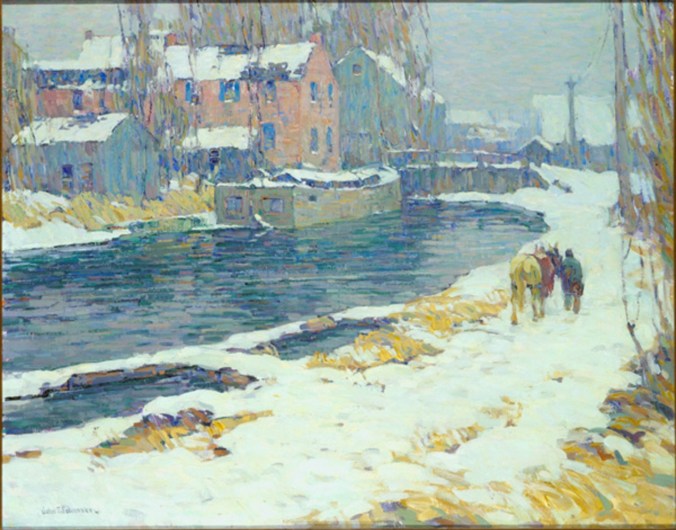
Folinsbee_21_7John Fulton Folinsbee’s “Grey Thaw,” one of the works in the Corcoran’s collection. (Corcoran Gallery of Art’s board of trustees )

This week it was announced that the Corcoran’s board of trustees has decided that it will distribute almost 11,000 works remaining in its renowned collection, a historic giveaway that includes paintings by Washington Color School artist Sam Gilliam, photographs by Ansel Adams and Dorothea Lange, and prints by 19th-century French master Honoré Daumier.

Almost 9,000 pieces will go to the American University Museum at the Katzen Arts Center, with others headed to 10 Smithsonian Institution museums, several universities and the U.S. Supreme Court.

The distribution marks the final stage of the dismantling of the famed Washington institution. Under a controversial 2014 deal, the National Gallery of Art had first dibs on the entire collection and ended up acquiring about 40 percent of the 19,493 works. George Washington University gained control of the museum’s independent school and its two historic buildings, including the Flagg Building on 17th Street NW.


For more, please see these sources:

https://www.washingtonpost.com/entertainment/museums/the-end-of-the-corcoran-gallery-of-art/2014/02/19/accd8a38-99a3-11e3-b931-0204122c514b_story.html?utm_term=.e1e71071df4d

https://www.washingtonpost.com/entertainment/museums/bulk-of-corcorans-remaining-collection-headed-to-au-museum-at-the-katzen/2018/05/13/1ae68b48-5550-11e8-9c91-7dab596e8252_story.html?utm_term=.0801f8cb53cc

The quarries of Settignano, where Michelangelo lived

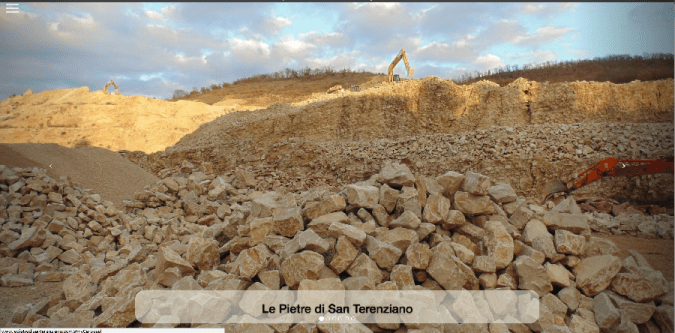
santerenziano

The Settignano quarries yielded macigno, a fine-grained grey sandstone that was much prized in Florence. It is a gravely beautiful material in a range of dark-greenish and bluish greys, fine enough to carve in crisp detail and with a quality of simultaneously absorbing and reflecting the light, producing a paradoxical impression of dark luminosity.

This is the material that Brunelleschi used for the columns and capitals of his buildings. Michelangelo would employ it in the same way in his projects at San Lorenzo in Florence.

The Florentines, being interested in this stone enough to make fine distinctions, gave names to the differing grades, the finest type being pietra del fossato, and the others including pietra serena and pietra forte.

Michelangelo, who had immense sensitivity to stone, went further than these broad categories. He knew that each quarry, every stratum, would produce material of subtly differing character. The contract for the stairs and two doors of the library Michelangelo was building at San Lorenzo in the 1520s stipulated that the pietra serena supplied should be of the same ‘colour and flavour’ (‘ colore et sapore’) as in the sample. ‘Flavour’ is a wonderful word to use of stone: bringing out its sensuous character as if it were actually edible.

When he designed buildings in Rome, Michelangelo was attentive to the qualities of the local material, travertine, a limestone noted for the pits and troughs in its surface – as different in its flavour and colour from Florentine sandstone as roast beef is from pâté de foie gras. His use of travertine for the walls of St Peter’s and the palaces on the Capitoline Hill made the most of its rugged nature.

For sculpture he used only the finest type of pure white marble, known as statuario, found particularly in certain quarries above Carrara. Even this sculptor’s marble, according to the sculptor and goldsmith Benvenuto Cellini, came in at least five or six grades, the first having a ‘very coarse grain’ and the softest, which he describes almost like flesh, ‘the most cohesive, the most beautiful and the tenderest marble in the world to work from’.

Michelangelo was renowned for his ability to discern the quality of a potential piece while it was still in the rockface. When he was engaged from 1516 onwards on large construction projects at San Lorenzo in Florence which involved the quarrying, transport, dressing and carving of huge amounts of both marble and macigno, a majority of the masons he employed were from Settignano.


Gayford, Martin. Michelangelo: His Epic Life (Kindle Locations 803-811). Penguin Books Ltd. Kindle Edition.

How art history became an academic (& my favorite) field of study

Before Charles Eliot Norton had become Harvard’s first professor of that discipline, art history had, in general, been considered, not a field of study, but a matter of craft and technique to be taught by painters to other painters.

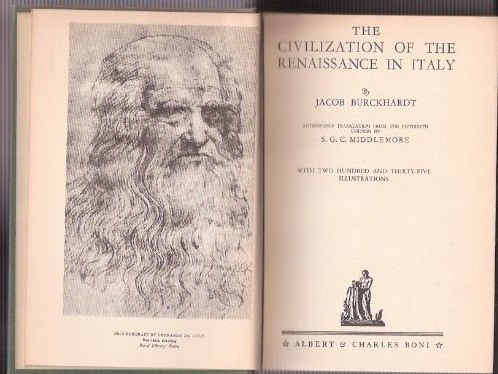
Scholarship about art, and especially about Italian art, entered a new era as the German universities began developing large-scale historical studies like those of Swiss scholar Jacob Burckhardt, whose Civilization of the Renaissance in Italy was published in English in 1878.

Die_Kultur_der_Renaissance_in_Italien

In Great Britain, tastes were influenced by the work of Norton’s close friend Ruskin in books like The Stones of Venice (1851–1853) and The Seven Lamps of Architecture (1849).

The_Seven_Lamps_of_Architecture_-_titlepage

Following Ruskin, Norton loved best in Italy the powerful moral uplift of Dante and of Italy’s medieval Gothic architecture. In Norton’s art history courses, the Renaissance was the unhappy termination of the Middle Ages, which had been the last great era of spiritual unity and well-being.

There was a joke current among Harvard undergraduates that Norton had died and was just being admitted to Heaven, but at his first glimpse staggered backward exclaiming, “Oh! Oh! Oh! So Overdone! So garish! So Renaissance!”

“Norton,” Bernard Berenson commented drily years later, had done what he could at Harvard to restrain “all efforts toward art itself.”

Rachel,Cohen. Bernard Berenson (Jewish Lives) (p. 45). Yale University Press. Kindle Edition.


Wartime Florence

In 1565, by connecting the Uffizi and the Pitti and provided the Medici with an escape route in the event of political unrest. Its narrow hallways are decorated with more than a thousand paintings, mostly self-portraits, by many of the artists whose works adorn the walls of the city’s museums and churches. Farther north is the Palazzo Vecchio (the town hall), the Duomo, and the Accademia, home to the world’s most famous piece of marble, Michelangelo’s David.

In the summer of 1944, war placed this legendary city, and centuries of creative achievements, in danger of utter destruction.

ON NOVEMBER 10, 1943, Adolf Hitler remarked to Ambassador Rudolf Rahn, “Florence is too beautiful a city to destroy. Do what you can to protect it: you have my permission and assistance.” Hitler’s affection for the city initially gave Florentine Superintendent Giovanni Poggi and other city officials hope that Florence would be spared the fate of Naples. The fact that Rome and Siena had escaped major damage also encouraged them.

But, as Allied soldiers inched closer each day, a small group of dedicated souls—now seen as guardian angels of Florence—became increasingly concerned that the coming battle would overtake their city. They had few resources and dwindling options. These benefactors’ best hope was to push Germany and the Allies to jointly declare Florence an “open city,” first suggested by the Director of the Kunsthistorisches Institut, Friedrich Kriegbaum.

But for a city to be declared “open,” it had to be undefended; there could be no military targets; and both sides had to have freedom of entry. In Florence, German forces had positioned two artillery batteries in the della Gherardesca and dei Semplici Gardens. They had stationed soldiers at numerous mortar positions in the city.

Additionally, Florence, like Rome before it fell to the Allies, served as a major rail transport hub for the German Army. Even after the Allies’ air attacks on the Santa Maria Novella and Campo di Marte marshaling yards, men and materiel moved through the city.

Undaunted by these facts, German leaders referred to Florence as an “open city,” accusing the Allies of refusing to publicly affirm that designation. For their part, the Allies wouldn’t declare Florence an open city until the Germans removed their guns and soldiers.

The standoff held through the spring and early summer of 1944, while Allied forces were engaged in combat operations hundreds of miles to the south. Things grew much more urgent following the liberation of Rome in June and of Siena in July.

City officials believed that their portable art treasures, tucked away by Poggi in Tuscan villas, were safe. But protecting the city’s architectural treasures still depended upon securing an official, unequivocal declaration of Florence as an open city.

Members of the principal group working toward this designation were the German Consul, Gerhard Wolf; the Archbishop of Florence, Cardinal Elia Dalla Costa; the Extraordinary Envoy and Minister Plenipotentiary of San Marino to the Holy See, Marchese Filippo Serlupi Crescenzi; and the Swiss Consul in Florence, Carlo Alessandro Steinhäuslin. These four men did more to save Florence than anyone else.

After four years of service in the German Army, Gerhard Wolf attended Heidelberg University, where he met Rudolf Rahn, who would become a lifelong friend. In the years following graduation, both would enter Germany’s Foreign Service. Seeking to distance himself from the Nazi Party, Wolf accepted a position as the German Consul to Florence.

Cardinal Dalla Costa, a seventy-two-year-old prelate, was another of the city’s guardians. Soft-spoken yet forceful, he assumed an increasingly visible role in defense of the city. During Hitler’s 1938 visit, he ordered that the windows of his palace be shut in symbolic protest. He declined to participate in the official celebrations, explaining that he did not worship “any other cross, if not that of Christ.”

As the situation became more desperate, the cardinal agreed to issue notices that stated, “His Eminence Cardinal Elia Dalla Costa, Archbishop of Florence, declares that this building and the artworks inside, are under the protection of the Holy See.” While he pleaded with the German commanders to respect Florence as an open city, he did so knowing that, “in order to truly protect Florentine works of art, it would be necessary to place a huge pavilion made of impenetrable steel and unbreakable bronze, to cover the entire city.”

Edsel, Robert M.. Saving Italy: The Race to Rescue a Nation’s Treasures from the Nazis, W. W. Norton & Company. Kindle Edition.


Galleria Rinaldo Carnielo, Florence

From Wikipedia, the free encyclopedia

 The Galleria Rinaldo Carnielo is a museum encompassing the small palace and studio of the artist Rinaldo Carnielo (1853-1910), located on Piazza Savonarola #3, Florence, region of Tuscany, Italy.

 Facade of Gallery undergoing restoration in 2006.


The eclectic collection consists of nearly 300 works or models, mainly sculptures, by Carnielo, as well as some paintings by Carniello, and some of his colleagues Silvestro Lega, Michele Gordigiani, and Arturo Calosci. Among the works of Carnielo are some macabre sculptures such as Tenax Vitae, Dying Mozart, and Angel of Death.

The small palace is built in the Italian counterpart of Art Nouveau, known as Stile Liberty, and was donated to the commune in 1957 by the sculptor’s son. In October 2015, the museum was temporarily closed.[1]

The design and construction of the palace dates to the 1880s and appears to have involved Rinaldo Carnielo and Enrico Lusini. The facade has various inscriptions including a bust of the artist with the inscription “Non ominis moriar”. A scroll in the center facade states “Onorate l’arte che è vita della vita” (Honor art which is the life of life).[2]


Saving Florence’s art during WWII

ON JULY 4, the same day Keller arrived in Siena, Superintendent of Florentine Galleries Giovanni Poggi received a summons to report to the German Military Commander of Tuscany, Colonel Metzner. With barely a greeting, Metzner asked “if Villa Bossi-Pucci in Montagnana contained works of art of such importance to require their transportation across the Apennines” to northern Italy?

Poggi, fluent in both German and French, was surprised by Metzner’s sudden mention of Montagnana, site of the Villa Bossi-Pucci, which served as one of Tuscany’s thirty-eight art repositories. The constant shifting of the battlefield had prevented Poggi and his team from reaching many of the Tuscan repositories, but the Germans had no such impediment.

Metzner’s sudden curiosity about the Villa Bossi-Pucci—which housed close to three hundred masterpieces from the Uffizi Gallery and the Palatine Gallery at the Pitti Palace, including Botticelli’s Minerva and the Centaur, Giovanni Bellini’s Pietà, and Caravaggio’s Sleeping Amor—was cause for great concern. By July 1944, few men in the world had more hands-on experience protecting works of art than Poggi, a native Florentine described by Hartt as “a character who walked out from one of Ghirlandaio’s frescoes.”

Poggi oversaw a domain that included the provinces of Florence, Arezzo, and Pistoia. At age sixty-four, he had lived long enough to witness war engulf his homeland twice. Fate selected Poggi to be a defender of the arts. An illustrious connoisseur and curator, he had been appointed Director of the esteemed Uffizi Gallery in 1912, at the age of thirty-two.

The following year, he helped recover the world’s most famous painting, Leonardo da Vinci’s Mona Lisa, stolen from the Louvre in 1911. The painting had been missing for more than two years before surfacing in a Florence hotel. After a brief showing at the Uffizi, and a tour through Italy, Poggi accompanied the painting back to Paris in December 1913.

Just six months later, the outbreak of the Great War consumed Europe. The burning of the library in Louvain galvanized art officials across the continent. Few if any nations had more at risk than Italy, no single city more than Florence. Poggi’s quick work protecting the Uffizi’s treasures drew the attention of officials in Rome. Soon they enlisted his aid in safeguarding prominent masterpieces in other Italian cities.

Now, for the second time in twenty-six years, Poggi found himself responsible for protecting the treasures of Tuscany from a world at war. Poggi calmly answered Metzner’s question, telling him that there were indeed highly important works from the galleries and museums of the State in Montagnana.

But, “due to agreements taken with the General Direction of the Arts and with the Office directed by Colonel Langsdorff, it had been decided, as with the other repositories, not to remove anything unless there were some urgent peril, and in that case paintings would have been moved to Florence and not across the Apennines.” Unfazed, Metzner pressed Poggi further, asking in an ominous tone, “So you are rejecting our offer?” Ten months of dealing with German officers had taught Poggi to appeal to their authority—and ego. He explained: “We are not rejecting it, on the contrary, we are grateful. We accept it in the event that it becomes necessary to move these things to Florence.” The meeting concluded soon thereafter; Poggi assumed his replies had settled the matter.

THE OUTBREAK OF war in 1940 had caused Italian superintendents to transfer collections to areas outside the city centers. Acting with “frenzied lucidity,” Poggi and his team had moved almost six hundred major works to privately owned villas and palaces in the Tuscan countryside in less than two weeks. That number had increased more than eighteenfold—to 11,139 various art objects—within six weeks. Those that couldn’t be moved, usually due to their size and weight, had to be protected in situ, often by employing the most ingenious of methods.

Local artisans built a brick tomb around Michelangelo’s towering sculpture of David, and smaller ones for each of his adjacent works, referred to as the Slaves. Poggi hoped that these brick silos would provide protection against bomb fragments or even the collapse of the roof in the event of a direct hit on the building. With the dramatic increase in Allied bombing of Italian cities in the fall of 1942, Poggi and other superintendents received orders to make additional evacuations from the cities.

This required him to secure more villas for storage. The groupings of art were historic. Villa di Torre a Cona contained not only Michelangelo’s statues from the Medici tombs in the Church of San Lorenzo but all of the contents of the master’s family home, Casa Buonarroti. This collection contained two of his earliest works and many of his letters and drawings. Never before had so many of Michelangelo’s works

been gathered in one place. Sitting alongside were masterpieces by Verrocchio, Donatello, Della Robbia, Lorenzo Monaco, and the most important surviving work by the Flemish painter Hugo van der Goes, the Portinari Altarpiece. The quality and rarity of the art was simply staggering. The Castle of Montegufoni housed 246 masterpieces from the Uffizi and the Pitti by great masters such as Cimabue, Giotto, Botticelli, Raphael, Andrea del Sarto, Pontormo, and Rubens.

The repository at Poppiano sheltered Pontormo’s emotive masterpiece, Deposition from the Cross, from the Capponi Chapel in the Church of Santa Felicita, and Rosso Fiorentino’s crowning achievement, Descent from the Cross, from the town of Volterra. The Palazzo Pretorio at Poppi held Hans Memling’s Portrait of a Young Man and Michelangelo’s Mask of a Faun; the Oratory of Sant’Onofrio at Dicomano contained Roman sculptures and sarcophagi; the villa at Poggio a Caiano housed Donatello’s Saint George and Michelangelo’s Bacchus. The quality and importance of each villa’s contents surpassed the last, each filled with the accomplishments of civilization’s most creative minds. The fall of the Badoglio-led government and the occupation of Italy by German forces in September 1943 prompted most Italian art officials, including Lavagnino and Rotondi, to relocate their collections to the Vatican. But Poggi made the decision to keep the Tuscan artworks within his reach at their existing countryside repositories.

These villas, he believed, afforded more protection from aerial attack than any fortress in an urban setting. By the time he realized that the Tuscan repositories lay in the path of the coming ground battle, it was too late to return all of the works of art to Florence. And that gave rise to another concern, one he could do nothing about: perhaps overconfident at the time, Poggi had allowed many of the masterpieces to be transported from Florence uncrated. Poggi certainly knew that the safest place for a painting was hanging on the wall of a museum.

Once it began a journey, the risks of damage increased dramatically. Moving uncrated paintings in trucks exposed them to dust. Canvases were vulnerable to tears, punctures, and scratches. Vibration alone could cause the wood of a panel painting to split. Poggi also knew well that paintings on panel are reactive to sudden changes in humidity. Low humidity during winter weather diminishes the moisture in the wood, increasing the risk it might crack. Sculpture, whether marble (more durable) or terra-cotta (more fragile), was always at risk of being chipped, much less ruined if dropped. Subsequent moves would compound these risks even further,

SS Colonel Alexander Langsdorff, head of the Kunstschutz, to discuss how best to protect the Florence repositories from the looming battle. Anti insisted that the treasures be evacuated again and moved north, but his argument ignored the shortage of transportation and the speed with which enemy troops were approaching Tuscany. After a heated discussion, Poggi prevailed. The art would remain in the existing repositories. “It is too late,” Anti noted ominously in his diary.

In early July, Social Republic officials once again pressed for the works of art to be transported northward. Certain that he knew what was best for “his” works of art, Poggi shrewdly parried the request with the Medici Family Pact of 1737, which required that their collection (the core of the Uffizi and Pitti collections) “never be removed or taken outside its capital and the Grand Duchy.” At this stage of the war, Poggi had no real power to keep Fascist officials or the Germans from removing works of art. Clever excuses and tricks were his only tools.

Several days later, Poggi received a shocking telephone call from the German Consul, Dr. Gerhard Wolf, informing him that Wehrmacht troops had loaded 291 paintings from the Villa Bossi-Pucci repository at Montagnana onto trucks and taken them to the small town of Marano sul Panaro near Modena, some ninety miles north of Florence. This was the same villa Colonel Metzner had questioned Poggi about just days earlier. “At one blow at least an

eighth of the most prized contents of the Uffizi and Pitti had vanished.” Further queries by Consul Wolf later revealed the treachery: the paintings had been taken—and were already en route north—before Metzner’s portentous meeting with Poggi on July 4. Gerhard Wolf requested that Langsdorff report to Florence to resolve the matter. Without transportation, Poggi could do nothing. On Sunday evening, July 16, Poggi received a call from Consul Wolf’s assistant, advising him that a different German unit had removed works of art from a second, as-yet-unidentified repository. Poggi should expect to take custody of them at German Military Headquarters, in Florence’s Piazza San Marco, the next day at 8 a.m.

With no sign of Langsdorff, and no further word about the disposition of the artworks from Villa Bossi-Pucci, this latest news horrified and infuriated Poggi. The following morning, Poggi and other officials watched three German trucks pull into Piazza San Marco, right on time. The officer in charge of the operation, Colonel Hoffmann, informed them “that since the castle of Oliveto was under the fire of the Allied artillery, the military command of the area had decided on the immediate transport to Florence of the works of art.” The unloading of paintings commenced, notably those from the Horne Foundation museum and altarpieces from the city’s churches—eighty-four paintings, twenty-three crates, and five frames. For reasons Hoffmann didn’t explain, more than one hundred paintings had been left behind. While Poggi tried to make sense of it all, the custodian of the repository at the Castello Guicciardini in Oliveto, Augusto Conti, who had accompanied the trucks into Florence, discreetly informed him that Hoffmann’s explanation was a lie. The area around the castello had been quiet, void of any combat activity. Conti then shared even more distressing news.

Two panel paintings by German Renaissance painter Lucas Cranach the Elder—Adam and Eve—had been loaded into an ambulance. He had no idea what had happened to them after that. Poggi knew both paintings well—and he knew that Hitler did too. During the Führer’s 1938 tour of the Uffizi, Poggi remembered watching how much Hitler had admired the German painter’s works. The disappearance of such masterpieces, which had entered the collection of the Medici in the late eighteenth century, caused great alarm among Florentine officials. Langsdorff finally arrived in Florence on July 17.

Poggi assumed he could rely on the senior representative of the Kunstschutz, just as he had in May, when Langsdorff had provided cranes, trucks, and personnel to return Ghiberti’s Baptistery doors to the Pitti Palace. Poggi began by informing Langsdorff of the removals from the Castello Guicciardini in Oliveto that Colonel Hoffmann had delivered just hours earlier. That a portion of the contents from the Oliveto repository never made it to Florence, in particular the two Cranach paintings of Adam and Eve, worried him.

These removals violated the agreement made among Poggi, Carlo Anti, and Langsdorff at their June 18 meeting: in the event of any emergency evacuations of repositories, works of art were to be brought to Florence. Under no circumstances could this occur again. Langsdorff assured Poggi that not only would he investigate what had happened to the missing items, he would accept full responsibility for locating and returning the Cranach paintings to Florence. As part of his investigation, Langsdorff asked Poggi to prepare a memorandum summarizing what he knew about the removal of art from the Villa Bossi-Pucci. When the report was completed, he wanted it delivered to the Hotel Excelsior, where he had a room overlooking the Ponte Santa Trinita and the Ponte Vecchio.

This response hardly satisfied Poggi, but, under the circumstances, he could do little else. News of continued Allied advances forced Langsdorff to reassess orders he had received from Army High Command (OKH) three days earlier, stating, “The rescue of art objects by the troops has to generally be stopped.” The order also included a directive stating that any art objects that had already been removed should be turned over to the “bishops of Bologna or Modena.” German troops had in fact attempted a delivery of the Montagnana items, but the bishops had turned them away, stating they didn’t have sufficient space to store the items nor did they have authority to accept such responsibility. Cranach paintings, and he repeated his promise to find and return them to Florence. What Langsdorff didn’t tell Poggi was that the Cranachs were already safe. In fact, they were in his possession, “handed over by the troops . . . asking me to take them north, so that they would not fall into the hands of the British or the Americans.” In the course of his debriefing of Infantry Regiment 71’s Oberleutnant Feldhusen in Oliveto, Langsdorff learned that the Cranachs had been “separated from the rest because they were ‘Germanic art’ and could not be exposed to the danger of being returned to Florence.” Never mind the fact that Infantry Regiment 71 had traveled those same unsafe, bomb-cratered roads into Florence two nights earlier. He then wrote out a receipt for “two undamaged pictures, Adam and Eve, by Lukas Cranach which are to be taken to Germany by the undersigned, MV Abt. Chef Langsdorff,” and handed it to the Oberleutnant. Using the safe passage afforded by an ambulance, Langsdorff and his “passengers”—Adam and Eve—set out for Florence, just as he had assured Poggi he would do. Wednesday evening, July 19, Poggi stopped by the Hotel Excelsior to visit with Langsdorff and deliver the memorandum he’d been asked to prepare concerning the Montagnana removals. Much to Poggi’s surprise, Langsdorff had already checked out and departed Florence. Had Poggi thought to ask the concierge, he might have learned that Langsdorff left the hotel with two life-size parcels that, oddly enough, had arrived two nights before in an ambulance. In just two weeks, Poggi had been duped by the German Military Commander of Florence, Colonel Metzner, and lied to by the officer who delivered the works of art from Oliveto, Colonel Hoffmann. But those two betrayals paled in comparison to the disappointment he felt toward Langsdorff. Unlike the other two officers, Langsdorff was the senior German Kunstschutz official in Italy. He had an obligation to protect art, not to steal it.

Edsel, Robert M.. Saving Italy: The Race to Rescue a Nation’s Treasures from the Nazis (pp. 148-149). W. W. Norton & Company. Kindle Edition.