



Textiles
What’s in a word? History, association, description, and sometimes even poetry.

To me there are certain words that just seem poetic in and of themselves.

Indigo is one of them.

Indigo. I like the way it sounds.

I like to say it. Indigo.

I like the objects that are made using it.
From the sublime:

To the indispensable:

I love to think about where the word comes from and all the associations it carries. Once the dye was so valuable in the world market that it was known as “blue gold.”

indigo (n.)
17c. spelling change of indico (1550s), “blue powder obtained from certain plants and used as a dye,” from Spanish indico, Portuguese endego, and Dutch (via Portuguese) indigo, all from Latin indicum “indigo,” from Greek indikon “blue dye from India,” literally “Indian (substance),” neuter of indikos “Indian,” from India (see India).
Replaced Middle English ynde (late 13c., from Old French inde “indigo; blue, violet” (13c.), from Latin indicum). Earlier name in Mediterranean languages was annil, anil (see aniline). As “the color of indigo” from 1620s. As the name of the violet-blue color of the spectrum, 1704 (Newton).
http://www.etymonline.com/index.php?allowed_in_frame=0&search=indigo

The color indigo was named after the indigo dye derived from the plant Indigofera tinctoria and related species. Blue dye was hard to achieve. A variety of plants have provided indigo throughout history, but most natural indigo was obtained from those in the genus Indigofera, which are native to the tropics. The primary commercial indigo species in Asia was true indigo (Indigofera tinctoria, also known as I. sumatrana).


A common alternative source of the dye is from the plant Strobilanthes cusia, grown in the relatively colder subtropical locations such as Japan’s Ryukyu Islands and Taiwan. In Central and South America, the two species grown are I. suffruticosa (añil) and dyer’s knotweed (Polygonum tinctorum), although the Indigofera species yield more dye.
India is believed to be the oldest center of indigo dyeing, both in terms of production and processing. The I. tincture species was domesticated in India. It was a primary supplier to the rest of the world of indigo dye.
The dye was in Europe as early as the Greco-Roman era, where it was valued as a luxury product. The Romans used indigo as a pigment for painting and for medicinal and cosmetic purposes. The extravagant item was imported into the Mediterranean lands from India by Arab merchants.
Indigo remained a rare commodity in Europe throughout the Middle Ages. A chemically identical dye derived from the woad plant (Isatis tinctoria), was used instead. Woad was replaced when true indigo became available through trade routes.

In the late 15th century, the Portuguese explorer Vasco da Gama discovered a sea route to India.

This led to the establishment of direct trade with India, the Spice Islands, China, and Japan. Importers could now avoid the heavy duties imposed by Persian, Levantine, and Greek middlemen and the lengthy and dangerous land routes which had previously been used. Consequently, the importation and use of indigo in Europe rose significantly.
Much European indigo from Asia arrived through ports in Portugal, the Netherlands, and England.

Spain imported the dye from its colonies in South America.
Many indigo plantations were established by European powers in tropical climates; it was also a major crop in Jamaica and South Carolina, with much or all of the labor performed by enslaved Africans and African Americans.
Indigo plantations also thrived in the Virgin Islands.
However, France and Germany outlawed imported indigo in the 16th century to protect the local woad dye industry.
So valuable was indigo as a trading commodity, it was often referred to as blue gold.
https://en.wikipedia.org/wiki/Indigo_dye
Indigo is among the oldest dyes to be used for textile dyeing and printing. Many Asian countries, such as India, China, Japan, and Southeast Asian nations have used indigo as a dye (particularly silk dye) for centuries. In Japan, indigo became especially important in the Edo period, when it was forbidden to use silk, so the Japanese began to import and plant cotton. It was difficult to dye the cotton fiber except with indigo. Even today indigo is very much appreciated as a color for the summer Kimono Yukata, as this traditional clothing recalls nature and the blue sea.

The dye was also known to ancient civilizations in Mesopotamia, Egypt, Britain, Mesoamerica, Peru, Iran, and Africa.

The association of India with indigo is reflected in the Greek word for the ‘dye’, which was indikon (ινδικόν). The Romans used the term indicum, which passed into Italian dialect and eventually into English as the word indigo. El Salvador has lately been the biggest producer of indigo.
https://en.wikipedia.org/wiki/Indigo

The first known recorded use of indigo as a color name in English was in 1289.

Historically,blue dyes were rare and hard to achieve, so indigo, a natural dye extracted from plants, was important economically. A large percentage of indigo dye produced today – several thousand tons each year – is synthetic. It is the blue often associated with blue jeans.
The primary use for indigo today is as a dye for cotton yarn, which is mainly for the production of denim cloth for blue jeans. On average, a pair of blue jean trousers requires 3–12 g of indigo. Small amounts are used for dyeing wool and silk.

Indigo carmine, or indigo, is an indigo derivative which is also used as a colorant. About 20 million kg are produced annually, again mainly for blue jeans.[1] It is also used as a food colorant, and is listed in the United States as FD&C Blue No. 2.

In 1675 Newton revised his account of the colors in a rainbow, adding the color of indigo which he located between the lines of blue and violet.

Newton had originally identified five colors, but enlarged his codification to seven in his revised account of the rainbow in Lectiones Opticae.
Indigo, a color in the rainbow.

Indigo

What’s beer-making got to do with interior design?
Well, I’m so glad you asked!
You know how you have to break some eggs to make an omelette? Well, if you want to make beer, you gotta dry some hops.
And where do you dry hops?
Why, in an oast house, of course!
An oasthouse looks something like this one in Kent, England.

Kent is here:

If you know what I’ve been up to lately, you’ll know that the reason I am writing about oasthouses is that some of them have become residences for Brits…
and as we all know, residences must be decorated, and…
well…you know the rest.

When, oh when will my current obsession end? Only with the end of the BBC Two series, The Great Interior Design Challenge, comes to an end I fear! Yes, it is true I love interior design and up cycling old treasures, but what really floats my boat is the tour of fascinating English homes, high and low alike, and the history lessons of British social life and domestic architecture. I mean, what’s not to love?

But, I do have a couple of dilemmas.
Here’s one: whereas Google images usually has a great selection of images for most things a blogger wants to illustrate, whether it is fabrics by Fortuny or drawings of carnations, for some reason there are very few images online anywhere I can find of the various projects used in The Great Interior Design Challenge series on BBC Two. And the ones I can find won’t copy, as the folks at BBC Two obviously know how to restrict access to their intellectual property. I respect that.
So, I am unable to show you any images from the show of the oast houses featured on the series, exteriors or interiors. None of the images in this post are related to the show. But that’s okay!


Stone and timber-frame oast house interior, Leominster, Herefordshire, England.
Okay, now that I have that info out of the way, let’s look at some of these crazy oasthouses!
Here’s how they were originally used.


And here are some examples of how these great old structures have been converted for modern life.


And, for a quick primer of the variations in structural matters:


Here are some useful links for more info on British oast houses:
http://www.telegraph.co.uk/finance/property/9612529/How-about-an-oast-house.html
http://looking-at-london.com/2015/09/11/london-workers-22/
How to get a British fashion look
Sophie Robinson is obviously fun.

Her fashion sense is pretty unique. I usually like it, except for her shoe/tights combinations.

Here’s a fun video capturing some of her aesthetic:
http://www.bbc.co.uk/programmes/p03l94fq
1920s British beach huts
OMG! Who knew?!!

Having never lived on the British coastline, I had no idea that these so-called huts even existed. Built in the 1920s, these darling little buildings make an appearance on that tv obsession I currently have, The Great Interior Design Challenge, on BBC Two.
You can watch the episode on Youtube: https://youtu.be/dn0OtnufTC0

Aren’t they sweet?
So, here are some of the interiors. I want one.


Want to join me?
Here’s a little more into on the place they inhabit:
https://en.wikipedia.org/wiki/Canford_Cliffs
This is considered to be Britain’s best beach hut:

Read about it here: http://www.gazette-news.co.uk/news/13609885.Mersea_Island___s_Betty_is_Britain___s_best_beach_hut/
Men’s fashion in Italy (and New York) makes the news again
A nice way to start the week is looking at gorgeous Italian fashion, so here ya go. Enjoy!
It is always fun to watch Bill Cunningham’s New York videos as well, so here’s the latest, which is also about men’s fashion, for your enjoyment:
Have a great week everybody!
These are a few of my favorite things
There is a shop in Florence that is my favorite beyond all others. Along with the potpourri from the pharmacy of Santa Maria Novella, the trimmings from Passamaneria Valmar make life complete.
Or, pretty close to complete.
Well, at least as complete as it can be on earth.
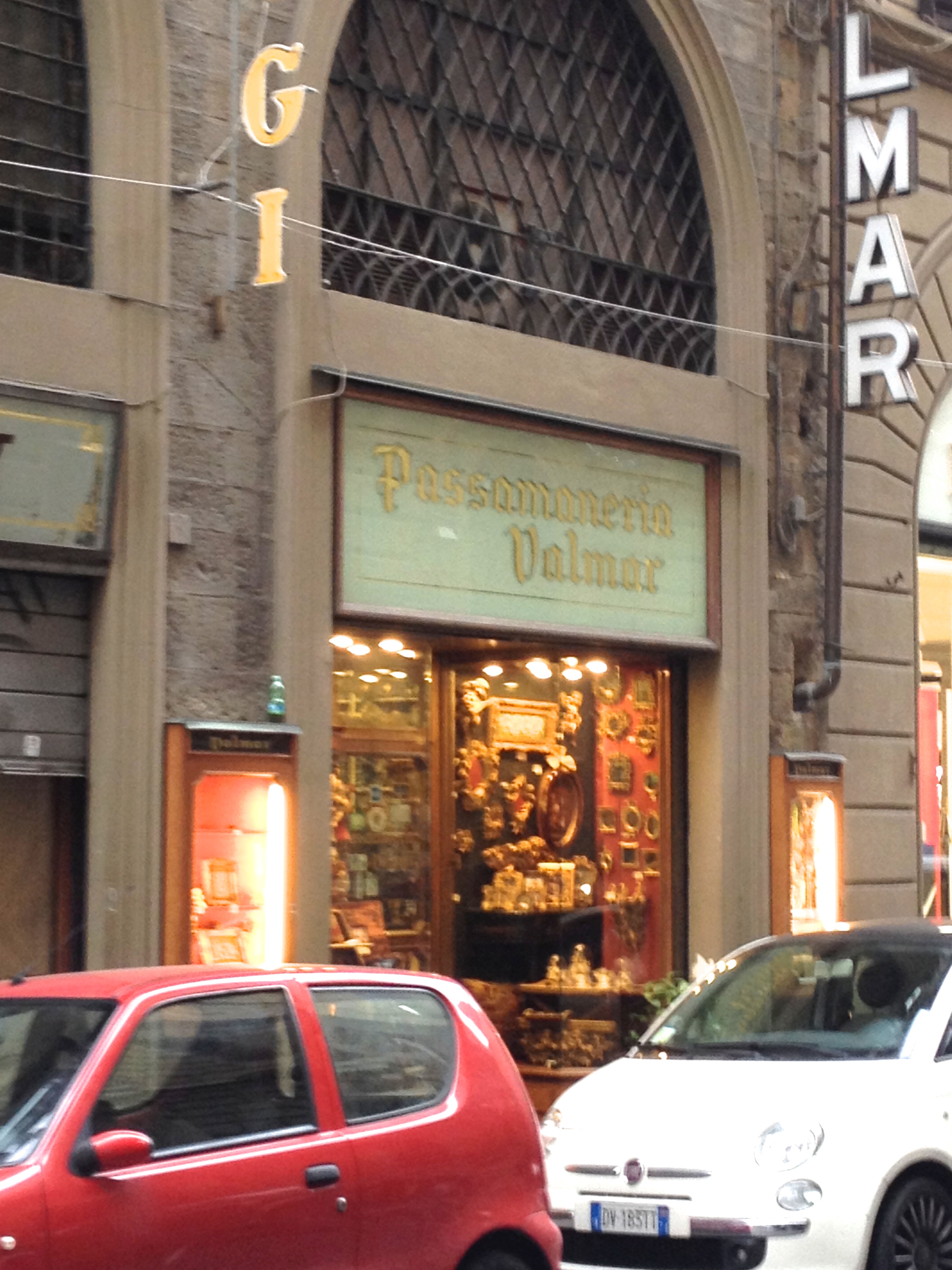
When you wander by this jewel box storefront, just steps away from one of my favorite old pensiones, La Porta Rossa, you know you have stumbled upon something special.

Inside you will find floor to rafters filled with textile trimmings.

But, to call Passamaneria Valmar a trimmings shop is a massive understatement. It is kind of like calling Queen Elizabeth a female. Yes, technically correct, but devoid of all the adjectives that delineate heritage, opulence and tradition.

The shop’s founder, Vittorio Lapi, pictured above, stands behind the counter in his shop. Signor Lapi opened his independent store in the 1960s, on a very prestigious shopping street in the heart of Florence’s historical center. It is located between the Via de’ Tornabuoni and Via de’ Calzaiuoli, really only a stone’s throw from the famed Ponte Vecchio. Thinking of Mr. Lapi’s retirement, the shop is now managed by his children and grandchildren.

From the store’s website, you will find: “tassels for keys and bracelets for curtains, embroidered velvet pillows, patchwork and vintage fabrics, as well as a wide range of centerpieces, table covers, footstools, tapestries, and various furnishing accessories, all strictly of our own production.” The store’s workshop is located right over the shop, so customizing order is never a problem.
It makes me very happy that I have customized sofa pillows and table runners from this purveyor of brocades, silks and velvets. I admire them every single day when I am at home. Just looking at and touching them can transport me in my mind’s eye to Firenze.
The following is also from the store’s website:
“Our store is proud to be the exclusive retailer in Florence of precious articles of “La Contessina” company, Italy’s leading manufacturer of articles of silk velvet (in 25 colors) hand-embroidered such as curtains, pillows, bedspreads, table covers etc… that may also meet the needs of an exclusive clientele. Over its decades long activity the “Passamaneria Valmar” has had the honor and the privilege of furnishing the rooms of the most prestigious Florentine homes in addition to export all over the world.”
There aren’t many places like this left in Florence, for, sadly, the luxurious products speak to an earlier age. I spoke to one of the family members in the shop yesterday and she mentioned how many trim shops in Florence have shuttered their doors permanently.
I hope this fantastic small boutique doesn’t share the same fate. But tastes, and indeed, even Florence, have changed.
Want to visit? start your process here: http://www.passamaneriaonline.it/
Florentine Silk
From today’s New York Times.
Down a quiet lane in the San Frediano district of Florence, beyond an iron gate and leafy courtyard, is Antico Setificio Fiorentino, the sole remaining artisan silk workshop in the city. Since moving to this location (Via Lorenzo Bartolini 4) in 1786, the small factory has maintained uninterrupted production, despite wars and floods. The art of silk-making in Florence flourished in the Renaissance, when noble families amassed fortunes and fame by producing exquisite silks. That tradition endures at Antico Setificio Fiorentino, where silks are woven by hand on antique looms using Renaissance patterns.

FLORENCE | A silk loom at Antico Setificio Fiorentino. Credit Stefano Ricci /ASF by Bernardo Conti
~~~~~~~~~~~~~~~~~~~~~~~~~~~~~~~~~~~~~~~~~~~~~~~~~~~
During a recent tour, the designer Maurizio Bonas rattled off the illustrious names of historic Florentine clans — Corsini, Pucci, Strozzi — whose signature patterns are still being produced. “When you go inside many historical houses in Italy, it’s Antico Setificio that did them,” said Mr. Bonas, who noted that the factory’s silks also adorn rooms in the Vatican, the Palazzo Vecchio and the Tribuna degli Uffizi in Florence, and even in the Kremlin in Moscow.
“To make these kinds of fabric, we cannot use the modern machines,” Mr. Bonas said, pulling out a roll of sumptuous blue embroidered silk velvet made with 350,000 stitches per meter. One worker who was weaving a cream-colored damask from a design named for the Renaissance painter Pinturicchio could be expected to complete only 80 to 100 centimeters of the fabric per day. And because the small factory employs only 20 artisans, production is predictably limited — and costly. In the adjoining showroom, walls are lined with bolts of silk, from plush velvets and intricate damasks to diaphanous taffetas, 110 to 1,360 euros (about $135 to $1,670) per meter. Decorative pillows are adorned with hand-woven trims. And, on a table, a basket is filled with sachets made of Ermisino, a shimmering silk taffeta that dates back 500 years. Inside each is potpourri from Officina Profumo-Farmaceutica di Santa Maria Novella, a 400-year-old pharmacy that has partnered with Antico Setificio for, as Mr. Bonas said, “only 250 years.”
A more recent partnership with the Stefano Ricci luxury men’s wear label, which acquired Antico Setificio in 2010, means the designer’s nearby store now stocks wearable wares made with Antico Setificio’s fine silk. INGRID K. WILLIAMS
 get back, lauretta!
You must be logged in to post a comment.