I love Sicily. I saw Greek ruins that rival any in Greece, for starters. Then there is the Roman and Italian culture and history and the food! And Mt. Etna. OMG. Visit Sicily!
and
I love Sicily. I saw Greek ruins that rival any in Greece, for starters. Then there is the Roman and Italian culture and history and the food! And Mt. Etna. OMG. Visit Sicily!
and
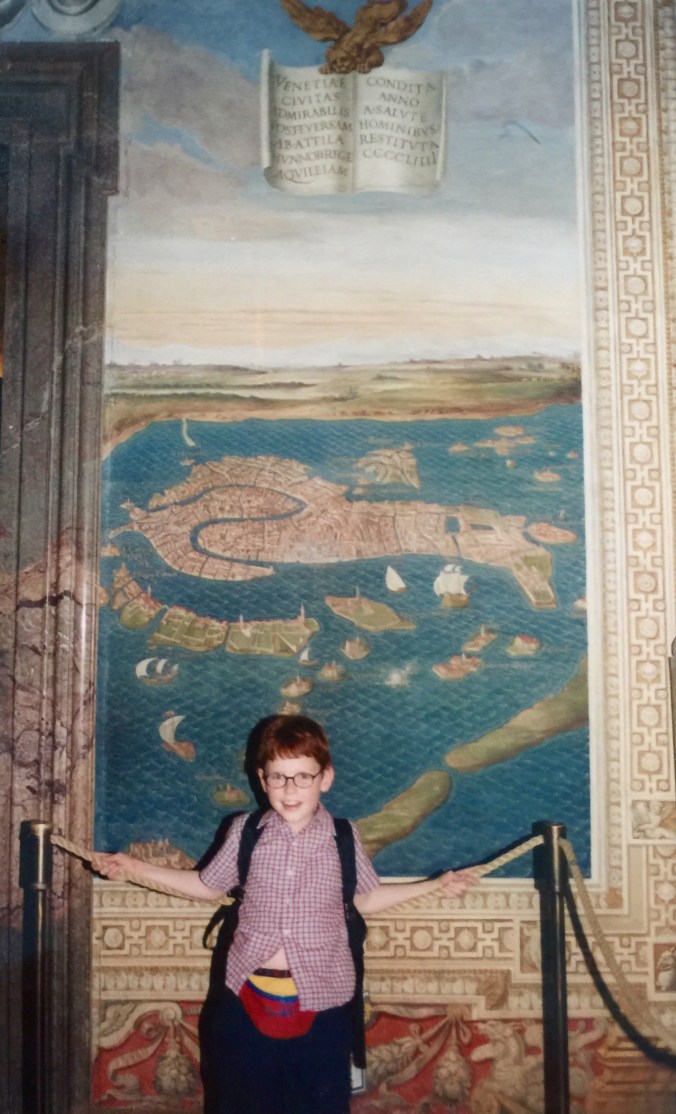
Here he is in the Vatican. We had a fabulous trip, but it was hotter than hell, even in Vatican City!!
Among my favorite churches in Florence is Santa Felicita. I love this church for many, many reasons. Let me count them.

1. Size: It is not too large and not too small. It feels just right. You can walk in and not feel overwhelmed by the size and scale of architecture, altar, chapels and more.

2. Location, location, location: Just steps from the world-famous Ponte Vecchio

3. Little known and under appreciated. Which means that it is never swarmed with tourists despite its premier location. At all times of day and every season of the year the Ponte Vecchio seems to be covered with tourists from around the globe, and yet, Santa Felicita is rarely visited by the hordes. It is an oasis within a sea of chaos. Which is exactly what churches are meant to be, I think.
Santa Felicita is a jewel, awaiting a visit by cogniscenti. Tourists pass by, thinking the edifice is just a backdrop for their frenzied nearby shopping extravaganza.

4. Design: The cherry on top it is that the design is as fine as the church is petite.

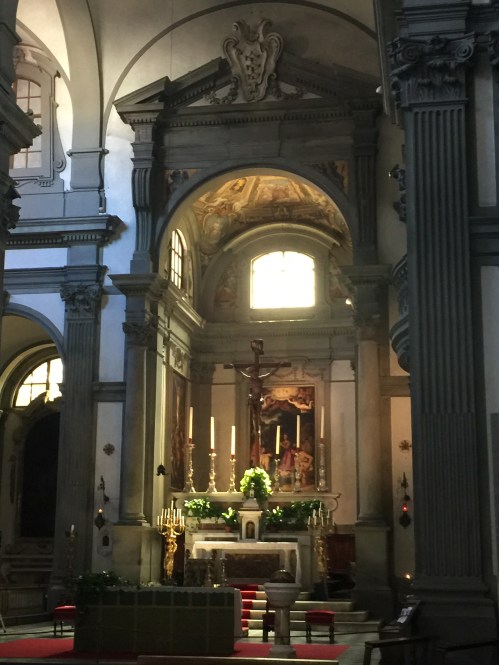

But oh, the loveliness that awaits those who enter.
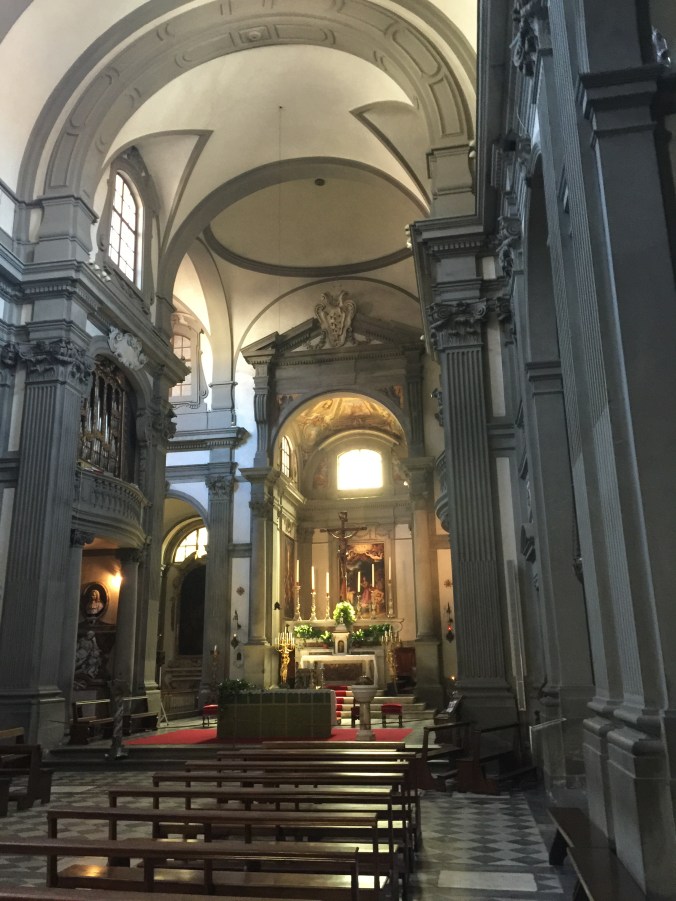
The serene gray hue of Tuscan pietra serena architectural details against the cool white plaster walls work together to create a calm, harmonized interior. The unadorned vaulted ceilings and the black and white marble floors and provide just the right amount of understated elegance to finish the setting. The interior is flooded with ambient light from the high windows during daytime hours.
5. Another thing that sets this pretty church apart from all the others in town is that it probably the oldest in the city, right after San Lorenzo. The first church on this site was probably built in the late 4th century and was dedicated to Saint Felicity of Rome. A new church was built in the 11th century and the current church largely dates from 1736–1739, under design by Ferdinando Ruggieri, who turned it into a one nave edifice. Oh, the history!


6. The Vasari Corridor passes through the façade of this church and on the inside there is large window, covered by a thick gate, where the Grand Dukes of the Medici family used to listen to the mass without being seen by the people staying at ground level.


The picture above is of the nave shot from the Vasari Corridor.
7. Masterpieces of Mannerist style paintings by Pontormo. Pontormo is one of my favorite artists but I will admit that, like Campari, Pontormo is an acquired taste. I love his work so much that I plan to devote a post to him soon.

8. The entry Vestibule is one of my favorite indoor/outdoor spaces in Florence. It is simple and feels very Tuscan. Here are some shots of what I love about the vestibule.

The wrought iron separates the church from the hoi polloi in the the street and piazza outside.
Ever wonder what the walls would look like without a fresco adorning them? Here’s the answer:

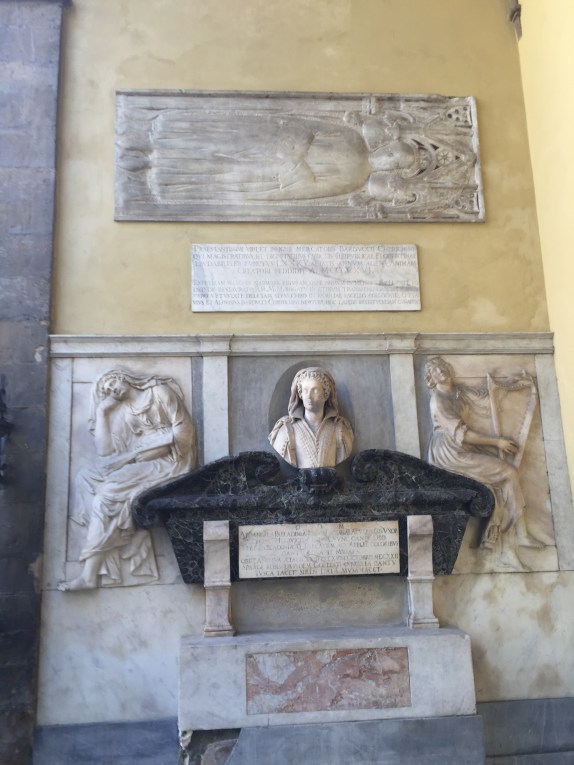
The muse of painting takes a nap while the muse of music plays a soothing tune.
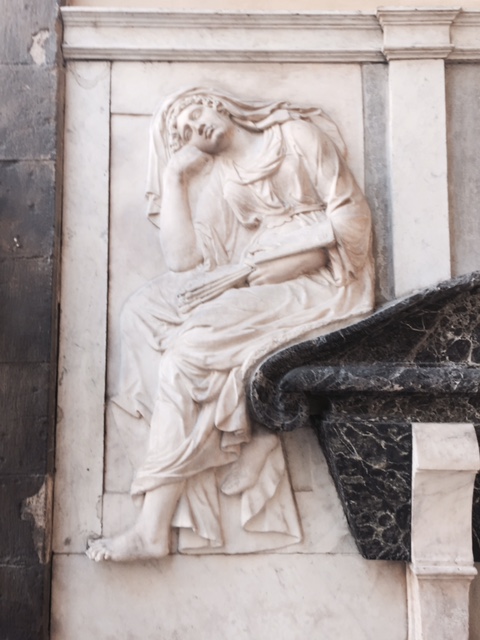
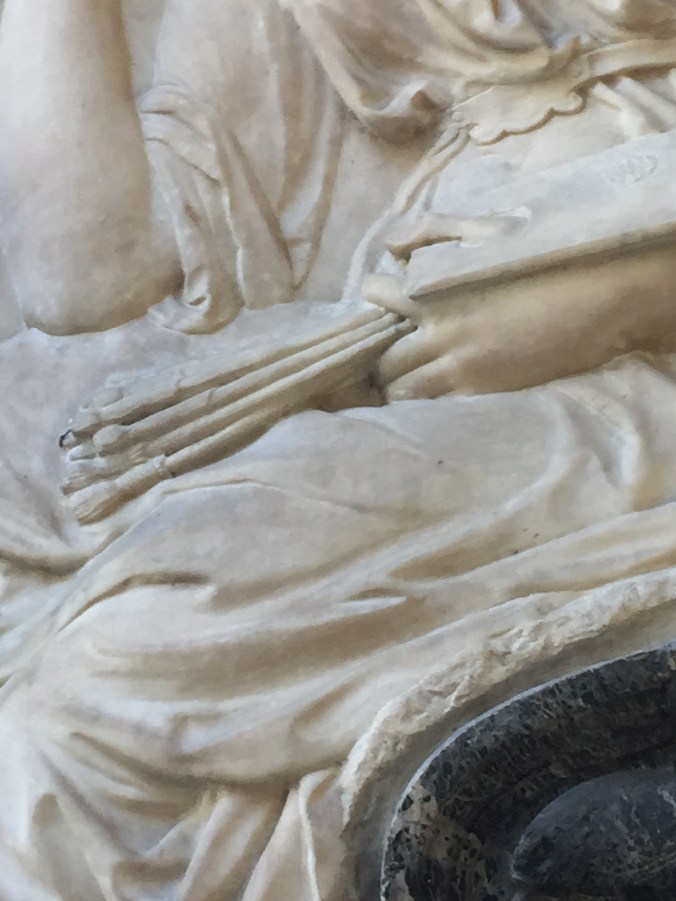
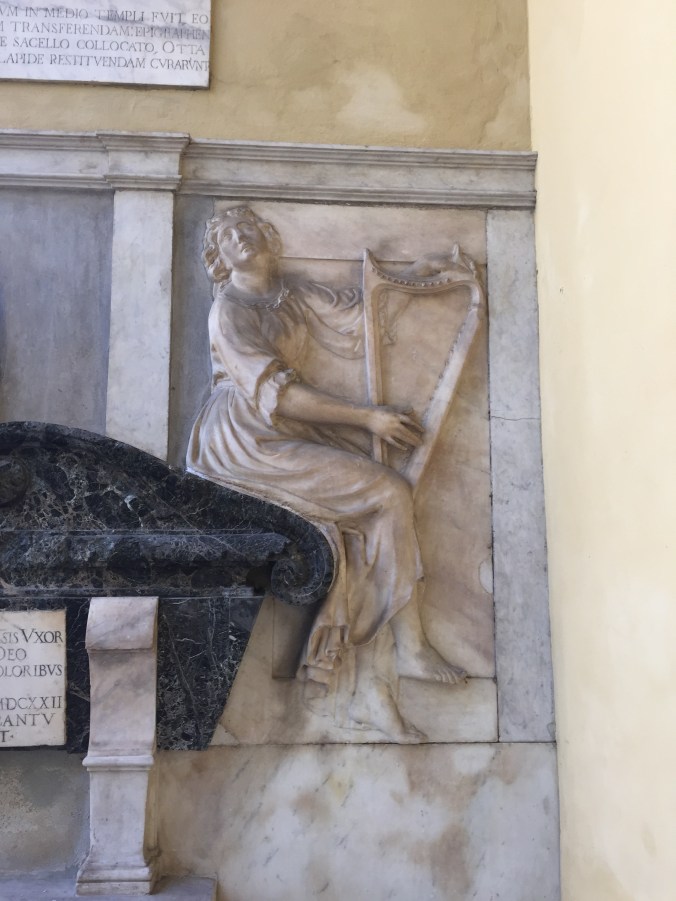
Santa Felicita, a Florentine jewel.
Crossing the border from Washington state into British Columbia. Peerless skies, lovely weather!


Into Vancouver, a city on the move.


I love Vancouver, B.C. It looks like the city’s planner chose one architect to lay out the modern structures, because they all seem to match. Glass the color of a turquoise sea and steel beams.


You know you are in Canada because the bank is Royal!

What’s this I see? The Roman Coliseum?

More skyscrapers. Beautifully done.


Hot art, wet city.


“O Canada!” Your anthem and your premiere B.C. city are both very pretty!

I should have posted this yesterday. But, it isn’t an April fool’s joke, so I guess it doesn’t really matter.
Many years ago my mother and I went to England. I had art historical research to conduct and she had a daughter to keep company and London and surrounding areas were the perfect place for both of our activities.

I won’t say that we loved all the food we encountered on our trip. Far from it! Grilled tomatoes and baked beans for breakfast seemed weird, but not nearly as strange as some of the meats we encountered.
High tea at Liberty was a huge success, as was high tea at Harrod’s. I mean, what’s not to love? Pour the clotted cream on anything and I will eat it all up! Maybe even on grilled tomatoes. Well, maybe not tomatoes. But anything else.
But while I have a generalized happy memory of all the dainty sandwiches and biscuits served at high tea, there is only one dessert, or pudding, that I have never forgotten. What made it more memorable was that I found it in a church basement cafeteria, somewhere in London.
My mom and I were visiting this particular church in order to see the 19th century neoclassical sculpture in the nave and when we were done it was lunch time and we were hungry. We realized there was a cafeteria in the basement and made our way there.
I don’t remember what we had for lunch, but I do remember encountering something called rhubarb fool in the pudding section of the cafeteria buffet. I had never heard of a fool, but I could tell it was made with cream and I was sold.

One bite of that rich combination of tart rhubarb compote mixed with whipped English cream and I was in heaven. I’ve never looked back.

Enjoyed with a shortbread biscuit, life is never sweeter!
Here’s a recipe and a link. The internet is full of rhubarb (and other fruit) fool information.
Serves 4
450g rhubarb, roughly chopped
5 tbsp golden caster sugar
300ml double cream
100ml Greek yoghurt
Small bunch of mint, leaves only
1. Put the rhubarb in a pan with 4 tbsp sugar and heat gently, covered, until tender. Uncover, turn up the heat slightly, and allow some of the juice to evaporate. Taste for sweetness, adding more sugar if necessary, then drain the rhubarb, reserving the juice. Allow to cool.
2. Whip the cream until it forms soft peaks, then stir in the yoghurt. Fold in the cooled rhubarb, and chill for at least an hour.
3. Serve in glasses with the reserved juice to pour over the top, and a few mint leaves on each portion.
Is fool the finest British summer dessert, both for ease and sheer, simple delight, and if so, what’s your favourite flavour? And what else do you like to do with rhubarb over the summer, now that crumble season’s finally on its way out?
http://www.theguardian.com/lifeandstyle/wordofmouth/2012/apr/12/how-to-make-perfect-rhubarb-fool
I spent last July living in Torino, Italy, getting to know the city, its monuments and museums and, of course, its shopping.



In the beautiful arcades that line the city center boulevards, I was delighted to follow this small girl, her balloons and her mother for a while. These are just some random shots I took of the moment. We were strolling up the Via Roma.


Ciao bambina! Have fun with those balloons!

In recent posts I’ve discussed blue gold and black gold.
But, what is red gold?

Well, Cleopatra bathed in it.

And, Alexander the Great used it as shampoo.

It comes from a delicate flower grown from a bulb.

It is the most expensive spice in the world.

Of course, it is saffron.
I’ve you’ve ever eaten bouillabaisse or paella, you’ve no doubt had saffron. Or saffron couscous. Divine.
Saffron is the most expensive spice by weight in the world precisely because it is actually the dried stigmas of a little purple perennial crocus flower that must be gathered by hand during a harvest that lasts just a couple of weeks in the fall. There are only three stigmas per blossom.
It takes about 75,000 flowers to yield a pound of saffron.
Fortunately, a pinch (about 20 threads) is usually all it takes to impart saffron’s distinctive yellow color and vaguely metallic, dried alfalfa hay and bittersweet wildflower-honey flavor. Saffron is featured in Spanish and Indian cooking; it’s often a major component of curry powders; Iran, Greece, Morocco, and Italy also harvest and use saffron, too.

The best source I can suggest is a (another!) BBC documentary on saffron grown in Morocco and Spain. I found it fabulous!
Here are a few pictures of the autumn saffron harvest in Morocco. While you can see why it is so labor intensive to harvest these crocus stigma, the sad truth is that these Berber families reap only a small percentage of the prices paid. It is the same old story that has haunted the spice trade since time immemorial: the middlemen take all the profit.


Next time you price saffron in your market, you’ll know why the price is high.
Update: April 9. I just heard (on the BBC so you know it’s true!) that saffron reached England 2000 years ago when Phoenicians brought it to trade for tin. Never mind the Medieval spice trade!
Well, I’m so glad you asked!
You know how you have to break some eggs to make an omelette? Well, if you want to make beer, you gotta dry some hops.
And where do you dry hops?
Why, in an oast house, of course!
An oasthouse looks something like this one in Kent, England.

Kent is here:

If you know what I’ve been up to lately, you’ll know that the reason I am writing about oasthouses is that some of them have become residences for Brits…
and as we all know, residences must be decorated, and…
well…you know the rest.

When, oh when will my current obsession end? Only with the end of the BBC Two series, The Great Interior Design Challenge, comes to an end I fear! Yes, it is true I love interior design and up cycling old treasures, but what really floats my boat is the tour of fascinating English homes, high and low alike, and the history lessons of British social life and domestic architecture. I mean, what’s not to love?

But, I do have a couple of dilemmas.
Here’s one: whereas Google images usually has a great selection of images for most things a blogger wants to illustrate, whether it is fabrics by Fortuny or drawings of carnations, for some reason there are very few images online anywhere I can find of the various projects used in The Great Interior Design Challenge series on BBC Two. And the ones I can find won’t copy, as the folks at BBC Two obviously know how to restrict access to their intellectual property. I respect that.
So, I am unable to show you any images from the show of the oast houses featured on the series, exteriors or interiors. None of the images in this post are related to the show. But that’s okay!


Stone and timber-frame oast house interior, Leominster, Herefordshire, England.
Okay, now that I have that info out of the way, let’s look at some of these crazy oasthouses!
Here’s how they were originally used.


And here are some examples of how these great old structures have been converted for modern life.


And, for a quick primer of the variations in structural matters:


Here are some useful links for more info on British oast houses:
http://www.telegraph.co.uk/finance/property/9612529/How-about-an-oast-house.html
http://looking-at-london.com/2015/09/11/london-workers-22/
Think of Britain and an image like this may spring into your mind:

As we continue with our virtual time-traveling tour of the UK–following the path set by the BBC Two show The Great Interior Design Challenge, Season 2–our next stop is the 17th century, where we visit the living rooms of three cottages where the proletariat once lived in rather crowded conditions.
We are visiting this highlighted section of England today:

The cottages look like this on the outside:

Charming, no?
Although originally meant to house many families, four hundred years after they were originally constructed, the cottages have been expanded within to single family homes.
Despite having larger interiors nowadays, however, the insides are often quite dark and usually centered around a massive fireplace.

Updating with a special eye towards brightening the interiors of living rooms in three similar cottages is the challenge facing the three amateur designers on this episode of my favorite new tv show.
You can find it on Youtube. It’s a pretty good episode. https://youtu.be/02oB-2KWslE
And, you can read about the Cotswold here, if you are the nerdy type like me:
https://en.wikipedia.org/wiki/Cotswolds
I recently watched the 2015 Nicole Kidman film, Queen of the Desert. The movie chronicles the life of a fascinating Brit, Gertrude Bell. It’s a beautifully produced film and features some interior shots of the world-famous hotel in Marrakech, La Maoumania. One thing always leads to another, and thanks to the internet, we can make a quick trip to Marrakech.
I highly recommend the film, as well as Morocco. I was lucky enough to spend a month there a few years ago and I loved it.


 get back, lauretta!
You must be logged in to post a comment.