Artist Liu Ruowang has a new installation in Florence, as seen below in the Piazza del Palazzo Pitti.
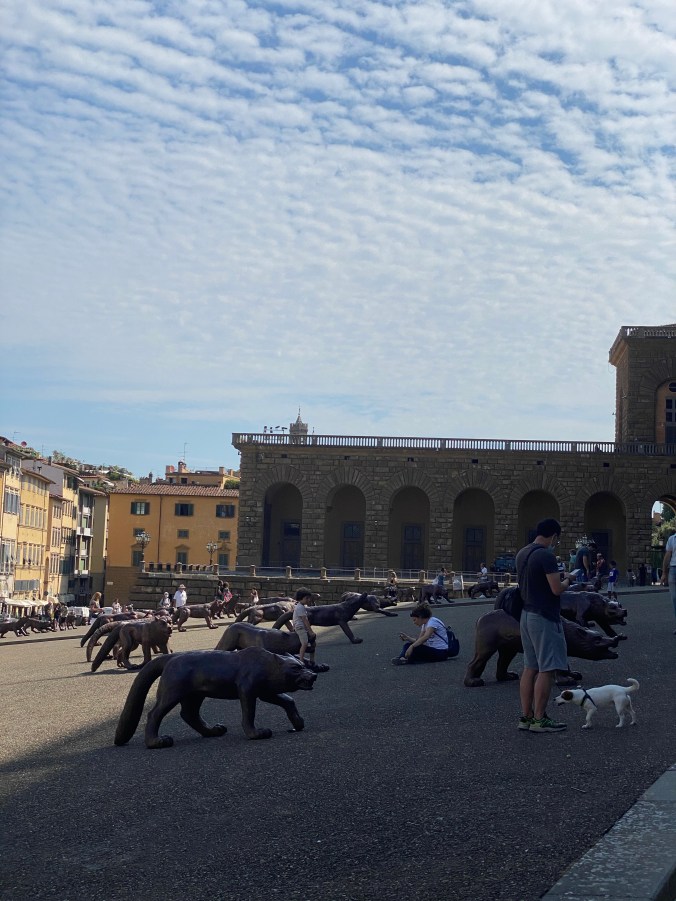
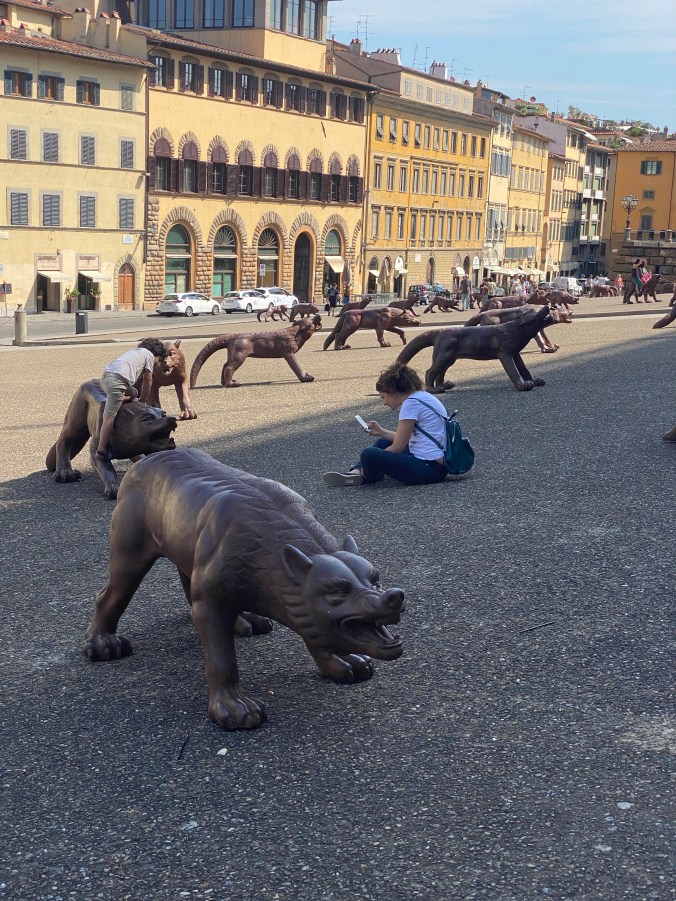


These metal wolves are meant “to protect” both Piazza Pitti and Santissima Annunziata. The monumental installation, named “The wolves on the way,” is possible thanks to the collaboration between the Municipality of Florence and the Uffizi Galleries and will be on view from 13 July and until 2 November. The work reflects on the excesses of progress in contemporary society, and are on view in Florence, symbol of the Renaissance, in dialogue with two masterpieces of urban architecture, Palazzo Pitti and the Spedale degli Innocenti.
Liu Ruowang’s wants you to reflect on man’s predatory attitude towards nature. The threatening pack of wolves composed of a hundred iron castings, each weighing 280 kg, which seems to attack an unseen warrior. It is an allegory of nature’s response to the ravages and predatory behavior of man towards the environment. And it is, at the same time, a reflection on the values of civilization, on the great uncertainty in which we live today – made even more evident by the dramatic effects of covid-19 – and on the actual risks of an irreversible annihilation of the environment.
Organized thanks to Matteo Lorenzelli, owner of the Milanese Lorenzelli Arte gallery, the exhibition aims to establish a physical, intellectual and even playful link with citizenship, stimulating curiosity and participation, so as to bring a wider audience than those who usually attend exhibitions and museums.
The project was conceived on the occasion of the celebrations of 50 years of diplomatic relations between the Italian Republic and the People’s Republic of China – the latter represented by Consul General Weng Wengang – and made possible by the collaboration between Eike Schmidt, Director of the Uffizi Galleries and Tommaso Sacchi, Councilor for Culture of the Municipality of Florence, who have made available two of the most symbolic spaces in Florence. Incoming Wolves interact freely with the city’s architecture, with its inhabitants or with those who are just passing through, thus responding to a specific intention of the author, who claims that “to teach love and respect for art to new generations , the best method is to bring art into everyday life, making museums increasingly accessible and beyond. My sculptures, for example, are placed in the squares: thus art also creates a link with public spaces.
It is important to build a culture of the common good .” Before arriving in Florence, Liu Ruowang’s wolves had “invaded” Naples, where they had been positioned in Piazza del Municipio. The installation in the Tuscan capital marks an ideal relationship between the mayors Luigi De Magistris and Dario Nardella, who have shown that they believe in the powerful message of the great work of the Chinese artist.
The director of the Uffizi Galleries Eike Schmidt says: “In Piazza Pitti, the pack of wolves that is about to enter the palace through the central door immediately reminds us of the dark counterattack of nature in the classic ‘The birds’ by Alfred Hitchcock, but calls to our mind also the recent experience of many wild species that returned to our city during the recent lockdown.
It is the metaphor of the relationship between man and nature. With the presence of Liu Ruowang’s wolves in our squares – elegant wolves, with a chiseled crown as in the ancient Chinese bronzes – we will have many months to think about how to contribute to respecting the balance of the planet. ”
Liu Ruowang (1977) is one of the major contemporary Chinese artists. Sculptor and painter, his is an original path placed in the wake of the Chinese tradition, and which amalgamates transversal elements with peculiar aspects of his tradition. Starting from the consideration that the history of man is also the history of his relationship with nature, the Chinese artist draws, on the one hand, from the culture of his country and on the other to the western one, and through references to globalization, represents the multiplication of the various real and virtual identities. The philosophical dimension of Liu Ruowang is also a real denunciation of the risks caused by the loss of human values, mortified by the oppressive system of contemporary life, theater of pain and violence.
“The upcoming Lupi installation is the result of the production of the last decade which must be considered fully the artistic maturity of Liu Ruowang. Behind the monumentality of the installation, moreover, there is an aspect dear to the East as to the West, the central pivot of all Liu Ruowang’s production, namely the ability to polarize the environment and space through a simple and sublime, which adapts the epic tones of the myth to today’s civilization, dominated by scientific and technological progress, increasingly in conflict with the natural order. ”







You must be logged in to post a comment.