The riches of Florence continue to amaze me. Every week brings a new discovery. Some things are hidden, others are hiding in plain sight.
The Teatro della Pergola is one of the obvious places one intrinsically knows will be a delight. One only needs the time to explore.

For me, that time arrived in mid November. I was fortunate to have a guided tour of the theater with one of the key people in the organization, Claudia. It was easy to set up as 1, 2, 3. You email Claudia at museo@teatrodellatoscana.it, or check this website: https://www.destinationflorence.com/it/dettagli/5522-pergola-gran-tour. Soon you will be time traveling in a beautiful space ship: a 17th century Baroque theater in the heart of Florence. The street is Via della Pergola, a 5 minute walk from the Duomo.

For those who can’t get to Florence to view this fantastic place, thank your lucky stars that we are living in the 21st century! You can take a virtual tour of the theater on Google’s Art and Culture platform.
https://artsandculture.google.com/streetview/teatro-della-pergola/ZAEBuIJpzoz0QA?sv_h=-146.45499777856364&sv_p=12.806449561634778&sv_pid=N3SpojGji8LMboRM9u7kUg&sv_lid=4006220043401357886&sv_lng=11.26147461842936&sv_lat=43.77317260396089&sv_z=2.4829477459908875
The Teatro della Pergola in Florence was the first theater in Italy, and the third overall after the Opéra in Paris and the National Theater in London, to be virtually hosted on the Google Cultural platform,making the vast European artistic heritage virtually accessible for aall the world to enjoy.
So, first things first:
Where did the name of the theater come from? Pergola means trellis, or a structure on which climbing or trailing plants can grow. The front of the theater is covered with ivy, which trails down over the small projecting metal and glass canopy over the entrance and lends a pastoral feel to the theater. Claudia told me that when the original building was constructed here, there was already a small vineyard planted, which undoubtedly had some sort of pergola. The name stuck.
A self-formed group of Florentines, calling themselves the Accademia degli Immobili, were dedicated to the cultivation of the arts in their city. While there was already a theater in Florence (the Teatro del Cocomero, later replaced and renamed by the still extant Teatro Niccolini), it was too small for the Accademia’s needs.
They commissioned Ferdinando Tacca (son of Pietro Tacca, who designed the two fountains in Piazza SS. Annunziata), to build them a theater. It was probably inspired by the courtyards of Renaissance palaces. One possible model is the Cortile Ammannati at Palazzo Pitti. The functionality of these courtyards was in part that they allowed spectators (noble and aristocratic of course) to view all kinds of shows in the square or rectangular spaces within the palazzi. They could watch games, mock battles and all manner of entertainment, without mixing with the entertainers, one imagines.
The theater commission proved to be notable opportunity for the architect, Tacca. What he designed for the Accademicians was no less than the first “Italian theater,” whose design, with its incredible acoustics, served as the basis for later theaters built throughout Europe and the world.
Tacca took the basic horseshoe design which the Greeks and Romans had already established as the ideal shape for watching theatrical performances. He constructed the floor of the theater in a spoon shape, with rises at the back of the orchestra and the stage.
One of the most notable aspects of Tacca’s design were the boxes that surround the outline of the theater on 3 levels, with a gallery on the 4th level. This was the birth of this particular feature of classic Italian theater design. For the first time, small separate spaces allowed each noble family to admire the show, and to be admired by the fellow theater-goers, from a privileged position.
The boxes are worthy of their own post. Claudia told me that all manner of things happened in these separate spaces, whose doors could be locked from the inside and whose heavy draperies at the front of the box could be drawn closed. Florentines were proverbially argumentative and territorial, and it was hoped that by assigning a box to each family, the continual feuds could be managed. Unfortunately, along with the food, wine, sexual exploits that took place in the boxes, we know that even murders were perpetrated.
The coats-of-arms of the various noble families announced the ownership of each box. When the theater was renovated in subsequent centuries, the shields were taken down; the extant ones hang in the lobby of the theater.


There are 25 boxes on each level and, currently, there are only two restricted boxes: the number 1 of the first level, which remained reserved for the last heirs of the founding members of the Accademia, and the box on the opposite side. This box is the 25th on the first level, and is reserved for the theater director. You can see it in the photo below: It is the first box on the first level, just to the right of the stage. It has pink marble facing it, unlike the other boxes which have white stucco facing.

The photo below was taken from the stage. You can see the Royal Box in the center taking up the 2nd and 3rd level spaces in the center. The size of this theater is small and intimate. I can see how it would be ideal for theatrical or musical performances and I am eager to experience them soon.

Together with the large stage, and the boxes and gallery, another distinctive feature of the Pergola are the incredible acoustics. Tacca created a perfect space for hosting theater and music; the voices of the great actors are enhanced, thanks to the horseshoe outline.
One thing Claudia explained to me is that the only things made from metal allowed in the theater design are the necessary brackets for holding electrical stuff, such as the house lights and the stage lights. Everything else is stone or wood, because metal changes the sound waves in the theater.
The theater was completed in 1661. The inaugural production was the comic opera Il podestà di Colognole by Giovanni Andrea Moniglia.
Once upon a time:
The stage set was hidden from view at the beginning of performances with a large painted curtain depicting Florence and the Arno. The curtain that covers the stage today is itself quite grand.

Why a windmill?

The Accademia degli Immobili, or the founders of the theater, took for themselves the rather incongruous (to me) Dutch windmill as their theater symbol. I could not understand this choice until Claudia explained that Florence’s riches were at the time based upon the trade with the north and, I suppose, especially the Netherlands. The windmill is used throughout the theater in subtle design features. It even appears on the knobs on the box door handles:

Initially reserved for the court and aristocracy, the theater was reopened from 1718 to the paying public. The operatic works of the great composers, such as Antonio Vivaldi, were staged.
Below are photos of the to-scale model of the theater as it would have originally appeared. You can see the coats-of-arms over each first level box. Claudia told me that the benches with backs and cushions were reserved for women, and the benches without backs were for me.


The neoclassical lobby was a later addition. It provides a grand welcome to all visitors.


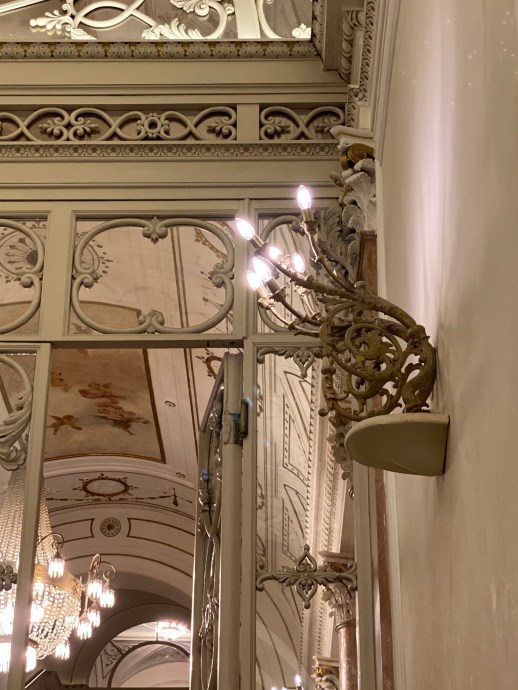
The building of La Pergola was remodeled several times. It was enriched with new decorative schemes and enlarged with all of the crafts and skills of the stage art.
In 1801 the Saloncino, a large room with stuccos dedicated to music and dance, was opened on the first floor by architect Luca Ristorini (completely restored in 2000; it is the second hall of the theater). Ristorini had also, in 1789, had renovated the great hall, changing the box design to create a very large royal box at the far end of the theater, directly opposite the stage.
The period between 1823 and 1855 were great years for the Pergola, for it was managed by the impresario Alessandro Lanari. Under his direction, Florence became one of the most important stages of Italian classic opera. The most important composers, beginning with Bellini, made important appearances on Via della Pergola and Florentines first hear the music of Giuseppe Verdi when he made his renowned Macbeth debut in 1847. The museum under the main hall has a wooden chair built especially for Verdi to sit upon while directing rehearsals. He was having problems with his legs and the chair made life better for him.


In 1826, Gasparo Martellini painted the historical curtain depicting the coronation of Petrarca in Campidoglio which is still used at galas. The machinist, Cesare Canovetti, designed and constructed an ingenious wooden machine for lifting the stalls which forms the basis for the museum under the hall. It was used when the hall was converted into a ballroom, to make the floor a single plane with the stage. The architect, Baccani, modernized the theater, designing the the “Atrium of the Columns.” And, very notably, a young stage apprentice, Antonio Meucci, experimented with a voice communication system between the attic where the curtains and sets were managed from above and the the stage. Meucci’s invention was the ancestor of the telephone, which Meucci perfected, when he emigrated to the United States. According to Claudia, Meucci sold the design of his invention to Alexander Graham Bell who went on to produce the first telephone.
In the 19th century:
The theater’s illumination was upgraded to gas lights, and Florence enjoys the rank of capital of Italy. The theater board sells a share of the Academy to the King Vittorio Emanuele II. Later financial problems encountered by the theater were partially solved by the intervention of the Commune.
Electric lighting was incorporated in 1898. The theater underwent drastic changes along with the lighting: plays were substituted for the opera (which moved to the larger Florentine theaters, the Politeama and Pagliano).
In December 1906, Eleonora Duse arrives at the Pergola with the legendary Rosmersholm by Ibsen. This play was directed by Edward Gordon Craig and a dressing room was designed for the grand dame. This Primo Camerino, is still in use, conveniently located right next to the stage.


In 1925, the Pergola became a national monument. During WWII, the theater was managed by Aladino Tofanelli. Ownership was ceded to the state in 1942 and it soon became a part of the newly created Ente Teatrale Italiano.
When Tofanelli died, the young, brilliant and innovative Alfonso Spadoni, arrived and revitalized the Pergola, primarily with great dramas. The Pergola is seamlessly woven into the urban fabric of Florence, providing a setting for important cultural events.
Another brilliant young man, Marco Giorgetti, is at the helm now. Since 1999 Giorgetti has been hard at work, reestablishing the ties between the theater and the city.
Today the Pergola is much more than a theater. At the epicenter of the Teatro della Toscana Foundation and a theater of national importance, the Pergola is a living cultural center, using its history and prestige. It maintains very active programming. The brightest stars in the theater firmament shine at the Pergola.
Walking in the corridors of the theater is like reading a book sprinkled with immortal names. All the objects tell a story, the individual fibers of fabric or wood particles bear witness to memorable events.
Below: the neoclassical painting on the ceiling of the grand hall.


Backstage at the Pergola:


The stage as it appeared the day I visited:


Some vintage posters in the museum:
























You must be logged in to post a comment.