Uncategorized
The Victoria and Albert Museum, London
Dale Chihuly shows up everywhere! He is a worldwide phenom…


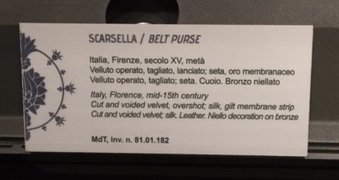
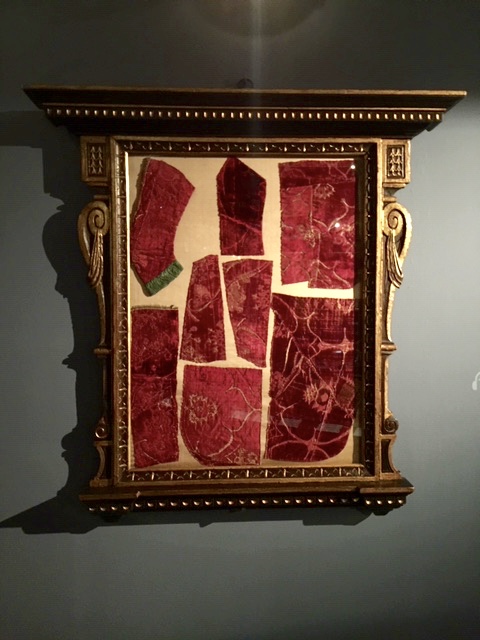
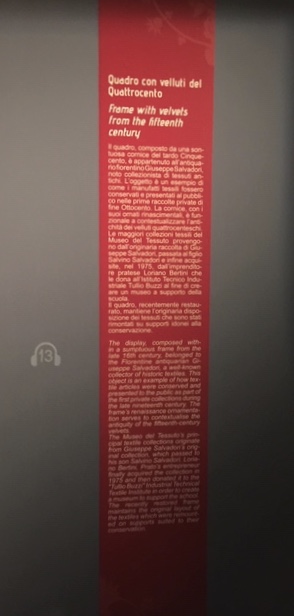
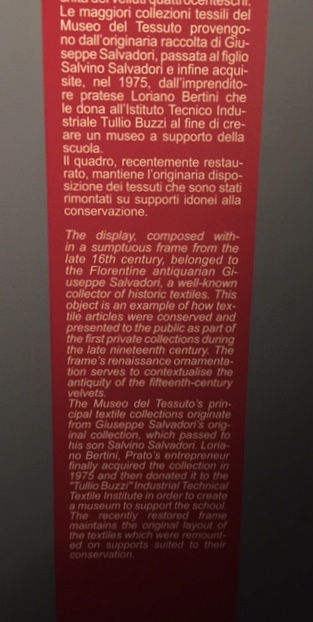
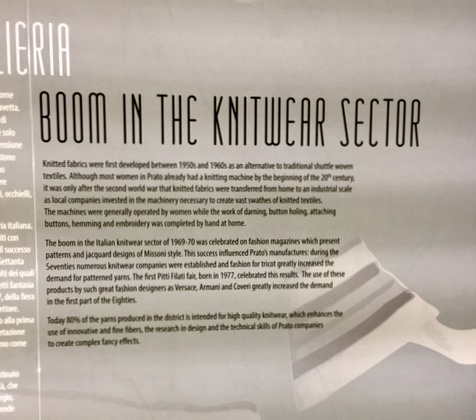
The Textile Museum, Prato
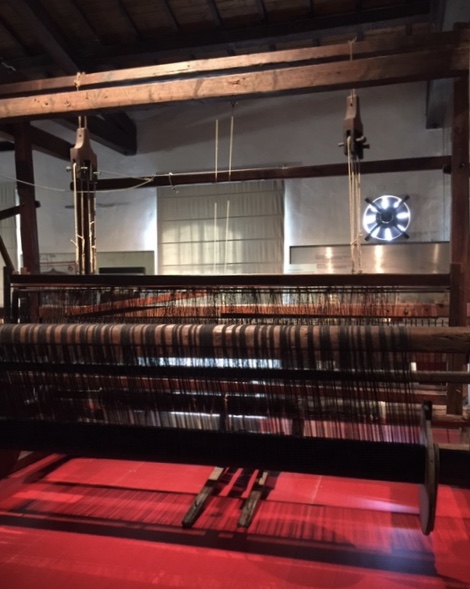
Prato, just a short distance from Florence, has a long and celebrated history of textile manufacture.
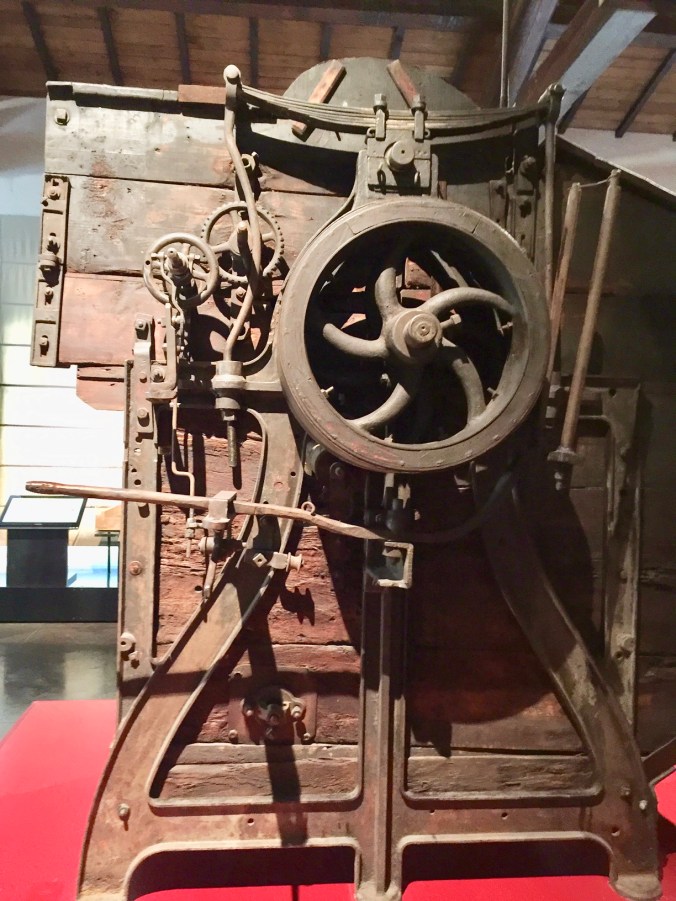
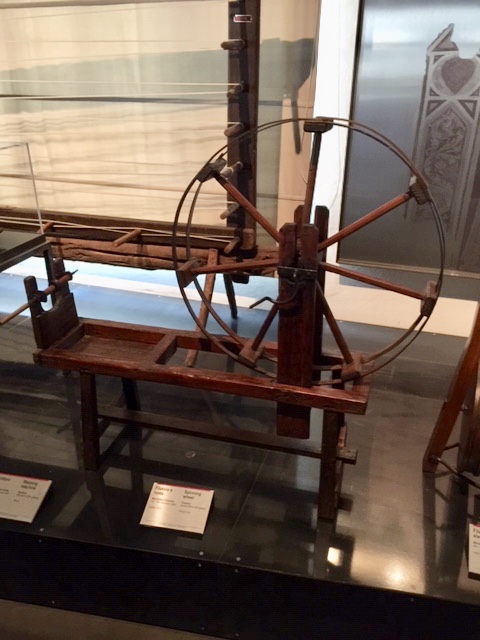
In honor of this long local tradition, Prato is also home to a fine textile museum, the Museo del Tessuto, dedicated to the city’s historical and contemporary textile production and art.

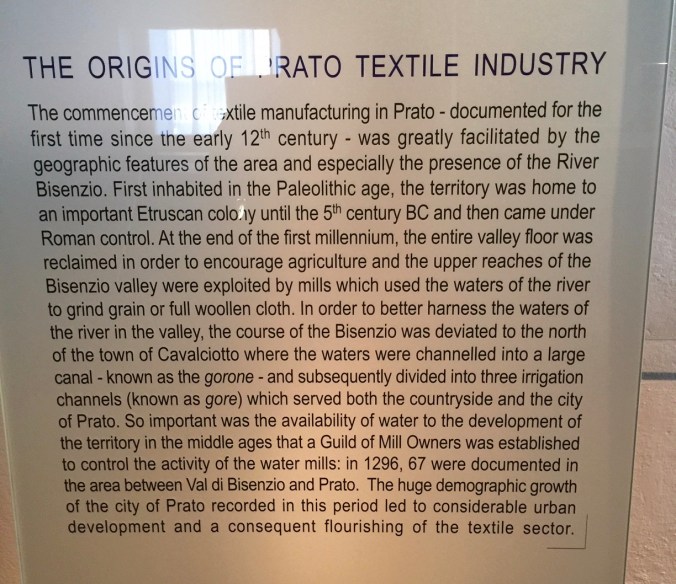
Even today, Prato is one of the largest industrial districts in Italy, the largest textile center in Europe and one of the most important centers in the world for the production of woolen yarns and fabrics.
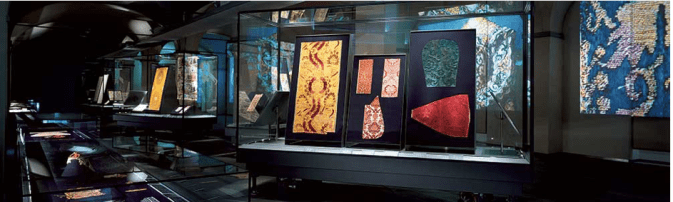
The Museo is the largest cultural center of its kind in Italy. It celebrates the Prato district, which has been identified with textile production since the Middle Ages. Today the district boasts over 7,000 companies operating in this sector.
The Museum was founded in 1975 within the “Tullio Buzzi” Industrial Technical Textile Institute, as the result of an initial donation of approximately 600 historical textile fragments.

These were added to examples which had been gathered over the years by the Institute’s professors for students to consult and study. Since then, the collection has grown thanks to the contribution of the Buzzi Institute Alumni Association and other important civic institutions, such as the Municipality of Prato, Cariprato and the Pratese Industrial Union.
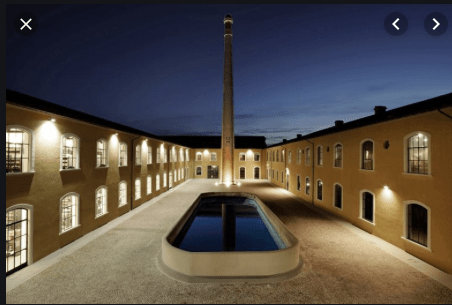
In 2003, the new, permanent home of the museum was inaugurated in the restored spaces of the former Campolmi factory, a precious jewel of industrial archaeology situated within Prato’s old city walls.
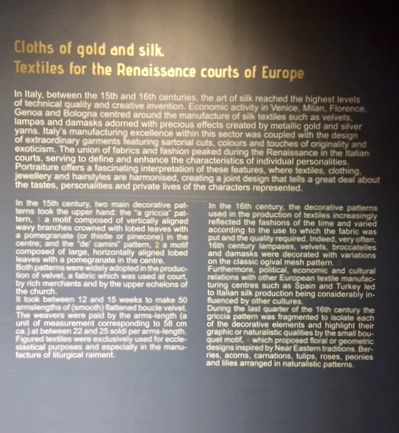
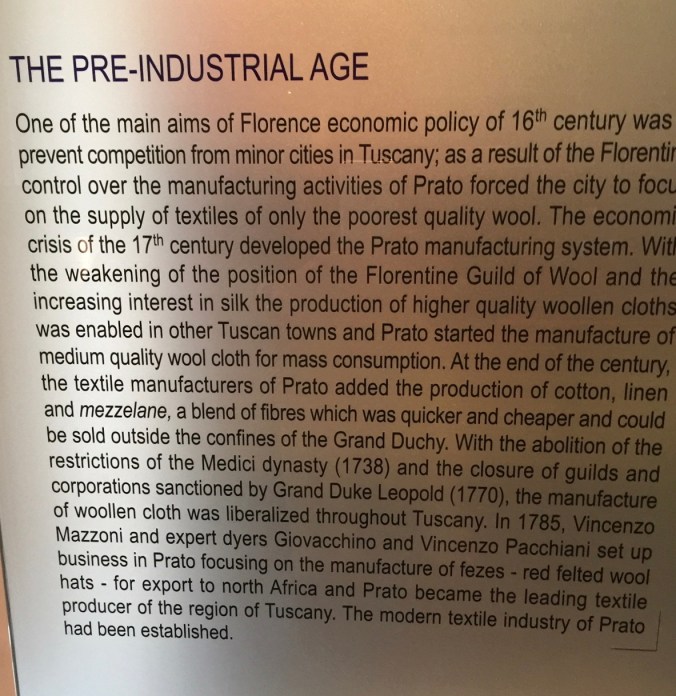
Prato began to specialize in textiles in the 12th century, when garment manufacturing was regulated by the Wool Merchants’ Guild.
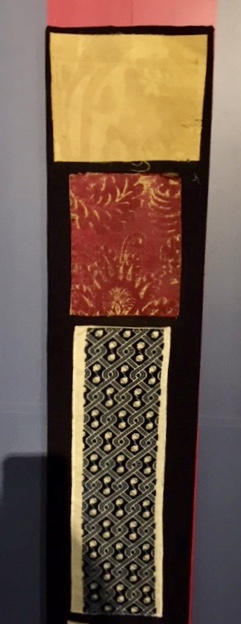

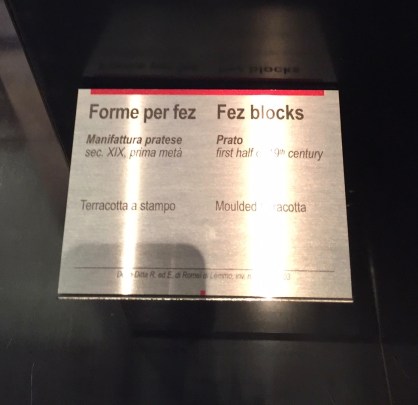
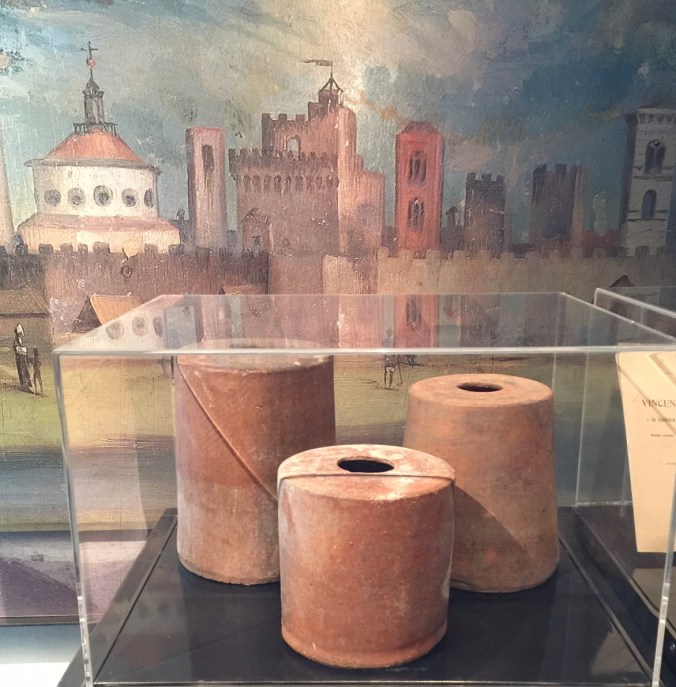
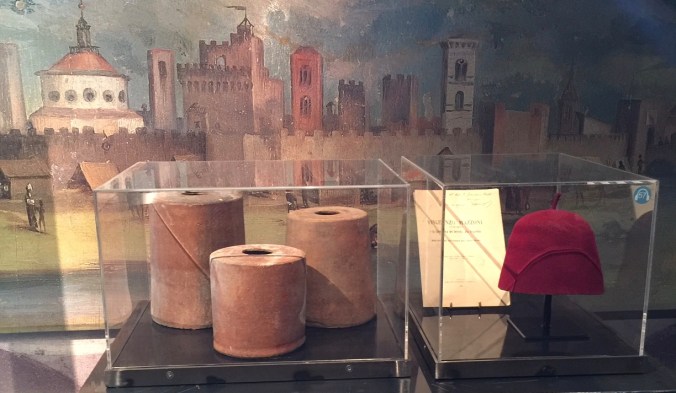
The political and economic decline experienced in Italy during the 16th and 17th centuries caused a drop in textile activities, but it resumed in the late 18th century with the production of knitted caps made for Arabian markets.
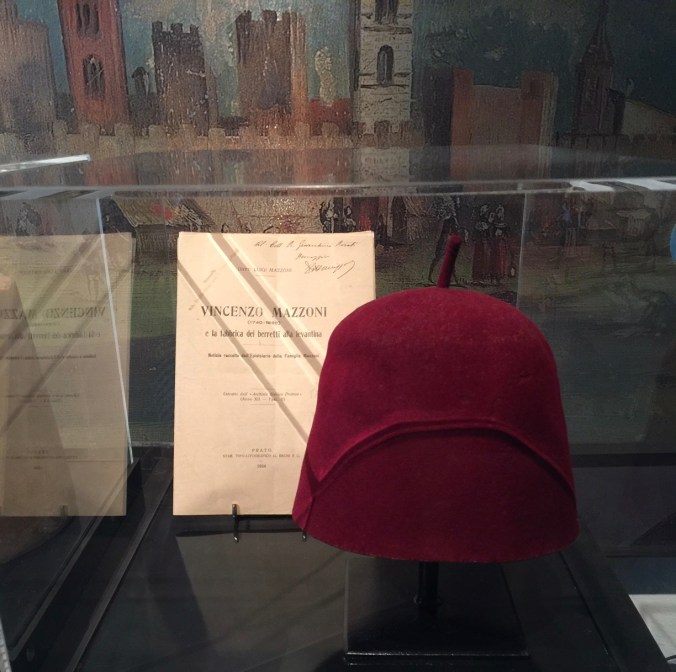
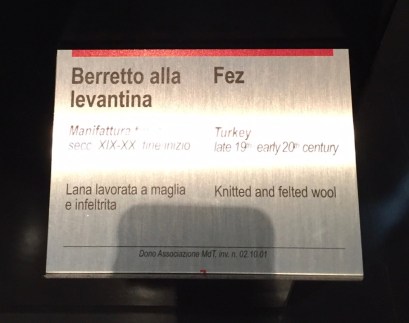
In the Prato area, industrial activities got under way at the end of the 19th century, with the introduction of mechanization (to which the brilliant local inventor Giovan Battista Mazzoni made important contributions) and with the intensification of textile working processes. The industrial take-off was also supported by foreign investors such as the Koessler and Mayer families of Austria, who created a company that lasted for decades and became locally known as the fabbricone, the big factory.
The lower costs of carded wool processing, caused by the gradually increasing production of recovered wool obtained from shredding old clothes and industrial scraps (“combings”).
Basically, up to World War II the Prato textile industry was divided in two production circuits: one based on large vertically integrated companies with generally low-level standard productions (rugs, military blankets, etc.) made for export to the poorer markets (Africa, India, etc.); the other based on groups of firms carrying out subcontract work for the production of articles designed for the clothing markets.
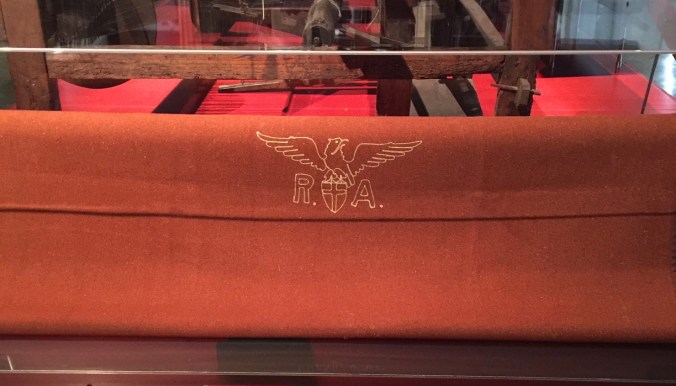
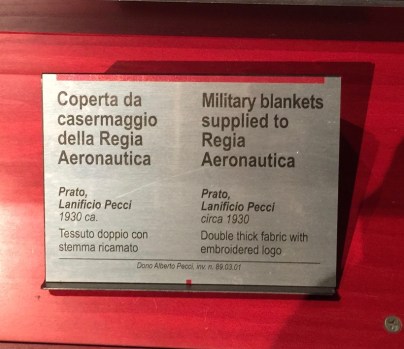
Between the postwar period and the early 1950s, the outlets towards low-level standard production markets rapidly disappeared. The production system underwent a rapid evolution, and the result was not so much the decentralization of subcontract work but an original form of reorganization largely based on the widespread distribution of work among small-scale enterprises (the so-called “industrial district”). The two dynamic factors of the new system were: (a) the subcontracting firms, which carried out the actual production and (b) the front-end firms, which were involved in product design.
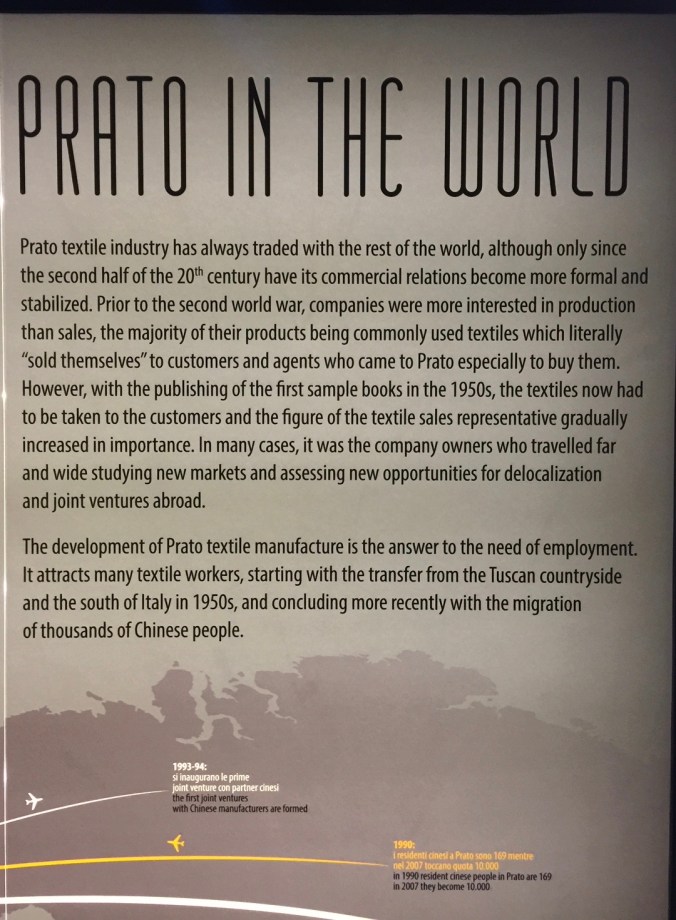
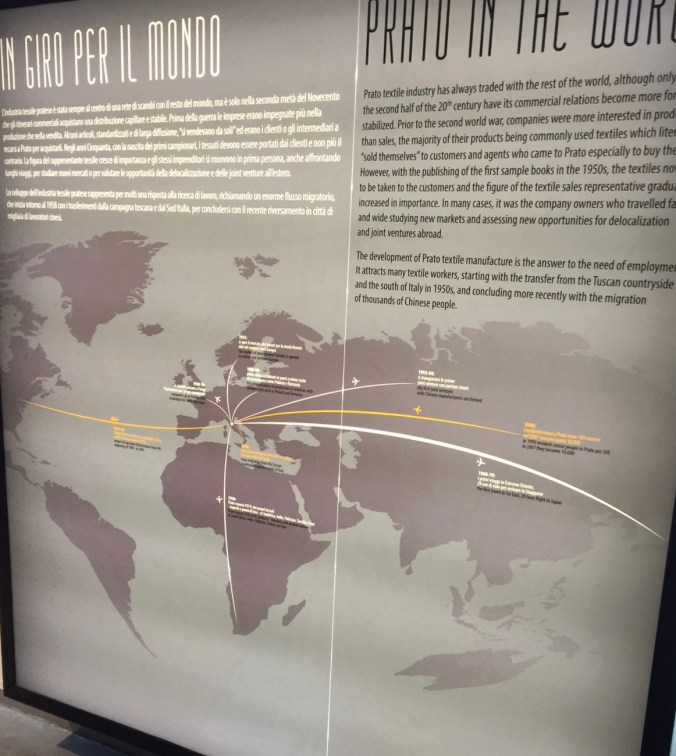
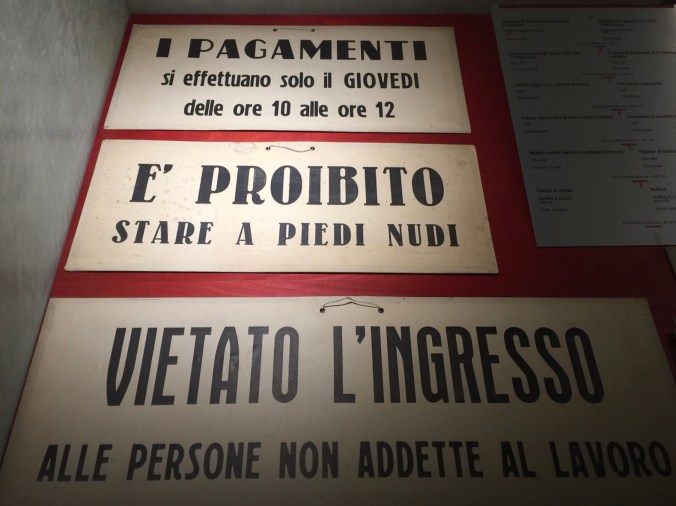
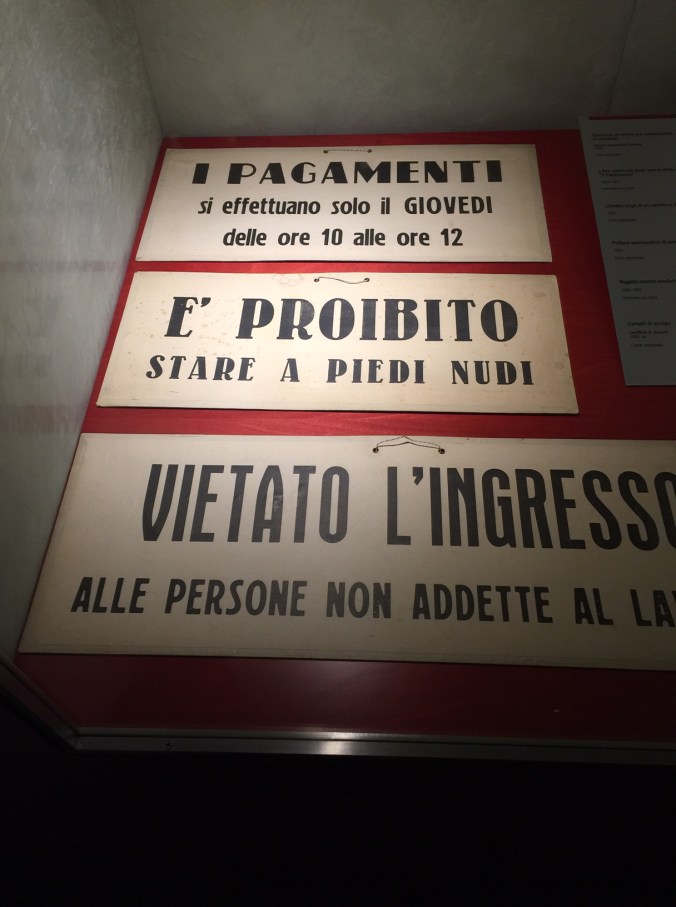
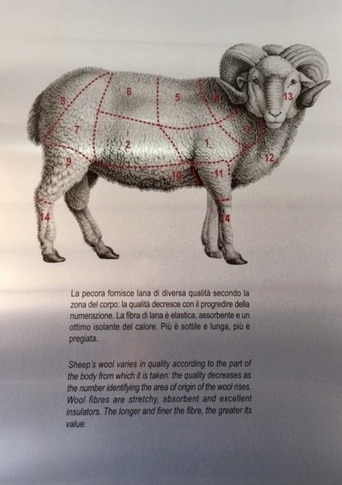
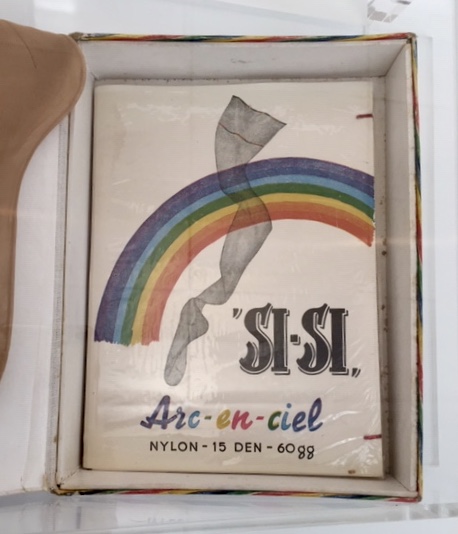
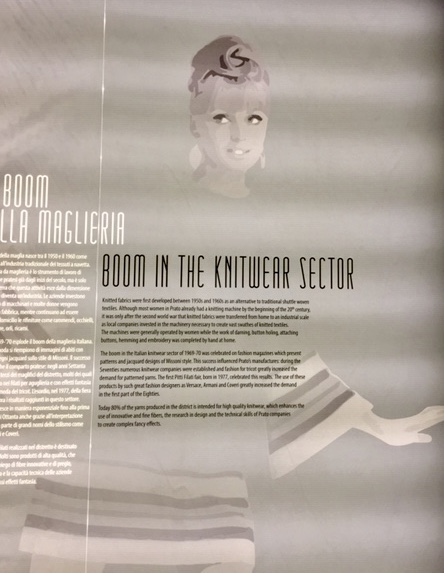
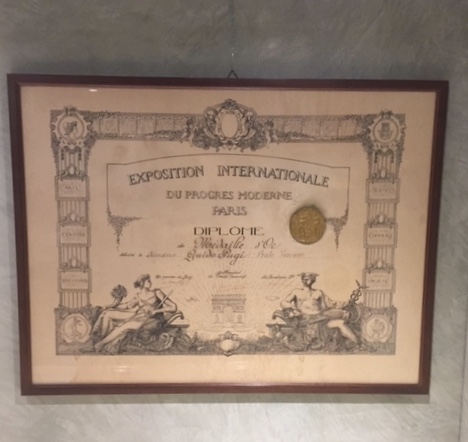
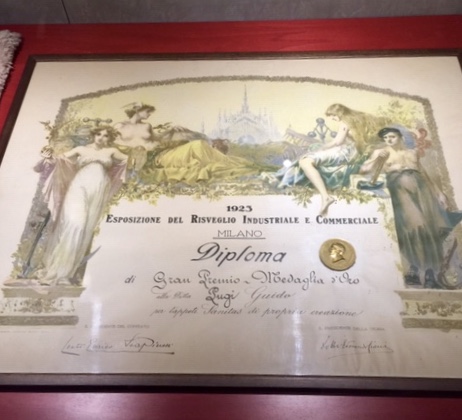
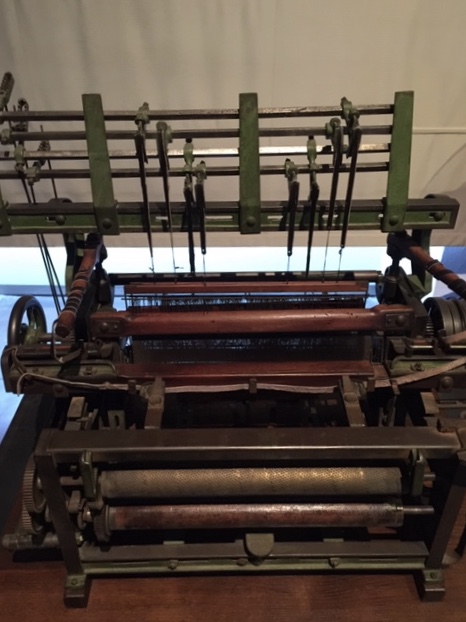
Below, some miscellaneous shots of the museum.



Celebrating women art patrons: the Roman Empire’s Livia Drusilla
Livia Drusilla (ca. 58 B.C.E.–C.E. 29)
Empress of Rome

In the long-running Roman Empire, statues, portraits, and coins were the best indications of a ruler’s identity. Livia, the wife of the republic’s first emperor, Augustus, used these media to her advantage. “She looked to statuary to present her persona in Rome and the empire, relief sculpture to describe her relationship to other members of the imperial family, coins to advertise the emperor’s policies, and gems to articulate that same vision for a more selective audience,” writes art historian Diana E. E. Kleiner in Cleopatra and Rome (2005).

Livia was less interested in creating a uniquely individual presentation than in codifying a traditionally feminine ideal for Roman empresses and nobility in general. She took inspiration from statues depicting classical Greek goddesses and Hellenistic queens to align herself with the values of the previous Republican “golden age” that Augustus hoped to restore in his new empire. Unlike Cleopatra, her opulent predecessor in Egypt, Livia communicated virtuousness through an austere image that favored modesty and simplicity. Still, Rome’s first empress took measures to stand out among other elite women. Kleiner has suggested that the empress had artists depict her with hairdos that only a stylist could have arranged, indicating her superior taste and wealth.
Emporio Duilio 48, Firenze
The “Emporio Duilio 48,” was founded in Florence (in the current Coin department store building, in Via de ‘Calzaiuoli) in 1902. The sales formula was, everything was under the price of 48 cents.
It is a fascinating story about early 20th-century Florence, with the tragedy of WWII a part of it.


The creator of the formula “all at 48 cents” was Joseph (Giuseppe) Siebzehner who was born in Vienna in 1863 and died in the Milan-Auschwitz route in the train departed on 29 January 1944 from platform 21). He was a Jewish merchant of a large Polish family, originally from Kańczuga (south-eastern Poland), married to Amalia Koretz (born in Plzeň on 15 March 1871 and dead in Auschwitz), daughter of Ferdinando.
The Siebzehner, already active in trade in Vienna at the end of 1800, took over the commercial activity called Grande Emporio Duilio and founded in Florence in 1888 by the Papalini brothers, who in turn had taken over the renowned Bazar Bonajuti, founded in 1834 by the architect (son of merchant) Telemaco Bonajuti.
The expansion of the Florentine headquarters in 1907 gave rise to the new name Emporio Duilio 48. This was soon joined by the two more stores in Montecatini and Viareggio; the latter was initially located in a bench where today stands the renowned shoe store Gabrielli, next to Magazzini 48.
It seems that after 1911 there were also 2 stores in Bologna, named simply: Emporio Duilio.
It’s clear that Giuseppe Siebzehner was a cutting-edge merchant, ahead of his time in Italy.
In fact, from the family archive (owned today by Count Federico di Valvasone and the last descendant, Riccardo Francalancia Vivanti Siebzehner), it emerges that Giuseppe already had two exclusive contracts at the end of the 19th century.
One with a comasco producer of festoons, lights of paper and decorations for the holidays.
The other, even more important, was with the great Bolognese blacksmith, Giordani, who built prams, tricycles, and especially bicycles for which he became a famous producer after WWI.
Even more avant-garde, Joseph was the first to produce a product catalog with mail order, a forerunner of today’s online shopping phenomenon.
The activity later passed into the hands of Giuseppe’s sons: Giorgio Vivanti Siebzehner (born in Florence, 1895 and died in Florence, 1952), lawyer and author of the Dictionary of the Divine Comedy and his brother Federico (born in Florence, 1900 and died in Florence in 1978), an electronic engineer who was among the first in Italy to conduct extensive experiments on ceramic resistance at the Italian Ceramics Society – Verbano. He, was awarded the honor of Knight to Merit of the Italian Republic in 1956.
Over time, the Francalancia Vivanti Siebzehner heirs of Valvasone and Bemporad took over the property until the commercial activity was sold to Coin Department store in 1988. The Viareggino building was instead ceded to the Fontana family in the 1990s. They later opened the Liberty Store, one of the most famous record and video games stores in the city.
Celebrating women art patrons: Gertrude Stein
Gertrude Stein (1874–1946)
Expat American writer who hosted the avant-garde art world at her Paris salons
 Through collecting art, American writer Gertrude Stein solidified her position among avant-garde artists in Paris, and found a community that was supportive of both her experimental work and her lesbian lifestyle. In 1901, Stein dropped out of Johns Hopkins Medical School and followed her aspiring-artist brother, Leo, to London and then Paris.
Through Leo, Stein began to acquaint herself with the bohemian artists living around the Montmartre neighborhood. In 1905, Stein met Pablo Picasso. He began to paint her portrait, which he finished the next year. It was a crucial step in the development of modernism: In the picture, Stein’s face adopts a flatness and mask-like quality that Picasso would soon push to the extreme in Les Demoiselles d’Avignon (1907), the firstCubist painting.

Stein’s patronage helped Picasso to continue painting throughout the early 1900s before he received international acclaim. His portrait of Stein is seen above her left shoulder in the photograph below.

Stein also collected work by Paul Cézanne, one of the great Post-Impressionist painters, renowned for his radiant landscapes, intense portraits, and complex still lifes.
,Juan Gris and Henri Matisse also benefited from her patronage. Meanwhile, Stein produced her own groundbreaking body of literature, which grew to include Three Lives (1909), Tender Buttons (1914), and The Autobiography of Alice B. Toklas (1933).
The American Memorial Chapel at London’s St. Paul’s Cathedral

The website of St Paul’s proudly states that “the UK has had a long relationship with the American people, formed largely after the Second World War, a conflict in which thousands of Americans based within the UK were to give their lives.”
The most visible striking reminder of this sacrifice and subsequent deep friendship can be found beyond the High Altar at the very east end of the Cathedral, in the American Memorial Chapel, a space rebuilt after being destroyed in the Blitz and dedicated in its entirety to the American dead of WWII.
At the heart of the chapel sits a huge, 500-page, leather-bound book; a roll of honor to the 28,000 Americans – from Aaberg to Zingale – stationed in the UK who gave their lives throughout the War. The book opens:
Defending freedom from the fierce assault of tyranny
they shared the honor and the sacrifice.
Though they died before the dawn of victory their names and deed
will long be remembered where ever free men live.
Thousands of the men named in the roll of honor died on the Normandy beaches on D-Day, as well as in training operations in the lead up to the campaign and in the subsequent battles on the European mainland, right up until the day on which the Allies celebrated Victory in Europe.
The book was unveiled in 1958 at a service to dedicate the Chapel, attended by The Queen and American Vice President, Richard M Nixon.
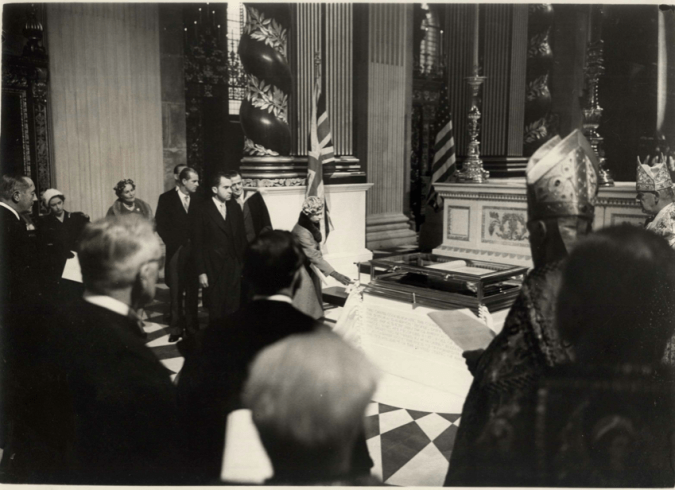
A year later, President Dwight D Eisenhower visited the Chapel and the roll of honor. Words in the book written by the President, who as a soldier commanded the Allied troops on D-Day, read:
Each name inscribed in this book is a story of personal tragedy and a grieving family; a story repeated endlessly in white crosses girdling the globe. The Americans, whose names here appear, were part of the price that free men have been forced a second time to pay in this century to defend human liberty and rights.
Fittingly, this roll of honor has been enshrined by the Mother Country of all English-speaking democracies in this special chapel of St Paul’s, once a target of barbaric attack. Here, we and all who shall hereafter live in freedom will be reminded that to these men and their comrades of all the Allies we owe a debt to be paid with grateful remembrance of their sacrifice and with the high resolve that the cause for which they died shall live eternally.
St Paul’s proudly states that the chapel itself is truly a place for all Americans. The three stained-glass windows contain the state symbols of every American state. The wood carvings contain the birds, plants and flowers of America and hidden away in one panel are a space rocket and stars – a nod to the space program that was being developed at the time the Chapel was completed.

Each November, St Paul’s holds a US Thanksgiving service, to which all Americans in London are invited.
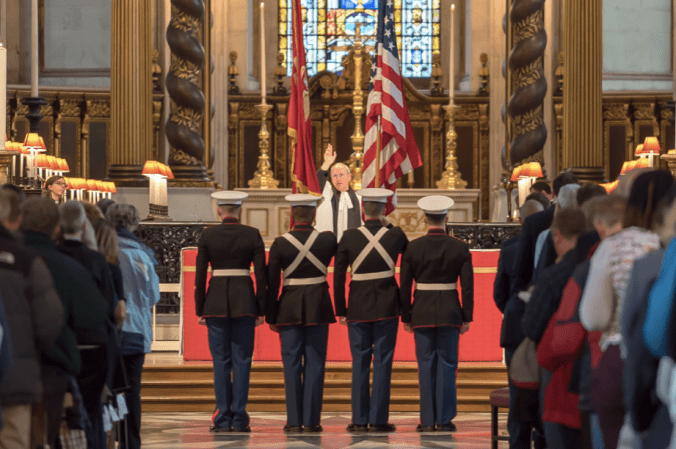
I visited this august memorial last month and was struck by its peaceful majesty. In this calm, quiet space, the American war dead are remembered. The inscription in the floor tells the story, simply and beautifully. It reads: “To the American dead of the Second World War from the People of Britain.”


Trapeze school in London’s Regent’s Park
When I grow up, I want to attend trapeze school in London. I saw this on my recent visit and I want to try it!
Sad and true, the anti-reforms in Italy’s art world

Sadly, the reforms that allowed even foreign art world personnel to guide Italian public museums have been repealed. You can read about it here:
Il Duomo, Prato
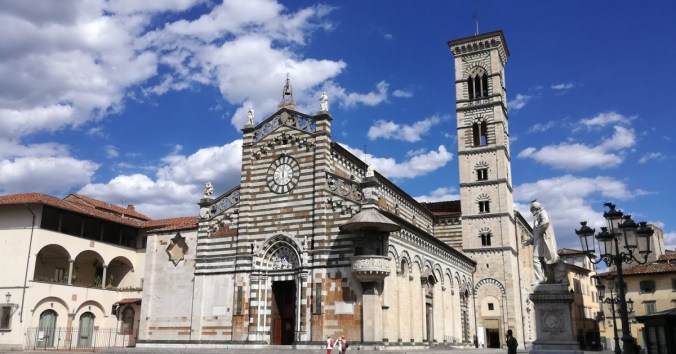
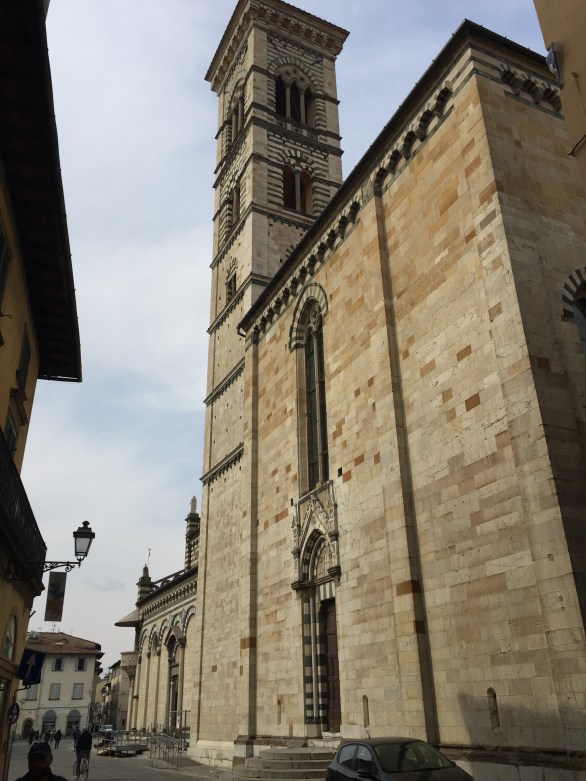
The Prato Cathedral (Cattedrale di San Stefano) is a handsome Roman Catholic Church in Prato, Tuscany, Central Italy. It is one of the most ancient churches in the city, already in existence in the 10th century. It was built in several successive stages in the Romanesque style. The church contains a number of notable works of art, in particular fine sculpture.
Error
This video doesn’t exist
Prato’s church of Saint Stephen was built in a green meadow (in Italian: prato) after an appearance of the Virgin Mary near the village of Borgo al Cornio (the present center of Prato). The first building was a small parish church. which the earliest document dates to AD 994.
The expansion of the church began in the 15th century and transformed the modest building into one of the most lovely Gothic-Romanesque buildings in Tuscany.
The video below shows the annual celebration during which the relic, the so-called “sacred belt or girdle” of the Virgin Mary is shown.

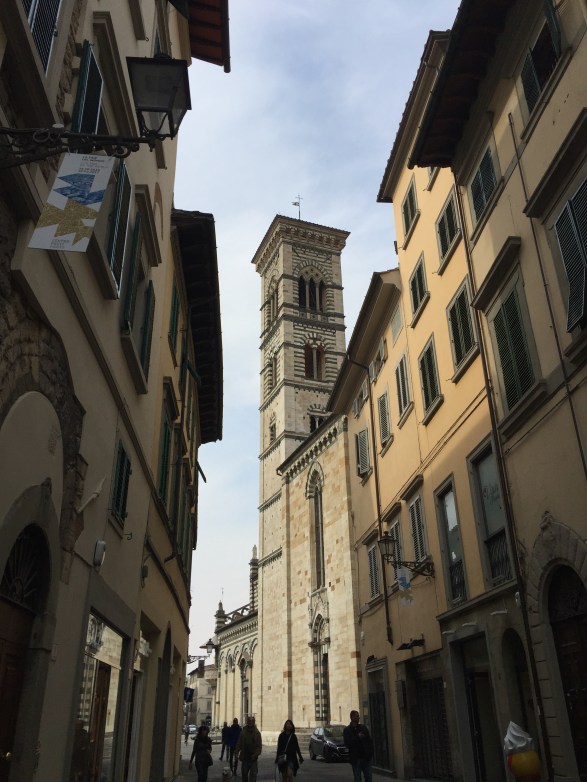
The church we see today dates from the Romanesque period of the 12th century: the nave, side walls and greater part of the bell tower remain from this date. The upper stage of the bell tower was constructed in 1356.
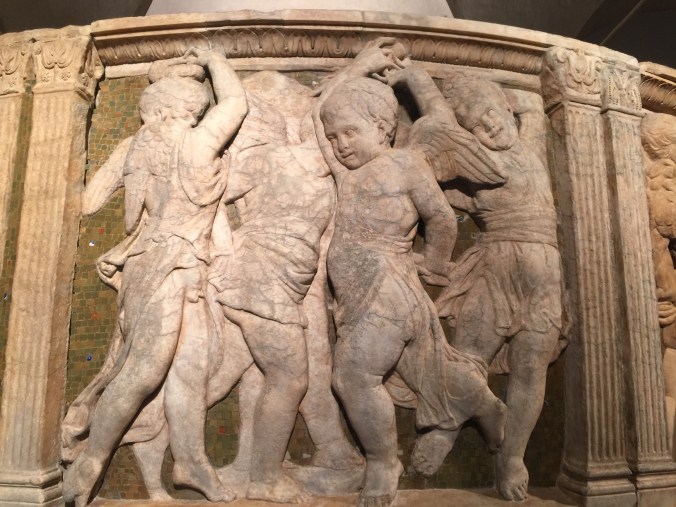
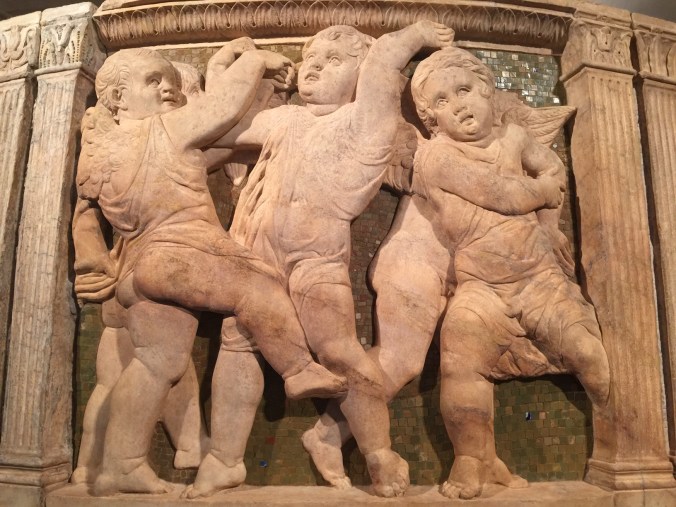
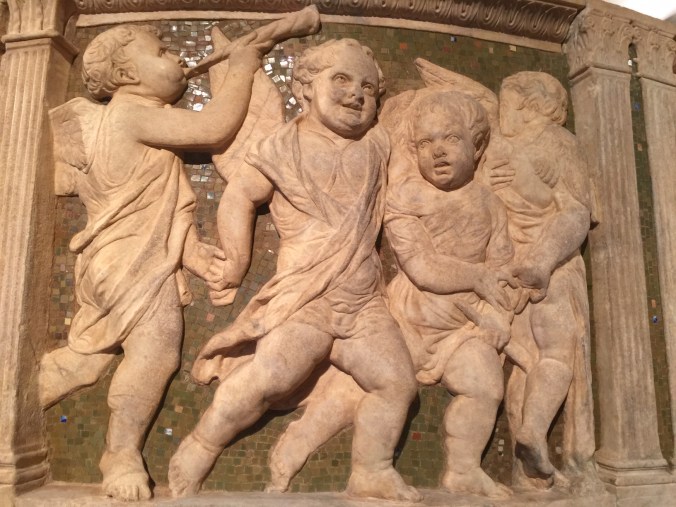
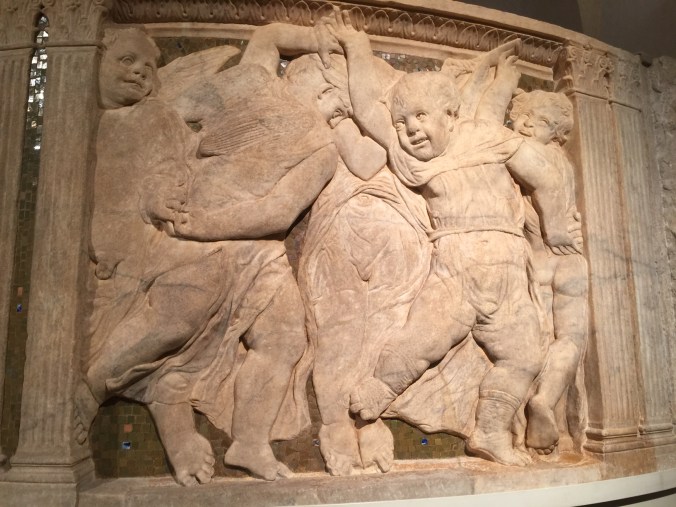
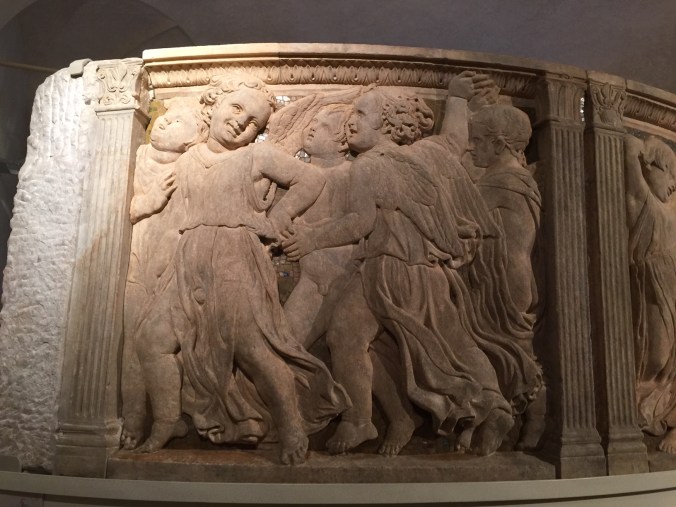
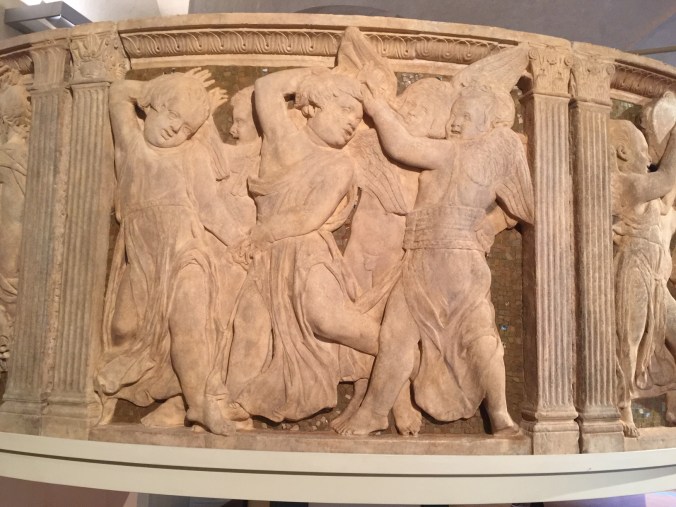
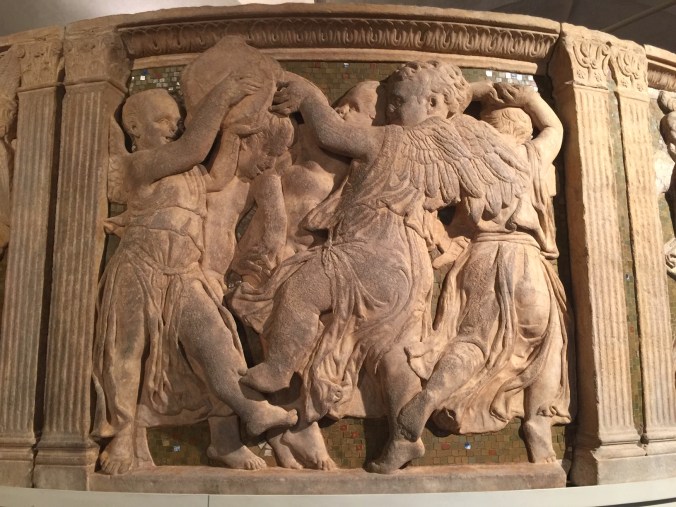
The church’s exterior pulpit by Donatello and Michelozzo:
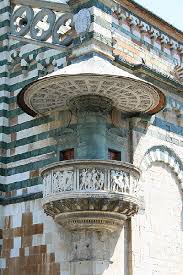
In the 14th century, the cathedral obtained a relic, the so-called Sacra Cintola or “Holy Belt” of the Virgin Mary and the church was re-envisioned. The 2nd facade was built, allowing a transept to be constructed between the old facade and the new one. This space gives way to a new, exterior pulpit, built by Michelozzo and decorated by Donatello, between 1428 and 1438.
The exterior pulpit was constructed on the right front corner of the facade.
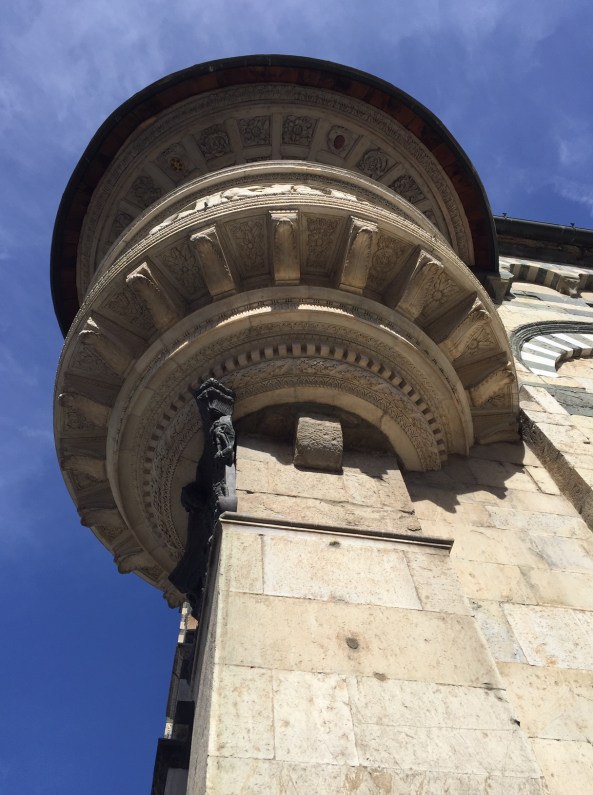
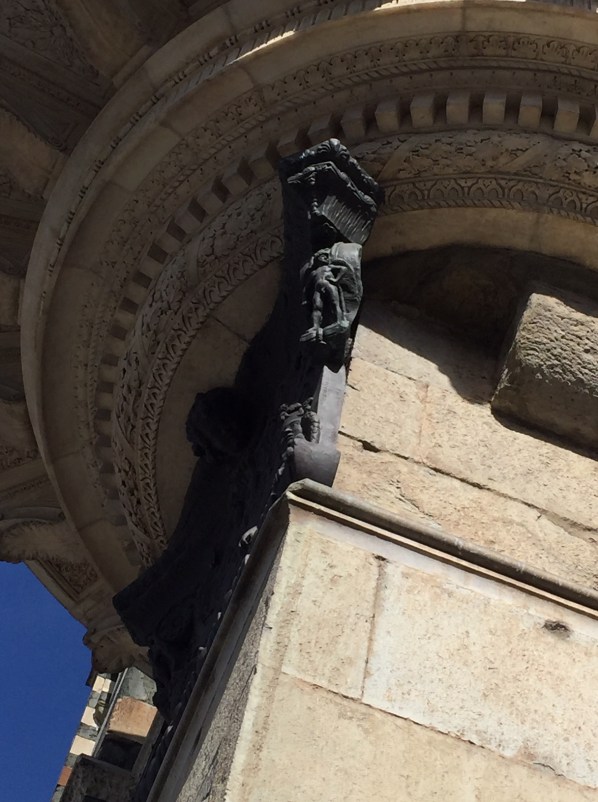
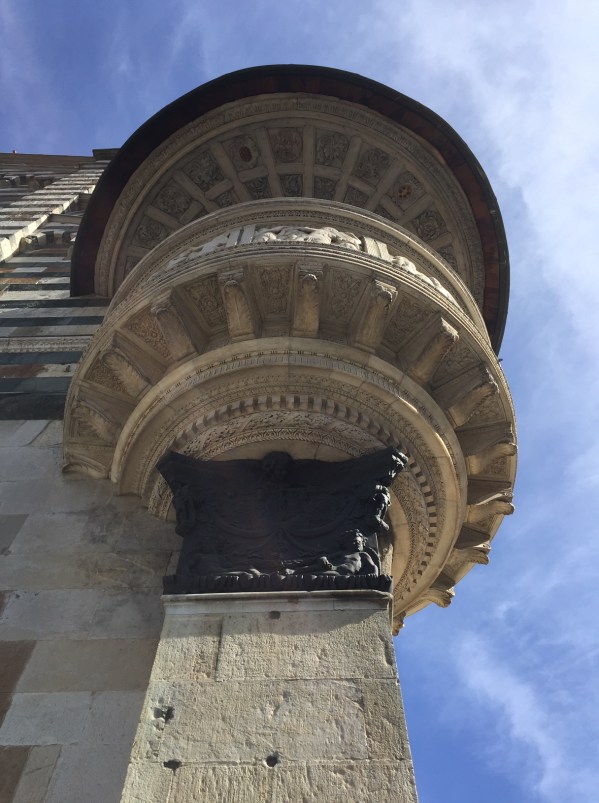
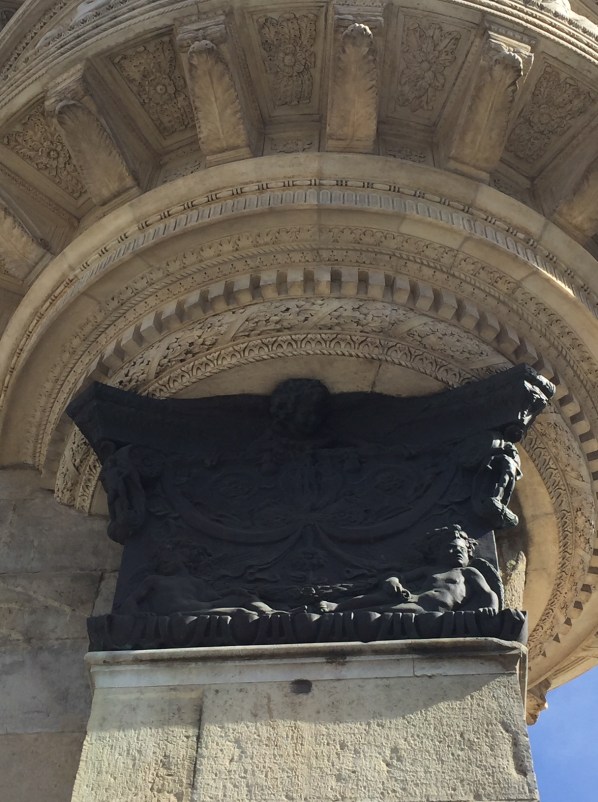
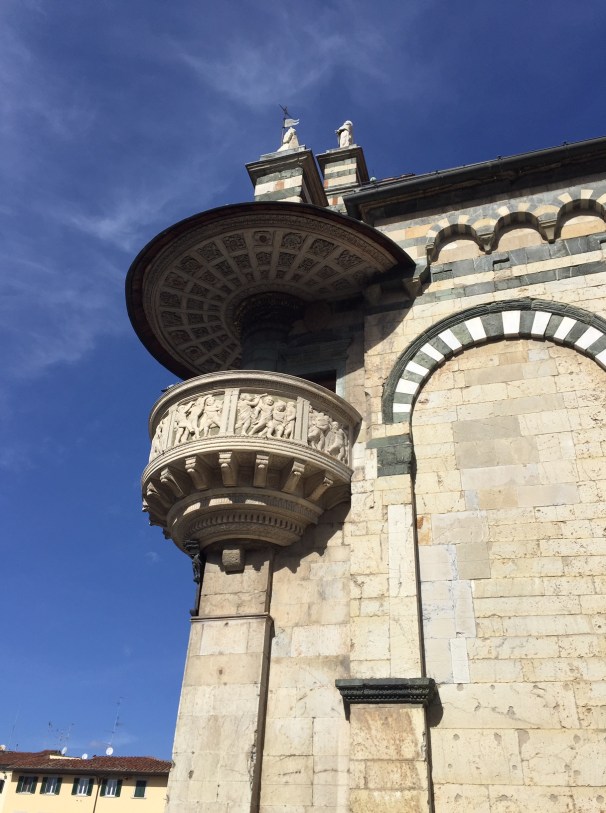
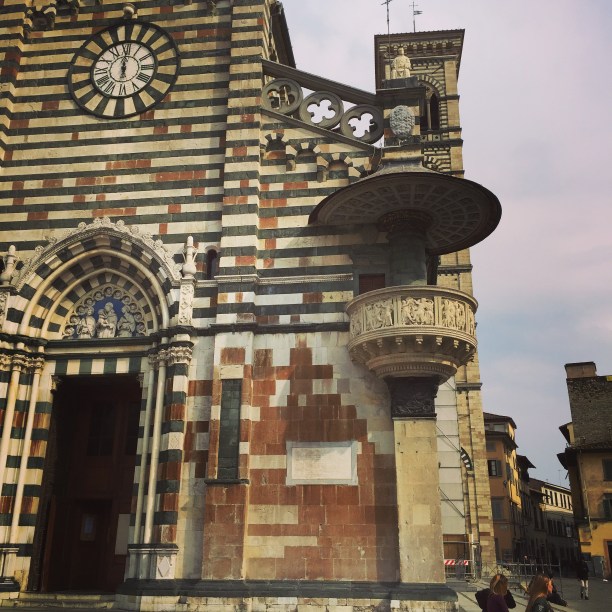
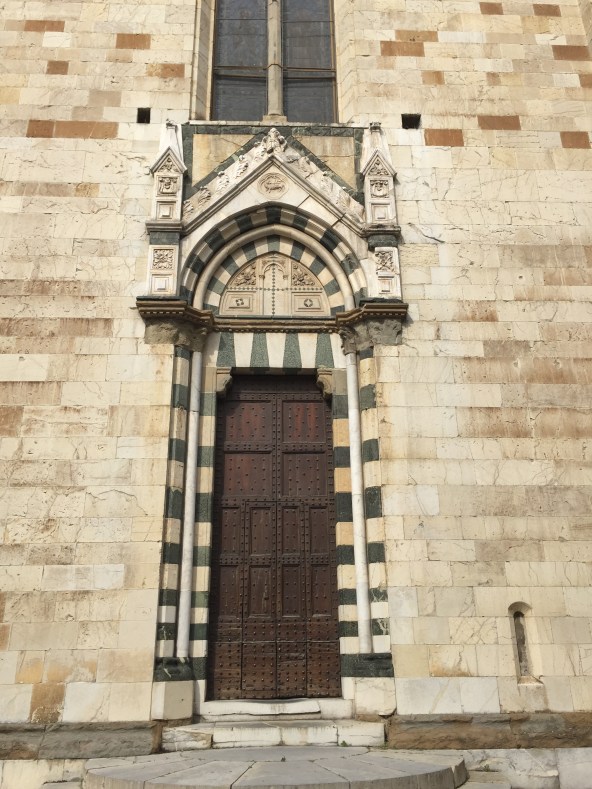
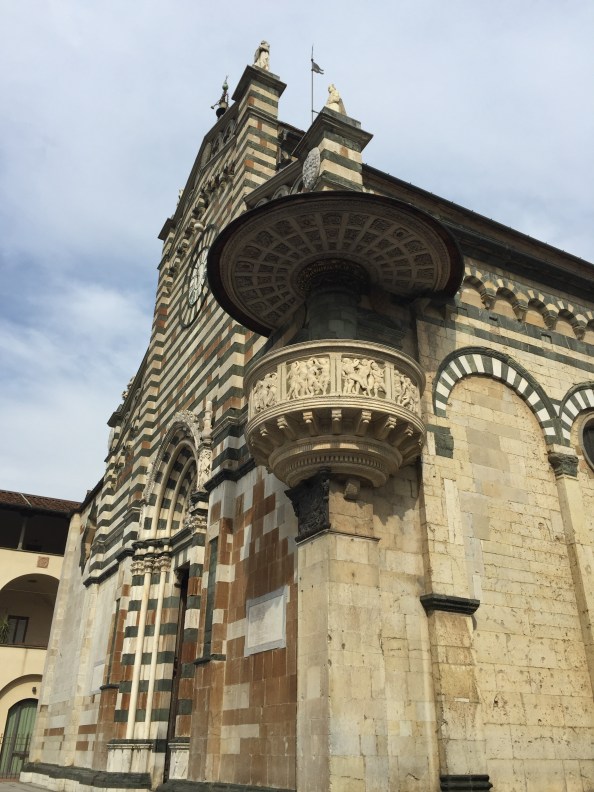
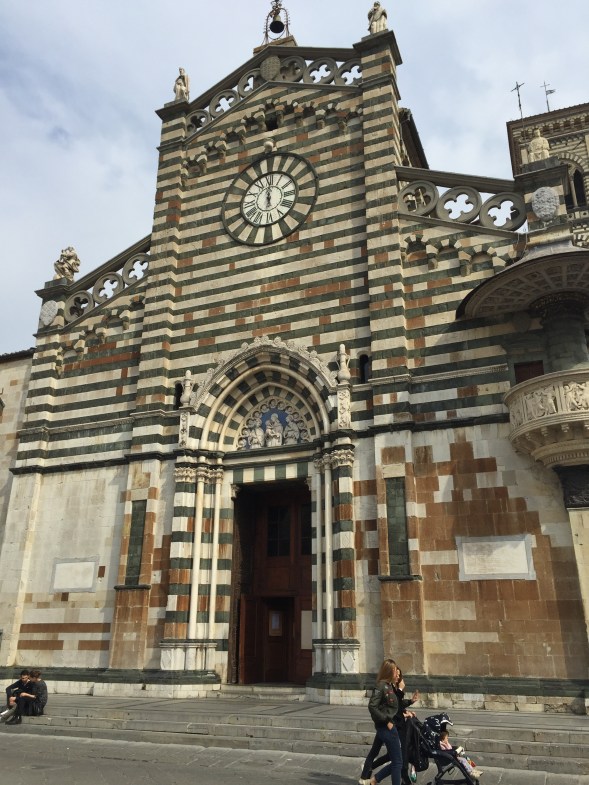
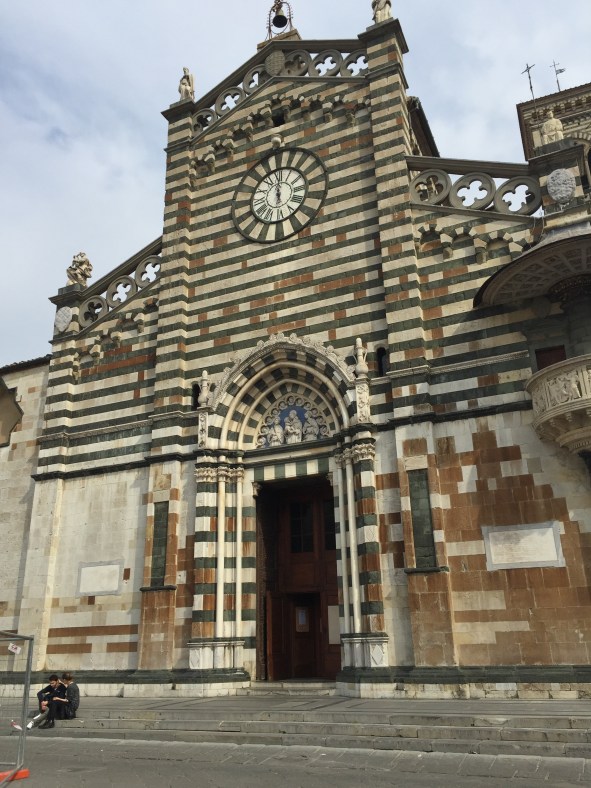
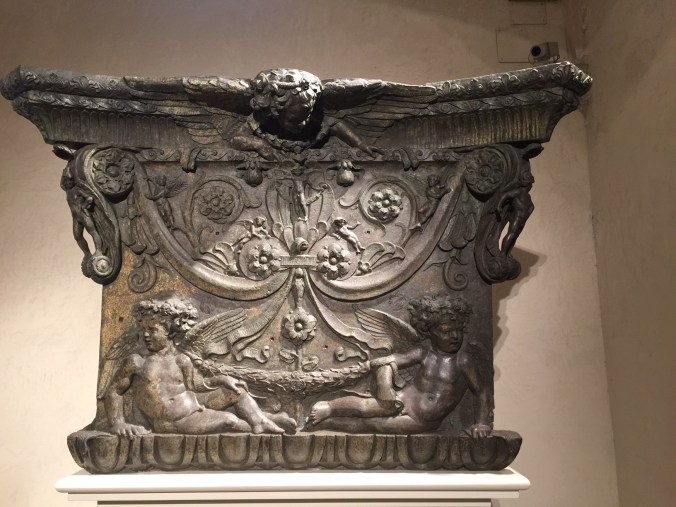
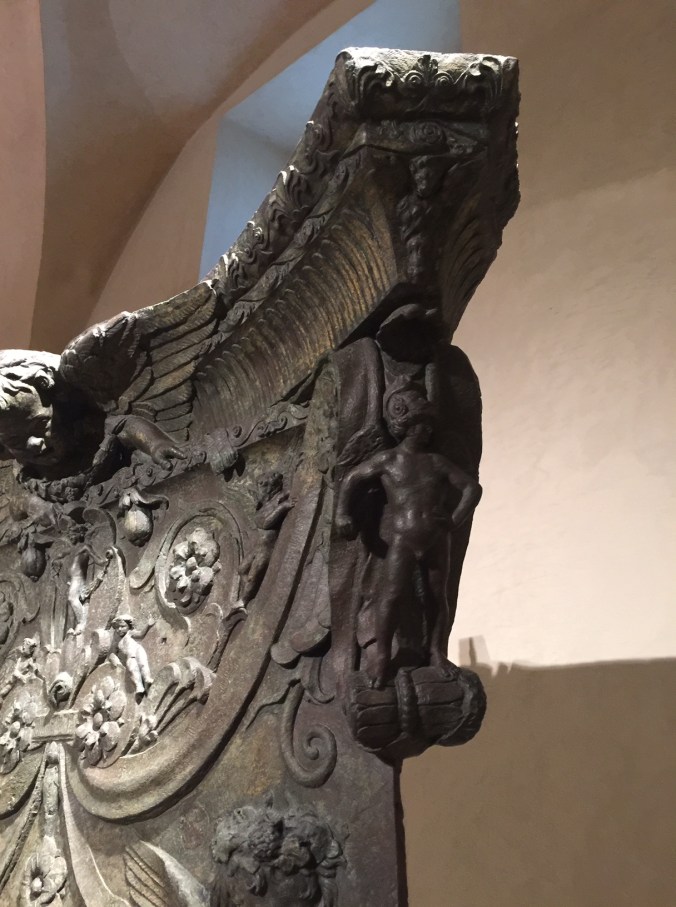
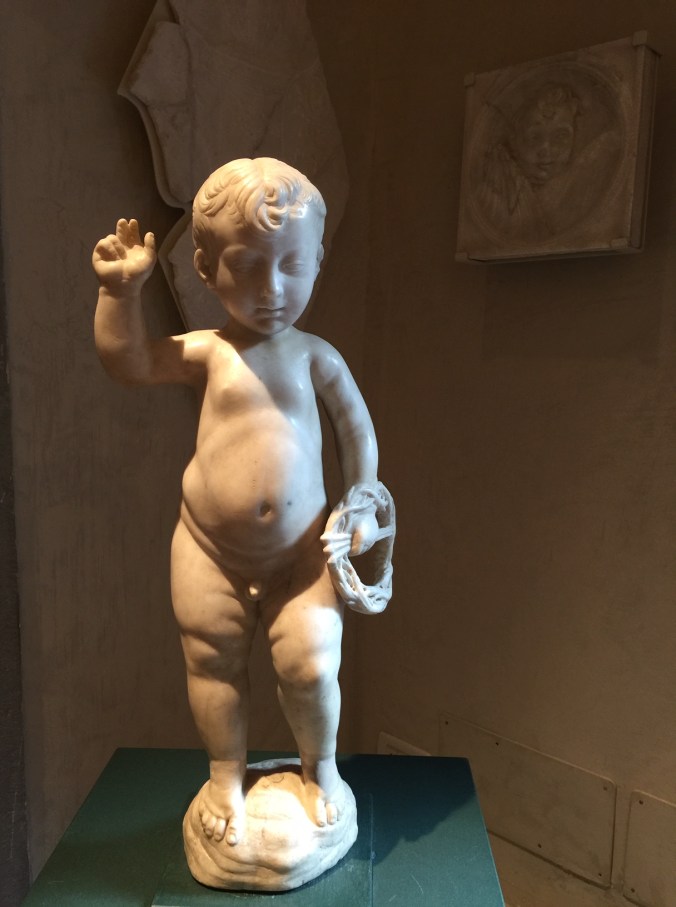
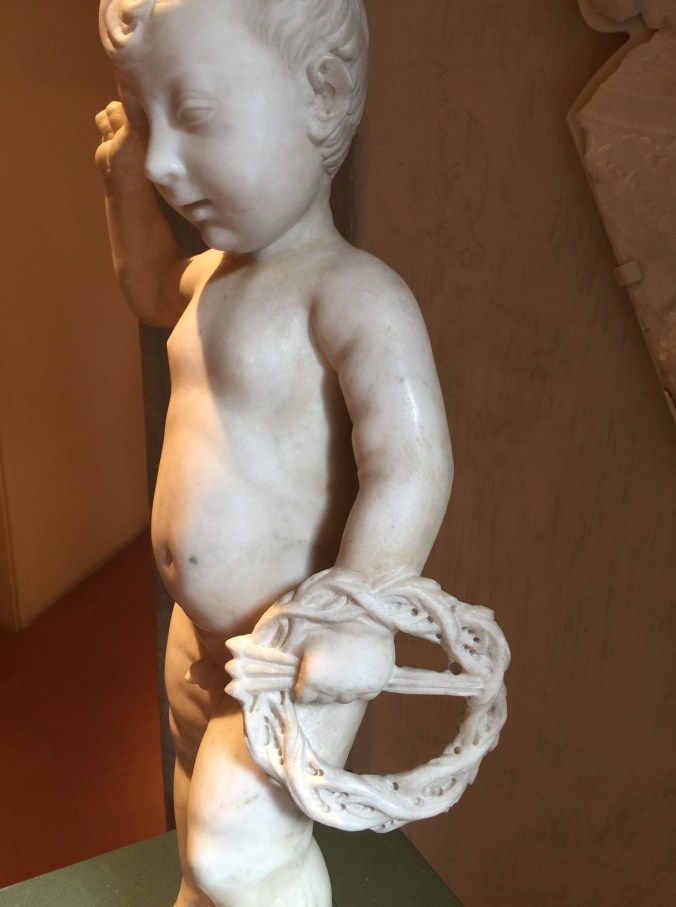
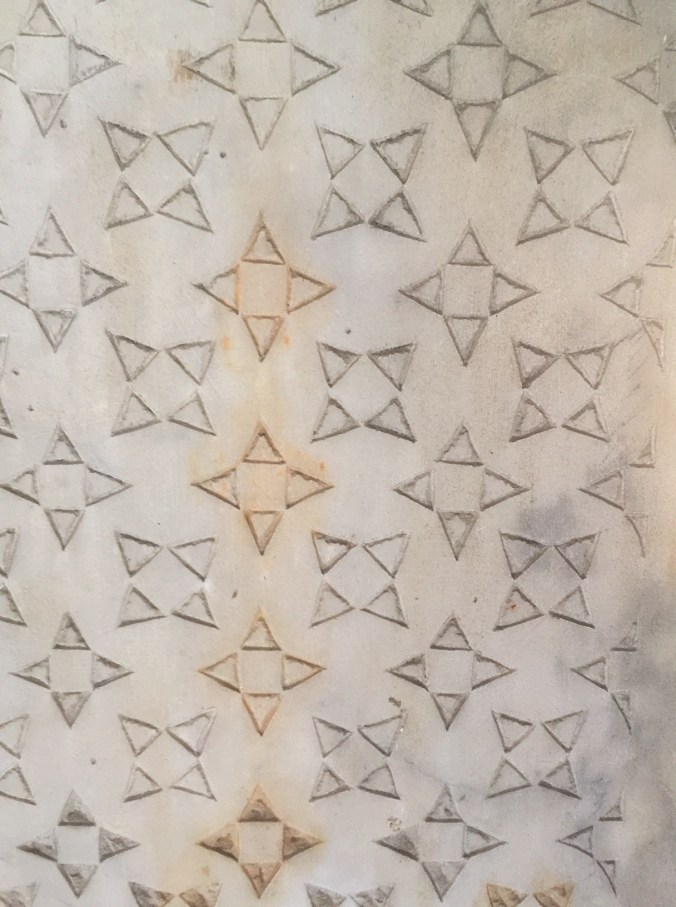
The seven original reliefs of the parapet were removed from the pulpit in 1967 and can be seen today in Prato’s cathedral museum. Here they are, photographed inside the museum:
Error
This video doesn’t exist
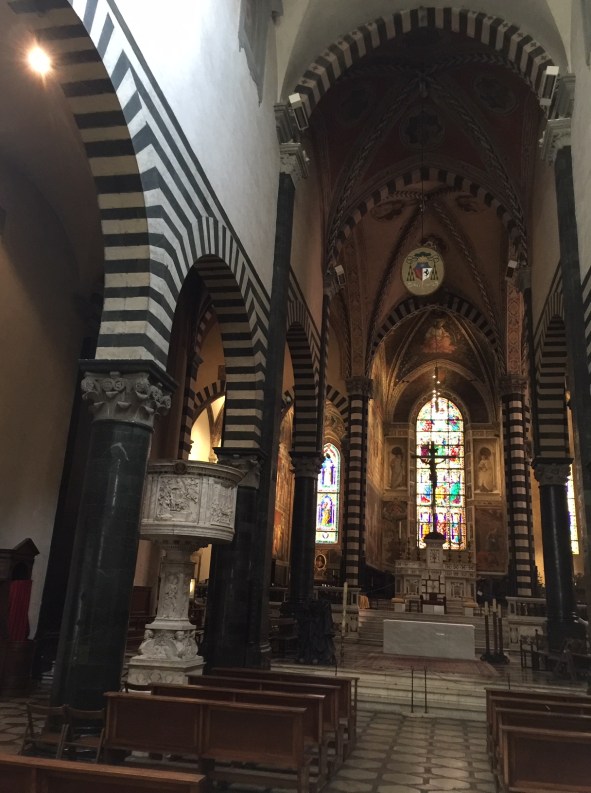
The church was built with a Latin cross ground plan in Romanesque style. The aisles are separated from the nave by elegant columns of green serpentine, the capitals being attributed to Guidetto. The vaults, designed by Ferdinando Tacca, were added in the 17th century.
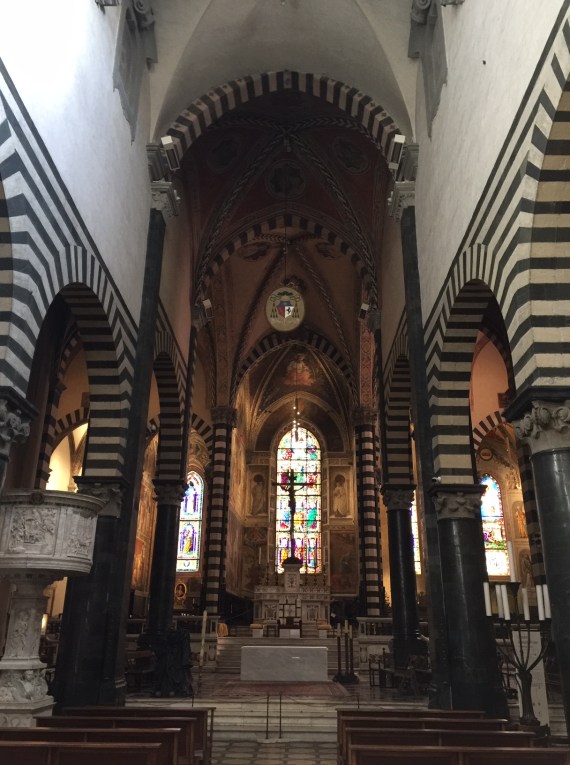
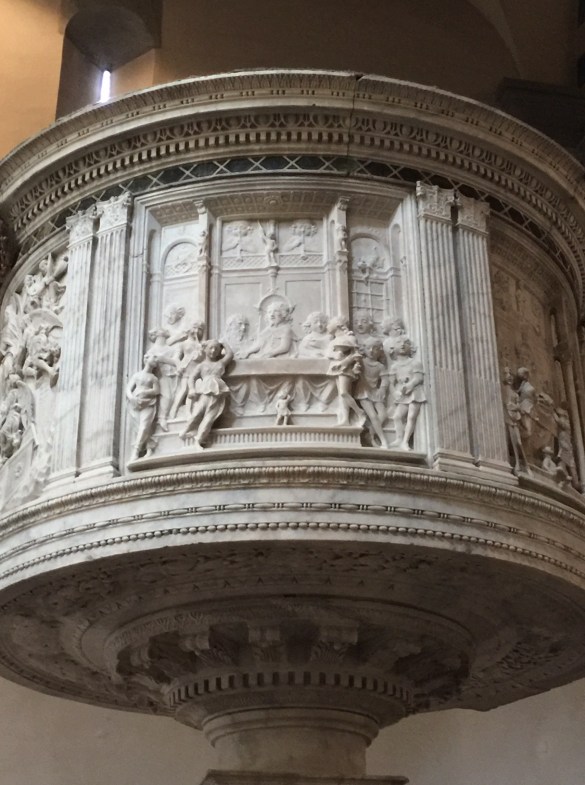
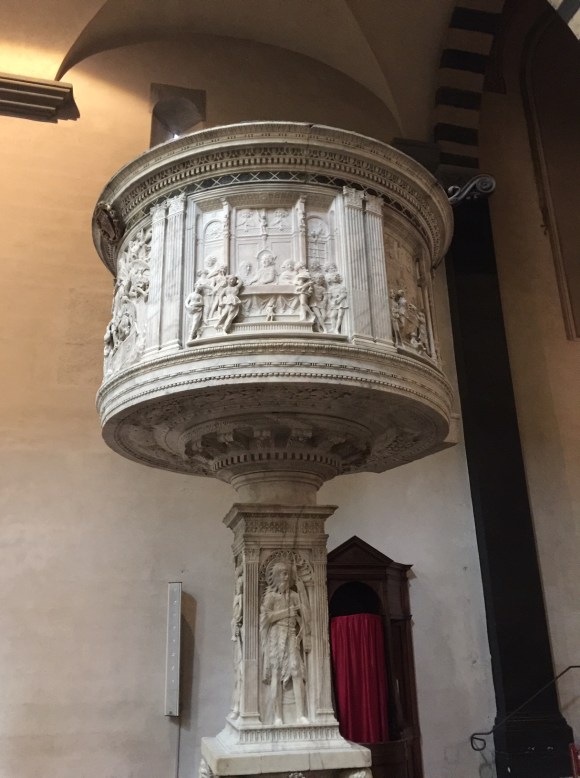
The north aisle houses a notable Renaissance pulpit in white marble (1469–1473). The base is decorated with sphinxes. The parapet has reliefs by Antonio Rossellino, portraying the Assumption and the Stories of St. Stephen, and by Mino da Fiesole portraying the Stories of St. John the Baptist.
Error
This video doesn’t exist
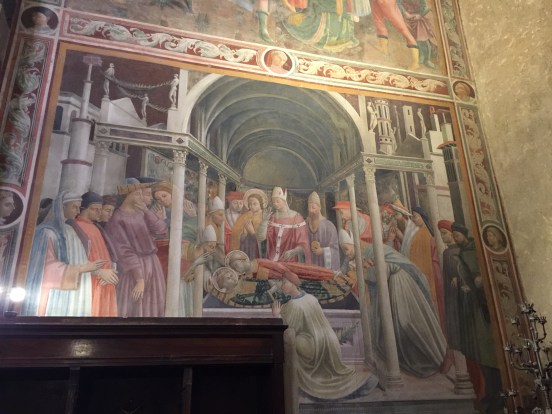
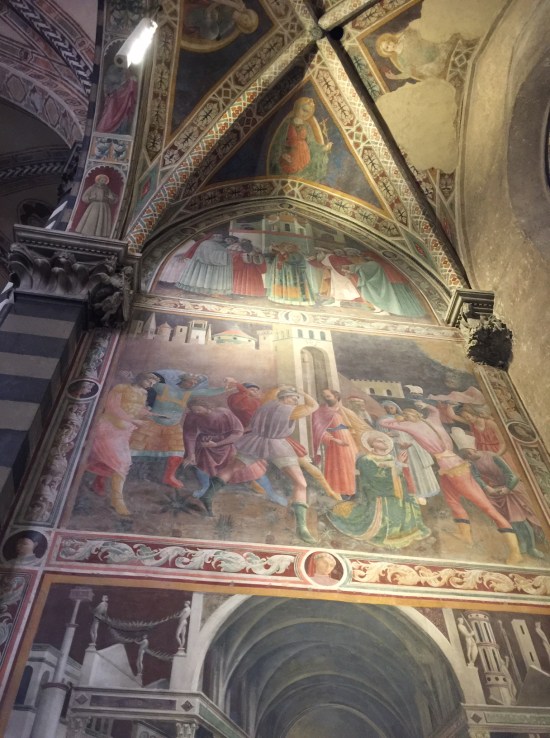
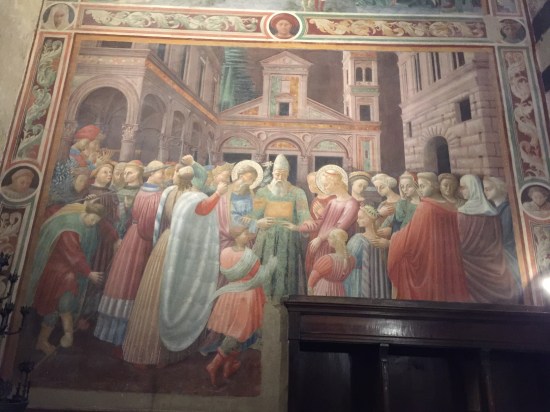
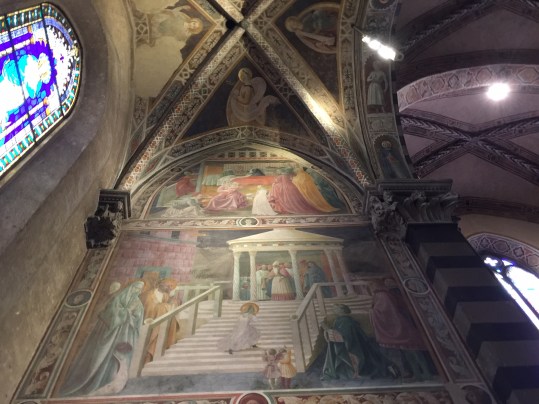
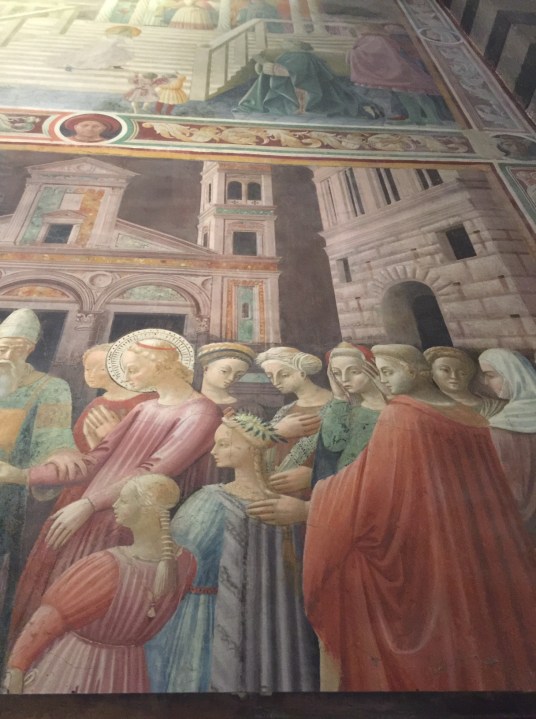
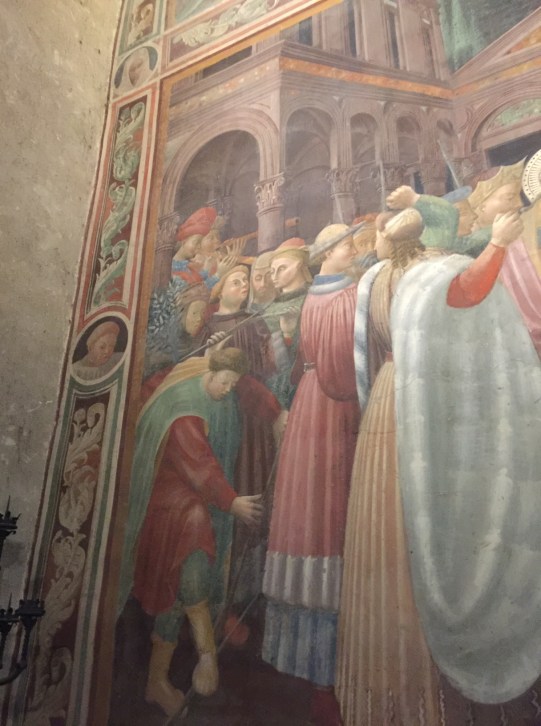
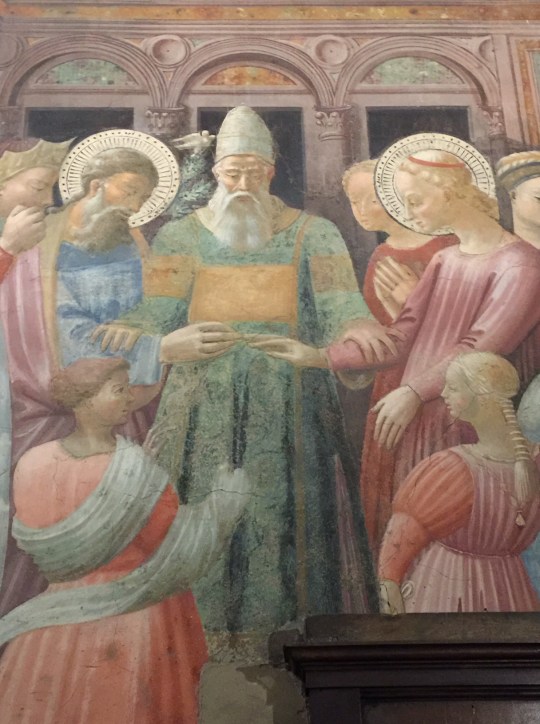
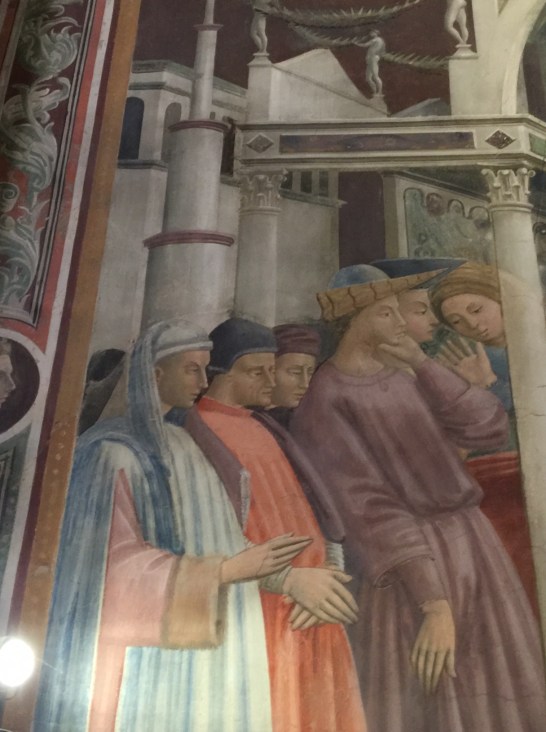
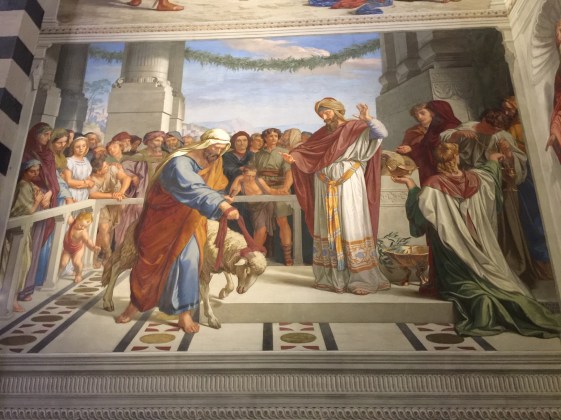
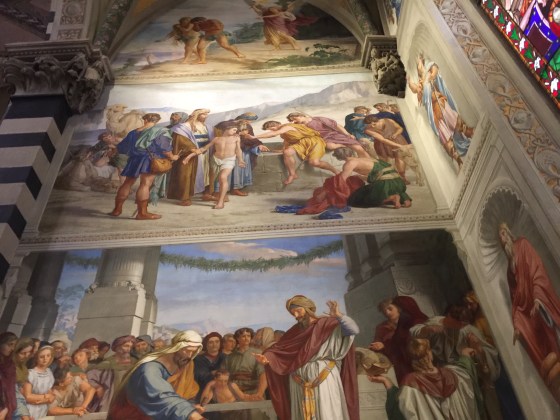
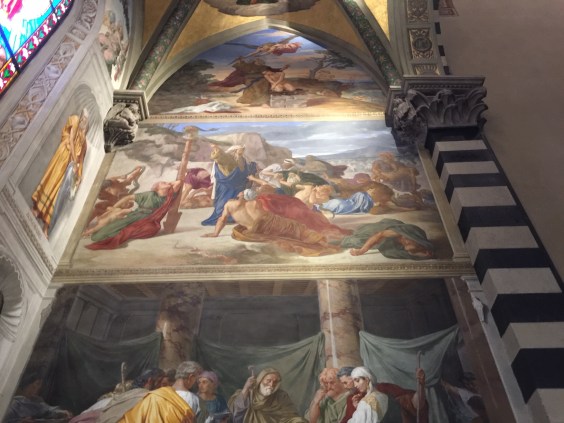
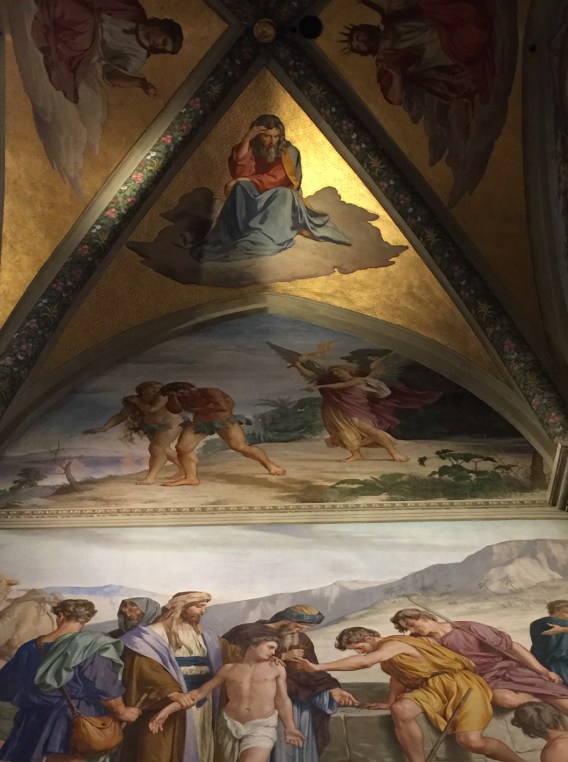
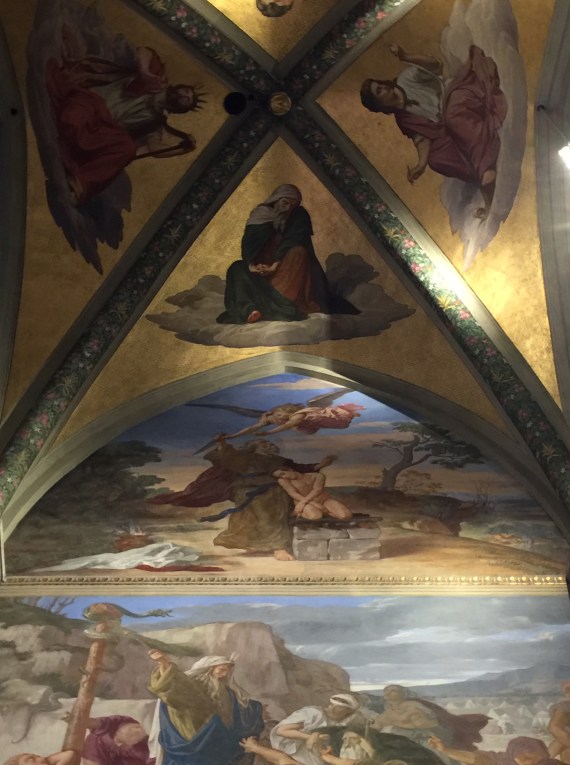
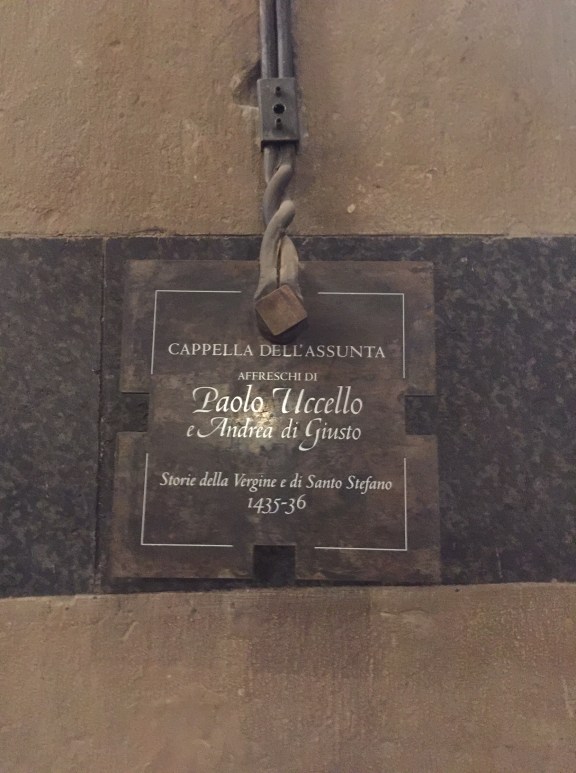
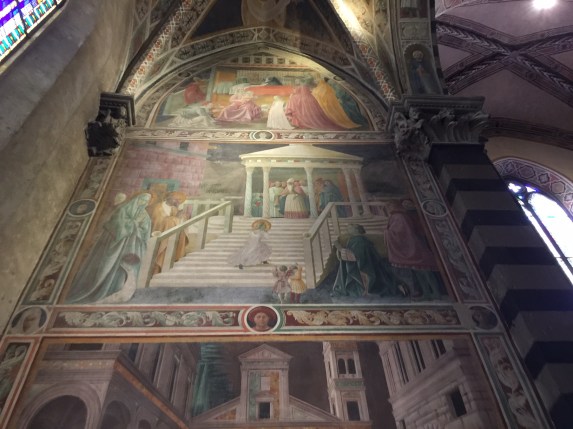
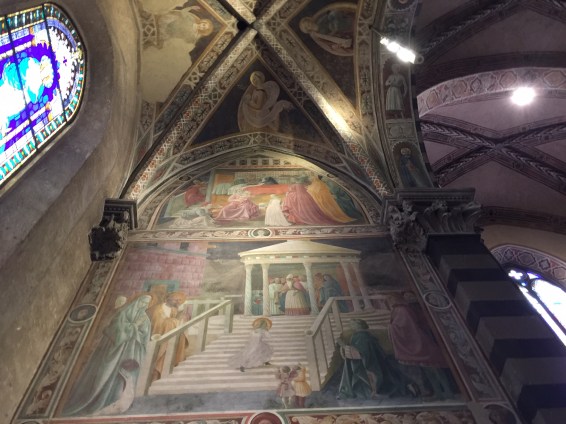
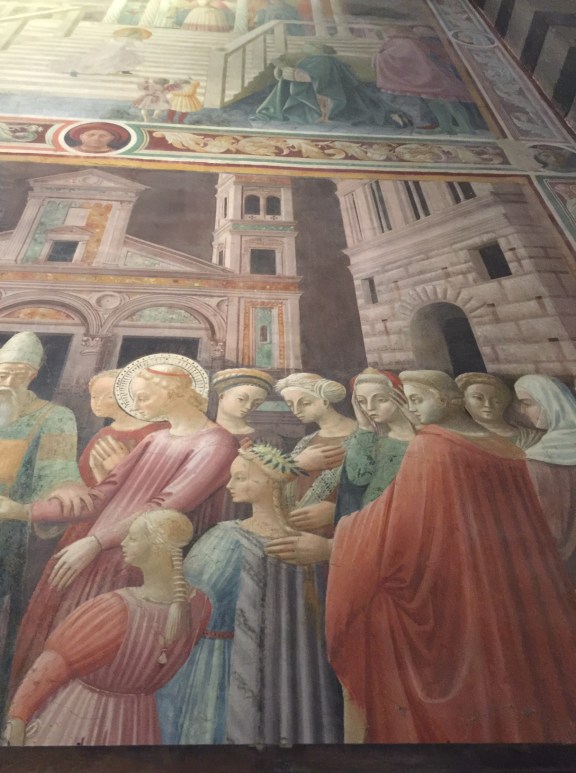
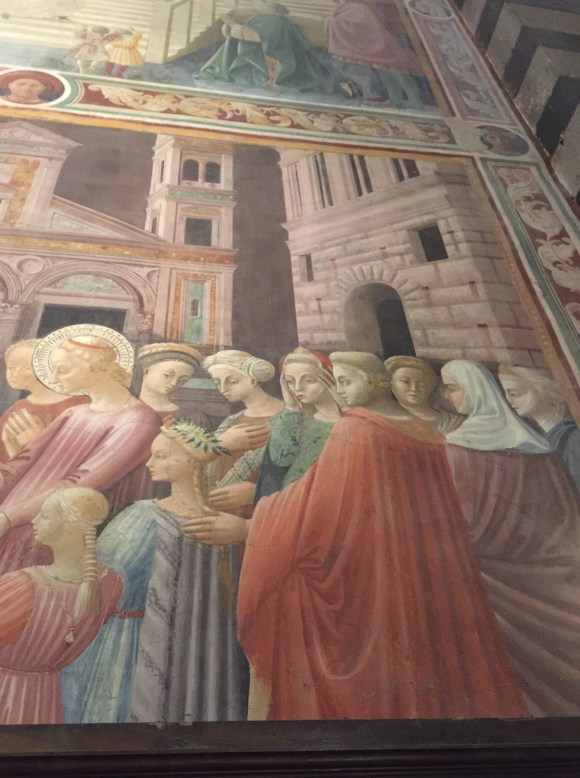
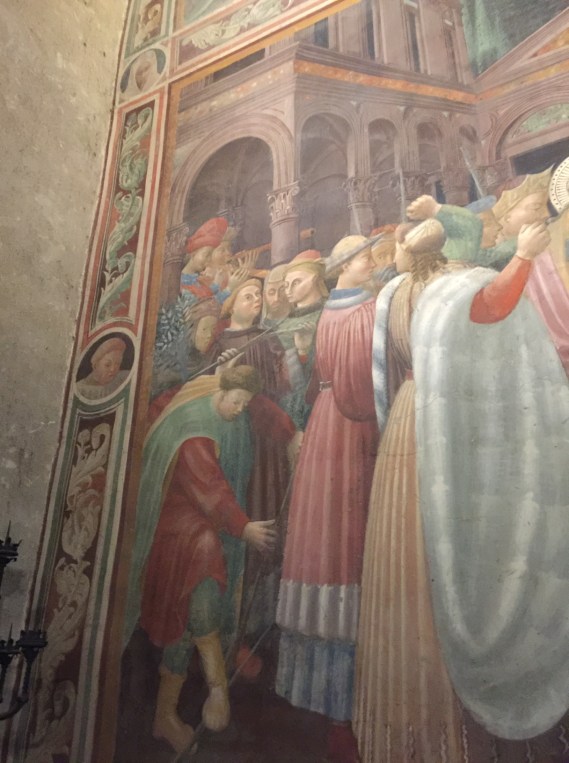
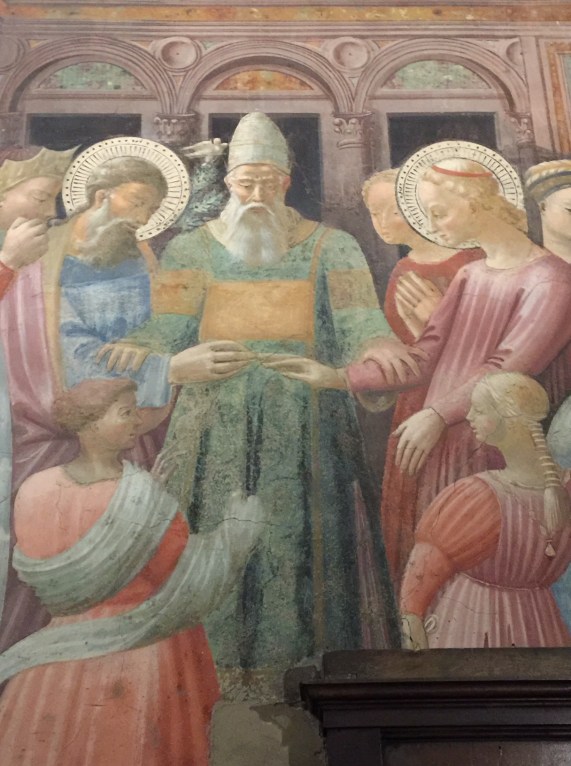
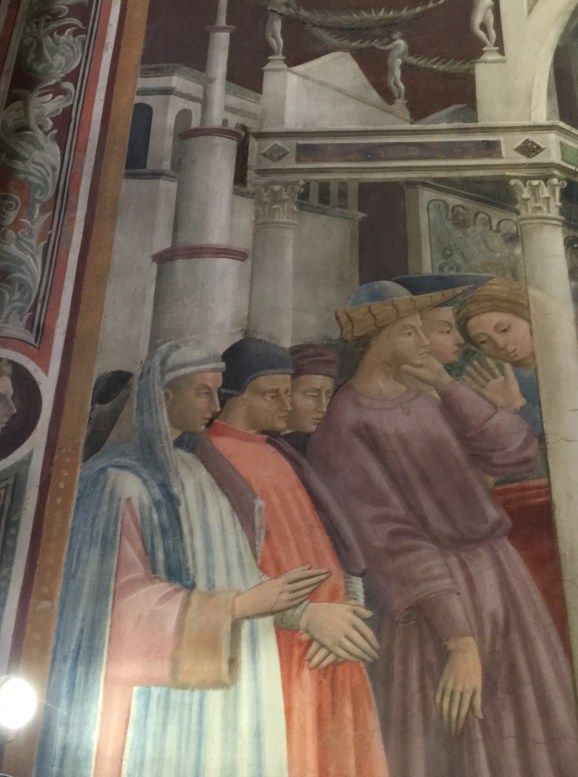
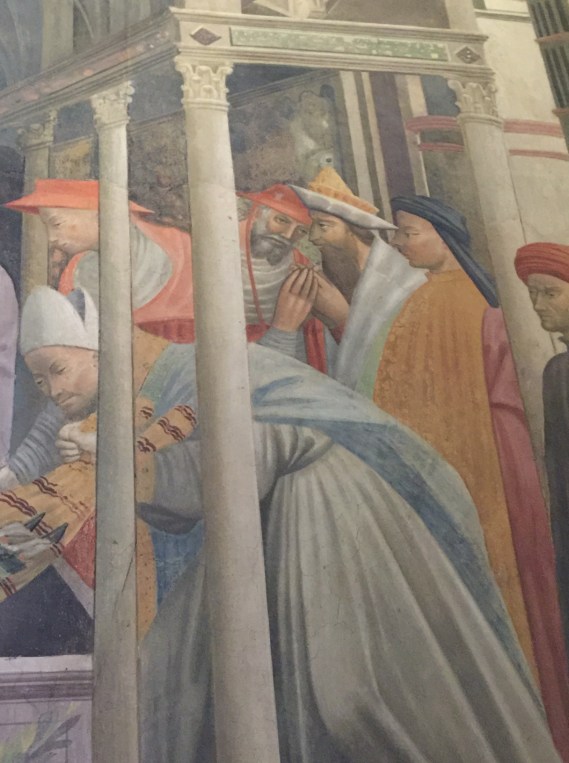
The Assumption Chapel in the transept was frescoed in 1435-1436 by the so-called Master of Prato and by a young Paolo Uccello, who painted the Stories of the Virgin and St. Stephen. They show a bizarre fantasy of enchanted figures caught in a wide range of brilliant colors, and surrounded by Brunelleschi-like architectures.
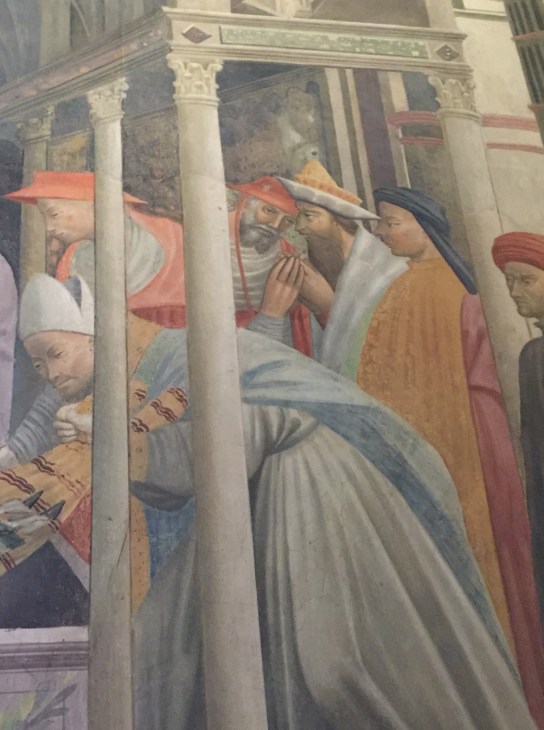
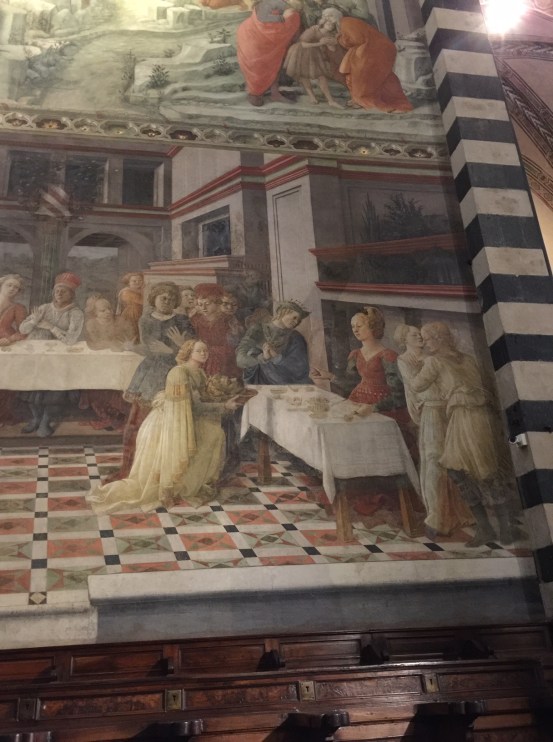
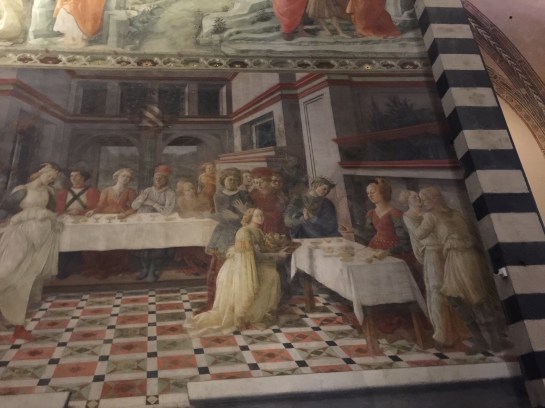
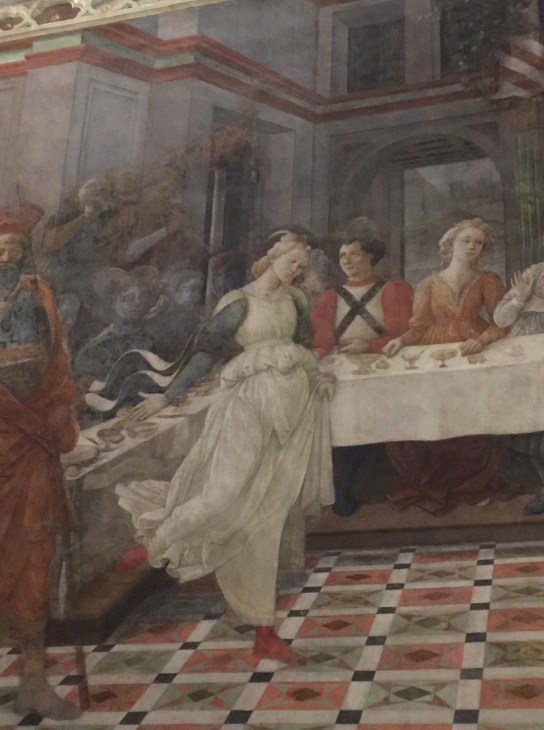
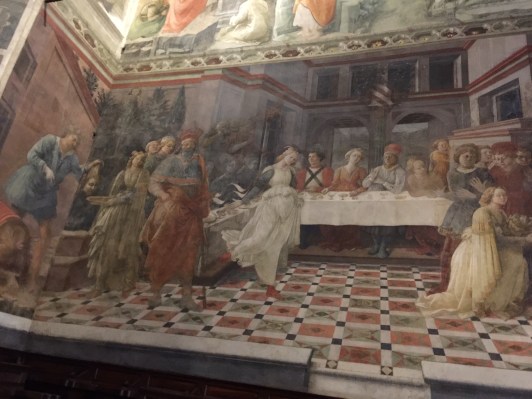
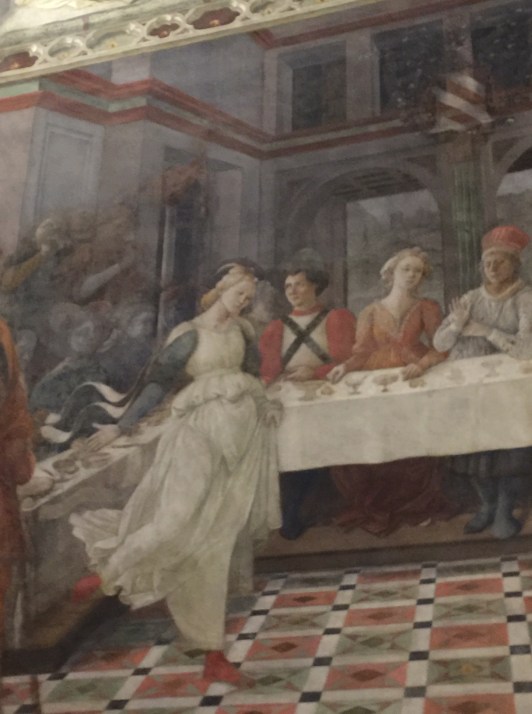
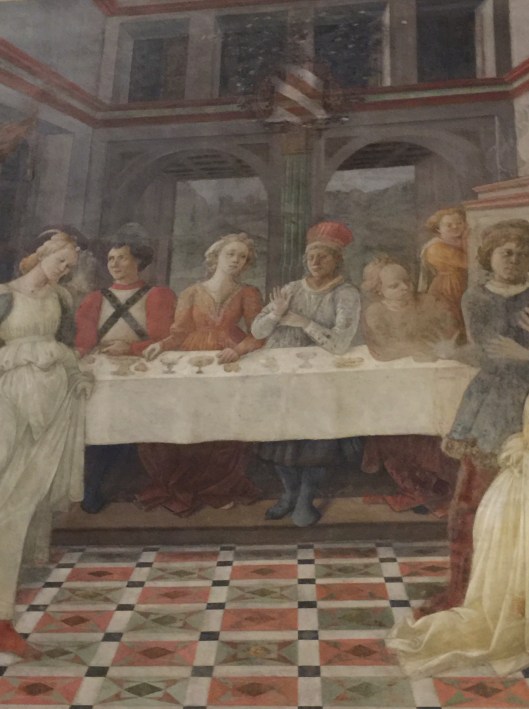
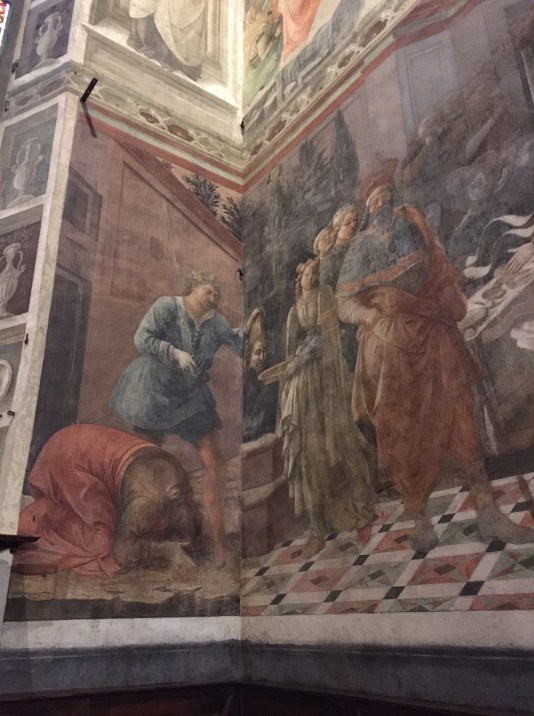
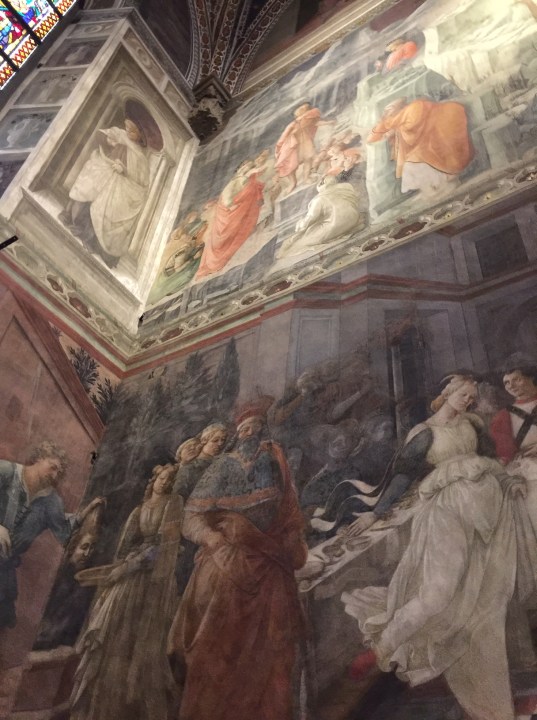
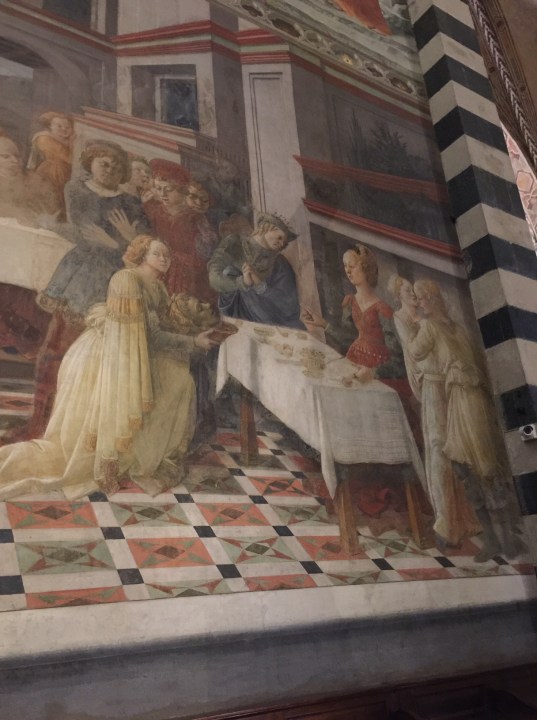
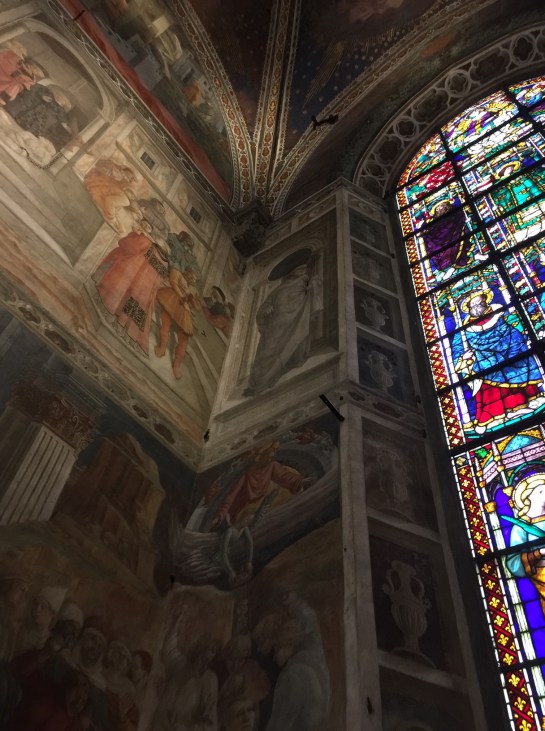
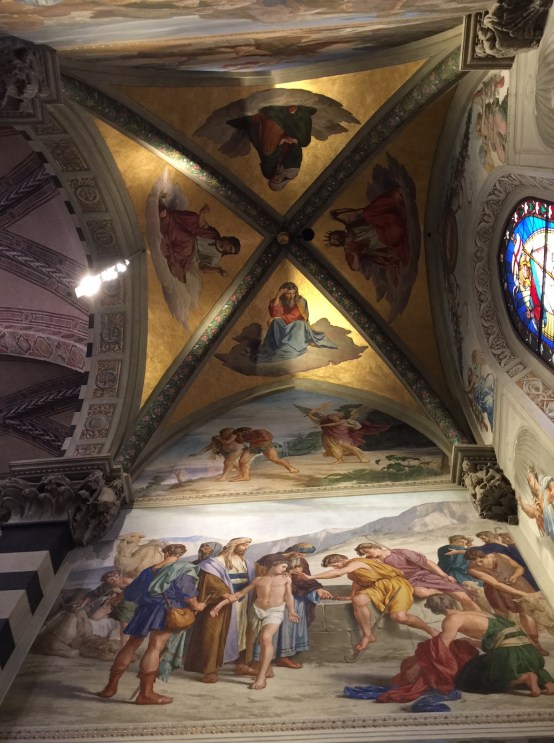
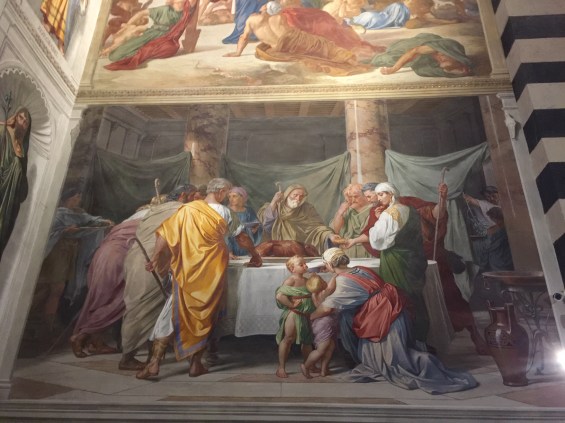
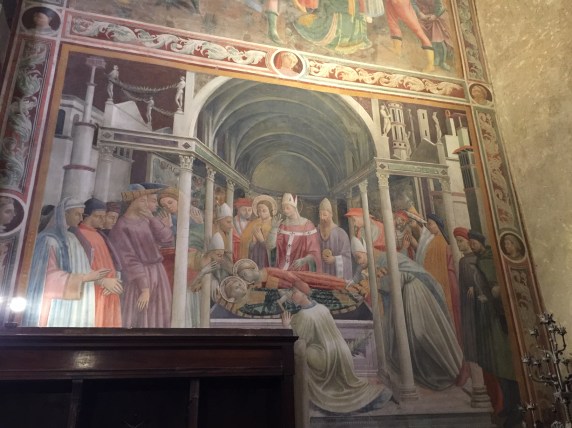
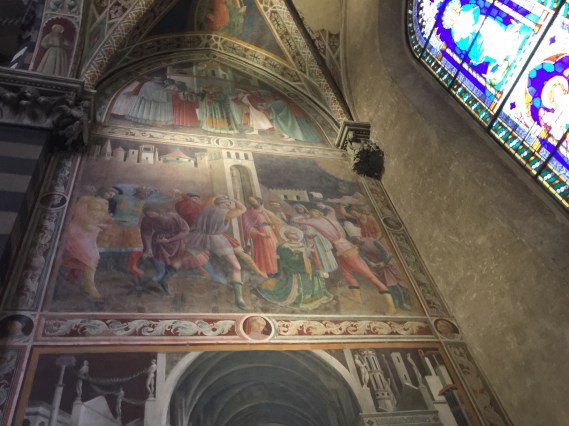
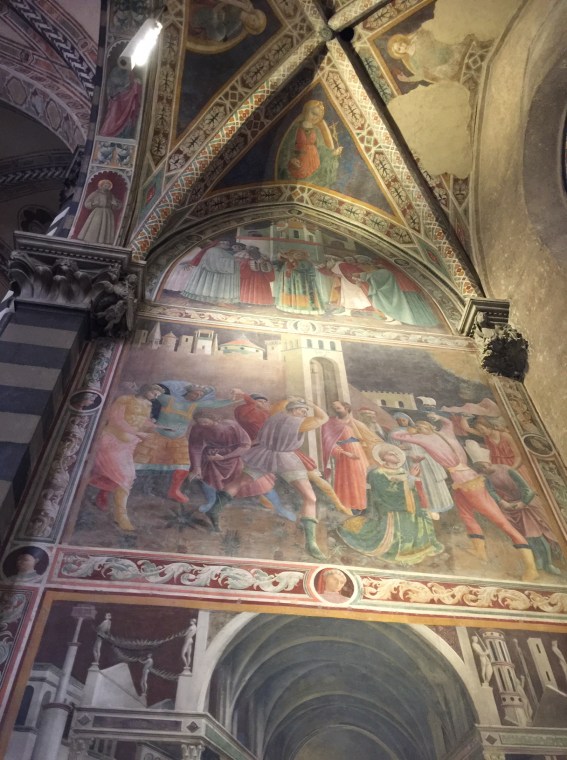
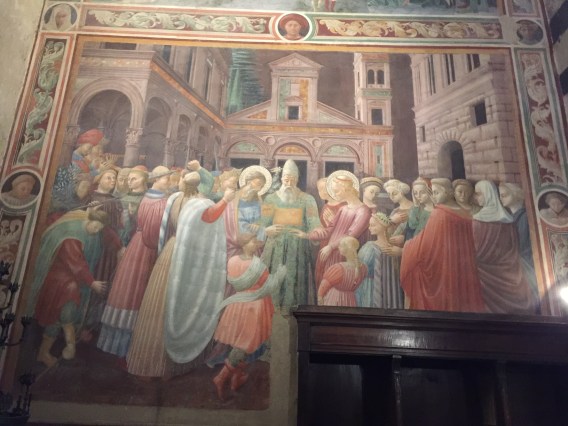
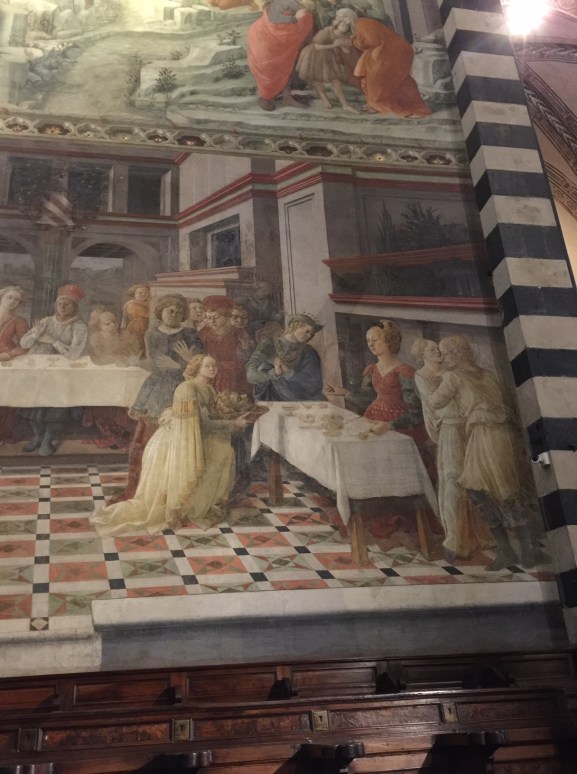
In the main chapel, or chancel, Filippo Lippi and Fra Diamante painted the Stories of St. Stephen and St. John the Baptist.
On the lower north wall are depicted the Obsequies of St. Stephen, in which Lippi portrayed Pope Pius II, set in a Palaeo-Christian basilica, as an imposing figure in scarlet costume. On the right is the artist’s self-portrait. On the opposite wall is Herod’s Banquet, showing a large hall in which Salome is performing her ballet, and the handing over of the head of John the Baptist to Herodias. The altar is by Ferdinando Tacca (1653).
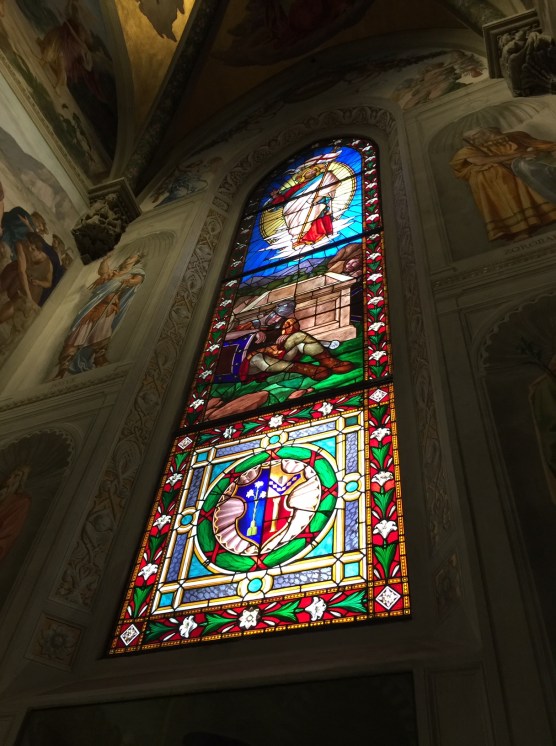
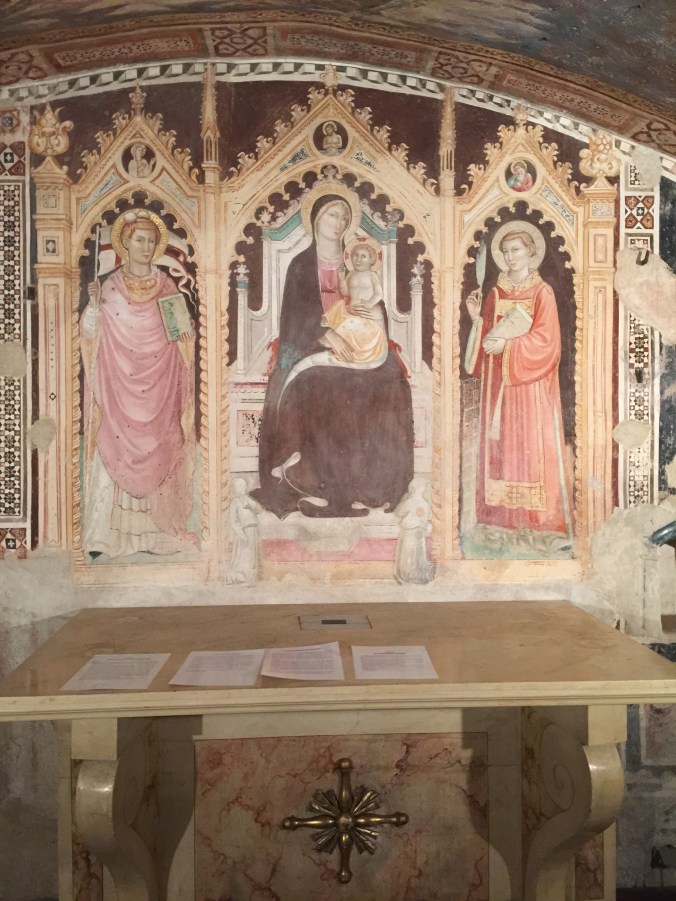
The Manassei Chapel was frescoed by a pupil of Agnolo Gaddi in the early 15th century with Stories of St. Margaret and St. James. The last chapel on the left, the Chapel of the Inghirami, houses a funerary monument attributed to Benedetto da Maiano and a stained glass window from the early 16th century.




You must be logged in to post a comment.