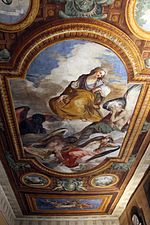
I recently visited, on a lovely parcel of land just outside of beautiful Firenze, a once-magnificent villa known as Villa la Quiete. Located upon the Castello hill, at the foot of the Monte Morello, this villa is considered to be among the most important settings of its kind. It takes its name from a fresco by Giovanni da San Giovanni entitled, La Quiete, which dominates the winds (see below).
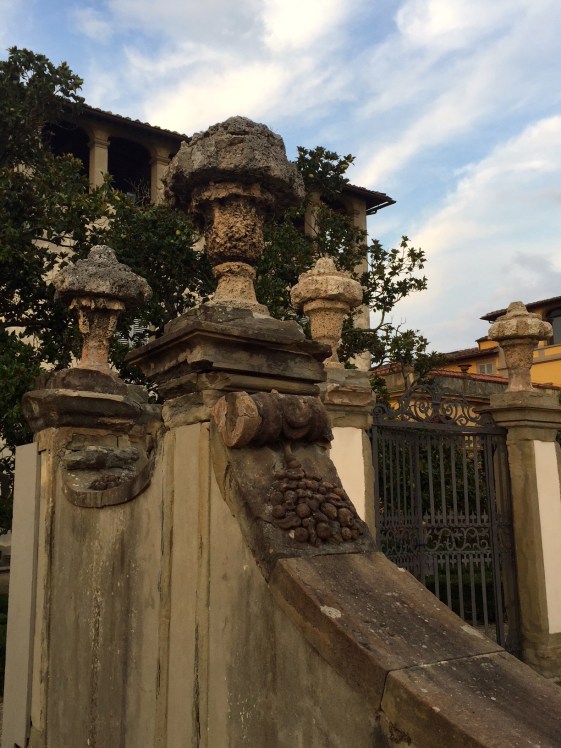
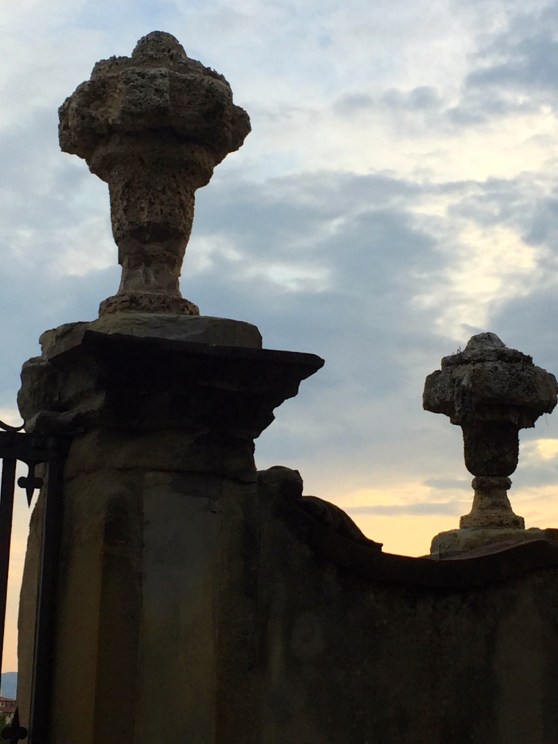
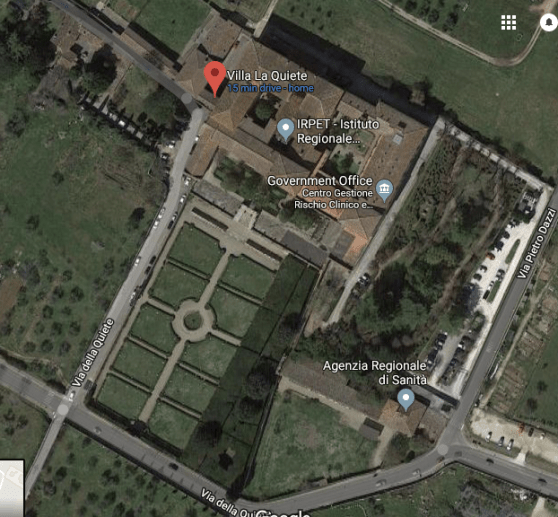
The Medici family particularly loved this area and owned some of its most beautiful residences, including the Villa di Careggi, Villa di Castello, and the Villa della Petraia. You can locate Villa la Quiete on these 2 Google Earth slides below and, in the last one, also locate the 3 Medici villas just mentioned.
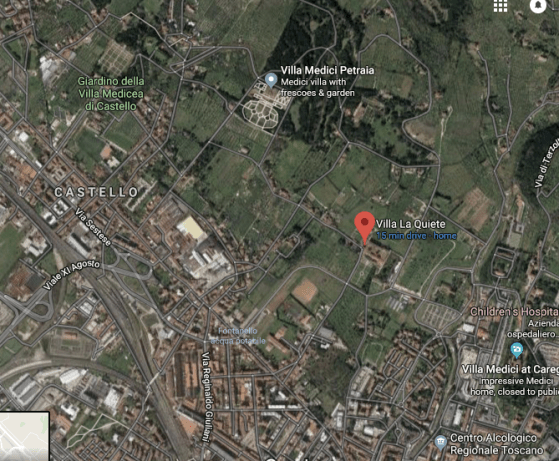
This parcel of land has lots of history, naturally. In 1438 it was given by the Florentine Republic to the condottiere Niccola da Tolentino, for his military services. In 1453 the Medici acquired the land, and later Cosimo I passed it to the commander of the Order of Santo Stefano.
In 1627 the property was again acquired by a Medici, this time by Cristina di Lorena. She had the palazzo rebuilt, and had a suspended passage constructed (a small variant of the Vasari Corridor), connecting the villa to a nearby Camaldolese monastery. Cristina also commissioned the painting of la quiete che pacifica i venti, by Giovanni da San Giovanni in 1632.
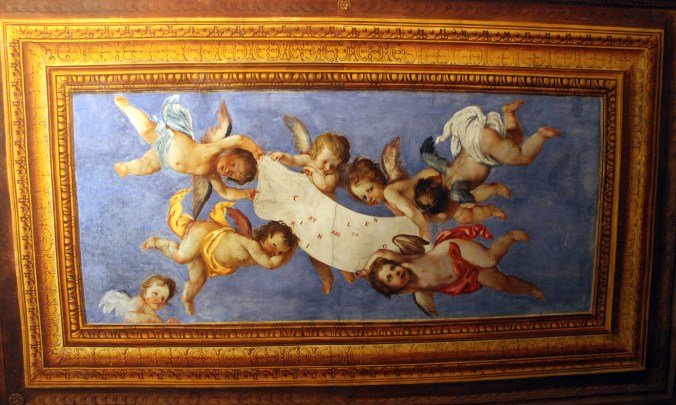
Cristina’s name even appears in another fresco, by Giovanni da San Giovani. in which curious anagram masquerading as a hymn inscribed on a scroll supported by putti in flight.
The villa has, thereafter, been known as Villa la Quiete.
The complex was bequeathed to Cristina’s grandson, the Grand Duke Ferdinando II. Later on, in 1650, the villa was sold to Eleonora Ramirez de Montalvo, who dedicated it as a country retreat for a congregation she founded, the Montalves. At that time the villa was called Istituto della Quiete.
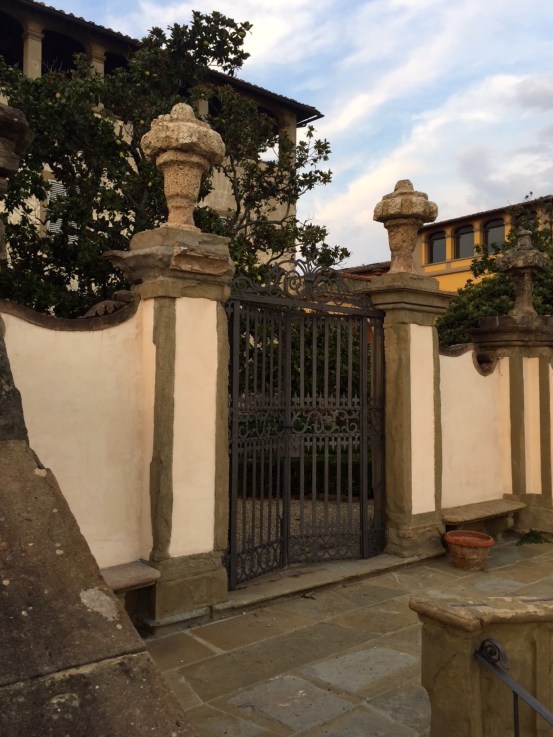
After Eleonora’s death, her friend the Grand Duchess Vittoria della Rovere administered the Institute, and sponsored the construction of the Montalve church, completed in 1688.
Anna Maria Luisa de’ Medici, the last descendant of the Medici family, resided in the villa between 1720 and 1730 and she furnished it with objects from the Palazzo Vecchio and Palazzo Pitti.
Anna Maria had the villa renovated and redecorated and she installed a beautiful grand garden, bringing water to it by a pipe to the nearby Fonte delle Lepricine.
The director of this new, vast garden was the botanist Sebastiano Rapi, who just happened to be the person in charge of the Giardino Boboli. Rapi, with the support of Anna Maria, brought the best botanical and fruit species from the various Medici villas.
Even today, the specimen magnolia trees they selected still grow in a courtyard connecting the garden to the palazzo.
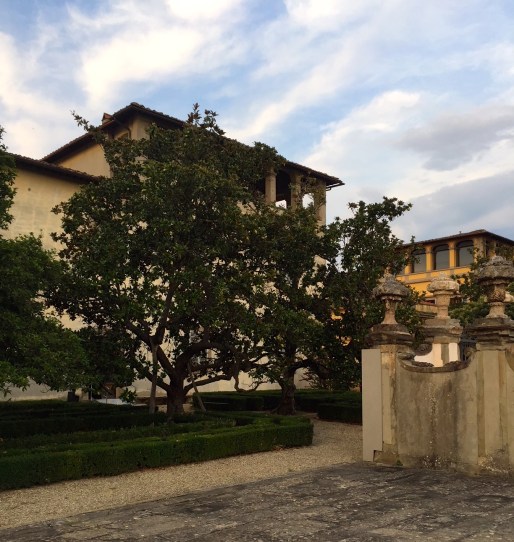
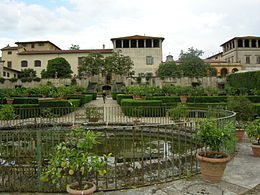
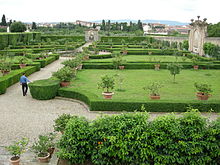
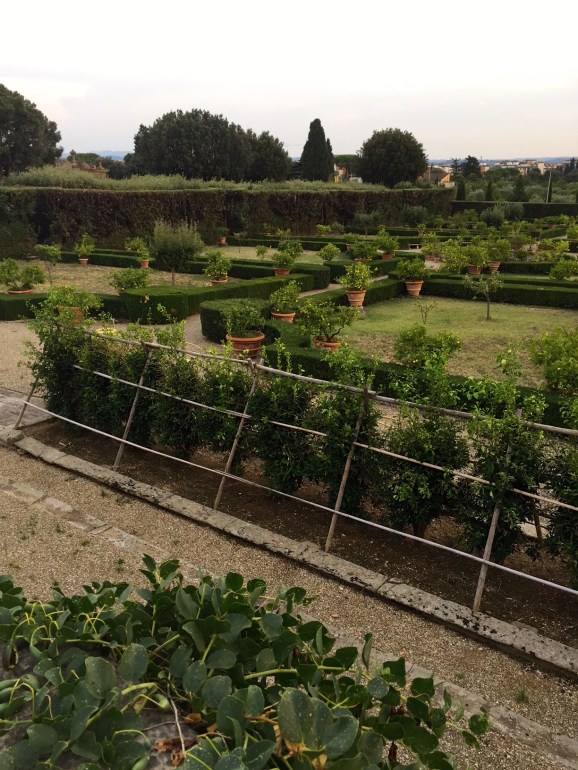
The garden today remains one of the rare examples of an 18th-century garden, with no changes in the plantings, other than refreshing them. You can see the layout of the formal, rectangular gardens, lined with pots of lemon trees, in the Google slide:
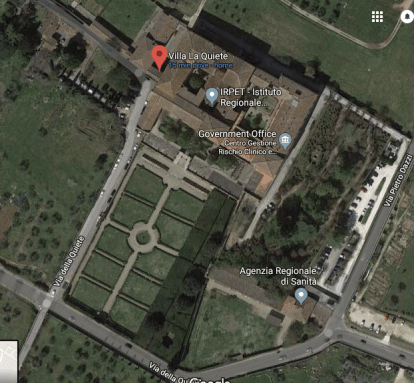
The secular order of Montalve, dedicated to the education of girls of good family, only had to abandon their church of San Jacopo di Ripoli in 1886, and they brought their numerous furnishings and works of art with them to the Villa la Quiete.
It was only in 1937 that the order became religious. The villa complex remained for a long time the seat of the education institute, ending only in 1992. The last pupil graduated in 2001.
In February 1992 the villa, together with the entire real estate of the Conservatory of the Montalve alla Quiete, passed University of Florence. A small part of the villa has been used by the University for the Center for Culture for Foreigners and Polo offices.
It is possible to visit the villa, as I did, only by appointment and in the months of July and August on Tuesday and Thursday evenings. To arrange a visit, contact the Ufficio Servizi Didattico Divulgativi, Sistema Museale D’Ateneo, tel 055-2756444 or by email to edumsn@unifi.it.
In a few days I will be writing a post about the artworks located in the villa.







You must be logged in to post a comment.