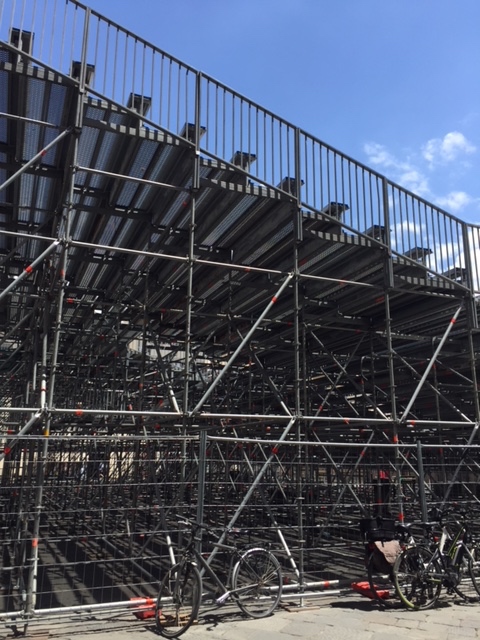
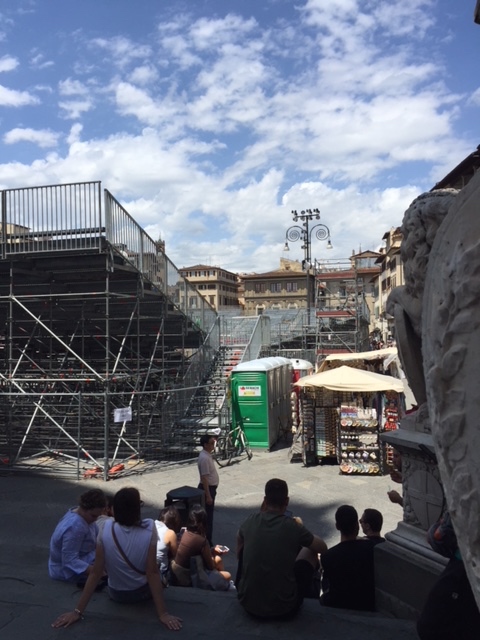
Stazione Leopolda, Firenze

If you’ve ever been lucky enough to come to Florence and if you arrived by train, chances are good that you’ve been at the Stazione Santa Maria Novella to the west of the historic center of the city. Every time I’m in that station nowadays, I always time travel in my mind back to the day when I was 27 years old and first set foot in Florence and Europe.  Just walking through this classic 1930s building makes me remember the wonder and excitement I felt that day.

But, you probably didn’t know that this famous stazione was not Florence’s first train station.  That distinction goes to the Stazione Leopolda which is over by the Porta al Prato, just outside what would have been the circle of walls surrounding Florence when the station was built.  It is also next to the Teatro Maggio Musicale Fiorentino, located on the Viale Fratelli Rosselli.  The stazione has gone through many transformations, as you will see below, but it is still in situ and is used today as a venue for many exhibitions, meetings and congresses.

Here’s a Google Map image to help you situate the area in your mind:

Screen Shot 2018-06-11 at 4.27.50 PM

So, let’s time travel back to the 1840s together and have a look at this interesting building complex.


Today it looks like this:

Firenze,_stazione_leopolda,_ingresso


But when it was first inaugurated in 1848, it looked like this:

PI_NWS_LEOPOLDA1


And by 1861 it looked like this:

35142871_1753825548041440_5175600333740572672_n

Stazione Leopolda. Foto del 1861.

Do you know your railroad history? Well, the very first railway line constructed in all of Tuscany was the route that connected Livorno, an important port, to Pisa. In 1841, work began to connect Florence with Livorno as well.

A new station in Florence would thus be needed to allow for arrivals and departures on the new Livorno/Florence line and the Grand Duke Leopold II commissioned architect Enrico Presenti to build a large terminus station to be situated in an open space just outside the Florentine walls, near Porta al Prato. The new station, Stazione Leopolda, was opened on 12 June 1848, taking its name from the Duke himself.

PI_NWS_LEOPOLDA1

The new station was designed with 3 large rooms, the central one was for the tracks and the arrivals/departures and the 2 side rooms were for services.  The station was constructed with a stone and stucco finish, using rounded arches and pilasters borrowed from the neoclassical style.

Almost simultaneously, another train station was envisioned and built; this one was constructed closer into the city center and this is the station that is still in use for passenger arrivals and departures  24/7, the Stazione Santa Maria Novella.  As time went on, the SMN stazione saw a continuous increase in passenger traffic and it was decided to divert all regional and national lines to it, and to close the Leopolda.  This happened by 1860.

Now it just so happened that the reunification of Italy was happening through these same years. Authorities had to figure out what to use the Leopolda for and, since the first annual Esposizione Nazionale Italiana delle Arti e delle Scienze was scheduled to be held in Florence in 1861, it was decided to rework and reuse the Leopolda for this grand exposition.  Architect Giuseppe Martelli (1792-1874) was commissioned in 1861 to rework the Leopoldo in order to provide a good venue for the exposition.

It opened to great fanfare and the day it opened it looked something like this:

Esposizione_Nazionale_1861


re1861


Screen Shot 2018-06-11 at 4.05.37 PM

The exposition was large, with more than 6,000 exhibitors in the fields of the arts, sciences, and Italian industries.  It was visited by about 30,000 people.

Incidentally, this exhibition was one of the first venues in which the nascent school of the macchiaioli were shown.

On March 17, 1861 the new Kingdom of Italy was officially proclaimed, with King Vittorio Emanuele II as the the monarch.  He was on hand to inaugurate the exposition later that same year.

Unfortunately, the exhibition was a disappointment financially and the annual expositions did not come to pass.  Italy would have a few subsequent expos, but never an annual event as such.

The Leopolda, having served 2 purposes so far in its history as first a passenger train station and then the home of a grand exposition, it would soon be reworked again, for Florence soon became the capitol of the new Italian state in 1865.

Stazione-Leopolda-Firenze

This time architect Marco Treves was commissioned to expand and modify the Leopolda so it could house many small offices needed for the bureaucracy in Florence. Treves added a mezzanine to make better use of the interior space.

In 1871 the Capitol of Italy was moved to Rome and, you guessed it, the Leopolda was yet again put to another use. It came to house a workshop for train maintenance, using small parts of the old, original railroad tracks.

During the WWI, bullets were manufactured in Leopolda. During WWII, Leopolda housed factories devoted to maintaining and repairing train equipment.  During the Nazi occupation, Resistance workers used the site to sabotage and clog up the delivery of raw materials.  These activities continued right up to May 2, 1944, when Florence was bombed and the workshops were closed. 

In the post-war period the building was once again modified, leaving intact essentially one large room in the center of the building which was used until 1993 as a railway depot. After that, the complex was repurposed once again.

Finally–or perhaps I should say currently–the Leopolda got a spruced up front by Gae Aplenty in 1996 and the old train station connection to the space ended.  Today the space is open for fashion events and exhibitions, among which is the Pitti Imaggine, SRL which oversees the Leopolda nowadays.

1200px-Stazione_leopolda

Indeed, today the Leopolda is one of the most exhibition spaces in all of Florence, managed by Stazione Leopolda Srl (a Pitti Immagine company) and the great central vault is now used for music, fashion and markets. 

5911949ec9f56b4ad68d30e6


Firenze,_stazione_leopolda,_ingressoFirenzepp_1

leopolda_logo_cmyk_300dpi


Do you like alone time?

Audrey Hepburn took to her apartment. “I have to be alone very often,” she told Life magazine in 1953. “I’d be quite happy if I spent from Saturday night until Monday morning alone in my apartment. That’s how I refuel.”

Thinkers, artists, and innovators from Tchaikovsky to Barack Obama, from Delacroix and Marcel Marceau to Chrissie Hynde and Alice Walker, have expressed the need for solitude. It’s what Rodin has in common with Amy Schumer; what Michelangelo shares with Grace Jones.

Philosophers and scientists spent much of their lives in solitude, including Descartes, Nietzsche, and Barbara McClintock, the Nobel Prize–winning geneticist who resisted having a telephone until she was eighty-four.

Countless writers, including Shakespeare, Dickinson, Wharton, Hugo, and Huxley, mined solitude as a theme. Symphonies and songs, poems and plays, and paintings and photos have been created in solitude.

For the creative person, “his most significant moments are those in which he attains some new insight, or makes some new discovery; and these moments are chiefly, if not invariably, those in which he is alone,” Storr wrote in his seminal book, Solitude: A Return to the Self. While other people can be one of our greatest sources of happiness, they can at times nonetheless be a distraction.

Their presence may also inhibit the creative process, “since creation is embarrassing,” as the writer Isaac Asimov said. “For every new good idea you have, there are a hundred, ten thousand foolish ones, which you naturally do not care to display.”

Monet slashed his paintings before the opening of an exhibition in Paris, declaring the canvasses unworthy to pass on to posterity. Robert Rauschenberg flung his early works into the Arno.

Yet just as alone time can be important for creation (and possible subsequent destruction), it can also be necessary for restoration. Some of the latest research has found that even fifteen minutes spent by ourselves, without electronic devices or social interaction, can decrease the intensity of our feelings (be they good or bad), leaving us more easygoing, less angry, and less worried.

Studies led by Thuy-vy Nguyen, published in the Personality and Social Psychology Bulletin, suggest that we can use solitude or alone time as a tool, a way to regulate our emotional states, “becoming quiet after excitement, calm after an angry episode, or centered and peaceful when desired.”

Alone, we can power down. We’re “off stage,” as the sociologist Erving Goffman put it, where we can doff the mask we wear in public and be ourselves. We can be reflective. We have the opportunity for self-evaluation, a chance to consider our actions and take what Westin called a “moral inventory.” We can also take inventory of all the information that has accumulated throughout the day. We can organize our “thoughts, reflect on past actions and future plans, and prepare for future encounters,” as the psychologist Jerry M. Burger wrote in the Journal of Research in Personality.

Even Bill Clinton, exemplar of extraversion, acknowledged that as president he scheduled “a couple of hours a day alone to think, reflect, plan, or do nothing.” “Often,” he said, “I slept less just to get the alone time.”

This notion of reflection harks back to an ancient Greek principle known as epimelesthai sautou. The philosopher Michel Foucault translated it as “to take care of yourself,” and though it was once “one of the main rules for social and personal conduct and for the art of life,” Foucault observed that there is a tendency, particularly in modern Western society, to view caring for oneself as almost immoral. And yet alone time has the potential to leave us more open to others.

And yet alone time has the potential to leave us more open and compassionate toward others. John D. Barbour, a professor of religion at St. Olaf College in Northfield, Minnesota, has written that while solitude involves the self, it’s not necessarily narcissistic. He’s suggested that the solitude sought by biblical prophets helped shape their perspective and may have made them more sensitive to the suffering of people who were less powerful or outsiders. “Solitude at its best,” he wrote, is not about “escaping the world, but toward a different kind of participation in it.”

Unfortunately, there’s a tendency in our own age of scant nuance to conceive of solitude and society as either-or propositions: You’re either alone on your couch or you’re organizing dinner parties.

That’s an unhelpful (and often wrong) distinction. The psychologist Abraham H. Maslow found that self-actualizing people—those who have attained the highest tier of his hierarchy of human needs—are capable of being more than one thing at one time, even if those things are contradictory.  They can besimultaneously individual and social; selfish and unselfish.

Burger wrote that people with a high preference for solitude don’t necessarily dislike social interaction, and aren’t necessarily introverted. They probably spend most of their time around others, and enjoy it; he said it’s simply that, relative to others, they more often chose to be by themselves because they appreciate the reflection, creativity, and renewal that solitude can offer.

Rosenbloom, Stephanie. Alone Time: Four Seasons, Four Cities, and the Pleasures of Solitude. Penguin Publishing Group. Kindle Edition.
Why doesn’t the Leaning Tower of Pisa fall over?

The Leaning Tower of Pisa has withstood earthquakes for centuries. Now, scientists know why.
image1
Yes, the Leaning Tower of Pisa is still standing. Here’s why it’s earthquake-proof.
The tower and its 5.5 degree lean have vexed engineers for centuries.  

Partially constructed on unexpectedly soft soil, the ancient bell tower began to lean before it was even finished, a historical goof that went on to become one of the world’s historical oddities — and made the tower a UNESCO World Heritage site.

How can something so obviously structurally unsound endure in an earthquake-prone region for hundreds of years? People who assemble an IKEA cabinet and have 18 pieces left over don’t expect to pass a wobbly Hemnes down to their great-grandchildren.

Professor George Mylonakis wanted to know why.

You can read all about it here:

https://www.washingtonpost.com/news/speaking-of-science/wp/2018/06/07/the-leaning-tower-of-pisa-has-withstood-earthquakes-for-centuries-now-scientists-know-why/?utm_term=.f83e68b12400&wpisrc=nl_rainbow&wpmm=1

Show a little courtesy, per favore!

Saw this sign on the street the other day and thought it was interesting and entertaining. It points out that this place on the street, which just happens to be near a major supermarket, is a spot for “Pink Parking,” un gesto di cortesia (a courteous gesture). It’s obviously meant to call on the public’s morality and generosity to save this space for pregnant women.


IMG_9532

I can promise you that in the many times I’ve walked by it, there is never a space saved for a pregnant woman.  Too bad!

Lorenzo de’ Medici’s sculpture garden

Lorenzo de' Medici and His Artists in the Sculpture Garden


Ottavio Vannini – Michelangelo Showing Lorenzo il Magnifico the Head of a Faun, surrounded by the other sculpture students


Young Michelangelo Carving a Faun's Head


Young Michelangelo Carving a Faun’s head by Emilio Zocchi


The Piazza San Marco on the former Via Larga, which is now Via Camillo Cavour, was where Lorenzo de’ Medici’s Sculpture Garden was situated in Florence. In the map below, you can get a sense of where the garden was in relationship to Piazza San Marco. The sculpture garden would have been where the words “Army Facility” show below.


Screen Shot 2018-05-29 at 6.34.27 PM


The Google map showing a satellite view, gives an even better sense of this former garden area.  Think away the Army building to the south end of the space, where Via Cavour and Via degli Arazzieri intersect, and you can see that there is still garden area in the site of the former Medici garden.

Screen Shot 2018-05-29 at 6.37.12 PM


Created with the hopes of becoming a great educational institution for studying art, Lorenzo de’ Medici curated a garden full of antique sculptures for artists to come and sketch as part of their artistic practice. Lorenzo also added sleeping and dining quarters so that students could easily live among the work they were studying. Francesco Granacci and Bertoldo di Giovanni are two of the many people to enter through its doors.

The most famous story of Michelangelo’s time in the Garden surrounds Michelangelo’s Faun statue. When Lorenzo saw this statue, he jokingly told Michelangelo that he looked too perfect to be an old faun. Michelangelo than took his drill and knocked out one of the teeth in the mouth of the Faun.

He showed his subtraction to Lorenzo who gained much amusement and pleasure from Michelangelo’s ability to listen and act on his critique.  Although the Faun statue has not been found, the two works of Michelangelo’s attributed to this time period are the Battle of the Centaurs and the Madonna of the Stairs. 


San Marco, Firenze

The monastery of San Marco, which stood just two blocks north of the Palazzo Medici, had been founded in the thirteenth century. However, it had been completely renovated and considerably expanded by Lorenzo the Magnificent’s grandfather, Cosimo de’ Medici in the 1450s.

san-marco

Cosimo had used his favourite architect Michelozzo Michelozzi, and incorporated the work of the resident monk Fra Angelico, one of the great early Renaissance artists.

annunciazione

Michelozzi would be responsible for some of the finest early Renaissance architecture in Florence, including the renovation of the Palazzo della Signoria and the design of the Medici villa at Careggi.

For his part, Fra Angelico’s ethereal paintings would heavily influence Michelangelo, whose depiction of God’s finger passing on life to Adam in the Sistine Chapel was directly inspired by the artist-monk.

The work of Fra Angelico and Michelozzi came together at San Marco in the delightful shaded San Antonio cloister, whose delicate pillars and colourful frescoes enclosed a tranquil green garden in the midst of the monastery.

Cosimo de’ Medici had undertaken the renovation of San Marco late in his life, intending it as absolution for the sin of usury, which had enabled him to accumulate his fortune as a banker. Yet there had also been a less manifest reason for Cosimo’s benevolence, one that explained why in particular he chose to lavish his wealth on San Marco, rather than other similarly prestigious monasteries in the city.

Before the 1433 coup which had removed Cosimo from power in Florence, almost costing him his life, he had managed in the nick of time to transfer secretly to San Marco a large quantity of the funds held in the Medici bank in Florence.

After Cosimo’s banishment into exile, his enemies had raided all Medici premises, as well as those of known supporters, but had been unable to discover the whereabouts of these funds, which had been held on trust, without a word, by the monks at San Marco.

In consequence, Cosimo had spared no expense on the rebuilding of San Marco, which eventually cost 30,000 florins – an unprecedented sum at the time.

The monastery had been furnished with a library, together with many hundreds of religious manuscripts, intended for public use – the first lending library in Europe.

Instead of the usual communal dormitory, each monk was assigned his own cell, many of which contained frescoes painted by Fra Angelico and his assistants. These were mainly portrayals of angels and biblical scenes.

mockingofchrist700

A special double cell, sumptuously frescoed, had been created for Cosimo’s personal use, to which he would often retire for periods of contemplation.

However, he had taken a more active role in the creation of the gardens across the street from San Marco: as a man who delighted in retiring to the countryside, he had done his best to create a pastoral space here within the walls of the city. These gardens would in turn become a favourite spot of Lorenzo the Magnificent, who began decorating the shady spaces with pieces of ancient classical sculpture.

.

Strathern, Paul. Death in Florence: The Medici, Savonarola, and the Battle for the Soul of a Renaissance City, Pegasus. Kindle Edition.

\