And it is bellisimo!


And it is bellisimo!
Wow! I’ve seen some live performances and heard some music in my life, but last Saturday in Florence was very special.

The Opera di Firenze mounted a true spectaclo. One of the finest orchestras in Italy, the sonorous Orchestra del Maggio Musicale Fiorentino, is directed by Ivan Ciampa (my Italian teacher says the Florentine orchestra is second only to that of La Scala in Milano. My teacher has never led me astray) provided the rich, beautiful music, while the company performed the libretto.
La Bohème, the opera in four acts composed by Giacomo Puccini.


The world premier of this beloved opera was in 1896 in Turin, conducted by none other than Arturo Toscanini.


(btw, in 1946, 50 years after the opera’s premiere, Toscanini conducted a performance of it on radio with the NBC Symphony Orchestra; this performance was eventually released on records and on compact disc and is the only recording of a Puccini opera by its original conductor.)
La bohème went on to become part of the standard Italian opera repertory and is one of the most frequently performed operas worldwide.

The opera this fall in Florence was directed by Bruno Ravella and the stage sets were designed by Tiziano Santi. Santi’s scenes tend to suggest rather than literally depict the French environments with a system of small, open and slightly distorted stage boxes.
The story unfolds in a traditional way, and for me, the most captivating moments were in the large choral scenes suggesting Paris’s Latin Quarter in the 1840s. The opera choir is sensational and delights the audience through their singing and choreography. A favorite scene is when Musetta sings of her romances on a swing like a cabaret performer. One stark but moving scene is between the two lovers in their duet “O soave fanciulla.” They stand on the proscenium in front of a dark mesh-looking screen, on which are projected snowflakes. The young people seem distanced from the rest of the world, caught up in their isolated sphere.
Also surprising and delightful is the projection of light to resemble a carpet of flowers which accompanies “Sì, mi chiamano Mimì.”
The cast is composed of many young performers.

Benjamim Chou reprises the role of Marcello; according to the same critic above, who wrote that Chou’s Italian accent is not perfect. Angela Nisi plays Musetta. Goran Jurić takes the part of Colline and Andrea Vincenzo Bonsignore provides Schaunard. William Hernandez plays Benoit and Alessandro Calamai is Alcindoro. Carlo Messeri reprises Parpignol.
Matteo Lippi performs Rodolfo and opposite him shines the key role of Mimi, reprised by Maria Mudryak. Of her superb performance, an Italian critic wrote (I’ve translated it):
The young soprano draws a flurry of flattery and fragile, in line
with tradition, through a voice with a burning stamp, which is
intensified especially in the centers
and in the acute register. Such voice material allows the interpreter
to face the part with the right glance and an enviable security.
Shee only misses a variety of accents and phrasing to make the character really
remarkable.
I guess the talented soprano should practice her Italian; kinda like me! The only thing, alas, that she and I have in common.

At 23, soprano Maria Mudryak’s singing career has already brought her to the world’s great stages, to sing some of the most enviable roles in the operatic repertoire. Her training started early, with a move to Italy at the age of 10; she soon joined the children’s chorus of the Teatro alla Scala, and was later accepted into the Conservatory Giuseppe Verdi in Milan at just 14. She made her professional debut as Susanna in Le nozze di Figaro in Genova, and has since filled her seasons with performances of Adina (L’elisir d’amore), Musetta (La bohème), Marie (La fille du régiment) and Violetta (La traviata).
Here you can get a sense of Mudryak (n.b. the videos are not from Florence’s La bohème).


Al termine della recita il pubblico elargisce grandi ed entusiastici applausi a tutti gli interpreti e al direttore.
Teatro del Maggio – Passione Puccini
LA BOHÈME
Opera in quattro quadri di Giuseppe Giacosa e Luigi Illica
Musica di Giacomo Puccini
Mimì Maria Mudryak
Musetta Angela Nisi
Rodolfo Matteo Lippi
Marcello Benjamin Cho
Schaunard Andrea Vincenzo Bonsignore
Colline Goran Jurić
Benoit William Hernandez
Alcindoro Alessandro Calamai
Parpignol Carlo Messeri
Sergente dei doganieri Vito Luciano Roberti
Un doganiere Nicolò Ayroldi
Orchestra, Coro e Coro delle voci bianche del Maggio Musicale Fiorentino
Direttore Francesco Ivan Ciampa
Maestro del coro e del coro delle voci bianche Lorenzo Fratini
Regia Bruno Ravella
Scene Tiziano Santi
Costumi Angela Giulia Toso
Luci D. M. Wood
Nuovo allestimento del Teatro del Maggio Musicale Fiorentino
And, just for fun:

Yesterday I had the great pleasure of attending a performance of La Boheme at Florence’s ultra modern opera house. It was a fabulous experience!

Soon I’ll post about the performance, but for now I want to focus on the building itself.

Unusual for an Italian city, the new opera house complex includes green space.


 ‘
‘
Florence is, of course, the city where opera was born in 1597 and where opera has been performed in numerous venues including, for many years, a functional but ungainly theater called the Teatro Comunale. When Matteo Renzi was mayor of Florence from 2009 to 2014, among his projects was this new opera house and concert hall, not far from the Teatro Comunale.
Renzi, who became prime minister of Italy at the age of 39, was an audacious and controversial leader, but there is no denying that he effectively set the national discussion on a new course.
Before Renzi became Prime Minister, some laws were passed that tried to reform arts funding and administration in Italy. These laws require, in exchange for federal money, more administrative control from Rome of some of the fondazioni—the entities that run the 14 important theaters in Italy that present opera.

The New Florence Opera House, is one of the most innovative in all of Europe. After years of deliberating the need to provide Florence, and its renowned opera festival Maggio Musicale Fiorentino, with a modern venue, at last this new complex took shape.
The complex is comprised of three large and spacious halls: the opera hall, built with special walls that direct soundwaves towards the audience without echoing; the concert hall which holds 1000 seats; and the spectacular rooftop amphitheater, which offers 2000 outdoor seats with an captivating panoramic view of the city.

With its stark, modern structure and cutting-edge technologies, the new opera house is one of the most modern opera houses in the world, uniting modernity and antiquity, vision and tradition, in the city that gave birth to the first opera in the 1600s.


For this reason the opera house is open and accessible to the public during daytime hours. The bookshop and café will be always open and families can go for a walk, wander among the fountains, or meet with friends on the grounds.
The project was undertaken by the Presidenza del Consiglio dei Ministri with funds made available (150 million Euro grant) for the celebration of the 150th anniversary (in 2011) of the unification of Italy and with contributions from the Regione Toscana and the city of Florence. A 255 million Euro public investment partially financed the ambitious project of the New Florence Opera House which represents.
The theater also boasts one of the most technologically advanced scene-changing mechanisms in the world that enables rapid scenography changes so as to allow even multiple and simultaneous performances in the same day, increasing the theater’s potential.
Credits
Presidenza del Consiglio di Ministri
Executive Officer Dr. Elisabetta Fabbri (Architect)
Project Manager Dr. Giacomo Parenti (Engineer)
Director of Works Dr. Giorgio Caselli (Architect)
Contractors A.T. I : S.A.C Spa e I.G.I.T Spa
Project Coordinator Dr. Angelo Reale (Engineer)
Executor Co-ordinator of the project and its operative phases Dr. Angela Ranieri (Engineer)
Design
Architects Studio A.B.D.R – Roma
Structural Design Italingegneria – Roma
Systems Design Enetec – Roma
Consultants
Acoustics Müller – BBM Monaco
Stagecraft Biobyte
In Florence, I believe, one of the problems is that despite the city’s history with opera, it is not widely popular with local people and with the millions of visitors who come here for days of intensive touring of museums full of the masterpieces. And with the old and new theaters slightly out of the heart of tourist traffic, no one walks past them as part of a stay here.
Construction on the new theater (based on designs by Paolo Desderi) began in 2009 and it was inaugurated on December 21, 2011 so that it could be said to have opened in the year of the 150th anniversary of the Unification of Italy. It was quickly closed after one concert as it was nowhere near complete. It has had a couple of more “openings” and its official one was on May 10, 2014.
Let’s say you are one of the major sculptors of Renaissance Italy, and that you live in Florence. Where would you want to have your studio?
How about, right on the piazza around il duomo? Non e’ male!
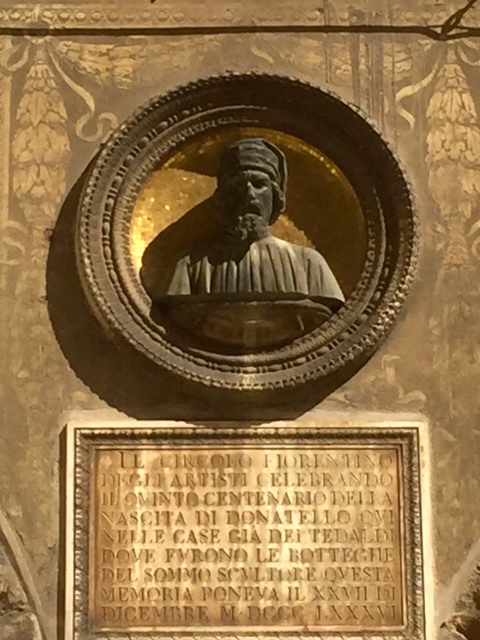
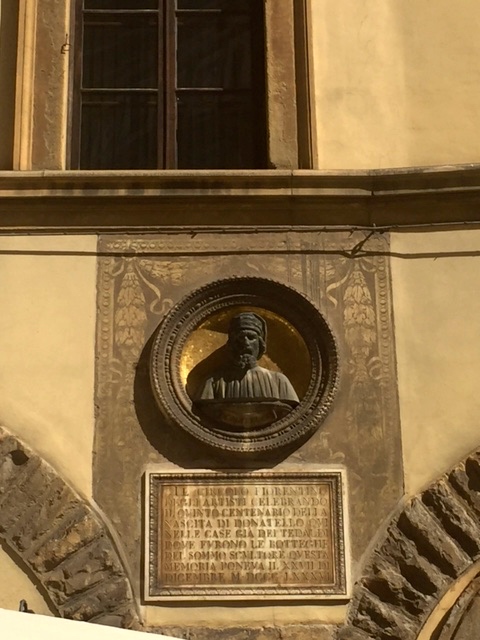

Using the map above, you will find the bust of Donatello and the plaque recording his studio location about where the P in “Panini Toscani.” You can find Panini Toscani words on the upper right side of the map.

We know some, but not enough, about Donatello (c.1386-1466). He was apparently born in Florence and grew up with the Martelli family, where it is hypothesized that he received early training from a goldsmith, before training and working in the studio of the famous metalworker and sculptor, Lorenzo Ghiberti.
There is very little known about his life as he was growing up; however, Vasari tells us a few stories which give insight to the generous and proud man that he was. Vasari, in his “Life of the Artists” where he wrote biographies of other artists, enjoys playing with the name Donato which is a variation on the Italian verb “to donate”. Several pieces of Donatello’s artwork were donated to those whom he held in high esteem.
It is possible to see many pieces of Donatello’s works throughout Florence – but be aware that several pieces available on display outdoors are expert copies since the originals have been moved indoors for safe keeping.
The map below shows the spots in Florence where you can find major Donatello works.

Both the Museo of the Opera del Duomo and the Bargello have extensive works by Donatello. It is so easy to forget that many pieces were made for a specific setting, like the facade of a church or an altar. Once they’re in a museum, even if the work is beautiful on its own, you sense that if viewed in its original position, the work of art would seem different.
If you decide to go outside of Florence and still want to see works he had a part in, here’s a short list to guide you:
In the San Matteo National Museum in Pisa, you can view the Reliquary of San Rossore, statue, gilded bronze. Via San Matteo in Soarta 1 (Pisa)
At the Villa Guinigi in Lucca, (also known as “pleasure palace” but which is now a national museum), you can admire Madonna and Child relief in tile. Piazza della Magione (ex Manifattura Tabacchi), Lucca
Inside the impressive Cathedral in the center of the historic part of Arezzo, you can admire the baptismal font with a bas-relief marble carving of the Baptism of Christ.
Between the Baptistery of San Giovanni, the Cathedral of Siena and the Museum dedicated to the artwork from the Duomo, you will find several works of art dating from the time Donatello worked in Siena.


I’m so happy I found pickles (not quite dill, not quite sweet, but better than nothing) here. Of all the things I miss, I never expected it to be dill pickles. But, not to worry; they’re available!

This box on the street spoke to me: do not upset!!

Today’s lesson: how to boss people around (ha ha) with imperativo!

The photo below encapsulates my favorite kind of view in Florence. I love the bars with every good kind of coffee, pastries, sandwiches and all kinds of treats. Humble or ritzy, I love them all!
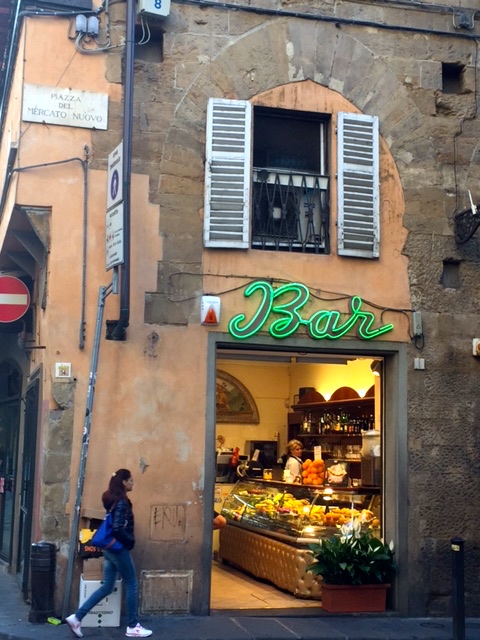
I noticed this spritely gentleman in the Mercato Nuovo. His face looks like JFK.

And finally, today’s fruits at Mercato San Ambrogio.

I love that Italians sell and buy pesche settembrine. September peaches. What could be better than that!


“One doesn’t come to Italy for niceness. One comes for LIFE!”
–E.M. Forster, A Room with a View

The Italians have named a necessary life skill, that of arrangiarsi. This means the ability to make the best of a bad situation.
“Quello che voi siete noi eravamo; quello che noi siamo voi sarete.”
“That which you are, we were; that which we are, you will be.”

On the Via Veneto in Rome is a small church, Santa Maria della Concezione, attached to which is a crypt of Capuchin monks. The burial ground consists of a few small chapels, the pilasters, arches, and vaults profusely decorated with the bones of four thousand exhumed monks that were brought to the church in 1631.

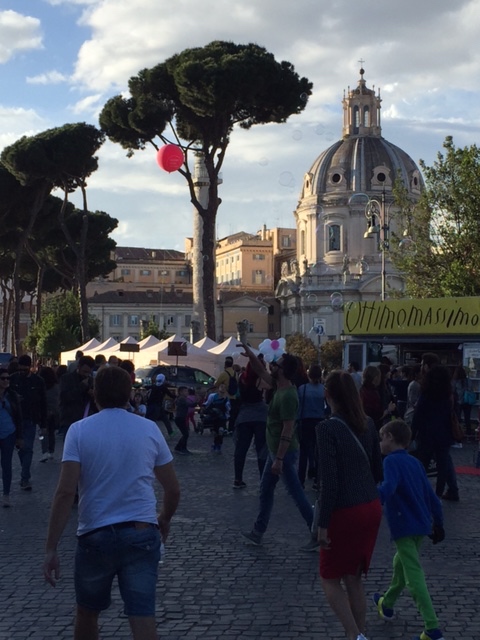
Imagine being three thousand years old. Suppose by some mysterious process you had managed to avoid the limitations of mortality, and year after year you keep going, adding more and more experiences to your life story until you have no choice but to repeat them because you have exhausted all possibilities.
You are the very essence of what it means to be human. You have had more than your share of victories and defeats, triumphs and tragedies, moments of glory and those of abjection, times when you wish you had never been born and times when you want to go on forever. You have loved and lost, have abandoned and been left behind, been rich and poor, skinny and fat, lived high on the hog and been forced to scramble for a few morsels of stale bread. You have seen it all, done it all, regretted it all, and then gone back and done it all again.
You are la città eterna, Rome, the Eternal City.
Epstein, Alan. As the Romans Do: The Delights, Dramas, And Daily Diversio (p. 1). HarperCollins. Kindle Edition.


You must be logged in to post a comment.