The scent of heaven.

I have adored the beautiful Dominican church of Santa Maria Novella, Alberti’s Renaissance masterpiece, in Florence since I was 20 years old and first saw it in a slide in my art history course in college.

images

images-4

I’ve written about the perfume shop known as the Officina Profumo-Farmaceutica di Santa Maria Novella in years back on this blog.  It is among my absolute favorite places to visit/shop in Florence.

img_8158img_8159

images-5


They have potions and lotions to die for, as well as candles, soaps, and myriad other products.  It would be fun to try them all.

images-7images-9


The perfumes alone are amazing.

images-6


The rooms themselves are gorgeous, each more beautiful than the last.

images-8

Check out the frescoes:

Error
This video doesn’t exist


But, without question, my favorite product and the reason I always return to the pharmacy is the potpourri.

I’ve loved potpourri since I was a teenager, and used to concoct it from petals I harvested and dried from my mother’s rose bushes.  But, nothing I prepared came close to the heavenly scent of this potpourri.

images-12

images-10


They mix the concoction in large containers as above and sell it in beautiful packaging like this below:

images-13

It is super strong and not loved by everybody.  I think it is acquired appreciation.  I’ve acquired the appreciation.  I love the scent.  I bought more today.


History:

Dominican monks began concocting herbal remedies here in the 13th century, in the time of Giotto and Dante. The monks’ simple apparatus for distilling flower water rests inside wooden cabinets, flanked by old containers used for lotions and potions, lists of ingredients and even the monks’ original recipe ledgers. Merchandise lines the walls of the dimly lit, frescoed rooms—all manner of soaps, sachets and scents, many made according to ancient formulas.

The Dominicans, an order devoted to poverty and charity, first arrived in Florence in 1219, in the last years of Saint Dominic, who would die in Bologna in 1221. His followers took over a church, then called Santa Maria delle Vigne, and began the process of transforming it into a monastery. At the time, the Dominicans were engaged in fierce competition with the Franciscans for the loyalty of medieval Florentines in what would soon become one of Europe’s wealthiest and most powerful cities. Their cause was helped by a Verona-born Dominican, later known as Saint Peter the Martyr, who attracted huge crowds to his sermons at Santa Maria Novella, as Santa Maria delle Vigne had come to be known.

By 1381, the Dominicans were operating an infirmary there, with herbal remedies made by the monks themselves. Among the first distillates was rose water, a simple essence prescribed as an antiseptic to clean houses after an outbreak of plague. (It remains on the pharmacy’s shelves today, although it’s now more likely to be used for perfume or aromatherapy.)

Also among the early creations were tonics reflecting the sensibility of the times: the imaginatively named “Vinegar of the Seven Thieves,” for example, was a popular remedy for women suffering from “fainting fits.” The vinegar is still available for those in need of a quick pick-me-up. Also available to Florentine ladies was a concoction designed to calm “hysterical women.” It, too, is still on the shelves, bearing the innocuous name Santa Maria Novella Water—now recommended for its “antispasmodic properties.”

By the late 15th century, Florence was plunged into turmoil, with political attacks on the Medici dynasty spurred by the fiery preaching of the Dominican monk Savonarola—who denounced all vice and exhorted the citizens of Florence to burn their finery in a “bonfire of vanities.” The pharmacy’s nostrums, however, were mostly medicinal, and the monks quietly labored on. By the mid-16th century, relative calm had returned to the city under the rule of Cosimo de’ Medici.

By then the monastery’s pharmaceutical activities were being run as a separate business, managed by a layman and, it appears, were profitable. One entry in church records reports a large investment in vases, stoppers and pestles. The operation’s manufacture of perfumes was apparently key to winning the allegiance of its most famous customer, Catherine de’ Medici.

She had been born in Florence in 1519, and at age 14 famously became the bride of Henry, Duke of Orleans, the future king of France. She proved a legendary figure both for her political intrigues and her love of novelty: she is credited with promoting, in the French Court, innovations ranging from the sidesaddle to the handkerchief—even tobacco. The pharmacy created a new fragrance for her, a perfume that became known as acqua della regina, or “water of the queen.” In due course, Catherine’s patronage proved the making of the place.

The growth of the business was not welcomed by all; unease among some monks that the sweet smell of success might distract from the Christian pieties led to a temporary shutdown of the production of medicines in the early 1600s. But manufacture resumed in 1612, for a run of two and a half centuries. In 1866 the Italian state confiscated all church property. The move could have been the pharmacy’s death knell but for the vision of the last monk to act as its director, Damiano Beni. In a deft move, he handed over control of the enterprise to his layman nephew, who eventually bought it from the state. His descendants remain involved in the business today.

As a secular endeavor, the pharmacy could fully exploit the trends of the times. In the 1700s, it had expanded its product line from distilling medicines and perfumes to manufacturing alcohol. In the 19th century, as alcohol-laden patent medicines and tonics became all the rage in the United States, the pharmacy’s liqueur, Alkermes—advertised as a way to “revive weary and lazy spirits”—became a top seller.

Today the pharmacy still occupies its historic quarters, but it has expanded into an international concern, with stores in New York, Los Angeles and Tokyo. Eight years ago it opened a small factory two miles away, where the monks’ ancient techniques have been streamlined, but where much of the manufacturing continues to be done by hand. The factory can turn out 500 bars of soap a day in any one of 25 varieties; each bar is then aged for a month before being chiseled by hand into its final shape.

For those who fancy themselves a modern-day Catherine de’ Medici, the pharmacy produces a fragrance similar to the “water of the queen,” although it now goes by the less regal name of Eau de Cologne Classica. Some 40 colognes, in fact, are offered, catering to a huge range of tastes. The current managing director, an urbane Florentine named Eugenio Alphandery, has expanded his clientele still further with a new fragrance, Nostalgia, based on his own passion—fast cars. A whiff of the cologne evokes nothing so much as leather seats, tires on a track and a hint of gasoline fumes.


Alchemy!

Who can take the simple ingredients of a few eggs and a fresh artichoke and turn it into a masterpiece?  The chef at Trattoria Sostanza, that’s who!

img_8153

Il camiere ground fresh black pepper over my torta at the table and that, with a spritz of fresh lemon juice, made me want to swoon for the taste of this seasonal delight!

What do you follow a torta like this with, for dolce?  How about a bowl of fresh, wild strawberries, with a sprinkling of sugar and a dose of heavy cream.  OMG! Paradiso!

img_8154

Soon enough, I suspect, I will stop sharing the names of the places I love, for Florence is way too popular for its own good.  I’m sorry.  I’m not nice.  Santa (or perhaps more likely, La Befana) will surely leave me coal this year.

But for today, I share: I love Trattoria Sostanza.  In business since 1869, they know what they are doing.

img_8156


The menu is simple but choice.

img_8151

The Christmas season begins in Florence!

Every Thursday in the arcade of the Piazza della Republica, a flower market pops up for the day.  Today it was filled with Christmas greens and berries.

img_8168

I love the contrast of the time worn, massive, permanent architectural stonework with the ephemeral, bright beauty of the ilex berries!


There were branches of variegated holly available, as well as all the red/pink/fushia tones of cyclamen.

img_8171


There were magnolia branches painted gold and silver.

img_8177


There were hellebores in bloom, as well as heather.

img_8175


And there were lovely fresh greens wreaths, some plain, some decorated.

img_8173


For those people who are not in the mood for Christmas, there were roses.

img_8172

img_8183


And there was a hearty woman who kept track of it all.

img_8184

It was a sight to behold!

12 Days of Christmas: edible delights inspired by Italy

Peanut brittle, Italian style.

OLYMPUS DIGITAL CAMERA


Doesn’t this dark confection look just like what you would think Italian peanut brittle would look like? It does to me!  Very earthy and dark.  It reminds me of the rich potpourri I adore from Profumeria Farmaceutica Santa Maria di Novella.  More on that later.

OLYMPUS DIGITAL CAMERA


When I was young, my mother made peanut brittle every Christmas.  I never liked it because I didn’t, and still don’t, like the taste of raw peanuts.  But this brittle seems to be made with peanuts that have been cooked?  I don’t know.  I don’t love it but I know my mother would!  This one’s for you, Linda!

OLYMPUS DIGITAL CAMERA

Florence inspires me. Leather works.

Can you tell?  I’ve posted about 100 posts in the past 5 days.  And, I’m just getting started!

So, here’s what’s on my mind right this minute.  Today I’ve been reading about the history of leather making here for the past, oh, I don’t know, millennium. And it turns out that this craft, which I’ve always loved in Italy, has left its mark on the city strata.  Not surprising when you think about it.  By the 1300’s, for example, there were already 1500 shoemakers working in Florence.

images

Still today in the Santa Croce section of the city, east of the cathedral, is the Via dei Conciatoi, or the Street of the Tanneries.  You can see it right in the center of this map, running on an angle from left to right.

Screen Shot 2016-11-29 at 4.32.22 PM.png

Author Laura Morelli writes that “In medieval Florence, many of the tanneries were located along the Arno in order to facilitate washing away the detritus of this process, and in many other cities of medieval Europe the tanneries were required to locate outside the city walls altogether. The via dei Conciatori, in the eastern part of the city near Santa Croce, retains the memory of the Florentine tanneries and is the location of the current Scuola del Cuoio or leather school.”

Sitting right on the banks of the Arno River, the neighborhood of Santa Croce in Florence has been home to water-heavy trades, like hide tanning, since the 13th century and the tradition lives on today. In fact, 35% of national leather production still takes place in this area today!

And, in another part of town, not far from Il Duomo, is another street, Via dei Calzaiuoli, Street of the shoemakers. On this map the street runs N-S right smack dab in the middle.

Screen Shot 2016-11-29 at 4.31.29 PM.png

Via dei Calzaiuoli

Trailing from Piazza del Duomo to Piazza della Signoria, Via dei Calzaiuoli is a popular street filled with high-end to everyday modern stores. You’ll find ultra luxury from Chanel to department store Coin, Sisley, and Furla.

Again, Ms. Morelli tells us “Although they remained of modest means, shoemakers sat atop the leather hierarchy and were considered a pillar of medieval Florentine society. By the 1300s some 1,500 shoemakers were already working in the city. About a third of these settled in the Oltrarno district. Cobblers made shoes for local consumption, but also participated in a lively export trade, forming the roots of the Tuscan international leather shoe industry that still thrives today. The statutes of the shoemakers’ guild or Arte dei Calzaiuoli (or Calzolai) specified many aspects of their working lives, from the quality and types of leather that the shoemakers must use in their production, down to their shop opening hours. Fifteenth-century documents place shoe- and belt-makers’ shops along the via dei Calzaiuoli, as well as on the streets stretching toward the church of Santo Stefano near the Ponte Vecchio. In contrast to the high-end fashion boutiques that line the via dei Calzaiuoli today, surely this street must have been lined instead with more humble workshops.”

Morelli, Laura (2015-04-01). Made in Florence: A Travel Guide to Fabrics, Frames, Jewelry, Leather Goods, Maiolica, Paper, Woodcrafts & More (Laura Morelli’s Authentic Arts) (Kindle Locations 668-669). Authentic Arts Publishing. Kindle Edition.

Next time you are in Florence, maybe you’ll stroll in your hand-made Italian footwear over these two leather-associated streets and think of the long history of this fine art in the city.

Home, right now.

Here’s where I live right now in Florence.  In this stately building on the Lungarno Torrigani.  My apartment (which is as big as my house in Denver) is the top 3 large windows on the left side of the building.  I’m officially on the 3rd floor.

dsc05307

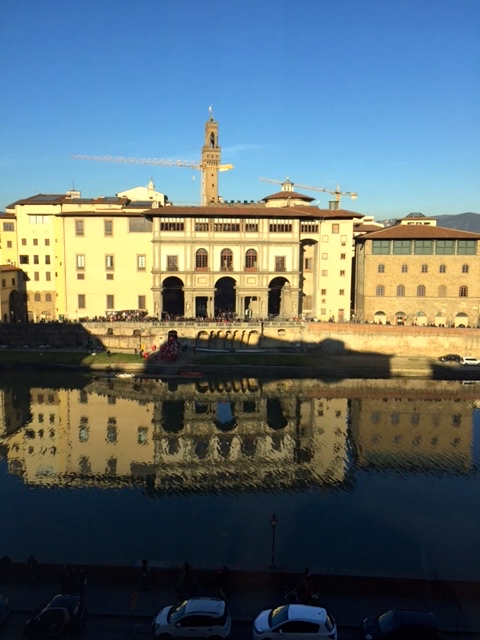
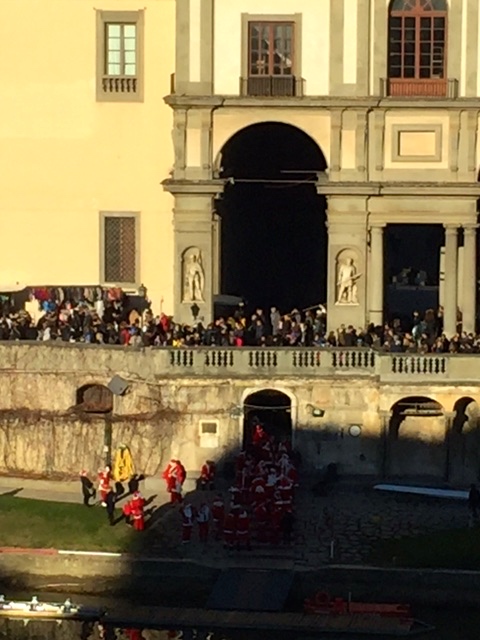
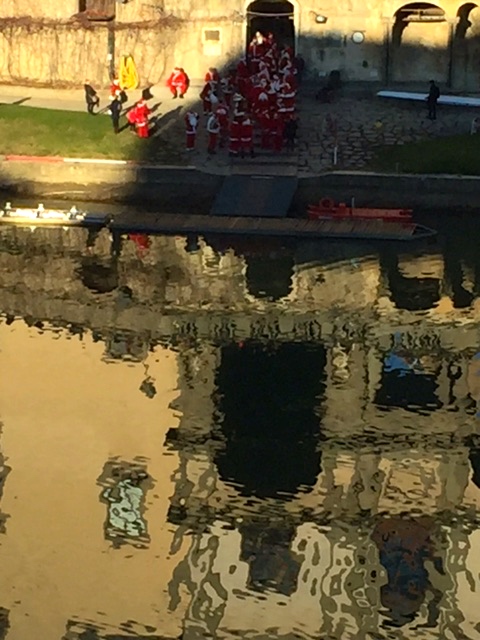
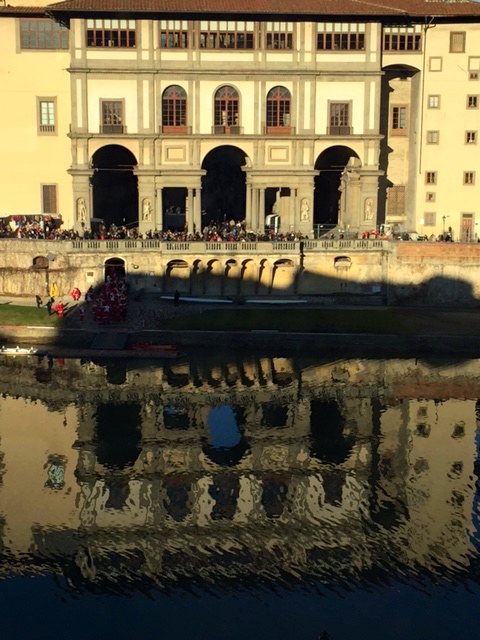
This is my view.  I look directly across the Arno at the Uffizi:

dsc05288

Here’s looking out my 2nd bedroom window at the Uffizi.  The tower belongs to the Palazzo Vecchio.  Crazy view!  Almost completely unbelievable to me!

dscn0599

Here’s my bedroom.  I can lie in bed and gaze at the Uffizi, visualizing my favorite paintings.

dsc06962dsc06963dsc06965

I’m happy to be living here for a month.  I’ve already found my next place and it is to die for!  I’ll be there for Christmas, New Year’s and my birthday!

So, I had a date. A really fresh one. My first ever.

Ha!  I bet you thought I meant a man!

But I meant this:

OLYMPUS DIGITAL CAMERA

They look like large black olives, no?

So smooth and plump.

OLYMPUS DIGITAL CAMERA


But, take a closer look.  You’ll believe it is a date, a really fresh one:

OLYMPUS DIGITAL CAMERA


These are dates I found yesterday at my ordinary grocery store in Florence.  The dates themselves are from Israel.  The label reads: “Datteri:Hayani”

OLYMPUS DIGITAL CAMERA

Growing up in the middle of the USA, and even living on both coasts as an adult, I never even knew fresh dates like these were available.  But, of course they were and are!  New worlds!  You may keep your artistic masterpieces!  This is the world I love to explore.
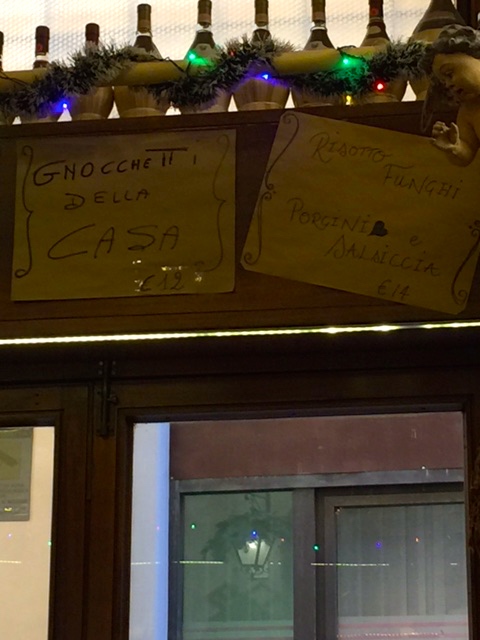
Read the following fascinating info from the website, which I have thoughtfully translated here for you. The purveyor: Mc.Garlet, Quality tropical produce, “Keep in touch with the flavour”  mcgarlet.it

Best part:  here you can find a way to “stabilize lazy intestines.”

DATTERI

DATTERI FRESCHI
PIANTA
I datteri fanno parte della famiglia delle Arecaceae e la raccolta avviene nei mesi di agosto e settembre.
La palma da dattero (Phoenix dactylifera L.) è una pianta originaria del Nordafrica. È inoltre ampiamente coltivata dalla penisola arabica fino al Golfo Persico, dove forma la caratteristica vegetazione delle oasi. Si coltiva anche alle Canarie, nel Mediterraneo settentrionale e nella parte meridionale degli Stati Uniti. 

PLANT
The dates are part of the Arecaceae family and the harvest takes place in the months of August and September.
The date palm (Phoenix dactylifera L.) is a plant native to North Africa. It is also widely cultivated from the Arabian Peninsula to the Persian Gulf, where it forms the characteristic vegetation of the oasis. It also grows in the Canary Islands, in the northern Mediterranean and the southern United States.

FRUTTI
Sono bacche oblunghe, di colore arancione scuro a maturità, lunghe fino a 5 cm nelle varietà coltivate, con polpa zuccherina, contenenti un seme di consistenza legnosa.
I datteri freschi sono lisci e perfettamente cilindrici. I migliori sono senza dubbio quelli iraniani, piuttosto grossi, scuri e dolcissimi.

FRUITS
They are oblong berries, dark orange when mature, up to 5 cm in the cultivated variety, with sweet pulp, containing a woody texture seed.
The fresh dates are smooth and perfectly cylindrical. The best are undoubtedly those Iranians, rather thick, dark and sweet.

DIFFERENZE TRA DATTERI SECCHI E DATTERI FRESCHI
Quasi tutti i datteri vengono fatti seccare al sole, in modo tale da aumentare la concentrazione degli zuccheri. In questo modo diventano più dolci e si conservano più a lungo. Questa caratteristica li rende disponibili tutto l’anno.
I datteri freschi sono molto meno calorici e più ricchi di vitamine di quelli secchi, possono essere consumati come frutta in tutti i periodi, sia d’estate che d’inverno.

DIFFERENCES BETWEEN DATES DRIED AND FRESH DATES
Almost all the dates are dried in the sun, so as to increase the concentration of sugars. In this way it becomes sweeter and are preserved longer. This makes them available throughout the year.
The fresh dates are much less caloric and richer in vitamins than dry ones, they can be eaten as a fruit in all seasons, both summer and winter.

CURIOSITA
Considerata la prima pianta coltivata dall’umanità, fin dall’antichità si capì che era possibile fecondarla artificialmente, appendendo vicino ai fiori della pianta femminile le infiorescenze quasi mature asportate dalla pianta maschile.
La palma da dattero è una pianta ricca di significati simbolici: per gli Egiziani era un simbolo di fertilità, raffigurata dai Cartaginesi nelle monete e nei monumenti e utilizzata da Greci come ornamento per celebrazioni trionfali, fortuna e prosperità.
I latini attribuivano valori simbolici di onore e vittoria, perché pur gravata dal peso consistente dei suoi frutti non si piegava, ma anzi cercava disperatamente di ergersi verso l’alto. Nella tradizione cristiana, le foglie rappresentano un simbolo di pace e ricordano l’entrata di Gesù in Gerusalemme. Gli antichi romani usavano donare un ramo di palma agli attori più bravi, agli aurighi e ai gladiatori e per i Cristiani, le foglie delle palme sono tuttora un simbolo di pace.

CURIOSITY
Considered the first plant cultivated by humanity since ancient times it was understood that it was possible to fertilize artificially, hanging close to the flowers of the female plant the flowers almost ripe removed from the male plant.
The date palm is a plant rich in symbolic meanings: for the Egyptians was a fertility symbol, depicted by the Carthaginians in the coins and monuments and used by Greeks as an ornament for the triumphal celebrations, luck and prosperity.
The Latin attributed symbolic values of honor and victory, because although burdened by the considerable weight of the fruit did not bend, but rather desperately tried to stand up. In the Christian tradition, the leaves are a symbol of peace and remember the entry of Jesus into Jerusalem. The ancient Romans used to give a palm branch to the best actors, the charioteers and gladiators, and for Christians, the palm leaves are still a symbol of peace.

PROPRIETÀ
Questi frutti possono avere un effetto terapeutico per l’infiammazione delle vie respiratorie: basta cuocerne in 1/2 litro di latte 100 grammi per alcuni minuti e aggiungere un cucchiaio di miele.
I datteri freschi sono un frutto energetico e molto rimineralizzante.
Tra le loro proprietà ci sono anche quelle di contribuire a far scomparire l’acne della pubertà e di regolarizzare gli intestini pigri.
Inoltre, forniscono pochissime proteine, e sono adatti quindi nelle diete ipoproteich. I datteri contengono più potassio delle banane.

PROPERTY
These fruits can have a therapeutic effect for inflammation of the respiratory tract: just boil in 1/2 liter of milk 100 grams for a few minutes and add a tablespoon of honey.
The fresh dates is a very energetic fruit and mineralizing.
Among their properties, there are also those to help to wipe the acne of puberty and stabilizing lazy intestines.
In addition, they provide very little protein, and are therefore suitable in ipoproteich diets. The dates contain more potassium in bananas.

IN CUCINA
I datteri freschi si possono mangiare al naturale come un qualsiasi frutto: sono molto indicati per la colazione. Sono ottimi anche nei dessert, snocciolati e farciti con frutta secca come mandorle, nocciole o noci, per fare il gelato e per accompagnare i formaggi, specie quelli più saporiti.
Anche l’abbinamento di datteri con il té alla cannella è una vera prelibatezza, mentre la tradizione araba vuole che il dattero fresco sia immerso nel tè nero bollente come dolcificante.
Ottimo è anche l’abbinamento con una buona selezione di Rum.
Il succo detto anche “miele di dattero” può sostituire burro e zucchero in cucina: si ottiene frullando i datteri fino a ottenere una crema (aggiungendo poca acqua) da conservare in frigorifero. La polvere dei noccioli è usata in fitoterapia.

IN THE KITCHEN
The fresh dates can be eaten plain as any fruit: they are very suitable for breakfast. They are also excellent desserts, pitted and stuffed with dried fruits such as almonds, hazelnuts or walnuts, to make ice cream, and to accompany cheeses, particularly flavorful ones.
Even the combination of dates with tea with cinnamon is a delicacy, while the Arab tradition, the fresh date is immersed in boiling black tea as a sweetener.
Great is also the combination with a good selection of Rum.
The juice also known as “honey of date” can replace butter and sugar in the kitchen: is obtained by blending the dates until creamy (adding a little water) to be stored in the refrigerator. The powder of kernels is used in herbal medicine.

CONSUMAZIONE
Prima di consumarli è preferibile lasciarli almeno un’ora a temperatura ambiente.

CONSUME
Before consumption it is preferable to leave at least an hour at room temperature.

Keeping it real.

Moving abroad, no matter to how wonderful a place, takes adjustment.  I’m adjusting.  This morning when the alarm went off at 7 a.m. to rise for school, I felt like a dead person and my apartment was cold. I wanted to pull up the duvet, roll over, and go back to the dream I was having. After all,  it was 11 p.m. my time and I was getting up to start my day learning a new language.  Well, not entirely new, but still.

I’ve gone from a bucolic suburban setting with a car to drive for errands to urban living as a pedestrian.  As I write this, the workers 3 floors down on the pavement below are drilling the cobblestone street to repair something below grade.  It’s noisy and my nerves are stretched very thin. Everything is new.  Walking to the street corner takes concentration since I live on a steep narrow hill, which I love, but it takes focus not to step in front of a bicycle or Vespa.

images

But, I’m still glad I’m here. :-))

On the brighter side of the ledger:  I survived the first day of class, even though my brain was not operating.  Also, I had a cappuccino at the cafe at the Opera del Duomo and, although the Opera houses masterpieces of Gothic and Renaissance sculpture, I had a superb modern coffee in a terrifically trendy place.  Loved it!

images-3

This shows the cafe from outside; I stood at bar and drank the liquid caffeinated bliss!  Tres chic!