Allied forces in Florence

From the safe distance of 2018, it is interesting to think back to the situation in Florence during WWII, especially after the Allied Forces liberated the Renaissance citta’.

D378_44_137_0004_600

The leaders and troops of the Allied Forces are my heroes. There are many to name.  General Dwight D. Eisenhower is foremost among them.  I recently wrote a post on his directive, which saved many cultural monuments in Italian. Here is a picture of Ike in Italy:

Screen Shot 2018-04-29 at 12.30.35 PM


As the Allies liberated region after region in Italy, starting from the southern tip and working their way north, thanks to the farsighted leaders, as many cultural works as were possible were saved.

99686daed1bb4cc176004ca149b1c1d8


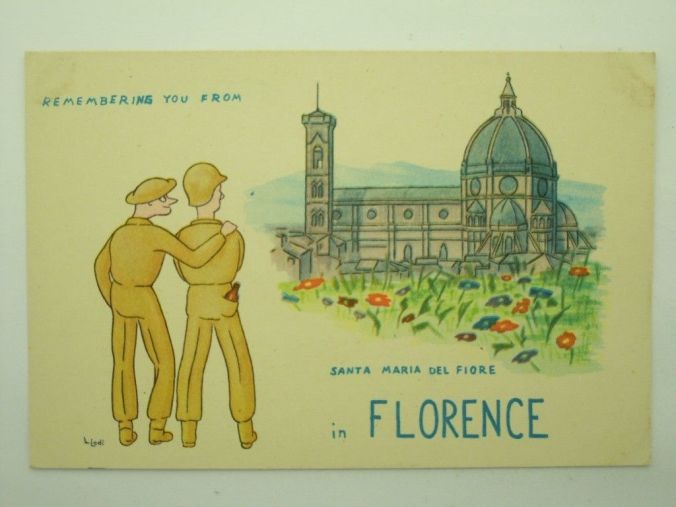
These wonderful postcards, with their simple illustrations of the Florentine architectural masterpieces, tell a poignant story.

s-l225

s-l1600


General Dwight D. Eisenhower as protector of cultural heritage

99686daed1bb4cc176004ca149b1c1d8

The cumulative weight and momentum of General Marshall’s mid-October admonition about the importance of protecting Italy’s cultural treasures, followed by successive warnings from McCloy and Woolley and the reports of Monuments officers themselves, finally produced a change.

On December 29, General Eisenhower Eisenhower issued a directive that placed the responsibility of protecting cultural property squarely upon the shoulders of every commander and, in turn, every officer and every soldier.

Screen Shot 2018-04-29 at 12.30.35 PM


It also, for the first time, introduced the Monuments officers (referenced as “A.M.G. officers”—Allied Military Government) to everyone in uniform.  Here is Eisdenhower’s directive:

To: All Commanders Today we are fighting in a country which has contributed a great deal to our cultural inheritance, a country rich in monuments which by their creation helped and now in their old age illustrate the growth of the civilization which is ours. We are bound to respect those monuments so far as war allows. If we have to choose between destroying a famous building and sacrificing our own men, then our men’s lives count infinitely more and the building must go. But the choice is not always so clear-cut as that. In many cases the monuments can be spared without any detriment to operational needs. Nothing can stand against the argument of military necessity. That is an accepted principle. But the phrase “military necessity” is sometimes used where it would be more truthful to speak of military convenience or even of personal convenience. I do not want it to cloak slackness or indifference. It is a responsibility of higher commanders to determine through A.M.G. Officers the locations of historical monuments whether they be immediately ahead of our front lines or in areas occupied by us. This information passed to lower echelons through normal channels places the responsibility of all Commanders of complying with the spirit of this letter.

signed: DWIGHT D. EISENHOWER

Ike’s directive was bold; it was concise; and it was now official policy. His Chief of Staff, Major General Walter Bedell Smith, issued an accompanying order that provided more specific details on how this new policy should be implemented.

Woolley remarked that Ike’s words “made it clear that the responsibility for the protection of monuments lay with the army as a whole and not with the [Monuments officer] specialist.”

Even Churchill weighed in on the matter: “The weakness of the Monuments and Fine Arts organization in the past was . . . due to the fact that it had . . . depended on an external civilian body not in touch with the Army. . . . The new arrangements which have been worked out in the light of experience are well calculated to promote, as far as military exigencies allow, a more effective effort to protect historical monuments of first importance in the future.”

Many problems lay ahead for implementing this new order. Mistakes would continue. The order would be put to the test in a major way within just six weeks.

But it marked the turning point for the Monuments officers and their work. For the first time since Mason Hammond had landed in Sicily, the Monuments Men had the backing of the Commander-in-Chief. Their work contributed greatly to the experience Eisenhower would take with him to England to plan the invasion of Western Europe as the newly appointed Supreme Commander of the Allied Expeditionary Force.


Edsel, Robert M.. Saving Italy: The Race to Rescue a Nation’s Treasures from the Nazis (p. 68). W. W. Norton & Company. Kindle Edition.

Wartime Florence

In 1565, by connecting the Uffizi and the Pitti and provided the Medici with an escape route in the event of political unrest. Its narrow hallways are decorated with more than a thousand paintings, mostly self-portraits, by many of the artists whose works adorn the walls of the city’s museums and churches. Farther north is the Palazzo Vecchio (the town hall), the Duomo, and the Accademia, home to the world’s most famous piece of marble, Michelangelo’s David.

In the summer of 1944, war placed this legendary city, and centuries of creative achievements, in danger of utter destruction.

ON NOVEMBER 10, 1943, Adolf Hitler remarked to Ambassador Rudolf Rahn, “Florence is too beautiful a city to destroy. Do what you can to protect it: you have my permission and assistance.” Hitler’s affection for the city initially gave Florentine Superintendent Giovanni Poggi and other city officials hope that Florence would be spared the fate of Naples. The fact that Rome and Siena had escaped major damage also encouraged them.

But, as Allied soldiers inched closer each day, a small group of dedicated souls—now seen as guardian angels of Florence—became increasingly concerned that the coming battle would overtake their city. They had few resources and dwindling options. These benefactors’ best hope was to push Germany and the Allies to jointly declare Florence an “open city,” first suggested by the Director of the Kunsthistorisches Institut, Friedrich Kriegbaum.

But for a city to be declared “open,” it had to be undefended; there could be no military targets; and both sides had to have freedom of entry. In Florence, German forces had positioned two artillery batteries in the della Gherardesca and dei Semplici Gardens. They had stationed soldiers at numerous mortar positions in the city.

Additionally, Florence, like Rome before it fell to the Allies, served as a major rail transport hub for the German Army. Even after the Allies’ air attacks on the Santa Maria Novella and Campo di Marte marshaling yards, men and materiel moved through the city.

Undaunted by these facts, German leaders referred to Florence as an “open city,” accusing the Allies of refusing to publicly affirm that designation. For their part, the Allies wouldn’t declare Florence an open city until the Germans removed their guns and soldiers.

The standoff held through the spring and early summer of 1944, while Allied forces were engaged in combat operations hundreds of miles to the south. Things grew much more urgent following the liberation of Rome in June and of Siena in July.

City officials believed that their portable art treasures, tucked away by Poggi in Tuscan villas, were safe. But protecting the city’s architectural treasures still depended upon securing an official, unequivocal declaration of Florence as an open city.

Members of the principal group working toward this designation were the German Consul, Gerhard Wolf; the Archbishop of Florence, Cardinal Elia Dalla Costa; the Extraordinary Envoy and Minister Plenipotentiary of San Marino to the Holy See, Marchese Filippo Serlupi Crescenzi; and the Swiss Consul in Florence, Carlo Alessandro Steinhäuslin. These four men did more to save Florence than anyone else.

After four years of service in the German Army, Gerhard Wolf attended Heidelberg University, where he met Rudolf Rahn, who would become a lifelong friend. In the years following graduation, both would enter Germany’s Foreign Service. Seeking to distance himself from the Nazi Party, Wolf accepted a position as the German Consul to Florence.

Cardinal Dalla Costa, a seventy-two-year-old prelate, was another of the city’s guardians. Soft-spoken yet forceful, he assumed an increasingly visible role in defense of the city. During Hitler’s 1938 visit, he ordered that the windows of his palace be shut in symbolic protest. He declined to participate in the official celebrations, explaining that he did not worship “any other cross, if not that of Christ.”

As the situation became more desperate, the cardinal agreed to issue notices that stated, “His Eminence Cardinal Elia Dalla Costa, Archbishop of Florence, declares that this building and the artworks inside, are under the protection of the Holy See.” While he pleaded with the German commanders to respect Florence as an open city, he did so knowing that, “in order to truly protect Florentine works of art, it would be necessary to place a huge pavilion made of impenetrable steel and unbreakable bronze, to cover the entire city.”

Edsel, Robert M.. Saving Italy: The Race to Rescue a Nation’s Treasures from the Nazis, W. W. Norton & Company. Kindle Edition.


Artwork hidden from the Nazis

With the Academy Awards coming up soon and two of the best films nominated for best picture (Darkest Hour and Dunkirk) dealing with art hidden from Nazis in the U.K., comes this timely exhibition.

The National Gallery in London celebrates how it hid priceless paintings from Nazis in a Welsh mine. The gallery’s display will recall the summer of 1940 when, following Dunkirk, the British feared invasion.

TELEMMGLPICT000154393334_trans_NvBQzQNjv4BqoVHpc64Dw_9TYL9Y5RROLWujWjXObyQ1V6t2aEy3Fog

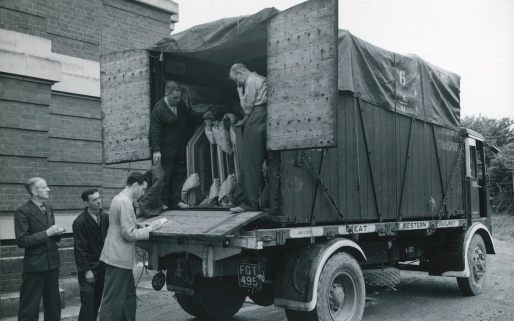
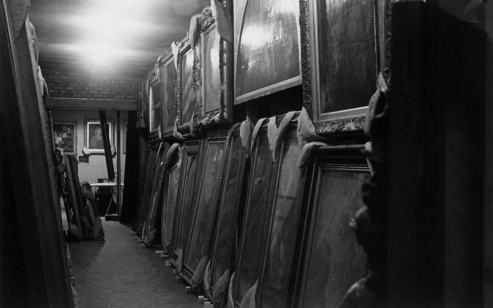
The new exhibition shows 24 archival photographs detailing how paintings were removed, packed, transported and stashed in a disused slate mine in Snowdonia, along with a picture of how it looks today.

A new 30 minute film about the rescue mission, capturing an “immersive” dance and spoken word performance, has been commissioned to accompany it, to be broadcast on BBC Two.

TELEMMGLPICT000154393264_trans_NvBQzQNjv4BqW-Lc0TAiyYzC8hrrx9reNKSpleVaApsUen8Ng0BEdKI

In 1940, the Bristish feared for the safety of the national art collection: Winston Churchill is known to have personally intervened to veto a plan to take them to Canada by ship, fearing a u-boat attack could leave paintings lost at sea.

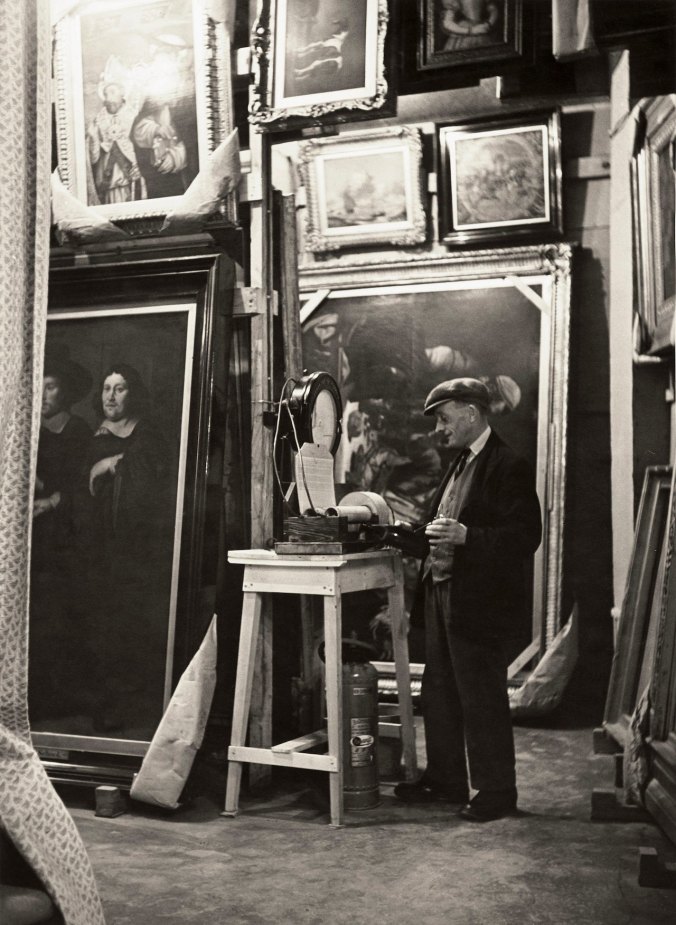
Instead, curators agreed to hide works in the Manod mine, enlarging its entrance with explosives and building small brick “bungalows” inside to protect them from damp.

Monitoring the conditions the paintings were kept in further led to “valuable discoveries” about how best to protect them, a spokesman for the gallery said, explaining air conditioning was then added to the renovated London gallery after the war.

TELEMMGLPICT000154393093_trans_NvBQzQNjv4BqqVzuuqpFlyLIwiB6NTmJwfSVWeZ_vEN7c6bHu2jJnT8

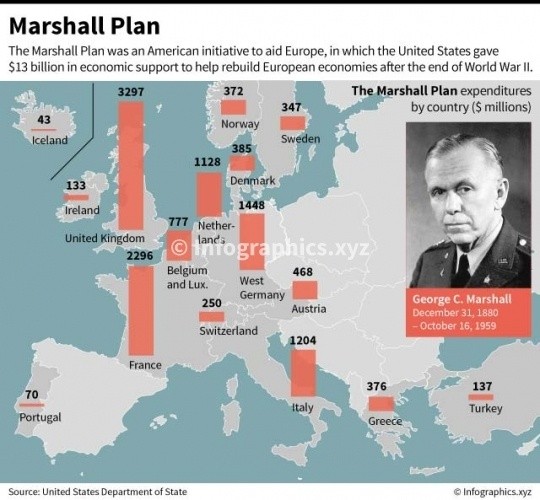
The Marshall Plan

main-qimg-deb590d4e0568e0d4c4f2d7dc7b4aff7-c

FROM JUNE 1947 to its termination at the end of 1951, the Marshall Plan provided approximately $13 billion to finance the recovery and rehabilitation of war-torn and postwar weary Western Europe.

In today’s dollars that sum equals roughly $100 billion, and as a comparable share of U.S. Gross National Product it would be in excess of $500 billion.

It was a mammoth sum, more than the United States spent to govern itself in the first fifteen years of the twentieth century.

More than the provision of dollars and aid, the Marshall Plan was the cornerstone of American foreign policy for much of those formative and consequential postwar years.

It was a monumental undertaking and—echoing Walt Whitman’s famous lines—it contained multitudes and contradictions.

For, after the war, Europe increasingly found itself looking across the Atlantic to the United States. The United States was the only power whose economy had flourished during the war. Europe needed the goods and natural resources abundant in the United States to fuel its recovery.

But, at the same time, Europe was not able to offer the United States goods or resources in return, nor could it draw on stores of investments or invisible earnings (like shipping or insurance).

Europe had a balance-of-payments problem with the United States: in 1946 Europe’s overseas trade debt was $5 billion and growing. It was known as the “Dollar Gap.” It was the key problem looming behind Europe’s incipient recovery and it was becoming dire.

From 1941 to 1945, American industry had mobilized its prodigious production capacity for the war effort.

By the end of the war, thirteen rationing programs were in effect, covering scarce commodities ranging from gasoline and shoes to sugar and red meat. Consumer goods such as refrigerators and automobiles were largely unavailable. Women were asked to leave the home and enter the workforce. By one count more than a quarter of American wives worked for pay during the war.

Americans were asked to save as never before. In 1940, personal savings amounted to around $4 billion. By 1945, it was $137.5 billion. All of this sacrifice was summoned after a decade-long economic depression.


from Behrman, Greg. The Most Noble Adventure: The Marshall Plan and the Time When America Helped Save Europe. Free Press. Kindle Edition.

Remember.

On this date in 1944 the retreating Nazi troops were leaving Florence in advance of the Allies arrival up the Italian peninsula. The retreating Germans did everything they could to wreak havoc for the Allies, destroying communication channels and destroying every bridge over the Arno, with the exception of the Ponte Vecchio.

In this picture below you see the destroyed Ponte Santa Trinita, with the Ponte Vecchio blessedly still in situ.

20597099_10155771033391614_6655739367043786808_n


Here’s a heartbreaking overview of the Lungarno in the Oltrarno, next to Ponte Vecchio.

20597349_10155771033516614_4264725542745114105_n


Naturally many Florentines were displaced from their homes and some were allowed to take shelter inside the Palazzo Pitti and the Boboli Gardens, where temporary beds were set up, as below.

20525759_10155771033356614_7858125415382806824_n20638285_10155771033361614_5855320616609754735_n

To remember those dark days, La Compagnia delle Seggiole will perform portions of Benjamin Britten’s “War Requiem,” tonight in the Piazza outside the Pitti.  The Requiem  was written to celebrate the reconstruction of the Gothic cathedral of Coventry. Entrance is free.

Biblioteca Nazionale Centrale di Firenze, or the BNFC

See this rather formidable looking building?  It is one of most important libraries in Europe.  Once housed inside the Uffizi, since 1935 has been located in this building designed around 1911 by Cesare Bazzani and later enlarged by V. Mazzei.  It is located along the Arno River in the quarter of Santa Croce.


IMG_4286

Sometime very soon, (more or less) armed with my newly (more or less) acquired Italian language skills , I’ll be entering this august archive to start my research on Florence after WWII.

Wish me a lot of luck: this place has a reputation for being formidable and working hard to keep people out.

IMG_4287

I’m not afraid to admit that I’m a bit intimidated!

IMG_4289IMG_4290

You may take a virtual tour of the library’s exterior here: http://arno66-archive.netseven.it/vt/index.htm


IMG_4291IMG_4292IMG_4293IMG_4294IMG_4295

Ah, what mysteries are held inside!

Here’s some formal data on the library, from Wikipedia:

The library was founded in 1714 when scholar Antonio Magliabechi bequeathed his entire collection of approximately 30,000 volumes to the city of Florence. By 1743, it was required that a copy of every work published in Tuscany be submitted to the library.

Originally known as the Magliabechiana, the library was opened to the public in 1747. Its holdings were combined with those of the Biblioteca Palatina (Firenze) in 1861, and by 1885, the library had been renamed as the National Central Library of Florence, or the BNCF. Since 1870, the library has collected copies of all Italian publications.

The National Library System (SBN), located in the BNCF, is responsible for the automation of library services and the indexing of national holdings.

Unfortunately, a major flood of the Arno River in 1966 damaged nearly one-third of the library’s holdings, most notably its periodicals and Palatine and Magliabechi collections. The Restoration Center was subsequently established and may be credited with saving many of these priceless artifacts. However, much work remains to be done and some items were forever lost.

Pisa, all but destroyed during WWII

SEPTEMBER–NOVEMBER 1944

The disappearance of its priceless artworks aside, Florence had been far more fortunate than Pisa. The Tuscan capital had lost a great number of medieval structures, but Florence and its citizens were alive.

In contrast, the city of Pisa—or what was left of it—was ghastly and quiet. War had emptied the streets and piazzas. While Deane Keller focused on saving Pisa’s Camposanto, his overarching concern was restoring life to the city itself.

U.S. Fifth Army troops battled the Germans for six weeks before liberating the city on September 2. Allied bombers had done their work well; the devastation had rendered the city largely uninhabitable.

Even then, German long-range artillery pounded the city for an additional three weeks. As Keller noted in his report, little remained undamaged: “Thirty-eight of her monumental churches exhibited major war damage; eight of her secular buildings of monumental importance suffered severely; numerous houses dating back to the Renaissance times were hurt . . . this in addition to the loss of her bridges, railroad station and other public utilities.”

Keller had other responsibilities in Pisa besides the Camposanto. The nearby Leaning Tower had been closed due to an accumulation of water that some thought might threaten the foundation. The water proved more of a nuisance because of the horrid smell than any structural problem. After arranging for the water to be pumped out, and rerouting traffic away from the building, he reopened the Leaning Tower to the public. It became an instant attraction for soldiers.

Well aware of Pisa’s reputation as a center of learning, Keller put his knowledge of academic life to good use by jump-starting the university. “Without the University the town has no economic future at all let alone its importance as an intellectual center. All its factories and industries are destroyed.” It took two months to locate the faculty, remove mines that the Germans had placed throughout the university’s buildings, and return to its library books that had been stored off-site for safekeeping.

On November 25, General Hume returned to Pisa and hosted a ceremony celebrating the reopening and the enrollment of some six hundred students. The city’s key institution was operational. The dead city Keller had encountered when he first arrived started to resuscitate.

Edsel, Robert M.. Saving Italy: The Race to Rescue a Nation’s Treasures from the Nazis (p. 204). W. W. Norton & Company. Kindle Edition.
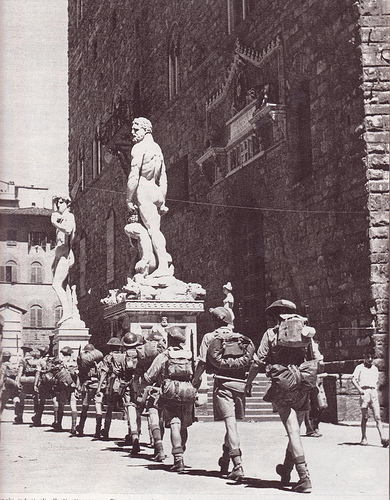
 

Dateline: Florence, August 4, 1944

In liberated Florence, war correspondent Martha Gellhorn—Mrs. Ernest Hemingway—filed this heartbreaking report:

“The botanical gardens are now a graveyard and they are the most frightening place in Florence. The Germans had taken all the hearses; the cemeteries of Florence lie to the north of the city and are in German hands, and there is no wood for coffins. Add to these basic facts the daily normal deaths in a city of three hundred thousand and the daily deaths resulting from mines, mortars, shells and snipers and you have the ghastly problem of Florence. Dead had been left unburied by the Germans, and it was not always possible to retrieve bodies. For instance, one body lay for days on the stumps of Alle Grazie Bridge. No one could reach it, first because of snipers and then because of mines. So trenches are dug in the botanical gardens and the uncasketed bodies are laid in them.”

Even after Allied forces gained control of the north side of the Arno, life remained miserable for Florentines. People accessed the north and south sides of the city by walking across the broken remains of the other shattered bridges. Few buildings had intact windowpanes.

Stretches of what had once been one of the world’s most cultivated city centers had been replaced with piles of rubble thirty to forty feet high along sections of both sides of the Arno.

Women picked through the pieces searching for heirlooms. Men, armed with picks and shovels, hacked away at the remnants of their beaten city to clear paths for workers and begin the process of rebuilding. Gaunt faces conveyed the hardship endured by the Florentines.

Barefoot women, standing shoulder to shoulder, prepared spartan meals on outdoor stoves in the Boboli Gardens. Others hunched over on their knees along the banks of the Arno, using its dirty water to scrub even dirtier clothes on pieces of stone debris created by the blasts. Despite the filth, thousands of people sought relief from the heat and dust by swimming in the muck.

No one indulged in vanity. Young, dark-haired women looked thirty years older, with their once-well-coifed hair standing on end, caked with grayish dust. Men patched and repatched their ragged clothes. A cluster of people usually indicated the location of one of the city’s temporary clean-water supplies. Such oases were fairly easy to find; just follow someone carrying straw-covered wine jugs or gasoline cans in each hand. The children of Florence sat in circles on the ground, devouring meager suppers.

It was a desperate moment in the city’s storied history.

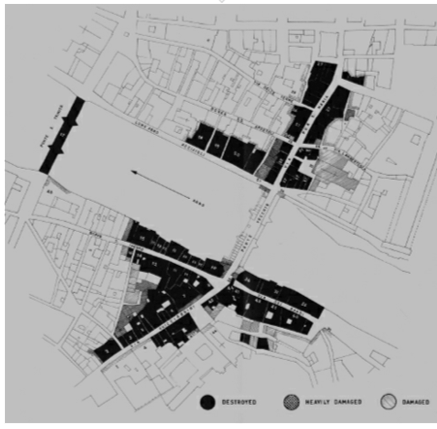
Here’s a diagram of what was destroyed in Florence on that fateful day:

Screen Shot 2017-07-23 at 1.07.14 PM

The Ponte Vecchio is in the middle of the image, Ponte Santa Trinita  to the upper left.


Edsel, Robert M.. Saving Italy: The Race to Rescue a Nation’s Treasures from the Nazis (p. 189). W. W. Norton & Company. Kindle Edition.

Florence in late summer, 1944

Mid-August–October 1944

New York Times reporter Herbert Matthews observed that “Florence is no longer the Florence that the world has known for 400 years. . . . the heart of Florence is gone.” Of its six bridges—San Niccolò, alle Grazie, Vecchio, Santa Trinita, alla Carraia, and alla Vittoria, only the Ponte Vecchio survived. In fact, the Germans had rigged it with demolition charges as well. Some among the Allies theorized that the Germans had changed their plans at the last minute, perhaps concerned that the debris caused by the destruction of the two-story bridge would actually have facilitated an Allied crossing by providing enough rubble to form a new foundation in the low water of late summer.

[American Monumnet’s Man, Frederick Hartt described the horrifying scenes during the initial days of liberation:]

In the city there was no water, no light. . . . the mosquitoes came in clouds from the stagnant Arno, the heat was intense and the air suffocating with the odors from the broken sewers and gas mains, the unflushable closets [toilets], and the corpses still buried under the ruins along the Arno.

Fascist snipers from windows all over the town picked off civilians at random. During this period nearly four hundred persons, mostly civilians, were killed by the German batteries which continued to shell the town sporadically from Fiesole.

Edsel, Robert M.. Saving Italy: The Race to Rescue a Nation’s Treasures from the Nazis (pp. 188-189). W. W. Norton & Company. Kindle Edition.