How Italian treasures survived WWII

De Rinaldis informed Cott that most of the works of art in Rome had been safely stored in the Vatican….the Vatican [itself] possessed one of the greatest collections of art in the world. [During the early 1940s, however, it housed as well] the temporary addition of works from the Brera Picture Gallery in Milan, Accademia in Venice, Borghese Gallery in Rome, Museo Nazionale in Naples, the holdings of dozens of less prominent museums, and many priceless riches from the nation’s churches, it now had few, if any, rivals anywhere on earth. Joining its remarkable collection were—to name just a few—the Caravaggios from Santa Maria del Popolo and San Luigi dei Francesi, and oversize canvases by Titian, Veronese, Tintoretto, and Tiepolo from Venice. Never before or again would the results of such creative genius be gathered in one place.

Edsel, Robert M.. Saving Italy: The Race to Rescue a Nation’s Treasures from the Nazis (p. 138). W. W. Norton & Company. Kindle Edition.
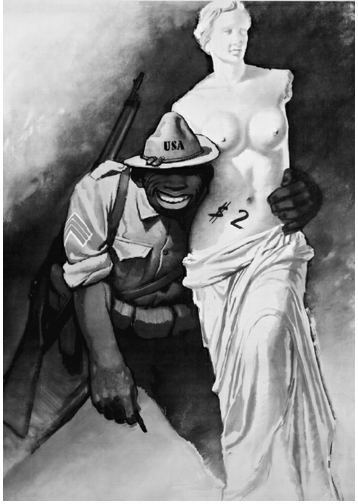
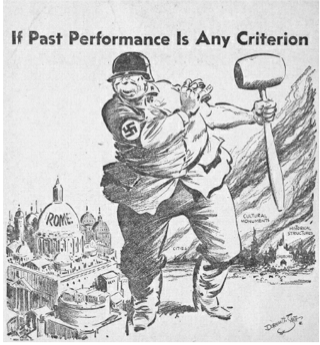
The bombing of Pompeii, 1943, on the anniversary of eruption of Mt. Vesuvius.

Things didn’t go so well for Italy’s artistic treasures at the beginning of the Allied invasion.  To wit:

No one wanted another embarrassing incident, such as the recent bombing of Pompeii. The Allies had flown at least eleven missions, dropping 156 bombs on suspected German command posts around the ancient archaeological site. This accomplished little beyond killing Pompeii’s dead, again and again. The southern portion of the site lay in rubble; the Pompeii Antiquarium was “half demolished” with “serious losses to the collection.” Adding irony to insult, the date of the first Allied raid—August 24—marked the 1,864th anniversary of the devastating eruption of Mount Vesuvius.

Edsel, Robert M.. Saving Italy: The Race to Rescue a Nation’s Treasures from the Nazis (pp. 61-62). W. W. Norton & Company. Kindle Edition.

Palermo, December 1943

The daily life in Palermo of a Monument Man, described in a letter sent home:

It’s a curious city of poverty & plenty, breadlines & marvelous pastry cakes, telephone wires strung by the Signal Corps on the heads & outstretched arms of marble saints, mounds of uncleared rubble in alleys, bombed Baroque churches, hot roasted chestnuts, walnuts, almonds & oranges, salvage dumps & hospitals, blackouts & bomb shelters. The things which effect [sic] life most are the lack of glass—most windows were shattered, shortage of water (I have to fill my helmet & wash in it morning & night), constant G.I. food (all restaurants are off bounds) & the cold (one is never quite warm).

Edsel, Robert M.. Saving Italy: The Race to Rescue a Nation’s Treasures from the Nazis (pp. 59-60). W. W. Norton & Company. Kindle Edition.