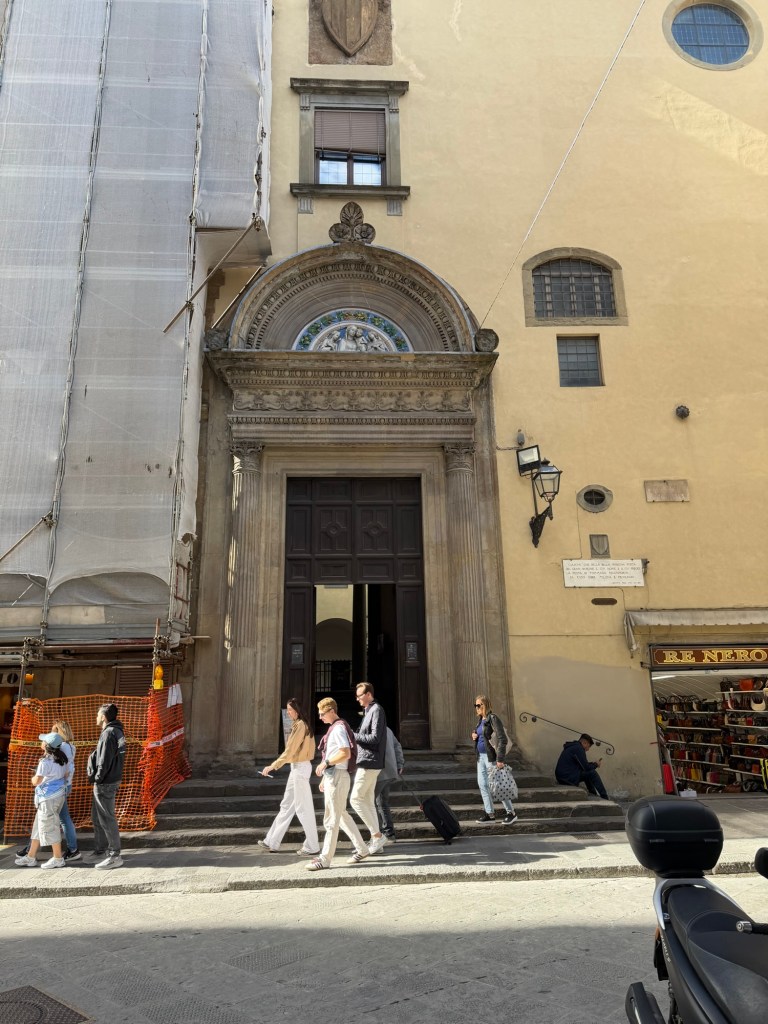
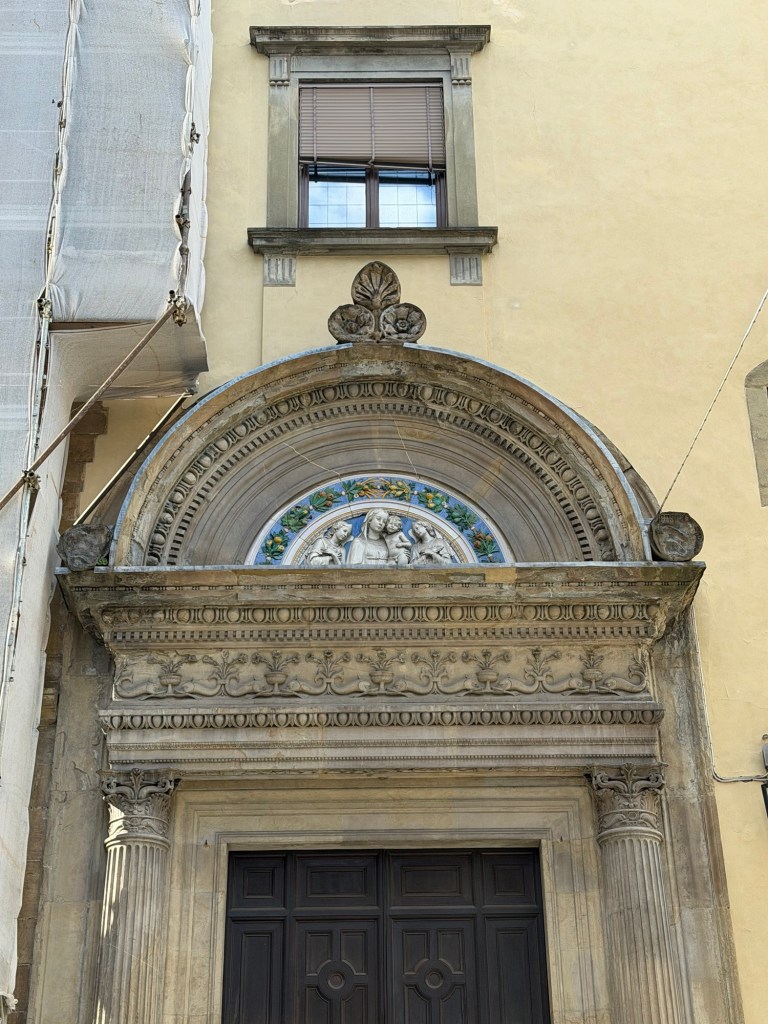
The interior of Palazzo Galli Tassi

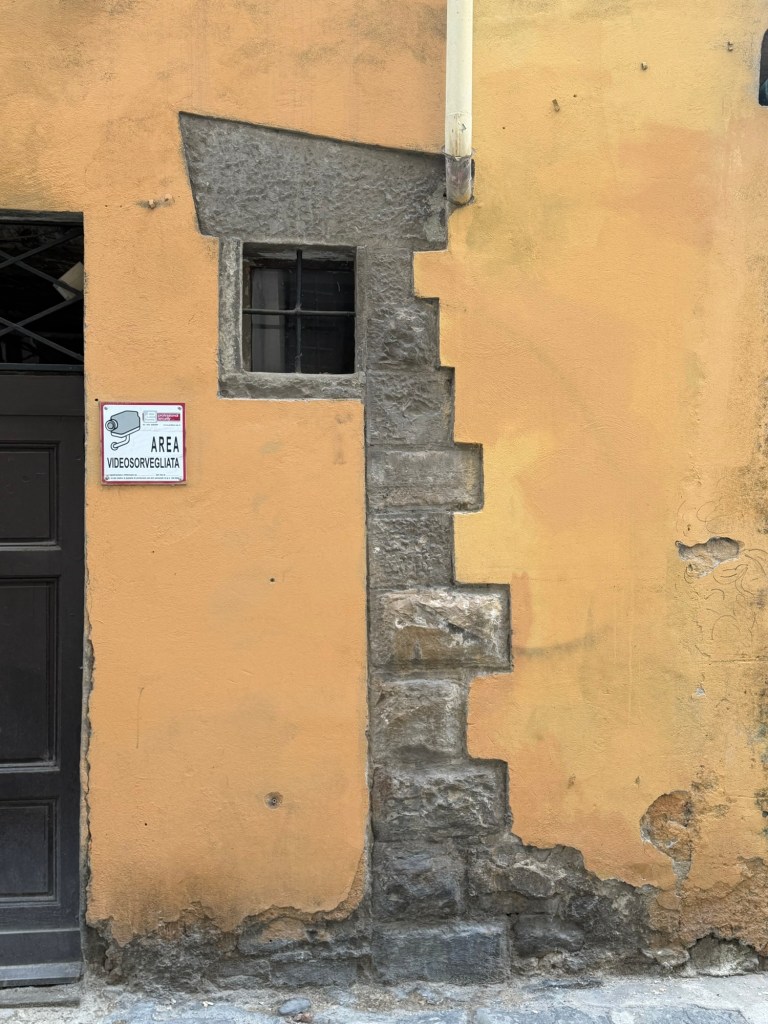
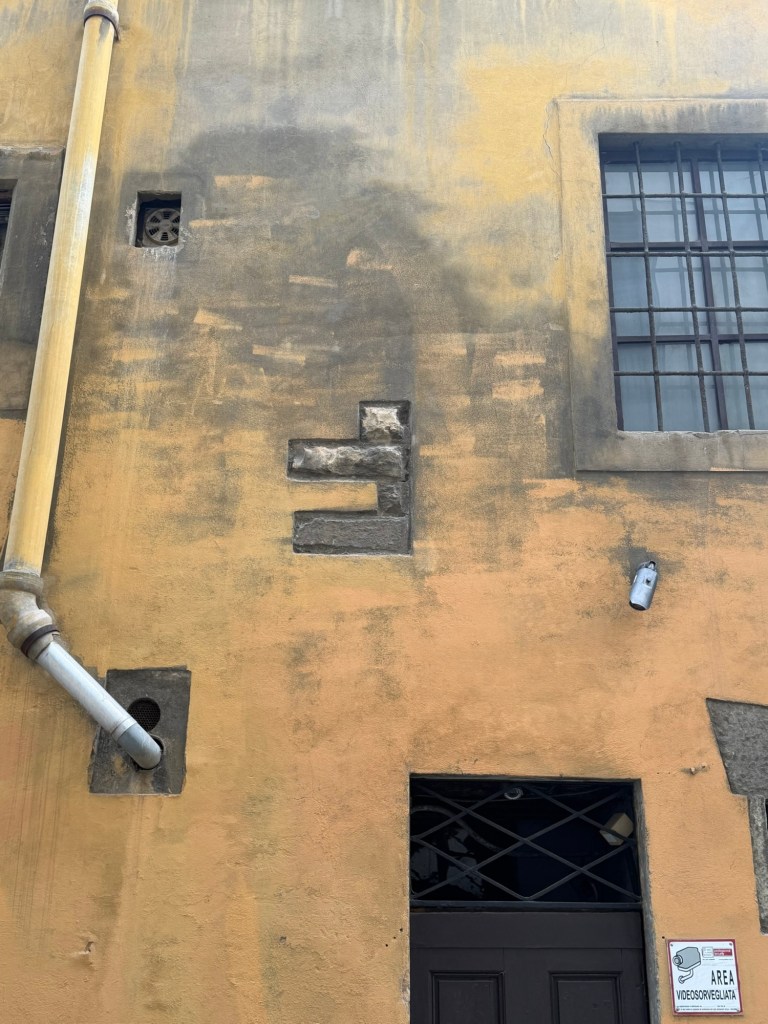
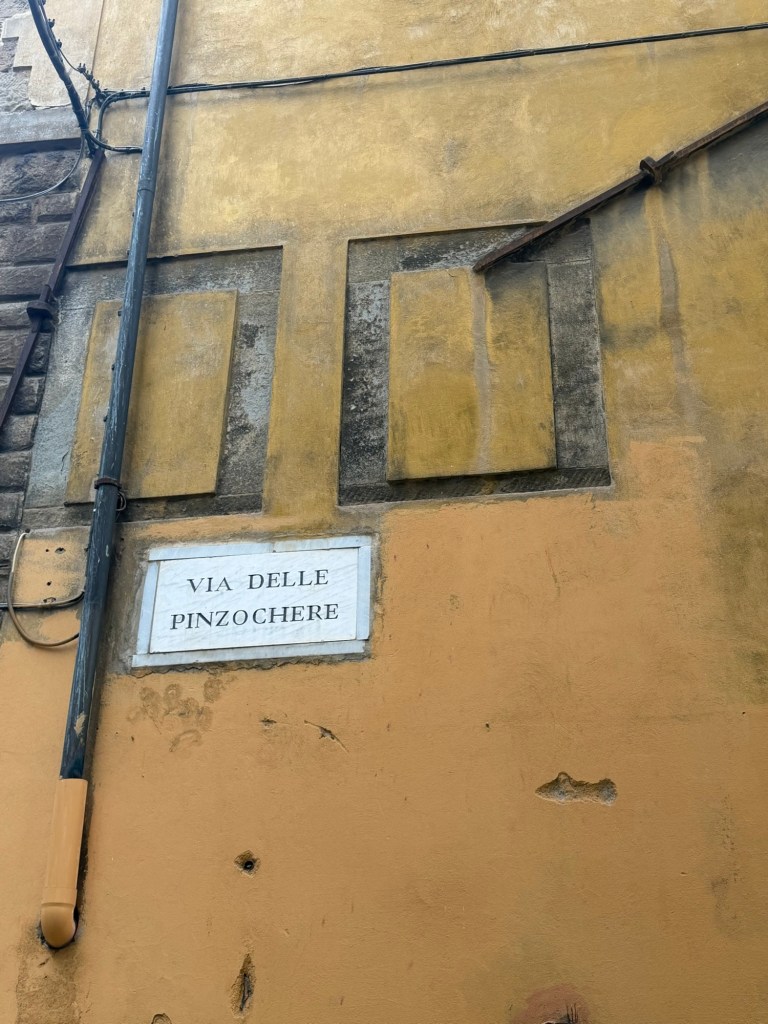
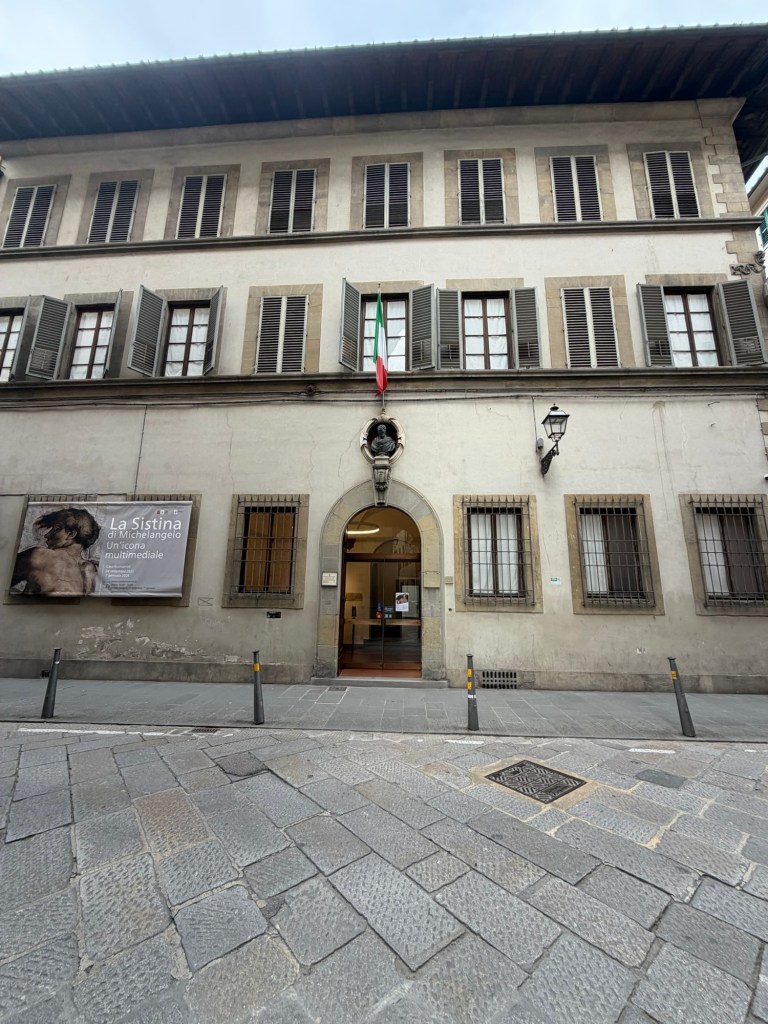
A while back I posted about the exterior of the Renaissance palazzo in Florence in which I have the great pleasure of attending Italian language classes. I’m finally getting back to it to show you the interior.

My video above shows how one enters the building and arrives first in the open air courtyard in the center. At the time of this video, an exhibition involving modern furniture was being installed. In the center you see a young woman in black and her boyfriend?/photographer, taking a bunch of pictures of her in front of the 18th century marble sculpture. Alas, this is the sight everywhere nowadays. If it isn’t a selfie, it’s a casual photoshoot. I long for the days of film cameras where there was less indulgence and a whole lot less posing going on. Pardon my rant.

The building today houses a small hotel and two language schools, as well as a small retail business.

This is my view every time I come to class. I climb the 2 ramps of the grand stairway, decorated overhead with this gorgeous baroque ceiling painted in white, with two neoclassical putti standing in greeting. One bears an inscription relating to Galli Tassi, a one-time owner of the palazzo. The next image shows a Google Translate translation of the inscription on the top statue, the one of the putti holding one arm up.

At the top of the stairs, just under a portion of a remaining fresco, is the 19th century sign for the syrup factory that was once housed in this building during that century.

Hello, I say to myself, just before class.

What a grand stairway!

On the ground floor of this building is this salon with frescoes. I was lucky to take this video before being shooed out by a supercilious hotel worker who seemed to think he was the marchese of the palazzo (he’s not). As a student of the language school I had every right to be there.

However, the rooms of the hotel houses within the building are not open for my gaze , but I found these photos on their website.

A couple other ground floor rooms are occasionally found open by an intrepid investigator (that would be I). I spied an original ceiling decoration and antique fireplace in one sala.

From the 3rd floor of the palazzo, where my school is located, there is another smaller less grand stairway leading to the 4th floor and maybe the roof (? A search I’ll make in another day).

Even this modest stairway, which was probably for staff, appears lovely to me.

And back down in the 3rd floor, here is the door leading to my school.

Open Sesame. The mysteries to be unlocked by the Italian language await.

Details, details, details

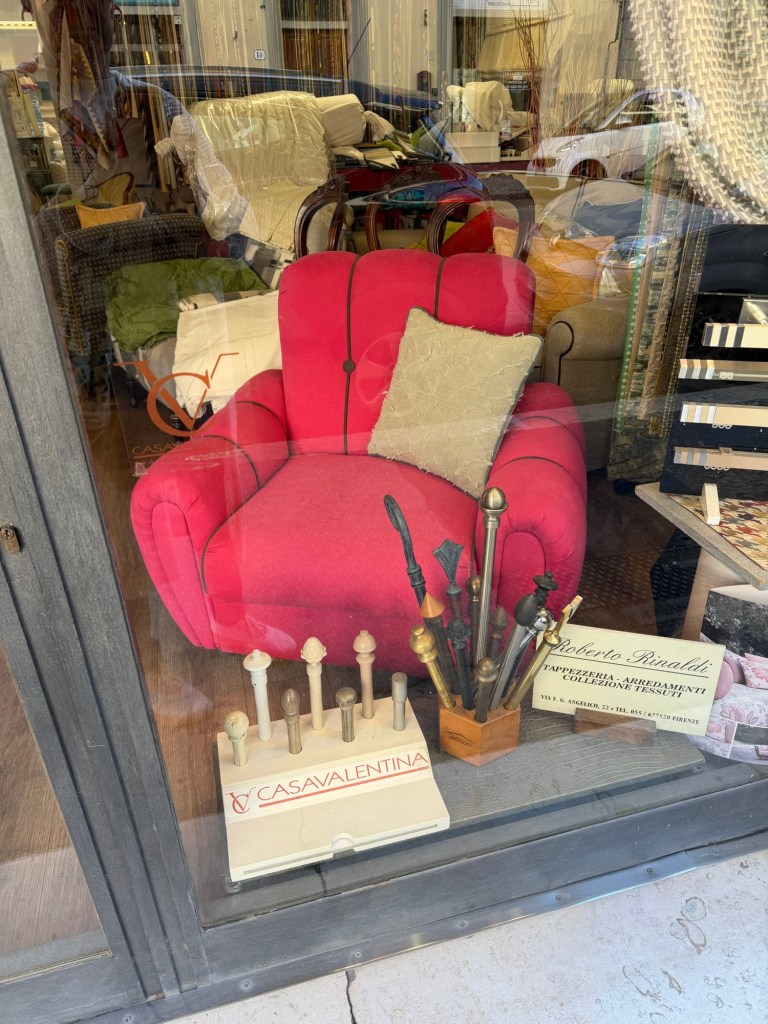
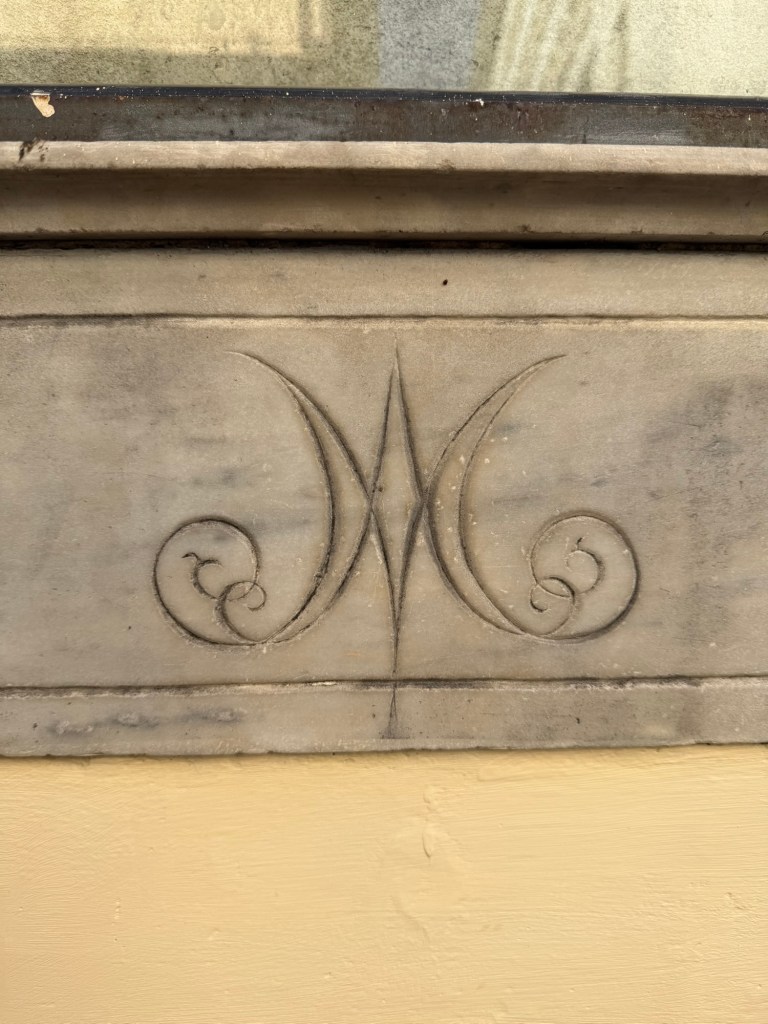
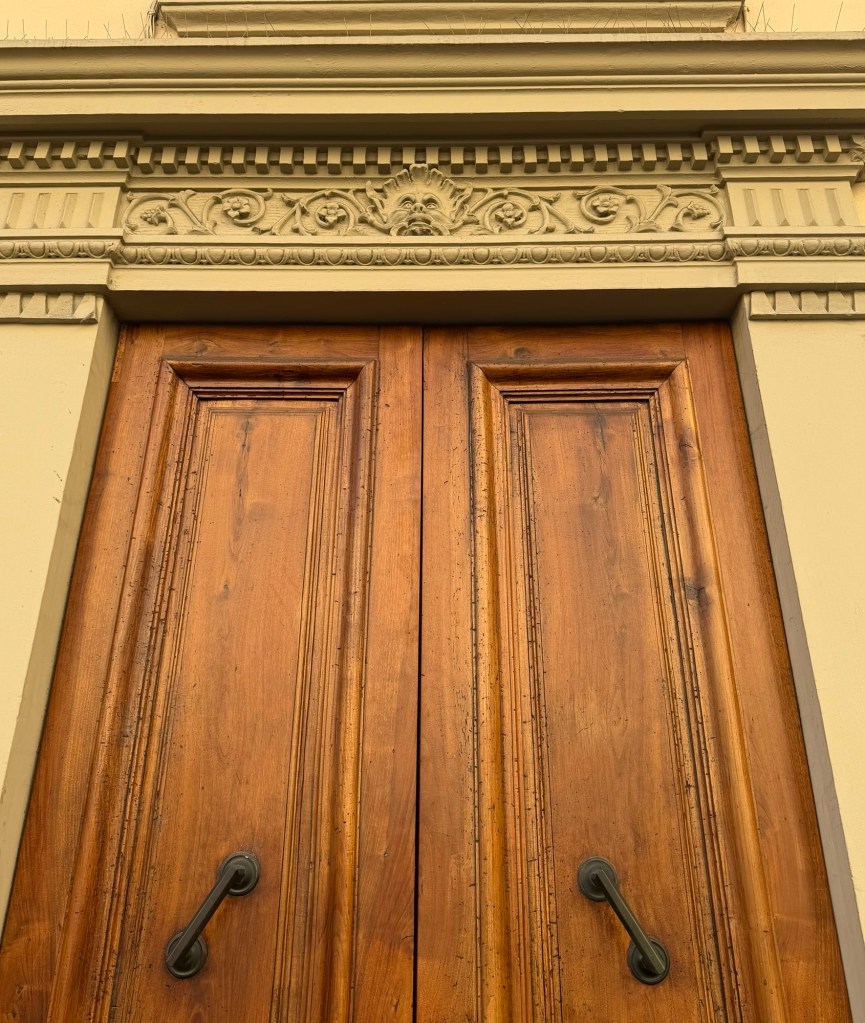
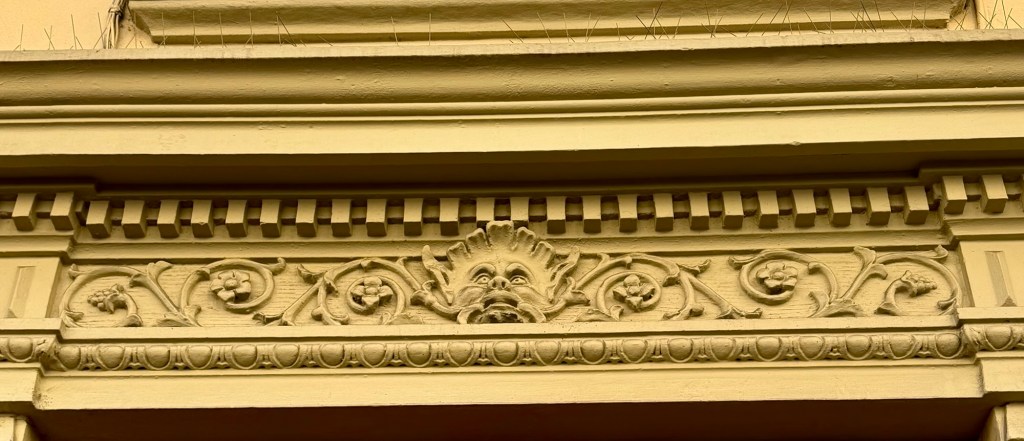
It was another hot, sultry day in Florence and I only had the capacity to notice the little things that form a part of bigger things.

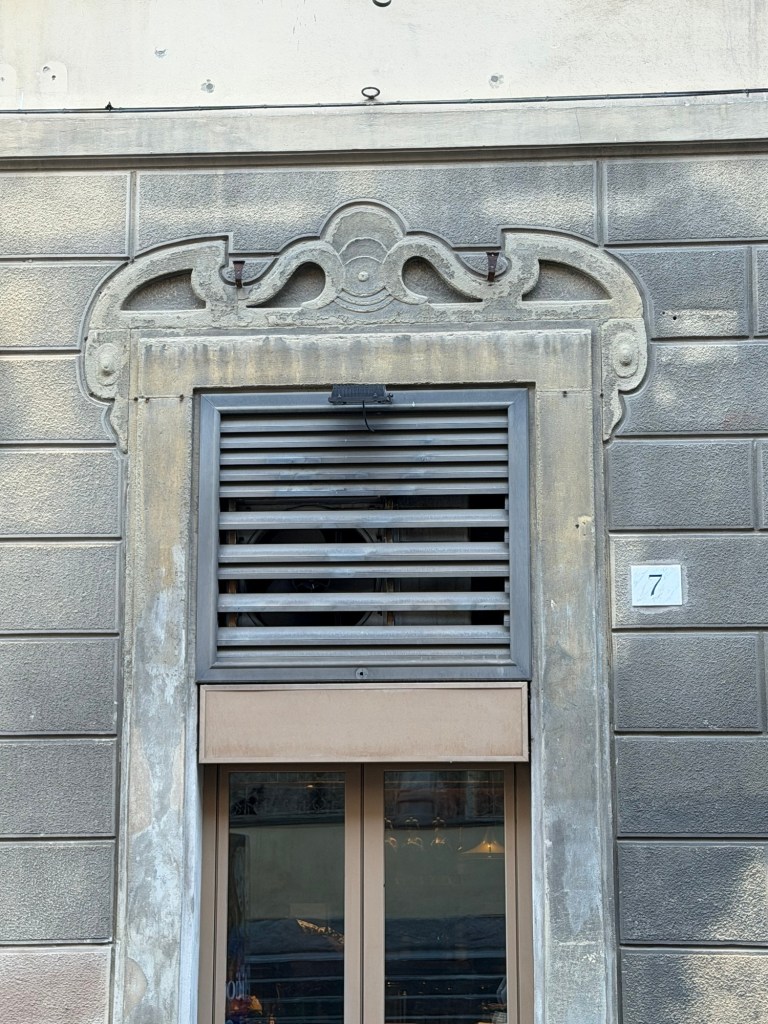
I often start a Saturday with a quick (20 minute) walk to view a Renaissance masterpiece fresco where nary a tourist is to be found. And, it’s cool inside. This day, I was drawn to these details on the walk there (the Vespa, the building decoration), but once I arrived my gaze was captured by the wood, the stone, the iron; all the finishes hand-created with either a chisel and hammer, iron tools and fire, or a painting formed with a brush and some paint. It’s all there. No where more lovely than here. You just have to look. It’s all beautiful.

And, not only that, but I learned something completely new that day, and will be posting about it soon. It is a detail of Italian culture, having to do with wooden furniture. Any guesses?!

Ferrara, birthplace of Savonarola

Readers of this blog will recall earlier this spring I did a big post with lots of pictures and videos of the Florentine celebration held annually to mark the brutal execution of Girolamo Savonarola in this city in 1498. But, did you know that the firebrand was born in Ferrara?

He’s commemorated in Ferrara with this statue depicting him in the process of delivering one of his fiery sermons. His importance is shown by the placement of the work of art: it’s in a wide open square surrounded by the city’s most important civic and religious buildings. I got the chills when I walked by the statue, knowing the history of this man the way I do.

The inscription says in English: “To Girolamo Savonarola in corrupt and servile times of vices and tyrants, flagellator.” Well, that’s blunt! He is remembered in Italy for his complaints against the church, predating Martin Luther.

I like being in the know about these things Italian. Savonarola is just one example of thousands.

The cathedral of Ferrara

The Medieval cathedral of Ferrara, whose style blends Romanesque and Gothic, typically looks like this photo below. You can see its distinctive pink and white marble clad bell tower, or campanile, which is the tallest part of the back in this shot, on the right side.

Typically, when I visited Ferrara recently, I found parts of the exterior of this august building under scaffolding. If you’ve spent any time at all in Italy, trying to see specific sights and not just what your tour guide shows you, you will know that scaffolding appears when you least expect or want it. It’s the story of research in Italy. I am often disappointed in this way, but at least I can console myself with the realization that I can return and try again. As indeed I will be doing with Ferrara. I am so grateful for that luxury.

So, above and below are pix of how the cathedral appeared to me on my recent trip.

Below, I am zeroing in on the right of the front of the church.

The Cattedrale di San Giorgio Martire, which is the proper name for this most important church in Ferrara, stands as a remarkable testament to the city’s layered history and architectural evolution, offering a blend of of Romanesque, Gothic, Renaissance and Baroque artistry.

The following elaborately carved bas relief, depicting the saint to whom the church is dedicated, is over the far left entry to the church.

Below is a close-up of the distinctive pink and white marble clad bell tower as it normally appears.

The following are shots of how the bell tower appeared when I was last in Ferrara.

The campanile is said to have been designed by Leon Battista Alberti and was left unfinished for reasons not fully understood. It was not uncommon for architectural projects to be left unfinished in Italy, however, and happened due to political or financial difficulties, including the death of the patrons or conflicts. Alberti’s design was innovative and inspired by Roman triumphal arches and classical proportions, including the golden ratio.

I will have to wait until my next trip to Ferrara to have a good look at this campanile.

Let’s take another look at the full shot of the cathedral. In particular, I want you to notice the arcaded loggia that appears in the exposed side of the church, running along the same side as the bell tower.

This entire side of the church was and is dedicated to commercial activities; it is lined with shops, some very au Courant in 2025 and snazzy, and you can tell by the architecture of the shops themselves as well as the blind loggia that runs above that this aspect of the building is as old as the church itself.

I’ve only seen this use of church walls for commercial space in one other place: in Mantova (Mantua) the same thing occurs on the side of the Basilica di Sant’Andrea. If you look at a map, Ferrara and Mantua are only 56 miles distant. Stylistic similarities are not that surprising, given this closeness. And Alberti was active in Mantua as well, so the possibility of his working in Ferrara is also not surprising.

Below are the shots I took of the shopping arcade attached to the cathedral in Ferrara.

Now, back to the cathedral itself. I didn’t take any shots or videos of the interior of the church because it has been completely redone in a pastiche of the Baroque style, and that is not of interest to me. Pure Baroque, yes. Pastiche Baroque, ho hum.

But, what is interesting is that Ferrara has kept aspects of the Medieval entrance to the church and housed it in a covered vestibule attached to the front of the church. The next few shots show this entryway and its sculptural adornment as currently arranged. It is badly aged, but the “bones” are still there.

So, there you have my experience. I’ll be going back to Ferrara and hope to see the campanile and facade revealed again! Buona giornata.

A Dutch string quartet concert at Palazzo Corsini, Firenze

Would you like to join me at a gorgeous concert in an amazing location? Well, feast your eyes and ears on this post.

Last night was a magical evening. I must start by saying that we had a tremendous thunder storm on Sunday, during which I almost did a dance in the rain on my terrace, so grateful was I for the relief in the temperatures! We cooled off 20 degrees and Monday was a delightful day here: sunny and mild. The relief is palpable, so that any event would be impressed with good feeling. Last night was the concert in a magnificent palace in the city and here are my shots.

I like to arrive early at these events not only to get a good seat but to take in the surroundings. I believe you can see why. This smallish room on the ground floor of the palace is known as the Sala Donna Elena, or the Lady Elena room. It is quite something and the acoustics are marvelous.

Above, this lovely woman in her golden metallic sandals welcomed us and explained a bit about the program. The evening was a fund raiser for seriously ill people in Florence. The music was provided by a stringed quartet from the Netherlands, about whom you will find more information below in this post.

The music began and I was a bit timid at first about filming, but as the evening progressed I became more comfortable and felt free to video.

As I listened to the music and watched the movements and faces of these talented young musicians, I was overcome with emotion, especially as I allowed my gaze to skim the surfaces of the incredible frescoes in this room. With a little imagination, I could feel what it must have been like to be entertained in this way several centuries ago, when candlelit evenings were spent like this instead of watching screens, at least among the most fortunate. Just for an evening I can feel like one of them.

See below for English explanation of these pages.

Above is the evening program.

An Italian woman and a man gave short recitations between the musical numbers, which dealt with different kinds of loss and sadness. It was very moving.

Another magical evening in Florence. The walk home, in the cool summer air, was equally thrilling, as I walked by illuminated monuments in the historic center. How lucky, I thought, am I tonight?

Giovanni Boldini, and his relationship to John Singer Sargent

Boldini is one of the 19th century Italian painters par excellence, secondo me. I happen to like his style very much, but you might judge me when I tell you why. In his work, I see the precursor to John Singer Sargent’s work and HE is one of my favorite painters of ALL time.

But more on that later. First let’s admire the paintings by Boldini from the exhibition recently held in his hometown of Ferrara. You might recall that I made the trip there from Florence recently just to see this show. In 35 degree Celsius heat. Against my better judgment (because of the extreme heat).

Boldini was born in Ferrara in 1842 and studied art in Florence where he was influenced by the Macchiaioli, a group of Italian painters who were precursors to Impressionism. Boldini is best known for his elegant and dynamic portraits, especially of high society figures, mostly women, which earned his great fame during the Belle Epoque period in Paris where he spent most of his career.

Boldini was nicknamed the “master of the swish” due to his distinctive flowing and energetic brushwork, which brought a sense of movement and vitality to his portraits. His style combined naturalism and impressionist influences with a modern, theatrical flair, making him one of the most fashionable portrait painters of his time.

Boldini lived in London for a while, gaining success with portraits of English aristocracy, before settling permanently in Paris in 1872. There he became a central figure in the artistic and social circles, painting portraits of many prominent cultural and social personalities. His work captures the elegance and dynamism of the late 19th and early 20th century society.

In addition to portraits, Boldini also painted landscapes, still life, and genre scenes. His legacy is preserved in major museums and collections, including a dedicated museum in Ferrara. He died in Paris in 1931.

The relationship between Boldini and Sargent was one of close friendship and artistic exchange, especially from the late 19th century into the early 20th. They likely met in Paris in the late 1870s or early 1880s, possibly introduced by their mutual friend Paul Helleu. Both painters moved in the same elite social circles and often painted the same high-society clients, such as Consuelo Vanderbilt.

Boldini was about 14 years older than Sargent and obviously influenced his style. You can tell by studying Sargent’s works that he picked up some stylistic techniques from Boldini. Their friendship was marked by mutual respect and admiration, with Boldini painting at least 3 portraits of his younger friend, including a famous one from 1890 that highlights Sargent’s commanding presence and filled with Boldini’s dynamic brushwork.

Below is one of Boldini’s portraits of Sargent. Could you not see this gentleman appearing in the homes of the current HBO series, The Gilded Age?

This small painting from c. 1890 is a vivid testament to the friendship and mutual admiration between these two leading portraitists of fin-de-siecle Paris. It captures Sargent, standing tall with a commanding presence. Boldini’s characteristic frenetic brushstrokes are featured in the background and his strong, linear composition forms Sargent’s posture, which great detail on his very artistic hands. Sargent’s vividly red cravat draws the eye to the painter’s face.

Yale University owns a small study of Sargent by Boldini, which I reproduce from a screenshot here.

Here’s another work attributed by Boldini and said to represent Sargent.

In 1886, Boldini took over Sargent’s Paris studio when Sargent moved to London, further cementing their professional and personal connection. They maintained contact over the years, sharing artistic ideas and social networks in Paris and London and both were leading portraitists of their era. They shared a prominent standing in producing the most famous portraits of the European world of the Belle Epoche.

The Este Palace and the Palazzo Municipal, Ferrara

My recent visit to Ferrara was full of interesting sights to behold. The historic center of this venerable city, which was a leading cultural center during the Italian Renaissance, has many important buildings, thank goodness. I say that because there was heavy bombing during WWII, but fortunately the center was pretty well preserved.

First up, let’s look at the Palazzo Municipale. It was begun in the 13th century, and, as it’s name suggests, it serves as the seat of the commune of Ferrara. It was the ducal residence of the Este dynasty until the 2nd half of the 15th century, when the family built the building I’ll be discussing next in this post. It is situated directly across from the cathedral of St. George, about which I’ll be posting soon.

Flanking the grand arched entrance of the building are two statues: on the left is a seated figures of Duke Borso d’Este and on the right is the equestrian statue of Marchese Niccolo III d’Este. The Duke holds a scepter and is depicted as if administering justice.

You can’t visit Ferrara and miss the palazzo that was home to the Este dynasty, at least from the outside. It is huge and takes up a lot of space in the historic center. It’s make of red brick, for the area was lacking in stone that could be used for building. And, unlike most Italian former palaces, it is surrounded by its moat.

This castle was originally built as a fortress after 1385 when the local populations revolted against the Este family. Once dynastic power was established, the building then transformed into a Renaissance palazzo. It features 4 corner towers, the moat, drawbridges and elegant white stone balconies added in the 16th century.

Oratorio dei buonomini di San Martino, Firenze

There’s a small, historic charity in the heart of Florence that has been in operation since 1441. Where else, I ask you, can you enter such a place pretty much any day you like? It is mind blowing, actually! It is the oratory of the good men of St. Martin, a charity organized to help the needy.

It doesn’t look like much from the outside, right? Especially with the refuse piled high in front of the entry, while the city does street work outside. All over Florence this year (including in front of my home), the streets are torn up for plumbing works.

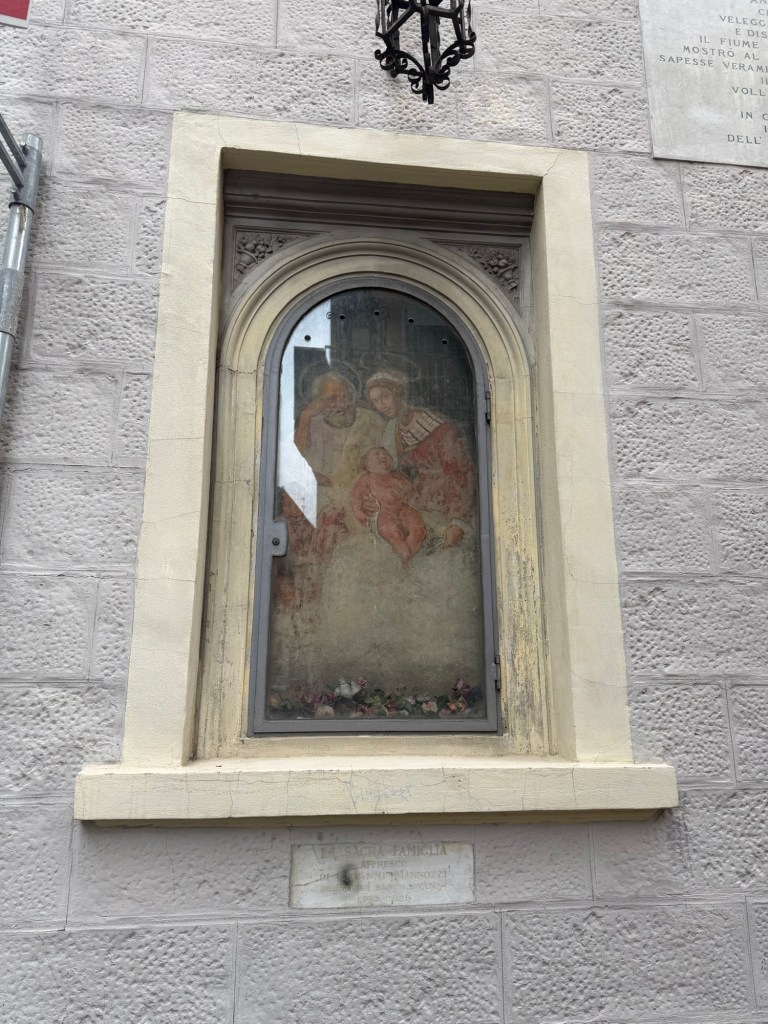
Above, you can just barely make out the painted scene of St. Martin ministering to the poor in the in situ tabernacle on the exterior of this oratory.

Let’s go inside:

Below, a picture of the altar wall, with the bust of St. Martin, said to be by Andrea del Verrochio, and two of the 10 frescoes seen on the wall above. The frescoes in this room date to the late Quattrocento, or the late 1400s and they were mostly painted by the artists in the workshop of Domenico Ghirlandaio. It is no wonder I admire them so! He’s one of my favorite painters. The paintings were created in this space between 1478 and 1481.

In the videos below, I show you the entire space. It isn’t large. And, in a city swimming in tourists, I had the place to myself. Knowledge is power!

The 10 frescoes lunettes in this room illustrate the good works of St. Martin of Tours, who is the patron saint of beggars, soldiers, tailors, wool-weavers as well as of geese and vintners and grape growers. Scenes from the life of Saint Martin and the seven works of Mercy are rare 15th-century frescoes still in situ, and they offer a vivid glimpse into 15th century Florentine life. That, in a nutshell, is why I love art. It is a window to the lost past.

The scene depicted in the lunette above and below is the famous episode from Martin’s life in which he cut his cloak in half to give part to a beggar. It is known as the Dream of St. Martin and recent research attributes this paining to Lorenzo di Credi.


Seven of the other lunettes illustrate the charitable activities carried out by the Buonomini confraternity, such as giving food and drink to the hungry and thirsty, clothing the naked, visiting the sick and prisoners, welcoming pilgrims, burying the dead, and assisting families in need.

The founding organization and its 15th century oratory are still operating today and we, the visiting, are asked to kindly make a donation which will go to the poor. I was happy to make a donation in the wooden box marked “alms.”

Here’s the label in the room: please read the English part if you’d like to know more about the oratory.

There was once an open window, seen below, from which bread was distributed to the needy during the pestilence of 1522, as the inscription says.

Below is a painting of the the madonna and child by Niccolo Soggi. In one of the videos above you will see the painting of the Madonna from the Byzantine school.

I highly recommend a visit to this small, serene and intimate space which was historically used to collect alms for the poor. The story goes that if someone needed to request funds, they could light a candle at the door to request help.

Tradition also holds that Dante Alighieri was married in this space, which may hold up if it is true that the house of his family was nearby as many scholars believe.

In any case, the oratory is a hidden gem, in plain sight, offering a unique combination of art, history and social charity in the heart of Renaissance Florence. You can visit it and soak up the charm without vying with tourists.

How to beat (or at least survive) the heat

To survive (with pleasure) I seek out a caffe shakerato alle Cantinetta dei Verrazano. It’s an iced espresso with a touch of milk.

Walking a bit took me by the Duomo, and today, in the heat and under that famous Tuscan sun, the campanile reflected to sun as if it were a mirror. I tried to capture it with my camera, but you may have to take my word for it.

And, back at home and thankful for the a/c, I bought some art supplies to fool around with. I’ll let you know if I have any luck painting!

Art and nature, around town

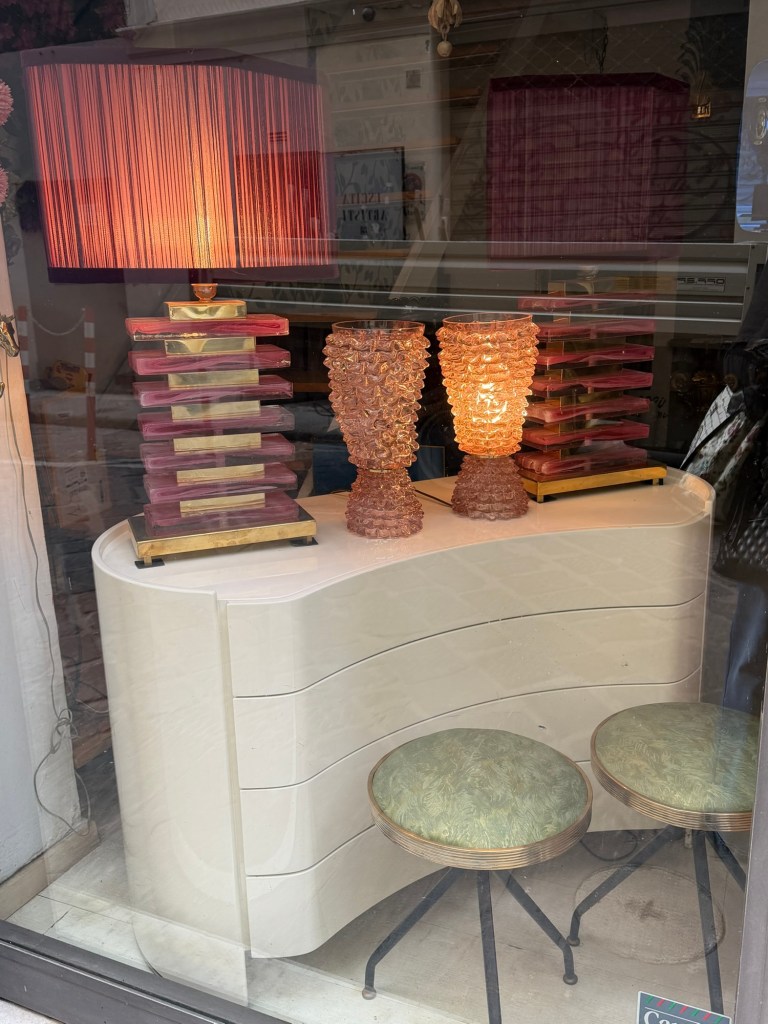
Walking down certain streets in the historic center of Florence is a such a treat. The art that is available for sale just blows my mind.

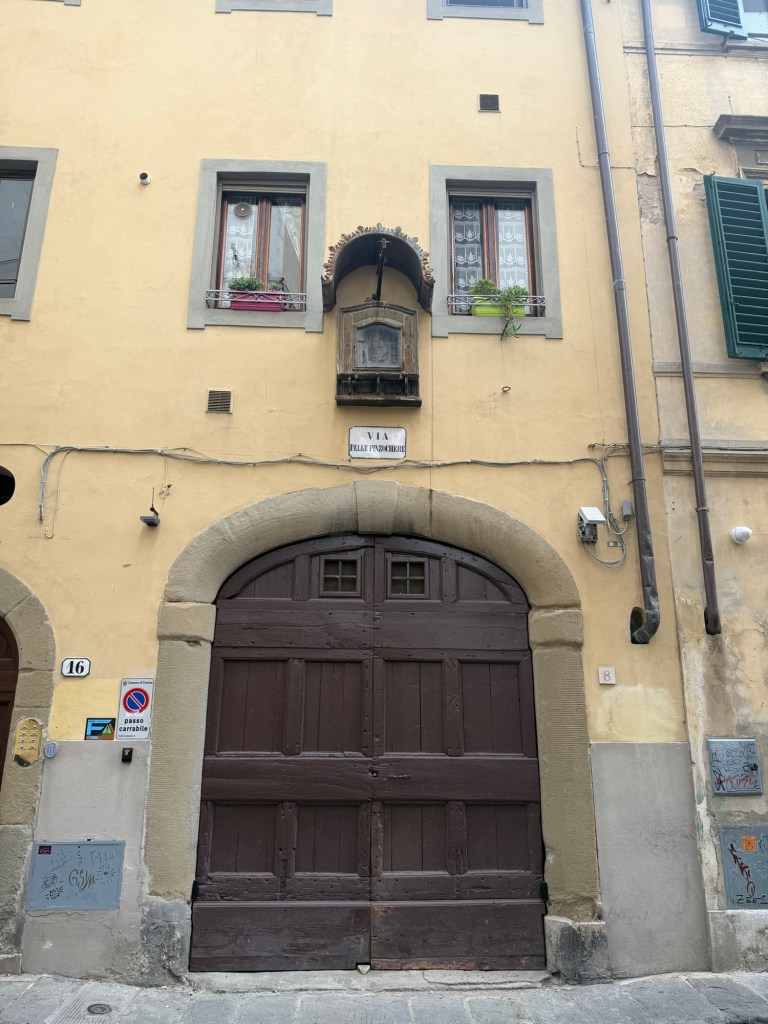
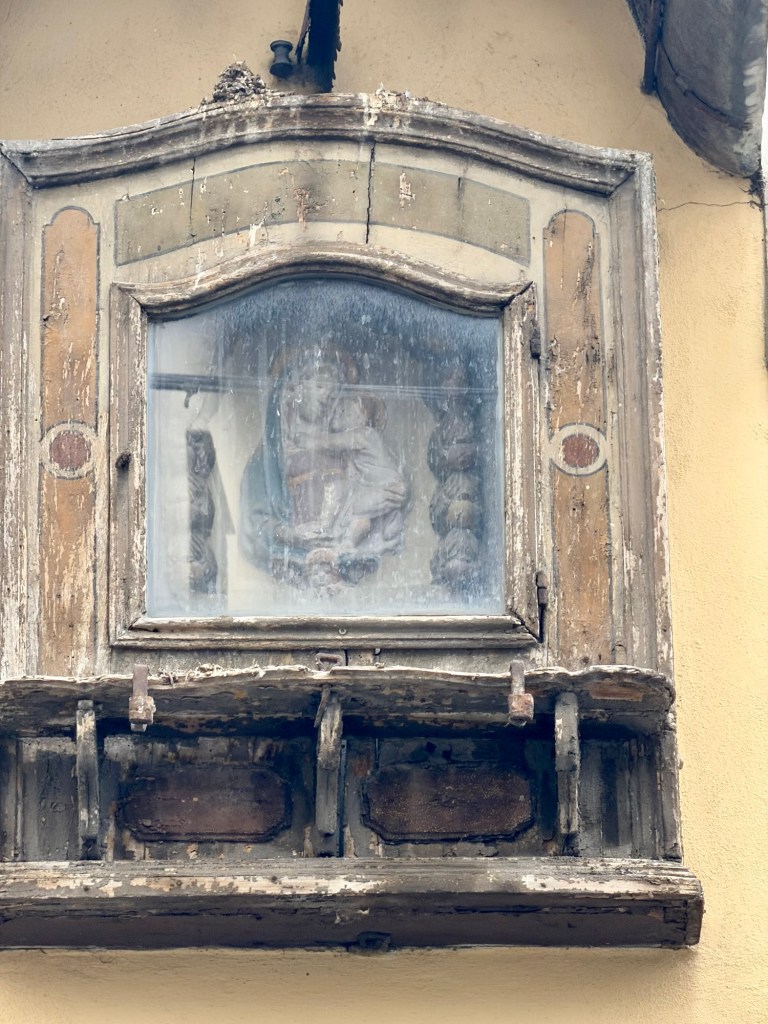
In this western section of Florence’s historic center is another of the ubiquitous tabernacles. I have posted about these before. This one is particularly elaborate, with the use of sculpture surrounding the painted images.

It dates to 1731!

And finally, a walk along the Arno provides some nature to offset the manmade. I love the pretty blossoms on these caper plants that self-seed and grow on the stone walls in Tuscany.

These stunning flowers are from the volunteer caper plants that seed themselves in the crevices of stone walls. Their blossoms are a lovely sight this time of year.

Last night, as I strolled along the Arno after 9 p.m., when the heat of the day started to slip away, I was serenaded by the strumming of cicadas. That is the quintessential sound of high summer for me. High summer arrives sooner and lasts longer here than in the other places I’ve lived. And I don’t like it.

The sound of late summer in my mind is the churring of crickets. I love that sound and the signal it sends: autumn is coming. Soon nature will turn silent.

We have quite a ways to go first!