There’s a small, historic charity in the heart of Florence that has been in operation since 1441. Where else, I ask you, can you enter such a place pretty much any day you like? It is mind blowing, actually! It is the oratory of the good men of St. Martin, a charity organized to help the needy.
It doesn’t look like much from the outside, right? Especially with the refuse piled high in front of the entry, while the city does street work outside. All over Florence this year (including in front of my home), the streets are torn up for plumbing works.
Above, you can just barely make out the painted scene of St. Martin ministering to the poor in the in situ tabernacle on the exterior of this oratory.
Let’s go inside:
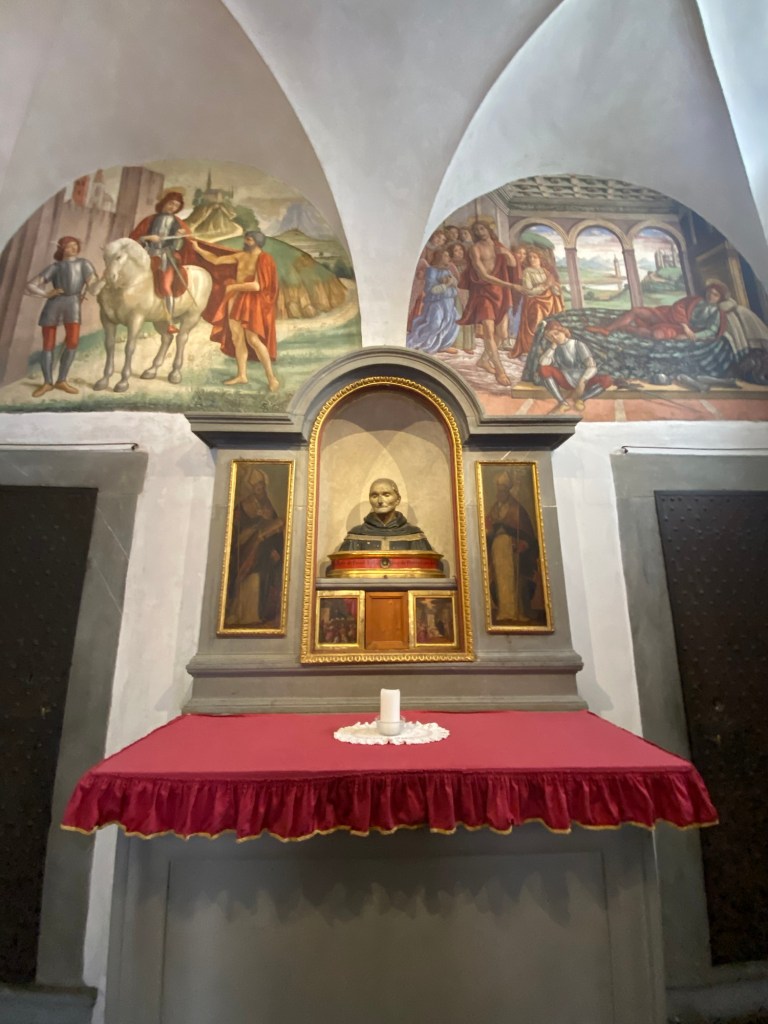
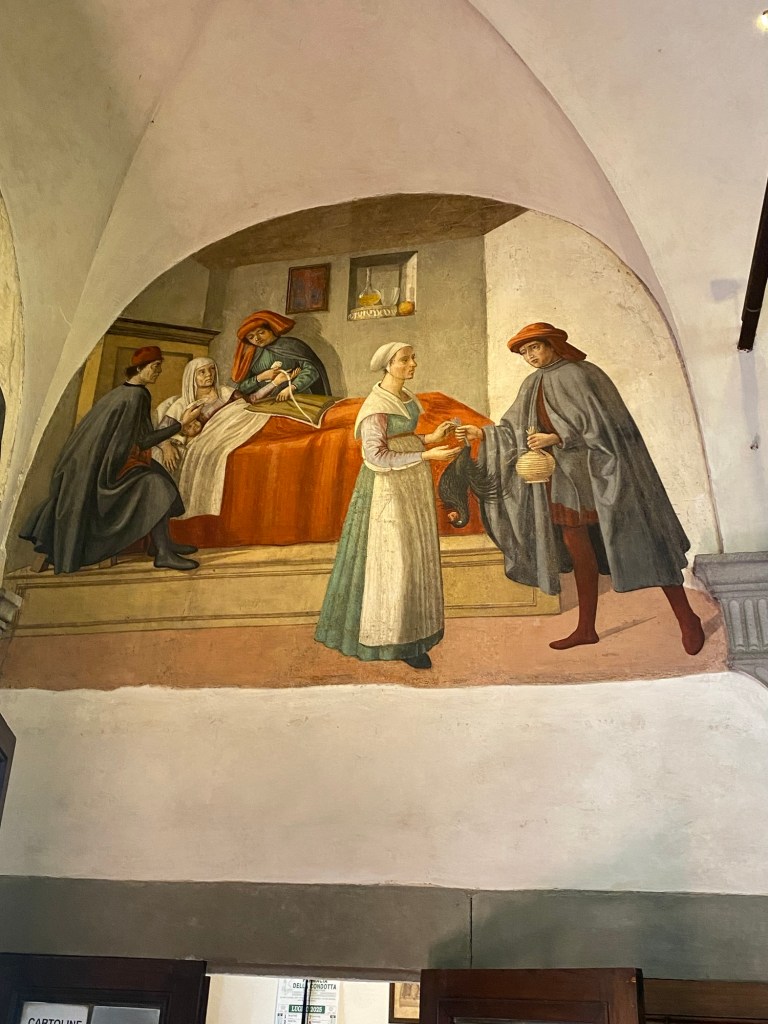
Below, a picture of the altar wall, with the bust of St. Martin, said to be by Andrea del Verrochio, and two of the 10 frescoes seen on the wall above. The frescoes in this room date to the late Quattrocento, or the late 1400s and they were mostly painted by the artists in the workshop of Domenico Ghirlandaio. It is no wonder I admire them so! He’s one of my favorite painters. The paintings were created in this space between 1478 and 1481.
In the videos below, I show you the entire space. It isn’t large. And, in a city swimming in tourists, I had the place to myself. Knowledge is power!
The 10 frescoes lunettes in this room illustrate the good works of St. Martin of Tours, who is the patron saint of beggars, soldiers, tailors, wool-weavers as well as of geese and vintners and grape growers. Scenes from the life of Saint Martin and the seven works of Mercy are rare 15th-century frescoes still in situ, and they offer a vivid glimpse into 15th century Florentine life. That, in a nutshell, is why I love art. It is a window to the lost past.
The scene depicted in the lunette above and below is the famous episode from Martin’s life in which he cut his cloak in half to give part to a beggar. It is known as the Dream of St. Martin and recent research attributes this paining to Lorenzo di Credi.
Seven of the other lunettes illustrate the charitable activities carried out by the Buonomini confraternity, such as giving food and drink to the hungry and thirsty, clothing the naked, visiting the sick and prisoners, welcoming pilgrims, burying the dead, and assisting families in need.
The founding organization and its 15th century oratory are still operating today and we, the visiting, are asked to kindly make a donation which will go to the poor. I was happy to make a donation in the wooden box marked “alms.”
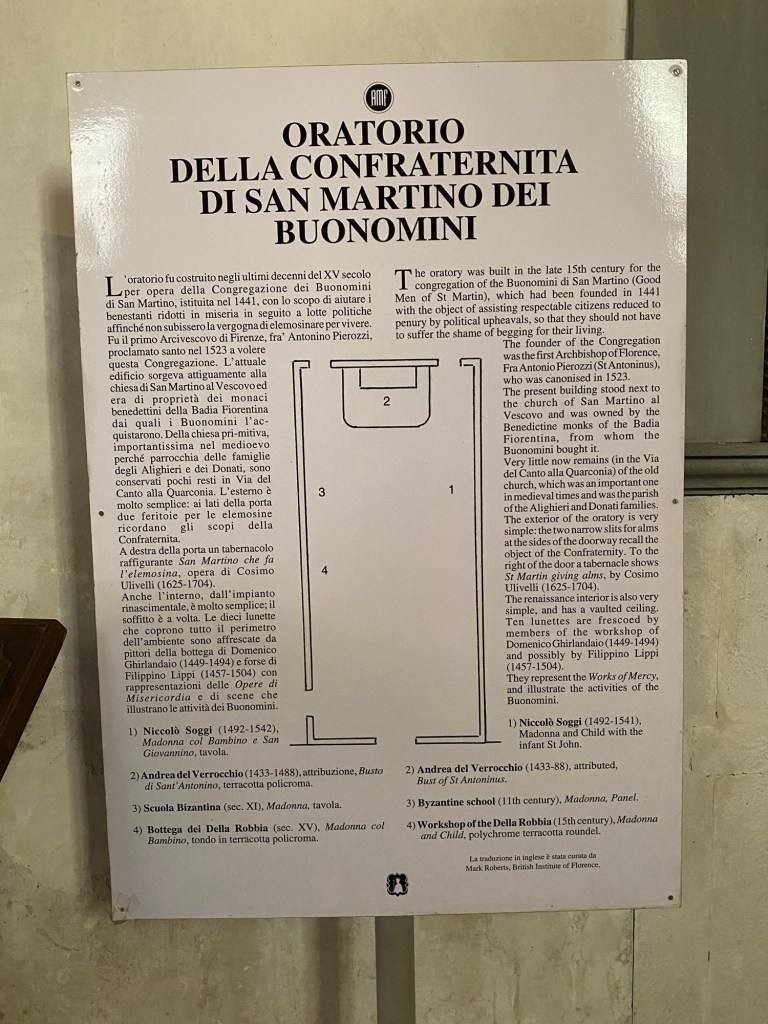
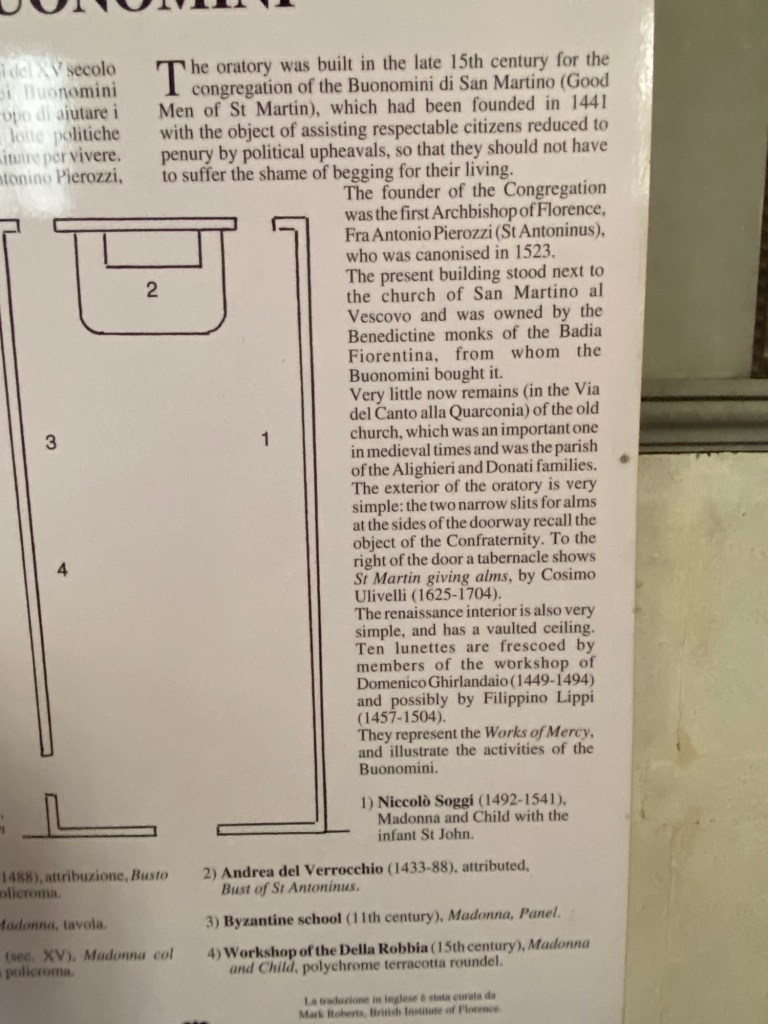
Here’s the label in the room: please read the English part if you’d like to know more about the oratory.
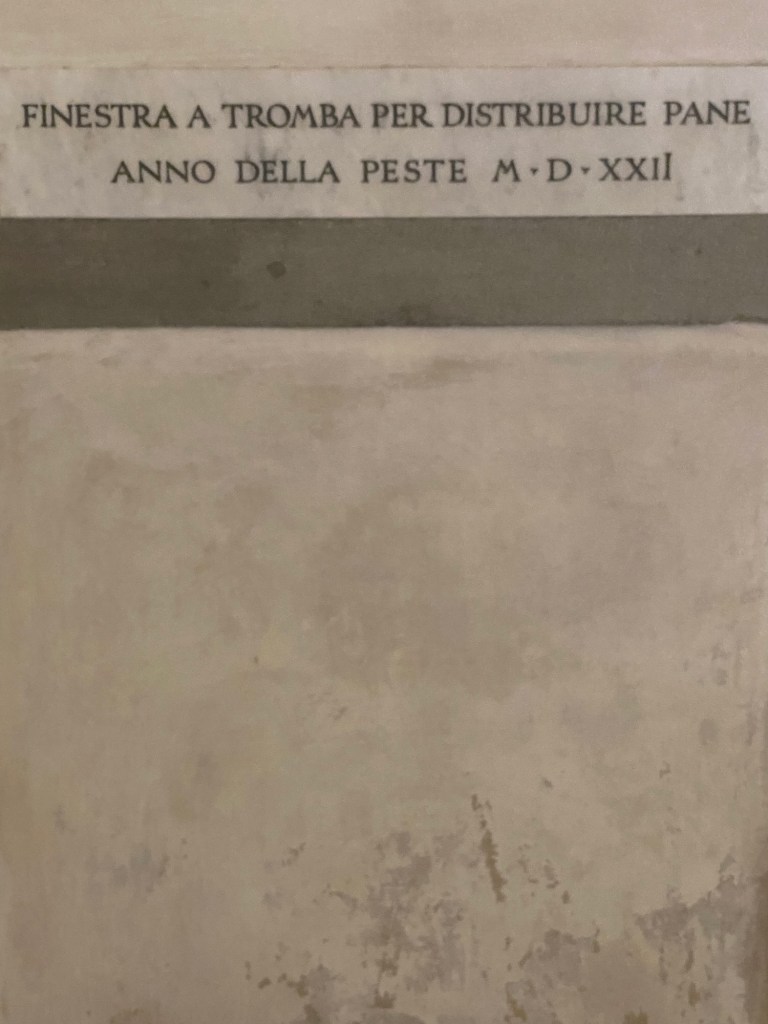
There was once an open window, seen below, from which bread was distributed to the needy during the pestilence of 1522, as the inscription says.
Below is a painting of the the madonna and child by Niccolo Soggi. In one of the videos above you will see the painting of the Madonna from the Byzantine school.
I highly recommend a visit to this small, serene and intimate space which was historically used to collect alms for the poor. The story goes that if someone needed to request funds, they could light a candle at the door to request help.
Tradition also holds that Dante Alighieri was married in this space, which may hold up if it is true that the house of his family was nearby as many scholars believe.
In any case, the oratory is a hidden gem, in plain sight, offering a unique combination of art, history and social charity in the heart of Renaissance Florence. You can visit it and soak up the charm without vying with tourists.
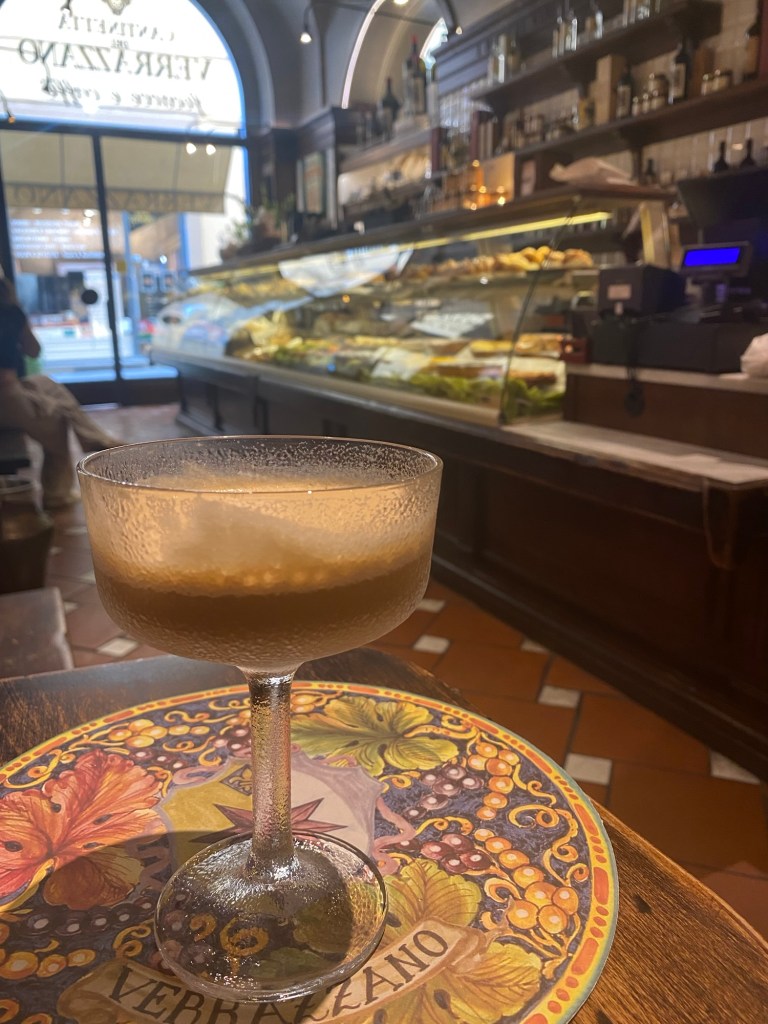
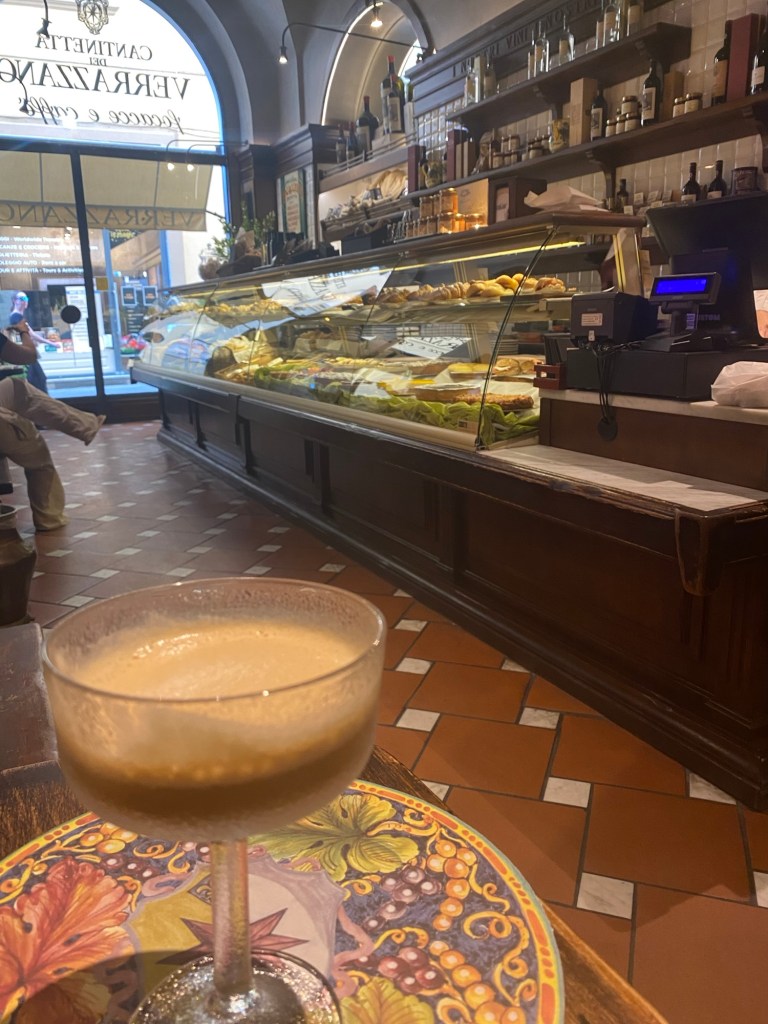
To survive (with pleasure) I seek out a caffeshakerato alle Cantinetta dei Verrazano. It’s an iced espresso with a touch of milk.
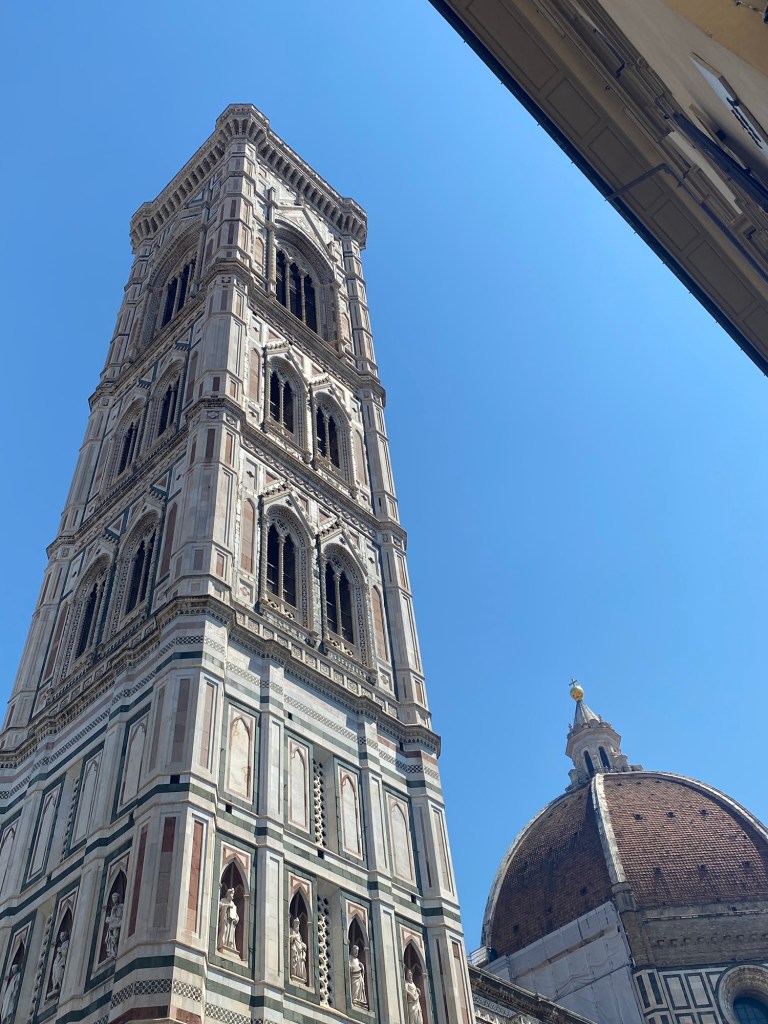
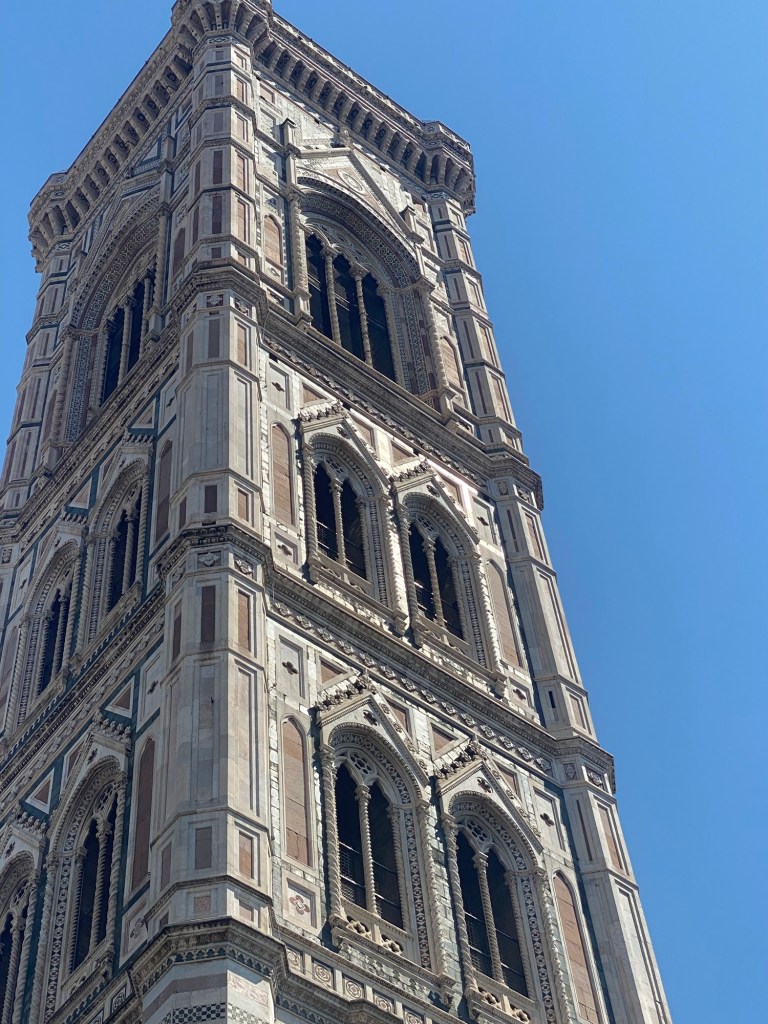
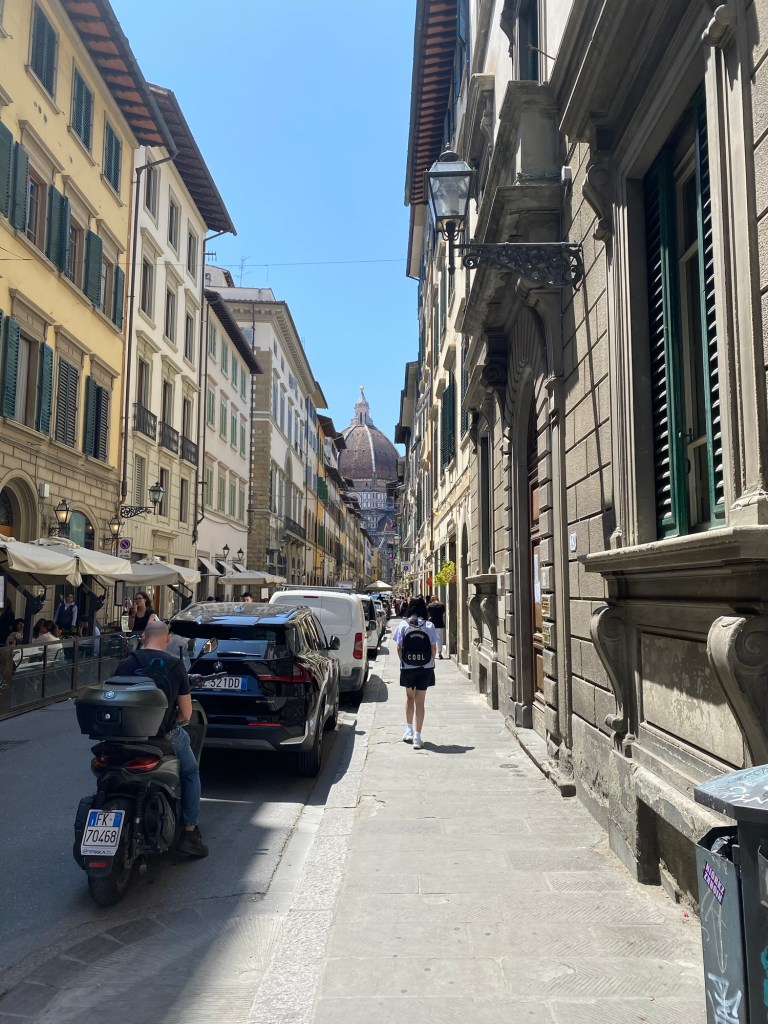
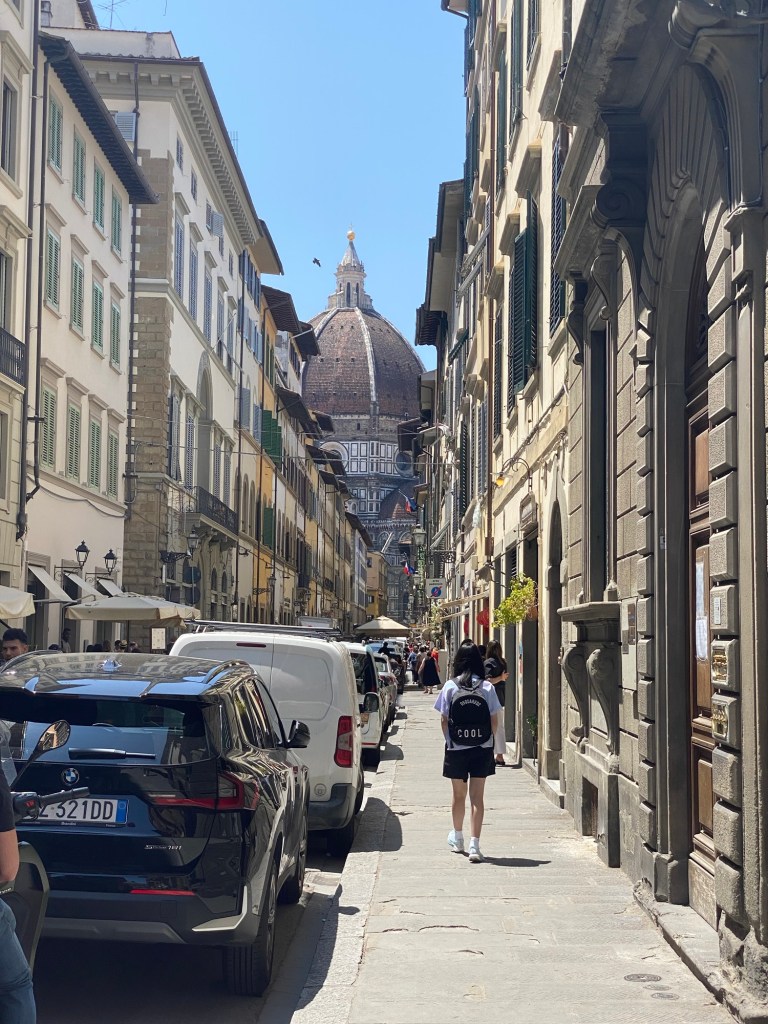
Walking a bit took me by the Duomo, and today, in the heat and under that famous Tuscan sun, the campanile reflected to sun as if it were a mirror. I tried to capture it with my camera, but you may have to take my word for it.
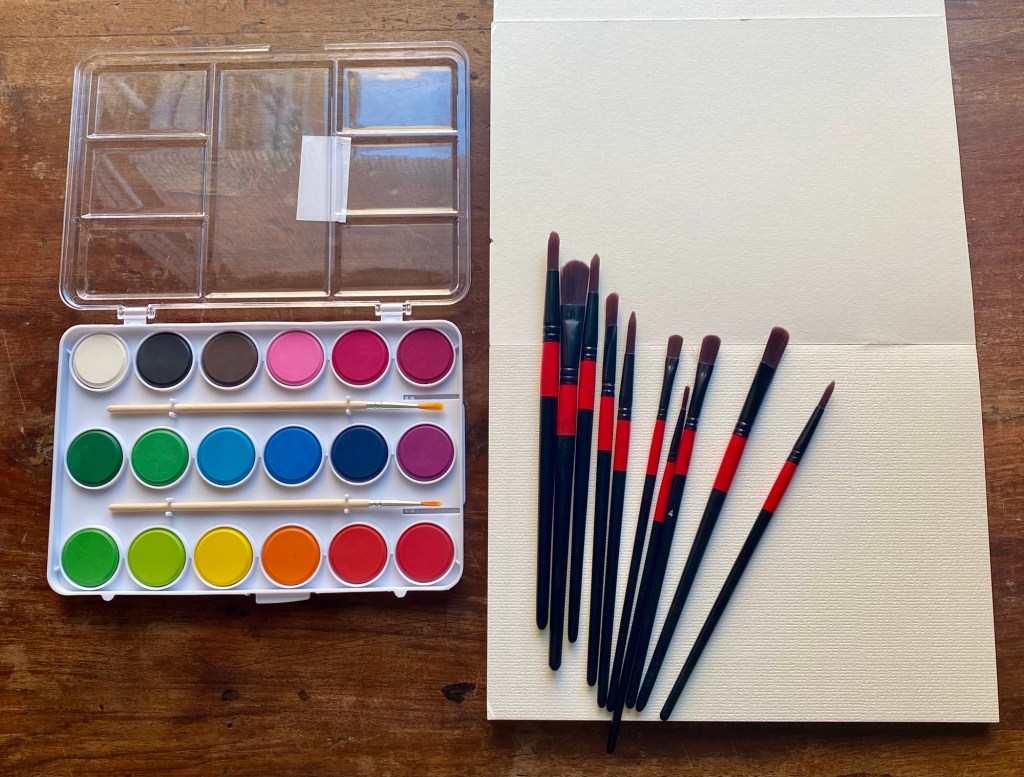
And, back at home and thankful for the a/c, I bought some art supplies to fool around with. I’ll let you know if I have any luck painting!
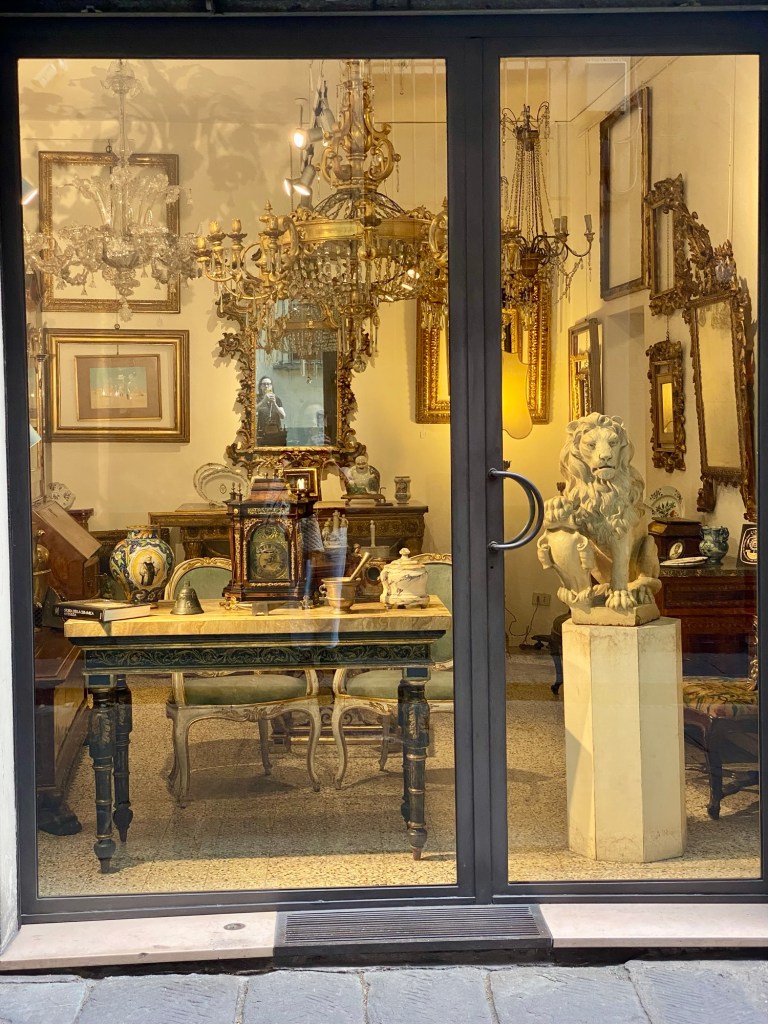
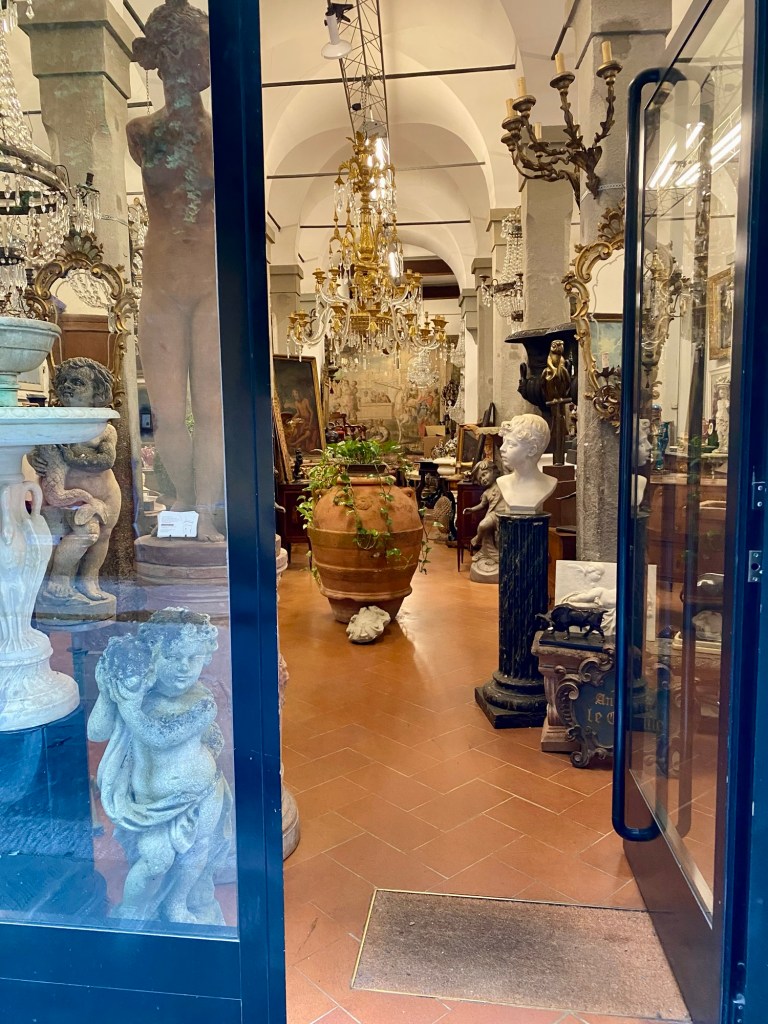
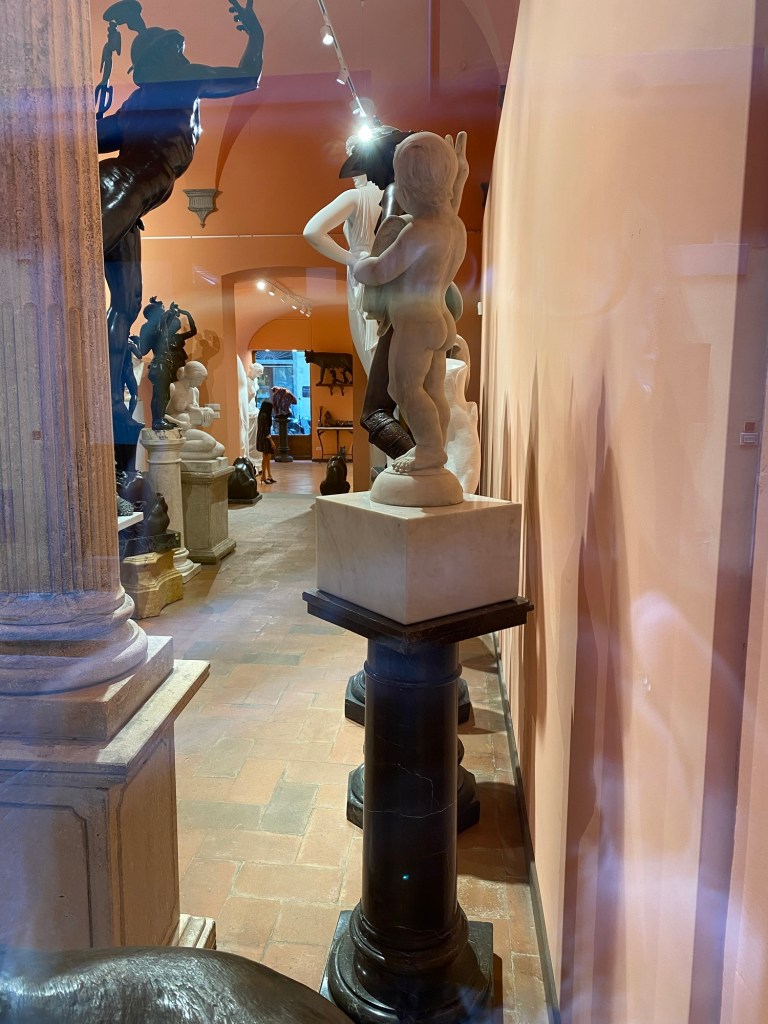
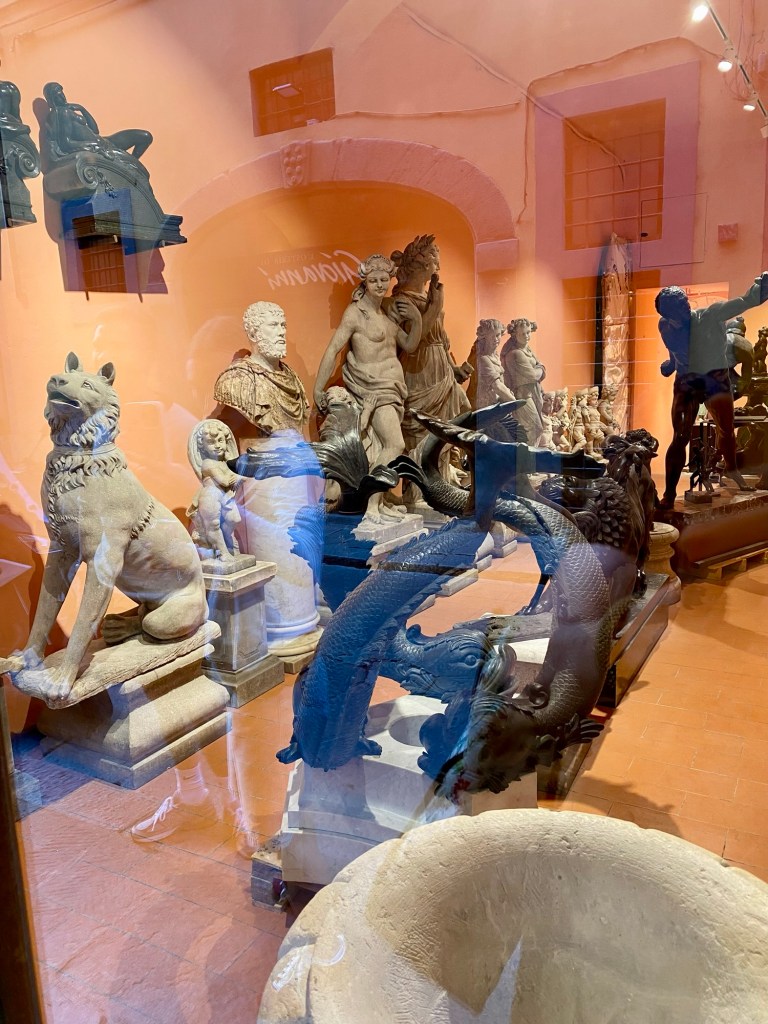
Walking down certain streets in the historic center of Florence is a such a treat. The art that is available for sale just blows my mind.
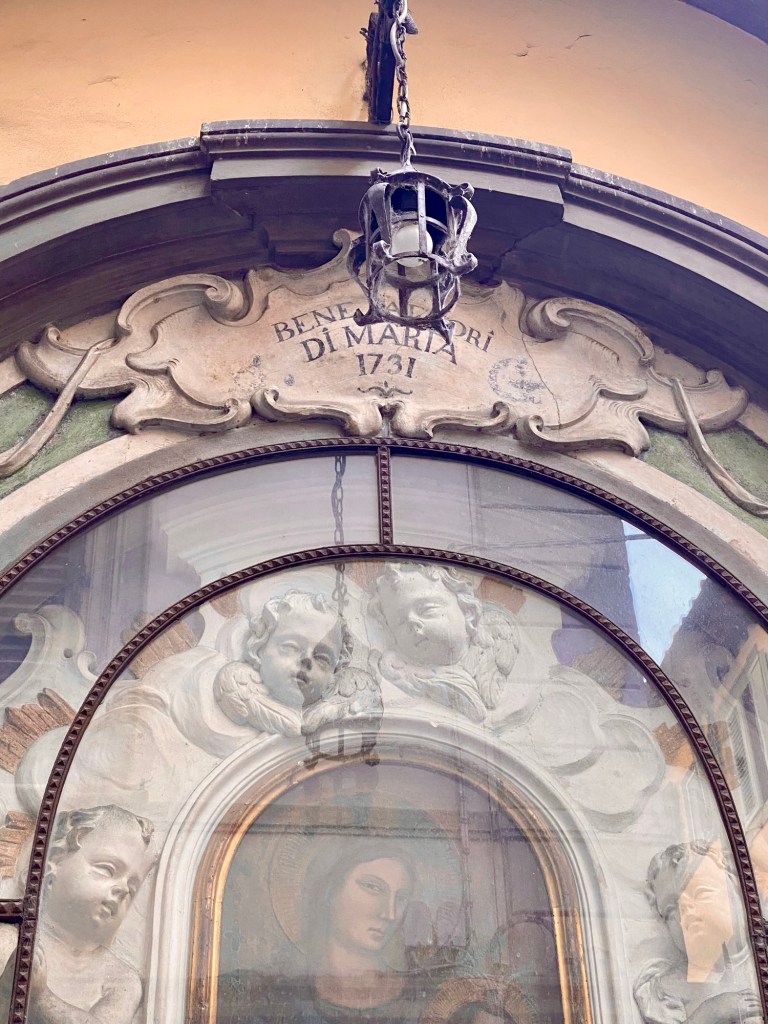
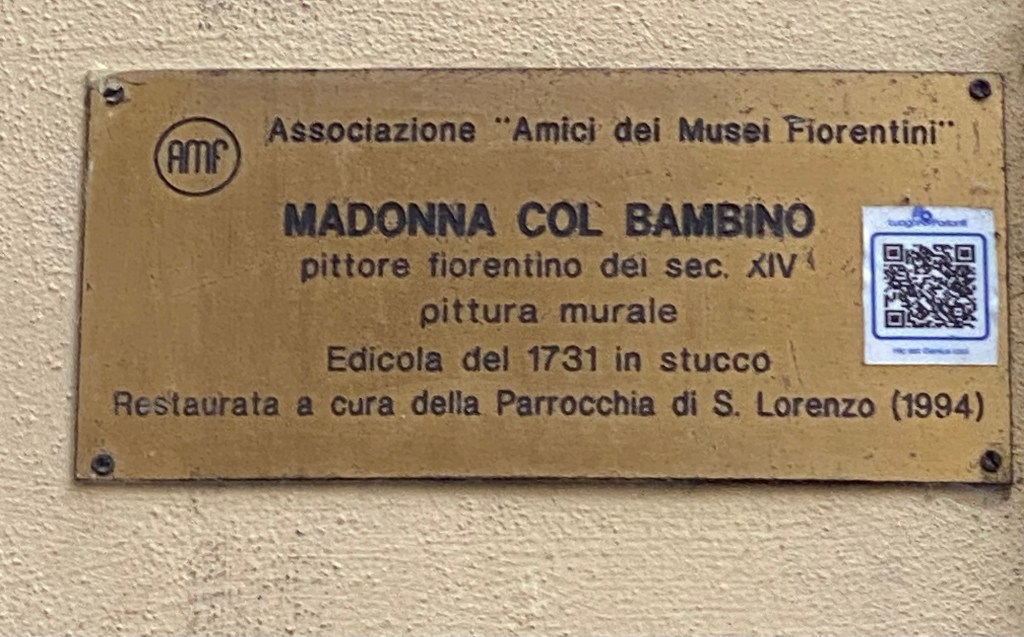
In this western section of Florence’s historic center is another of the ubiquitous tabernacles. I have posted about these before. This one is particularly elaborate, with the use of sculpture surrounding the painted images.
It dates to 1731!
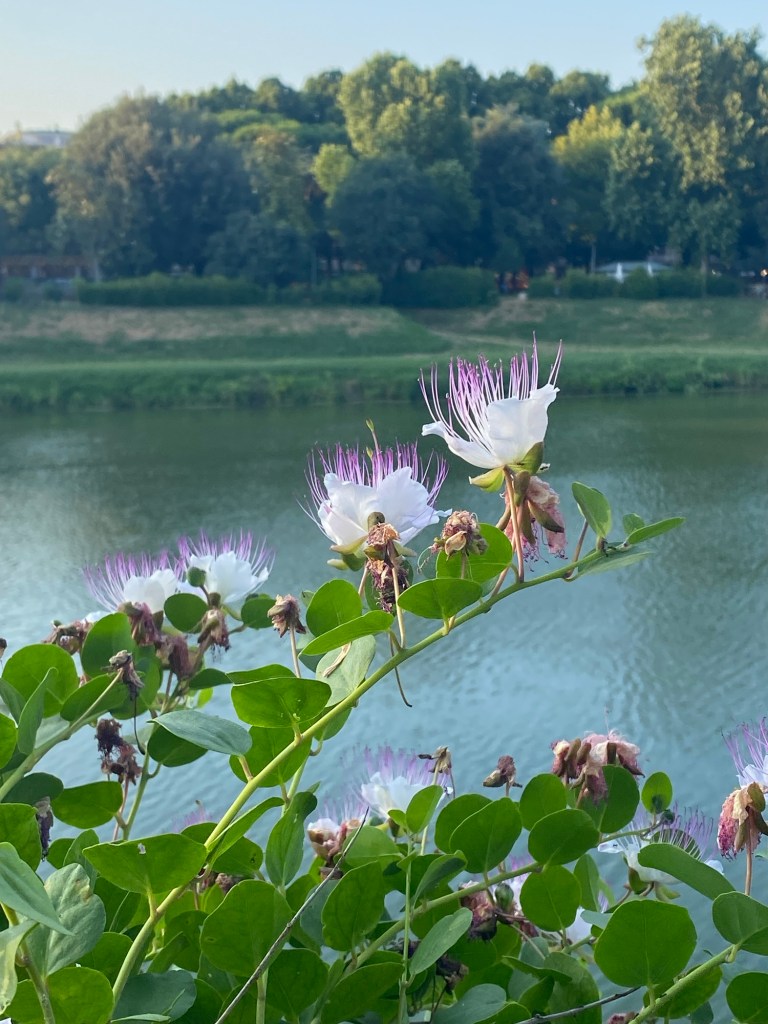
And finally, a walk along the Arno provides some nature to offset the manmade. I love the pretty blossoms on these caper plants that self-seed and grow on the stone walls in Tuscany.
These stunning flowers are from the volunteer caper plants that seed themselves in the crevices of stone walls. Their blossoms are a lovely sight this time of year.
Last night, as I strolled along the Arno after 9 p.m., when the heat of the day started to slip away, I was serenaded by the strumming of cicadas. That is the quintessential sound of high summer for me. High summer arrives sooner and lasts longer here than in the other places I’ve lived. And I don’t like it.
The sound of late summer in my mind is the churring of crickets. I love that sound and the signal it sends: autumn is coming. Soon nature will turn silent.
How lucky can you get?! I recently joined some Italian language classes but the great news is that the school is housed within a Renaissance palace considered to be a part of the artistic/historic patrimony of fabulous Florence! It fills me with pleasure each time I walk inside that storied building and up its spectacular stone stairway!
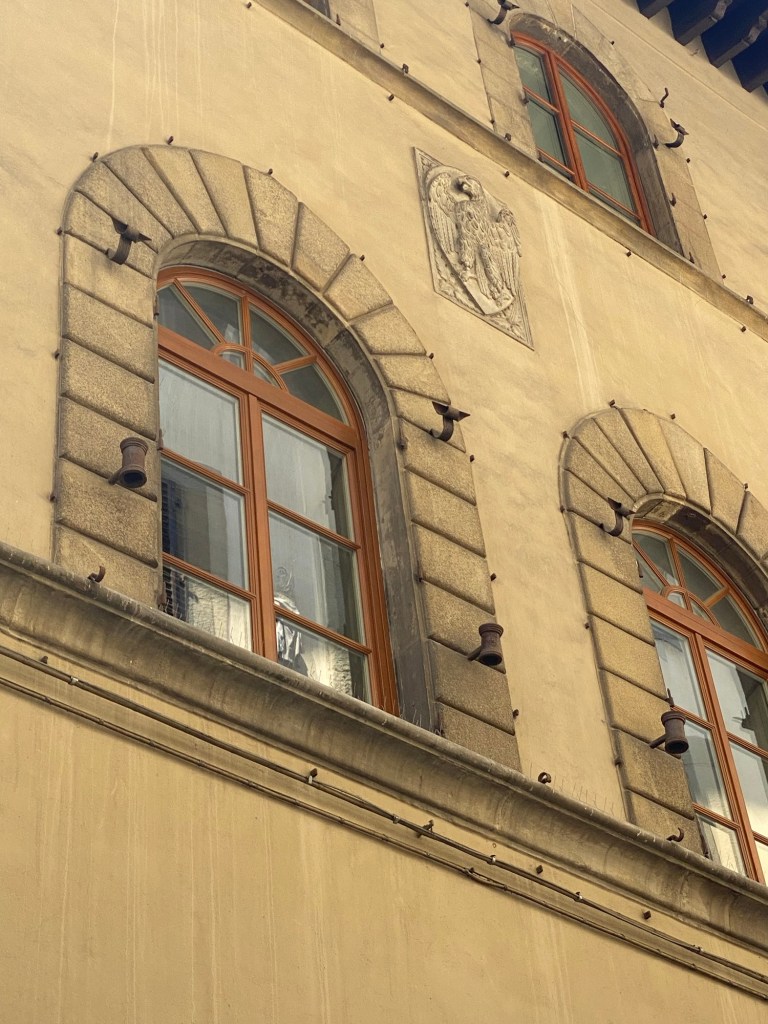
My photos below show the exterior located on via dei Pandolfini.
Now that you’ve seen the outside of the building, let me tell you a little about the interior! I’ll practice my translating skills, if you don’t mind. See each one of my translations after each paragraph in Italiano. The text is from Wikipedia Italia.
Palazzo Galli Tassi è un edificio storico di Firenze, situato in via dei Pandolfini 20, con un affaccio anche su borgo degli Albizi 23. Il palazzo appare nell’elenco redatto nel 1901 dalla Direzione Generale delle Antichità e Belle Arti, quale edificio monumentale da considerare patrimonio artistico nazionale ed è sottoposto a vincolo architettonico dal 1914.
Need a translation? I’m happy to oblige:
Palazzo Galli Tassi is an historic building in Florence at Via del Pandofini 30, with a 2nd entry on Borgo deli Albizi 23. The palace appears in a list published in 1901 by the Director General of Antiquities and the Fine Arts, which includes monumental buildings considered to be part of the artistic patrimony of the country and it has been under the protection of the state since 1914.
Eretto sulle preesistenze di varie case corti mercantili trecentesche, il palazzo viene tradizionalmente fatto risalire agli anni in cui risulta di proprietà di Baccio Valori (dal quale una delle denominazioni tradizionali dell’edificio), nel primo quarto del Cinquecento. Dopo la sua morte (1537) la proprietà, confiscata, passò ai Bellacci, ai Capponi e ai Dazzi, fino a che nel 1623 venne acquistata dai Galli Tassi.
It was erected over pre-existing 13th century houses of merchants; the palace is traditionally dated to the years in which it was owned by Baccio Valori (from which came one of the traditional names of the building), in the first quarter of the 16th century. After his death in 1537 the property was confiscated and passed to Bellacci, then to Capponi and to the Dazzi families, until in 1623 it was acquired by Galli Tassi.
Nel 1630, in previsione delle nozze di Agnolo Galli con Maddalena Carnesecchi (1632) furono intrapresi numerosi lavori di ampliamento e abbellimento degli interni. In particolare Federico Fantozzi riferisce di interventi di ammodernamento condotti nel 1645 da Gherardo Silvani (ma su base documentaria Francesca Parrini riconduce anche questi al cantiere del 1630-1633), al quale si devono tra l’altro le finestre inginocchiate del piano terreno: lo stato dell’edificio determinato da tali lavori è documentato da un cabreo datato al 1753, con la veduta assonometrica del palazzo assieme ad altre proprietà su via delle Seggiole, pubblicato da Gian Luigi Maffei.
In 1630, as part of the nuptials of Agnolo Galli with Maddelena Carnesecchi (1632) numerous renovations and amplifications were performed, further beautifying the interior. Federico Fantozzi in particular noted in his writings about modernizations that were conducted in 1645 by Gherardo Silvani (but on the documentary basis, Franceso Parrini noted in 1630-33), of which were added the kneeling windows of the ground floor: an axiomatic view of the palace was later published by Gian Luigi Maffei.
All’intervento del Silvani sarebbero seguiti i più tardi lavori condotti da Gasparo Maria Paoletti tra il 1762 e il 1763, periodo al quale risale l’imponente scalone neoclassico a due rampe. La situazione negli ultimi anni di proprietà Galli Tassi è attestata da una serie di piante, prospetti e sezioni sempre conservati nell’Archivio di Stato di Firenze e resi noti da Piero Roselli e da Gian Luigi Maffei. Alla morte dell’ultimo membro di questo ramo della casata, il conte Angiolo Galli Tassi (1792-1863, ben noto come benefattore dell’ospedale di Santa Maria Nuova), la proprietà passò per lascito testamentario agli Ospedali della Toscana.
The intervention of Silvani would be followed later works conducted by Gasparo Maria Paoletti between 1762 and 1763, a period in which were realized neoclassic stairways with two ramps. In the last years of the ownership of Galli Tassi a series of plans, perspectives and sections were made and always conserved at the State Archives in Florence; these were noted by Piero Roselli e by Gian Luigi Maffei. At the death of the last member of this branch of the house, count Angiolo Galli Tassi (1792-1863, noted as a benefactor of the hospital of Santa Maria Nuova) the ownership passed by will to the Hospital of Tuscany.
Negli anni di Firenze Capitale (1865-1871) il palazzo e gli edifici confinanti già dei Galli Tassi (in via de’ Pandolfini 18 e borgo degli Albizi 23) furono affittati per essere adibiti a sede del Ministero dell’agricoltura, dell’industria e del commercio: il generale stato di abbandono delle proprietà portò “a molti lavori di risarcimento e di trasformazione” tesi ad aumentare la superficie utile dell’edificio. In particolare, su progetto dell’architetto Paolo Comotto e direzione dei lavori dell’ingegner Francesco Malaspina, il grande salone fu diviso sia in altezza sia in pianta, ricavandone otto stanze, e la terrazza fu chiusa sul fronte di via Pandolfini ricavandone sei stanze. Furono inoltre aperte o chiuse varie finestre e porte e rifatti diversi pavimenti. Con il trasferimento della capitale a Roma il palazzo fu adibito a uffici per la Prefettura e l’Amministrazione Provinciale, fino a che venne acquistato dall’imprenditore napoletano Girolamo Pagliano, noto per essersi fatto promotore della costruzione del teatro attualmente noto come Verdi. Pervenne poi, per via ereditaria, alla famiglia Borgia.
In the years that Florence was the Capitol of the newly united Italy (1865-1871) the palace and the buildings already known as Galli Tassi (with the 2 same addresses as today) were used as the seat of the Minister of Agriculture, Industry and Commerce; the general state made many changes to the property. In particular, architect Paolo Comotto, directed by the engineer Franscesco Malaspina, the grand salon was divided in height to create 8 rooms and the terrace was closed on the front of Via Pandolfini to make 6 rooms. There were various windows and doors which received different flooring levels. With the transfer of the Capitol to Rome, the palace was turned into an office for the Prefecture and Province Administration, until it was acquired by the Neapolitan businessman Girolamo Pagliano, noted for being made the promoter for the construction of the theater now known as the Verdi. It then went by will to the Borgia family.
Al 1925-26 si datano importanti interventi di restauro, compreso quello condotto da Amedeo Benini sui graffiti della facciata. Importanti lavori di modifica interna e di restauro sono stati eseguiti tra il 1990 e il 1994, ma un altro cantiere doveva aver già interessato la fabbrica negli anni settanta, visto che il repertorio di Bargellini e Guarnieri la dice “recentemente restaurata”.
From 1925-26 important restorations took place conducted by Amedeo Benini with the sfraggiti on the facade. Between 1990 and 1994 important modifications and restorations were executed, but there must have already been a renovation in the 1970s seeing that Bargellini and Guarnieri reported that the building had been “recently restored.”
La facciata si presenta organizzata su quattro piani e sette assi, con grandi finestre ad arco incorniciate da conci in pietra, chiusa in alto da una altana, come detto ora tamponata e finestrata, nell’insieme del tutto rispondente a quanto documentato dal cabreo del 1753. Sotto il secondo ricorso è lo stemma aquilino dei Valori (di nero, all’aquila al volo abbassato d’argento, seminata di crescente del campo). Per quanto riguarda i graffiti, che caratterizzano l’edificio sia con un disegno a pietre squadrate sia con fasce decorate dove ricorrono iscrizioni e, insistentemente, il tema della vela gonfia di vento attributo della Fortuna, si è ipotizzato (Eleonora Pecchioli), nonostante i molti rimaneggiamenti, che questi possano risalire nella loro formulazione originaria alla fine del Quattrocento o ai primi del Cinquecento, il che porterebbe ad anticipare la datazione della fabbrica rispetto a quanto ipotizzato da tutta la letteratura precedente.
The present facade is organized into 4 floors and seven axes, with large arched windows framed with stone ashlars, closed at the top by a covered terrace completely corresponding to the records of 1753. Under the second stringcourse is the coat of arms of the Valori family black, with an eagle flying low in silver, on a crescent background. Re: the sgraffito, its attributed to Fortuna, with the theme of the sail with wind blowing and according to one hypothesis of Eleonora Pecchioli, the sgraffito could date back to the end of the 15th or early 16th century, although that means it would have been touched up later.
Nell’interno è da segnalare il bel cortile cinquecentesco con un gruppo marmoreo di Ercole e Iole di Domenico Pieratti (commissionato da Agnolo Galli nel 1629 e terminato nel 1659). All’interno sono presenti tra piano terra e piano nobile gli affreschi di Fabrizio Boschi (Ratto di Cefalo al piano terra, 1631), Giovanni da San Giovanni (Amore e Psiche e due gruppi di Putti, piano nobile, 1630-1631), Ottavio Vannini (Selene e Endimione, piano nobile, 1632), Cosimo Ulivelli (Ritratti dei committenti e di un servitore in finte porte del salone al piano nobile, 1640, già attribuito anche al Volterrano) e le Storie del Pastor fido e gli elementi decorativi di Baccio del Bianco e opere di Francesco Furini e Matteo Rosselli.
In the interior is a beautiful 15th century courtyard with a marble sculpture of Hercules and Iola by Domenico Pieratti (commissioned by Agnolo Galle in 1629 and finished in 1659). Frescoes by Fabrizio Boschi decorate the walls from the ground floor to the first floor (The Rape of Cefalus on the ground floor date 1631). Other frescoes by Giovanni da San Giovanni (Cupid and Psyche and 2 groups of putti, first floor, 1630-31); Ottavio Vannini (Selene and Endymion, first floor, 1632); Cosimo Ulivelli (Portrait of the patrons and one of a servant in false doors of the salon on the first floor, 1640, now attributed to Volterrano) and the Storiy of the faithful Pastor and the decorative elements by Baccio del Bianco and works of Francesco Furini and Mattero Rosselli.
Lo scalone. Il palazzo ha inoltre un affaccio su Borgo degli Albizi 23. Questa porzione sorge nel luogo di due case corte mercantili medioevali, unificate nelle forme attuali nei primi decenni del Cinquecento. Sicuramente nella prima metà del Settecento era stato unito alle proprietà dei Galli Tassi, come documenta un cabreo del 1753 pubblicato da Gian Luigi Maffei. Sviluppato su sei assi, il palazzo su questo lato presenta i consueti caratteri propri dell’architettura fiorentina del primo Cinquecento, con finestre e portali incorniciati da bugne di pietra. Al centro della facciata, sotto il secondo ricorso, è uno scudo con l’arme della famiglia Valori (di nero, all’aquila dal volo abbassato d’argento, seminata di crescenti del campo).
The stairway. The building has a second entrance on Borgo degli Albizi 23. This portion was built over two medieval mercantile housess, unified in the forms in the first decades of the 16th century. In the first half of the 18th century the 2 parts were united by the proprietor, Galli Tassi, as documents in the 1853 publication by Gian Luigi Maffei reports. Developed on 6 axes, the building on this side presents the typical Florentine architectural elements of the early 16th century, with windows and doors surrounded by stone ashlars. At the center of the facade, under the second stringcourse is the coat of arms of the Valori family (repeat of above paragraph).
Below are my pictures of the 2nd entrance to the Palazzo, located at Borgo degli Albizi 23.
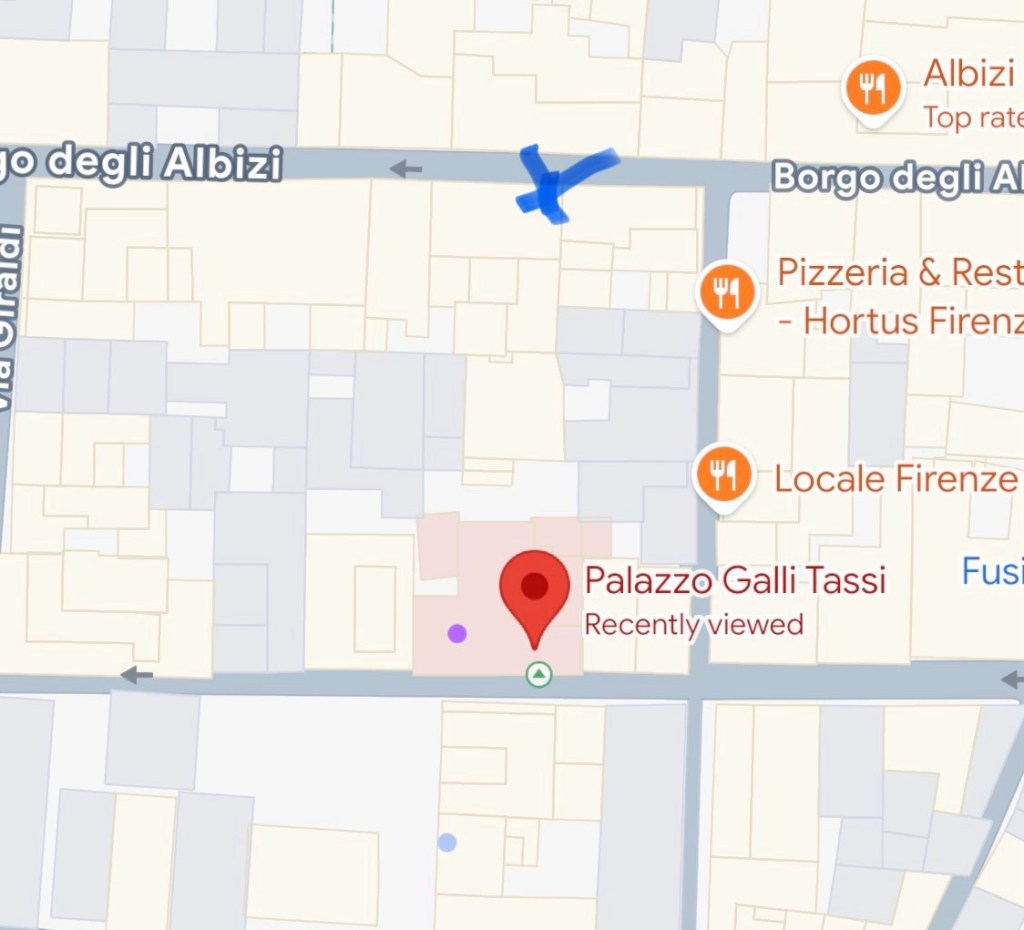
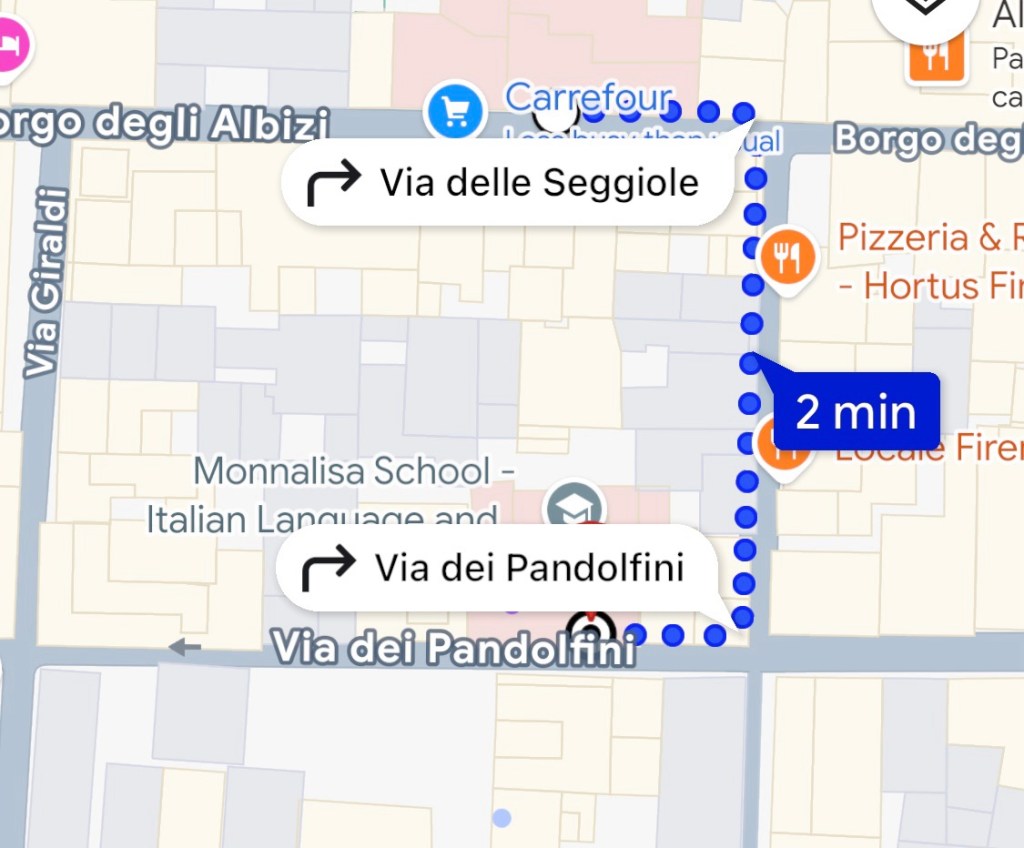
The maps below show the location of the palazzo, with a blue x marking the spot of the 2nd entrance.
Very soon I will be posting again, showing the interior of the august building.
Nothing makes me happier than learning something completely new and I had that experience again recently on my visit to the gardens at Villa La Quiete. Our lovely guide, seen below with the long hair, explained as we entered a small circular space surrounded by a circular planting of trees that had been pruned to form an open canopy around us. The center of the canopy was wide open to the sky and I regret not trying to take better pictures. At the time I was confused because ragnaia means spiderweb in Italian and I was struggling to understand its meaning here. At first I thought she was speaking about food for the silkworms that create the webs that can be spun into silk, because that was certainly an industry in Italy. It was only after I got home and did some research that I came to understand the purpose of a ragnaia in a garden.
Here’s what I learned: The ragnaia is a typical element of historic Italian gardens. The introduction of ragnaia coincides with the beginning of the golden age of the Italian garden, from the 16th century.
Above is an image of the actual ragnaia in the gardens at Villa La Quiete, although not mine. I found it on Google.
A ragnaia is a grove with tall trees, planted quite densely, between which nets were spread for the capture of small birds (aucupio), called ragne, as they resembled spider webs, hence the name. Unlike the uccellare which was generally made up of a clearing in a wooded area, the ragnaia usually had a linear layout, and very often followed a small stream that helped attract birds. Over time, in garden architecture, the ragnaia began to simply mean a grove, where one could perhaps find coolness in the summer months.
Another picture of the ragnaia at Villa La Quiete. The highlight and focus of this ragnaia is an enclosed “room” where seating is provided in these ornate stools seen above. One can sit here and enjoy the serene space, with its shade and subsequent coolness, and the sound of the moving air in the trees as well as birdsong and activity.
Our guide told us that the birds captures in the ragnaia provided most of the protein in the diet of the girls who attended school on this site.
The geometric structure of the formal garden coexists with the ragnaia. The ragnaia is a botanical architecture, made up of actual walls of plants, which runs longitudinally along the entire development of the formal garden and which was used for fowling, or hunting small birds. This sort of grove is made up of evergreen species, in particular holm oaks for the upper part and typical Mediterranean plants for the lower part such as phillyrea, buckthorn and boxwood. The perfectly linear structure of the ragnaia was constantly maintained to create walls of plants that were structured into avenues and rooms with completely green walls.
In the avenues of the so-called spiderwebs, nets would be laid out lengthwise, anciently called “spiders” because of their resemblance to cobwebs, which were used to capture birds attracted by the coolness and shade of this space, as well as by the possibility of food offered by the berries of the shrubs. Unable to land on the branches of the trees due to the perfectly linear pruning of the espaliers of the holm oak avenues, the birds were forced to descend to ground level, where the nets were laid out, and ended up being captured, as if getting caught in the spiderwebs. In the ragnaia, hunting was not the only activity: the “octagonal room” and the “royal room” are green rooms that still exist today made of walls of boxwood and centuries-old holm oaks, with stone stools and benches, where the Electress Anna Maria Luisa loved to stop to escape the heat, and enjoy the shade and the singing of the birds.
Typical of Italian gardens of the time, ragnaia were often scaled down or radically modified over the centuries to follow new garden trends that favored freer and less formal structures. This did not happen at La Quiete because the property, the Montalve conservatory, never changed until the end of the 20th century and thus there were no significant alterations to the original layout of the garden, which is a gift to us today.
Well, I go out walking, after 6 p.m., when the day is beginning to cool off. Summer days in Florence are hot! Understatement.
One of my favorite paths is walking along the Arno River heading east from my house. I love the activity on the river as seen in the next 2 videos.
As I head back home, I pass this lovely green walkway and, while it is still hot out, nature makes it feel cooler.
Lots of Florentines feel the same way and there are many bars throughout the area serving snacks and ice cream and various cold beverages. You won’t get any ice, however.
Even on a walk to beat the heat I see harmonious beauty.
On another day, in the center of town, the duomo sits majestically in the summer sun.
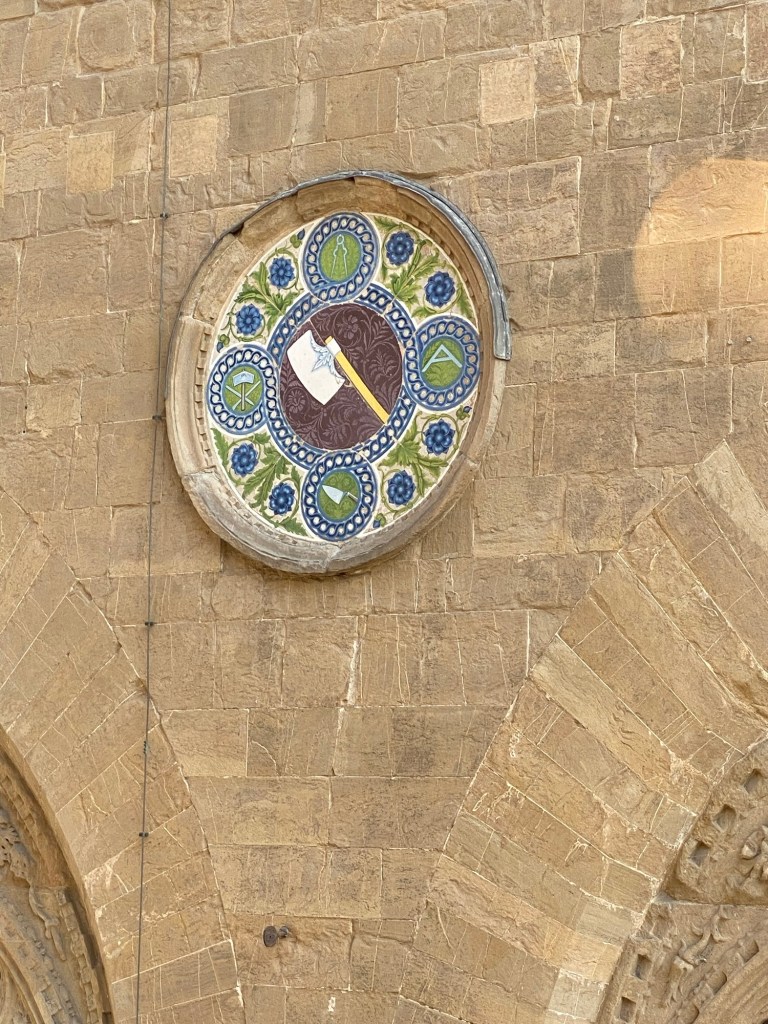
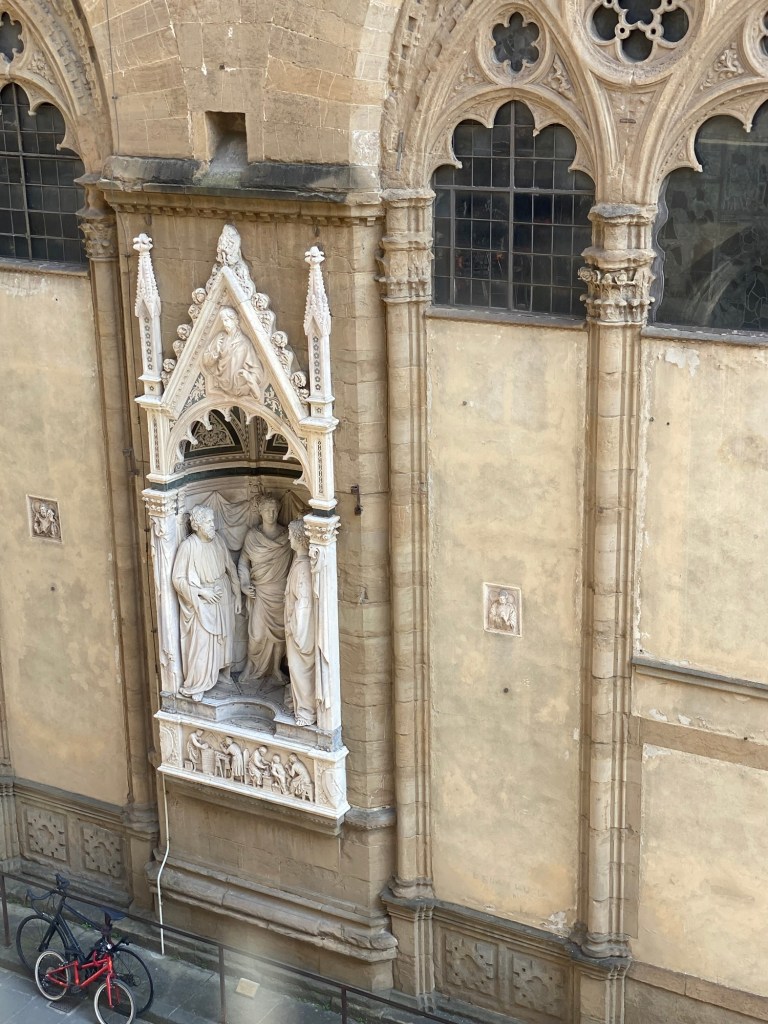
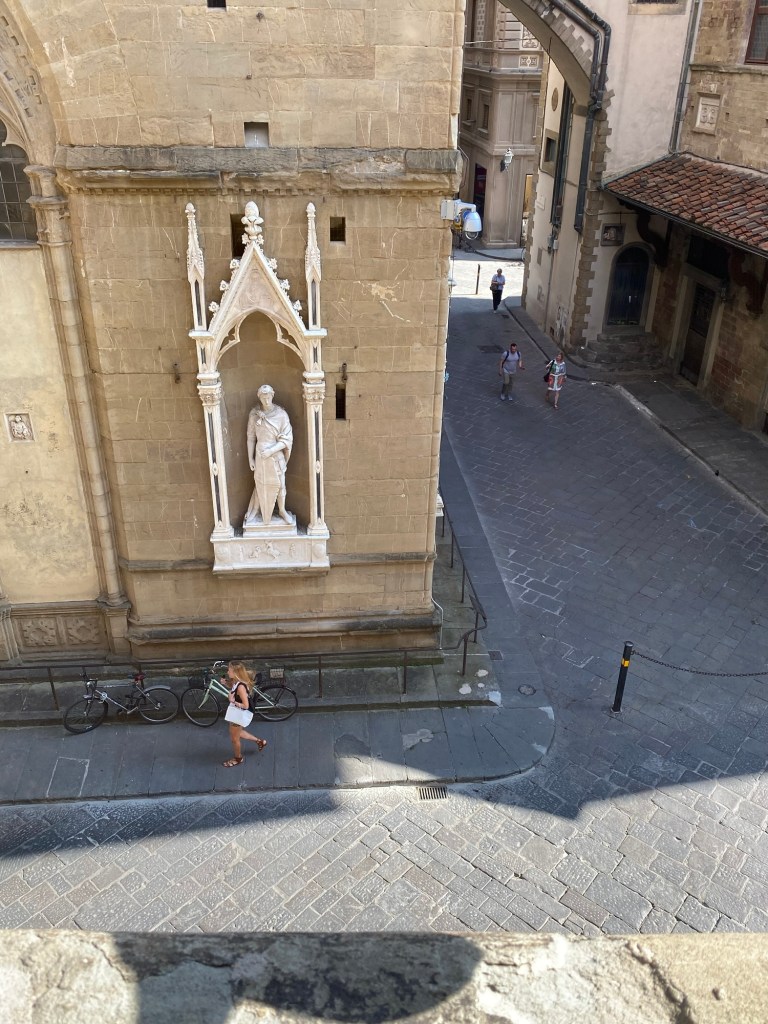
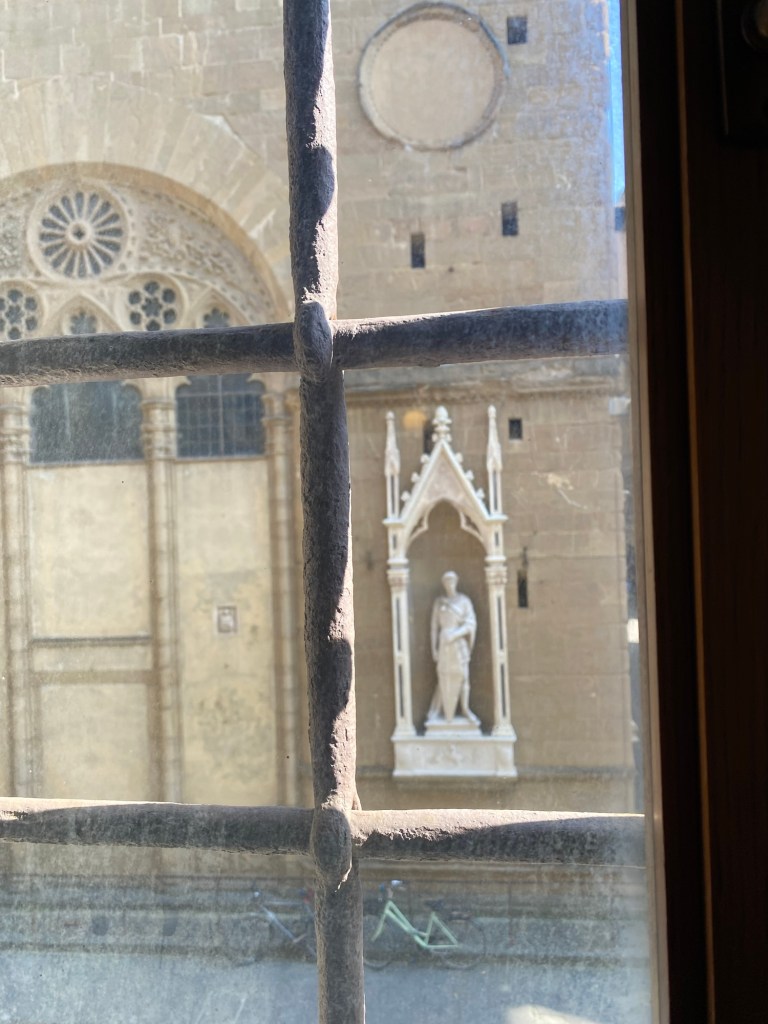
I recently posted about visiting the historic Palazzo dell’Arte dei Beccai in Florence and had an unexpected view of another major landmark in the city, the Orsan Michele which is and has been a church since the 15th century, but was built as a granary. It’s a fascinating building, but for today I am simply going to show you the pictures of it and especially its noteworthy niches for the display of sculptures that I was able to take from the upper stories of the Palazzo. It isn’t everyday one gets this opportunity!
I recently attended an art history conference held in a fascinating building in the heart of Florence, the Palazzo dell’Arte dei Beccai. It is a 14th century building that once was the guild hall for the association of butchers. That seems humble to us today, perhaps, but this was a major guild during the medieval period. People have always needed to eat.
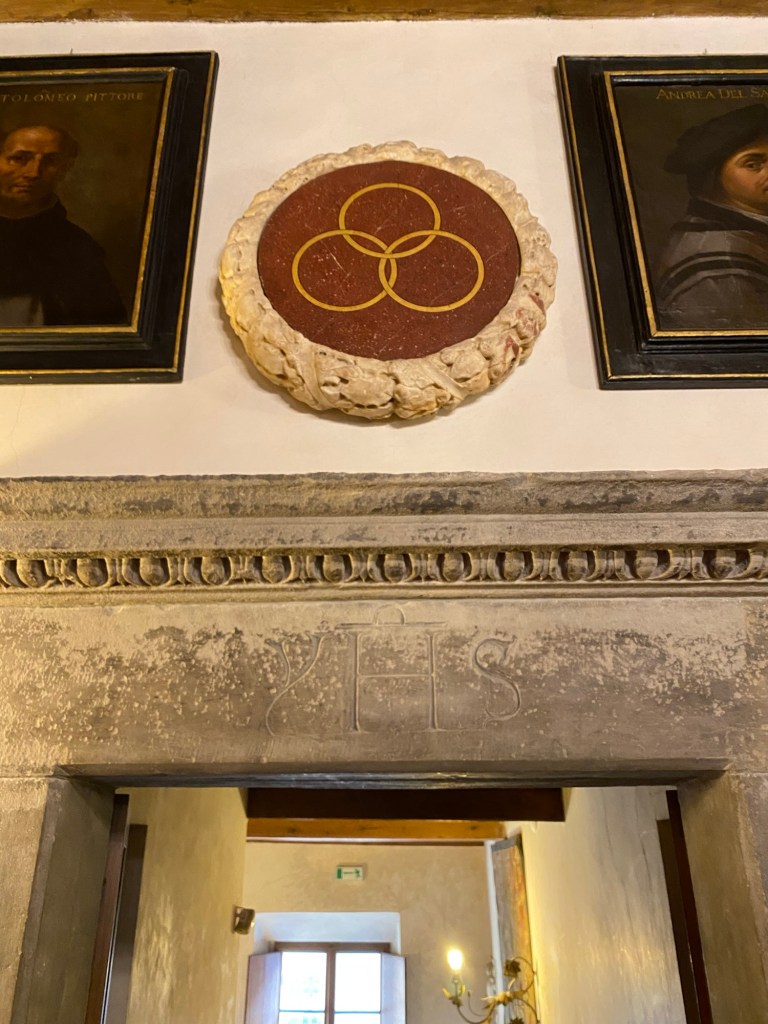
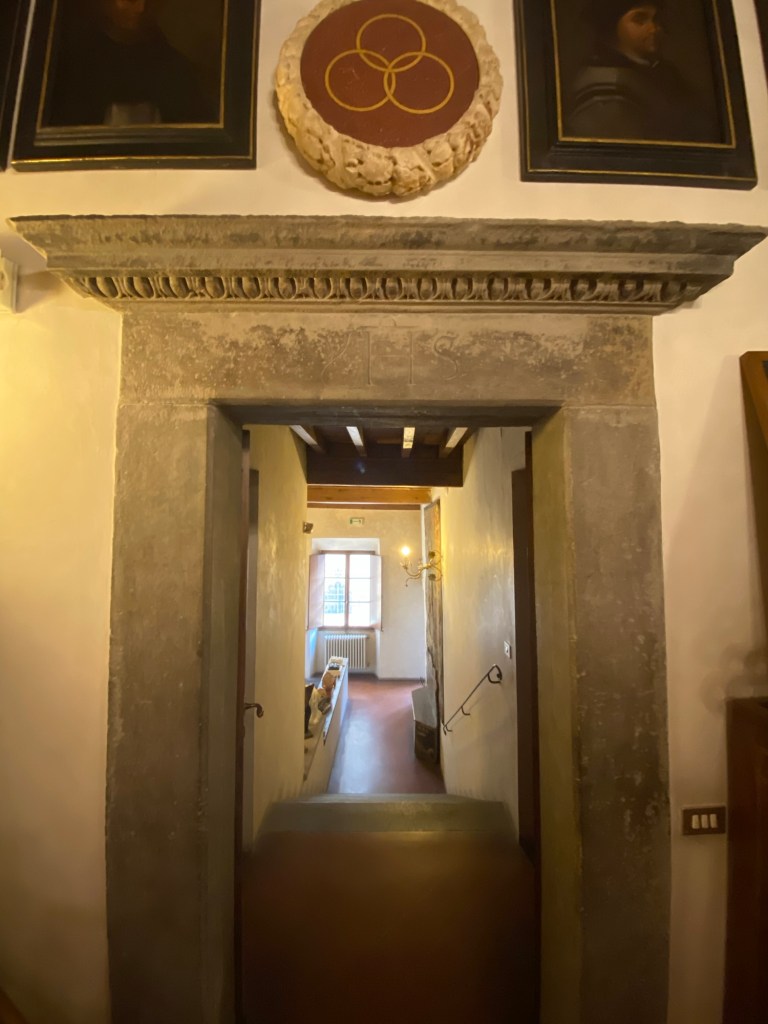
The façade is largely unchanged from its 14th-century appearance, although some windows have undergone later modification. The piano nobile is marked by four large arched windows. Above them are the arms of the Arte dei Beccai, a long-horned billy-goat, the Italian: becco from which the name of the guild derives; this work has been attributed to Donatello. Lower on the façade are other crests, the giglio or lily/iris of Florence and the three interlocking wreaths of the Accademia Fiorentina delle Arti del Disegno. In 1901 the building was included in a listing of buildings to be considered part of the national heritage, compiled by the Direzione Generale delle Antichità e Belle Arti, or “general directorate of antiquities and fine arts”.
Today the building houses the Accademia delle Arti del Disegno which has a storied history but today its declared purposes are the promotion and diffusion of the arts, and the protection and conservation of cultural heritage worldwide. It organises conferences, concerts, book presentations and exhibitions, and elects noted artists from all over the world to honorary membership.
I walked through those enormous wooden doors (I’ve actually been in the building before for another event, but had not known its significance then) and felt a certain something, a feeling of gravitas, and sat listening to speakers in both Italian and English discussing new findings on an 18th century woman artist. She would never have been allowed to be a member of the academy during her lifetime, but she is finally having a moment of recognition thanks to the hard work of some people today.
My photos and videos taken on that day are at the end of this post, but I want to take the time to discuss the art association housed within these hallowed halls first. You can skip all this and go directly to my images if you like. I wouldn’t blame you. Not everyone loves these details as much as I do!
In the late 15th century, a few art institutions that emphasized learning and knowledge over technical skill began to appear. Francesco Squarcione established a “studio” in Padua around 1440, perhaps the first to operate outside the guild and workshop system. The guilds of various professions flourished in Florence and other Italian cities and were essential to any professional person (read “man” of course) in any field from butcher to silk manufacturer.
Some 40 years later the so-called Medici Academy was created in Florence, under the sponsorship of Lorenzo de’ Medici, a great lover of the arts. It was administered by sculptor Bertoldo di Giovanni, a Medici favorite. Artists and young patricians met at a property the Medici owned around the Piazza San Marco, a pleasant retreat with rooms, loggias, and a garden where works from Lorenzo’s collection of ancient sculpture were displayed (although the finest were probably kept in the Medici palace). The sculpture garden was of sufficient interest to be highlighted on some early topographical views of Florence. The truly original “Academy,” the one created by Plato in the fourth century BCE, had met in a sacred grove outside Athens, a connection that Lorenzo and his humanist circle would not have overlooked as they sought to style their city a new Athens.
Information about Lorenzo’s sculpture garden is sparse, but it figures in two stories circulated about the young Michelangelo. One had the youth so impressed by the works of ancient sculptors he saw there that he abandoned his training as a painter on the spot, never returning to the shop of Ghirlandaio, where he had been apprenticed. The Michelangelo biographer Ascanio Condivi also recounts how the youth had taken up an unworked block and perfectly copied an antique head of a faun, amazing Lorenzo. Here, in one stroke, Michelangelo began his career as a sculptor and his long association with the Medici. Such accounts must be viewed with some skepticism, however, since Condivi, who took his cues and much of his actual text from the artist himself, continually underplayed Michelangelo’s artistic training to increase the sense of the master’s unique genius. Nor did either the artist or his biographer overlook any opportunity to underscore a Medici connection.
Vasari provided the most extensive description of the garden and named its pupils—but he had motives of his own. As the major force behind the Accademia del Disegno, Vasari was interested in giving that later organization a pedigree, especially one that could link it both to Michelangelo, in whom Vasari saw the perfection of art in his time, and to the illustrious ancestor of his own patron, Cosimo I de’ Medici. Lorenzo’s sculpture garden can probably be viewed as a proto-academy at best. Nevertheless, Lorenzo was certainly active in promoting the arts, visual and literary, in his city. Vasari said that Lorenzo had opened the garden to remedy a shortage of sculptors in Florence. It is also clear that he pushed sculpture in the direction of classical art. It has been suggested that some work carried out in the garden involved restoration of antique statues. By encouraging students to draw after antique models, Lorenzo provided a sort of training not always available in the city’s traditional workshops and enhanced Medici prestige through progressive patronage of the arts.
While Leonardo da Vinci was in Milan in the 1490s, he was part of something called the Academia Leonardi Vinci, about which little is known. Its members included literary men, other artists, and musicians. Rather than a forum for instruction, however, it seems to have been an informal association of people with shared enthusiasms.
The sculptor Baccio Bandinelli also assigned the label “academy” to his studios, initially in Rome in the 1530s and later in Florence. But the first true academy, an institution with official status organized to provide art students with a formal educational program, seems to have been the Accademia del Disegno in Florence.
The first true academy for instruction, the Accademia e Compagnia delle Arti del Disegno, was established in 1563 in Florence by the grand duke Cosimo I de’ Medici at the instigation of his court painter, advisor, and art historian Giorgio Vasari. The two nominal heads of the institution were Cosimo himself and Florence’s favorite son, Michelangelo. Membership in the Accademia del Disegno was an honor conferred only on already-recognized independent artists; you could not simply choose to join.
Duke Cosimo granted a constitution to the Accademia on January 31, 1563. Its origin lay a few years before, when the monk and sculptor Fra Giovanni Angelo Montorsoli (one of Michelangelo’s pupils) dedicated the crypt he was building for himself in the convent of the church of Santissima Annunziata for the common use of all practitioners of the arts of disegno—painters, sculptors, and architects—who died without a burial place; he also provided for masses to be said for their souls. Vasari saw Montorsoli’s endeavor as an opportunity to retool the old, now moribund, Company of Saint Luke (a Guild) into a new organization that, beyond its religious function, could promote the intellectual and theoretical education of young artists while further distancing them from traditional trades and the guilds. The group first convened in the cloisters of Santissima Annunziata in 1562 to rebury the remains of Pontormo, who had died in 1557. The new sepulchre was sealed by a stone with reliefs depicting the tools used by artists and architects.
Duke Cosimo called a competition for the design of a new impresa (emblem) for the Accademia. This design is one of several that Cellini made (though not the one he finally submitted). The long inscription helps explain the image. The figure is the famous ancient statue of Diana from Ephesus, with wings of inspiration added. She is flanked by a snake, a symbol used by Cosimo, and a lion, a symbol of Florence. From the arms of the goddess extend flaring trumpets—to herald the fame of art and artists. An “alphabet” of artists’ and architects’ tools parallels the letters used by poets and philosophers just above. In fact, the Accademia continued for many years to use the winged bull, symbol of Saint Luke, which had been the emblem of the old Company of Saint Luke. The new design eventually adopted consisted of three interconnected wreaths for the three arts of painting, sculpture, and architecture.
When the new Accademia (officially the Compagnia e Accademia del Disegno, a name reflecting its origin and continued role as a lay confraternity) was formally constituted the following year, Cosimo was made capo (head), forestalling any possible objection from the guilds. For the duke, this was an opportunity to bring the visual arts closer into the fold of the state, just as he had done with the humanities. With a small territory, a small army, and a short aristocratic history, Cosimo, like Lorenzo before him, used culture to enhance his prestige. (It worked: when the French royal academy of the arts was formed under Louis XIV in 1648, the first paragraph of its charter referred specifically to the patronage of the dukes of Tuscany.) Cosimo shared the title of capo with Michelangelo, who was then quite old and had not been in Florence for thirty years. But he was still revered: no one had more perfectly applied the ideals of disegno or done more to elevate the image of the artist. The standing of the Accademia was greatly enhanced by one of its earliest and most public projects—the staging of Michelangelo’s elaborate funeral in 1564, which celebrated the genius of one artist and all art. The Accademia was administered by Vincenzo Borghini, humanist and historian—and not coincidentally a friend of Vasari’s. Borghini did as much (or more, some argue) as the artist to shape the new organization, and he was close to the duke.
The statutes of 1563 laid the groundwork for the Accademia’s educational program, which offered regular lectures on geometry and other subjects and periodic demonstrations of anatomy. Academy members visited young artists in the workshops where they apprenticed to offer encouragement and suggest improvements to their work. Students without money were given financial support.
Vasari painted a fresco in the Accademia’s chapter room (which came to be called the Cappella di San Luca, partly on account of this work) in Santissima Annunziata. We see Luke, in the person of Vasari himself, painting the Virgin and Child. Looking on are Montosorli and the prior of the church. The chapel was actually dedicated to the Trinity—appropriate for the three arts of disegno but also a common focus in contemporary Counter-Reformation theology.
The Accademia became the most important art institution in Florence in the late 16th century. Records show that its membership included almost every artist working in the city; among the officers were Vasari, Benvenuto Cellini, Giambologna, and other leading practitioners. Members did not have to be Florentine—Giambologna, for example, was born and trained in the Low Countries. A plan to admit amateurs as well as practicing artists was discussed but abandoned. In the 17th century, however, “gentlemen and noble persons [who] are knowledgeable with respect to the sciences of architecture and the art of disegno” did participate.
In 1571 the Accademia petitioned Cosimo to formally release painters from the guild of the Arte dei Medici e Speziali, and sculptors from the Fabricanti (which had superseded the Arte dei Maestri di Pietra e Legname). Thereafter the Accademia assumed various guild functions and was finally incorporated as a guild itself in 1584. The institution endured until the late 18th century, and the most important years of its history lie beyond the period under consideration here. For us, it marks an important transition in the perception of the artist and the growing acceptance of his work as being on a par with philosophy, literature, rhetoric, and the other liberal arts.
When Vasari’s academy fell into disorganization rather early on, his ideas were taken up in Rome by the Accademia di San Luca, re-established as an educational program in 1593 by the painter Federico Zuccari and Cardinal Federico Borromeo. With its emphasis on instruction and exhibition, the Accademia di San Luca was the prototype for the modern academy.
Among its functions, and much imitated in later academies, was the sponsorship of lectures given by members of the academy and later published and made available to the general public. Such discourses became the means by which academies fostered and gained public acceptance for particular aesthetic theories. The Accademia di San Luca was firmly established by 1635, having received support from the powerful Pope Urban VIII. All the leading Italian artists and many foreigners were members; the secondary aims of the institution—to obtain important commissions, to enhance the prestige of the members, and to practice exclusionary policies against those who were not members—were avidly pursued.
The 1531 print depicts Bandinelli and students in Rome, with an inscription referring to the assembly as an “academy”; the second print, from the 1550s, shows the later establishment in Florence, where various parts of human skeletons are available for study. Anatomy was considered a particular skill of Bandinelli’s. In the Rome image, candlelight throws dramatic shadows on the walls, as students draw from ancient statuettes or casts. The pairing of silhouettes with their three-dimensional sources offers a concrete illustration of how drawing or painting and sculpture are related to each other through disegno.
For the following two centuries, academicism dominated Italian artistic life. The decline of the church and then of aristocrats as patrons—those groups had formerly commissioned the painting of whole rooms at a time—resulted in the abandonment of the artist to an anonymous market of buyers who might commission one portrait or some other single easel painting at a time. This made exhibition essential to the artist’s success. The state-supported academy, being the only institution financially able to provide this service on a large scale, came to control public taste, the economic fortunes of the artist, and ultimately the quality of his art by its determination of standards in the work it chose to show.
In France the Académie Royale de Peinture et de Sculpture was founded in 1648 as a free society of members all entitled to the same rights and granted admission in unlimited numbers. Under the sponsorship of the powerful minister Jean Baptiste Colbert and the direction of the painter Charles Le Brun, however, the Académie Royale began to function as an authoritarian arm of the state. As such, it assumed almost total control of French art and began to exercise considerable influence on the art of Europe. For the first time, the concept of aesthetic orthodoxy obtained official endorsement. The Académie achieved a virtual monopoly of teaching and exhibition in France, beginning in 1667 the long-lived series of periodic official art exhibitions called Salons. Thus, the idea, born of the Enlightenment, that aesthetic matters could be universally subjected to reason led to a rigid imposition of a narrow set of aesthetic rules on all art that came within the Académie’s jurisdiction. This approach found especially fertile ground in the Neoclassical style, which arose in the second half of the 18th century and which the Académie espoused with enthusiasm.
Meanwhile, numerous academies, usually state-supported and similar in structure and approach to the French Académie, were established throughout Europe and in America. By 1790 there were more than 80 such institutions. One of the most important to be founded was the Royal Academy of Arts in London, established in 1768 by George III with Sir Joshua Reynolds as its first president. Although Reynolds gave the obligatory discourses on the importance of harmony and uplifting conceptions in painting, the Royal Academy never dominated art as completely as academies on the European continent.
The first important challenge to the power of the academies came with the rise of Romanticism, which saw the artist as an individual genius whose creative powers could not be taught or externally controlled. Although most notable Romantic artists were absorbed into the academic system in the first half of the 19th century, eventually almost all artists of significance found themselves excluded from official patronage, largely because of the widening gap between their achievements and the taste of the bourgeois public to which the academies catered.
The blow that finally broke the power of the academy was struck in France. After a series of unsuccessful compromises (e.g., the Salon des Refusés, established in 1863 by Napoleon III for painters excluded from the Académie), the Impressionists, who exhibited independently between 1874 and 1886, succeeded in winning the complete acceptance of the critics. In the 20th century the art academy became an important source of instructi
Now, with no further ado, here are the pictures/videos I happily took on my lucky day.
Above and below, 3 frescoes by Pontormo that were detached from their original locations and moved to this building for safe keeping. We sat in front of these fine paintings for the presentations.
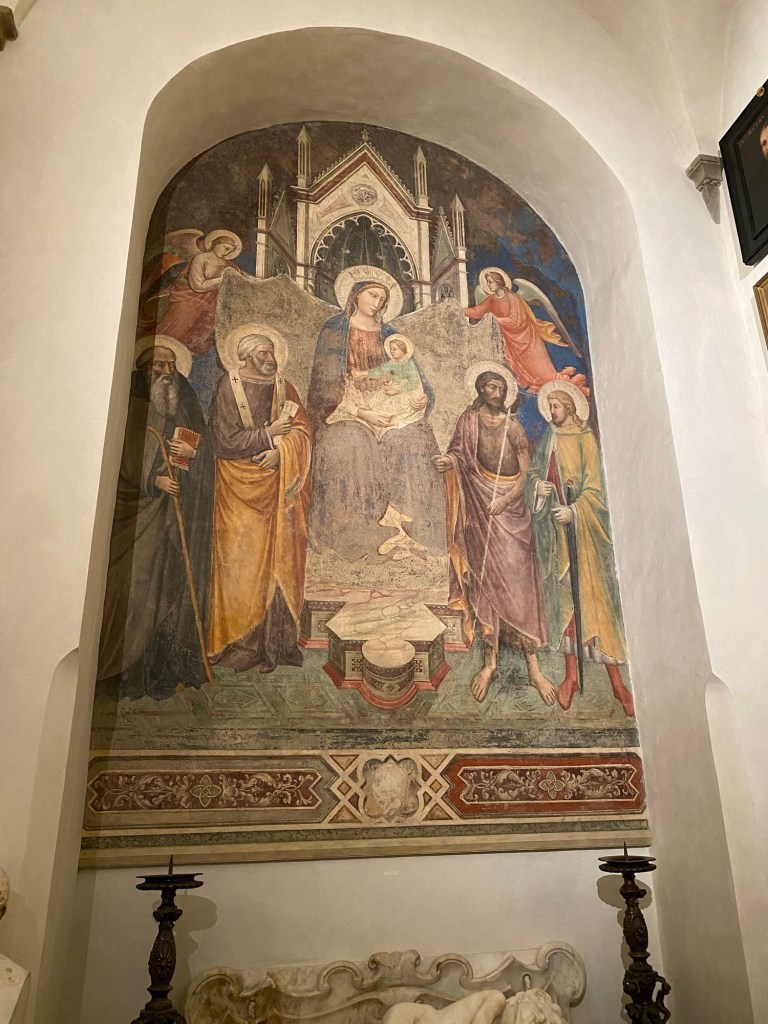
Above and below, this 15th century fresco is the only original art work that survives in this building.
It was a fine day and I was delighted to be a part of it.
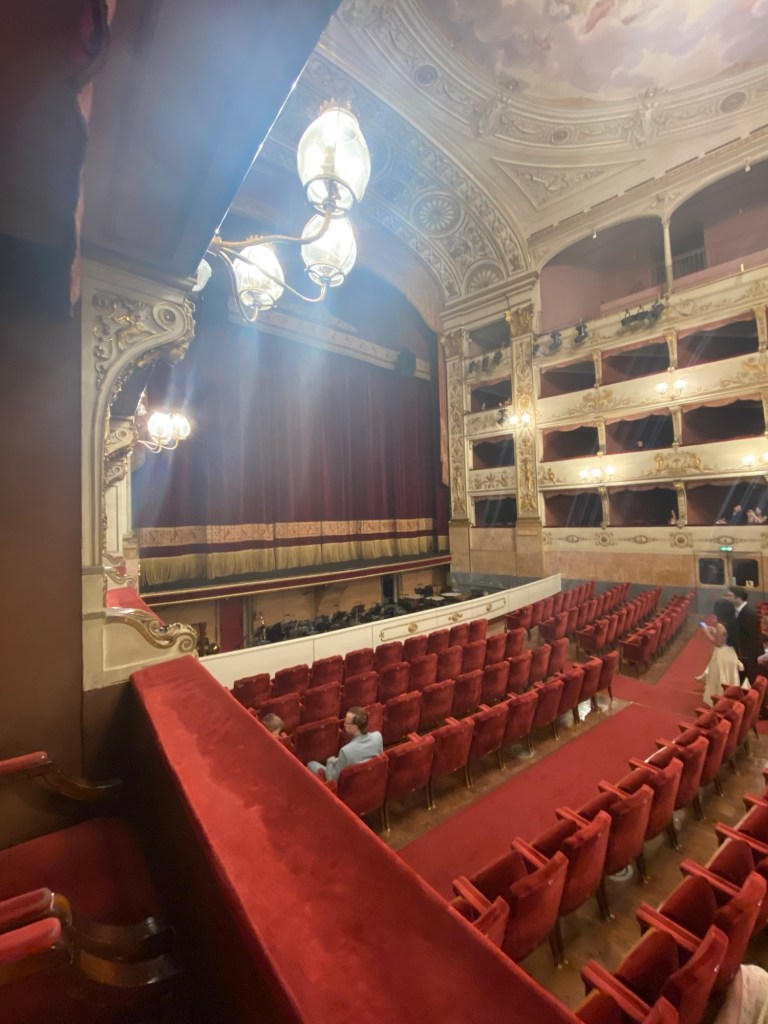
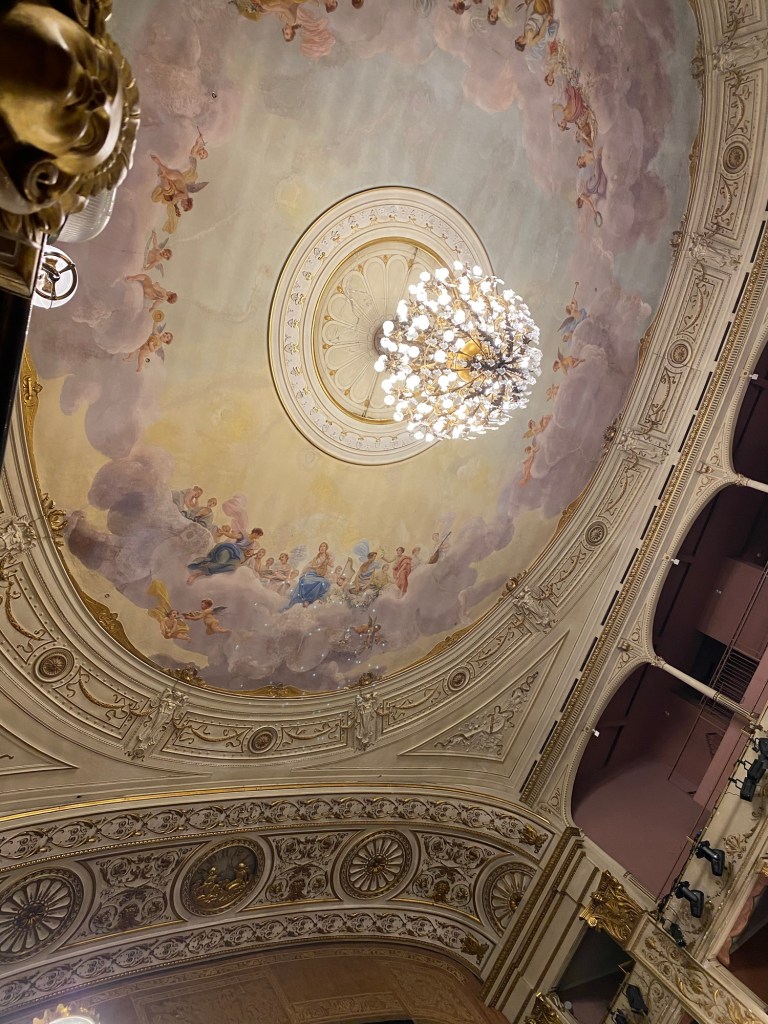
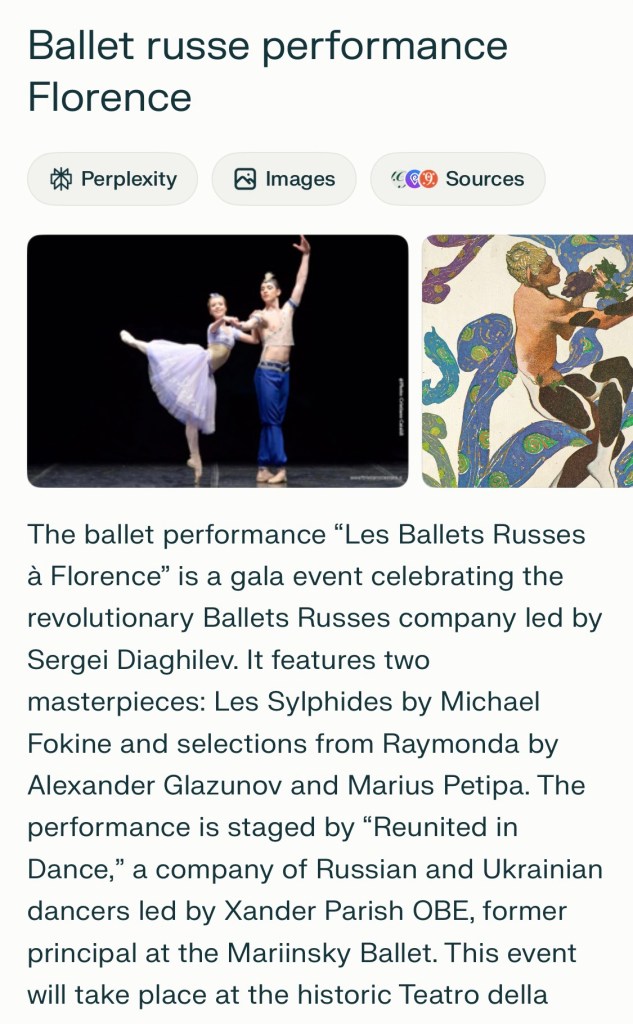
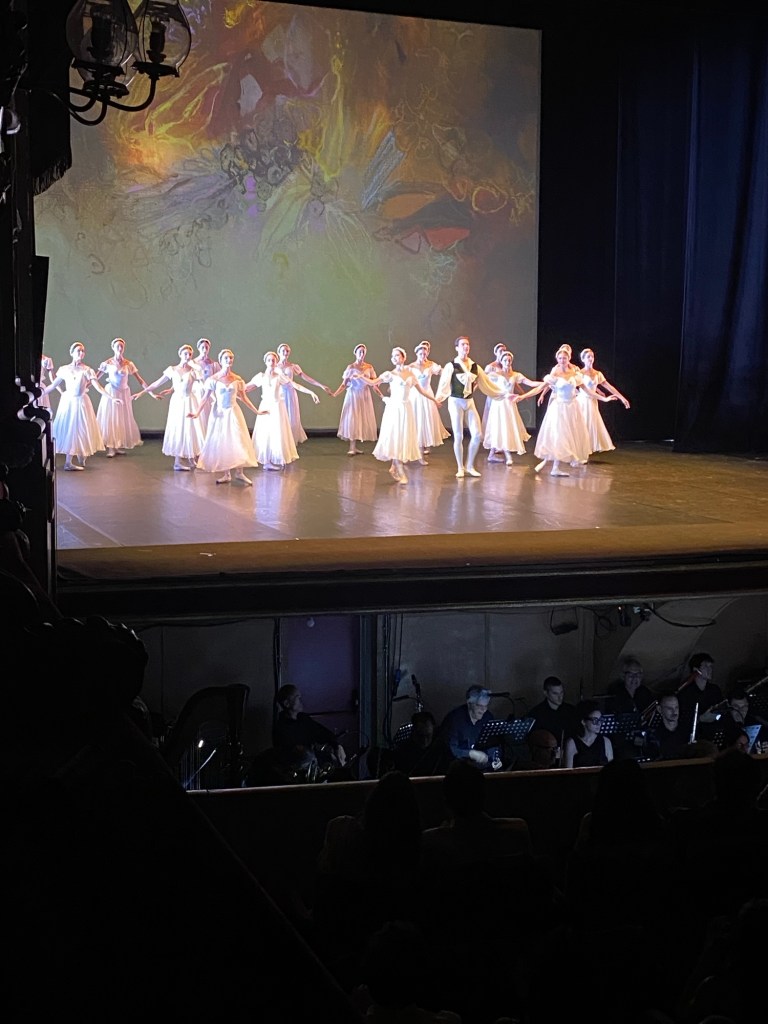
Please join me at the ballet! I recently attended a gala performance at the historic Teatro Della Pergola in Florence for an amazing one night event. I had rushed to buy a ticket to this night when I first heard about it a couple of months ago, to see something of the historic Ballet Russe created by famed Sergei Diaghilev in the early 20th century! That alone was enough to attract me but it was performed by a combination of Ukrainian and Russian dancers. I was thrilled to support their effort!
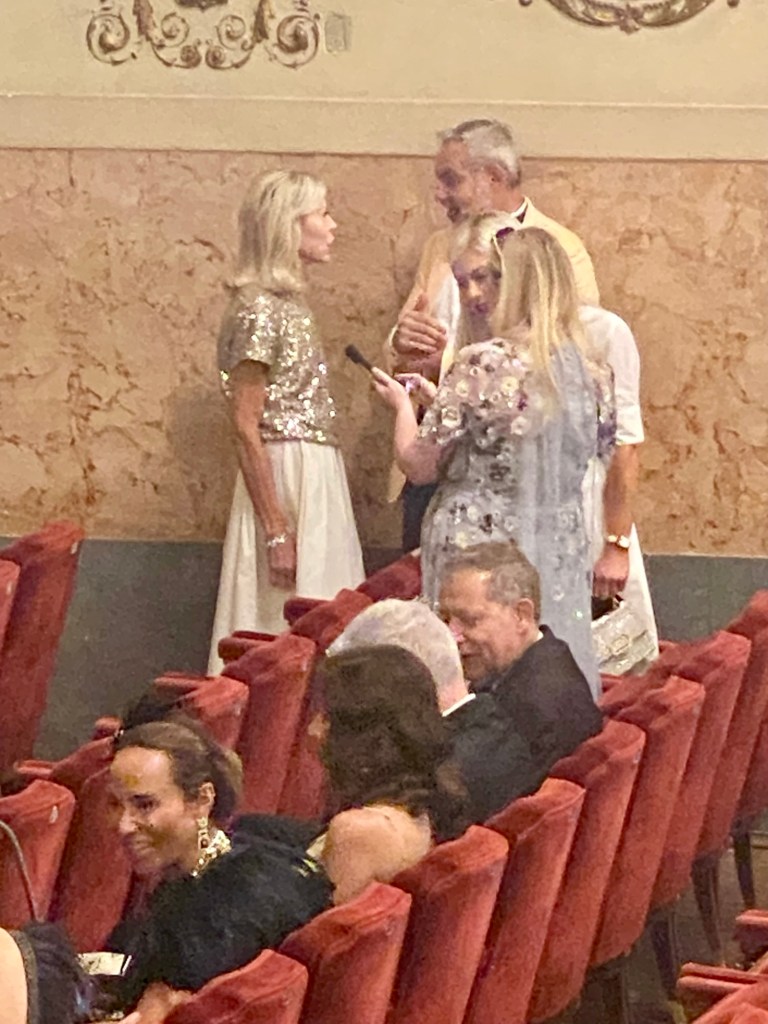
The first photos show the theater when I arrived early and took my seat.
Here’s the historic theater as the orchestra warmed up before the show.
I had a great seat in a box on the first tier and sat in the cool, air-conditioned theater as the audience began to fill all the seats. It was interesting to see how the Florentine ballet-goers chose to dress. Our weather is hotter than Hades, so there was understandably a lot of bare skin. The advertisement for the performance asked for black-tie or party clothes and most people turned out.
Of course it was not possible to video anything but I snuck a few shots in. I’m old! I had to do it so I could remember the evening!
Here’s the programme
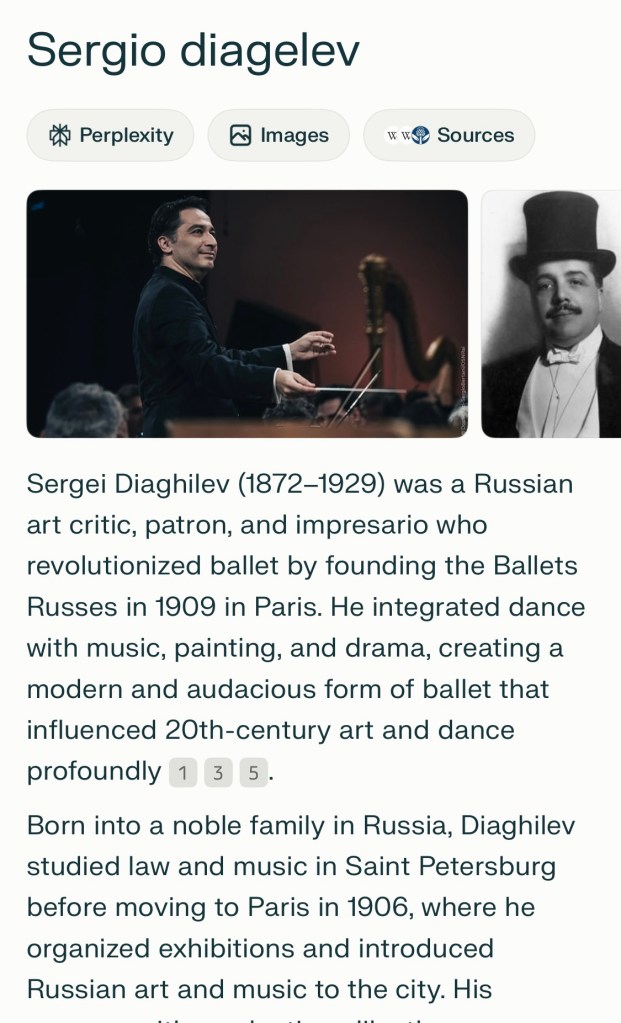
In case you are unfamiliar with this Russian ballet company, here’s a little summary from the app Perplexity, which has become my new best friend recently.
It was a beautiful evening! Russian and Ukrainian dancers, side by side. Peace.
I have got to post this blogpost asap. It is growing unwieldy!
Superb. Excellent. Unforgettable. This book rocked my world.
Kimono was an odd choice for me, but somehow it wound up in my content list on my Kindle. I vaguely recall buying it and I am happy I did. I really enjoyed it and highly recommend. Set in London and Japan in the very early years of the 20th century. Fascinating.
I could not put this book down. I remember when the movie came out and I didn’t want to watch it. The book was great. I still don’t want to see the film.
Unputdownable. A genius at her metier.
I love to read the classics from time to time.
Yes, yes, and YES! Even if it is 100 pages too long. Really, it should have been edited for length.
Well, I read it in 2 sittings. Not the kind of book I usually read, but it would make a great beach read.
Beautifully written, incredible story.
Another fine book! Another incredible story. Highly recommend.
Well done! So many great books to read! Amazing story.





































 get back, lauretta!
You must be logged in to post a comment.