As I mentioned in my last post on Le Marais, this area is also the most famous Jewish quarter in Paris and, in fact, in much of Europe, still maintaining strong traditions.

There have been Jews living in Paris on and off since the region was conquered by Rome in the first century BC.

The Rue Rosiers is a key street in the historical Jewish center of Paris; it is a charming pedestrian road and is known as the Pretzl or “little place” in Yiddish. The rue des Rosiers name refers to the “street of the rosebushes.”
Jews have a long history in France (full of prosperity as well as expulsions and persecution), but in Le Marais in particular. This area became the center of Jewish life in Paris in the 19th and early 20th centuries as Sephardic Jews came over from Eastern Europe.
And, while Paris has been a place of Jewish prosperity, scholarship, and greatness, it has also seen a lot of sorrow. For centuries, the Jewish community lived within France only at the sufferance of the king. Expulsions were common, and it was not until the French Revolution and then Napoleon Bonaparte that Jews finally had some measure of civil and religious freedom.
In Paris, in Le Marais, you will find kosher and Jewish style restaurants cheek by jowl with Jewish bookshops, small synagogues, prayer rooms, and kosher boulangeries and charcuteries. You will also see trendy shops, a sign of the increasingly gentrified nature of the neighborhood.
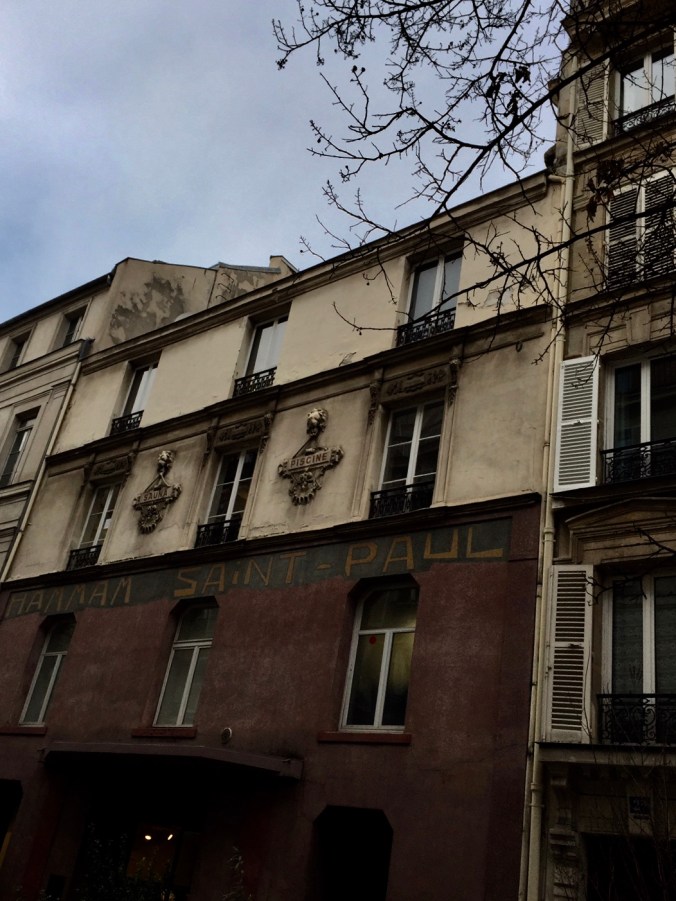
There’s an interesting pinkish building with “Hammam Saint Paul” written on it. Today the building houses a fashionable boutique, not a Turkish bathhouse.

The building dates to 1856 on the Rue des Rosiers and this bathhouse survived for 130 years, give or take. The hammam closed its doors in 1990. You can still see the painted name of the building in yellow on a blue background, dating from 1928, work by architects Boucheron and Jouhaud.
On the second floor are two sculptures on the piers, decorated with lion heads and stating the words Sauna and Pool. These date from 1901.
In an earlier post, I talked about 2 falafel restaurants; both are located on Rue des Rosiers: https://laurettadimmick.com/2018/12/29/a-little-friendly-competition/
Jardin des Rosiers – Joseph-Migneret
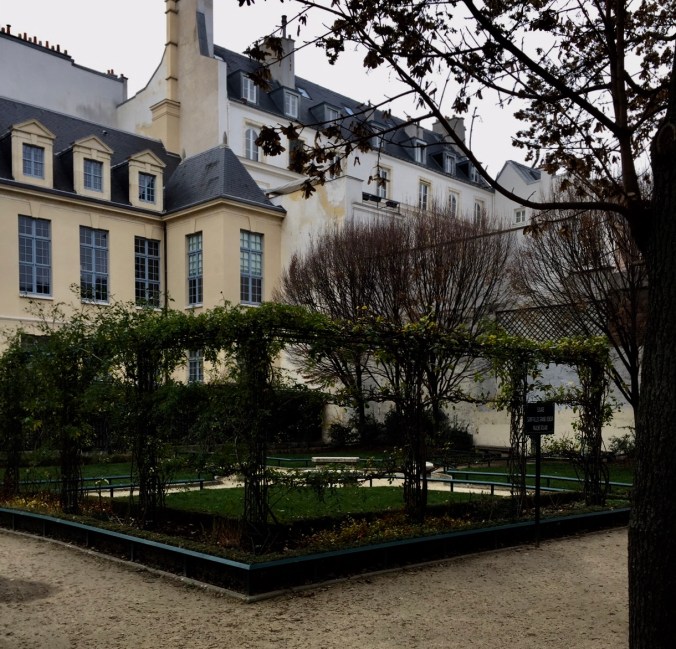
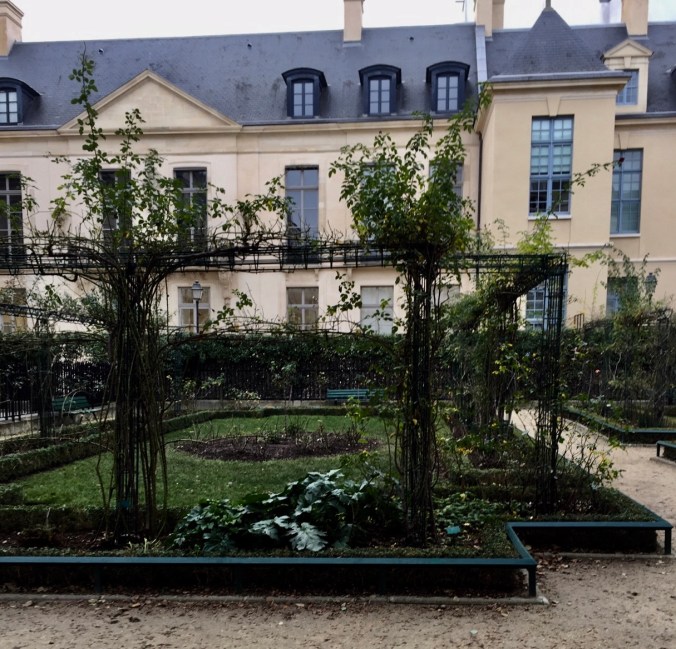
And then we come to a lovely small park, known as the Jardin des Rosiers – Joseph-Migneret.
During World War II, Joseph Migneret was the principal of the elementary school of Hospitaliers St. Gervais, located nearby at 10 rue des Hospitalières-Saint-Gervais.
During the round-ups of 1942, 165 Jewish children from this school were deported, mostly of them to Auschwitz, and not a single one survived. The school now bears a plaque that reads “165 enfants juifs de cette école déportés en Allemagne durant la Seconde Guerre mondiale furent exterminés dans les camps nazis. N’oubliez pas!” (In English: 165 Jewish children of this school deported to Germany during WWII were exterminated in the Nazi camps. Do not forget!”)
After the loss of so many of his students–only 4 students returned to school on October 1, 1942–Joseph Migneret dedicated himself to the Resistance and to helping the Jewish families escape further round-ups and persecution. He hid many of them in his own home. He died shortly after the end of the war; it is said he died of sadness on account of everything his students endured.
Jardin des Rosiers


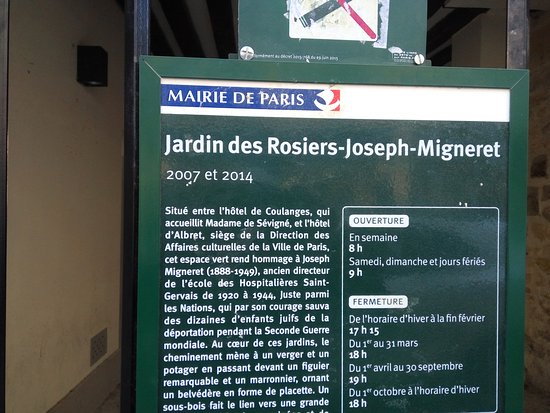
And, an equally heinous history is what happened to Jewish infants in the same city. There is a plaque imprinted with the names of 101 infants of the fourth arrondissement in Paris, who were arrested by French police of the Vichy Regime and handed over to the Nazis for extermination.
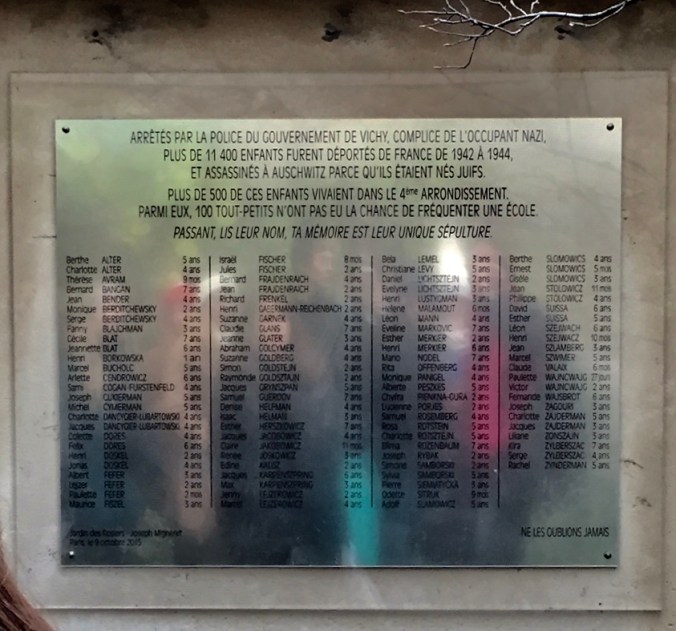
They were all too young to attend school. (If they had been old enough, their names would already have been placed on plaques at the schools they attended at the time of their arrest.)
The youngest was 27 days old.
The five lines at the top of the plaque set out their common fate:
“Arrested by the police of the Vichy government, accomplice of the Nazi occupation forces, more than 11,000 children were deported from France and murdered in Auschwitz because they were born Jewish. More than 500 of these children used to live in the fourth arrondissement. Among them, 101 were so young that they didn’t have a chance to go to school.
“These lines are followed by a message to passersby, who will pause to glimpse into the ugly past:
“Passerby, read their names. Your memory is their only tombstone. We must never forget them.”
Next up: Jardin Saint Gilles Grand-Veneur
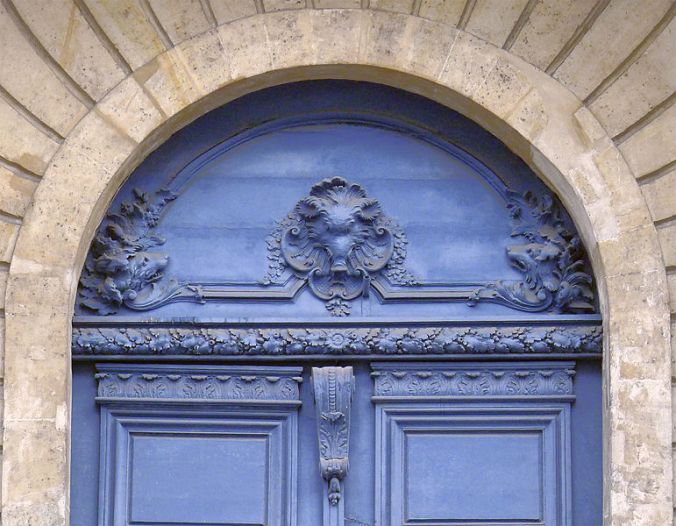
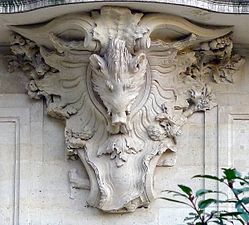
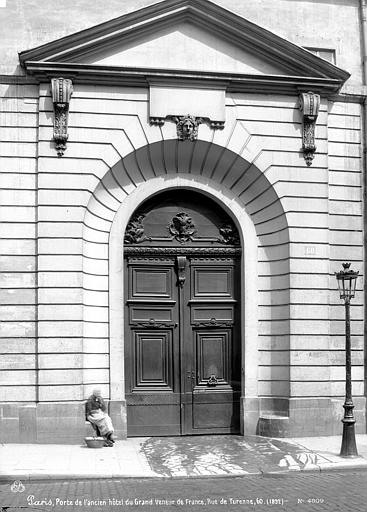
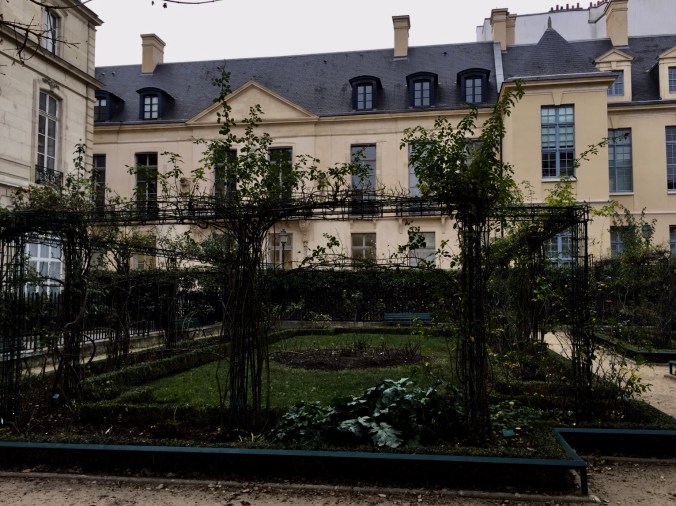
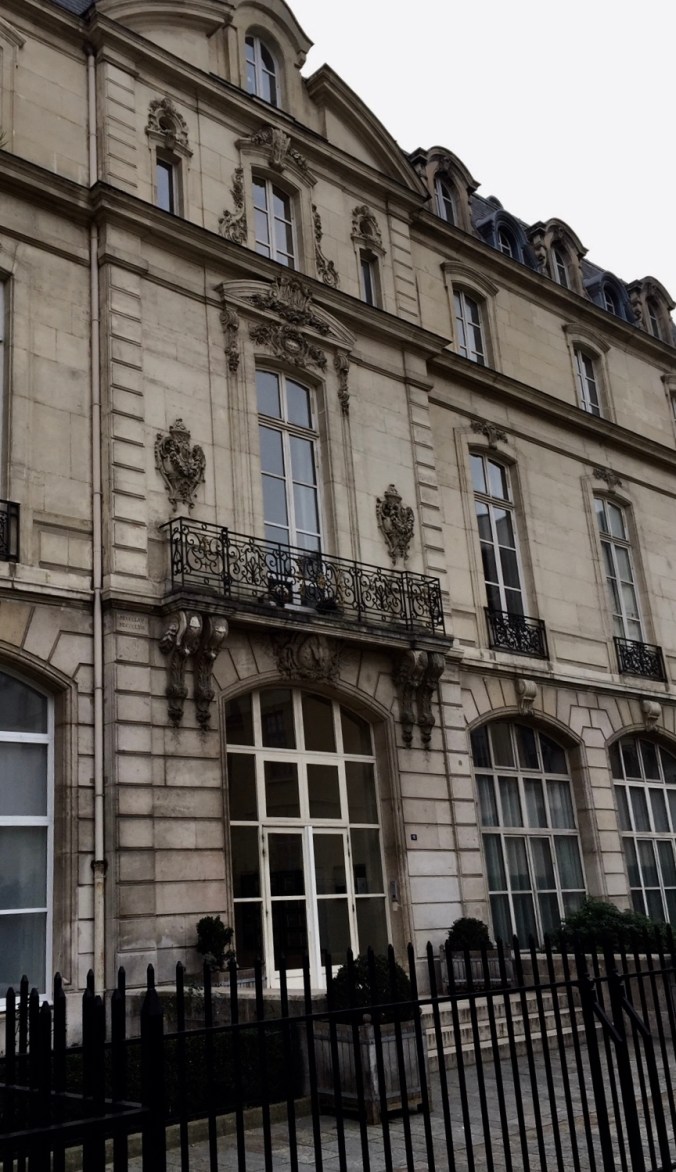
The Grand-Veneur hotel was built in the 17th century for Hennequin d’Ecquevilly, captain general of the King’s Vénerie: he was in charge of organizing the court hunts of the king. This square occupies the garden of this mansion.
The garden, built in 1988, pays tribute since 2010 to Pauline Roland (1805-1852), close to Georges Sand, former teacher, initiated to Saint-Simonian ideas in his youth, feminist and socialist activist.
.
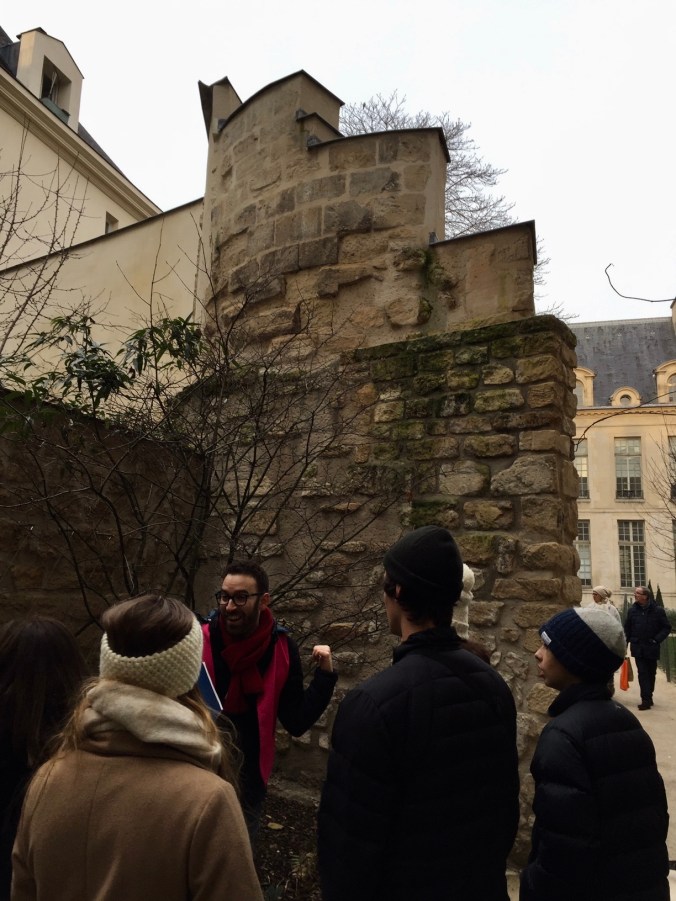

Along the rue de Rosiers, you’ll find the best Falafel in town and a few remaining orthodox eateries. The best falafel is apparently at L’as du Falafel. That said, I assure you, they’re all good.
https://www.algemeiner.com/2015/10/08/paris-to-unveil-memorial-for-infant-victims-of-the-holocaust/

 Late 19th century photo of exterior






You must be logged in to post a comment.