A few days ago I posted on the marvel that is the Villa Medici a Fiesole. There I covered the construction and importance of the Villa as a precursor for Renaissance villa design. That post kept growing and growing, so I decided to make a 2nd post on just the gardens.
So, let’s talk (garden) turkey:

In the imagine (picture, in Italian) above you see how Michelozzo and later architects sited the palazzo and its wonderful gardens. The palazzo itself sits on the center left side of the plan.

Looking outward from the palazzo within the gardens at the villa.
Below, with stonework that recalls grotto architecture, is the entrance to the gardens. I can’t remember who the sculptured bust represents, but it is no doubt one Medici or another. The coat-of-arms beneath the bust is, of course, most definitely that of the Medici.

So, let’s look at a plan of the site. The palazzo is not numbered but you can see where the 4 main gardens exist.

We’ll start our tour in garden #1. You walk through or beside #1 when you enter the grounds and approach the palazzo from the west. You can see the white-washed palazzo on the far right side.
As you walk along the pea gravel path from the entry gate to the palazzo, you have this immediate view of the garden with its terracotta pots filled with apple-red geraniums.

If you can peel your eyes away from the palazzo, which is now fully presented ahead of you, you can already gaze over the geraniums and be rewarded with a spectacular view of Florence. The unmistakable center of the city is marked with the dome of the Duomo.

Below, the city of Florence as seen from garden #1 at Villa Medici. Wow.

I’m going to try to avoid the view for a minute, because it always steals the show. Let’s look at just the plantings and layout of garden #1, shall we?
The north side of garden #1 is constructed with a high wall covered with vines, a small outbuilding, used I think, like a pavillion. A border of pink roses line the length of the north side of garden #1.


Within garden #1, as you look back from the Palazzo end, is laid out with large specimen trees, grass (very unusual in an Italian garden), and potted citrus, lemon and oranges mostly. The building in the lower section of the photo is the entry gate to the Villa.


Along this northern border of the garden, a fountain, with a grotto-like finishing of stones, is set into the short wall. It provides a relief from the steady gaze of border wall with its oval form, and on both sides of the fountain one can walk up a few steps to walk to the pavillion at the west end.

Below: looking back at the palazzo and garden #1 from west to east:

To enter garden #2, you must pass along the walkway to the south of the palazzo. You climb this tall hill, which is guarded by 2 terracotta lions.

Angels in the architecture of the gate proclaim the (almost?) divine majesty of the Medici family.

Through the gate, you see garden #2, with its own set of panoramic views, awaiting you.

I don’t know if everyone else is like me, but when I passed under the gate leading to garden #2, I was drawn like a magnet to the end walls of the property, where this view, framed by cypress trees, awaits the spectator. I mean, come on (and people ask me why I choose to live in Italy…don’t I miss the USA???)!!

Garden #2 is a more private, secluded space than #1. The palazzo on this, the west side, has magnificent magnolia trees, and, as you can see, the palazzo itself has many windows and arched openings to give those inside the palazzo a gorgeous smallish garden to observe, with extraordinary views available to anyone standing near the short walls that separate the site from the ravines below.

A low and wide fountain occupies the geometrically divided garden #2.

After strolling through this garden, lost in thought about the people who had walked through this garden throughout the last 500+ years, I tore myself away, for new gardens #3 & 4 awaited.
This is what the view leading back to garden #1 looks like. You pass through the gateway again, and walk along the gravel path to a structure on the east end of garden #1.


On the west end of garden #1, sits the backside of the first gateway. However, this is no regular backside! It is a semi-enclosed room with its own frescoes. The main fresco provides an imaginary walkway to follow into the depths of an imaginary garden.


To the right side of this small structure, you find a set of stairs leading to gardens 3 and 4. Unfortunately, caught up in the wonder of this Medici sponsored experience of passing between gardens, I forgot to take pictures. Dang it. The stairs lead you to a long, plant covered passage. This passage is quite long, with another pea stone path. It was the end of July when I visited this Medici villa, and the plants splayed over this path were not in bloom. I am not sure what the plant is, but it didn’t look like wisteria. Maybe it is honeysuckle? Not sure. Whatever it is, this covered passageway is garden #3 and I don’t have any pictures of it.
Garden #3 takes you from the east end of the site to the center of garden #4, pictured below. As you walk through garden #3, you have tantalizing views of garden #4, and, once again, the city of Florence in the background. Is it any wonder that I failed to take pictures of garden #3 itself?!


Oh wait, I do have one photo of garden #3

Beautiful, isn’t it, garden #3?
To enter the final garden, #4, you take these picturesque stairs below to the lower level. Now you are in the final garden, and it more than earns its position as the climax of this site’s garden experience:

Each side of this marvelous little stairway is planted with wisteria, and although the wisteria season is essentially over in the Arno valley, I could see the purple racemes in my imagination. I loved walking down these stairs, the wisteria branches tried to wrap you up from both sides. It was a very cool experience.
Here’s the big reward awaiting any visitor to garden #4, an unparalleled vista of the city of Florence, spread out before your eyes.

When you can tear yourself away from the views that open from garden #4, you can get lost for a while in the flowers that take center stage in this lowest level of the Villa Medici a Fiesole.
For example, below is the closest thing to an English-style border that I’ve ever seen in Italy. You are looking up from garden #4 through the passage (garden #3), and don’t fail to notice the cypress trees that also grace these plantings.


Let’s look for a second at the geometric beds laid out in garden #4. It is mostly marigolds which fill these beds.


Look back up at the palazzo from garden #4, and this is what you see.

The picture below show how landscape architects (could it have been Michelozzo who designed the palazzo?) treated the change in levels. This picture serves like a painting, with fore, middle, and backgrounds treated with hard and soft scapes.


Much use of wisteria is made on the west end of garden #4, which also has some modern architecture in it. Can you imagine living here, at the west end of the Medici villa?


Water makes a lovely cameo in garden #4, in the shape of a low circle at the exact center of the site.

Before departing, let’s take one last look at Florence from way up here:

And, finally, we must depart, or else the custodian might get nervous and come looking for us.
And now we depart, climbing the beautiful framed stairway from garden #4 to #3.

Pass through garden #3, constantly looking back and down and notice your senses have been used to the max. Seeing, hearing, touching, and the scent of the carefully used roses, have worked together to create an unforgettable experience.

Walking along the Via Beato Angelico that leads from the center of Fiesole down into the outskirts of Florence. One last backward glance, to see the Villa Medici in all its glory. Note the swimming pool that I doubt very much was added originally by Michelozzo. Or, who knows?!






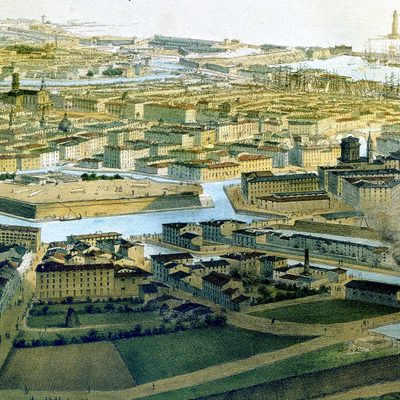 A 19th-century map of the city.























 W
W




You must be logged in to post a comment.