December 8 in Rome
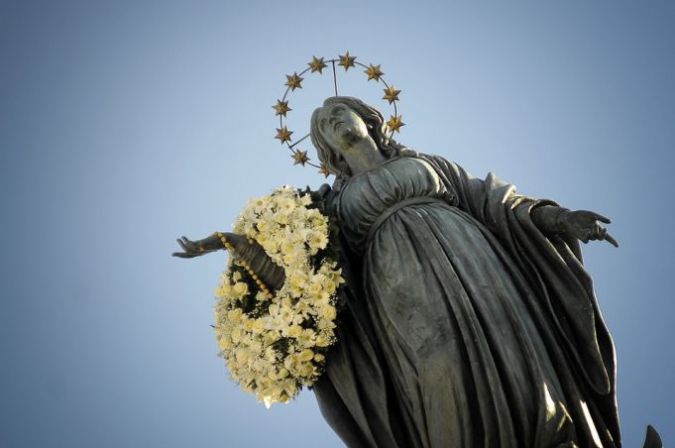
Feast of the Immaculate Conception
https://www.wantedinrome.com/news/feast-of-the-immaculate-conception-in-rome-2-2.html
Who can afford to buy a Leonardo today?
Bringing up baby
The year is 1934. My uncle is born. Say hello to Kenneth Dale Dimmick.
My grandmother, Lauretta, started Kenneth’s baby book. Last week my cousin and I went on a walk down memory lane, even if they weren’t our memories. Neither of us were even a distant thought in 1934.
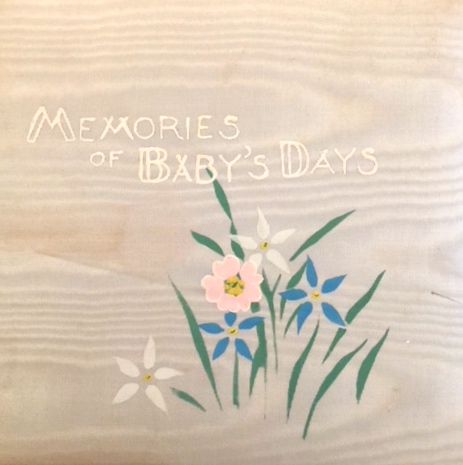
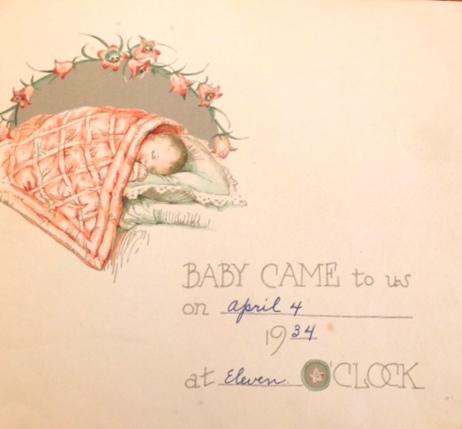
My uncle’s baby book is a delight to behold, a window into the 1930s.
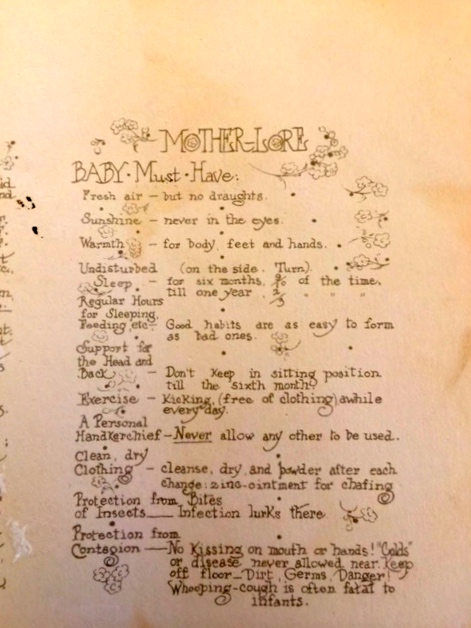
It also provides a window into infant development, as reckoned in the period. To wit: see the following helpful hints on bringing up baby:
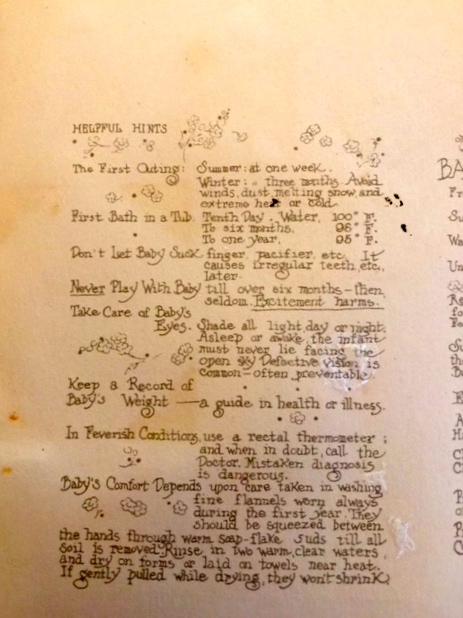
Shockingly, at least to 21st century mores, is the “helpful hint” about mid-way down the page above. “Never play with baby till over six months–then seldom. Excitement harms.” OMG! Child abuse and neglect.
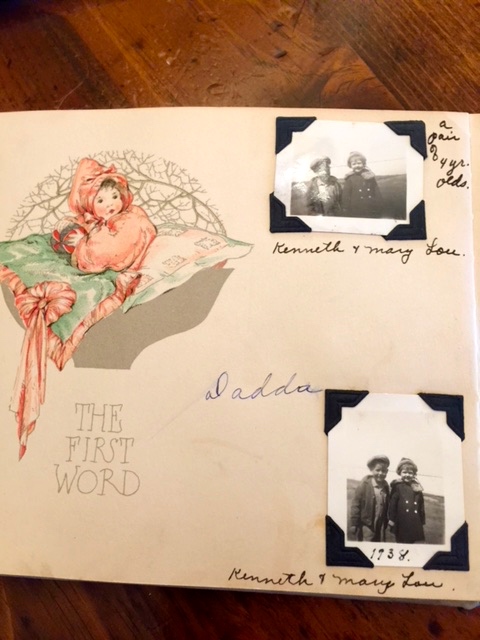
According to his baby book, Kenneth’s first word was “dadda,” which is interesting to me because it was also my son’s first word. I suspect it is the first word most babies in America form first–not from father love, but because it is easy to form. My son started with “dah” and repeated it, apropos of nothing. In other words, he said this word even when his father was no where near him.
Apparently Kenneth’s good friend was Mary Lou. My Grandmother wrote “a pair of 4 yr. olds” next to their picture, and no other child made it into Kenneth’s book.
I loved browsing through this relic.

Blooming
A child’s birthday party, 1930s
I’m sure we’ve all received cute birthday party invitations. Just look at this sweet one from my uncle’s baby book:

Did you catch the date? 1934. The heart of the Great Depression. Hard to imagine.
But, although we’ve all been invited to children’s birthday party, I don’t know about you, but I’ve never been to a party like this that was later written up in the social pages of the local newspaper.
Well, be that as it may, Miss Mary Lou Hellman’s “4th birthday anniversary” party was written up in the paper and here it is:
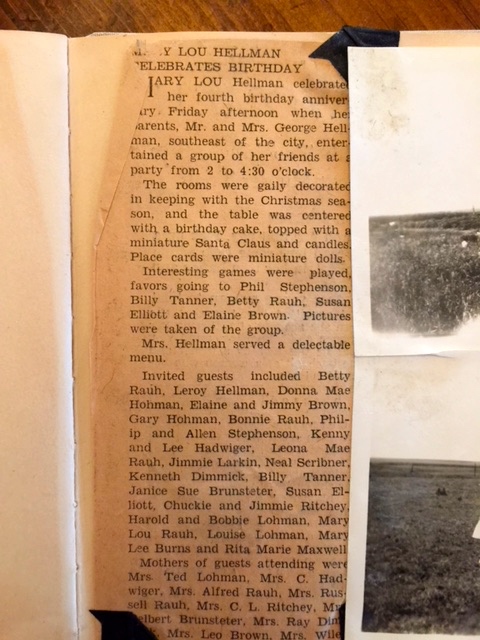
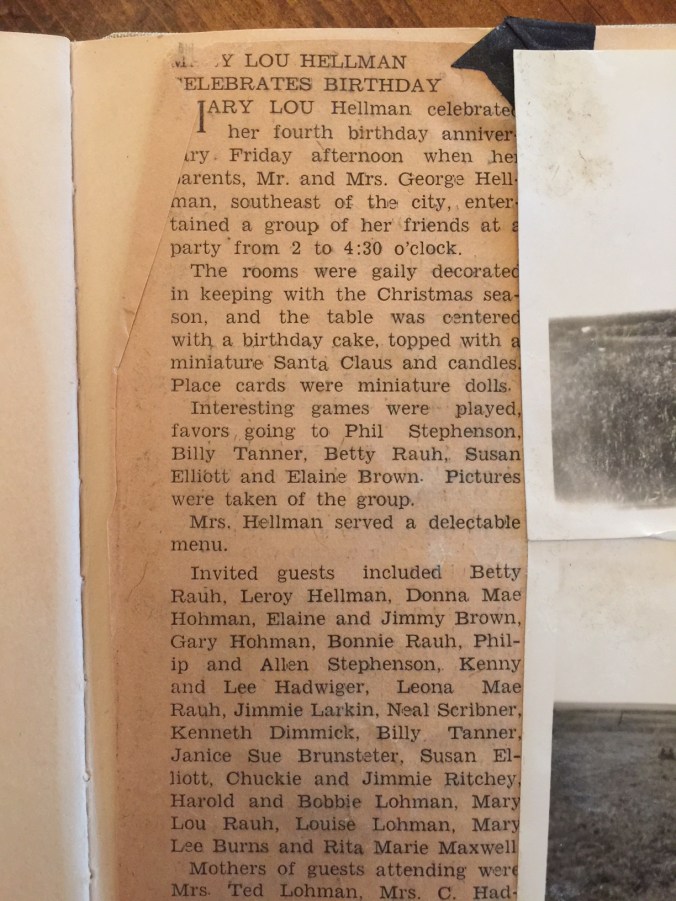
I’m happy to know that Mary Lou’s mother served “a delectable menu” and that “interesting games” were played.
I daresay this was the first time my 4 year old uncle’s name was published in the paper: Kenneth Dimmick.
What a hoot!
Have yourself a very Italian Christmas!
Richard Ginori Museum purchased by the Italian Ministry of Cultural Heritage
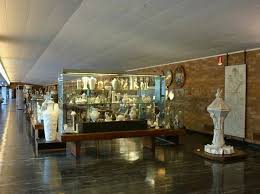
Following months of speculation, the Ministry of Cultural Heritage, led by Dario Franceschini, announced on Monday that the Richard Ginori Museum, belonging to the Doccia Manufacture in Sesto Fiorentino, was purchased by the Ministry for 700,000 euro. The museum has been struggling in recent years, set on a path to ruin unless a buyer was successfully found, a considerable loss for the country’s cultural heritage considering that Doccia is one of the oldest manufacture of porcelains and ceramics in Europe.
When announcing the purchase, Franceschini stated, “It is a pledge upheld, an exceptional collection saved, which is a fundamental part of Italian heritage.” Along with the building, which was purchased at a lower price than what was estimated by the Land Registry and Florence’s Court, MiBACT also acquired the museum’s collection, which will be ceded to the Ministry within 120 days from the date of purchase. With the collection officially in the hands of the state, the new museum will become part of the national museum network, allowing the Ministry to oversee the institution’s protection and promotion.
http://www.theflorentine.net/news/2017/11/ginori-museum-collection-purchased/

It can be hard to see true colors
Opera in Florence
Opera in Florence has often functioned most successfully when pursuing the intellectual curiosity of a cultivated elite rather than the lowest common denominator of popular taste.
In 1933, when conductor Vittorio Gui initiated Italy’s first large-scale festival, the Maggio Musicale Fiorentino, he conceived it in terms of a cultural mission: reviving forgotten masterworks (such as Spontini’s La Vestale, starring Rosa Ponselle in her only Italian performances) and revisiting the standard repertory with a teasing touch of sophistication (De Chirico’s provocatively modernistic sets for Bellini’s I Puritani).
Two years later, Rossini’s Mosè and Rameau’s Castor et Pollux were staged, and for three decades Florence became one of the few places in the world where Baroque opera and rare works by Rossini got a hearing with any regularity.
It was in this city that Renata Tebaldi had a chance to sing Rossini’s Assedio di Corinto (1949) and Spontini’s Olimpia (1950), and it was here alone that Maria Callas could be heard as Haydn’s Euridice (1951) and Rossini’s Armida (1952).
From that same period, Bruno Bartoletti — who has himself enjoyed an incomparably long and decidedly fruitful association with the festival — recalls the revelatory musical cogency of Dimitri Mitropoulos’s conducting in Puccini’s La Fanciulla del West (1954). And Bartoletti himself was protagonist — as conductor of Berg’s Wozzeckand Shostakovich’s The Nose — of the innovative 1964 Maggio Musicale, devoted to Expressionism.
Since then, Florence has continued to attract some of the world’s greatest musicians. Riccardo Muti was principal conductor here from 1968 to 1980, and since taking over in 1985, Zubin Mehta has upheld the highest standards of orchestral playing; but the festival has undeniably lost its cutting edge.
One of the reasons is that Gui’s highly individual mission has by now become standard strategy for many music festivals worldwide, making it difficult for the Maggio Musicale to stand out amid the competition. Another reason is that increasingly cumbersome productions have made it arduous to stage two or more operas simultaneously.
In spite of intermittent use of the intimate seventeenth-century Teatro della Pergola, as well as the much larger Teatro Comunale (an acoustically problematic venue, first opened in 1862), it has seldom been possible in recent decades to see at least two operas on consecutive nights — for most visitors, the principal appeal of any festival experience.
 get back, lauretta!
You must be logged in to post a comment.