Dopolavoro, a restaurant
The perfect spot at which to end your day of visiting Val d’Orcia and Iris Origo’s Villa La Foce is at the restaurant owned by the descendants of Origo.
If you look hard at the picture below you will see the words: Dopolavora Rurale – La Foce. That’s the name of this great dining spot and its menu and dining garden will delight you.

OLYMPUS DIGITAL CAMERA

I enjoyed the steak and rustic potatoes.


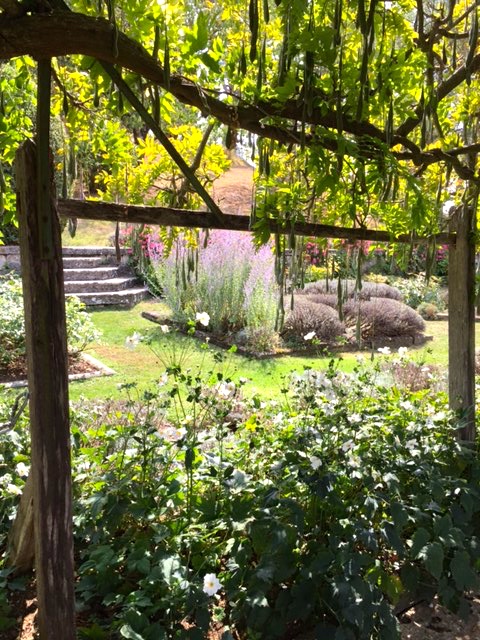
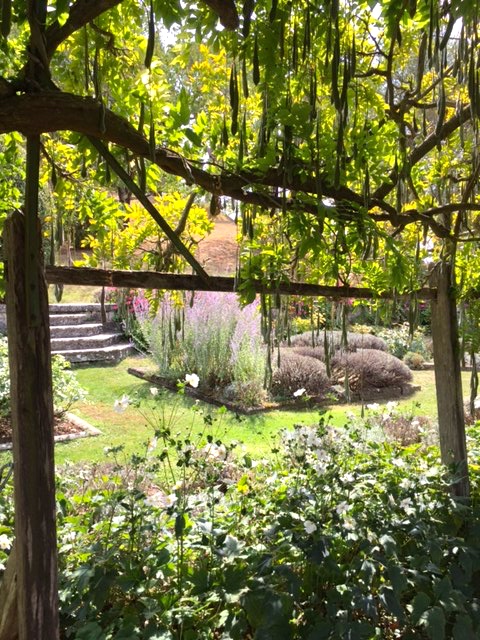
The al fresco dining area is the stuff dreams are made of.

OLYMPUS DIGITAL CAMERA

OLYMPUS DIGITAL CAMERA

The Dopolavoro La Foce was built in 1939 as a meeting place for the workers on the La Foce estate. Country dances and plays featuring the farmers’ children were held on the little stage, movies and news of the war were screened and people came from miles around to share a glass of wine and play a game of bocce (bowls) in the shade of the lime trees.
Along with the kindergarten, the school and the clinic, the Dopolavoro is part of a series of buildings built by the Origos in the 1920s and 1930s, when they carried out a vast plan of land reclamation and social innovation.
When Antonio and Iris Origo bought the vast estate of La Foce in 1924 the Val d’Orcia, for all its spectacular scenery, was a poor and uninhabited region, a land of low clay hillocks and stony, unfarmed soil. Not only did the Origos dream of reclaiming the barren fields and turning them into fertile countryside, they also aimed to improve the living conditions of workers on the estate.
Today the Dopolavoro once more belongs to the Origo family and reopens as a restaurant in which traditional Tuscan dishes are flavoured with the delicious La Foce extra-virgin olive oil and created with the best seasonal local produce. The restaurant boasts its own vegetable garden across the road, guaranteeing a genuine farm-to plate process. A path connects the vegetable garden to the famous La Foce gardens, which can be visited on request.
Firenze


WWII footage, the liberation of Florence
The most iconic roadway in Italy; the Strada di Valoresi
The Strada di Valoresi from Villa La Foce.
And the surrounding area.

OLYMPUS DIGITAL CAMERA

OLYMPUS DIGITAL CAMERA

OLYMPUS DIGITAL CAMERA

OLYMPUS DIGITAL CAMERA

OLYMPUS DIGITAL CAMERA

OLYMPUS DIGITAL CAMERA

OLYMPUS DIGITAL CAMERA

OLYMPUS DIGITAL CAMERA

OLYMPUS DIGITAL CAMERA

OLYMPUS DIGITAL CAMERA

OLYMPUS DIGITAL CAMERA

OLYMPUS DIGITAL CAMERA

OLYMPUS DIGITAL CAMERA

OLYMPUS DIGITAL CAMERA

OLYMPUS DIGITAL CAMERA

OLYMPUS DIGITAL CAMERA
Villa La Foce; a magnificent garden in Tuscany
I’ve been a few places. I’ve seen a few gardens. So you can trust me when I tell you that Villa La Foce, the villa and farm created by Iris Origo and her husband, Antonio Origo, is truly magnificent.
|
|
The villa is located in the crete sense (clay hills of Sienna) overlooking the beautiful Val d’orcia in souther Tuscany. La Foce is located near the site of an Etruscan settlement and burial-place that were in use from the 7th C. BC to the 2nd C. AD.
La Foce has been continuously inhabited for many centuries, partly because of its location on the Via Francigena (“the road that comes from France,” this ancient highway was a pilgrim route running from France [some say Canterbury, England] to Rome. In medieval times it was an important road and pilgrimage route for those wishing to visit the Holy See and the tombs of the apostles Peter and Paul).


The Origos dedicated their lives to bringing prosperity and cultural and social changes to this formerly poverty-stricken area of the Val d’Orcia. Years of work were devoted to preparing the difficult terrain for modern agriculture.
The gardens and estate of La Foce are among the most important and best kept early 20th-century gardens in Italy. Amid 3,500 acres of farmland in the countryside near Pienza, with sweeping views of the Tuscan landscape, La Foce was the dream garden of Iris Origo.
Passionate about the order and symmetry of Florentine gardens, she and Antonio employed the talented English architect and family friend Cecil Pinsent, who had designed the gardens at Villa Medici, to enhance the natural beauty of the site. Pinsent designed the structure of simple, elegant, box-edged beds and green enclosures that give shape to the Origos’ shrubs, perennials and vines, and created a garden of soaring cypress walks, native cyclamen, lawns and wildflower meadows.
Today the estate is run by the Origo daughters, Benedetta and Donata, and is open to the public one day a week.


The property was purchased in 1924 by Antonio Origo and his Anglo-American wife, Iris. Iris was the daughter of Lady Sybil Cutting who owned the Villa Medici at Fiesole, where Iris spent much of her childhood.


The Villa itself was built in the late 15 C as a hospice for pilgrims and merchants traveling on the via Francigena.


The garden is divided into three distinct sections on different levels, and was created between 1927 and 1939 in several stages, all parts composed to follow the lay of the land.


Grafitti in situ.
The real deal.


Basilica Santo Spirito, Firenze
Brunelleschi, Michelangelo and many other important artists have major works within this Renaissance architectural masterpiece in the Oltrarno that is so easy to miss. The church’s facade is so unimposing, it is almost invisible.
But step inside and behold: Brunelleschi’s lovely basilica.


Brunelleschi began designs for this interior as early as 1428. The first pillars to the building were delivered in 1446, ten days before his death. After his death, his plans for the church were carried on by his followers Antonio Manetti, Giovanni da Gaiole, and Salvi d’Andrea; the latter was also responsible for the construction of the cupola.
Unlike the Basilica of San Lorenzo, where Brunelleschi’s ideas were thwarted, his designs were carried through here with some degree of fidelity, at least in the ground plan and up to the level of the arcades.
The Latin cross plan was realized and the contrast between the nave and the transept, that caused such difficulty at S. Lorenzo, was here also avoided. The side chapels, in the form of niches, all the same size and 40 in number, run along the entire perimeter of the basilica.
Brunelleschi’s facade was never built and left blank. In 1489, a columned vestibule and octagonal sacristy, designed by Simone del Pollaiolo, known as Il Cronaca, and Giuliano da Sangallo respectively, were built to the left of the building. A door was opened up in a chapel to make the connection to the church.
Dominating the interior of the basilica is a Baroque baldachin with polychrome marbles, by Giovanni Battista Caccini and Gherardo Silvani, and placed over the high altar in 1601.
The church remained undecorated until the 18th century, when the walls were plastered. The inner façade is by Salvi d’Andrea, and has still the original glass window with the Pentecost designed by Pietro Perugino. The bell tower (1503) was designed by Bacio d’Agnolo.
The exterior of the building was restored in 1977-78.

The Augustinians had begun building the church and the convent in 1252. It was originally dedicated to Mary, All Saints and the Holy Spirit, changing by the end of the century to Mary, the Holy Spirit and Matthew.
The churches and convents of various mendicant orders were constructed with the financial support of the commune; the same is true for Santo Spirito beginning in 1267, and then again from 1292 to 1301.
The convent of S. Spirito became a center of scholarly activities and was recognized as Studium Generale of the Augustinian order in 1284. The first Rule and Constitutions of the Augustinians were approved in 1287 by the general chapter of the order that was held in Florence.

Santo Spirito was associated with the early humanism in Florence. One of the groups, led by Bocaccio, gathered there in 1360s and 1370s. Upon his death in 1375, Bocaccio bequeathed his library to the convent.
In the 1380s and early 1390s another circle of humanists met daily in the cell of Luigi Marsili (1342–94). Marsili had studied philosophy and theology at the Universities of Padua and Paris. He came into contact with Petrarch at Padua in 1370 and later became a friend of Bocaccio. This group included Coluccio Salutati (1331-1406), Chancellor of Florence from 1375. He soon became the central figure of the circle.
The most important of Salutati disciples was Leonardo Bruni (1370-1444), a future Chancellor of Florence. Another member of the circle was Niccolo de’ Niccoli, a humanist and an associate of Cosimo de Medici.


It was after the Florentine victory over the Milanese in 1397 during the second Milan war on the feast day of Saint Augustine (28 August), that the Florentine signoria decided to rebuild this church to honor the saint, and placing it under the patronage of the city.
Despite this decision, nothing much happened until 1434, when the operai retained the services of Filippo Brunelleschi. Work on the new church progressed slowly until March 1471. During the Descend of the Holy Spirit sacra rappresentazione organized by the laudese in honor of the visit of Galeazzo Maria Sforza the old church caught fire and was heavily damaged, together with parts of the convent.


The walls of the cloister to the left of the basilica are lined with tombstones from all nationalities and eras.
The convent attached to Santo Spirito has two cloisters; they are known as the Chiostro dei Morti (cloister of the dead) and Chiostro Grande (Grand Cloister). The former takes its name from the great number of tombstone decorating its walls, and was built c. 1600 by Alfonso Parigi. The latter was constructed in 1564-1569 by Bartolomeo Ammannati in a classicistic style.
The former convent also contains the great refectory (Cenacolo di Santo Spirito) with a large fresco portraying the Crucifixion over a fragmentary Last Supper, both attributed to Andrea Orcagna (1360–1365). It is one of the rare examples of Late Gothic Art which can still be seen in Florence.
The room also boasts a collection of sculptures from the 11th-15th centuries, including two low reliefs by Donatello, a high relief by Jacopo della Quercia (Madonna with Child) and two marble sculptures by Tino da Camaino (1320–1322).

The central courtyard of the cloister is lovely and green.


The bellower, as seen from within the cloister.


A fountain graces the center of the garden within the cloister.


One of the hundreds of tombstones within the cloister walls.


Michelangelo’s Crucifix
The young Michelangelo was allowed was allowed to make anatomical studies of the corpses coming from the convent’s hospital; in exchange, he sculpted this wooden crucifix, which was originally placed over the basilica’s high altar. Today the crucifix is in the octagonal sacristy that can be reached from the west aisle of the church.
Frescoes Crucifixion and The Last Supper were painted by Andrea Orcagna and his workshop in the 1360s.
Today in Florence
Random shots on a random day, dopo la classe, dopo la test, molto buono.
From a yarn shop near school:


Classic Vespa siting. Always makes me smile:

We had a strong thunder storm last evening and what these pictures from today don’t completely reveal is how gorgeous today is! Sunny, cool, fresh, clean, perfetto!
Piazza Santo Spirito. La signora vende i prodotti.


Yes, you see right: Piccadilly tomatoes!


And a new Clet to admire.

La merenda perfetta!
Let’s say it’s about 11 a.m. and you need a little pick me up. How about a slice of focaccia baked with fresh grapes (it’s autumn, this is a seasonal snack) and a great cappuccino?
Perchè no?
This is the snack they must serve in heaven any day around 11 a.m.


Tutte le conoscenze know that you would never have this snack in the afternoon. Milk in the stomach after lunch is something only per i bambini.

You must be logged in to post a comment.