Here are the final images from my visit. It is always interesting to me to discover what element in a museum is going to capture my imagination on a random day. On this visit, I seemed to be beguiled by the relief sculptures as you may have guessed from my 2 earlier posts.
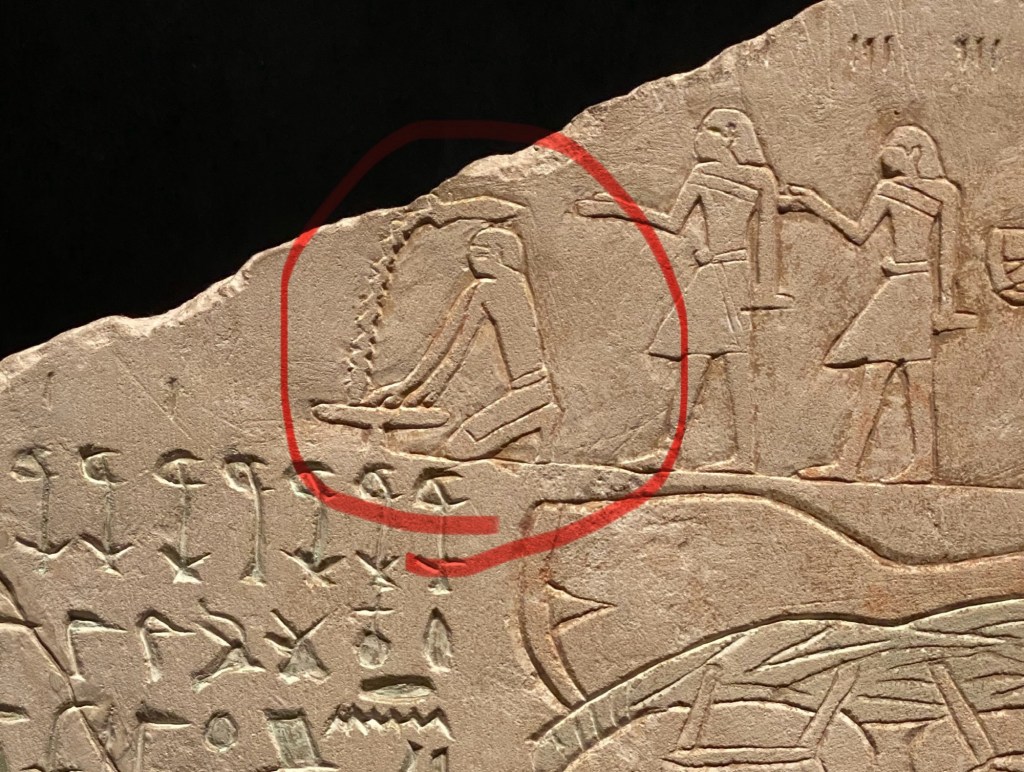
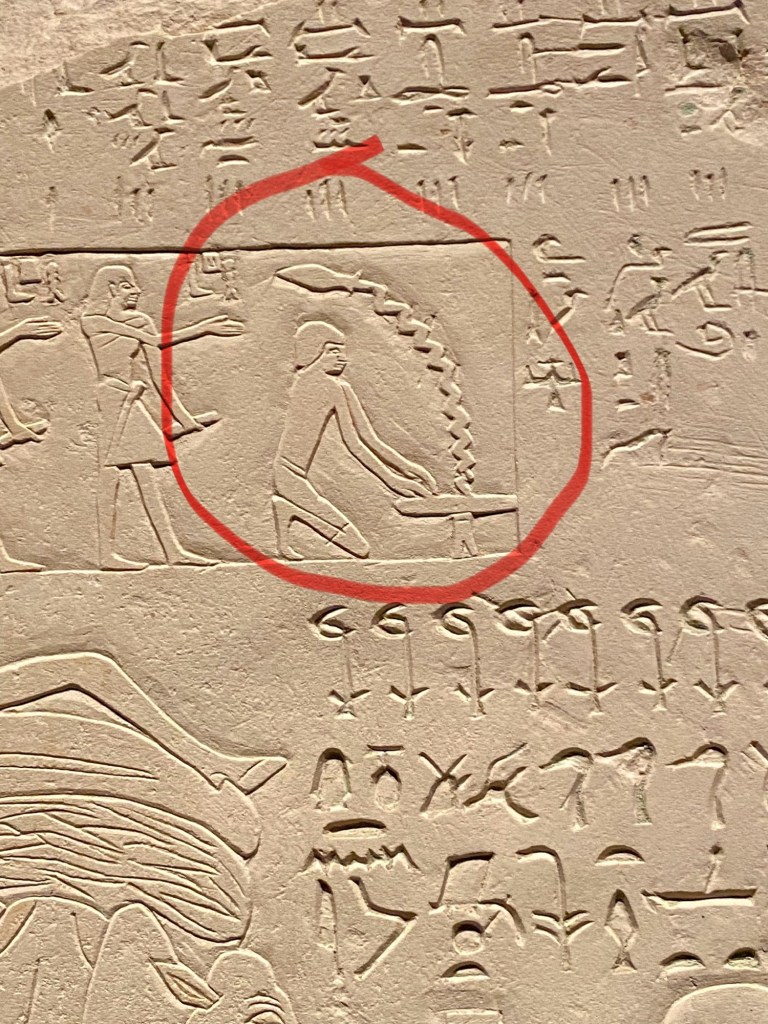
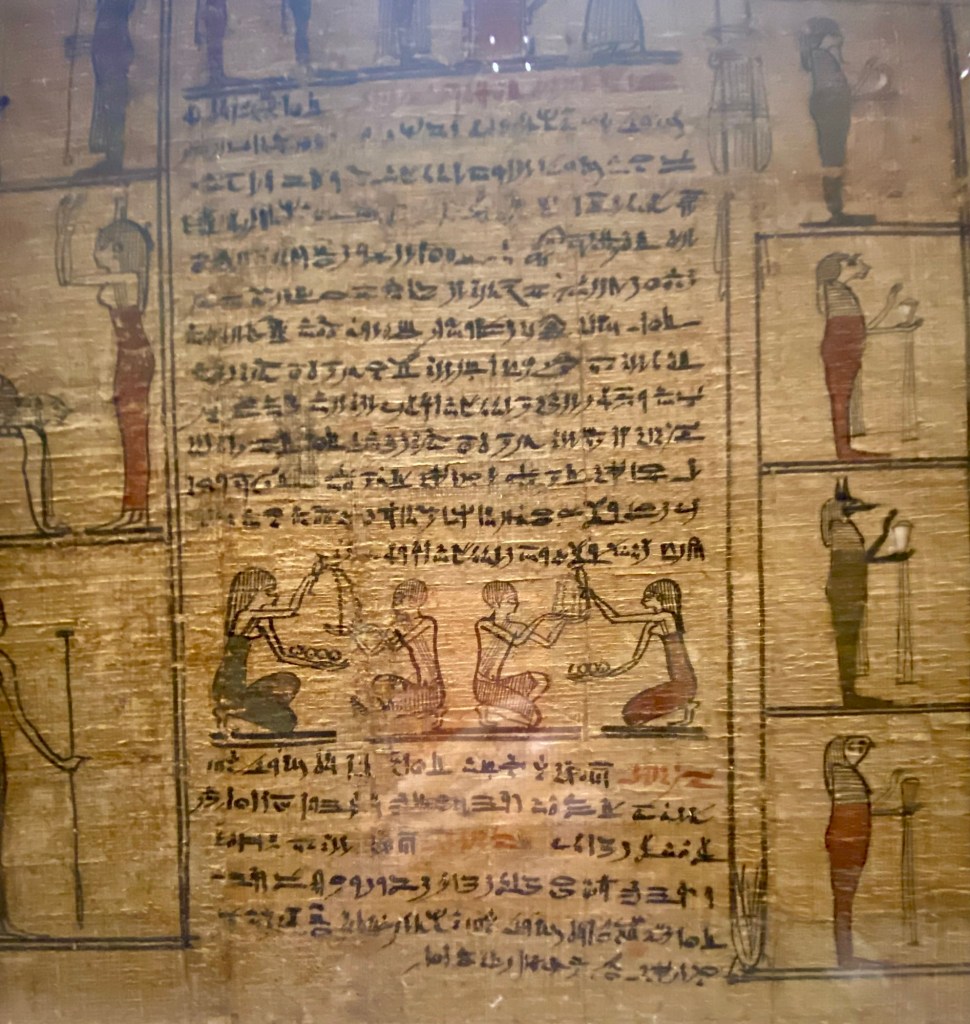
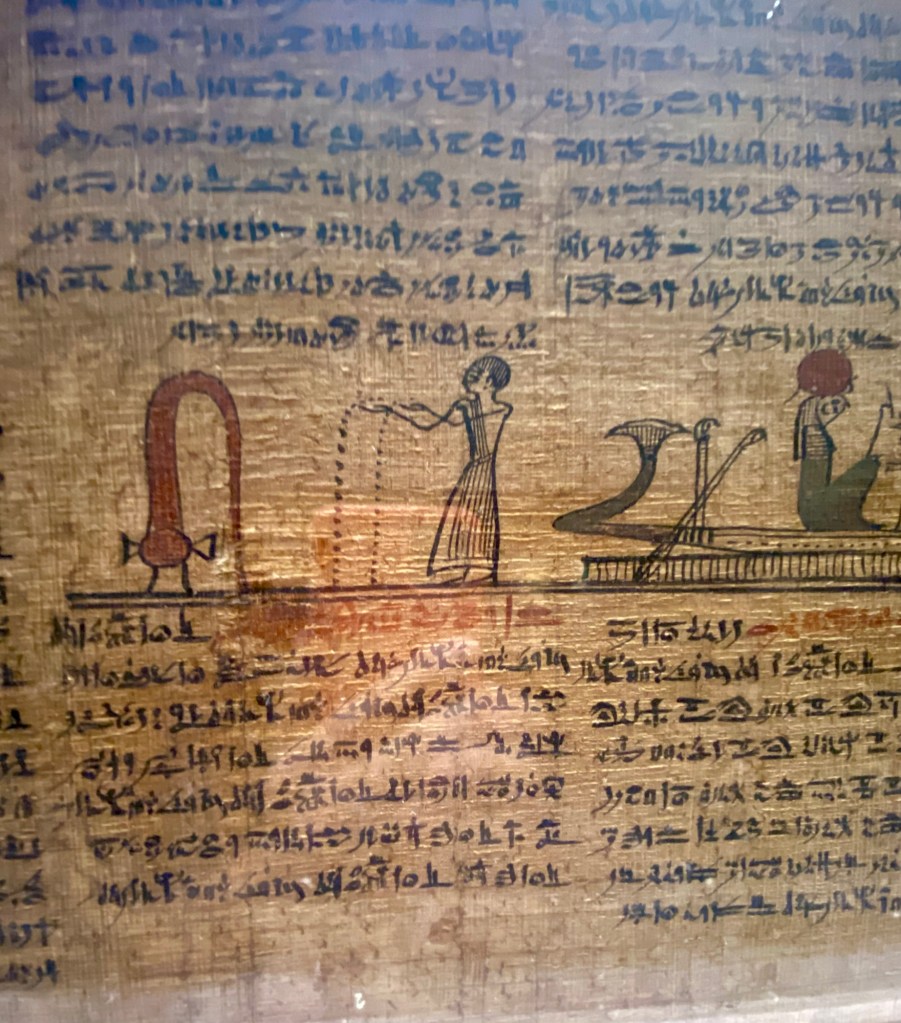
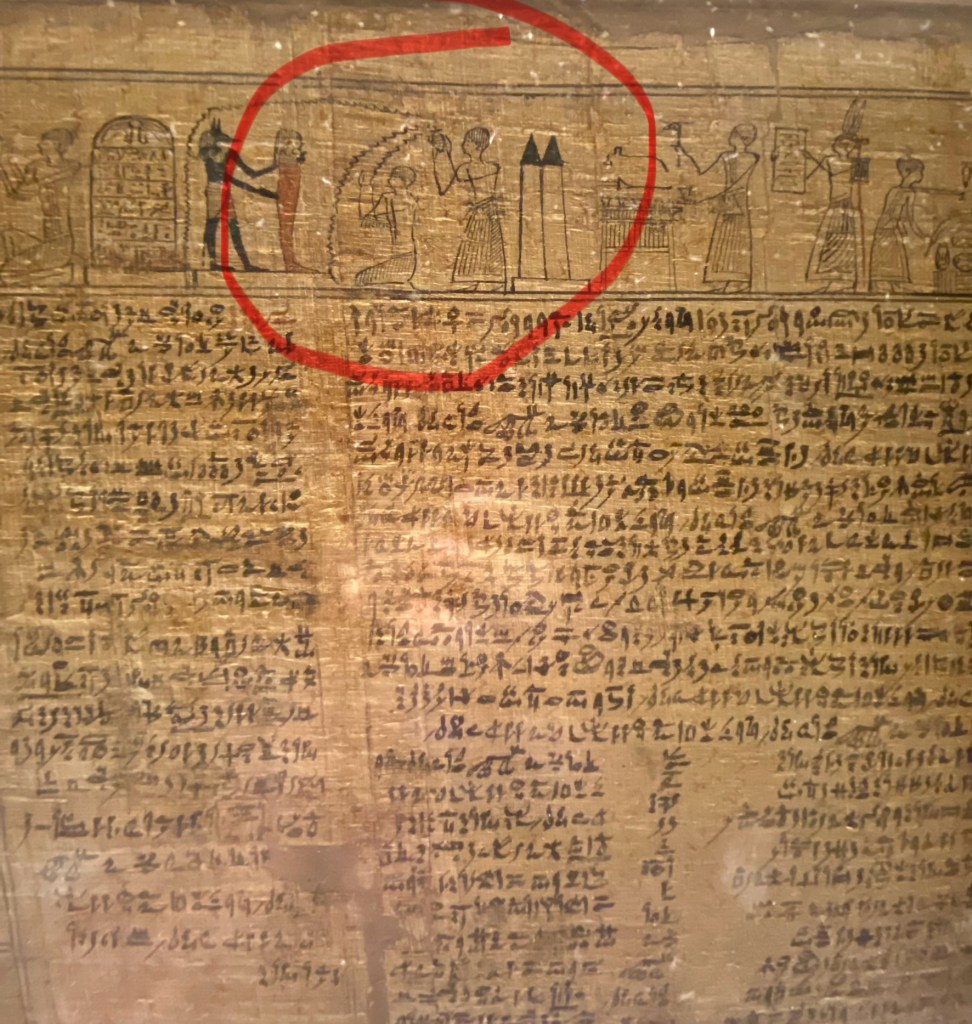
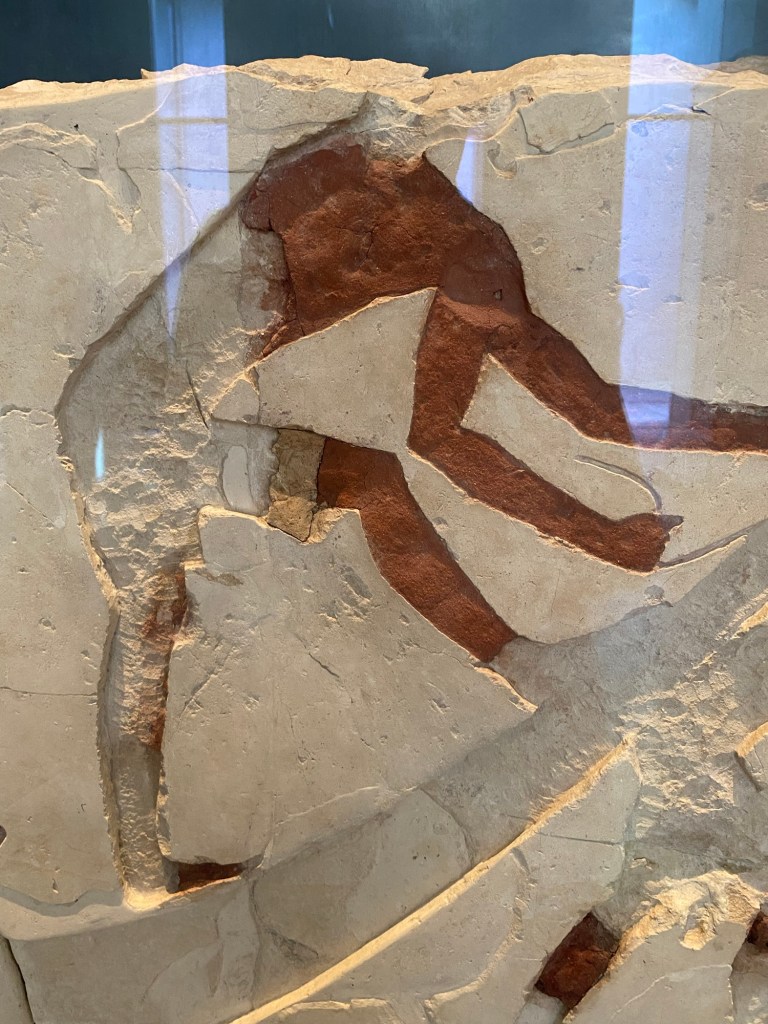
In the next several images, which I have indicated in marker on the photos, I was captivated by the depiction of moving liquid in these static Egyptian sculptures. Not sure what the precious liquid is that is being “offered” (?) in these tomb decorations, but I’d never noticed before that there is the attempt to showing wine/oil/water (?) in motion. That seems very radical to me.
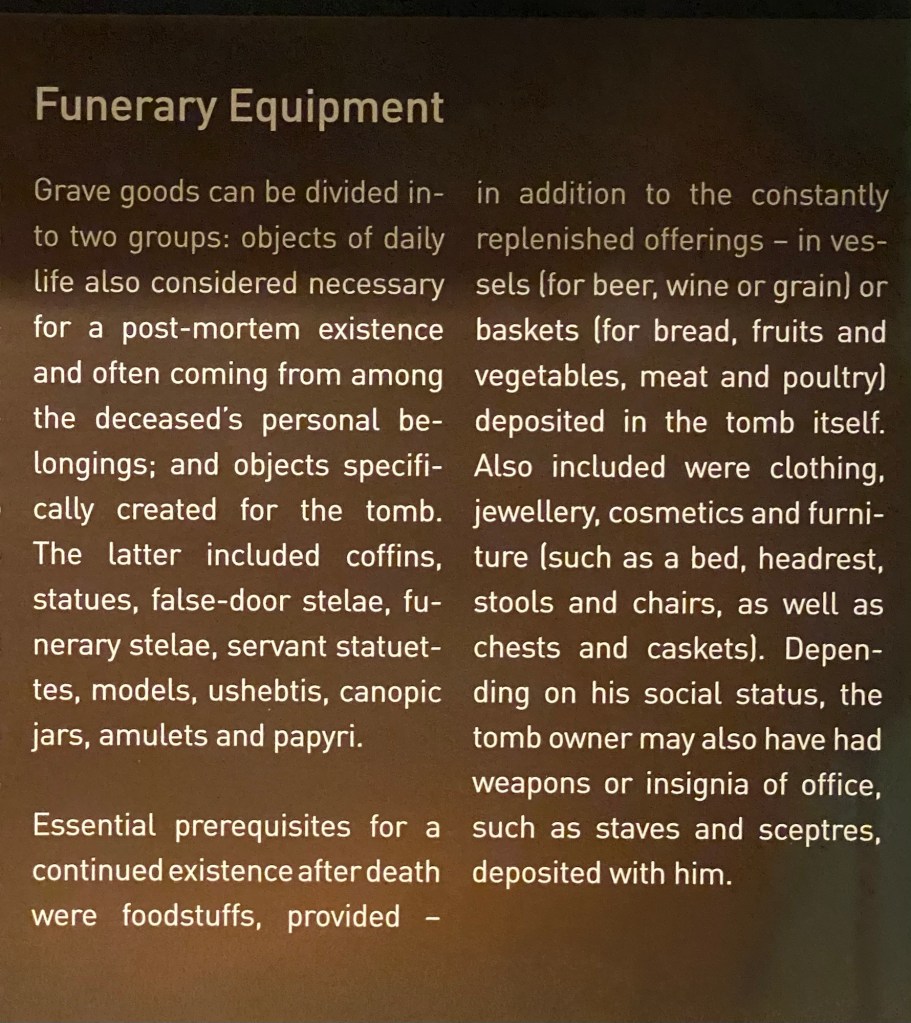
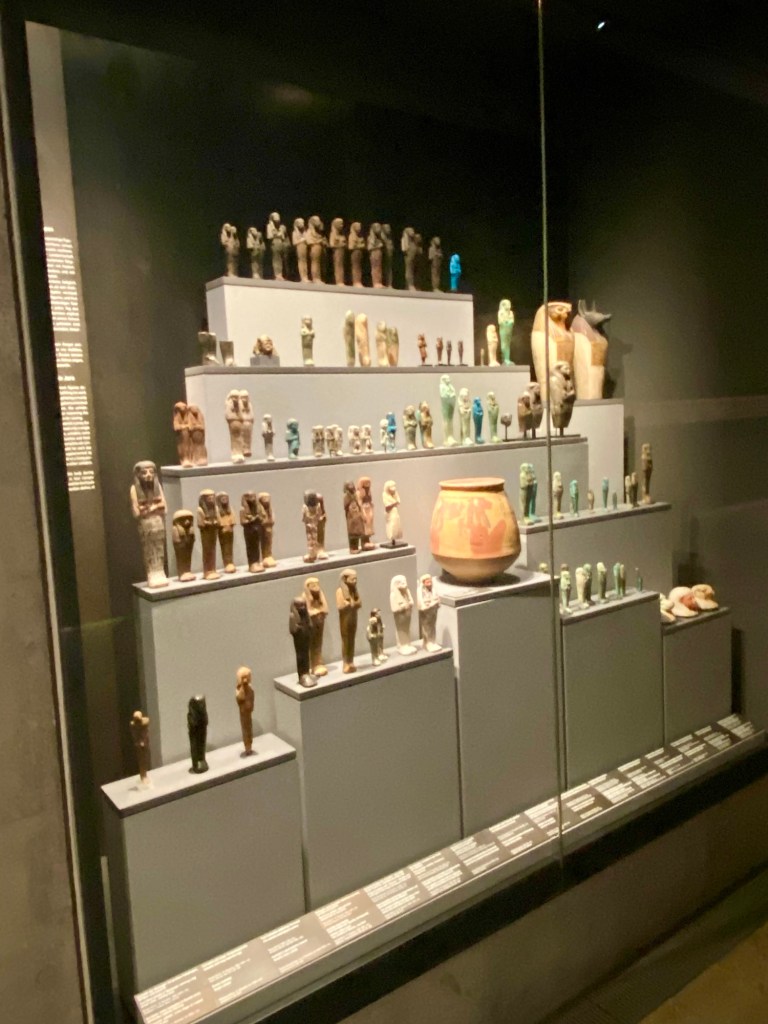
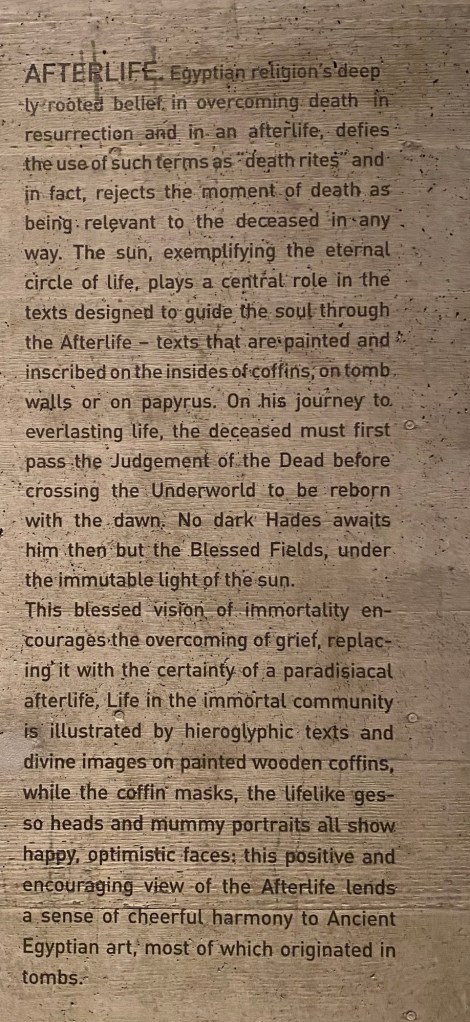
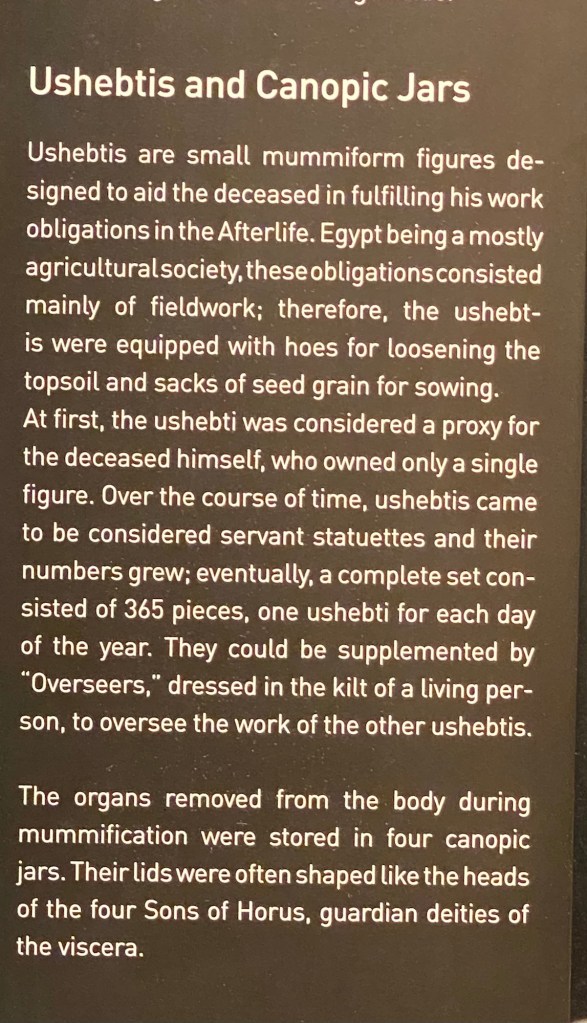
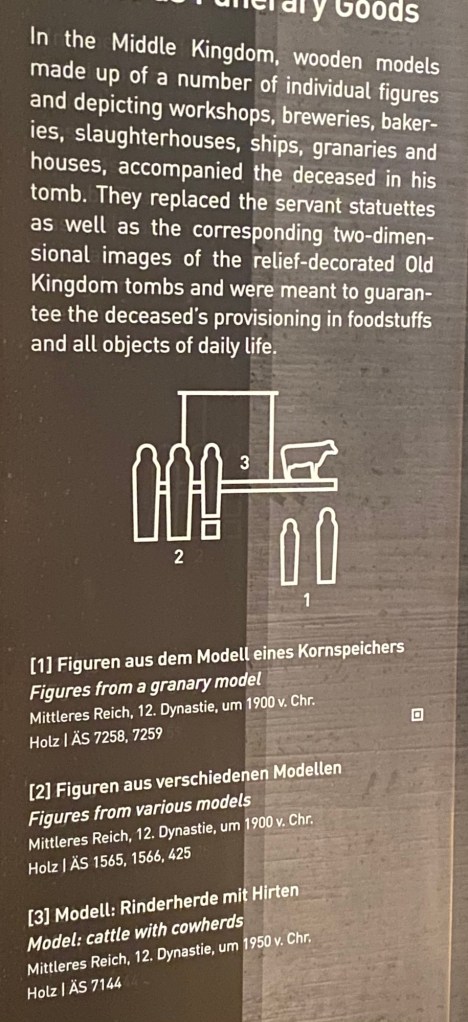
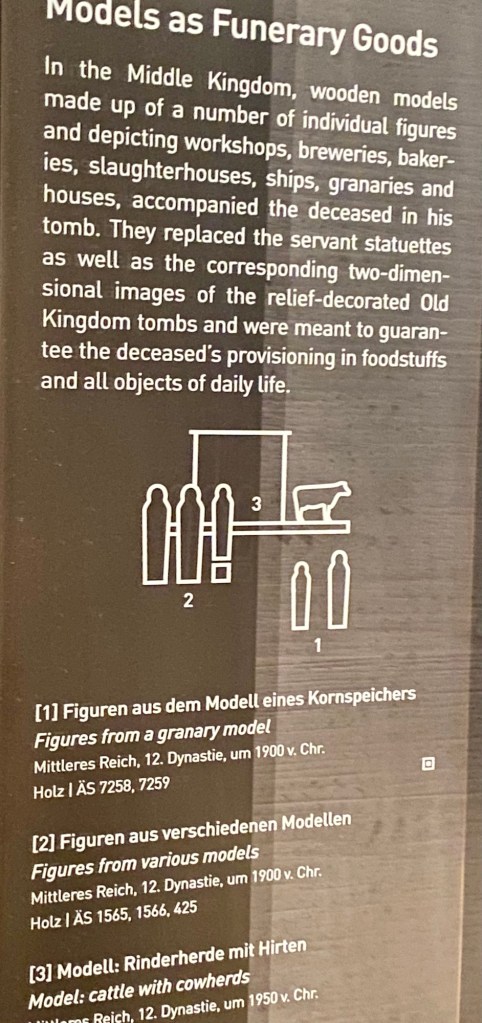
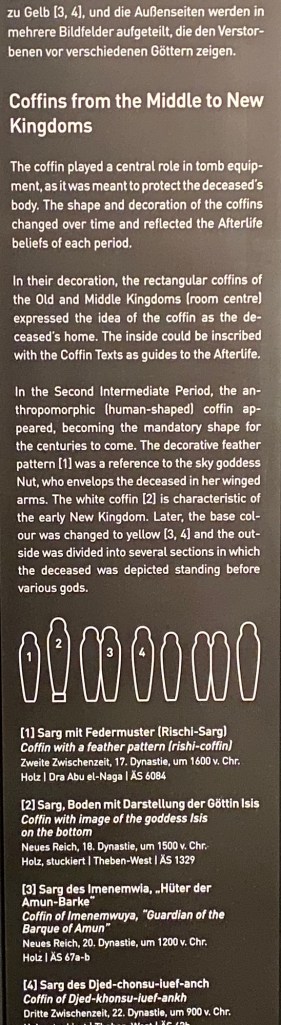
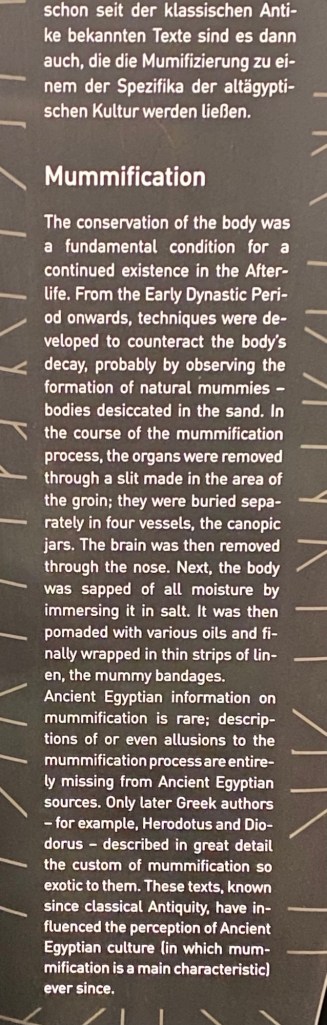
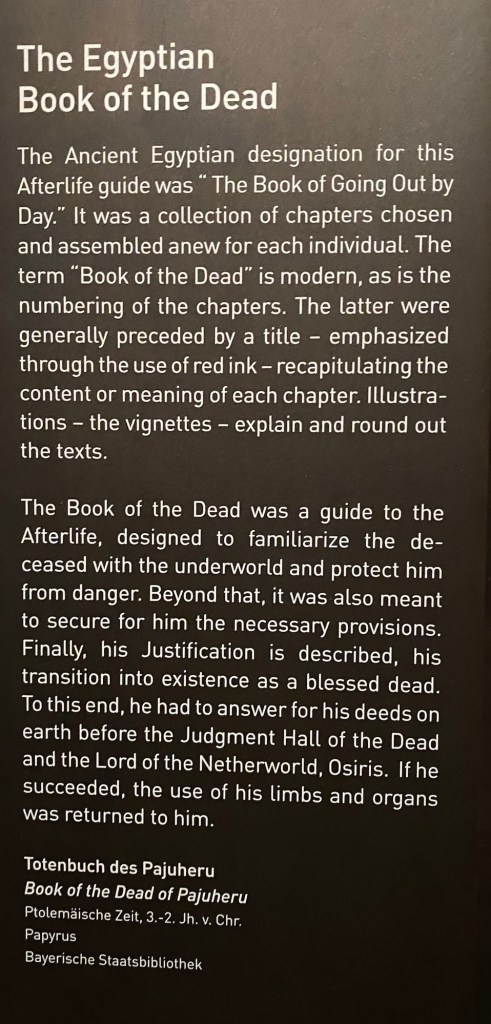
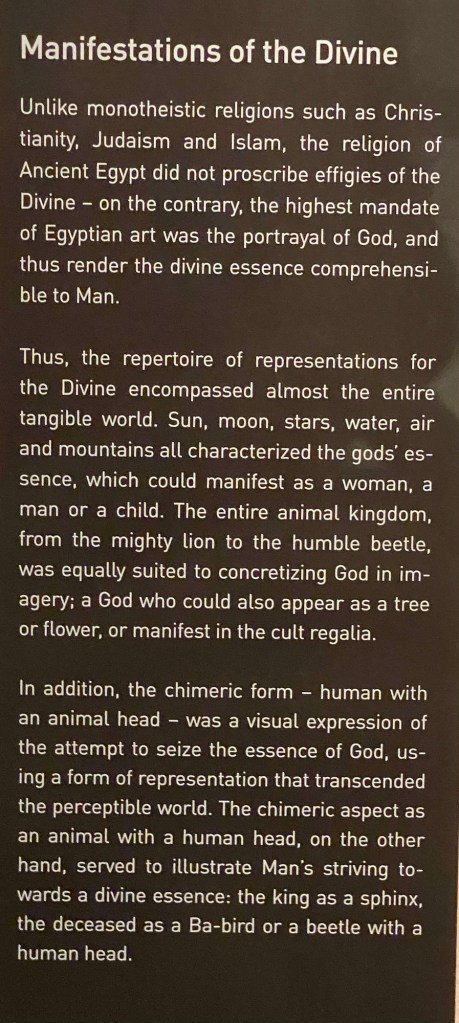
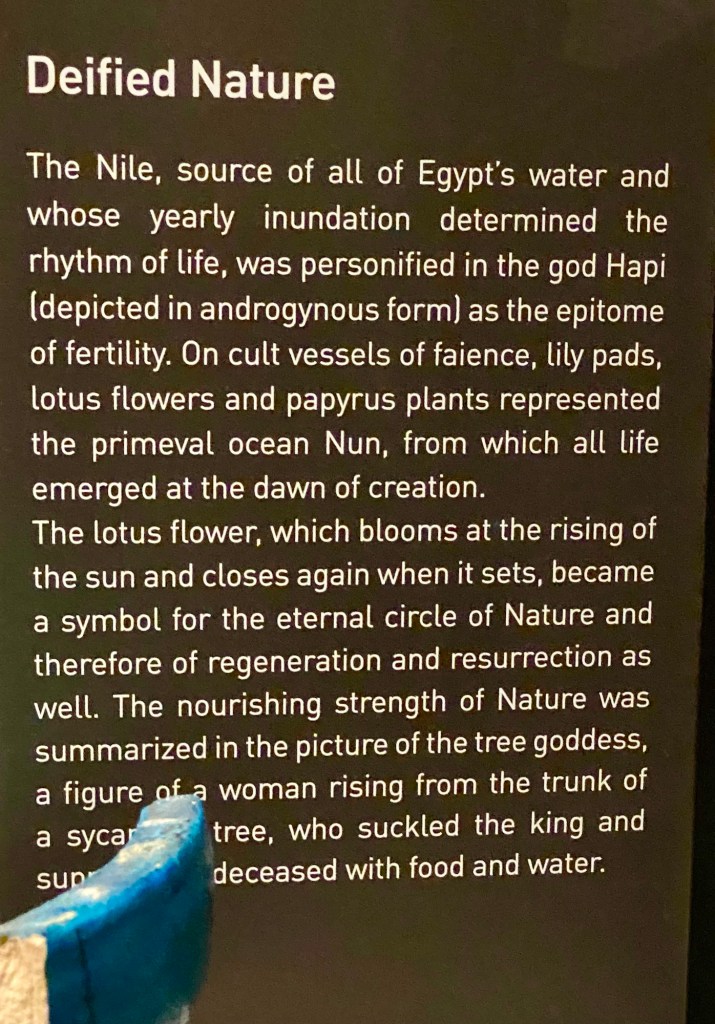
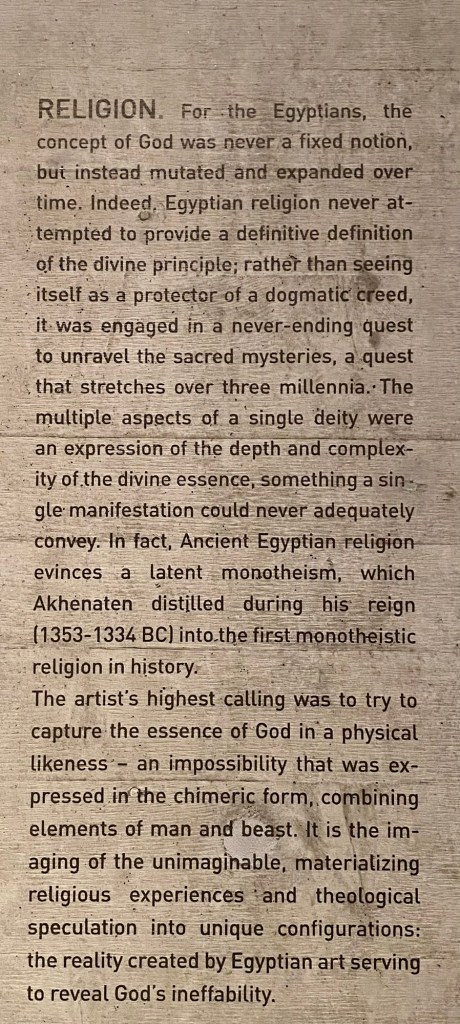
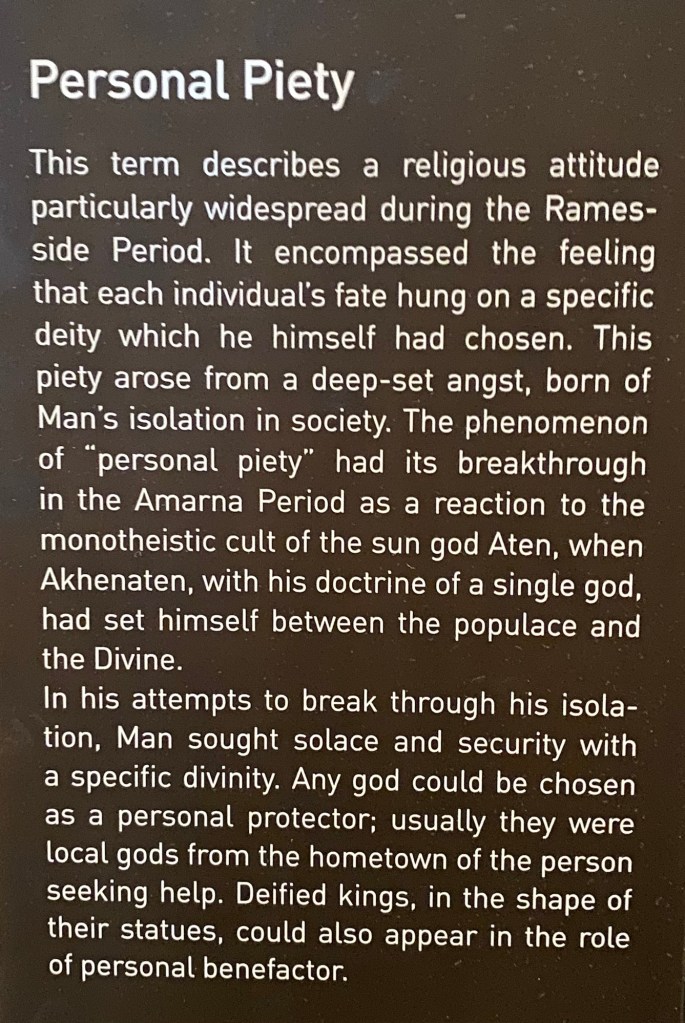
More fascinating labels, again, I might remark in Munich: in English! Thank you! Bitte! I didn’t regret one moment of time taken to read these illustrious summaries.
Below, a 3 d illustration parked in the gallery floor. This museum knows how to capture the visitor’s attention with a variety of exhibition devices.
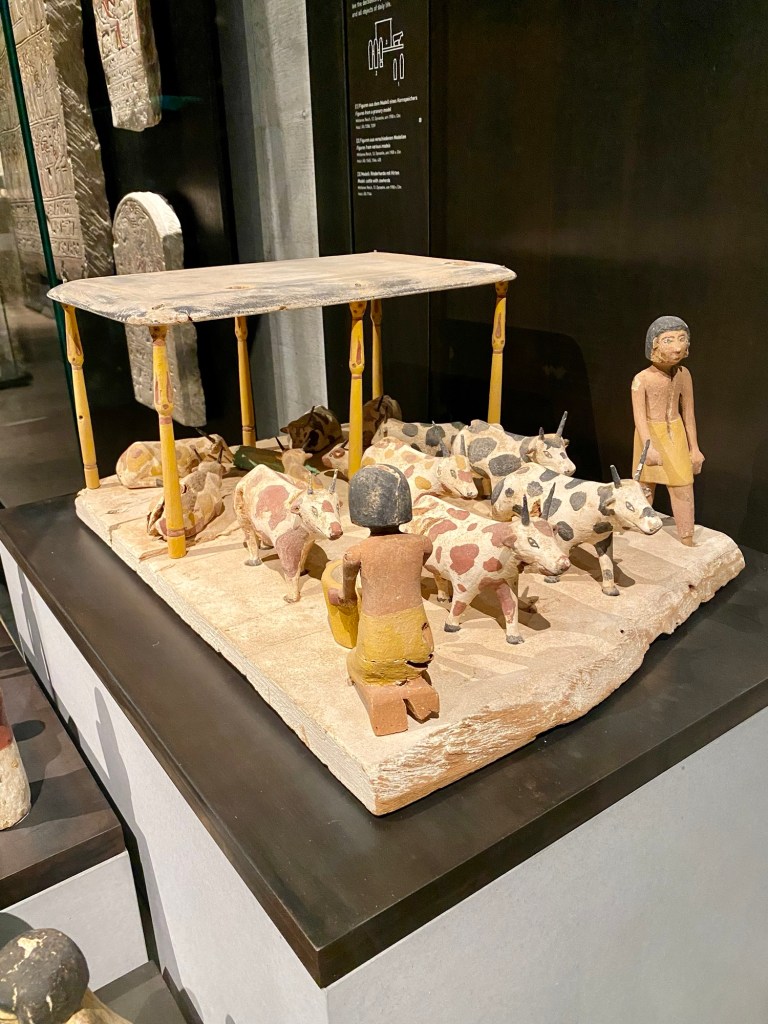
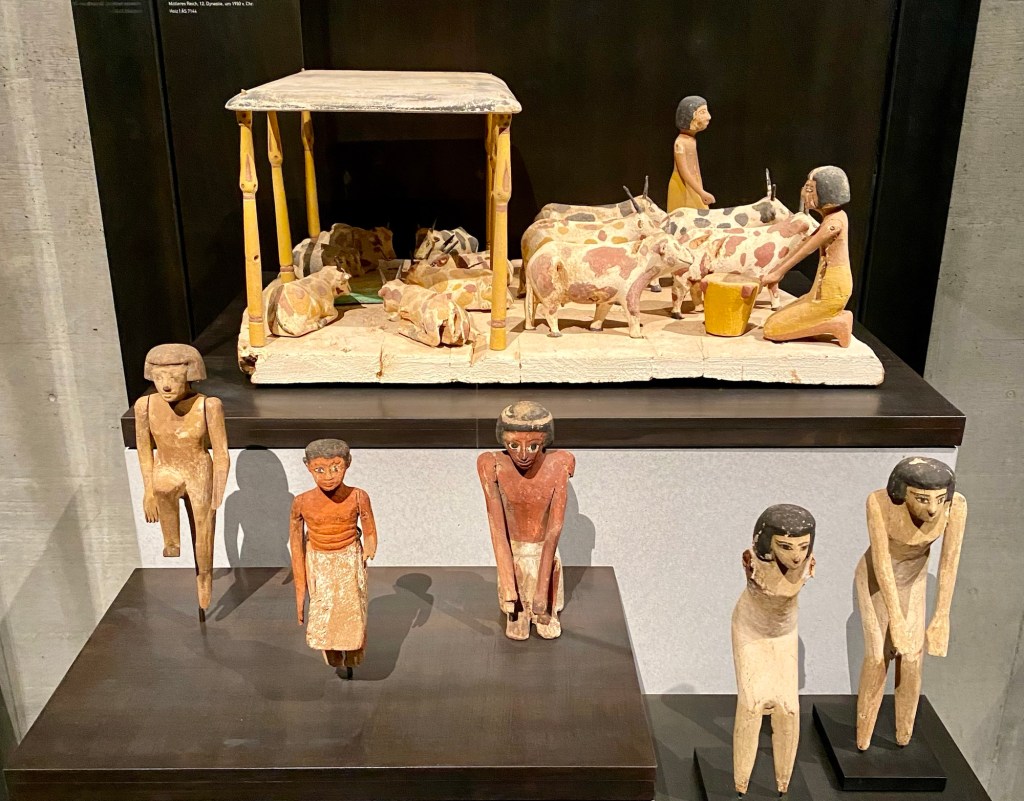
When I first saw the small scale models below, I first thought of Italian creche scenes. They are about the same size.
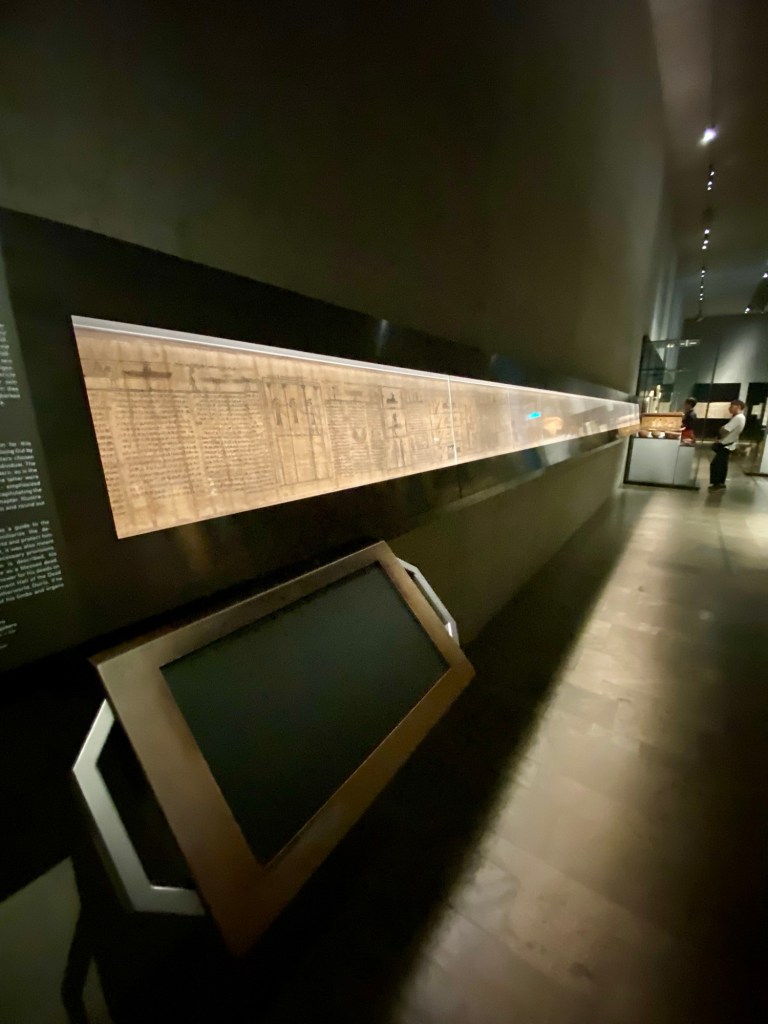
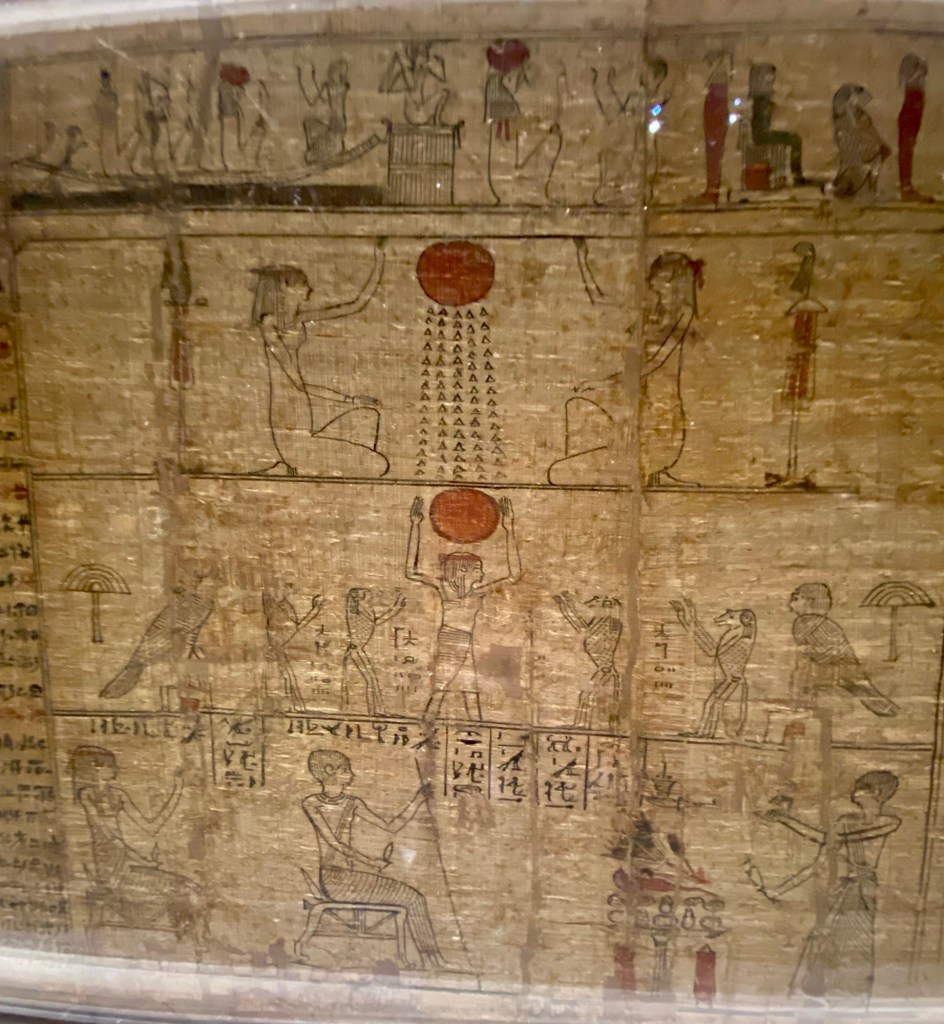
The next exhibit of the book of the dead was astounding. It is tremendously long and completely displayed. Remarkable.
Here are details from the displayed Book of the Dead. Note the depiction of moving liquid again, among other things.
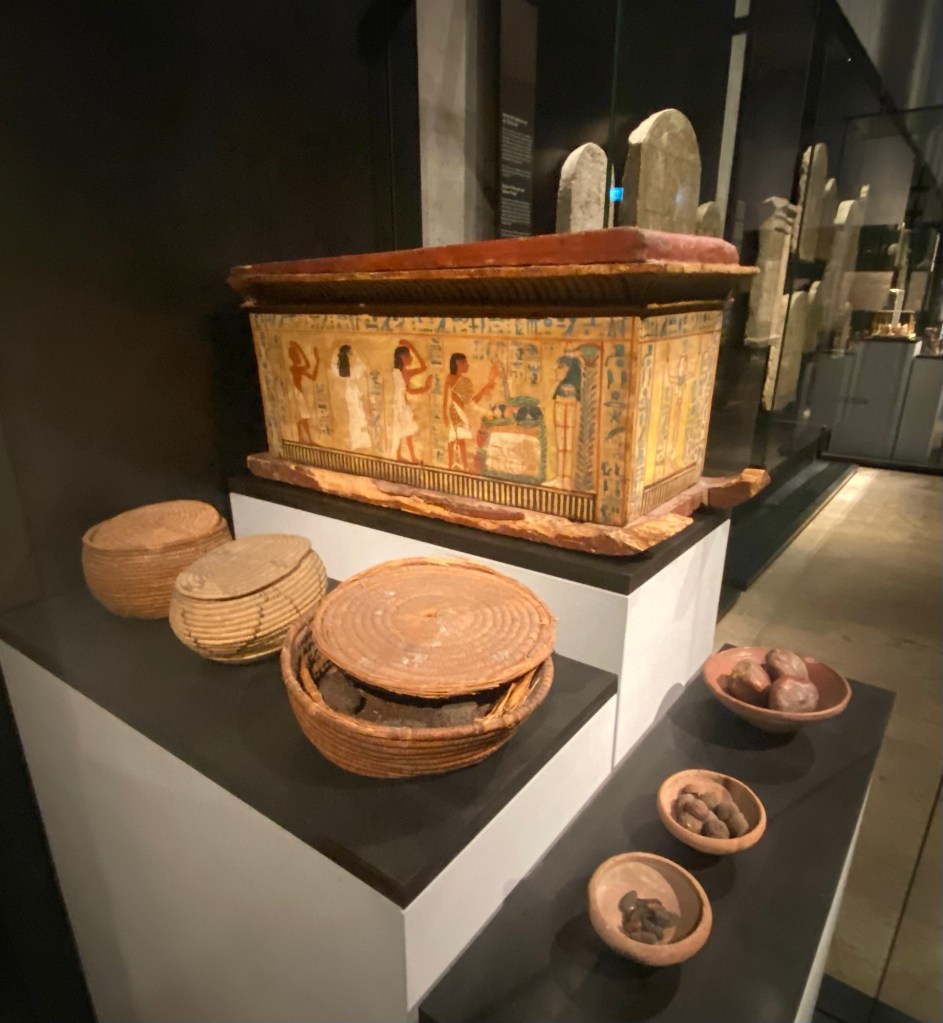
A child’s sarcophagus. Always an arresting subject to think about.
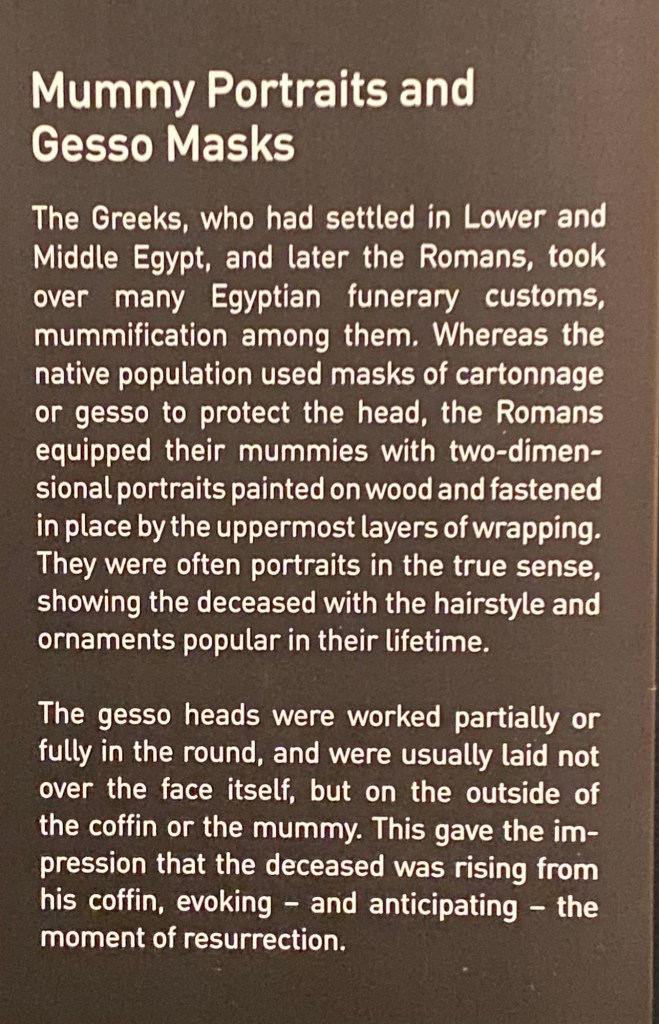
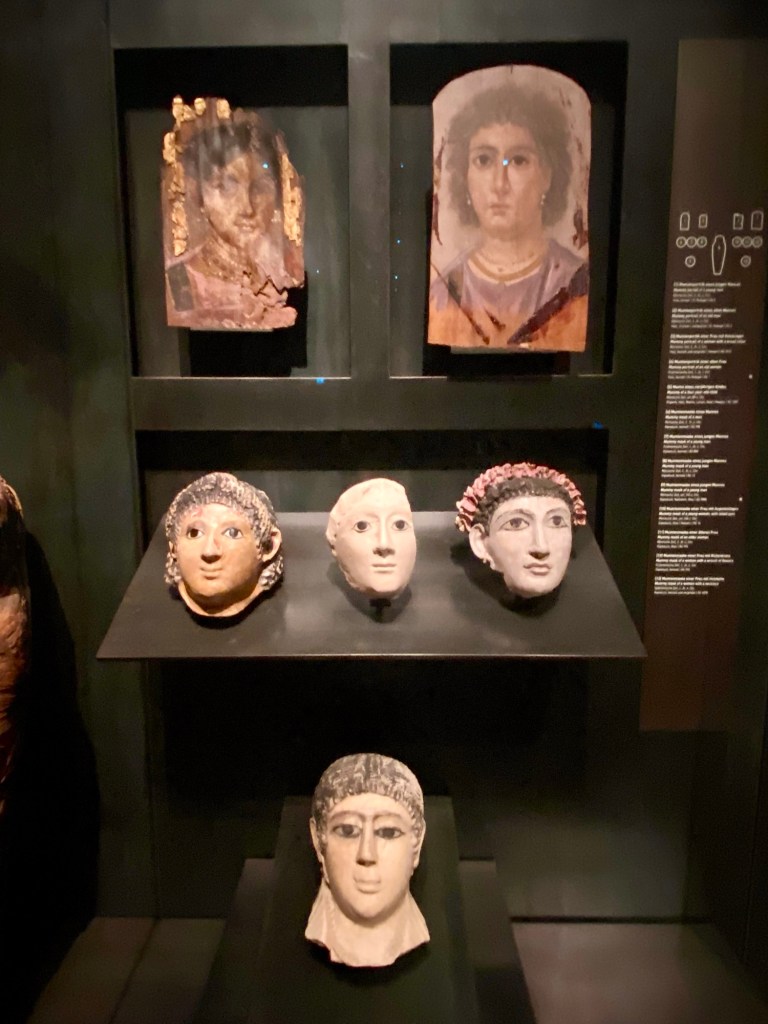
I’ve seen the mummy portraits created once the Romans got involved with Egypt in many museums. Never have I seen the phenomenon better explained.
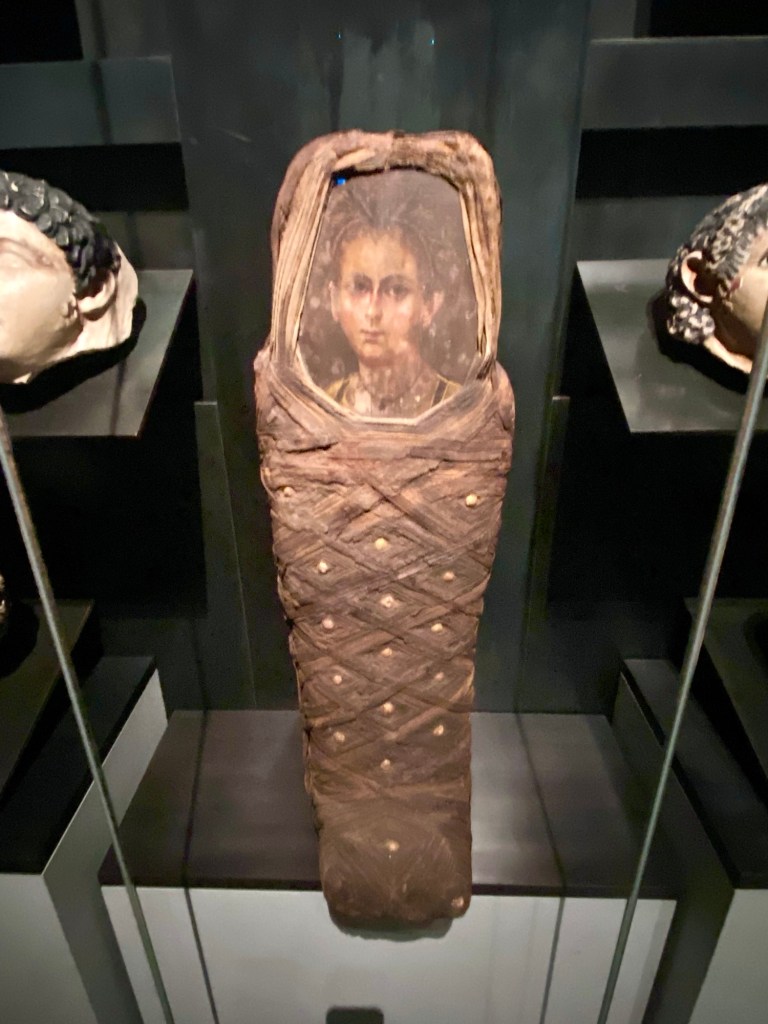
And never before have I seen an actual mummy with the portrait in place. Now it makes sense.
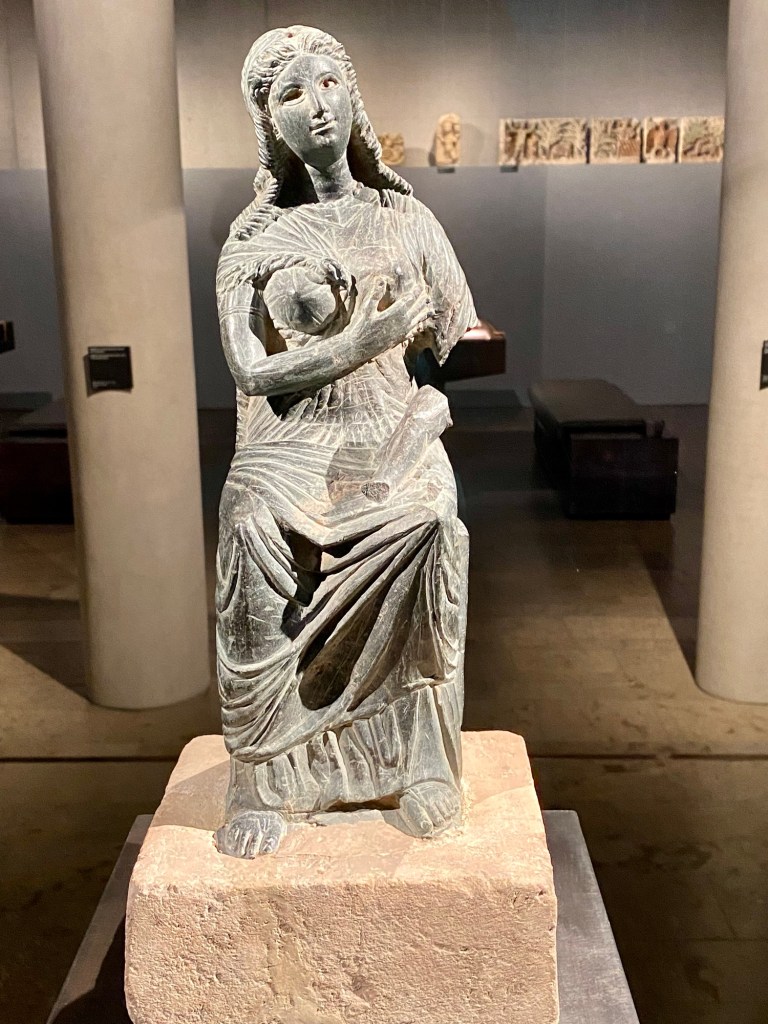
Isis holding Horus. I immediately thought of all the upcoming images of the Virgin and Child that will be produced in the Western world. Did they borrow this iconography?
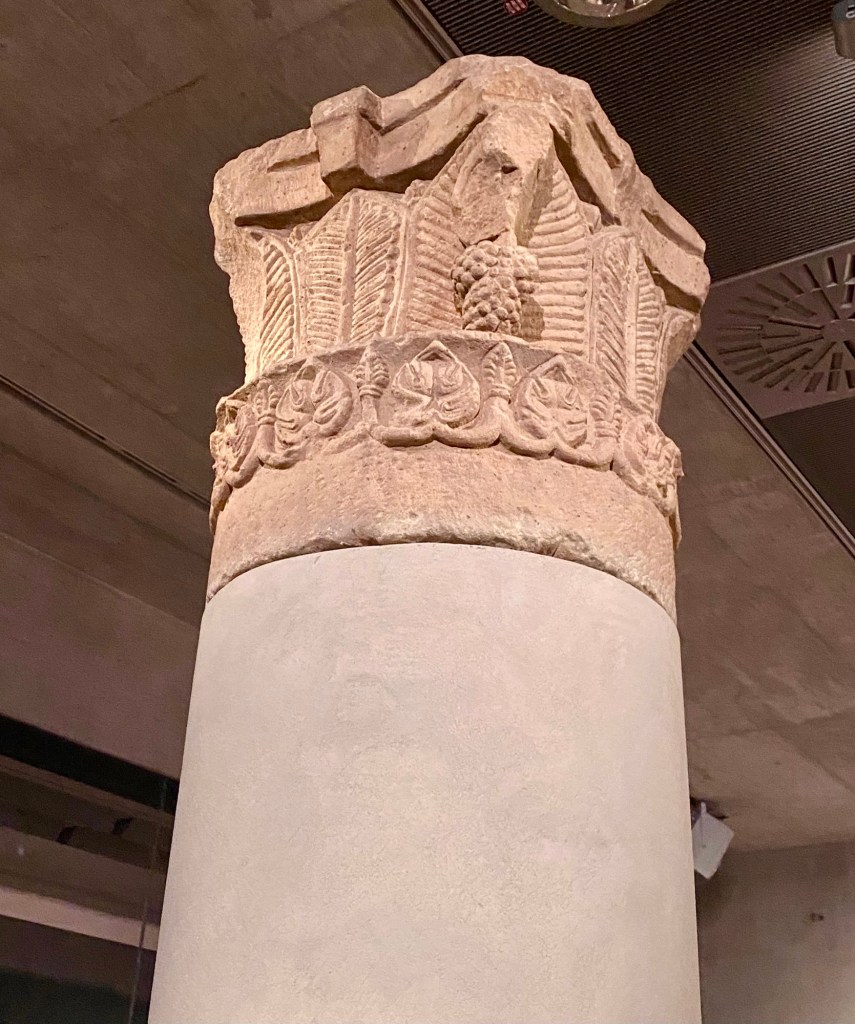
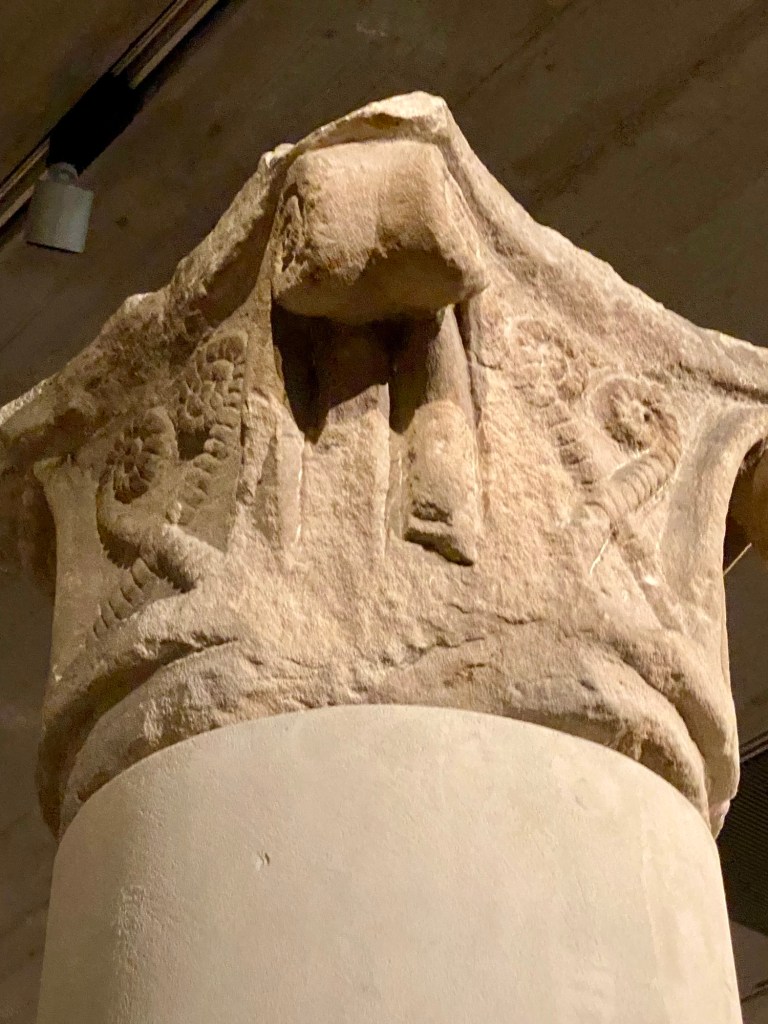
3 columns of Egyptian manufacture. I was intrigued by the capitals. I thought of the succeeding Greek capital designs and wondered about influences, back and forth.
Anyone lucky enough to spend time in this museum is fortunate indeed. I filled out a card at the reception desk remarking on the superlative experience I had on this vacation day, when I had intended to just float through a museum without much engagement. They caught me and I’m the richer for it.
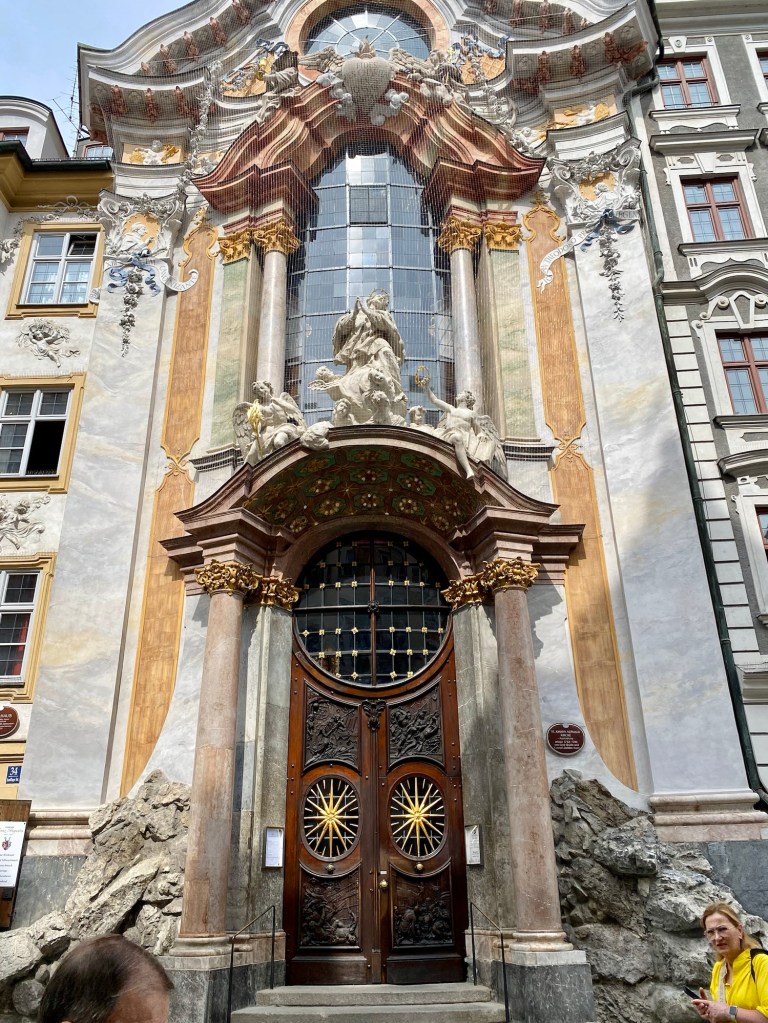
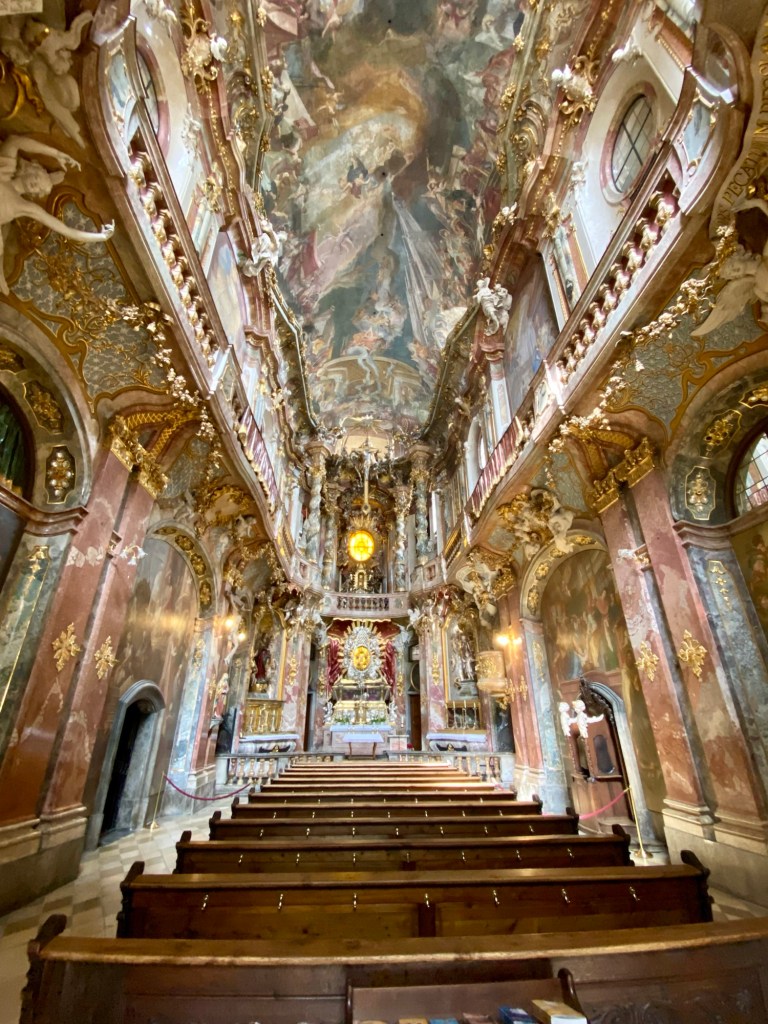
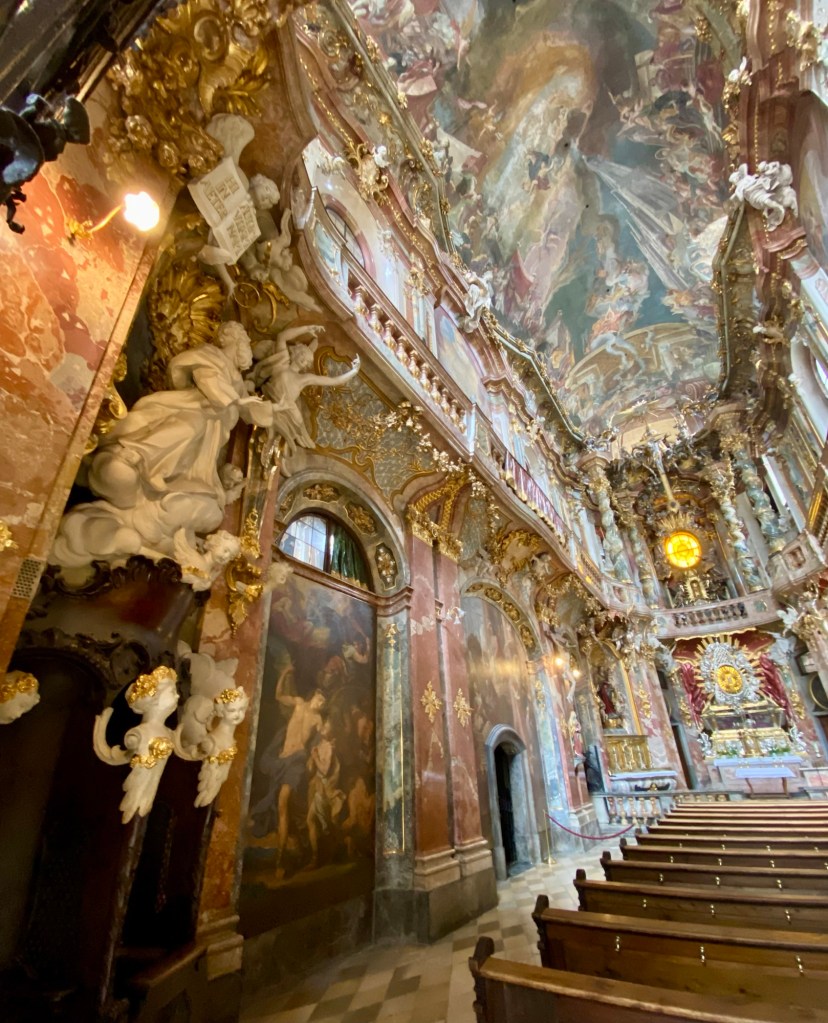
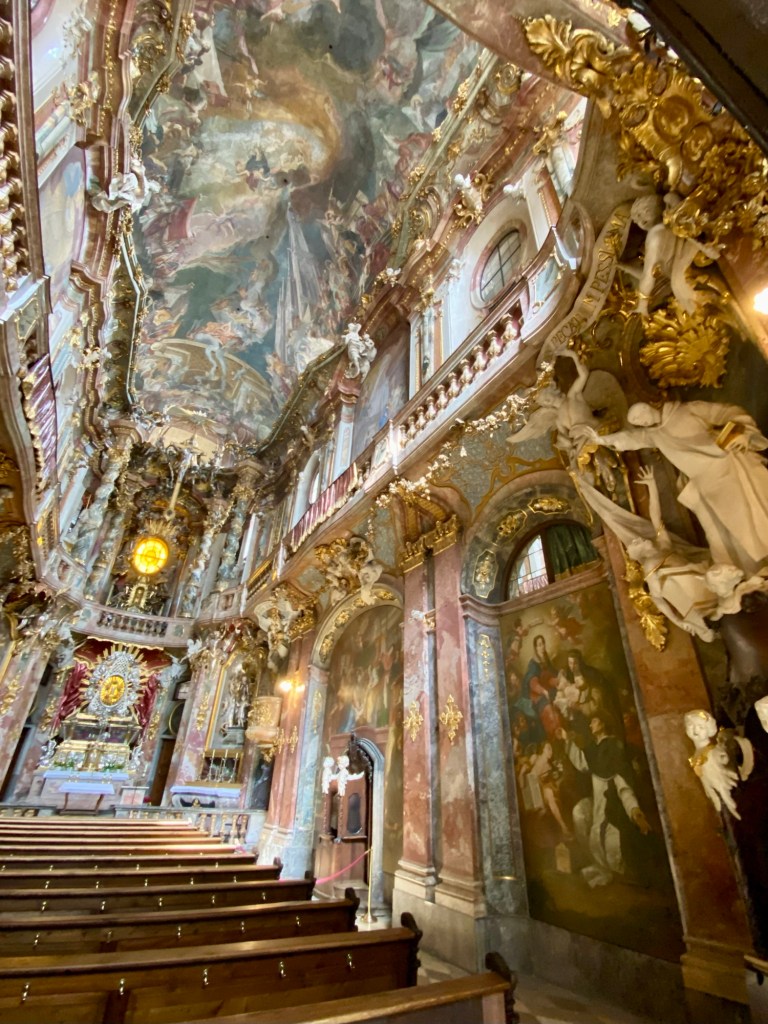
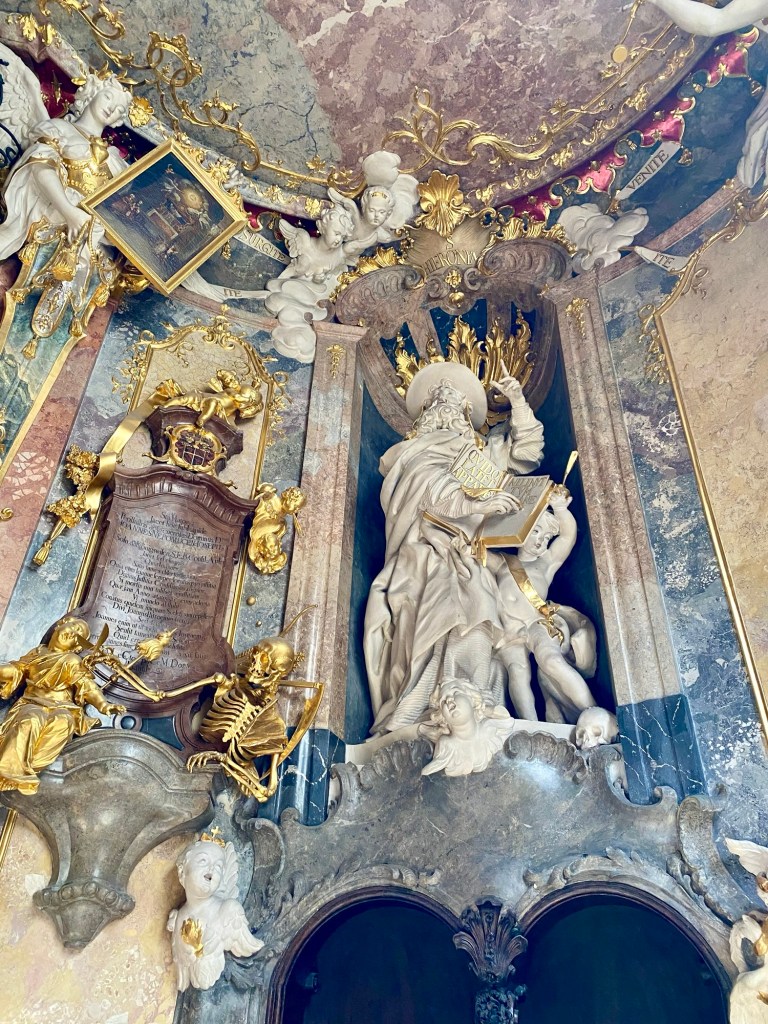
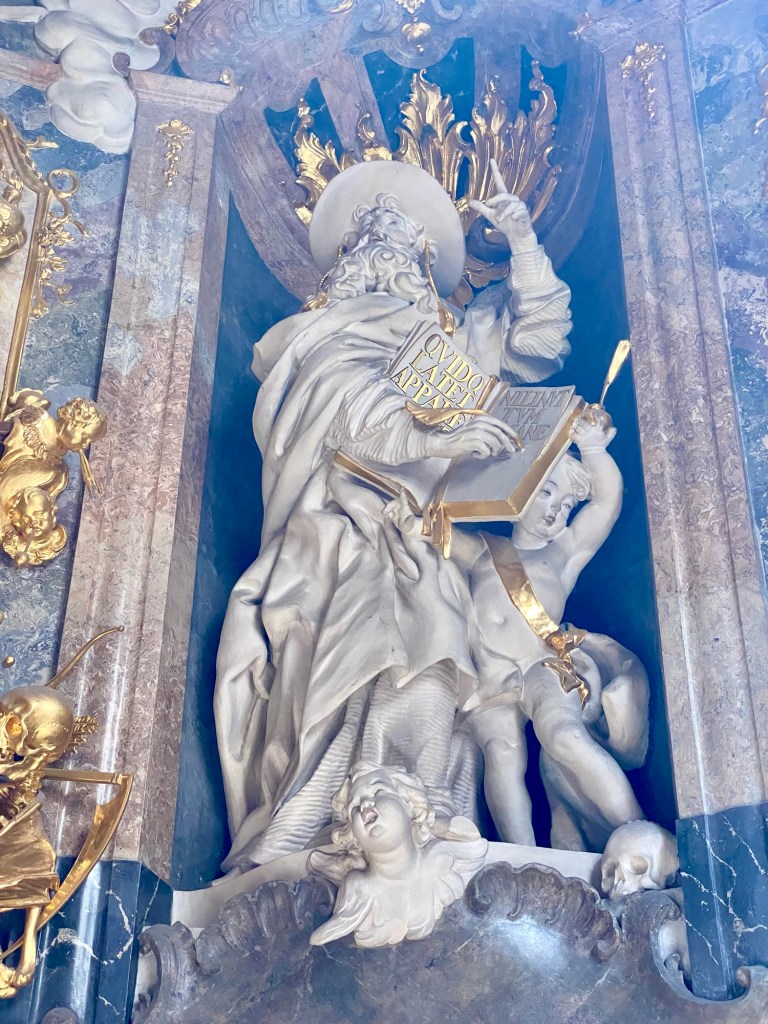
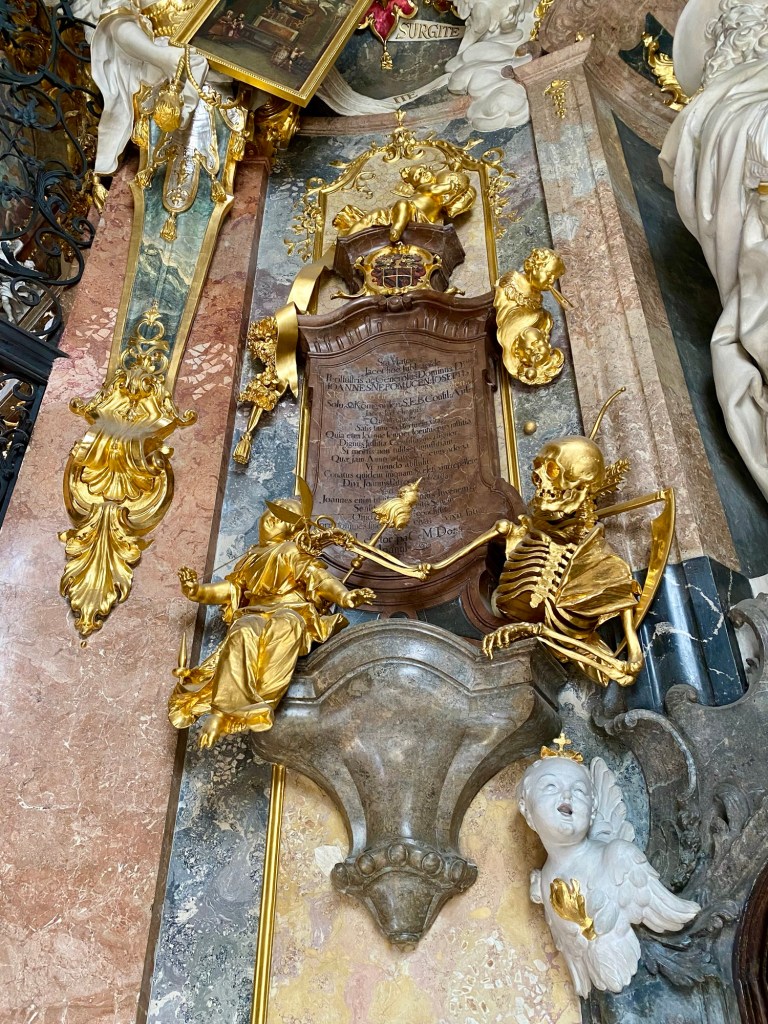
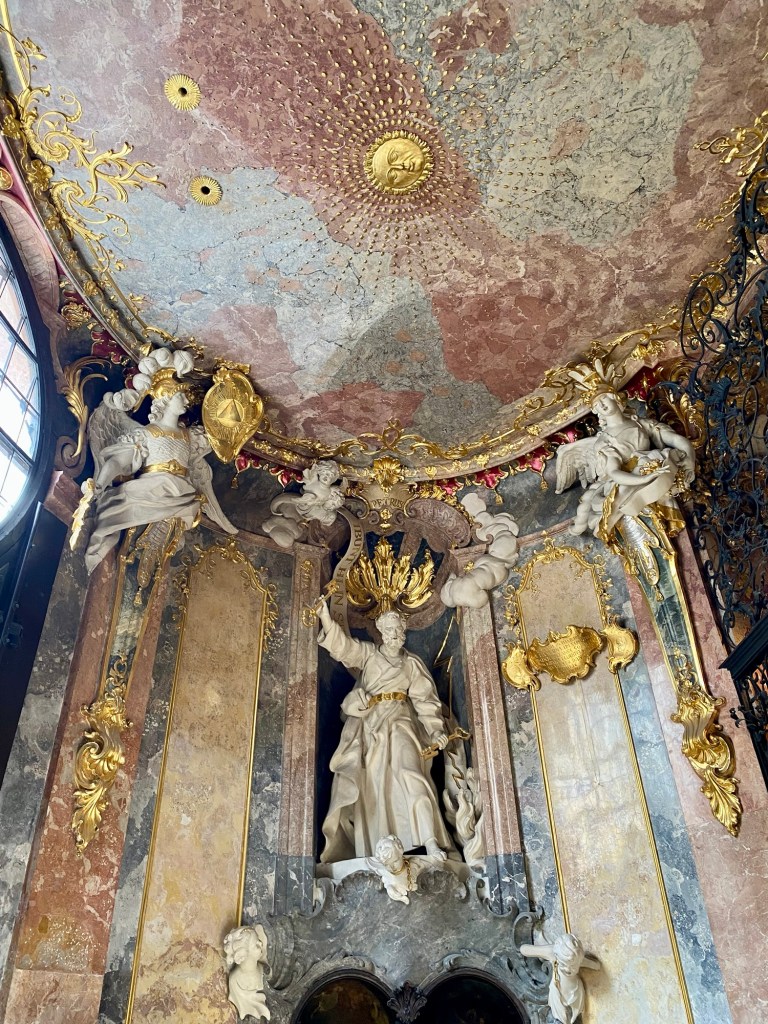
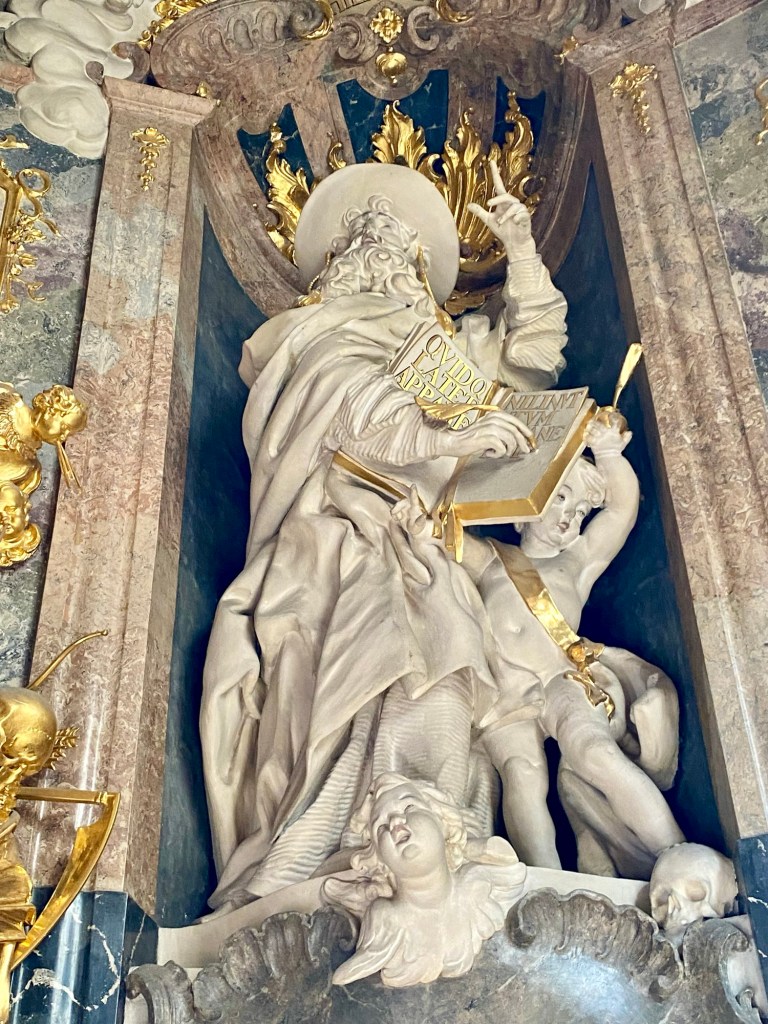
St. Johann Nepomuk, better known as the Asam Church (Asamkirche), is a Baroque church in Munich. It was built between 1733 to 1746 by a pair of brothers, sculptor Egid Quirin Asam and painter Cosmas Damian Asam, as their private church. It is considered to be one of the most important buildings of the southern German Late Baroque.
Nestled between townhouses on a lovely street in pedestrianized Munich, it would be hard to overlook.
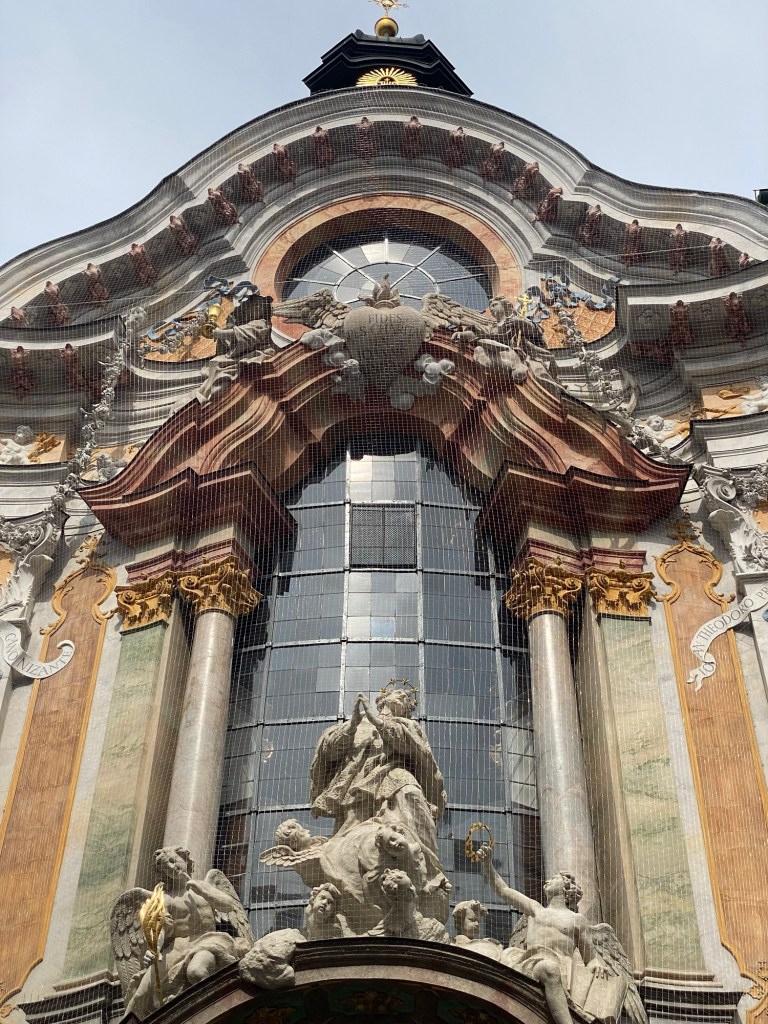
The Baroque façade is integrated into the houses of the Sendlingerstraße and swings slightly convex outward.
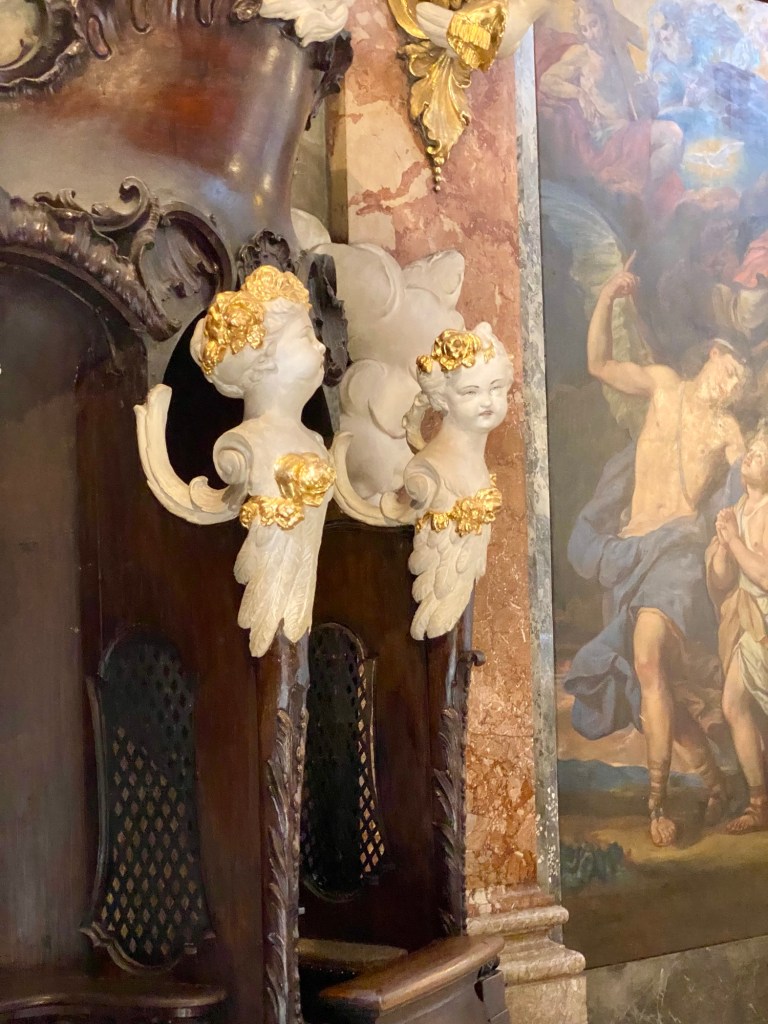
The church was not commissioned, but built as a private chapel for the greater glory of God and the salvation of the builders. This allowed the Asam brothers to create whatever they wanted. For example, Egid Quirin Asam could see the altar through a window of his private house next to the church (Asamhaus). He also designed the church as a Beichtkirche (confession church) for the local youth. The small church therefore has seven confessionals with allegorical scenes.
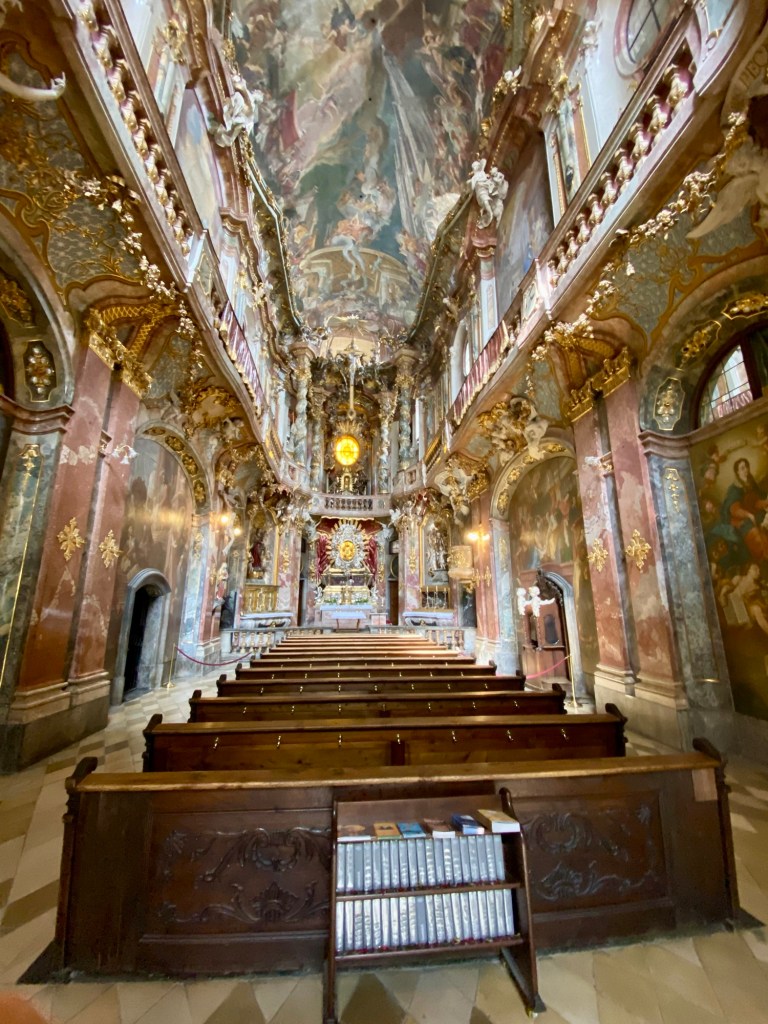
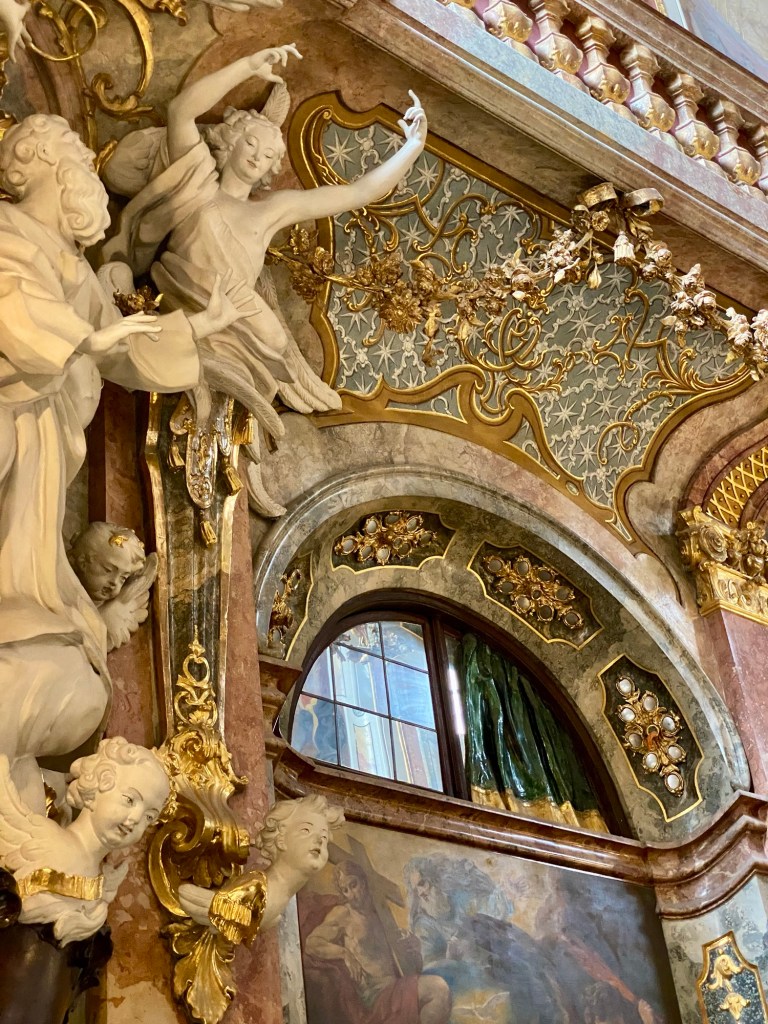
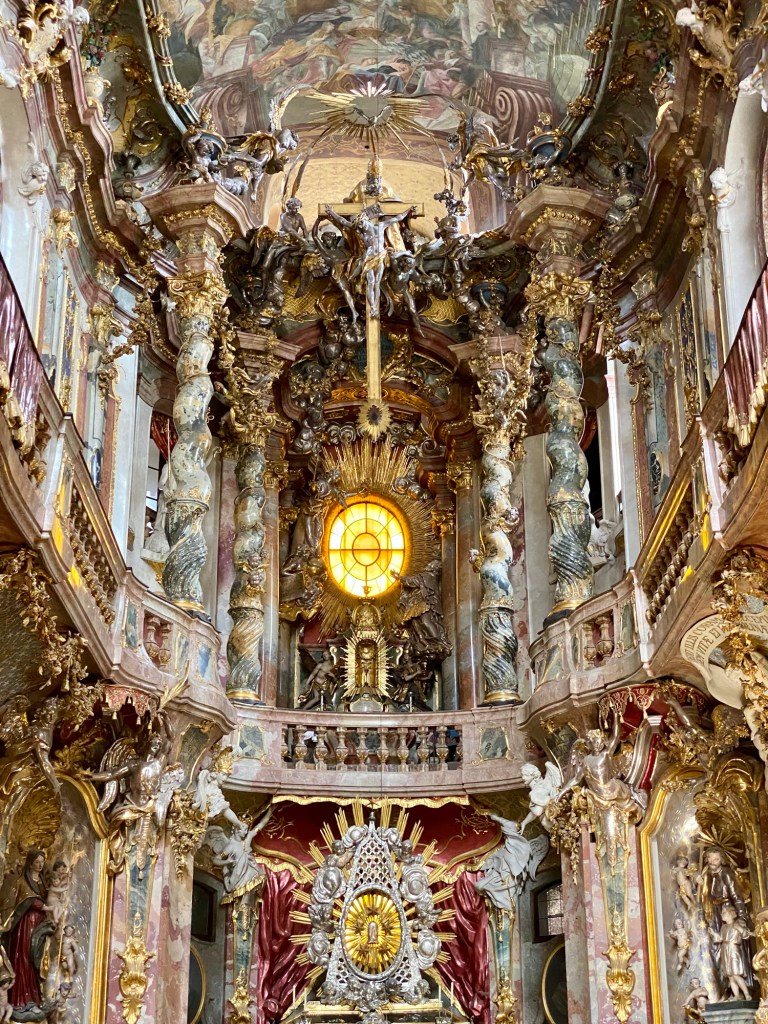
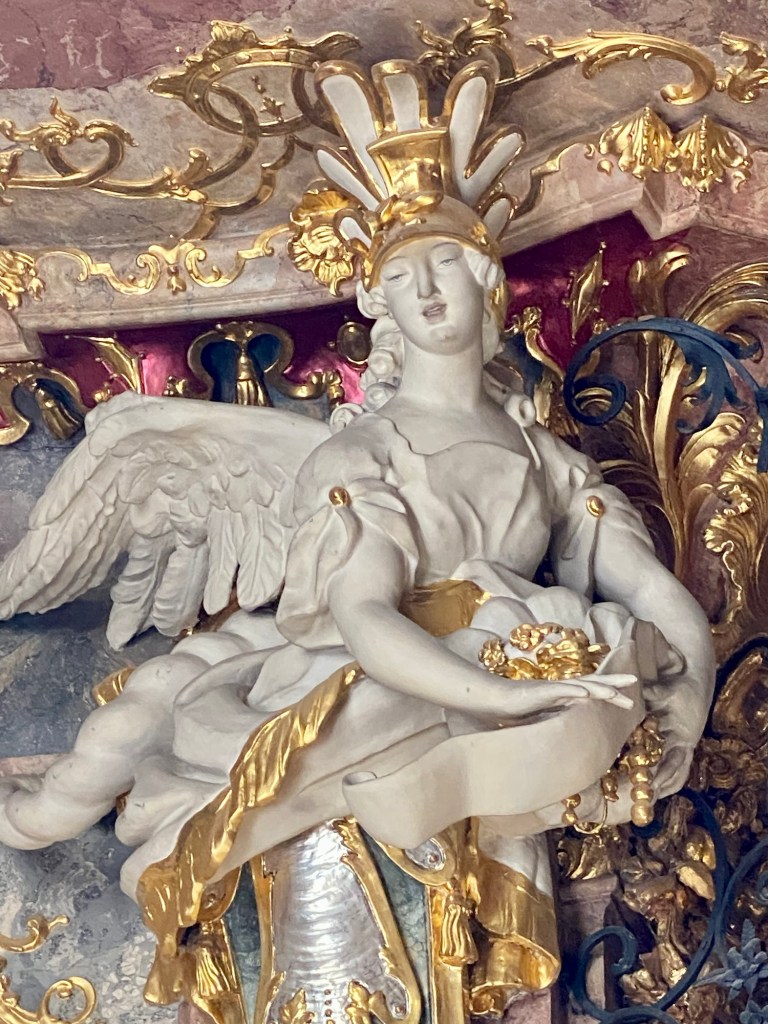
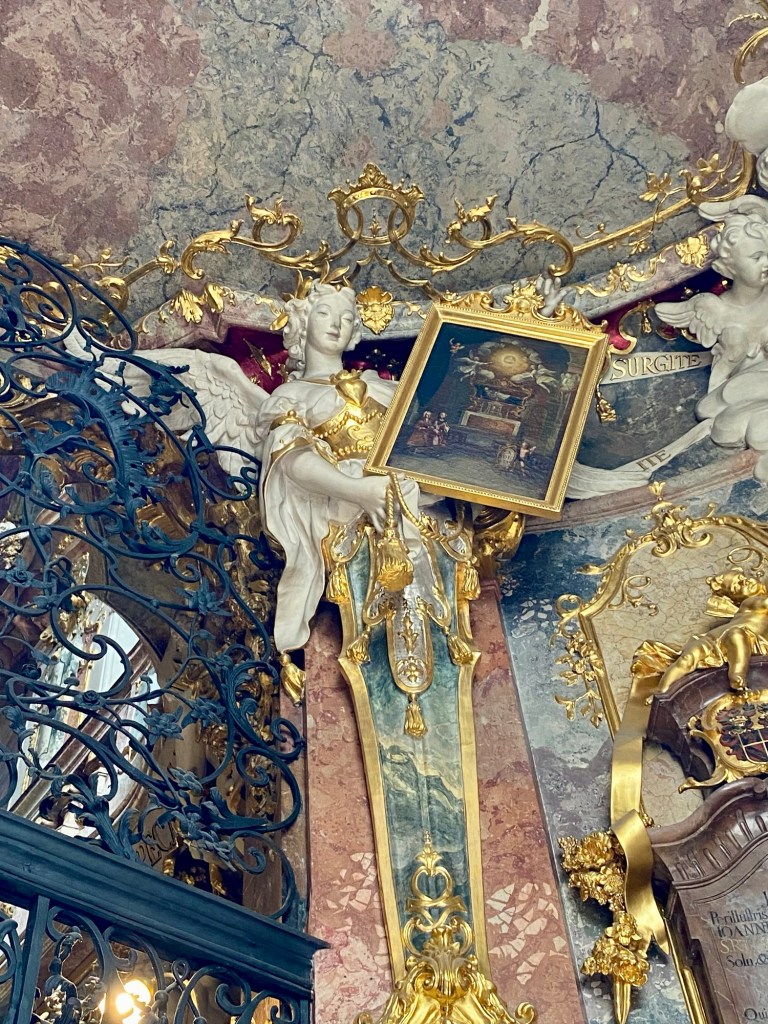
St. Johann Nepomuk was built in a confined space, its property just 22 by 8 m. Even more astonishing is the artistry of the two builders, who were able to harmoniously unite, in a very decorative manner, in the two-story space architecture, painting, and sculpture. The indirect lighting in the choir area is especially well done: hidden behind the cornice window, the Trinity figures are illuminated effectively from behind. The cornice itself seems to swing up and down on its curved construction.
Unfortunately, visitors cannot enter the church. You can go into the vestibule, but there is a decorative wrought iron gate separating it from the nave and so my pictures were taken through the rungs of the gate.
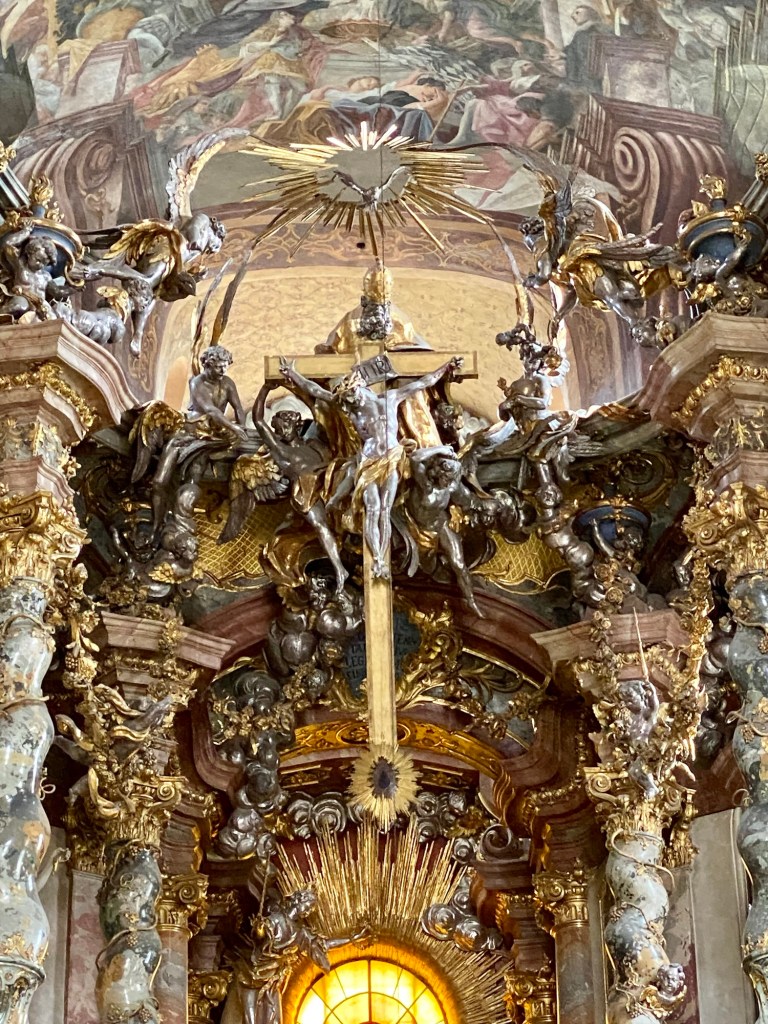
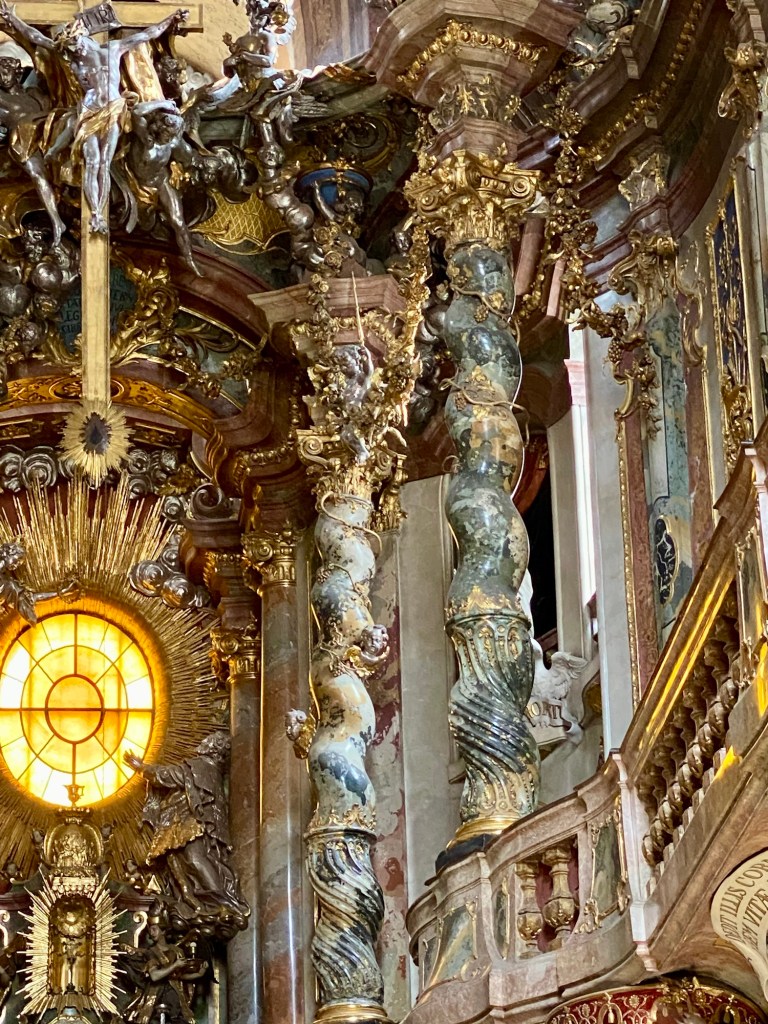
The ceiling fresco Life of Saint Nepomuk is considered a masterpiece of Cosmas Damian Asam. The high altar of the Asam Church is framed by four Solomonic columns. These four columns at the altar recall the four Bernini columns over the grave of St. Peter in St. Peter’s in Rome. Previously, the brothers Asam had studied in Italy at the Accademia di San Luca, under Lorenzo Bernini.
At the top is God, the Saviour. Below the tabernacle, a relic of John of Nepomuk is kept. Two angels, sculpted by Ignaz Günther, flank the gallery altar and were added at a later date.
Below, a confessional: I found it to be the simplest design in the whole ensemble. It was a restful place to park your gaze for a moment.
Below, the ceiling design of the vestibule. No inch of space was left undecorated.
To me, the sculpture in the photo below seems to represent the Americas. It was a common decorative element in churches and other elaborate designs of this period to represent the 4 continents in allegorical figures. I haven’t yet taken the time to research whether I’m right.
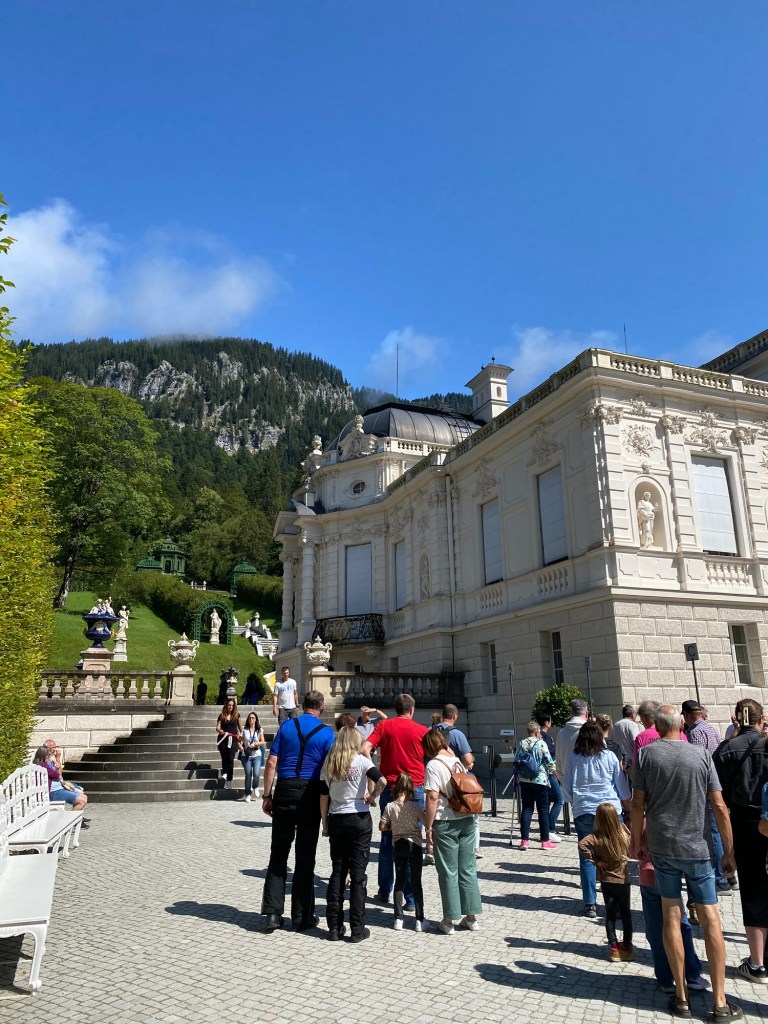
One post is not enough to cover this eccentric yet beautiful villa in the Bavarian Alps. Seeing it was a highlight of my summer in Germany.
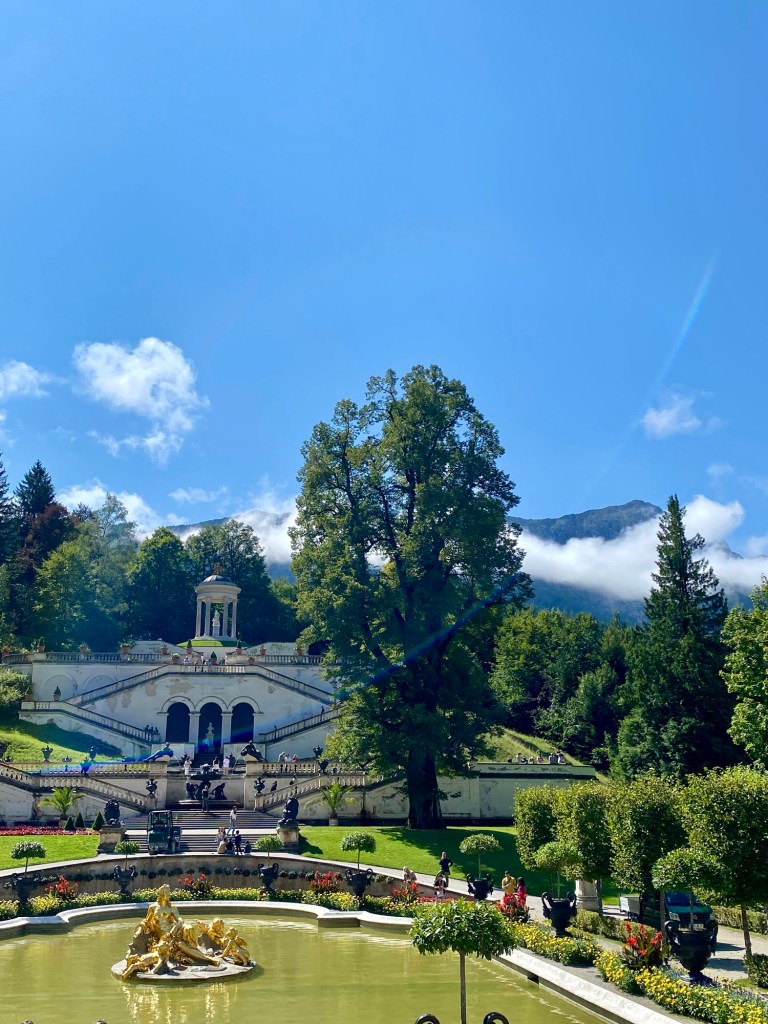
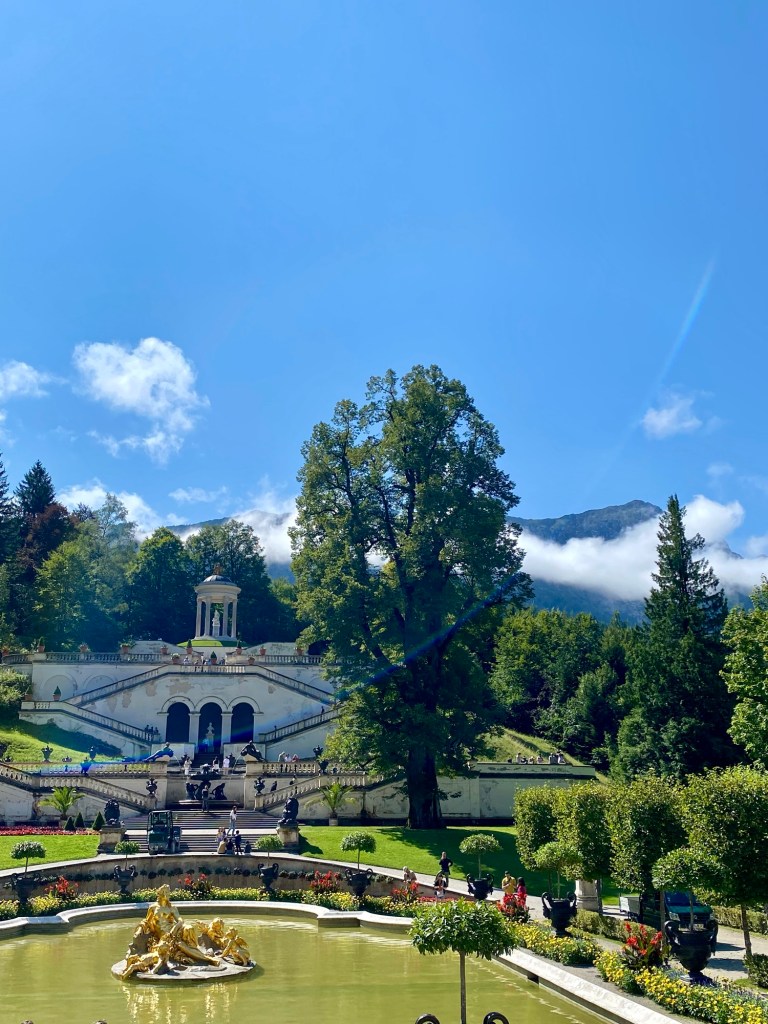
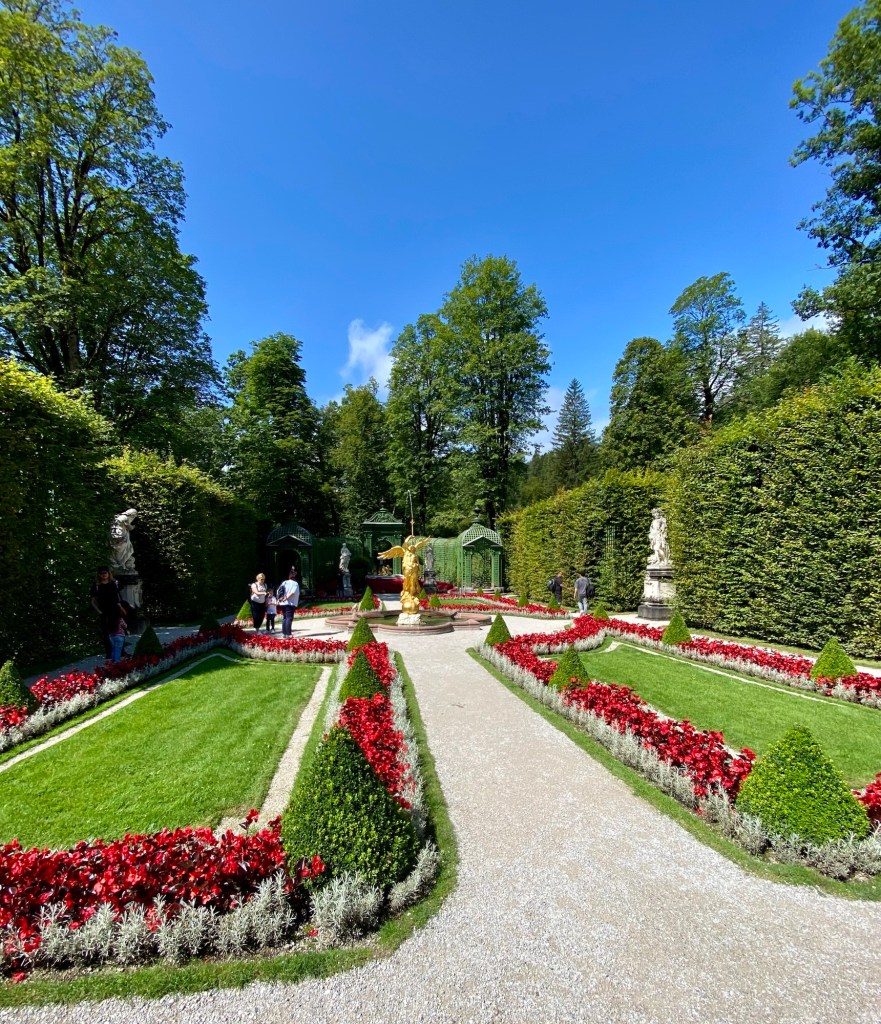
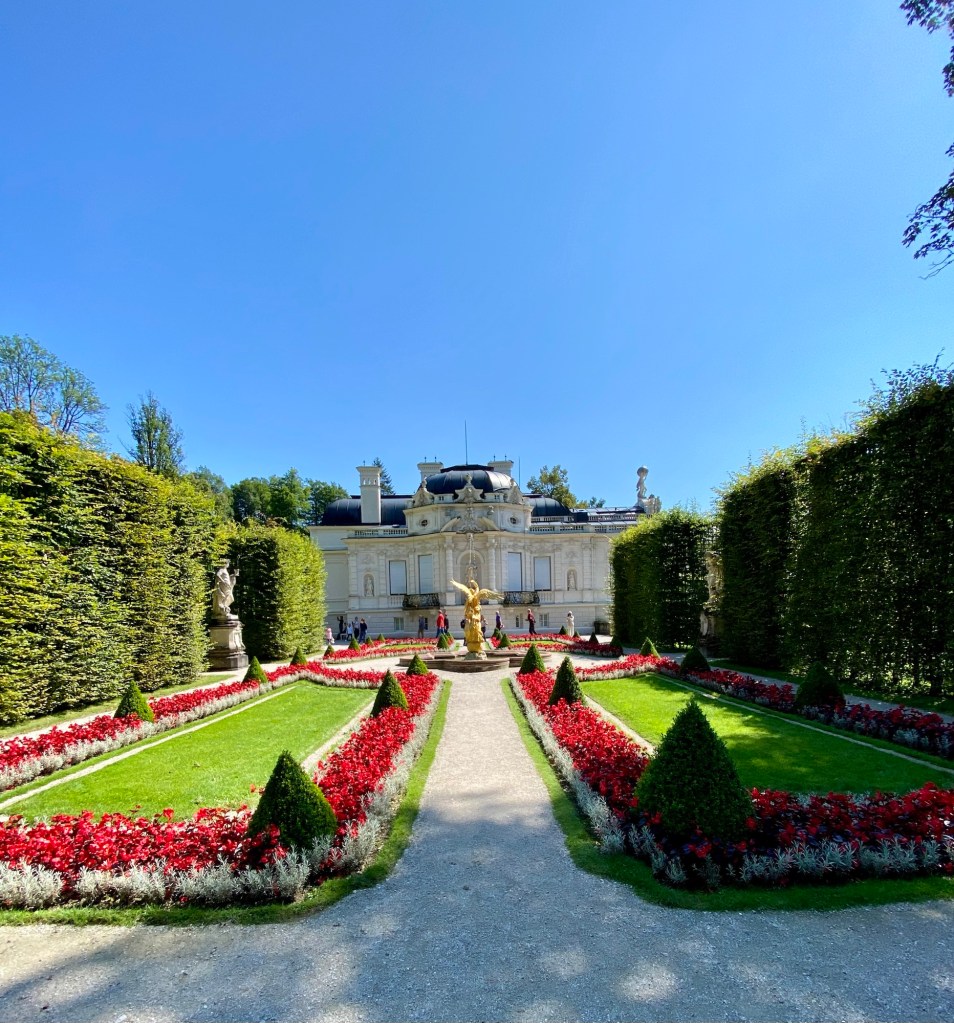
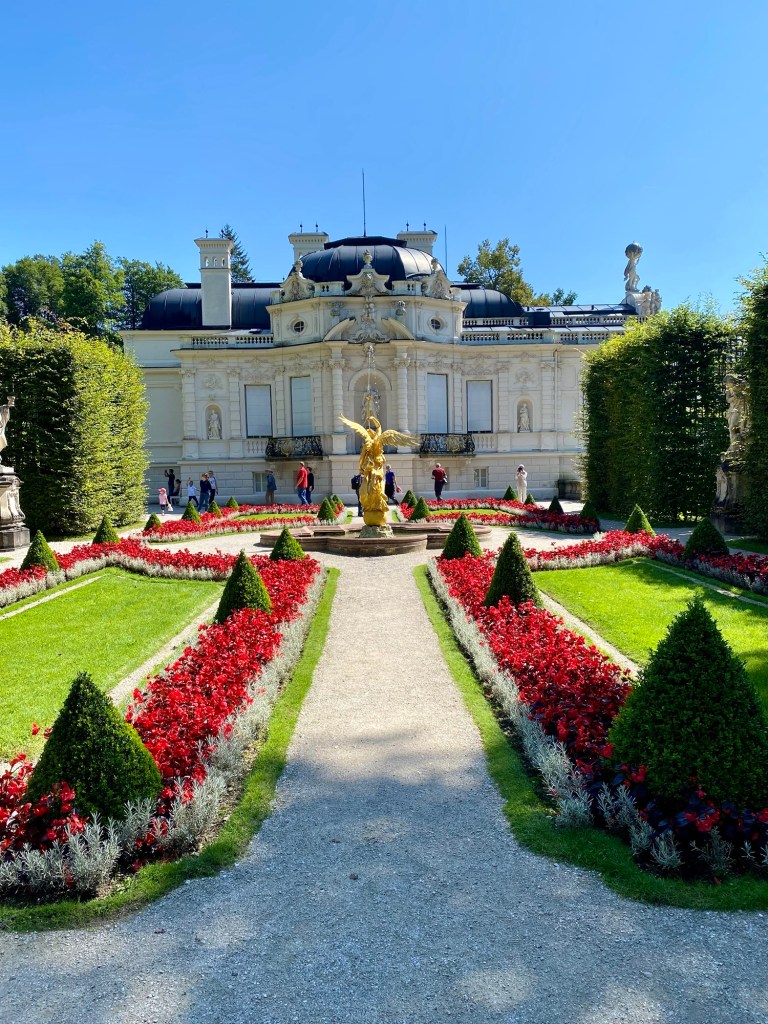
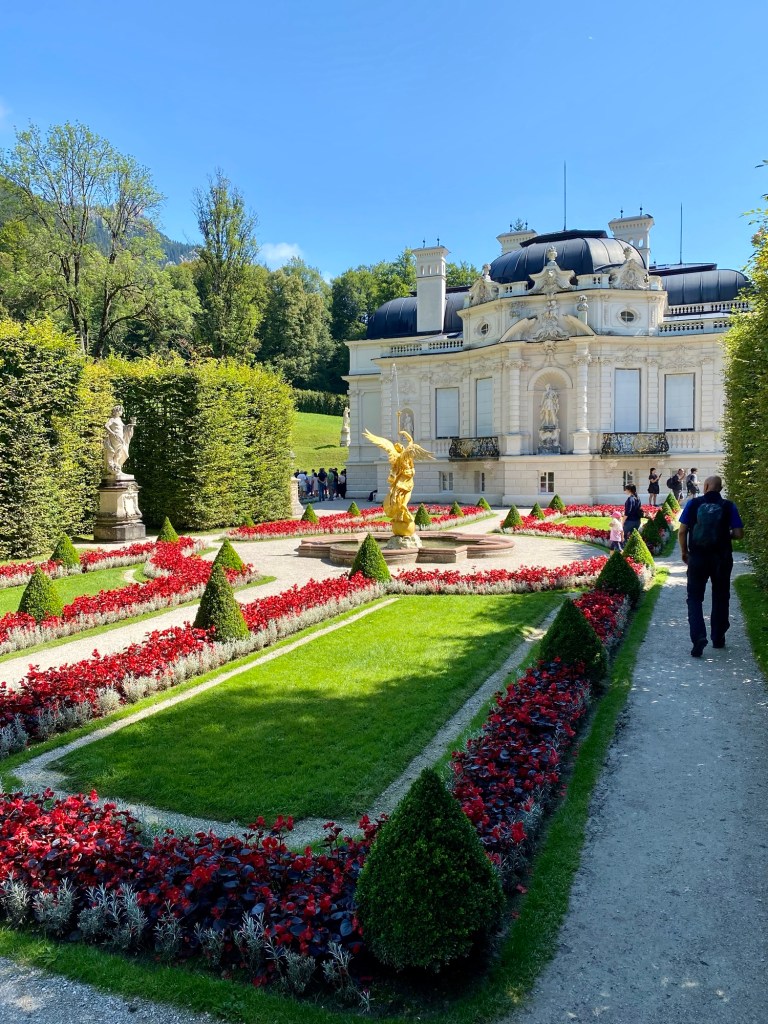
The palace is surrounded by formal gardens that are subdivided into five sections that are decorated with allegoric sculptures of the continents, the seasons and the elements:
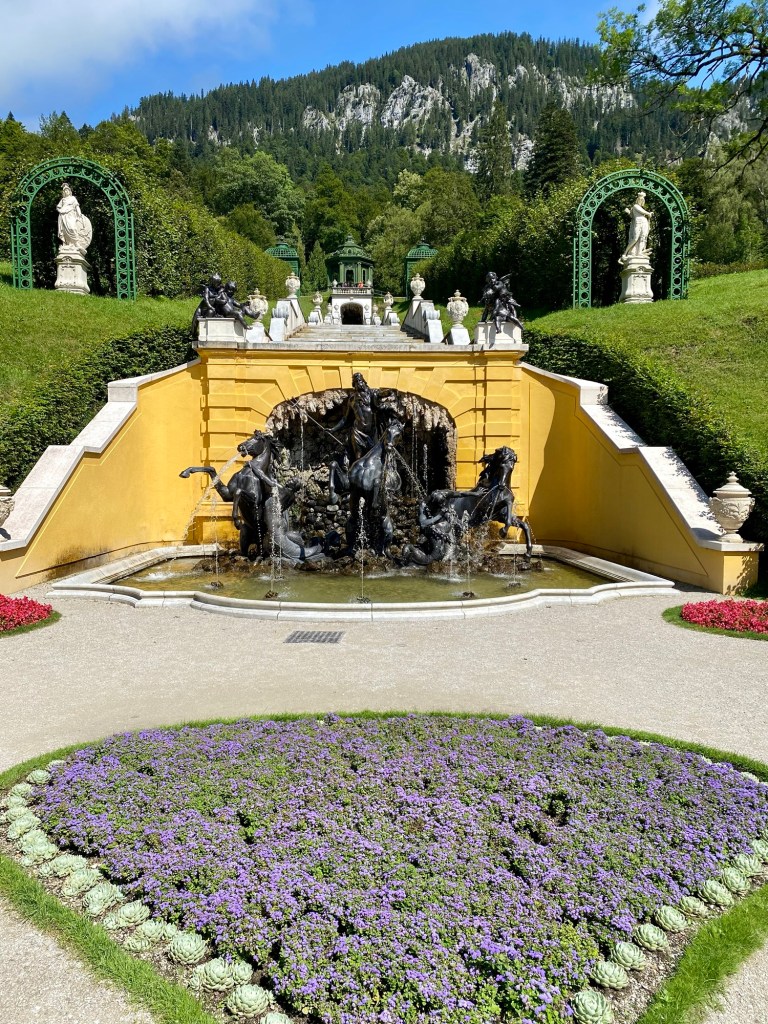
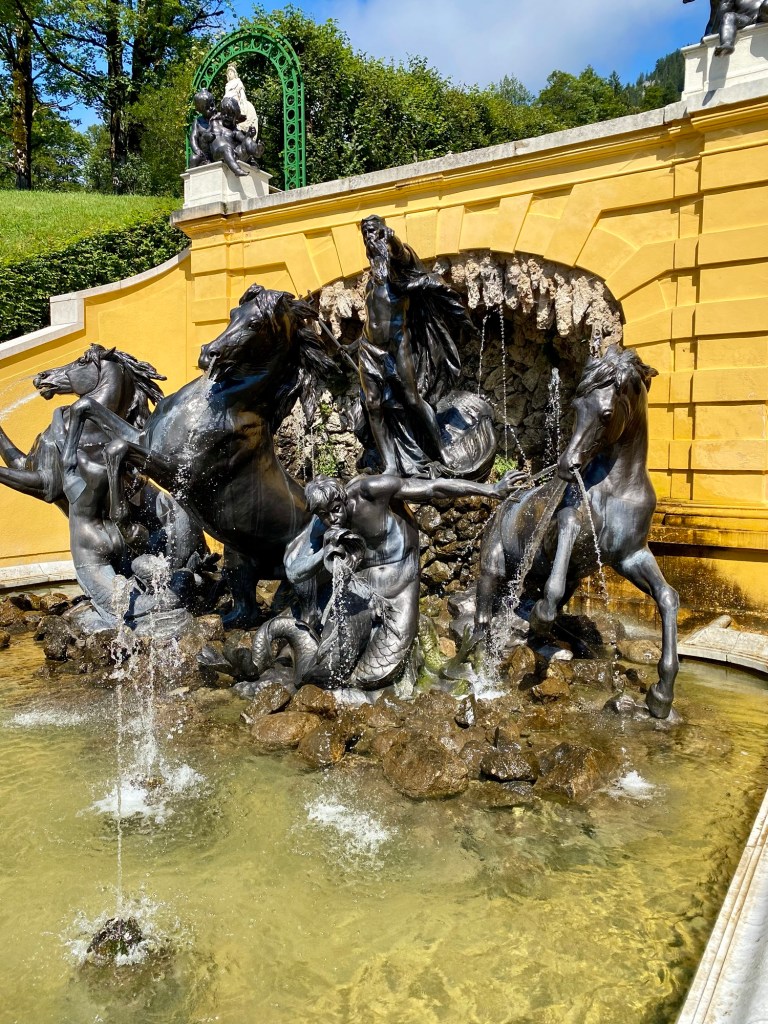
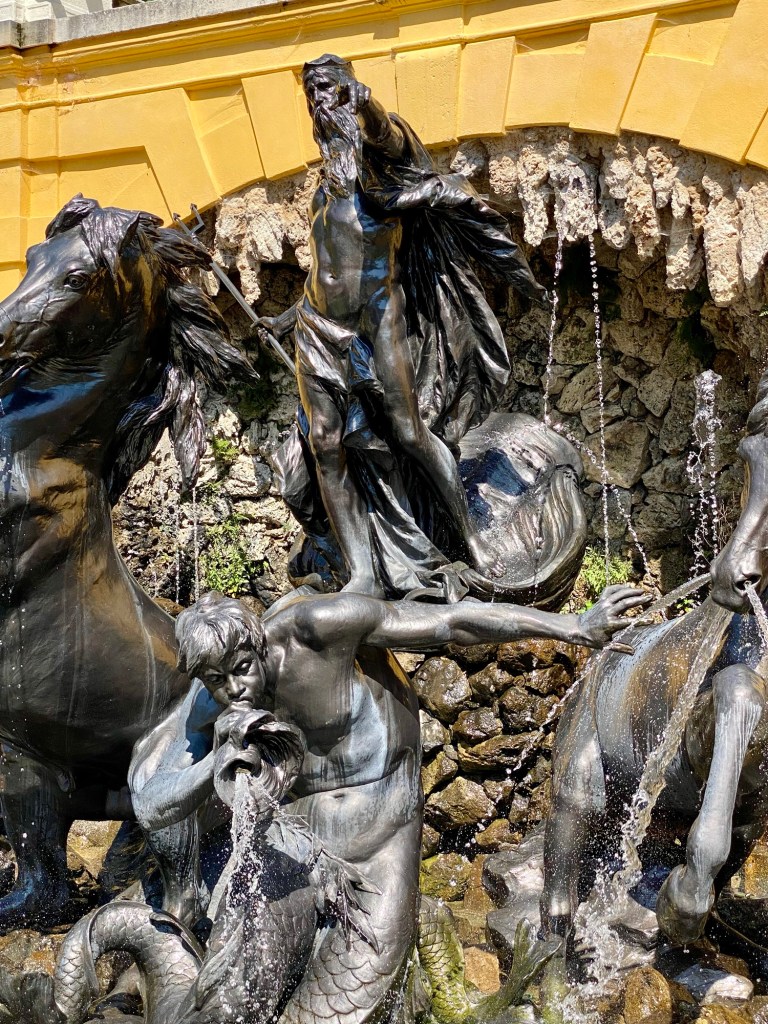
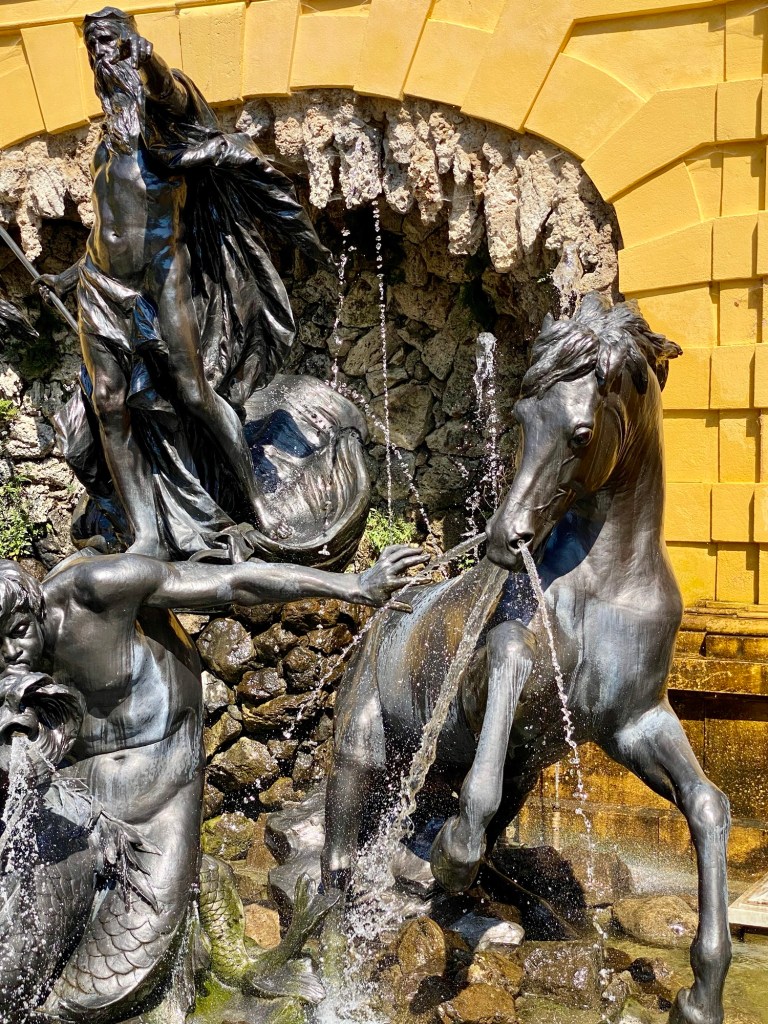
The northern part is characterized by a cascade of thirty marble steps. The bottom end of the cascade is formed by the Neptune fountain and at the top there is a Music Pavilion.
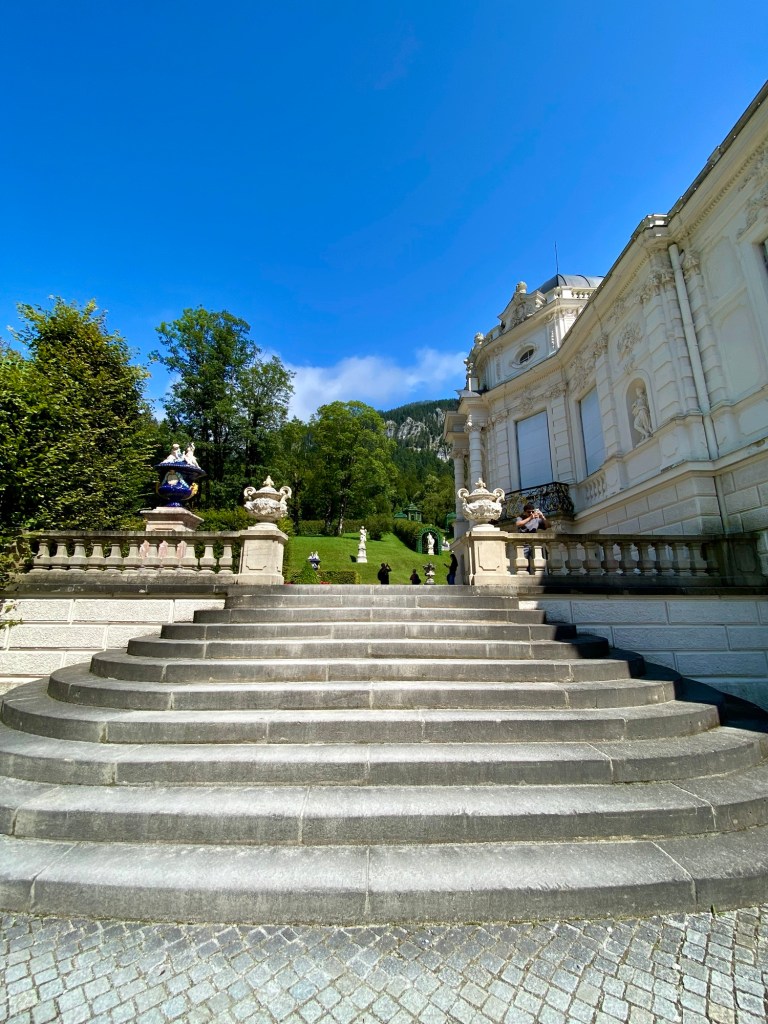
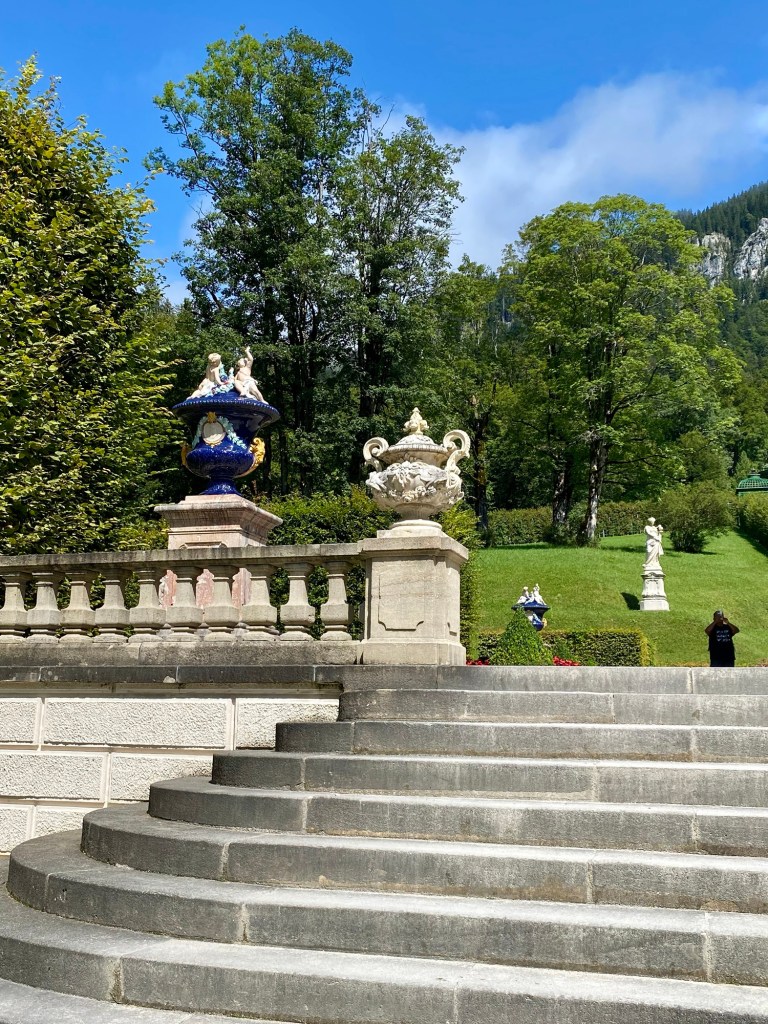
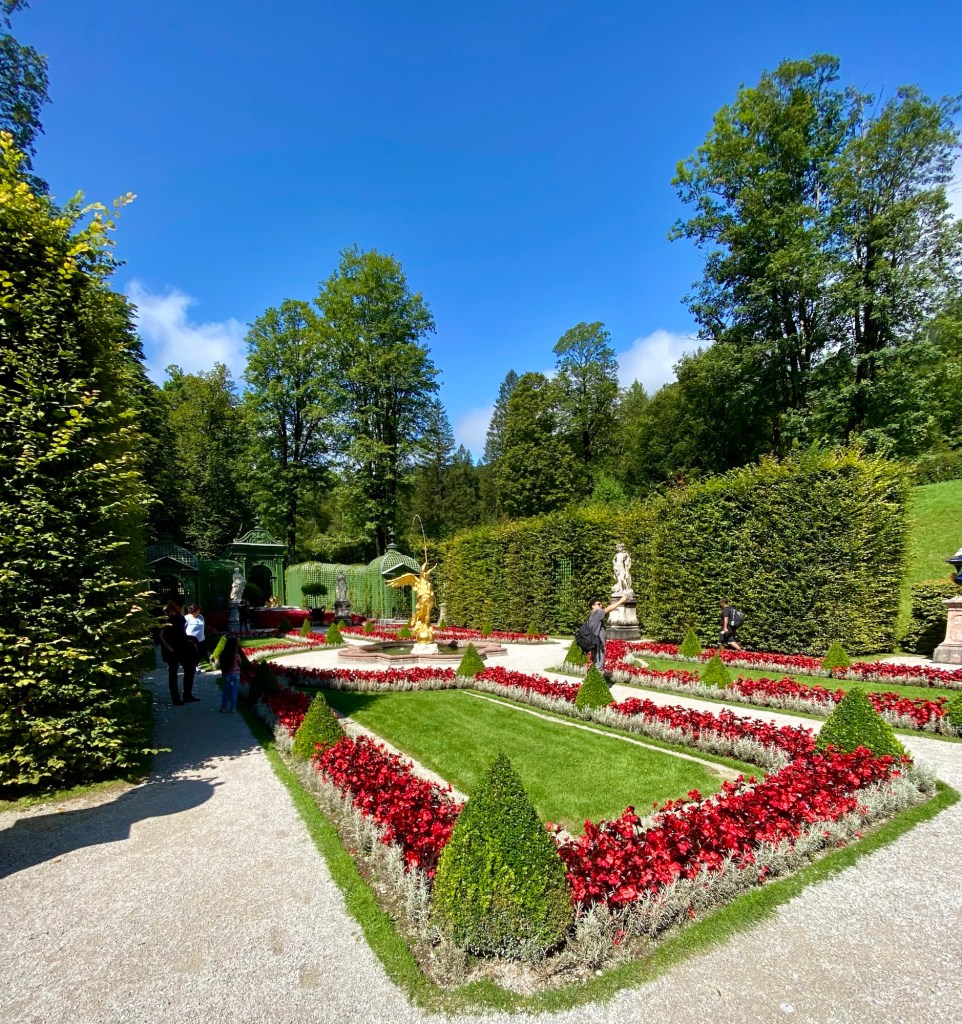
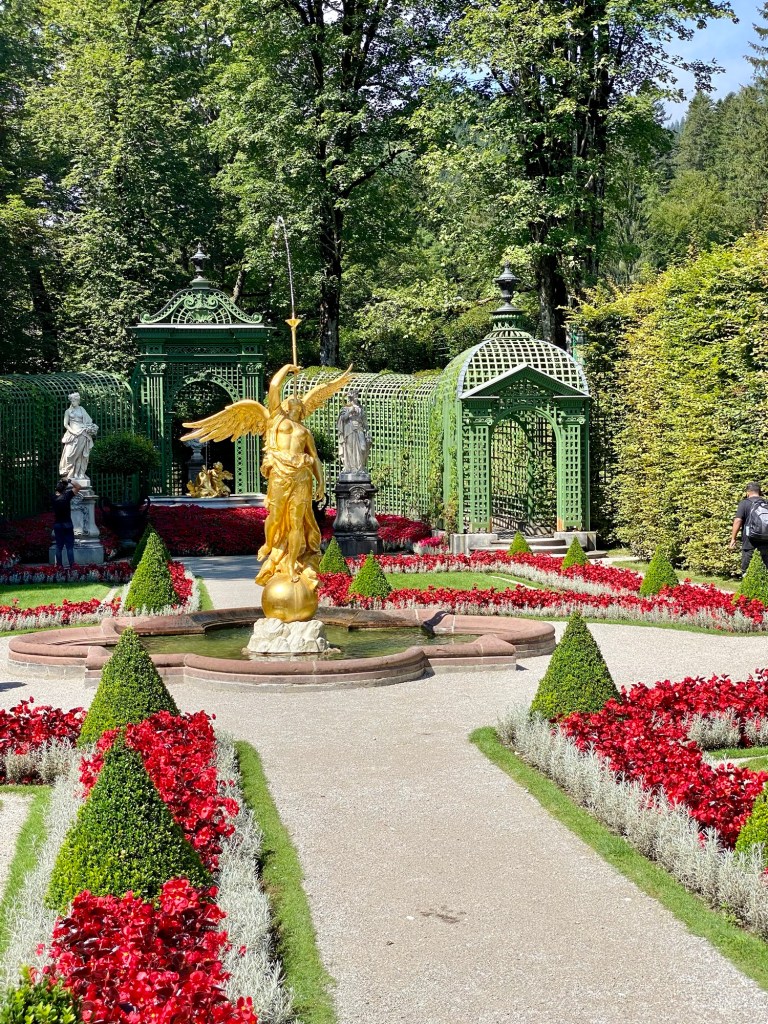
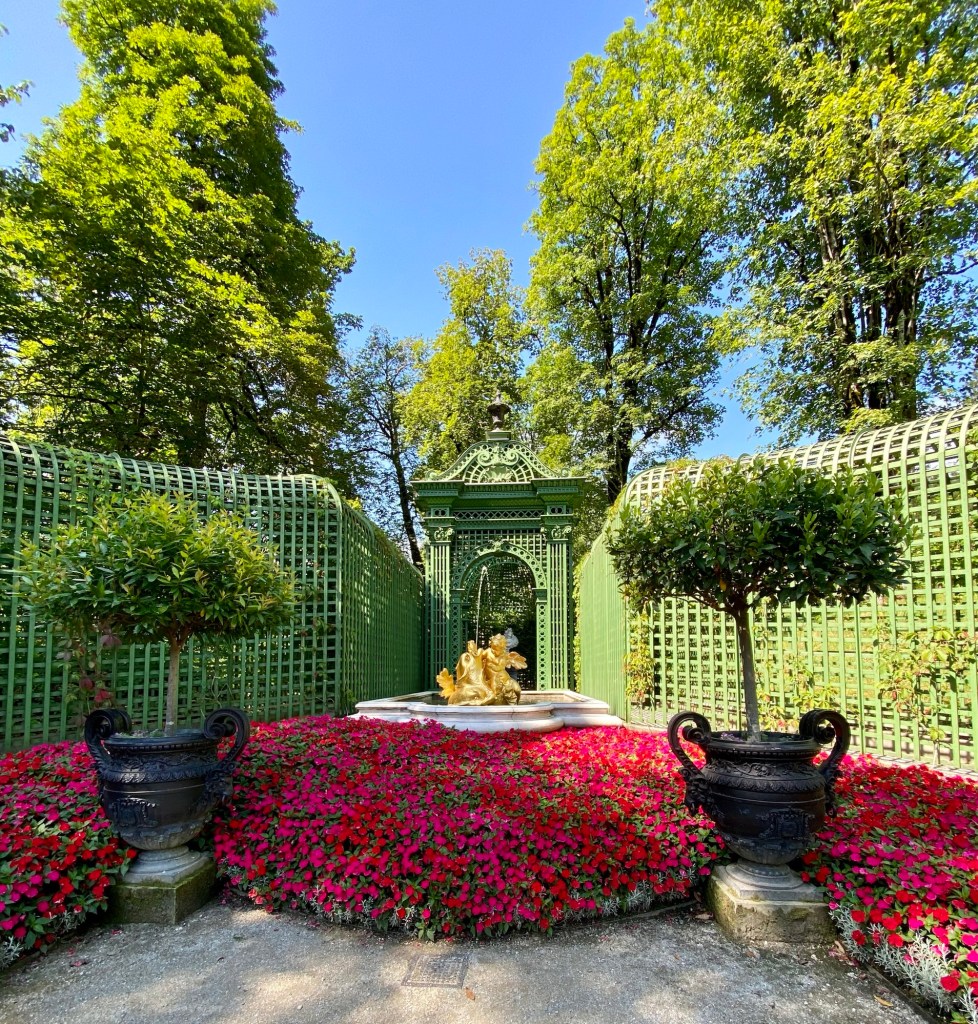
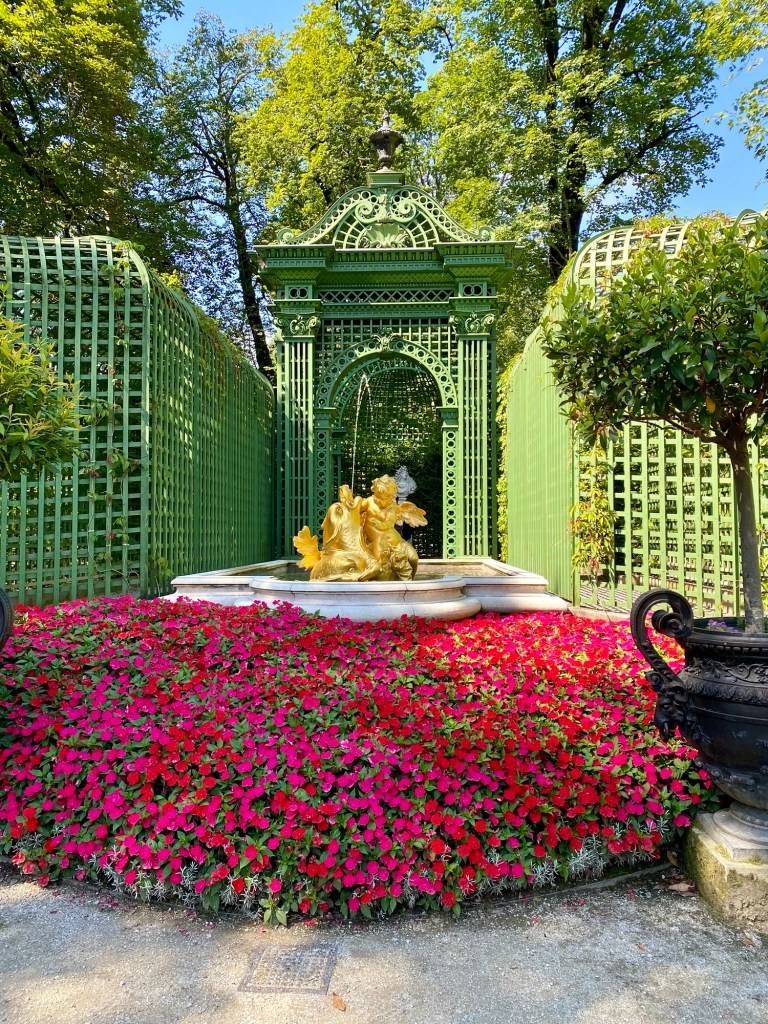
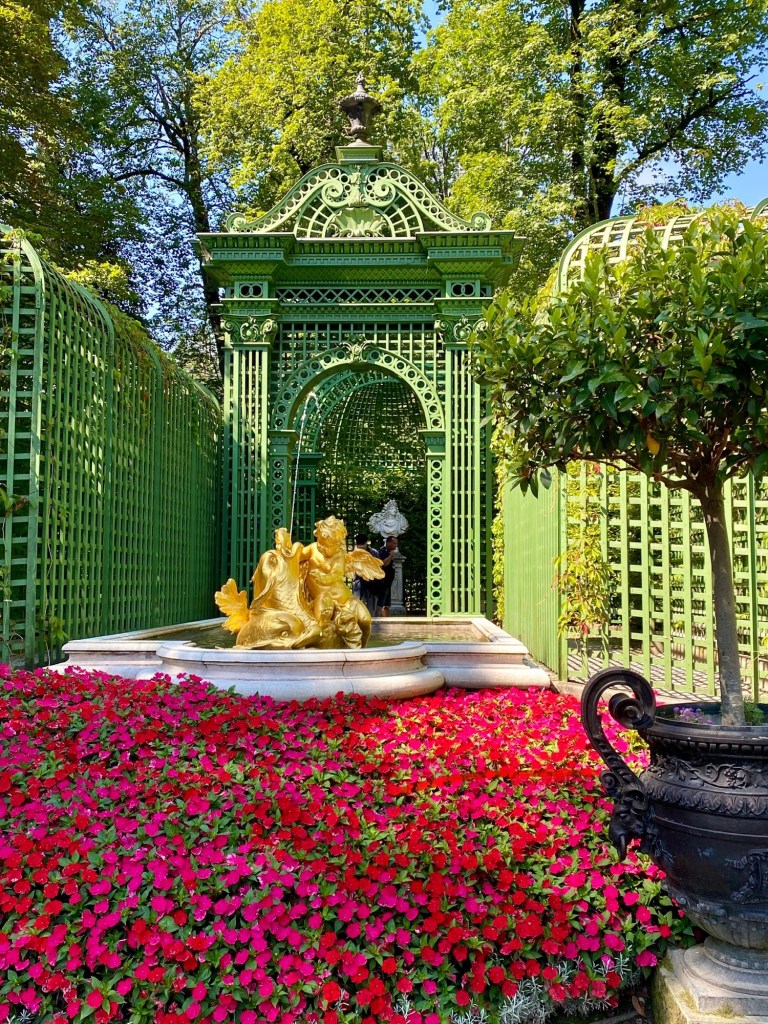
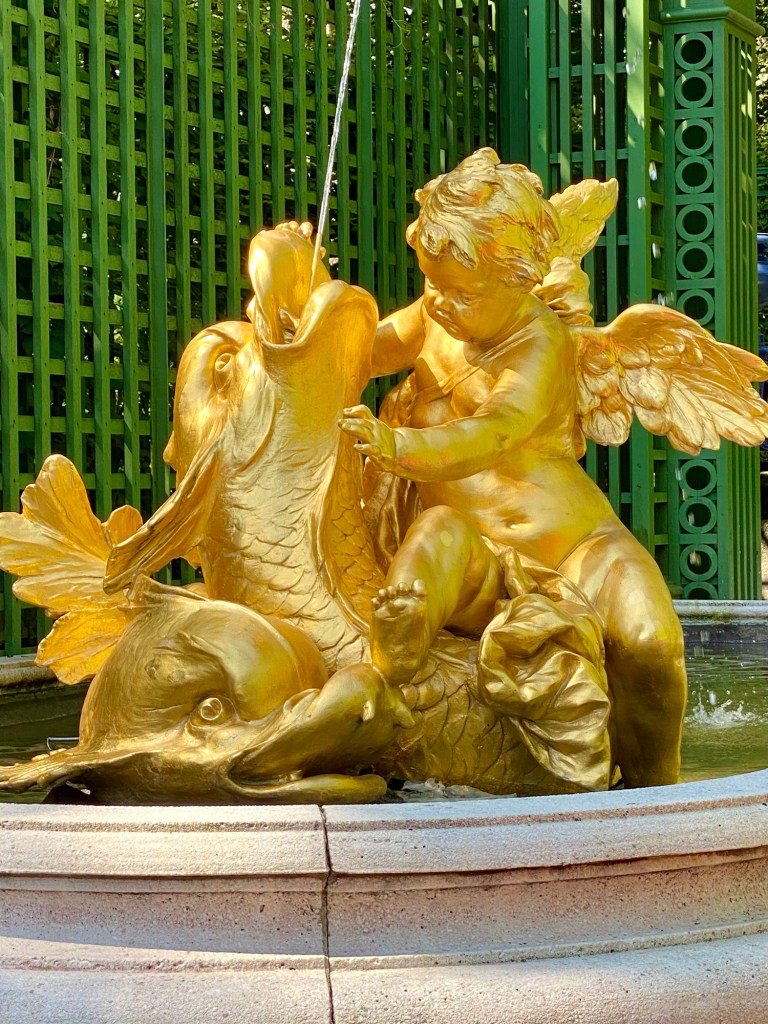
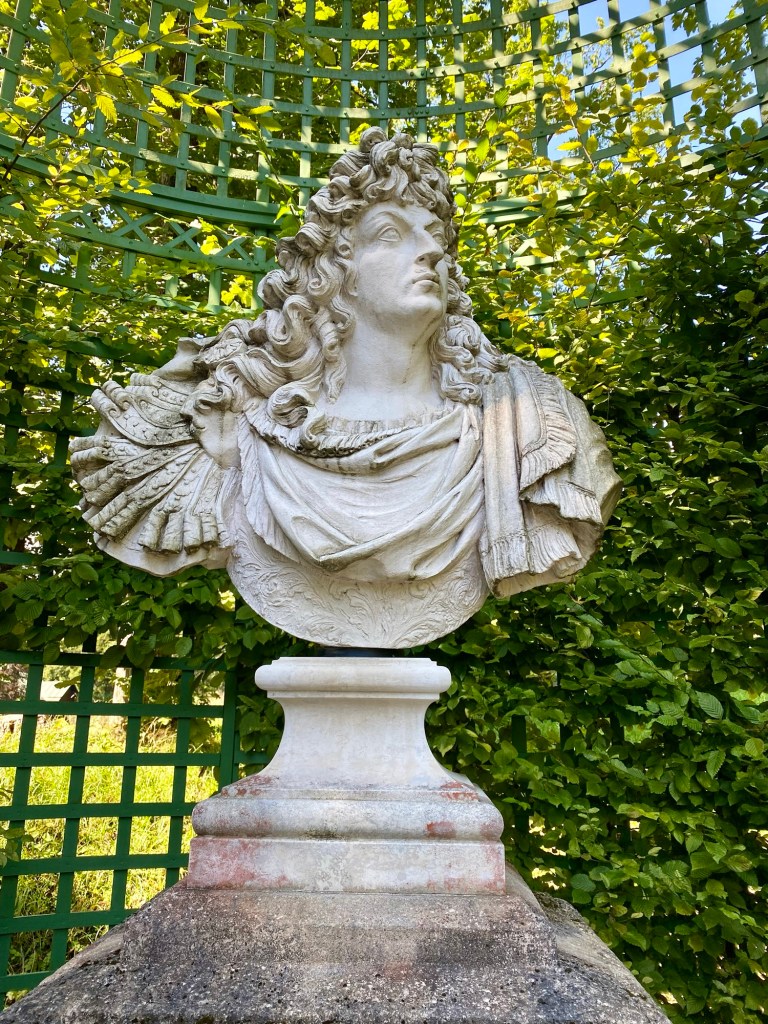
The center of the western parterre is formed by basin with the gilt figure of Fame. In the west there is a pavilion with the bust of Louis XIV. In front of it you see a fountain with the gilt sculpture Amor with dolphins. The garden is decorated with four majolica vases.
The crowning of the eastern parterre is a wooden pavilion containing the bust of Louis XVI. Twenty-four steps below it there is a fountain basin with a gilt sculpture Amor shooting an arrow. A sculpture of Venus and Adonis is placed between the basin and the palace.
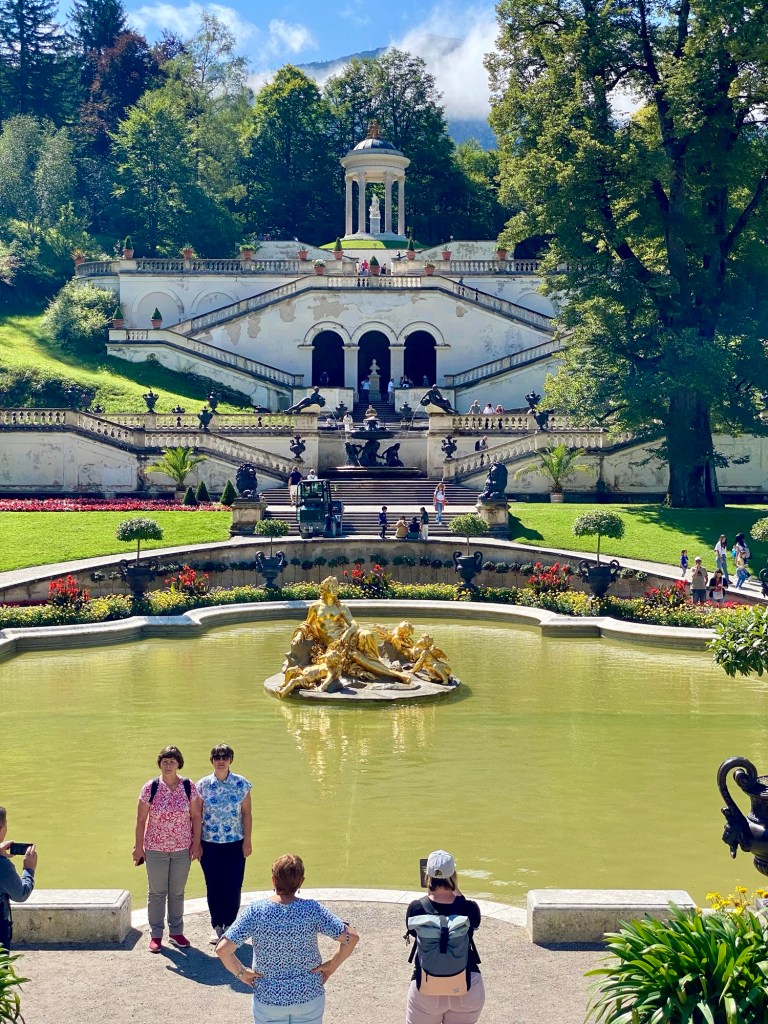
The water parterre in front of the palace is dominated by a large basin with the gilt fountain group Flora and putti. The fountain’s water jet itself is nearly 25 meters high.
The terrace gardens form the southern part of the park and correspond to the cascade in the north. On the landing of the first flight there is the Naiad fountain consisting of three basins and the sculptures of water nymphs. In the middle arch of the niche you see the bust of Marie Antoinette of France. These gardens are crowned by a round temple with a statue of Venus formed after a painting by Antoine Watteau (The Embarkation for Cythera).
The landscape garden covers an area of about 50 hectares (125 acres) and is perfectly integrated in the surrounding natural alpine landscape. There are several buildings of different appearance located in the park.
Venus Grotto The building is hidden under an artificial hill with a rock entrance. It is wholly artificial and was built for the king as an illustration of the First Act of Wagner’s Tannhäuser. At the beginning of the first act, Tannhäuser is in the cave of Venusberg. In keeping with the theme, the painting by August von Heckel in the background of the main grotto depicts Tannhäuser with Frau Venus.
The grotto was built under the direction of the opera set designer August Dirigl between 1875 and 1877. It is an iron construction whose partition walls were covered with impregnated canvas, which in turn was sprayed with a cement mixture from which the artificially created stalactites are made. The grotto is divided into two side grottos and a main grotto.
Seven ovens were needed to heat all of the rooms. A waterfall and a shell-shaped barge were custom-made for use in the grotto. A rainbow projection device and a wave machine completed the illusion as the king was rowed around on the artificial lake while musicians played motifs from Tannhäuser.
At the same time Ludwig wanted his own blue grotto of Capri. Therefore, 24 dynamo generators powered by a steam engine, had been installed by Johann Sigmund Schuckert in 1878 and so already in the time of Ludwig II it was possible to illuminate the grotto in changing colours. This is said to have been the first Bavarian electricity plant as well as the first permanently installed power plant in the world.The king’s desire for a “bluer blu” spurred the then young paint industry and, four years after Ludwig’s death, the Baden Aniline and Soda Factory (BASF) received a patent from the Imperial Patent Office for the production of artificial indigo dye.
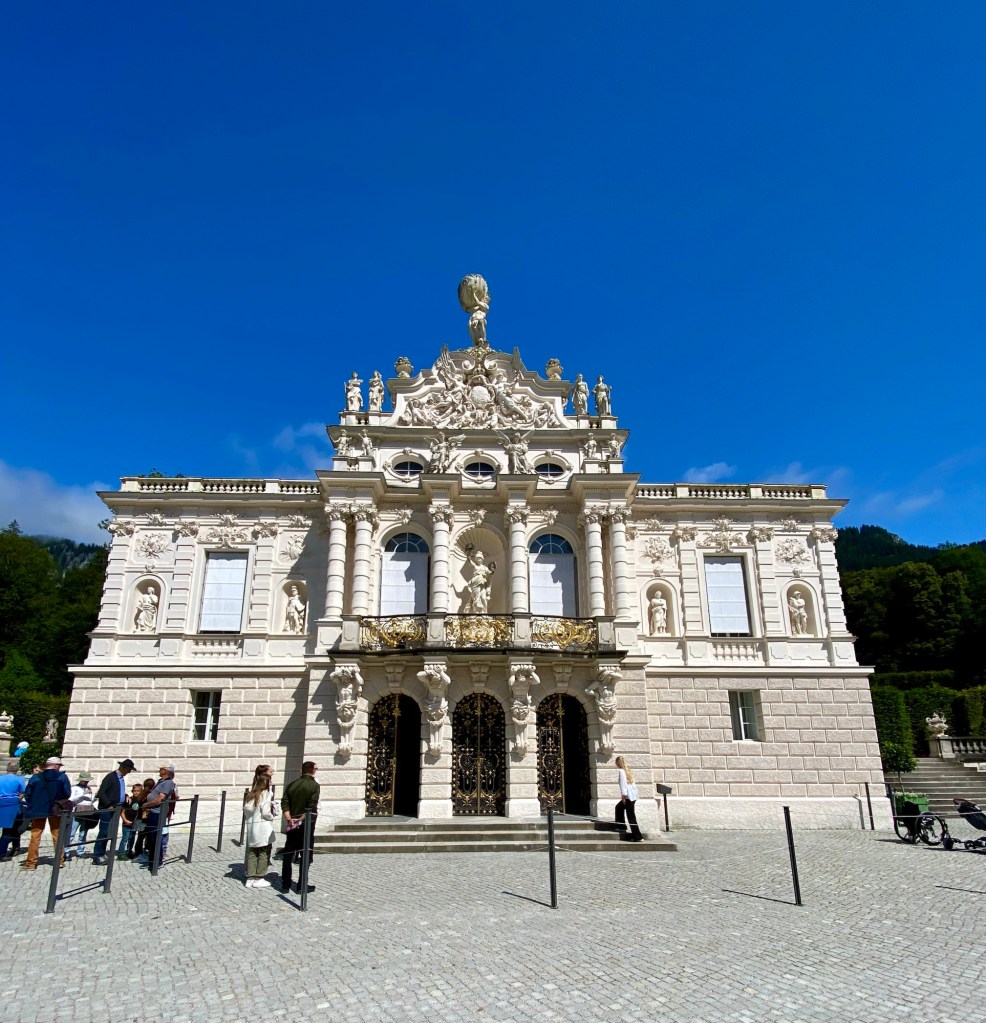
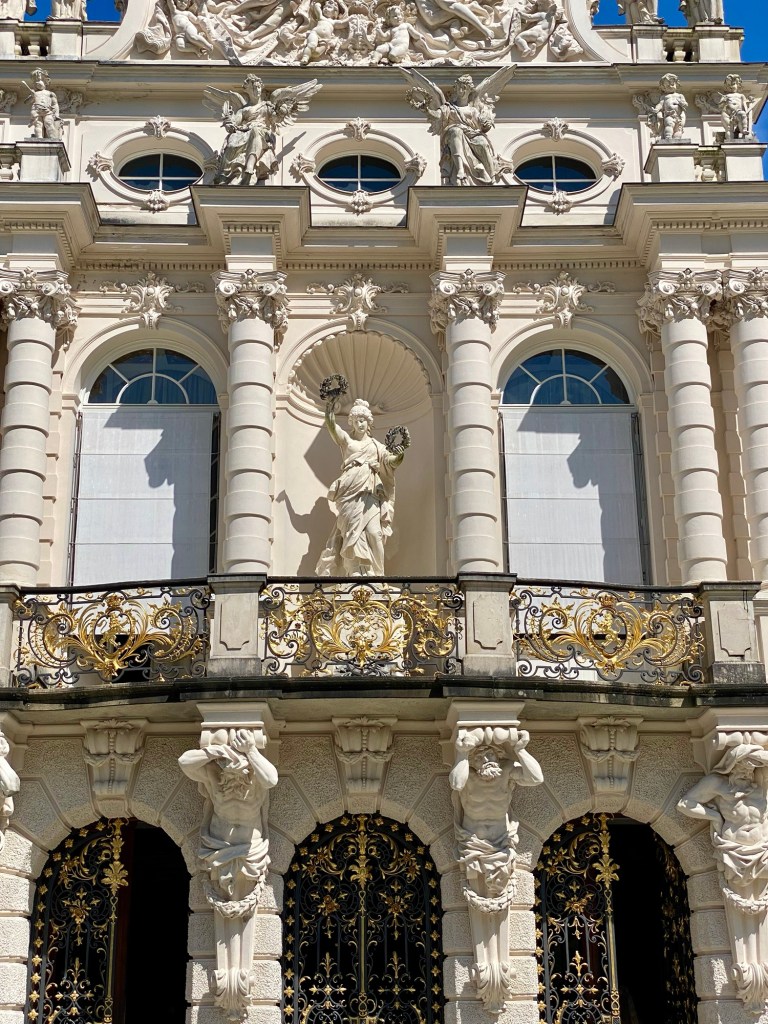
As with the recent Neuschwanstein Castle post, we are again discussing a royal residence designed by the eccentric King Ludwig II. This jewel is the smallest of the three palaces built by the King of Bavaria and the only one which was actually completed and that he lived in most of the time from 1876.
Ludwig II, who was crowned king in 1864, began his building activities in 1867/68 by redesigning his rooms in the Munich Residenz and laying the foundation stone of Neuschwanstein Castle.
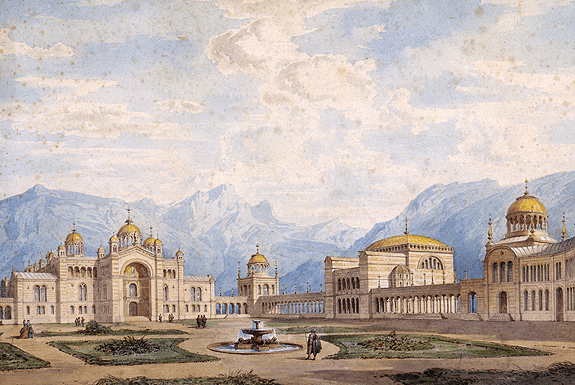
In 1868 he was already making his first plans for Linderhof. However, neither the palace modelled on Versailles that was to be sited on the floor of the valley nor the large Byzantine palace (see next picture) envisaged by Ludwig II were ever built. Instead, the new building developed around the forester’s house belonging to the king’s father Maximilian II, which was located in the open space in front of the present palace and was used by the king when crown prince on hunting expeditions with his father. Linderhof Palace, the eventual result of a long period of building and rebuilding, is the only large palace King Ludwig II lived to see completed.
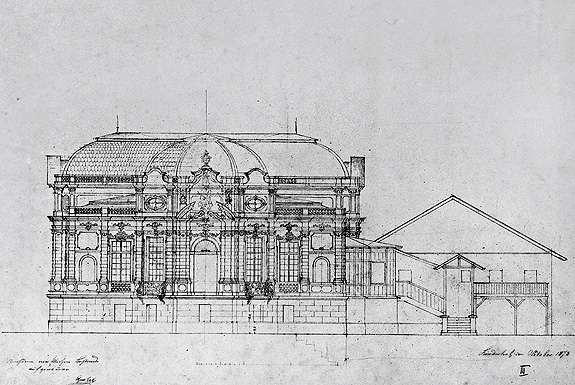
In fact, the earliest construction of this site was a wood-framed building shown at the bottom of this post.
Ludwig already knew the area around Linderhof from his youth when he had accompanied his father King Maximilian II of Bavaria on his hunting trips in the Bavarian Alps. When Ludwig II became King in 1864, he inherited a hunting lodge, the so-called Königshäuschen (King’s little house) from his father, and in 1869 began enlarging the building. In 1874, he decided to tear down the Königshäuschen and rebuild it in its present-day location in the park. At the same time three new rooms and the staircase were added to the remaining U-shaped complex, and the previous wooden exterior was clad with stone façades. The building was designed in the style of the second rococo-period. Between 1863 and 1886, a total of 8,460,937 marks was spent constructing Linderhof.
Although Linderhof is much smaller than Versailles, it is evident that the palace of the French Sun-King Louis XIV (who was an idol for Ludwig) was its inspiration. The staircase, for example, is a reduction of the famous Ambassador’s staircase in Versailles, which would be copied in full in Herrenchiemsee, another palace project by Ludwig that was designed less as a residential building than as a homage to the Sun-King.
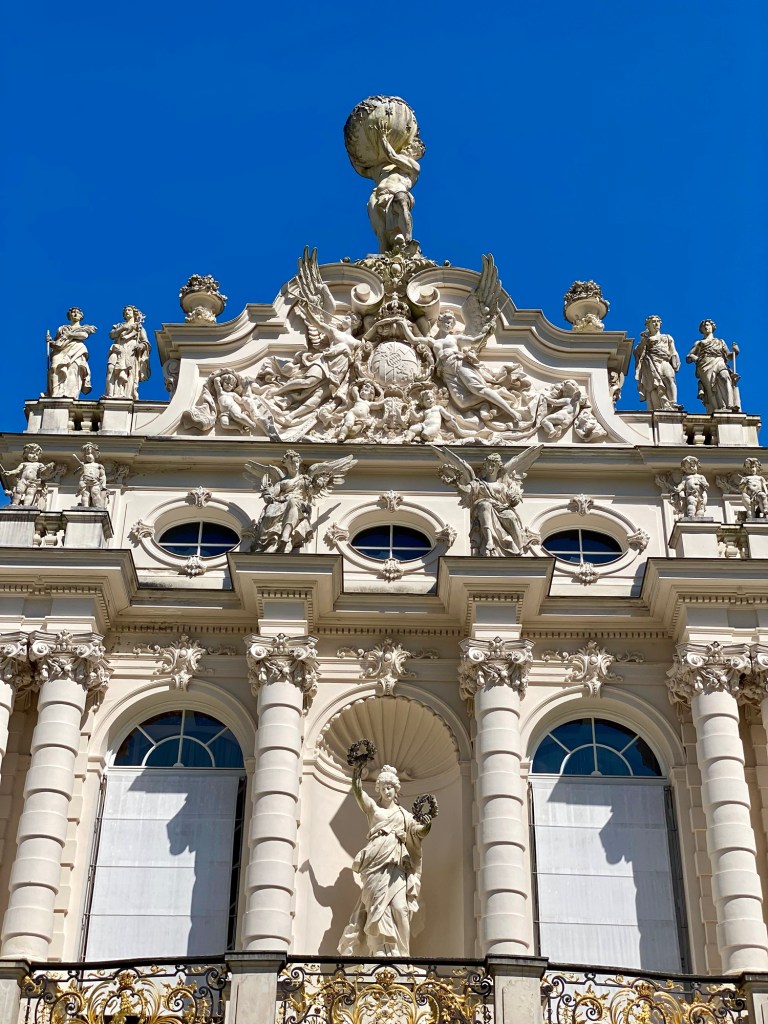
Stylistically, however, the building and its decor take their cues from the mid-18th century Rococo of Louis XV, and the small palace in the Graswang was more directly based on that king’s Petit Trianon on the Versailles grounds. The symbol of the sun that can be found everywhere in the decoration of the rooms represents the French notion of absolutism that, for Ludwig, was the perfect incorporation of his ideal of a God-given monarchy with total royal power. Such a monarchy could no longer be realised in Europe in the second half of the nineteenth century. The bedroom was important to the ceremonial life of an absolute monarch; Louis XIV of France used to give his first (lever) and last audience (coucher) of the day in his bedchamber. In imitation of Versailles, the bedroom is the largest chamber of Linderhof Palace. By facing north, however, the Linderhof bedroom inverts the symbolism of its Versailles counterpart, showing Ludwig’s self-image as a “Night-King,” because he had gotten into the habit of turning night into day and vice versa.
Linderhof, in comparison to other palaces built by other kings, has a rather private atmosphere. In fact, there are only four rooms that have a real function.
Plan for the west façade after the stone cladding (building phase 4) and with the Royal Lodge still in place, 1873
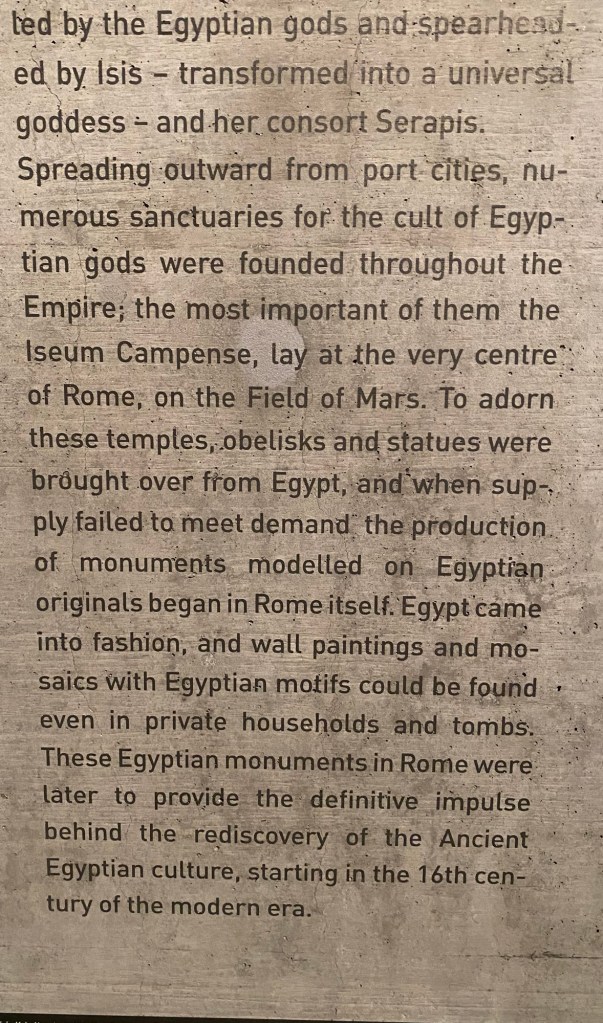
Since I am still convinced I’m here to simply be swept along on a current of art, I still can’t help but notice a few of the very excellent signs in English that this museum has thoughtfully provided for some if not all of its international visitors. Because, I think to myself, this museum deserves to have international visitors because even though I did no prior research so I know nothing about this institution and its collection. That’s what I’m thinking, after about 20 minutes inside, that it is quite something. I read:
Shifting into 3rd person: Well, that’s very interesting, you muse. You can’t recall ever having that particular bit of information about how the reliefs were produced. You always thought that, if you thought about Egyptian art at all, which is rare actually, the reliefs were carved from the surface down, forming shapes as the carving was done. You hadn’t thought about gouging out the stone in a more thorough fashion and then filing it in with gesso or something and then coloring it. Ah, must have known that. But, look at how well it’s explained and the many examples they are displaying. Well, one quick picture can’t hurt to take. But, no lable picture ’cause you aren’t really here to study.
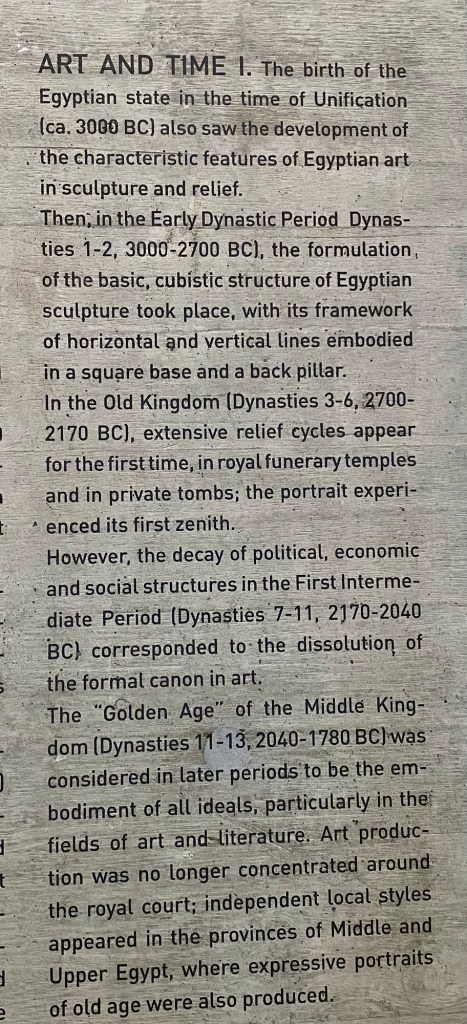
Another intriguing sign. Art and Time. That’s been my lucky life (not all of my life is lucky, but a lot of the art loving part of it has been).
I appreciate the simplicity of the labeling. It’s short and sweet and carries a lot of excellent info. It’s digestible. It’s not a Wikipedia summary.
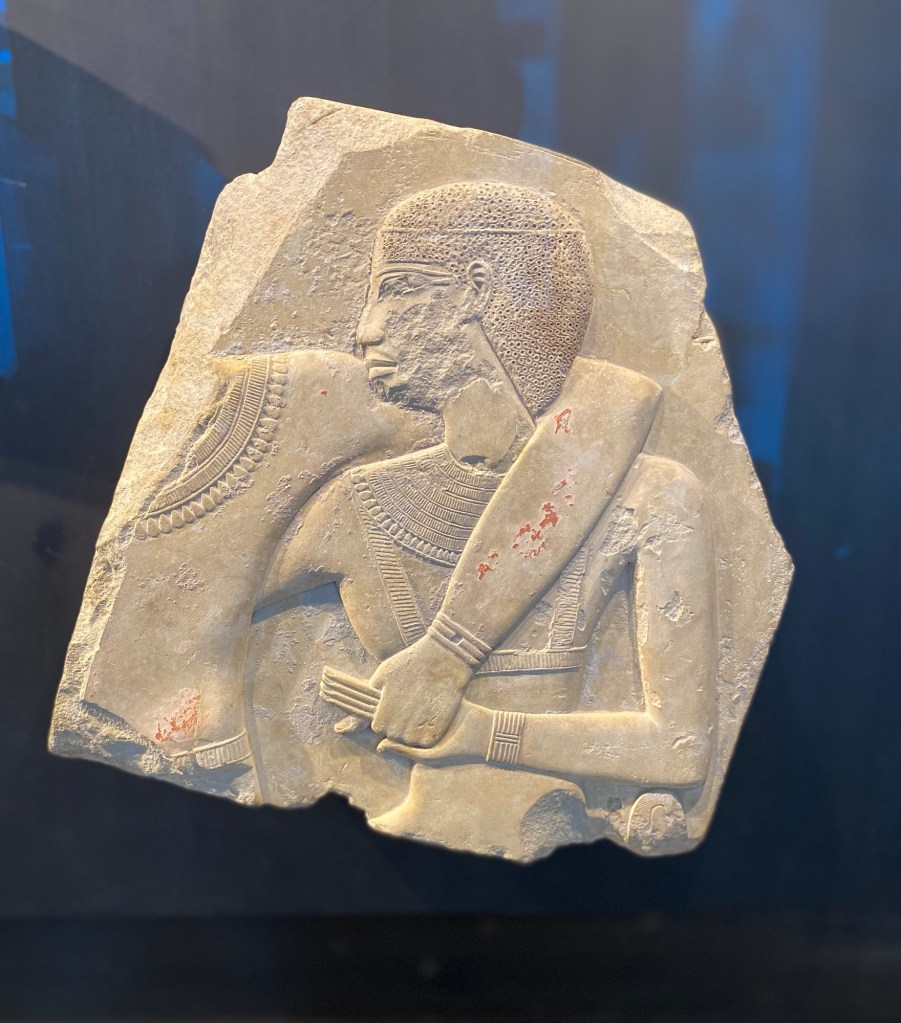
You wander along, swept by the current, and when you see the next sculpture, you are back at what you know, sculpture that is raised in relief from the background, not gouged into the stone. And then you notice all of the surfaces and think about the trouble the artist(s?) went to to portray the skin, the hair, the jewelry. You notice the almost disappearing polychrome and think about how it might have looked, fully painted. You think you prefer it this way, even if that is wrong.
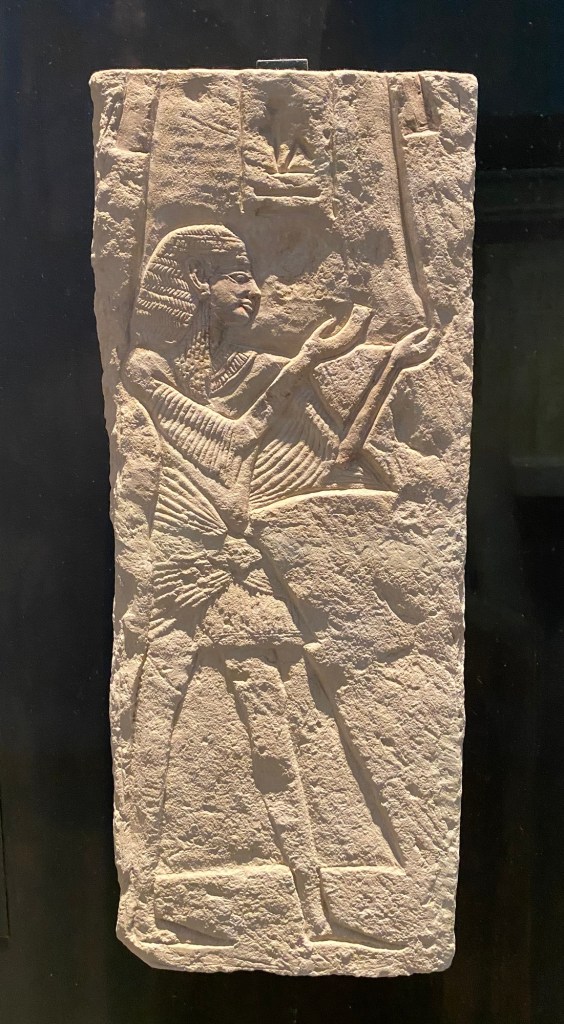
You spend more time thinking about the relief above, because once again you note the gesture of one arm behind another figure. You don’t know who these people represented are, but from the way they are dressed you’d guess that that one on the left is royal and the one on the right is an aide. Is the royal figure gripping the other for assistance in standing or walking? The almost missing royal figure looks young, so you doubt he needed help standing, but maybe he was sick or wounded. Does the aide have his arm around the royal figure out of kindness or concern, or is it just his job. You notice how the royal figure seems to grip the hand of the aide. You suspect there is real need in that grip.
Because you are an art scholar and teacher and museum curator by training, you can’t help think about how the artist mastered what is very shallow overlapping in the relief carving, but for the time period it is very advanced. You know that much. And it reminds you of the arm of the wife in the first statue, which is shown embracing her husband’s torso. Overlapping again. And, thinking back, was that a gesture of care and concern or was it just her job as his wife? Interesting to consider, don’t you think?
Then you are confronted by this sculpted head and it almost doesn’t seem Egyptian. For sure the facial features are Asiatic. What the heck? This seems new to me in an Egyptian museum. I read the label. I was right about Asia. And then my mind starts wondering about how many East Asian visitors there must have been for one of them to be represented permanently in art of the period. Who was this early voyager and what was he there for? The questions are endless, but I have miles to go and must stay on topic.
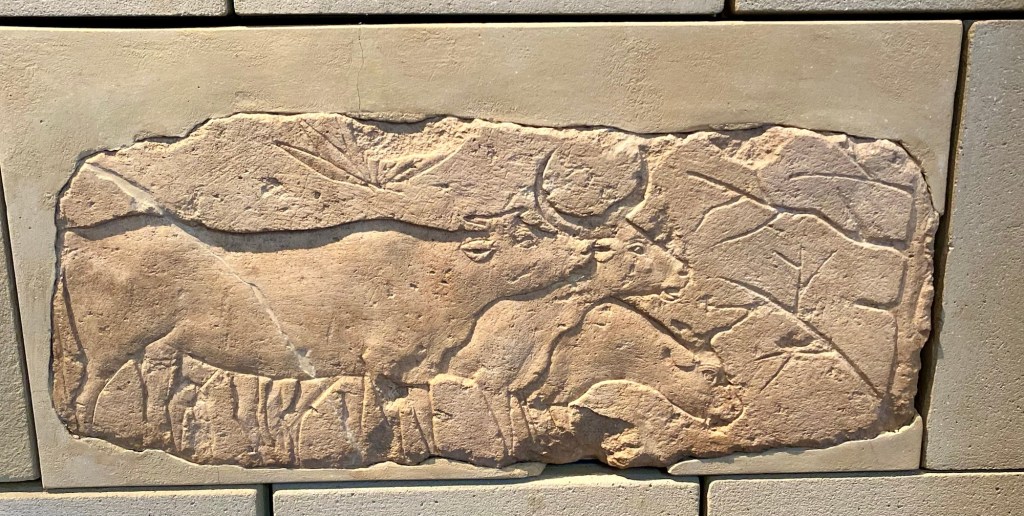
Without taking the time to photograph a label, because I’m off duty today, I can’t help but notice the use of overlap again in this relief carving of cattle. Very effective. Look at the legs as well as the heads. Very impressive.
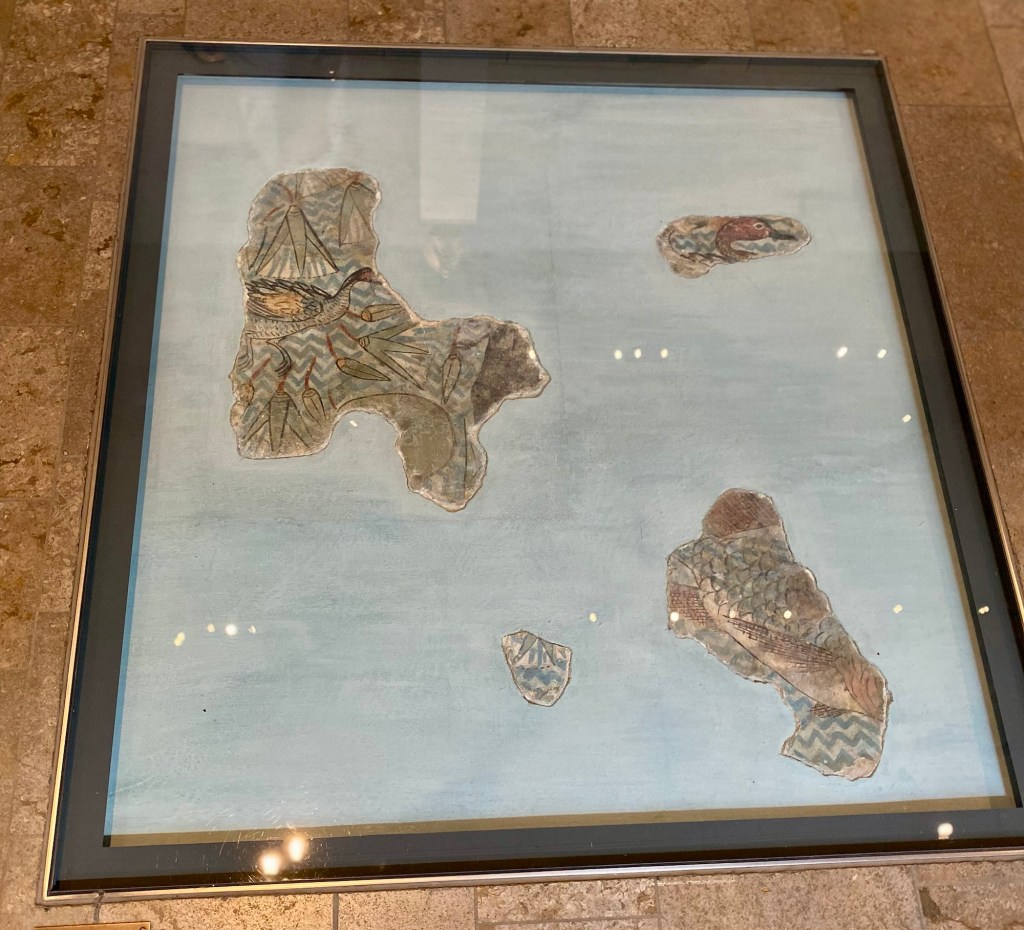
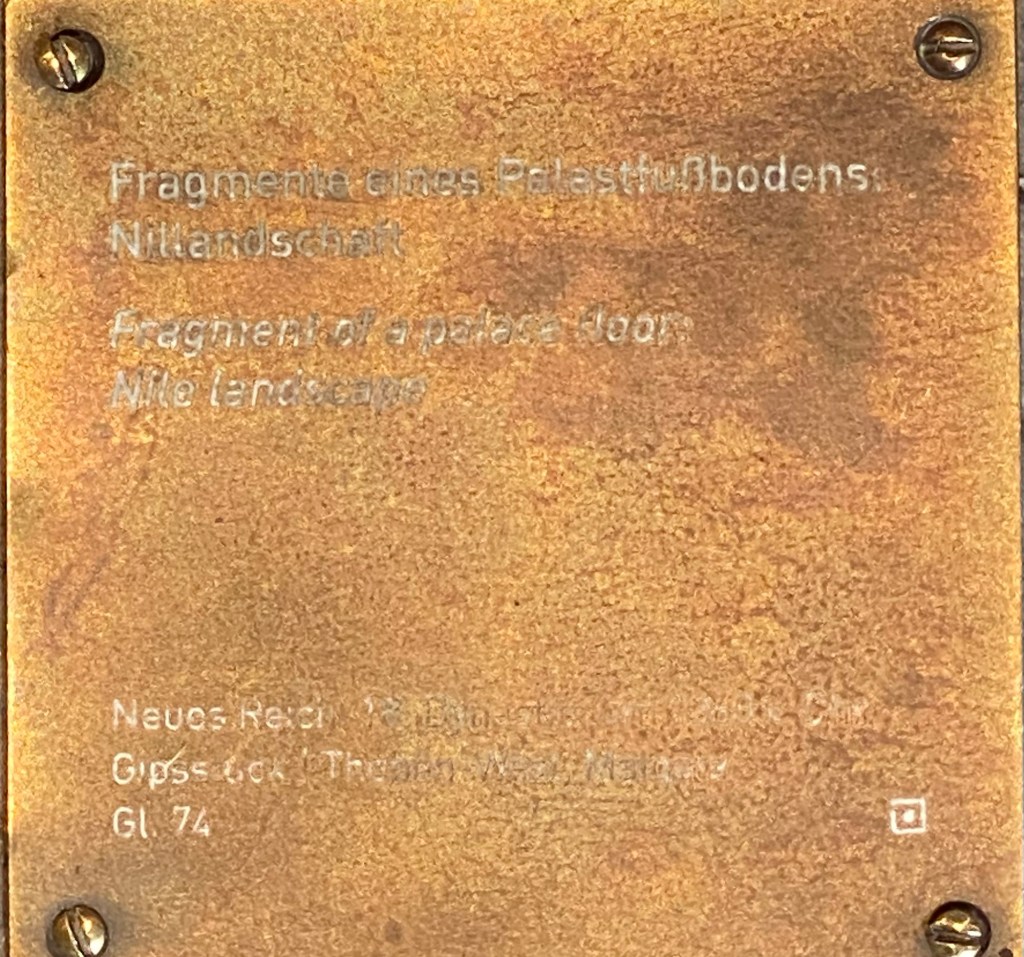
I notice an unusual display device: there is something in the floor. I spend a few moments looking at what I read in the label is a remnant of an Egyptian palace floor. Wow. For that to have survived is incredible. And I think for a moment about how Ludwig I probably was responsible for acquiring all of these incredible works of art and material culture and what must have been involved in transporting the objects from Egypt to Munich, not to mention the fact that these floor fragments were rescued at all and what was that all about? My mind is freshly blown. I must move on.
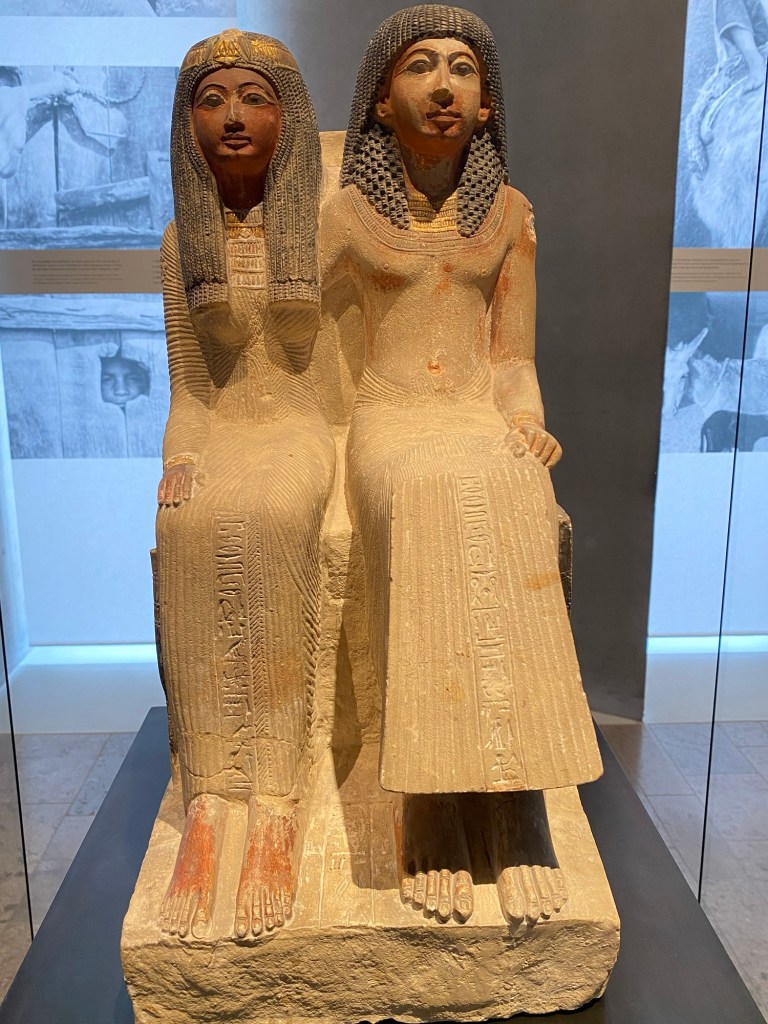
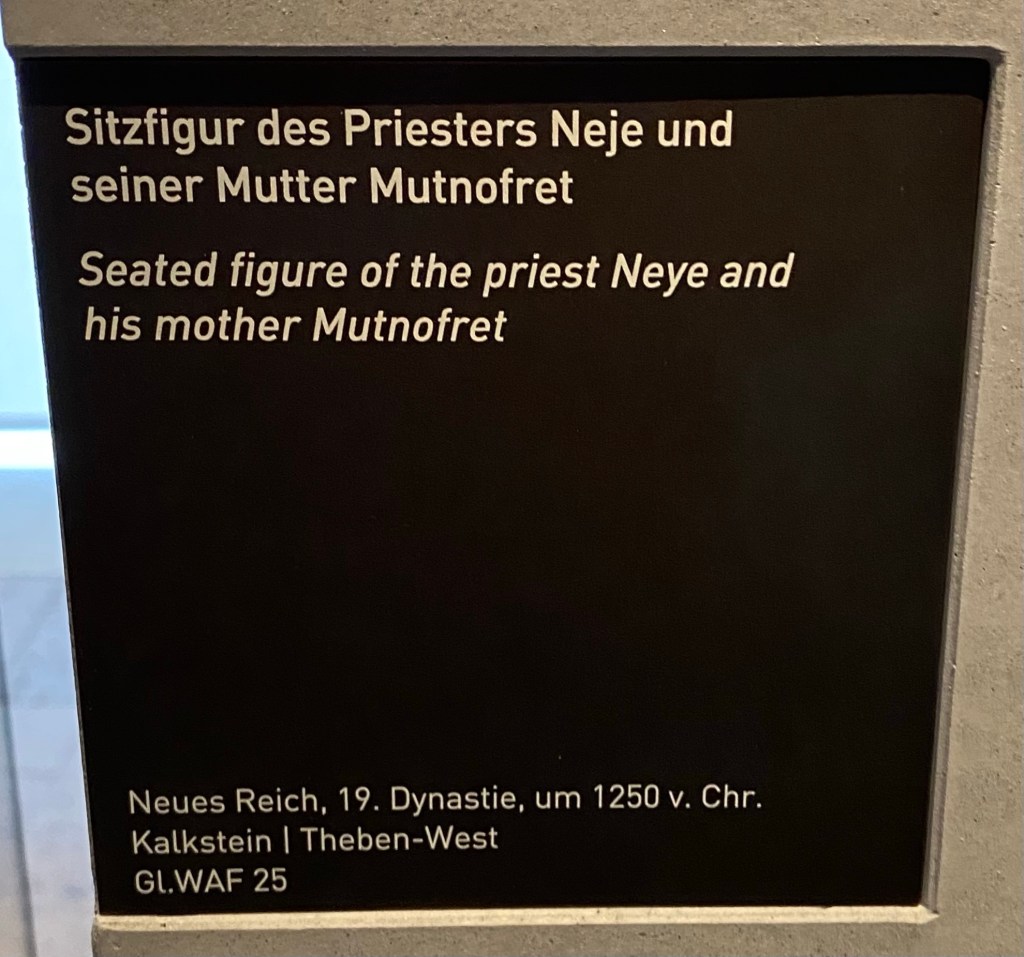
What’s this I see? I’m familiar of course with this type of sculpture. And not just from today. I’ve lectured in art history 101 about this type. I’m guessing it’s another husband and wife and I take a quick look at the label and discover its a mother and son!
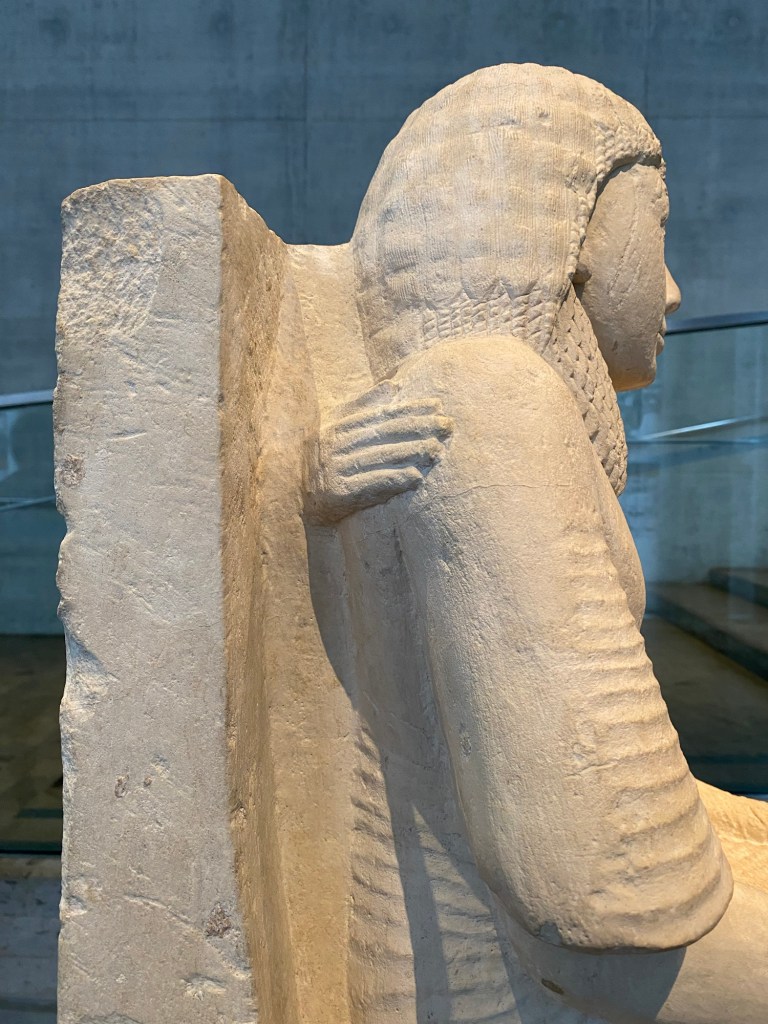
Well, that’s a refreshing change in the iconography and it sets me to thinking. Because I have a grown son and I understand on a very deep level the human emotion that could underlie this grouping. Her left arm is around her son; is that an important difference? Can only royal figures or only wives use their right arm to embrace their relative?
Of course I must go to the side to see if the mom’s arm is finished. It is! Her hand touches her son’s shoulder and I intuit that her touch is much more affectionate than that of the earlier wife whose arm is in contact her husband’s shoulder. Is that just my emotion talking or do you see it too?
I understand the relationship between a mother an grown son, because I have a grown son. He’s behaving like a jackal at the moment, but I still do and always will love him fiercely. And affectionately.
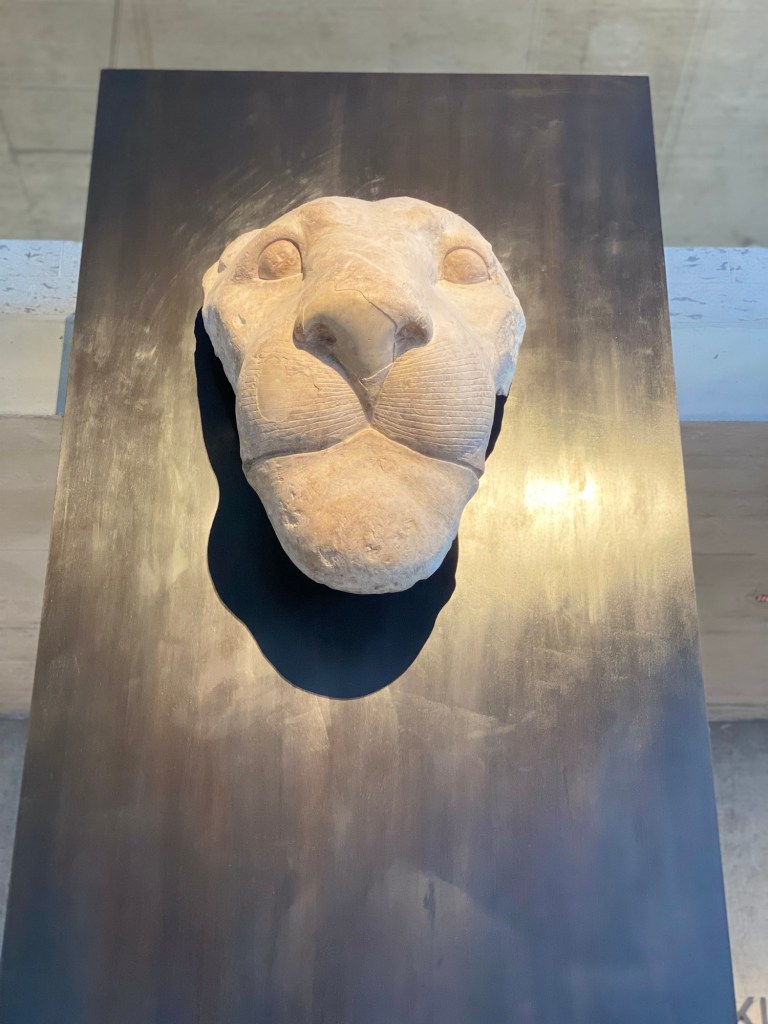
I honestly don’t know what caused me to take the next picture. It’s beautiful, but so were 1000 other objects in the building.
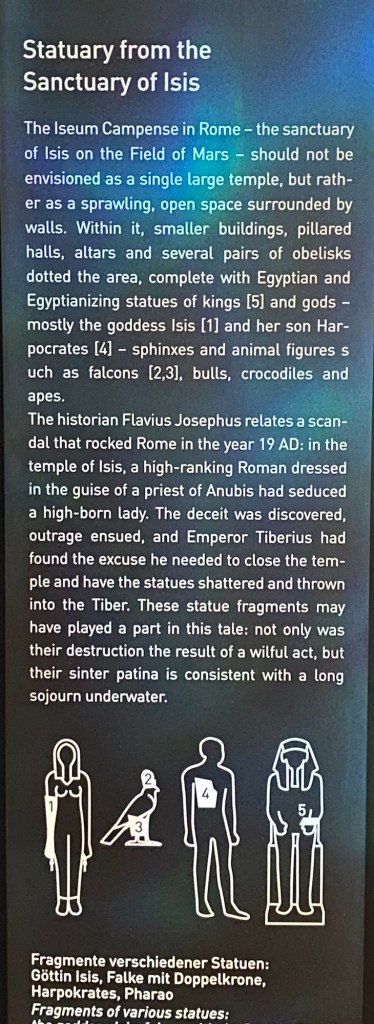
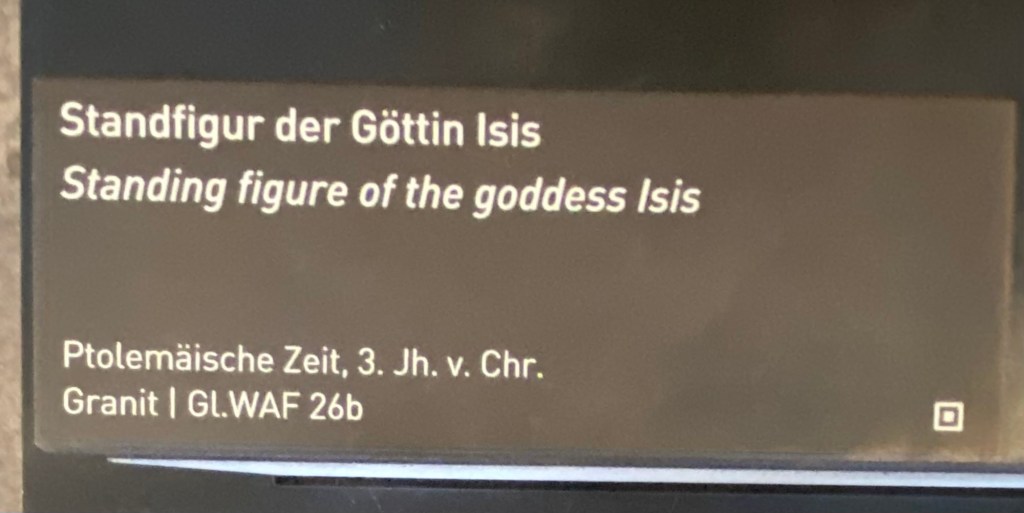
I do know why I took the next picture. It was refreshing to see a woman represented in all the standing statues. Of course, I realized when I read the label (which I photographed): it’s’ a goddess. Probably a real, regular woman (and what exactly would that be?) wouldn’t merit representation in Egypt.
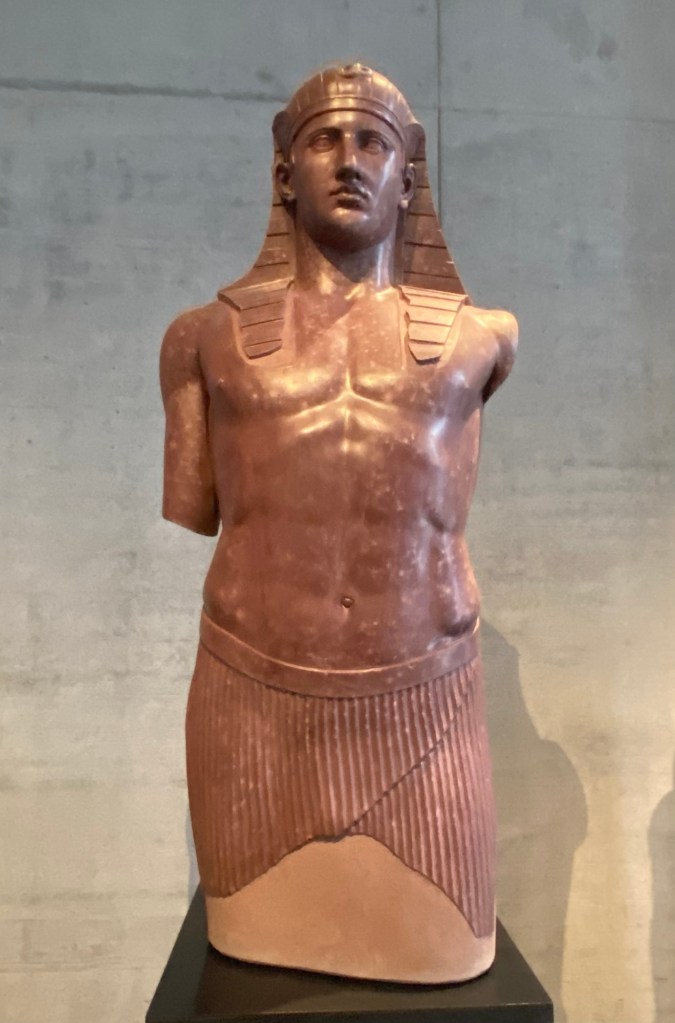
The next sculpture was surprising in this gallery of static block like figures. I detect a sway, some movement, some sensuality. Something is very different.
I read and photograph the label. Ah, it’s a Roman man, who has been “Egyptianized!” I know immediately when and where we are and it explains the figure to me.
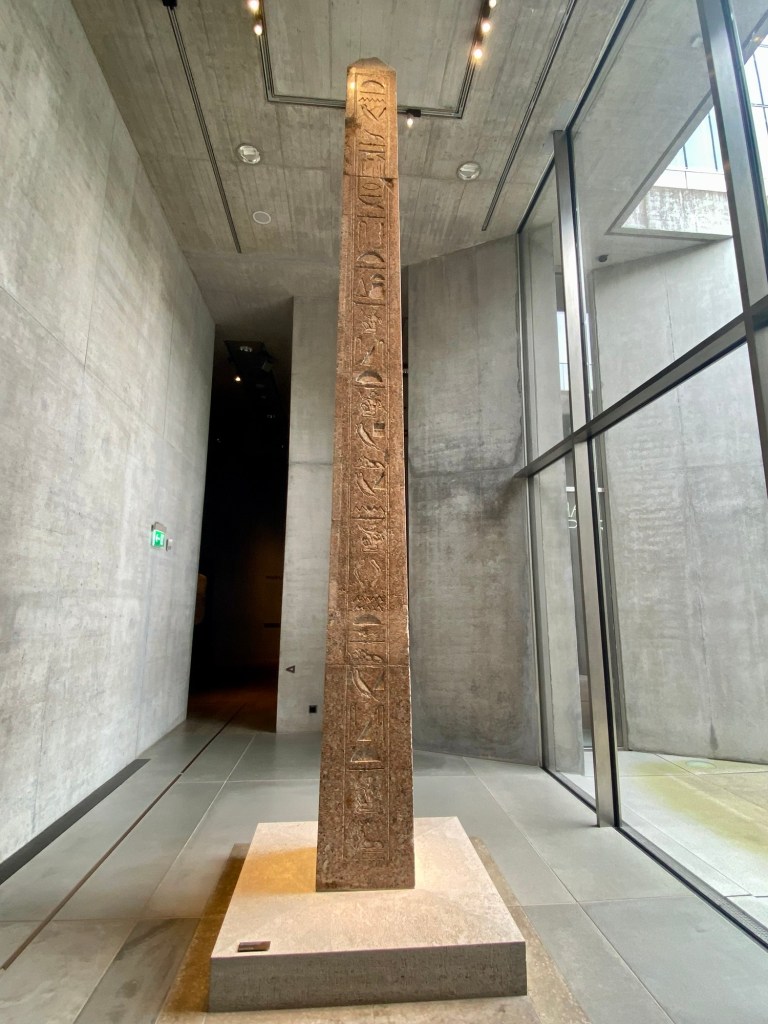
I walk on. I see an obelisk in the next small gallery. I’ve seen 1000 obelisks before, if not 10,000. Ho hum I think. I’m on vacation.
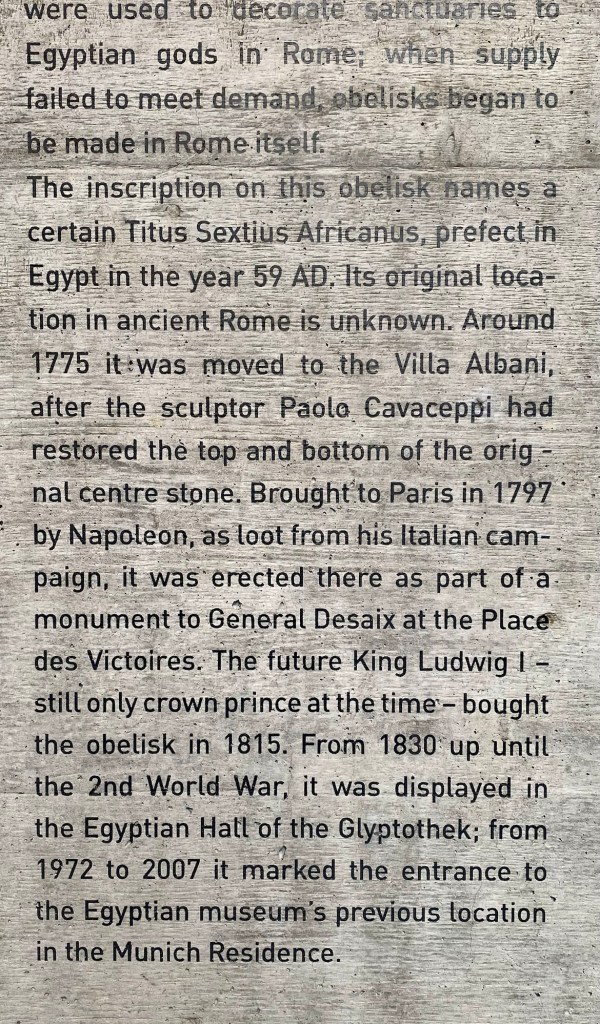
But I stop to read the excellent English label and I learn new things, in spite of me being off duty.
I had not known (even if I had read it previously) that obelisks were produced in Rome to keep up with the demand for them. That is news to me. And I love it!
And then I hone in on the provenance of this particular obelisk and I’m no longer on vacation. I am activated. This is fascinating and I want to know more and I want to think about it all.
Think about how/why this was produced. Think about where is was originally located in Rome (my Rome!) and where the heck was it for the 1700+ years after it was created? Obviously in Rome, but where? Where was it when Rome was sacked in 1527? It suffered damage to the top and restored in the 18th century by an Italian sculptor?!
When Napoleon was capturing artworks as well as kingdoms, he brought this obelisk to Paris in 1797. Ludwig I bought it and it came to Munich with so many other amazing treasures. It survived WWII. It’s before my eyes right now. It’s a miracle.
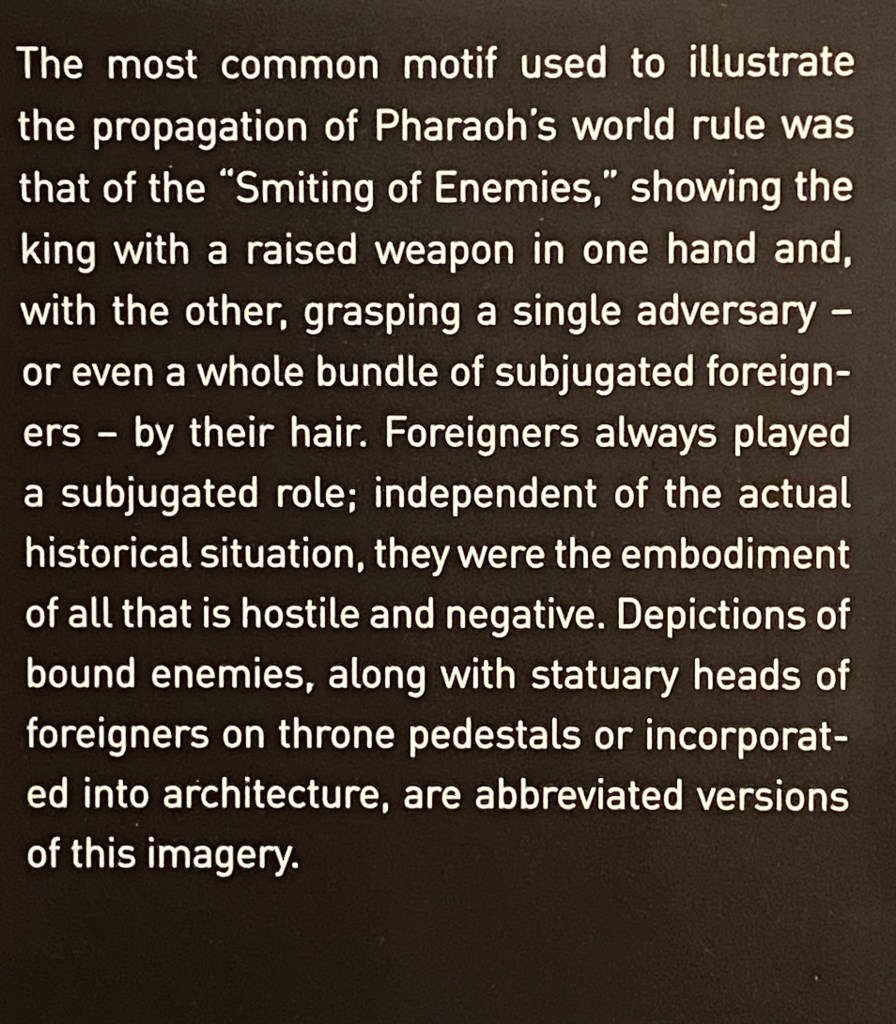
After musing for a while about the obelisk in general and this one in particular, I notice the next outsized label which captured me with its simple title: Pharaoh. Well, I mean I have to read this label. It’s arresting!
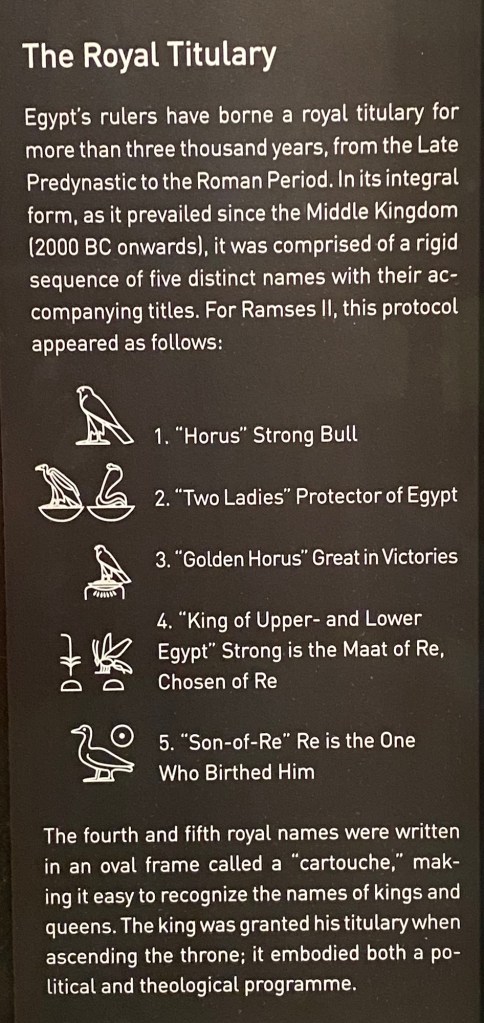
Next think I know, I’m taking pictures not of art works but of labels. There is too much great info in these labels to be ignored. Forget being off duty. I’m here! Let’s go!
Ah, I think, while reading this label. Here, in Munich and before in Berlin, I’m reminded constantly of WWII and its root causes. The “other” is always a scapegoat. The world suffers. I think of Israel and Palestine. I am saddened by current events, lost in the thought of endless battles and wars over what’s different.
I stop reading and thinking and move on. The next labels seems so succinct, I find myself interested and taking pictures. I’ll read this all at home and think about it there, I think.
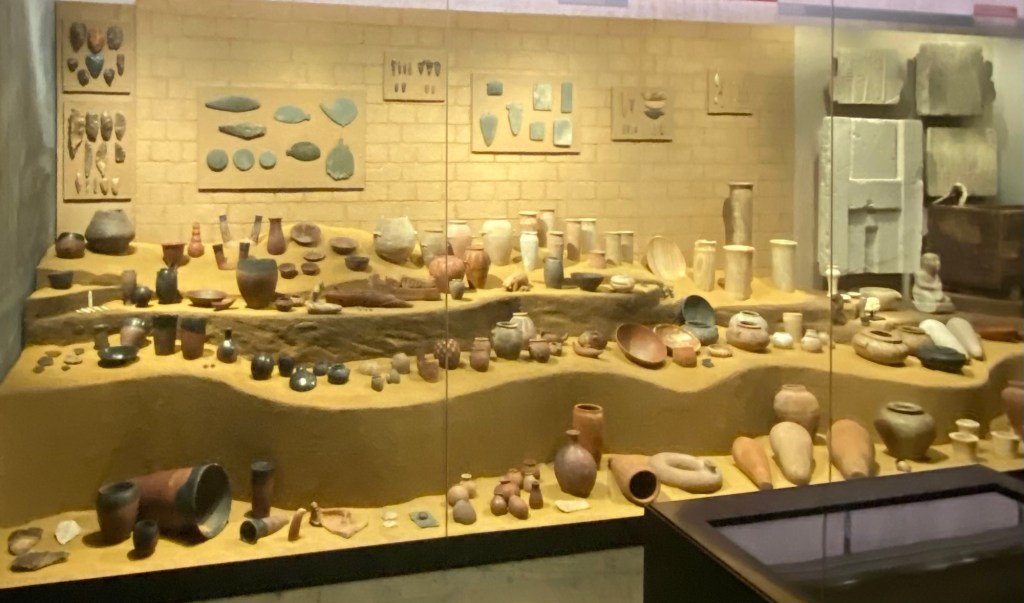
I enter the next gallery. It presents a time line of cultural developments and changes in a completely unique way. Yes, there are the dates and labels with info. But, it is SHOWN. Not told. Starting with the earliest finds of pottery, moving into the Roman era. It is presented before my eyes in the most effective way I have ever witnessed. I want to spend a day with this time line.
But, I must move on. I’m a visitor here. I don’t live here beyond the next couple of weeks.
What do you think happens next? Will I further succumb or will I be on vacation?
I promised myself, as I searched for the door to this museum, that today would be a holiday. I wouldn’t think too hard, but just allow myself to be swept along by the art works. I wouldn’t take a lot of pictures, which meant that it would also be a holiday for me in that I wouldn’t need to write a long post for this blog on this collection. It takes a lot of time to prepare these posts.
I found the entrance and thought, how clever they are. You descend below grade a long distance on wide granite steps to enter a building that evokes the feeling of entering an Egyptian royal tomb, a feeling I know from literature and movies. I’ve not been to Egypt, but I can imagine how it must feel to descend and then enter a world unlike any I’ve known on earth.
And, once you are in the museum and have your entry ticket, you must descend much further underground to some of the most lovely galleries ever. They are austere. They feel simple. The art works are arranged beautifully. You notice that there is an arrow on the wall, a brass arrow on a concrete wall, below eye level, that would be easy enough to miss if you aren’t paying attention. And that is a relief. You can know which way is the recommended path.
Have you been to the Louvre? Have you felt overwhelmed by the quantity of artworks in a museum and not had a clue which way was the best way to proceed so that your visit made some kind of sense and you weren’t just buffeted about on the vast sea of material culture? If you’ve experienced that, as I have multiple times, you’d be grateful for a simple arrow indicating the path to follow for optimal appreciation. Because, believe me, the curators have designed this for you. They want you to get the most out of your visit.
Immediately I am confronted by a masterpiece. It’s my favorite kind of confrontation.
I start to give myself over to the sculpture that is speaking already speaking volumes to me. I begin to relax. I lose myself in wonder.
I notice that the wife’s arm is behind her husband. I’ve seen this before but it never caught my attention like now. I am compelled to go to the side of the work to see if the sculptor finished this thought, or if that was too much to expect from someone sculpting in the 19th Dynasty? We are talking about an anonymous artist, who probably thought of himself as a trained craftsperson, working in the period between 1292-1189 B.C. Would that man (you know it was a man, women weren’t given this kind of opportunity in Egypt then) have thought to show up the rest of her arm and hand? You know the back of the block won’t be carved, so does her arm just disappear into an unfinished block of stone?
You must find out.
There is her hand, eternally resting on his shoulder. You are beguiled. You are captured. You will soon need more.
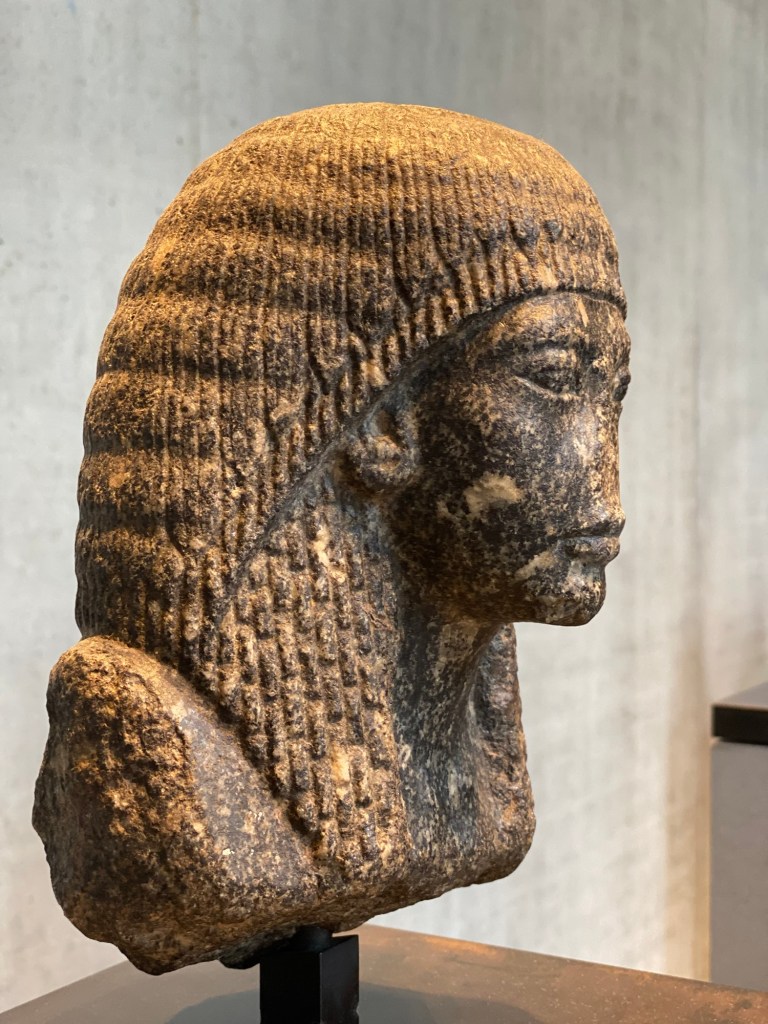
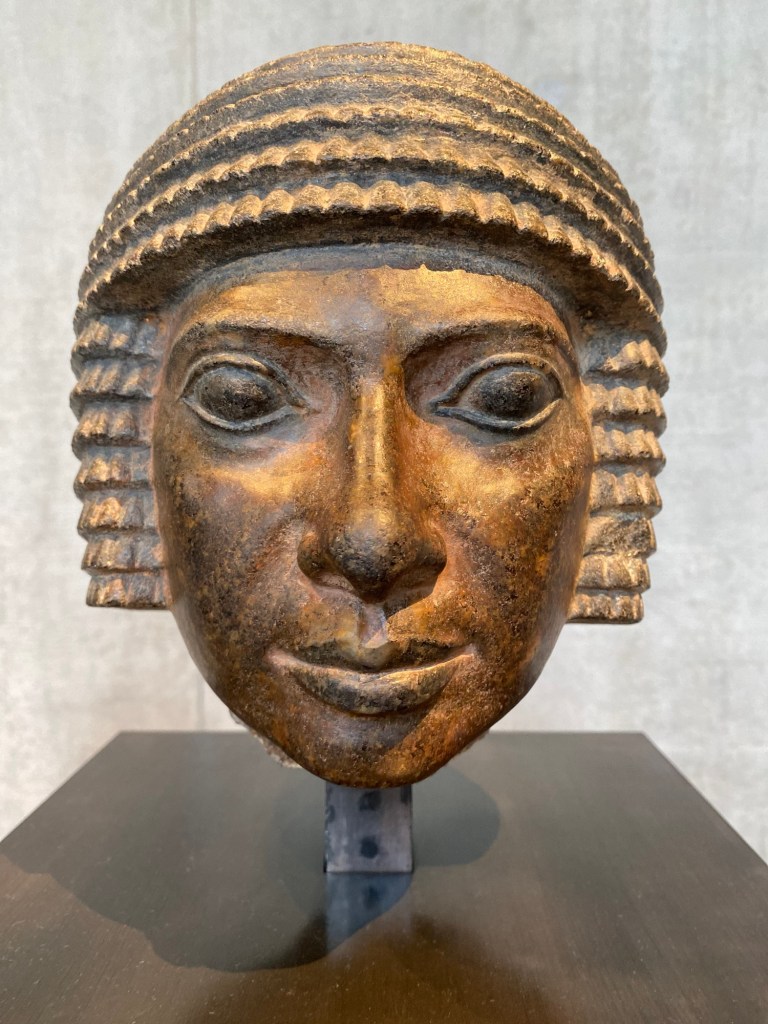
But you remember your promise. You are here to simply partake, not to document. But your phone is nearby and it has such an easy camera (of good quality) to use and you think, why not? Just a couple pictures of some fascinating heads in black stone. Such an interesting comparison, you think, to the gorgeous Greek and Roman busts you saw last week in Munich at the Glyptothek. Of course you don’t want to get drawn in to that kind of experience again, because you are on vacation today. So you take a few pictures of some beautiful sculptures, but you don’t photograph the labels, because you are resting, kind of.
Once you have thoroughly enjoyed this gallery, you follow the subtle brass arrow (see it on the lower right in the photo below?) You are intrigued by this sign, which even though you only know maybe 30 words in German, it probably tells you that it discusses the idea of “art and continuity” and that’s an interesting concept in an Egyptian museum. It doesn’t hit you between the eyes with a Wikipedia type summary of information (and on a work day, you appreciate Wikipedia type summaries and consult them all of the time) such as “Egyptian art begins in the ___th century B.C. and is characterized by…”. That kind of information has its place and you’ve written it many times for museums and articles and books, but you are on vacation today and you don’t want that kind of information. You are grateful it’s in German, because that lets you off the hook
Oh wait, there is some text in English. Ok, I’ll check it out. It’s short and sweet and goddammit, it’s interesting.
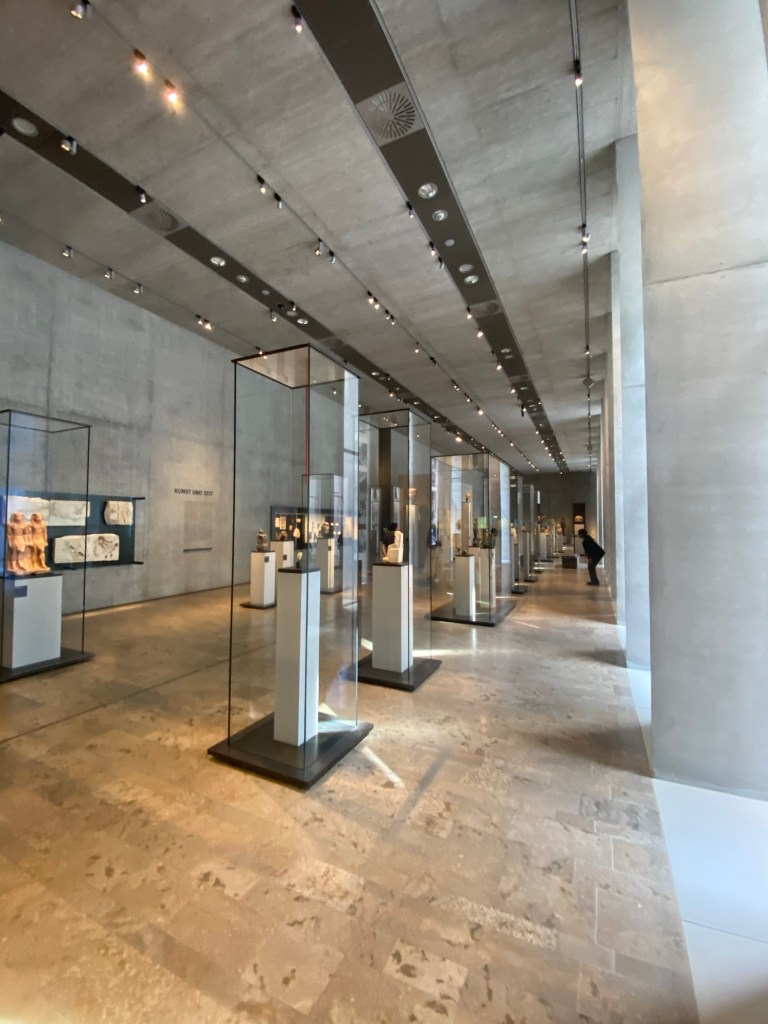
You walk into gallery 2 and you are impressed again by the quality of the display, not to mention the fascinating artworks and you take a quick picture of the gallery because you are NOT going to be photopgraphing the various artworks because you are on vacation. Remember that.
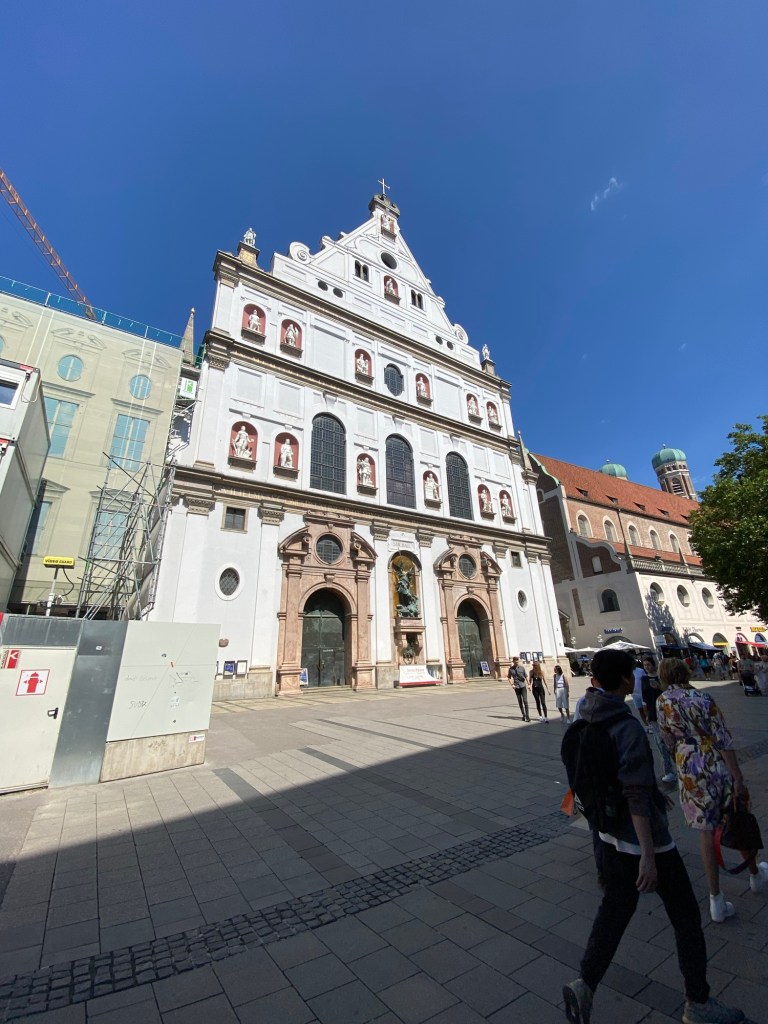
Near Marienplatz in the center of historic center Munich sits the important Jesuit church devoted to St. Michael. It has an august history and its striking architecture had an enormous influence on Southern German early Baroque architecture.
In 1556, Albert V, Duke of Bavaria granted the Society of Jesus permission to establish a presence in the city and this church was consecrated in 1597, after 14 years of construction. The church was built by William V, Duke of Bavaria between 1583–97 as a spiritual center for the Counter Reformation. The foundation stone was laid in 1585.
In order to realise his ambitious plans for the church and the adjoining college, Duke William had 87 houses in the best location razed, ignoring the protests of the citizens. The church was erected in two stages. In the first stage (1583–88), the church was built by the model of Il Gesù in Rome and given a barrel-vaulted roof by an unknown architect, the vault being the largest in the world apart from that of St Peter’s Basilica in Rome, spanning freely more than 20 meters.
The facade is impressive and contains standing statues of Duke Wilhelm and earlier rulers of the Bavarian Wittelsbach dynasty, cast in bronze, in the form of a family tree. Hubert Gerhard’s large bronze statue between the two entrances shows the Archangel Michael fighting for the Faith and killing the Evil in the shape of a humanoid demon.
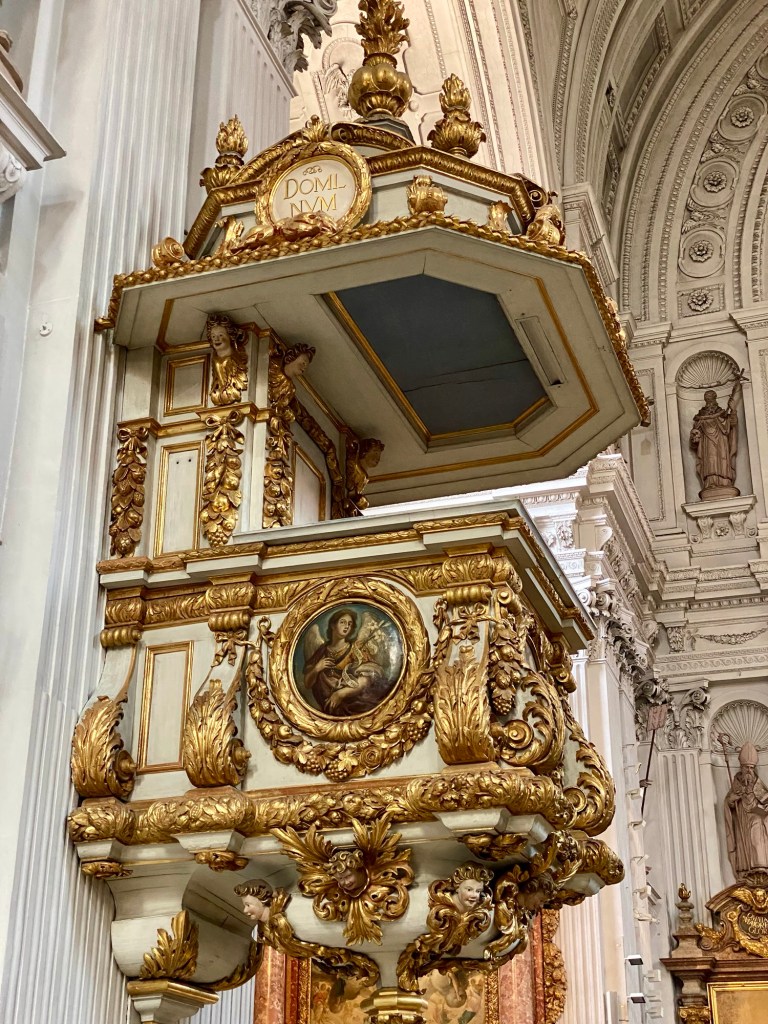
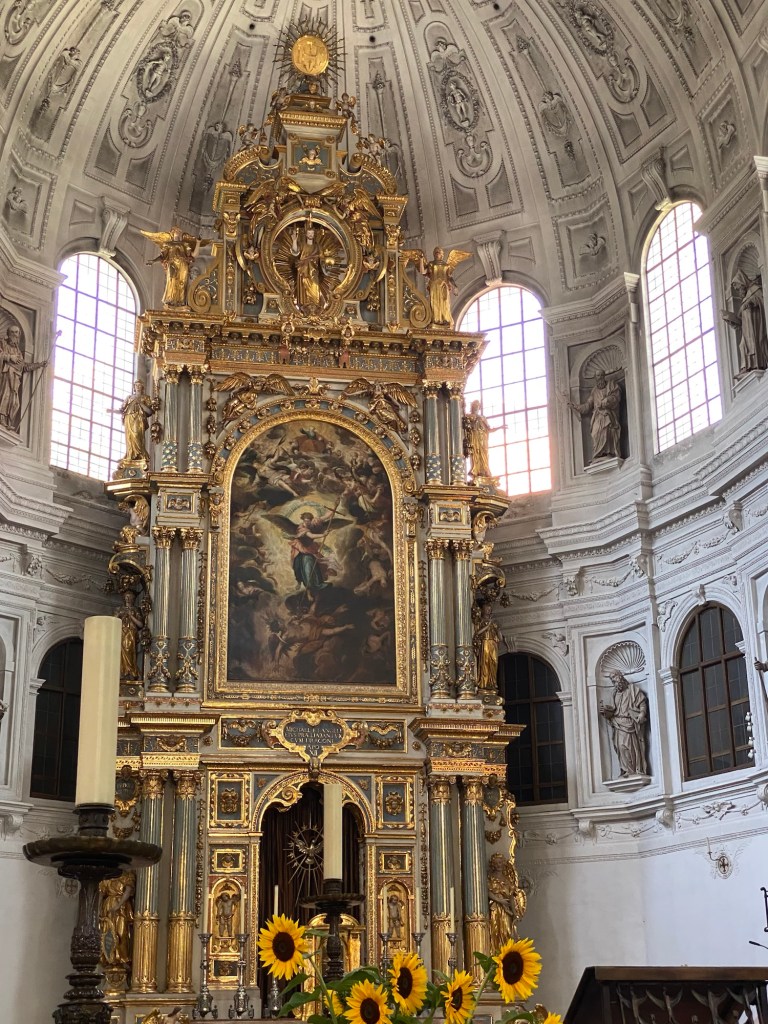
The interior is a representation of the triumph of Roman Catholicism in Bavaria during the Counter-Reformation. The heavily indented chancel arch as well as the short side aisles and even the side chapels are designed as triumphal arches in the ancient model. A very deep choir room adjoins the mighty nave. The stucco decoration of the nave represents the life of Jesus Christ. The altarpiece “Annunciation” was created by Peter Candid (1587). The sculpture of the holy angel in the nave by Hubert Gerhard (1595) was originally intended for the tomb of William V, which was not completed.
Having suffered severe damage during the Second World War, the church was restored in 1946–48. Between 1980 and 1983, the stucco-work was restored.
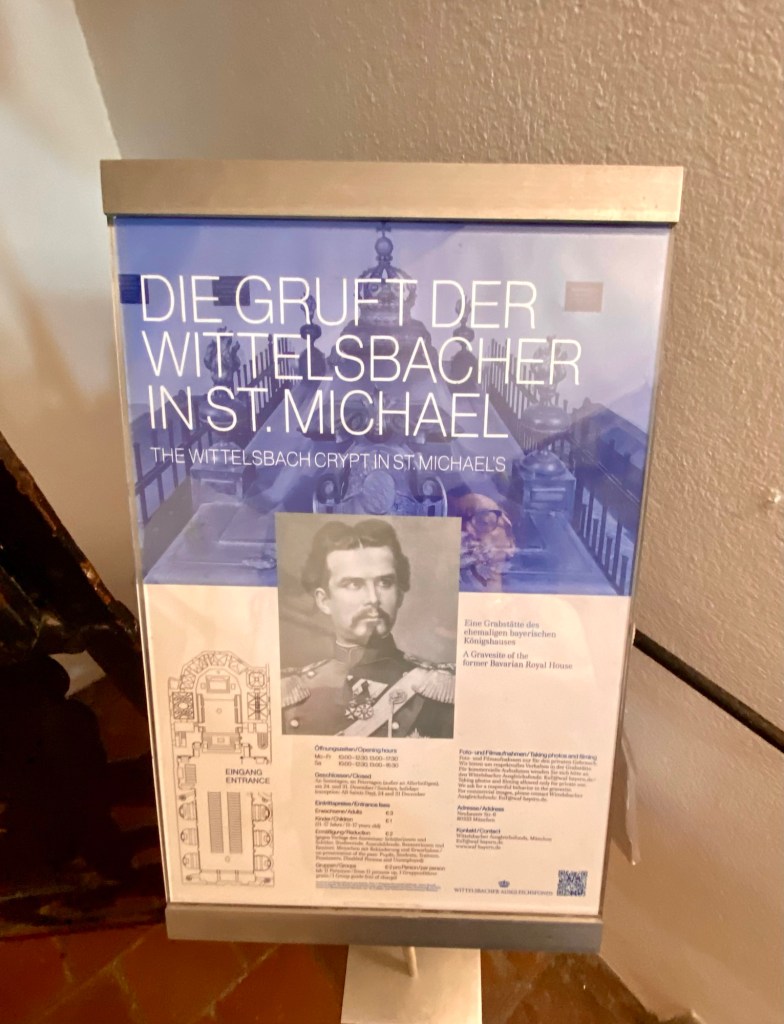
The church crypt contains the remains of Eugène de Beauharnais. Eugène was the son of Josephine de Beauharnais, Napoleon’s wife and her first husband, general Alexandre de Beauharnais. He married a daughter of King Maximilian I Joseph of Bavaria in 1806 and was created Duke of Leuchtenberg in 1817.
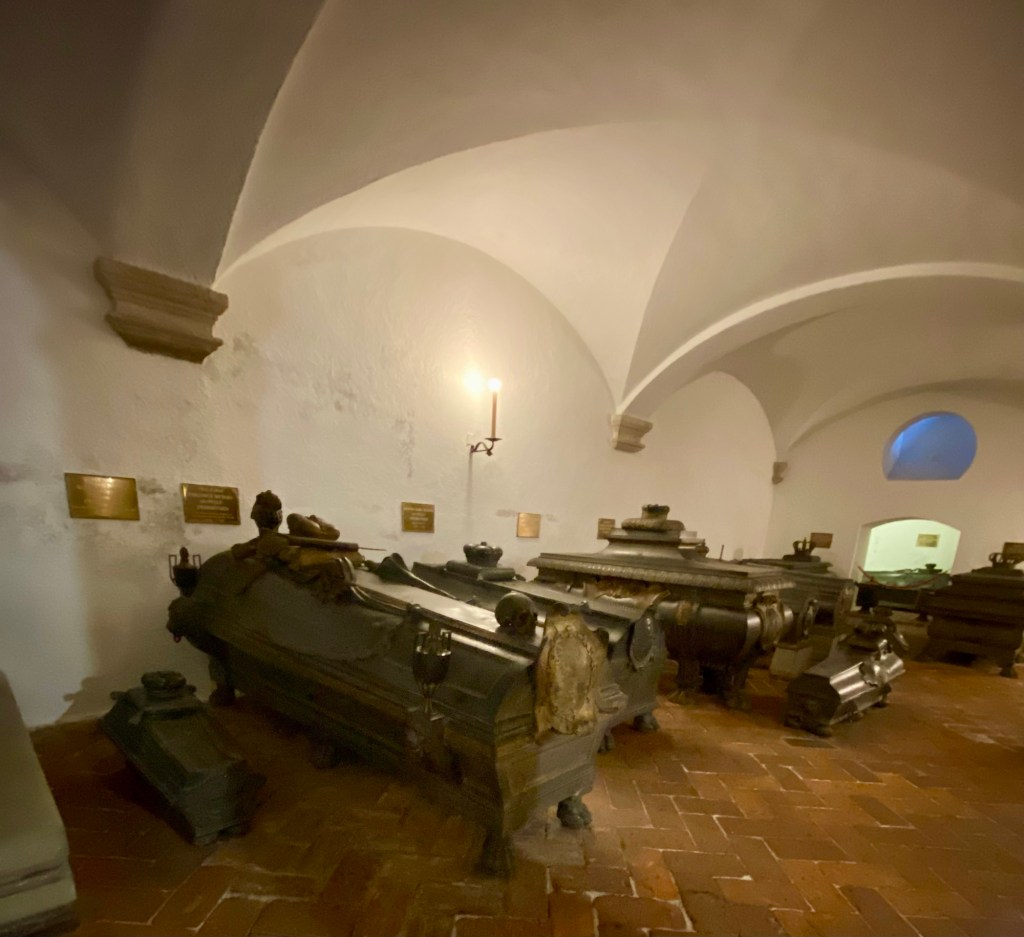
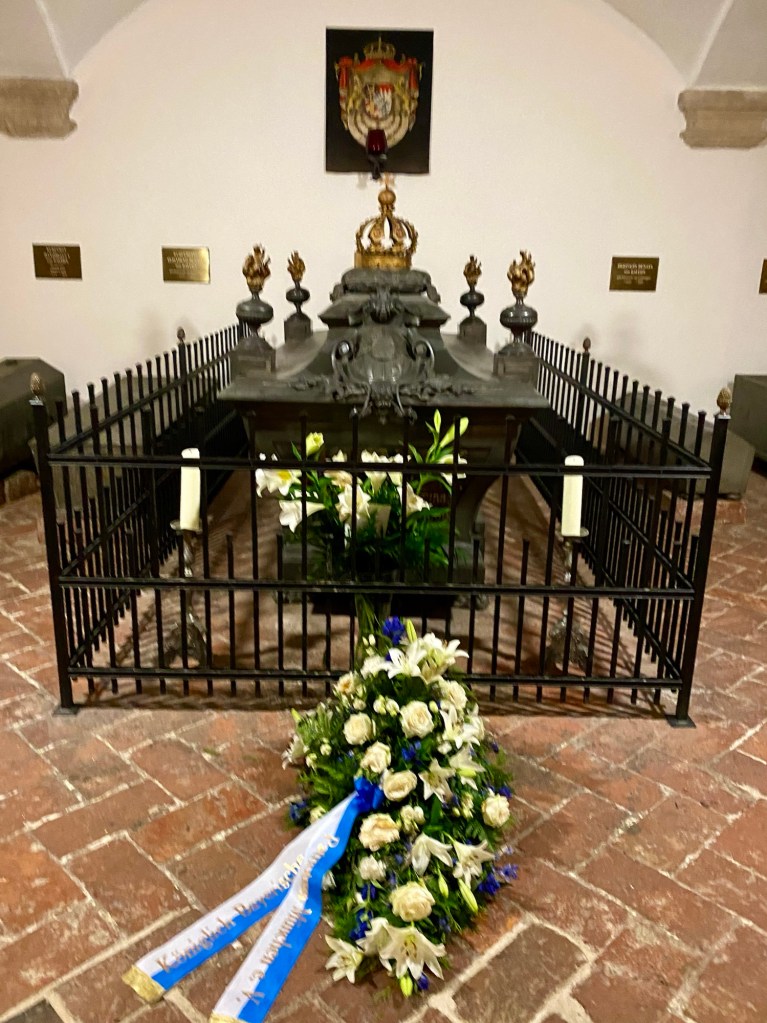
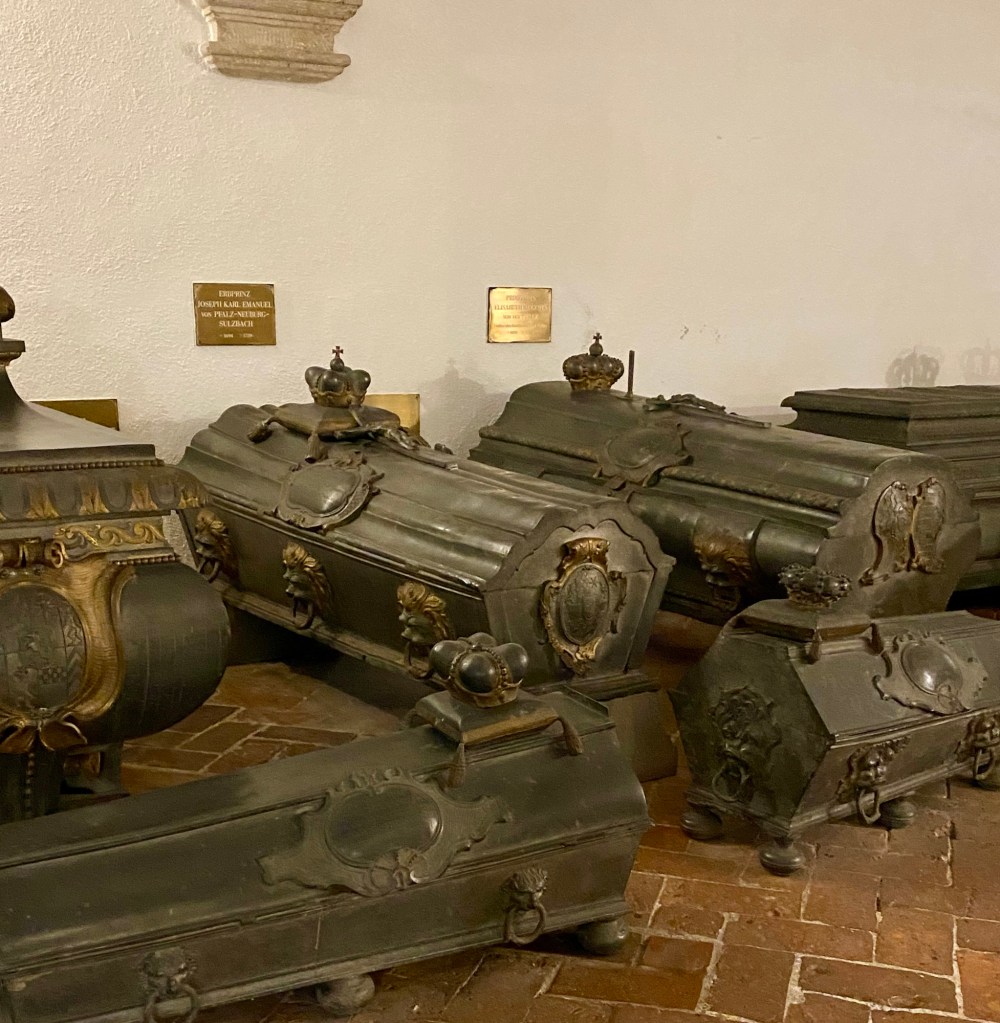
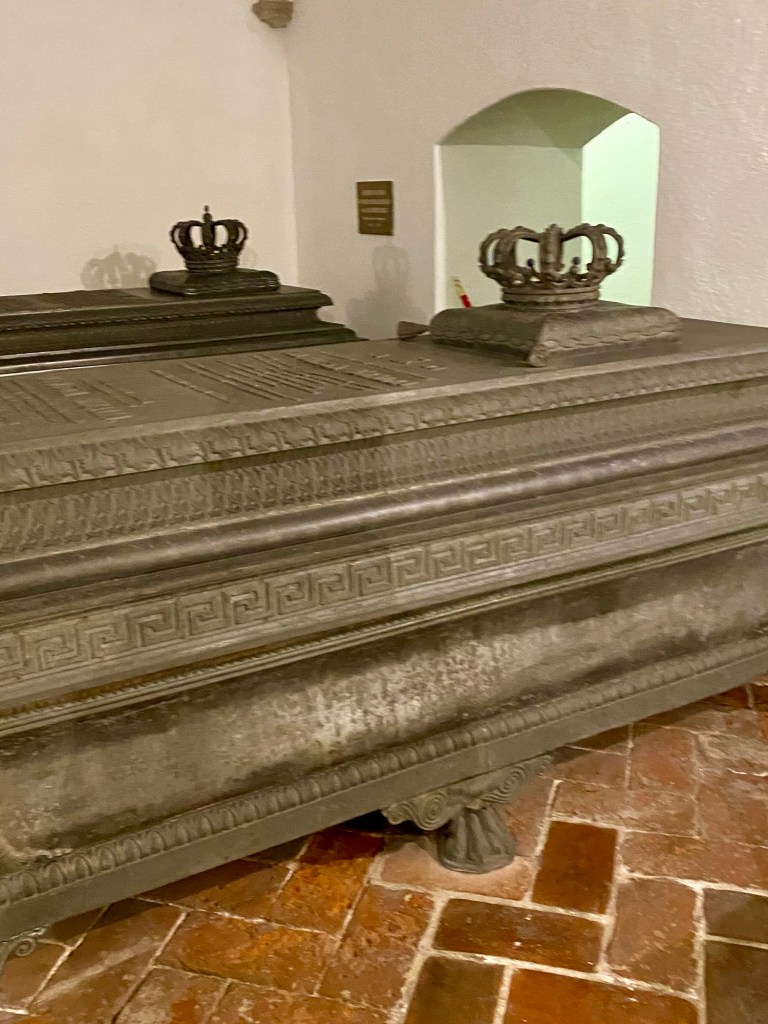
The crypt contains tombs of many members of the Wittelsbach dynasty:
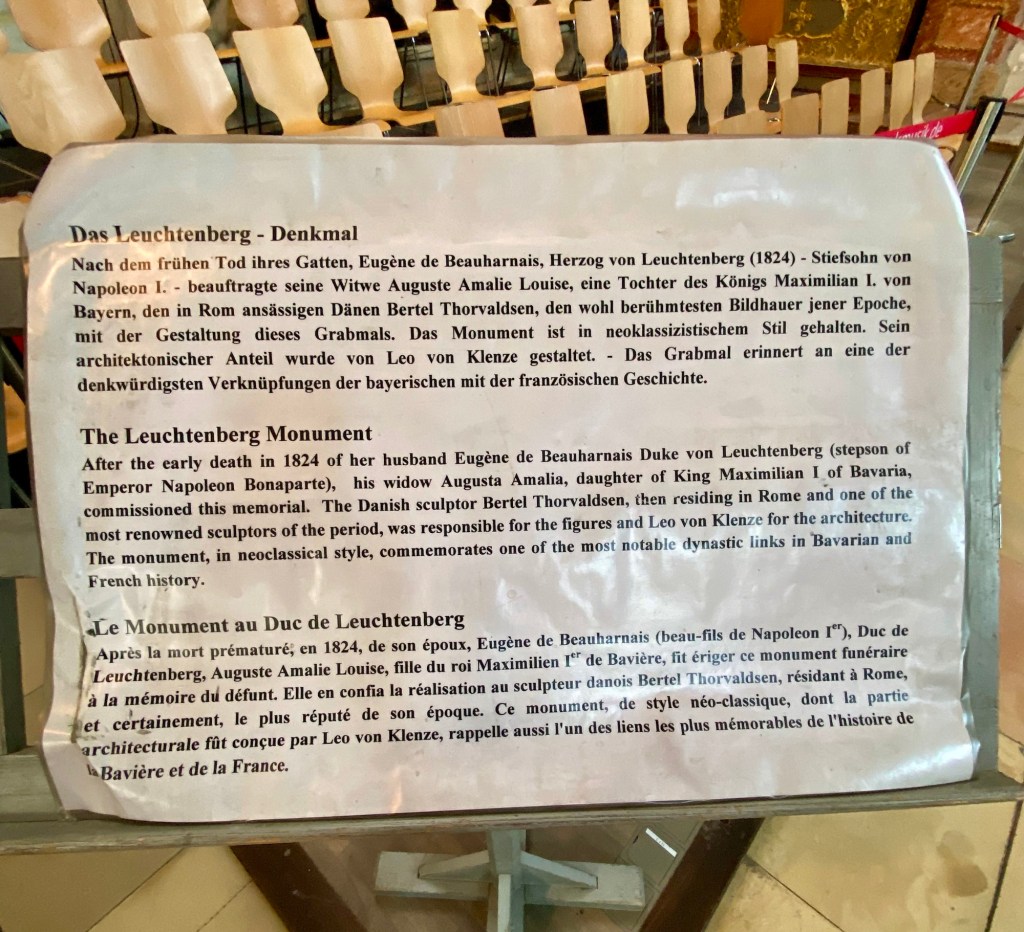
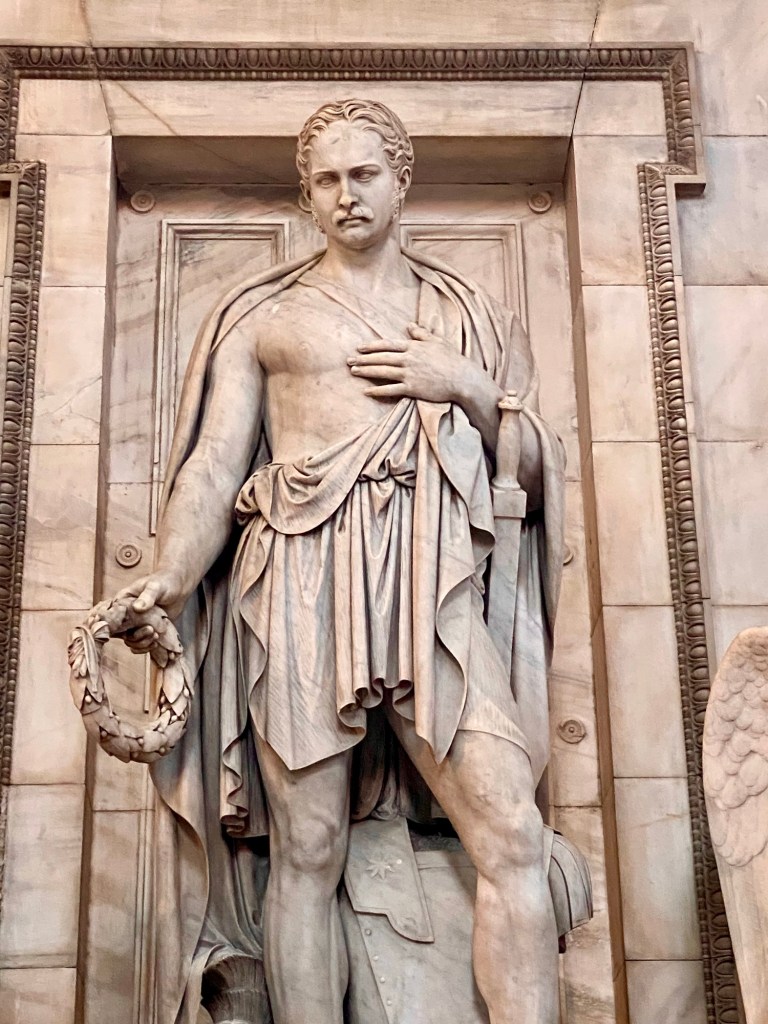
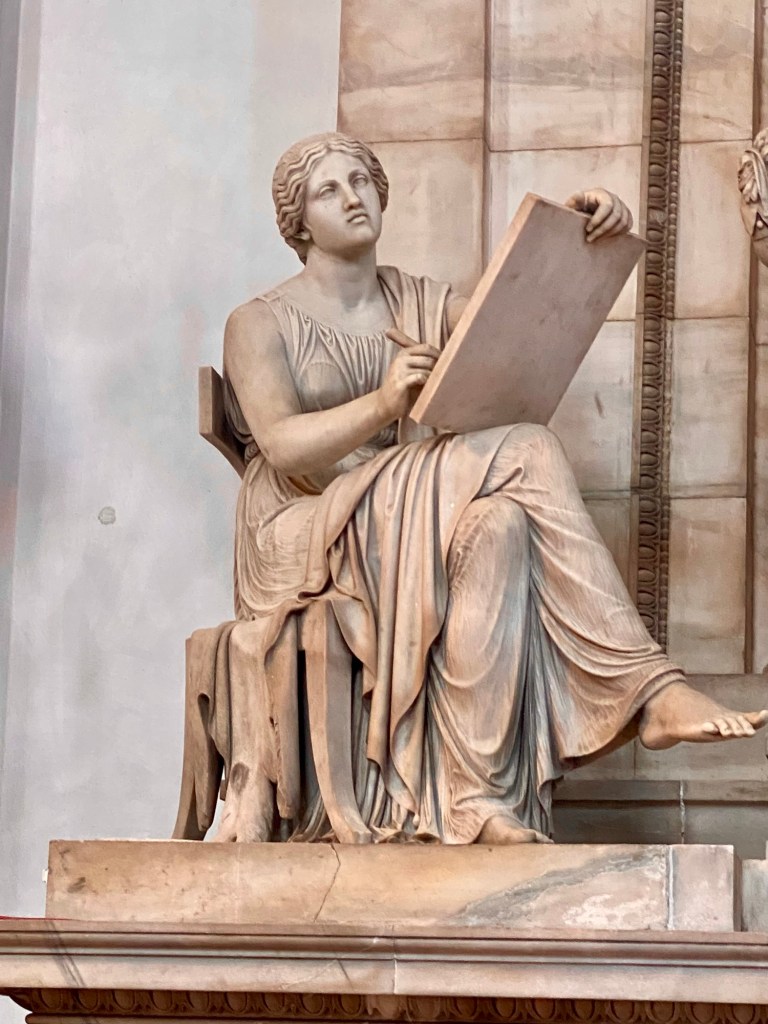
When I wandered into this impressive church one afternoon in Munich, I was surprised to find the Monument for Eugène de Beauharnais (step-son of Napoleon) by Bertel Thorvaldsen. Many moons ago, I was somewhat of an expert on 19th century sculpture and delivered a lecture in Rome on Thorvaldsen. I had forgotten (never planning to visit Germany) that this monument was in Munich. But here it was and here I was and it was a good moment.
I knew it was a Thorvaldsen in my senses before my brain registered it. The winged angels gave Thorvaldsen away to my senses.
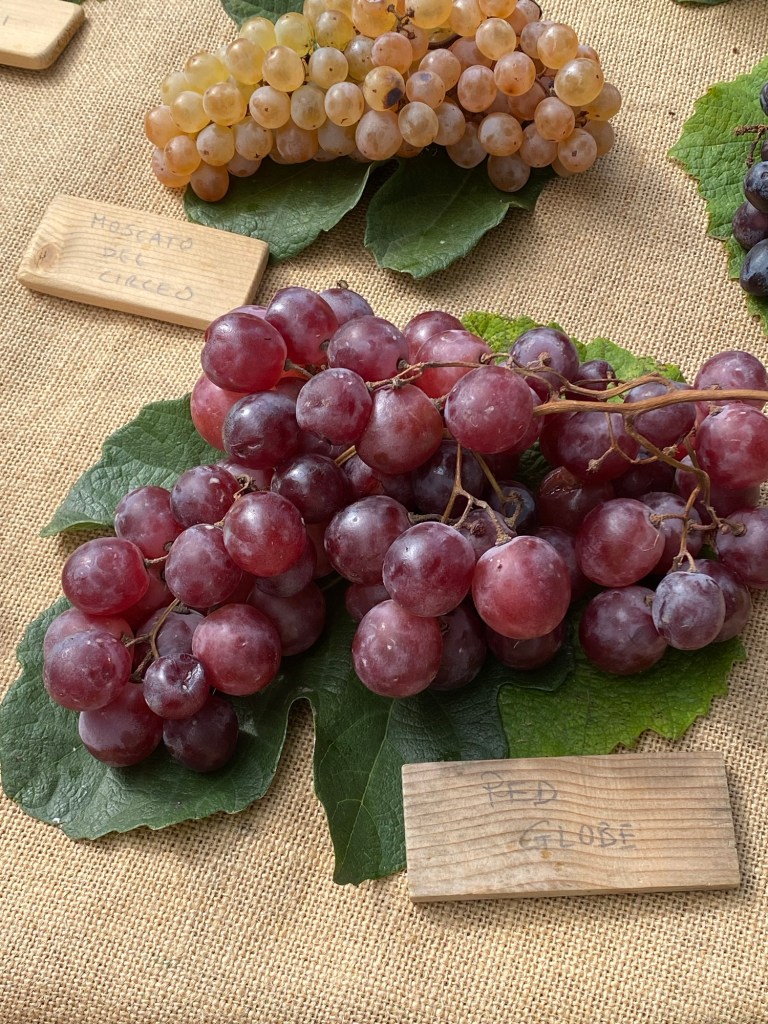
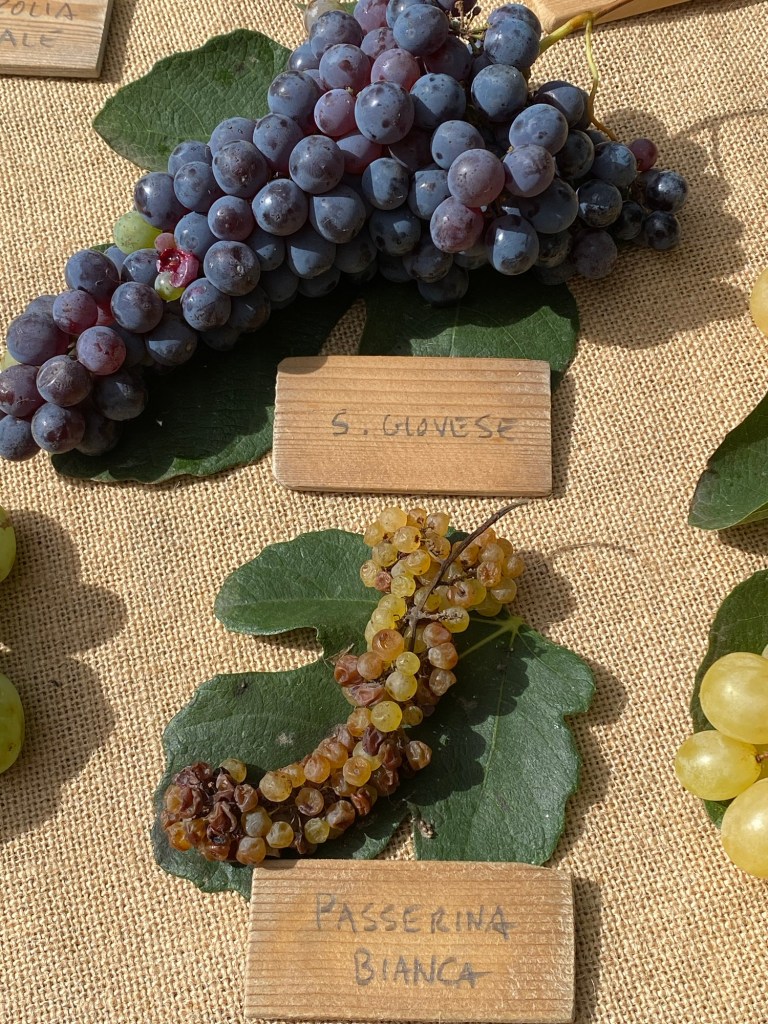
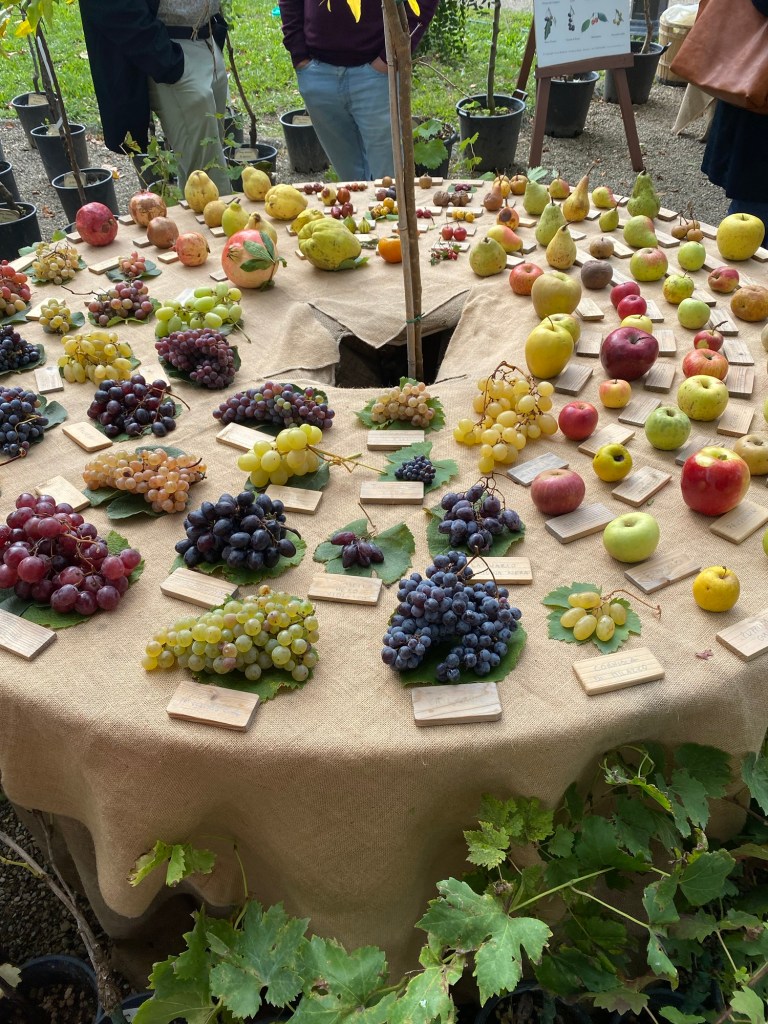
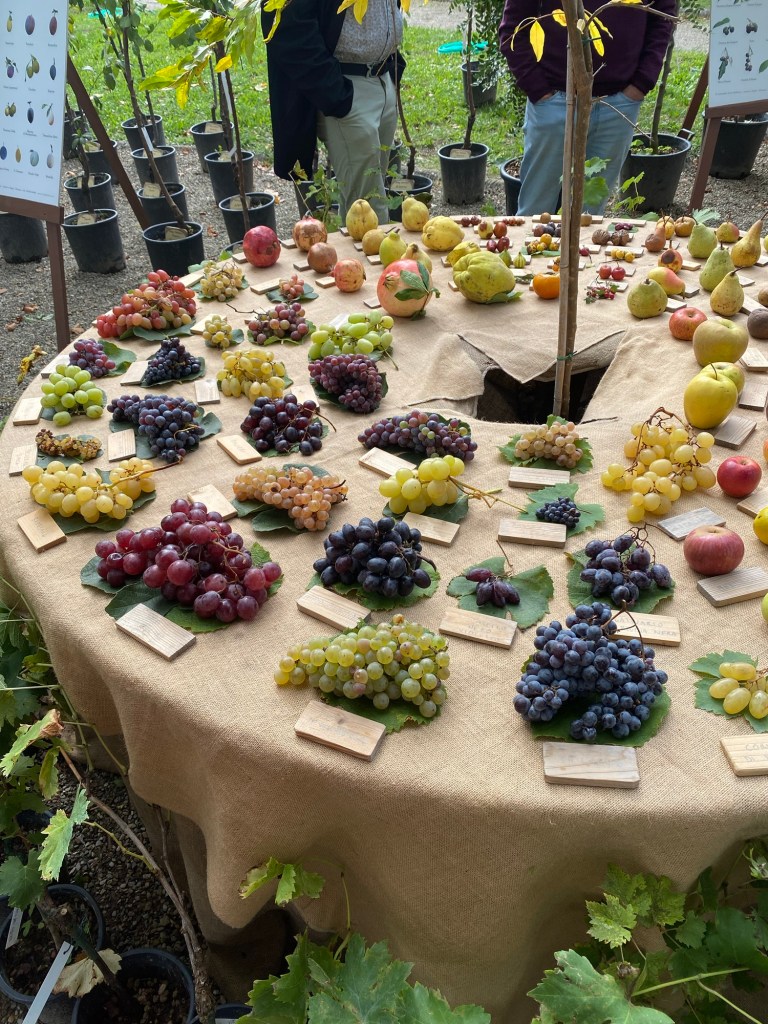
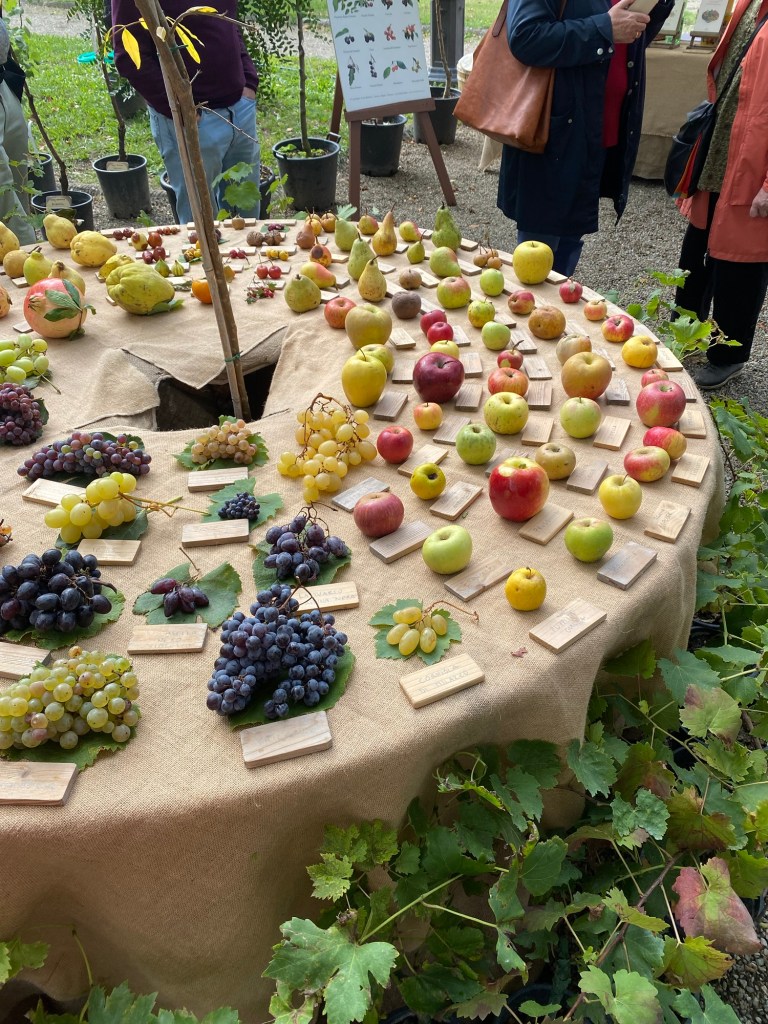
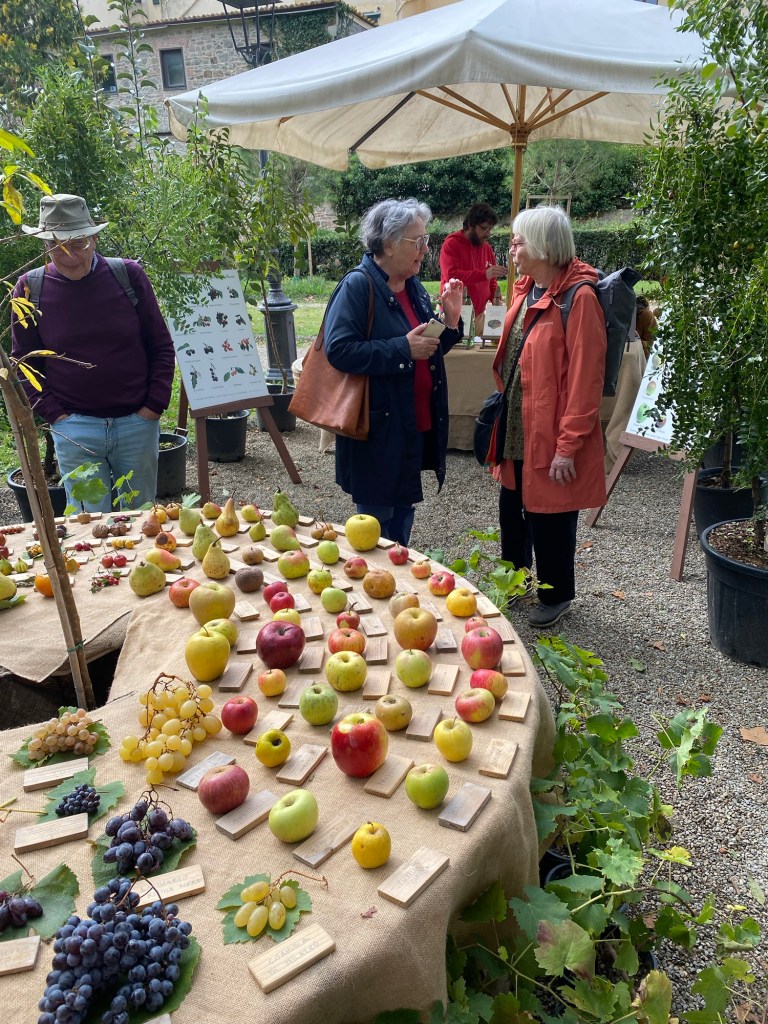
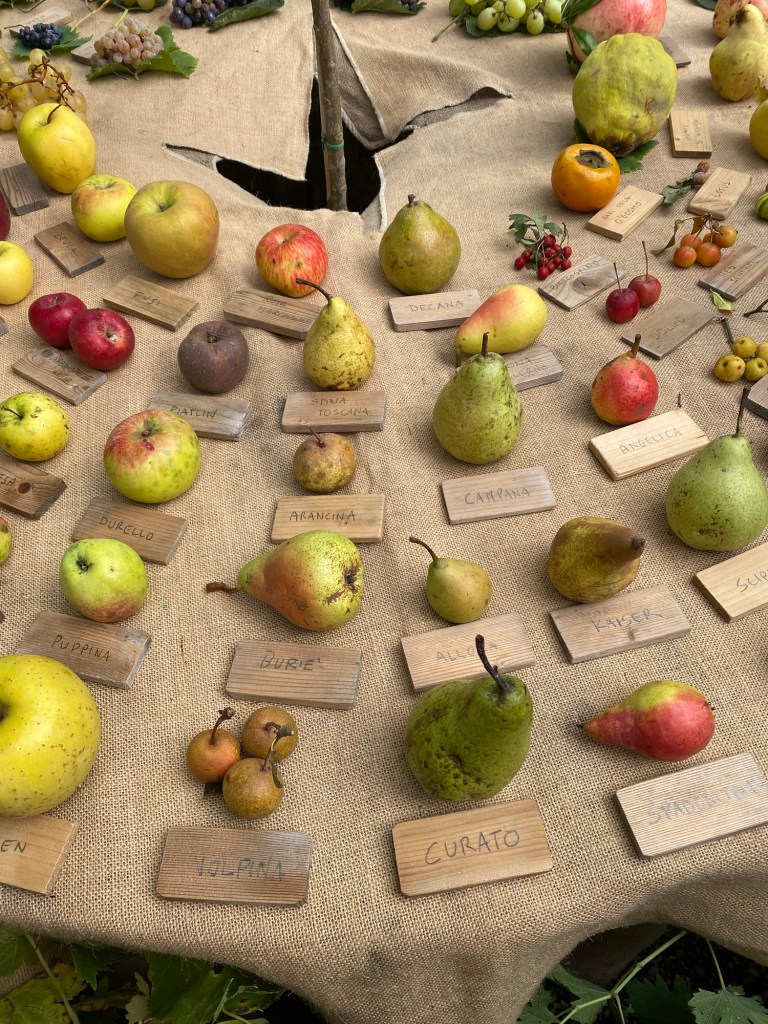
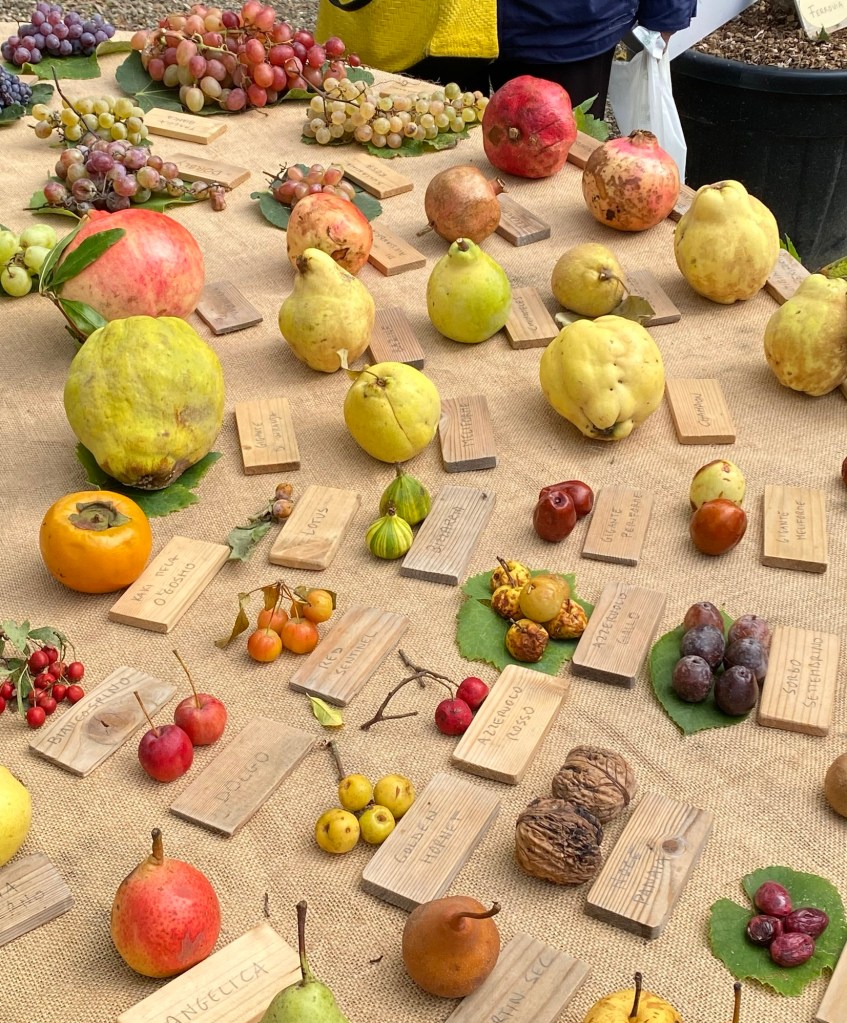
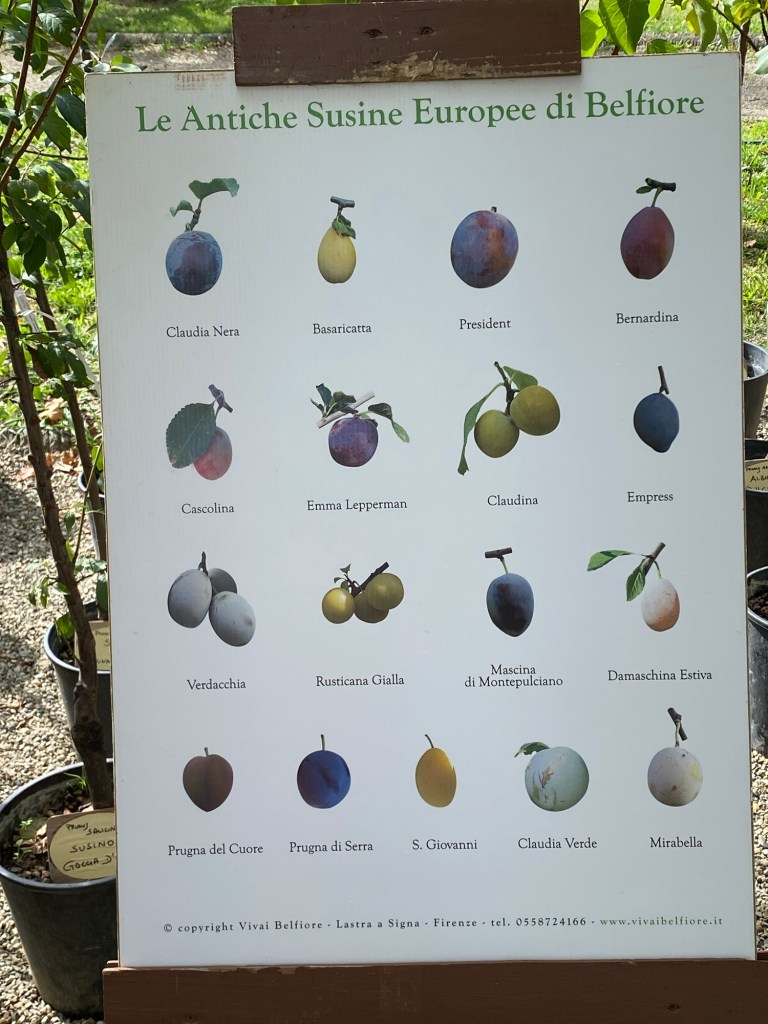
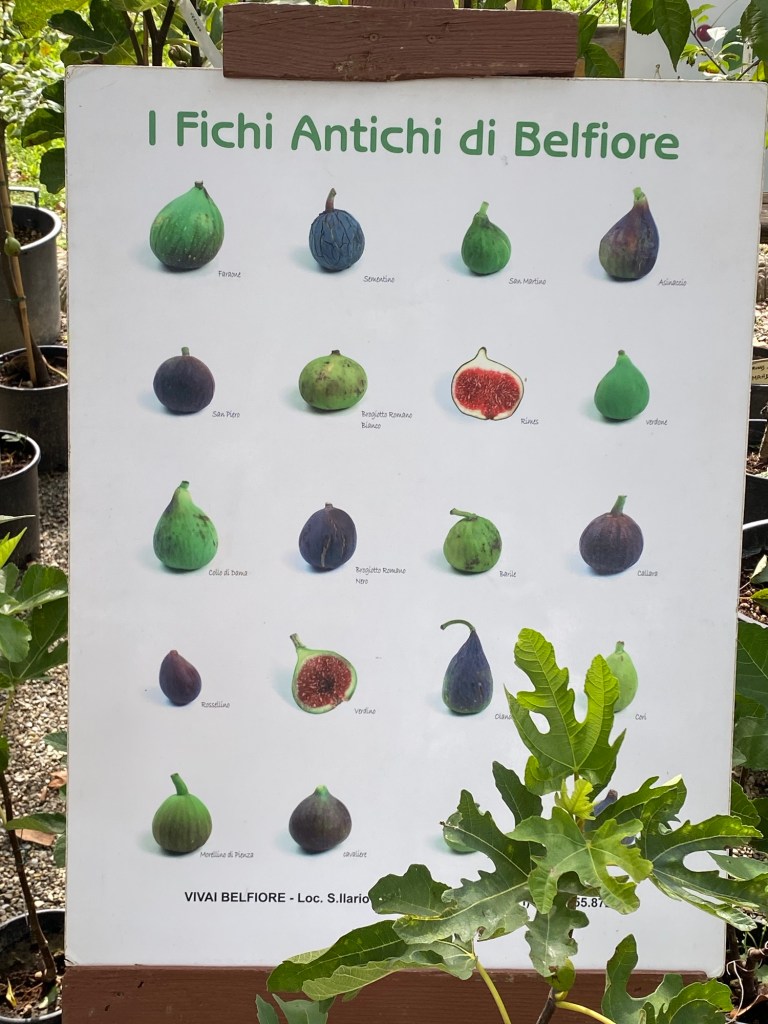
Still enjoying pictures of the various charms of the flower show/market at the Horticultural Garden. The displays are so well done!
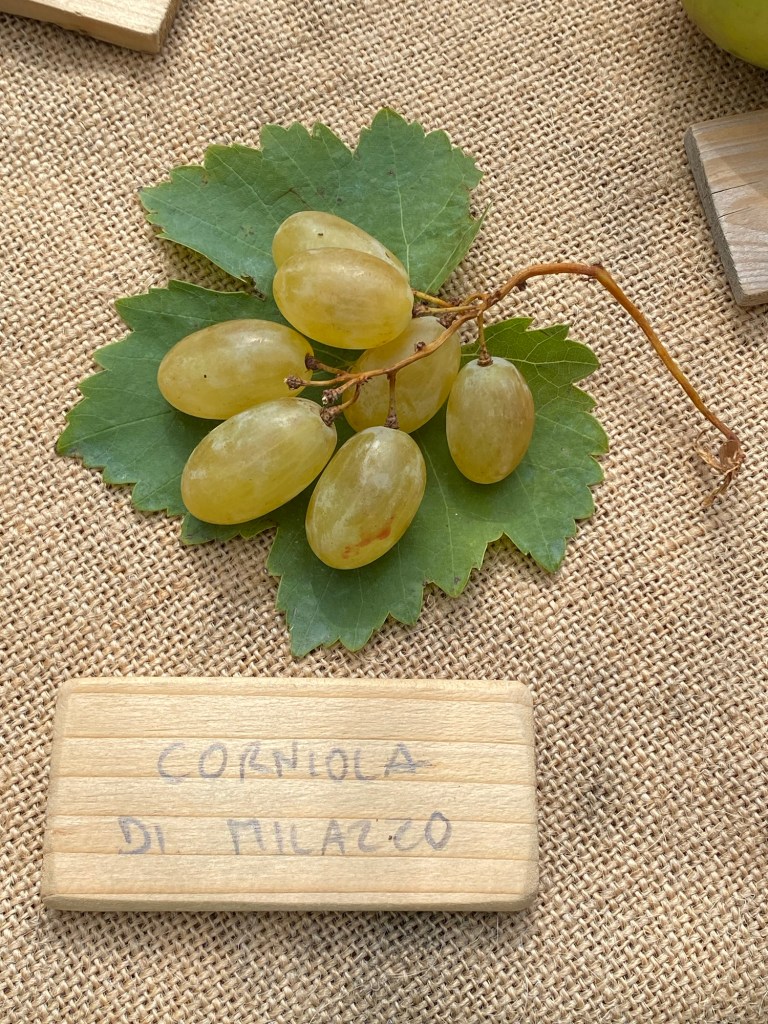
If you know anything about Italian grapes, you probably are aware that the San Giovese is the basis for the great Italian
.
Think of the time and the work needed to create the still-life displays below!
The flower show is a good time to catch up with friends, as these ladies demonstrate!
The apple above is the Red Florentine.
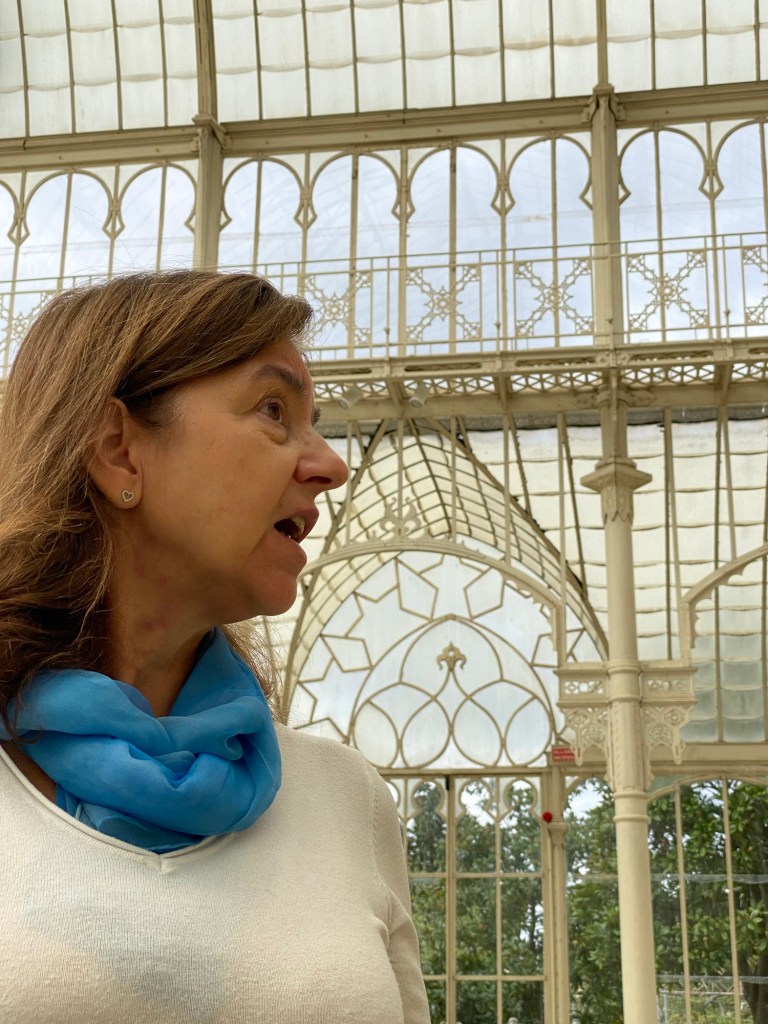
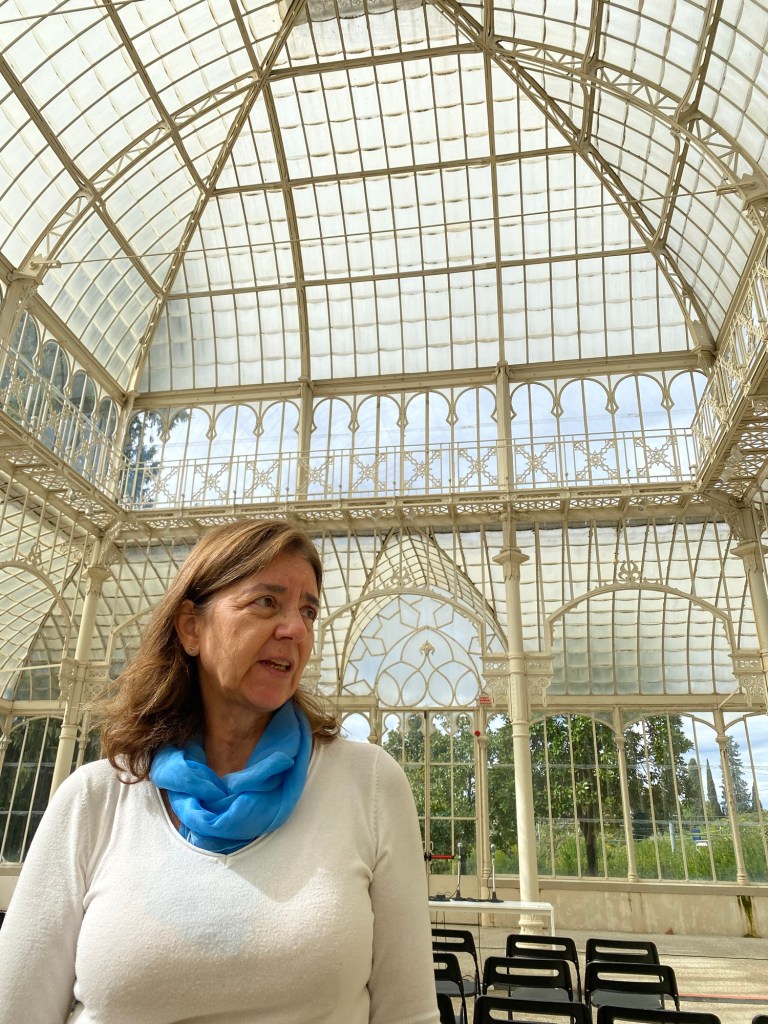
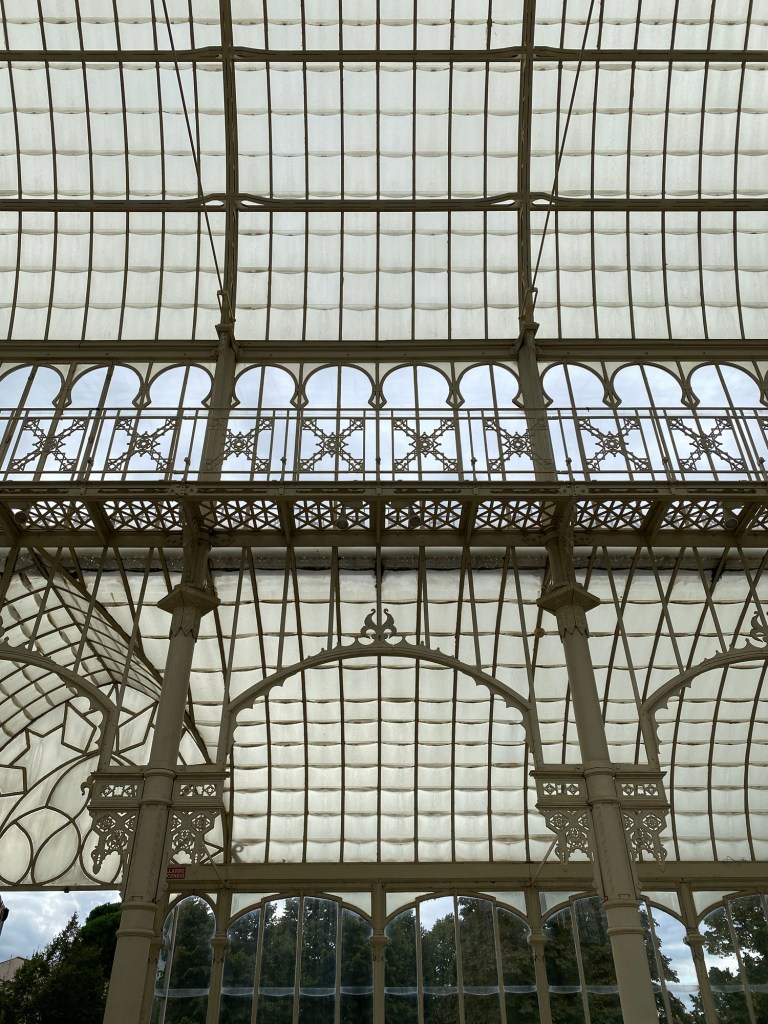
We took a break from looking at flowers and fruits and entered the 19th century glass house within the garden grounds. The house is so beautiful. We met a charming couple from Austria and in these pictures, Patrizia is talking to them about various things connected to the glass house. I took the opportunity to shoot her picture against the backdrop of the beautiful iron architecture.
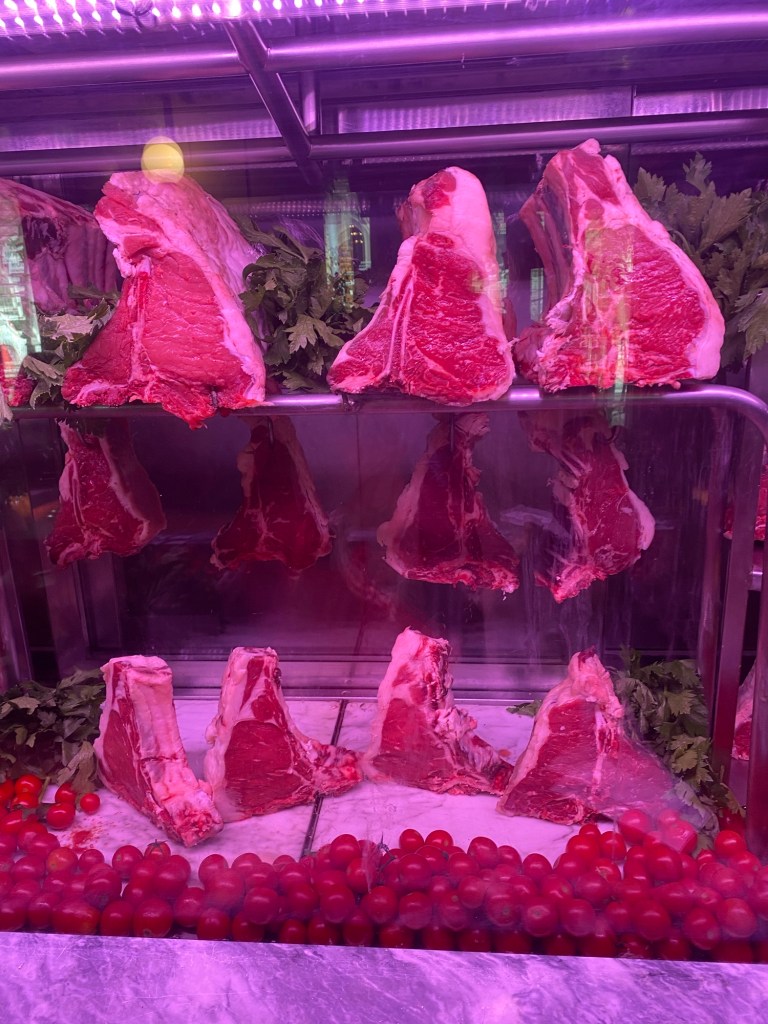
The we went to a nearby favorite restaurant where meat is king. They display the famous bistecca alla Fiorentina in glass cases with a kind of bluish light. It doesn’t make the most attractive picture, but believe me, the steaks were gorgeous.
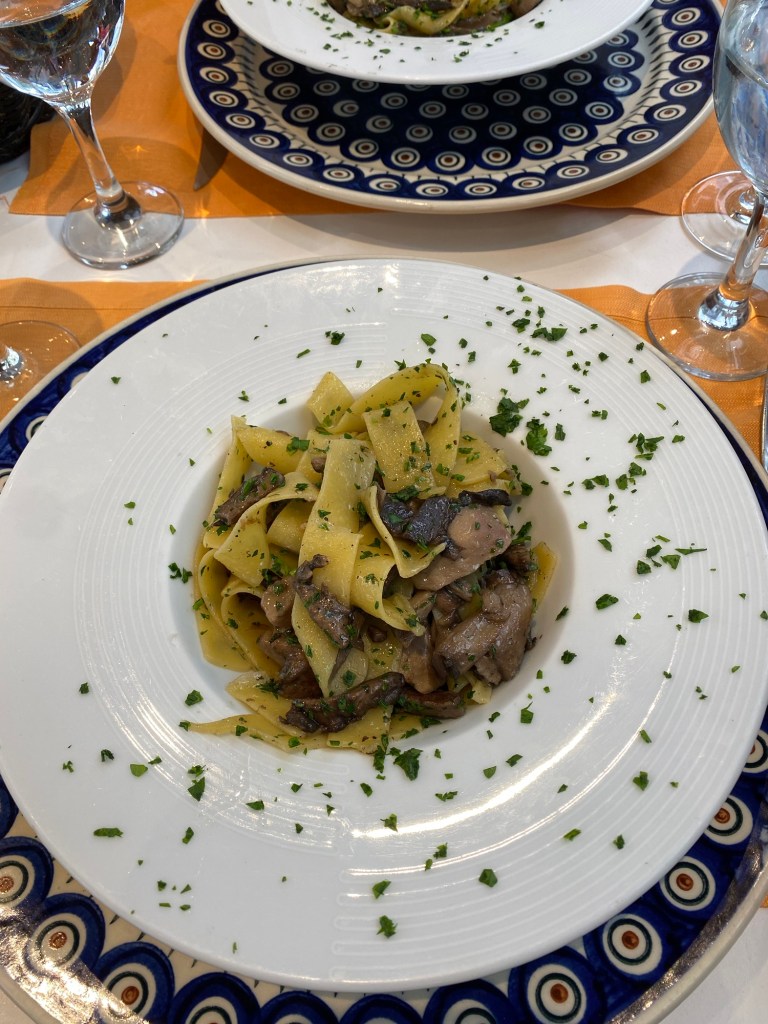
Since its fall, we opted for a fabulous pasta highlighting fresh mushrooms. We also had a plate of fried mushrooms, which I forgot to photograph. The home-made pasta in our tagliatelle al funghi was divine!
All in all, it was a gorgeous fall day with fun activities and great food with a dear friend. The best kind of day!





















































 get back, lauretta!
You must be logged in to post a comment.