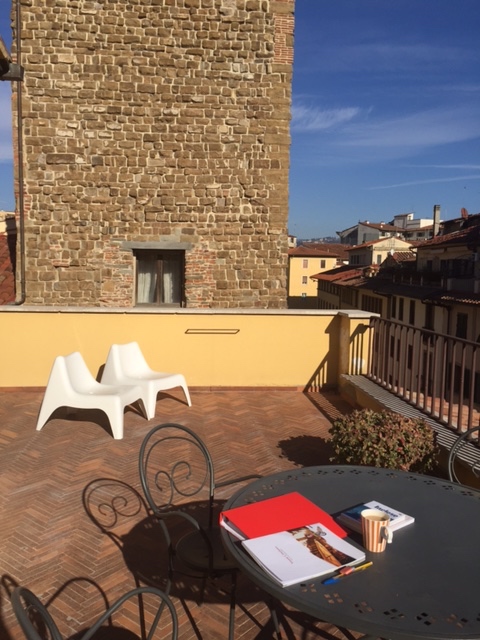
The Lungarno Acciaiuoli (or, how many vowels can you actually put in the center of one word?).

On either side of the long, languid Arno River that bisects Florence from east to west, run parallel roads, called the Lungarni.  These long roadways are, in typical Florentine fashion, divided up every few blocks or so, with various names.
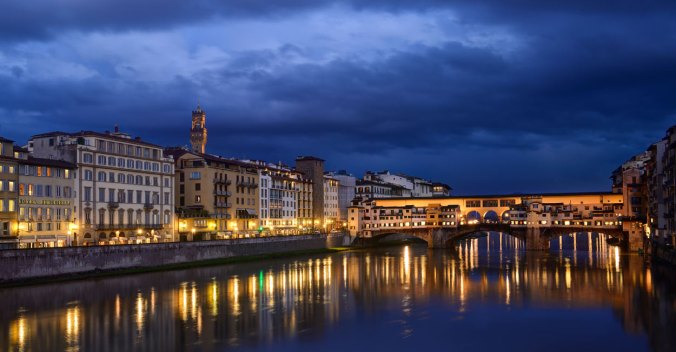
veduta-arno-iv

Italy has a lot of history and Florence in particular has a lot of names to commemorate.  The Lungarni passages provide a fertile field for memorializing important names.   Here they are:

North shore (from the west):

Lungarno Amerigo Vespucci
Lungarno Corsini
Lungarno Acciaiuoli
Lungarno Archibusieri
Lungarno Anna Maria Luisa de ‘Medici
Lungarno General Armando Diaz
Lungarno delle Grazie
Lungarno della Zecca Vecchia
Lungarno William Galeazzo
Lungarno del Tempio
Lungarno Cristoforo Colombo
Lungarno Aldo Moro


South shore (from the west):

Lungarno Bruno Buozzi (Lastra a Signa)
Lungarno dei Pioppi
Lungarno del Pignone
Lungarno Santa Rosa
Lungarno Soderini
Lungarno Guicciardini
Lungarno Torrigiani
Lungarno Serristori
Lungarno Benvenuto Cellini
Lungarno Francesco Ferrucci

As you can see, a lot of names were used in naming the sections of the Lungarni!

It fills me with some kind strange pride to note that I’ve had the personal good fortune to live on three sections of the Lungarni thus far in this lifetime (who knows about other lifetimes?  I can’t remember!): in the Oltrarno I had the pleasure of living for time on the Lungarno Serristori and later the Lungarno Torrigiani.  I loved every minute of both locations.  There is no better way of exploring a new area of the city than living in it for a while!

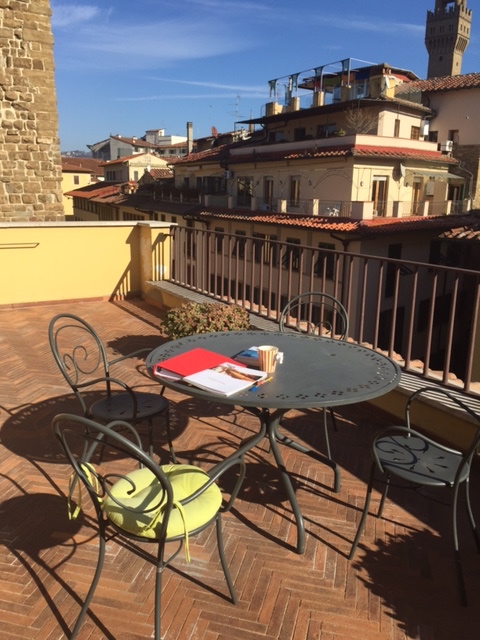
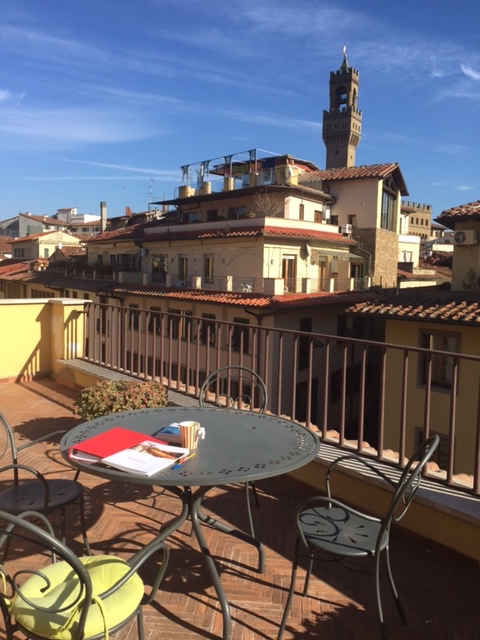
My focus today is on the North side of the river and on the section of the Lungarno on which I currently have the amazing luck to live. The prestigious Lungarno Acciaiuoli is the stretch of the north bank of the Arno River in Florence that runs from the Ponte Vecchio to the Ponte Santa Trinita.  This area of Florence is among the most elegant areas in the city.

My short passage of the Lungarno ends at the east end at the storied Ponte Vecchio and overlooks, on its west end, the Torre Consorti, and one side of the Palazzo Spini-Feroni, home of the Salvatore Ferragamo palazzo and museum.  It’s a tony avenue.

screen-shot-2017-01-28-at-7-18-01-pm

In olden times,  this section of the Lungarno was called i cappellai or “the hatters,” after the Florentine hat makers  who located their shops here.

Later, in the 19th C.,  two of the most important Florentine hotels were located here: the Grand Hotel Royal de l’Arno and the Hotel Royal de la Grande Bretagne.  Charles Dickens, Henry James and many others stayed in these famous hotels.  Sometimes, when I am walking around Florence on streets where I know for a fact that famous personalities from the past passed over, I imagine for a moment what it would be like to bump into, say Dante Alighieri or  Charles Dickens walking around town.  I’ve always had this sort of imagination.

Still standing from that era is the Hotel Berchielli, the ancient building that miraculously survived the landlines set by the retreating German army during WWII. This historic building has housed the Hotel Berchielli since 1890 and is among the most famous hotels in the center of Florence.

A marble plaque on the façade recalls the frequent stays of Romain Rolland, a distinguished literary critic and the winner of the Nobel Prize for Literature in 1915.  Rolland chose the Hotel Berchielli as his Florentine residence.

ROMAIN ROLLAND
INSIGNE WRITER
AND ART CRITIC
sTAYed HERE
IN 1911

And while you may not be familiar with Rolland, I’m sure you know that guy named Pablo Picasso, who also, several decades later, took up residence in the hotel (fall of 1949).

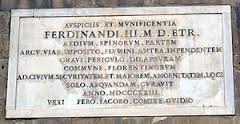
Also marking the area is a plaque at Red All’84-86, of Palazzo Spini Feroni:

AVSPICIIS. ET. MVNIFICENTIA
Ferdinandi. III. M. D. ETR.
AEDIVM. SPINORVM. partem
ARCV. VIAE. IMPOSITO. FLVMINI. ANTEA. IMPENDENTEM
SERIOUS. PERICVLO. DILAPSVRAM
COMMVNE. FLORENTINORVM
A.D. CIVIVM. SECVRITATEM. ET. Maiorem. AMOENITATEM. LOCI
ONLY. AEQVANDAM. CVRAVIT
YEAR. MDCCCXXIII.
VEXILLIFERO. Iacobo. COMITE. Gvido
images

The translation is: “Under the auspices and through the munificence of Ferdinand III, Grand Duke of Tuscany, the City of Florence in the year 1823, being the standard-bearer Count Jacopo Guidi, demolished for safety of citizens, and greater beauty of the place, the part of the houses the Spini who first faced the river on a place at the turn of the bow away and threatened to collapse with grave danger. ”

(reference: Francesco Cesati, the great leader of the streets of Florence, Newton Compton Editori, Rome 2003).

From the Lungarno Acciaiuoli, the world of Florence’s history, culture and elegance are readily available.

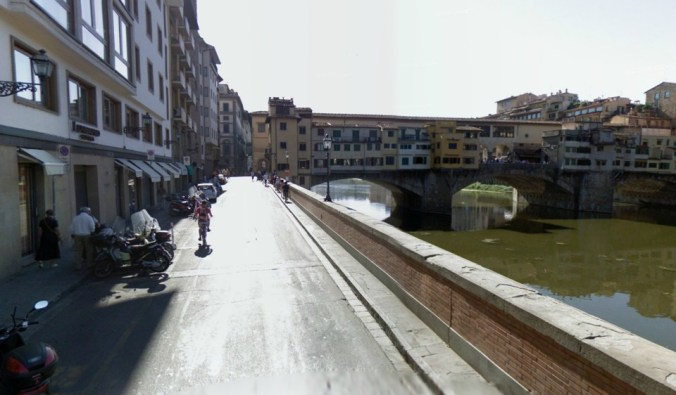
On the Lungarno Acciaiuoli, looking towards east to Ponte Vecchio:
lungarno-acciaiuoli-ponte-vecchio

Looking from the embankment in the opposite direction, towards the west, one can admire the graceful Ponte Santa Trinita, about which I will be posting soon. This bridge is considered to be one of the most elegant and refined bridges in Italy in particular or in all of Europe. The line of arches that create the bridge, along with the white scrolls on the summit of each arch, and the four statues placed on the corners to represent the seasons, the bridge is one of a kind. Standing on the bridge provides a unique panorama or the lovely Arno through this area.

The Lungarno Acciaiuioli is considered, along with the current Lungarno Corsini, to be the most ancient road opened along the Arno river.  This section of the Lungarni has a varied character, marked as it is by two building from the Middle Ages (the Consorti tower and Palazzo Spini Feroni), as well as restored buildings from the 19th-century and still others rebuilt in the 1950s and 60s with a modern character.

What a street!


Epiphany in Florence, 2017

Before the month of January slips entirely through my fingers, I want to get the rest of my Epiphany photos posted.

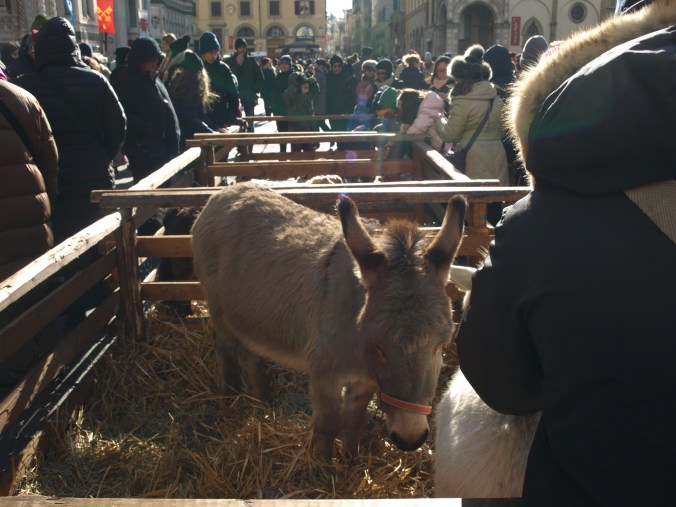
Here are the animals waiting patiently at the creche scene at the Duomo. They await the three Wise Men and their entourages,  marking the end of the long, ceremonious cavalcade.


OLYMPUS DIGITAL CAMERAOLYMPUS DIGITAL CAMERAOLYMPUS DIGITAL CAMERAOLYMPUS DIGITAL CAMERAOLYMPUS DIGITAL CAMERA


Once the Wise Men appear with their gifts, they are received by the magistrates of the city in a spectacular blending of church and state!

epifania_10

15823145_10155020962426614_8079433654972199975_n


The gifts are taken to the living creche scene.

epifania_11

After all the enactment, the hundreds of balloons, something I doubt Mary and Joseph ever imagined let alone saw, are set free!

OLYMPUS DIGITAL CAMERAOLYMPUS DIGITAL CAMERAOLYMPUS DIGITAL CAMERA


21

The entire day is a spectacle not to be missed!  I am so glad I got to see it!

Win some, lose some. The tale of my baking disasters and successes in Italy.

So, I love to bake.  The funny thing is that I am not much of a sweets eater, but I love to bake.

So, naturally, I’ve been experimenting in my new kitchen in Florence with baking.  It has been a hoot and a half getting to know the baking aisles at my local grocery stores, where I can often be found reading the fine print on the back of boxes, doing my best to understand the complicated Italian language as it describes the mysteries found inside the box!

For example: what do you think this is?

img_9096

From the picture on the box, you might think it is a cake mix.  Ha ha!  You’d be very wrong.  It is potato flour/starch.  Some of the recipes I’ve been playing with here require this completely new to me ingredient.  I felt like a winner when I finally found it on a grocery store shelf.

img_9097

Here’s the back of the box.  I decided to make these ricotta muffins, muffin all ricotta, but turn the muffins into a torta or cake.  I am still getting used to measuring grams rather than cups.  You can see the ingredients list is:

125 g di ricotta fresca       ricotta

80 g di zucchero                 sugar

70 g di farina 00                 flour, ground to 00

50 g di fecola di patate      potato flour/starch

50 g di burro                         butter

1 uovo                                     egg

a mela rosso                        red apple  (later we learn to slice thinly with skin on and lay a    piece of apple inside the batter in each muffin cup)

mezza di bustina lievito per dolce     1/2 a packet of rising agent for sweets

mezzo limone                    1/2 lemon (later in recipe we learn it is to be lemon peel)

pizzico di sale                     pinch of salt

zucchero a velo vanigliato    vanilla-flavored powdered sugar

To the best of my ability to understand Italian baking products, below we have the equivalent of what we call baking powder in the United States.  Only here it comes in packets and I share with you now what I’ve learned the hard way thus far (see below the picture).

img_9099

Read the recipe very carefully!  Because when the recipe says to use “mezza bustina di lievito per dolce” then you want to use 1/2 a packet.

I know this now, because I missed that adjective when I was baking my ricotta torta, and I wound up with a product that was completely overpowered by the taste of baking powder. Which is a nice way to say the cake tasted awful and I had to throw the whole thing out.

Fortunately, I am very patient with myself when it comes to baking (very unlike how I am when it comes to learning to speak Italian!!).  I was not very upset to bake a cake and throw it away. :-(

Whenever I bake, I like to play around with the ingredients somewhat, and I think almost every confection tastes better with vanilla.  I am accustomed to using a vanilla bean in the United States, or a high quality vanilla extract.  I haven’t been able to find that here yet, although I am certain it exists.

What I have found is this weird product:

img_9100

It is a consistency somewhere between an extract and a paste, and seems to be filled with millions of vanilla seeds, and it imparts a decent vanilla flavor to whatever I’m mixing up.

In addition, the product below is widely available in the baking aisle.  It is a white powdered version of what must be imitation vanilla?  The package says it imparts the “aroma per dolci di vanillina” or the “aroma for sweets of vanilla extract.”

Well, it does smell like vanilla but to me it doesn’t add much in the way of flavor to my baking.  I will stick to the above estratto until I can find real vanilla here.

img_9098

So, I can’t show you my finished ricotta torta, because I didn’t photograph it before I dumped it.  But here I include a picture of a torta margherita I successfully achieved a while back.

img_9079img_9086img_9090

The picture says it all!  It was wonderful!

Win some, lose some.  Questa è la vita.

I won’t stop trying!! :-))


P.S.  I’m going to try again to make the ricotta torta this weekend for a classmate’s birthday on Monday.  Wish me luck!  I am undeterred.

Beautiful Siena.


img_8835cropped-img_8835.jpgimg_8833img_8834


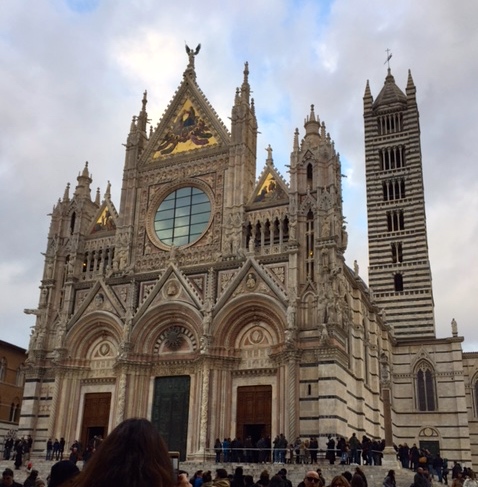
Siena still seems one of the blessed places of the Earth, a town whose beauty alone might justify the claim inscribed on the Camollia Gate:  – ‘Siena opens her heart wide to you’. From the shell-shaped Piazza del Campo, the three terzi (districts) spread along the town’s three curving ridges, their harmonious buildings constructed in the bricks of that warm hue known to artists as ‘burnt sienna’. In the prosperous years before the Black Death, ‘the city of the Virgin’, as it was called, had a population of over 50,000 in addition to another 50,000 in its contado, the country districts and small towns it controlled to its south and west. By the time of Lorenzetti’s frescoes, Siena had added Grosseto and Massa Marittima to its domains.

By the 1330s Florence had twice as many inhabitants as Siena, yet it was at this time that the smaller city, already possessor of the striking zebra-striped cathedral we see today, decided to erect the largest church in Christendom. The project was halted by the Black Death, which killed half the town’s population, and was abandoned soon afterwards, but some of its pillars and arches still stand as testament to monumental ambition. The existing cathedral, which is pretty large itself, would have become merely the transept of the greater glory. Siena’s rulers, whom their subjects might

Gilmour, David (2011-10-25). The Pursuit of Italy: A History of a Land, Its Regions, and Their Peoples (Kindle Locations 1226-1230). Farrar, Straus and Giroux. Kindle Edition.