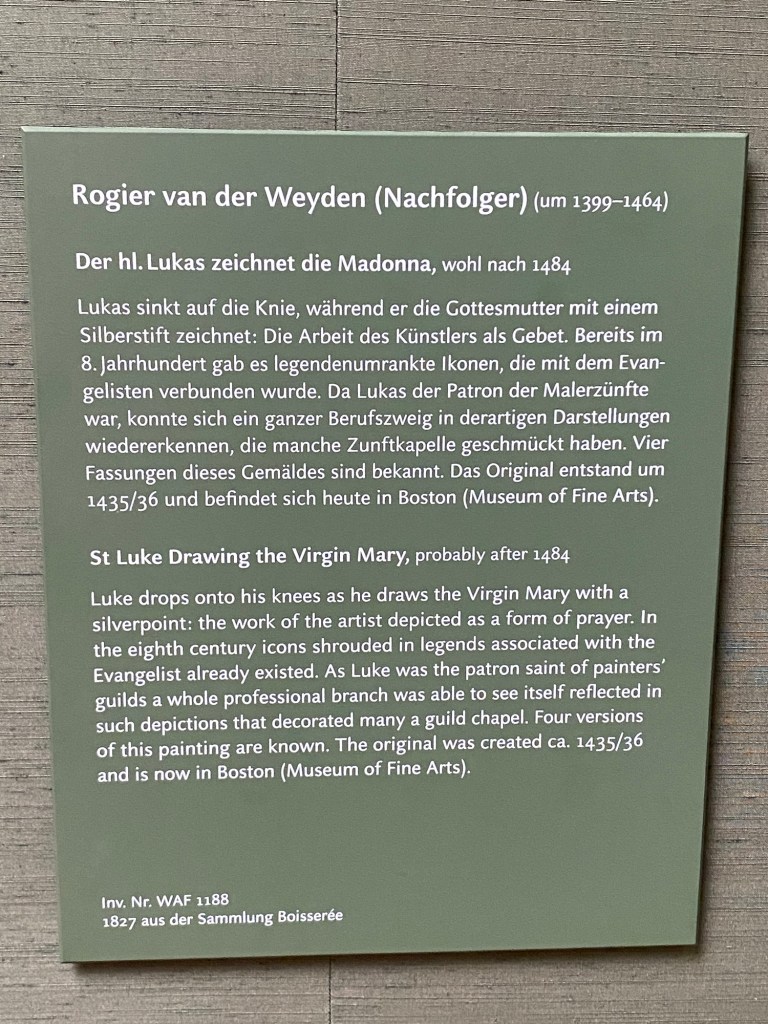
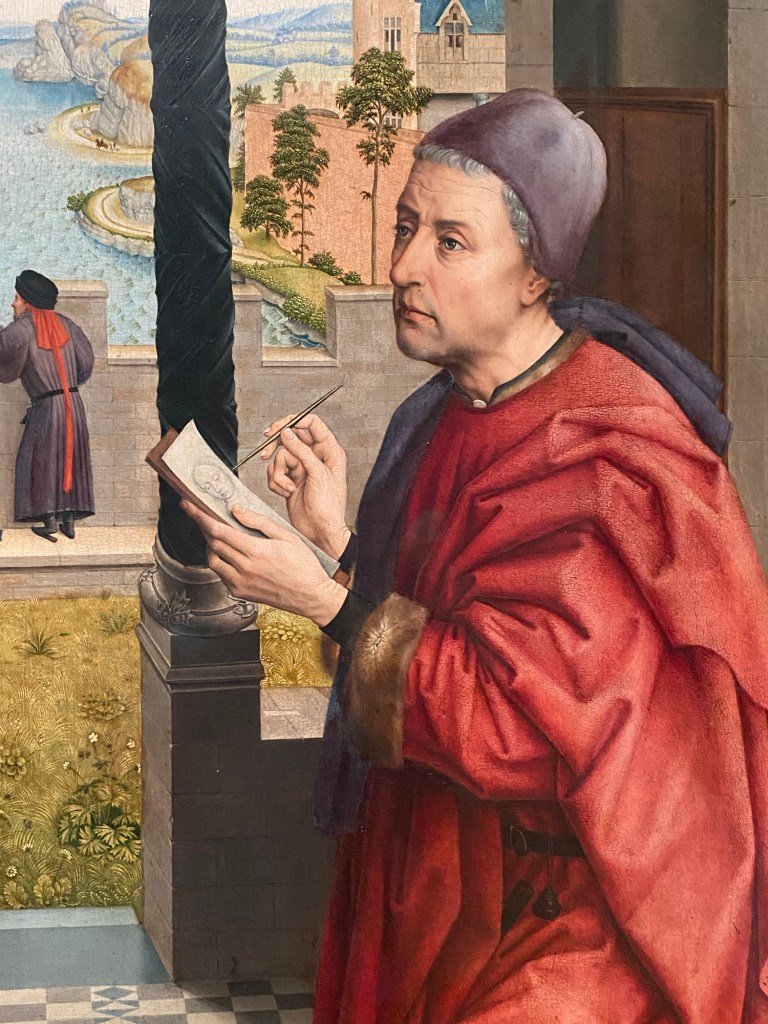
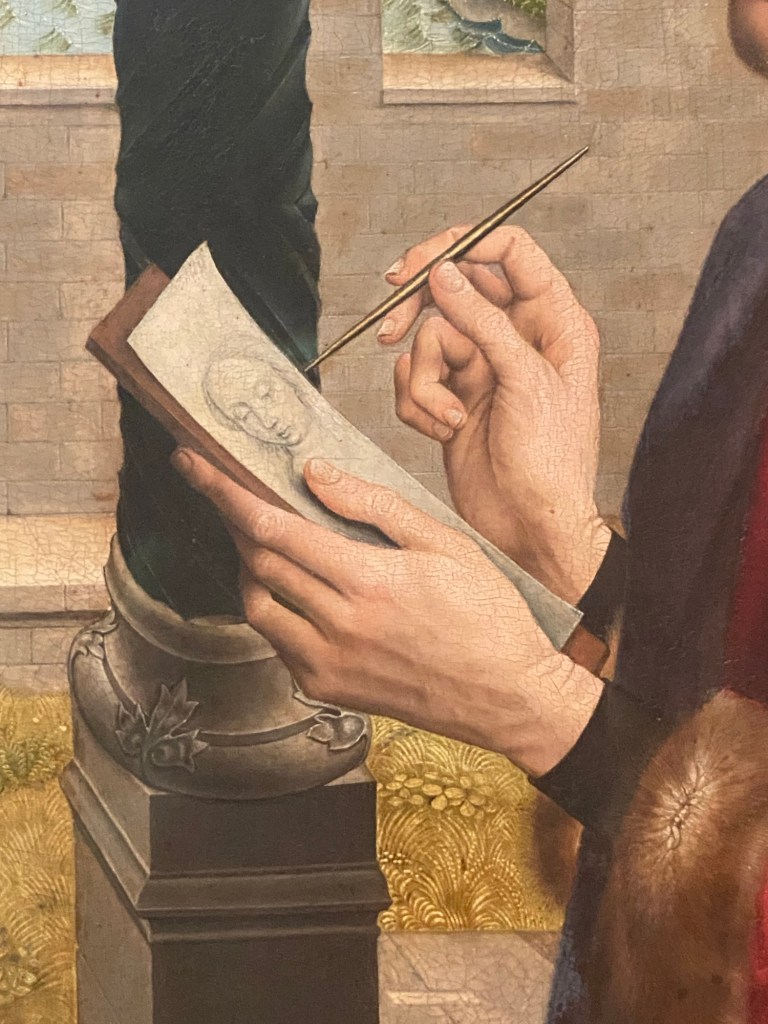
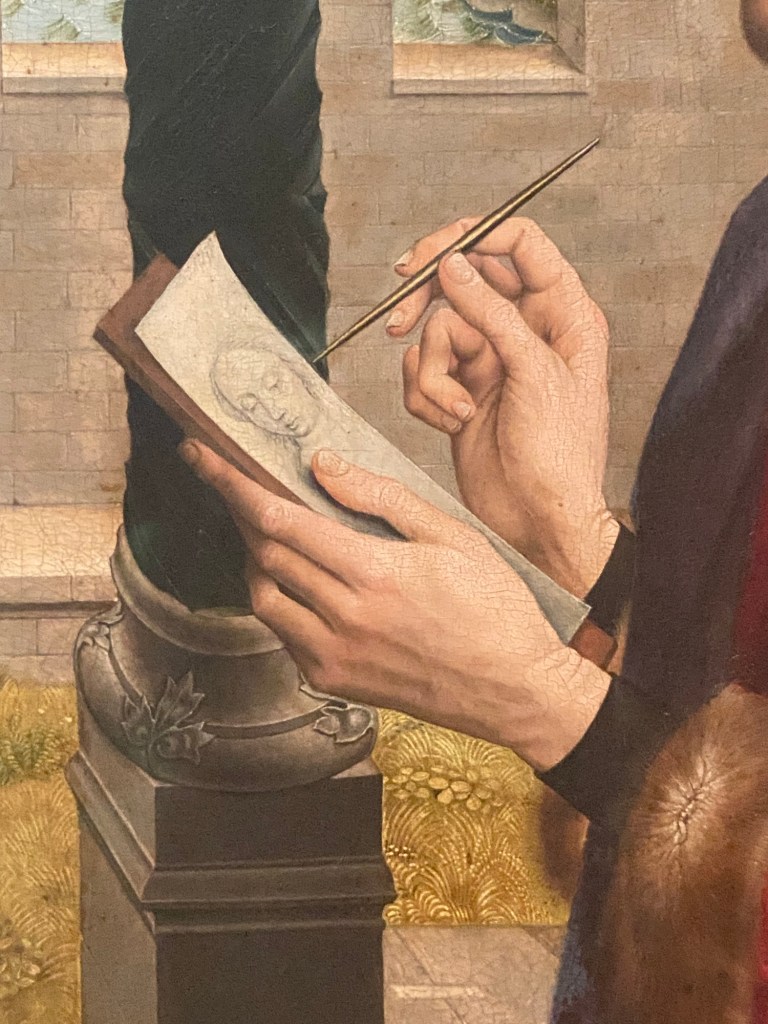
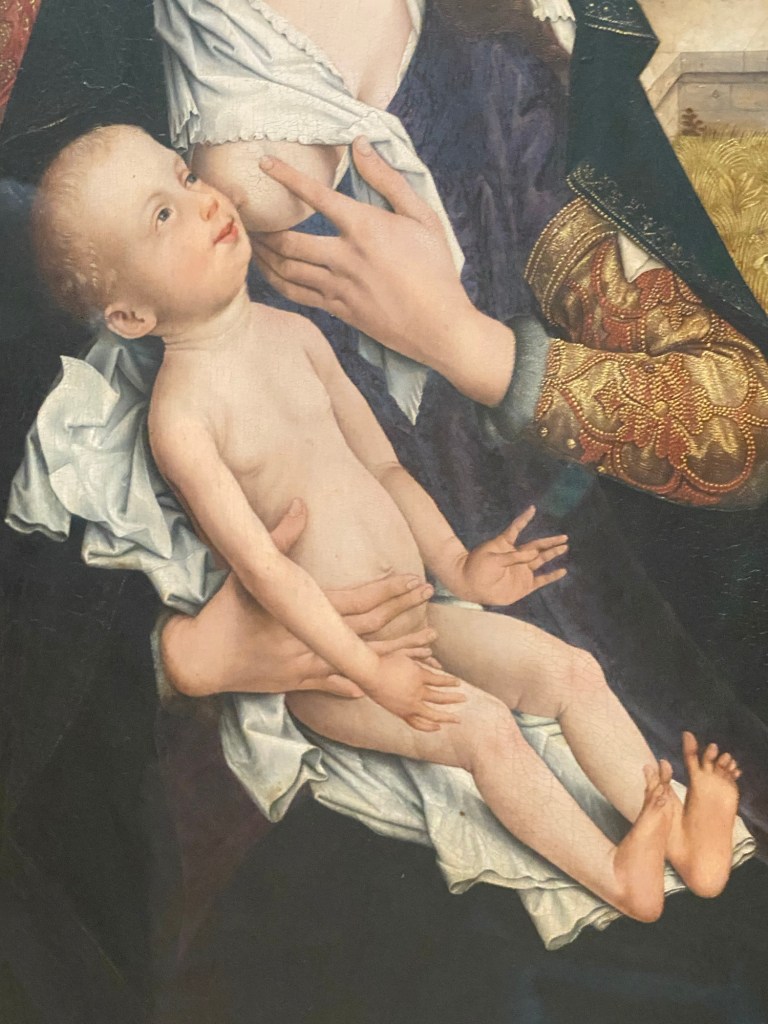
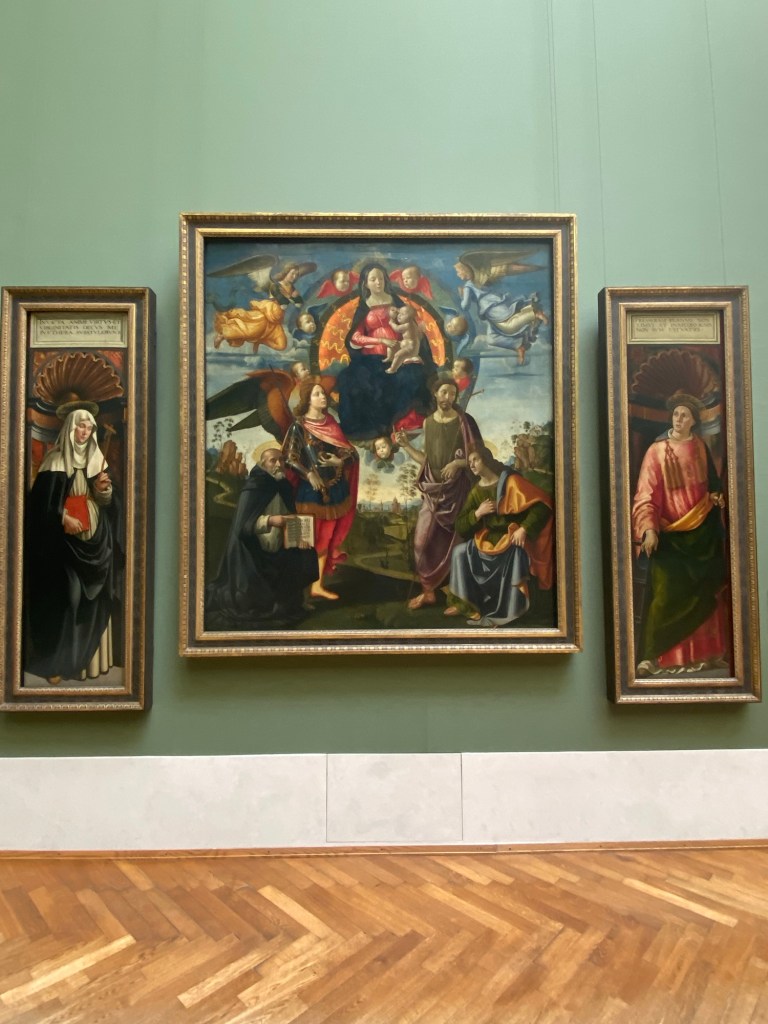
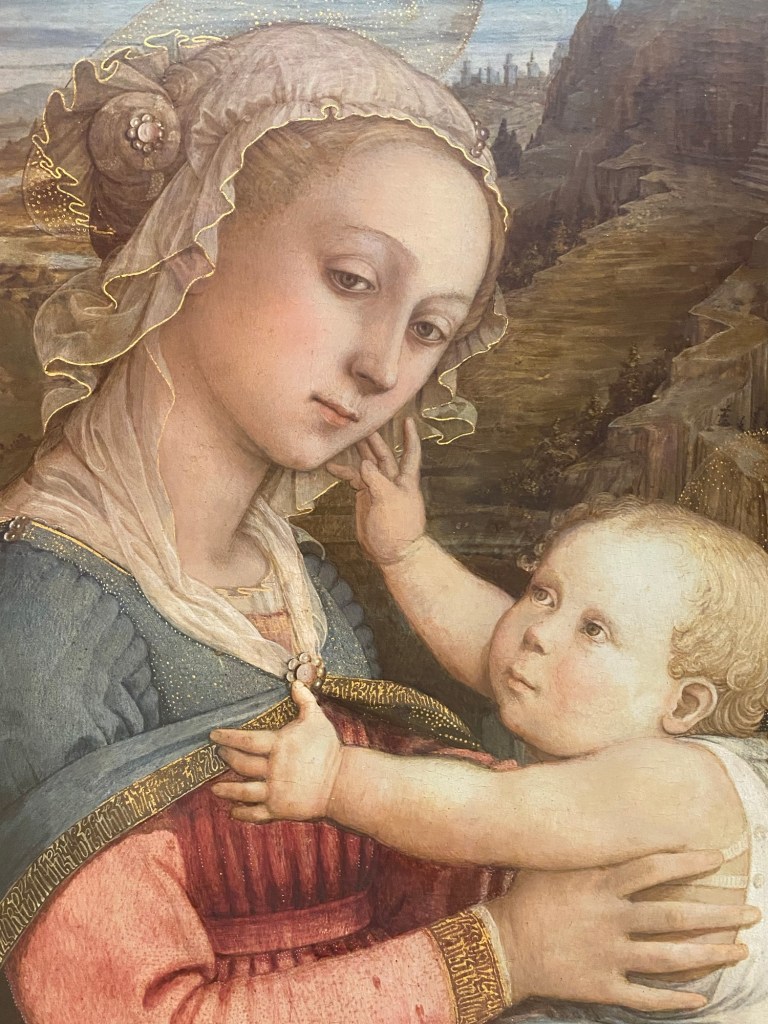
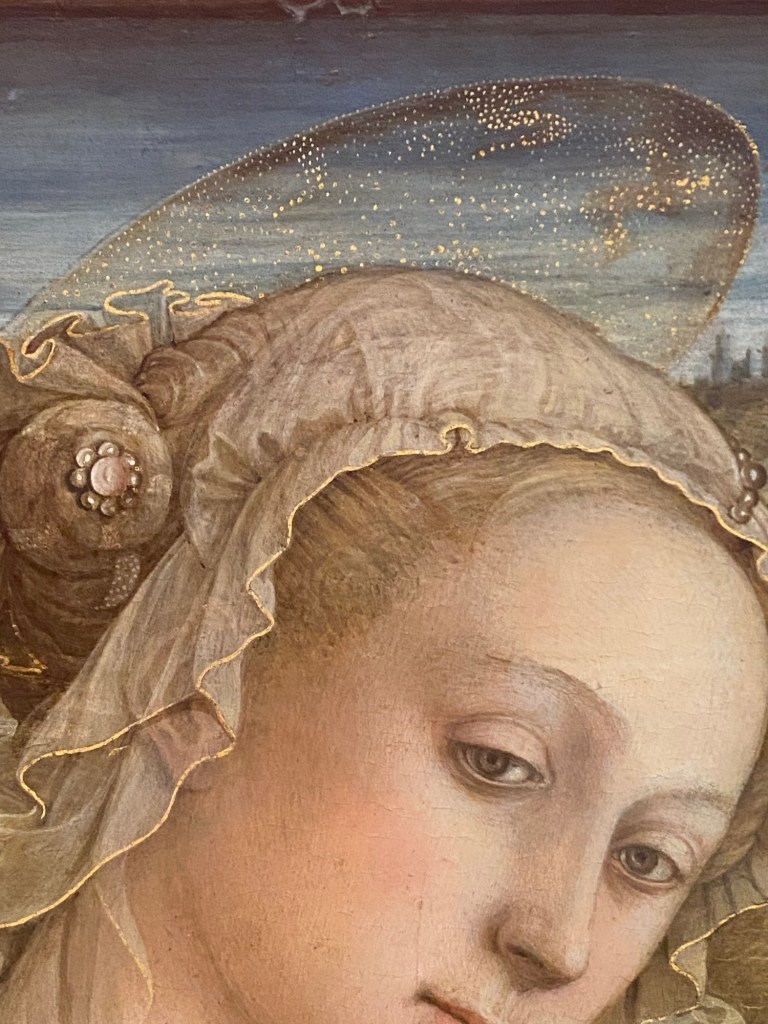
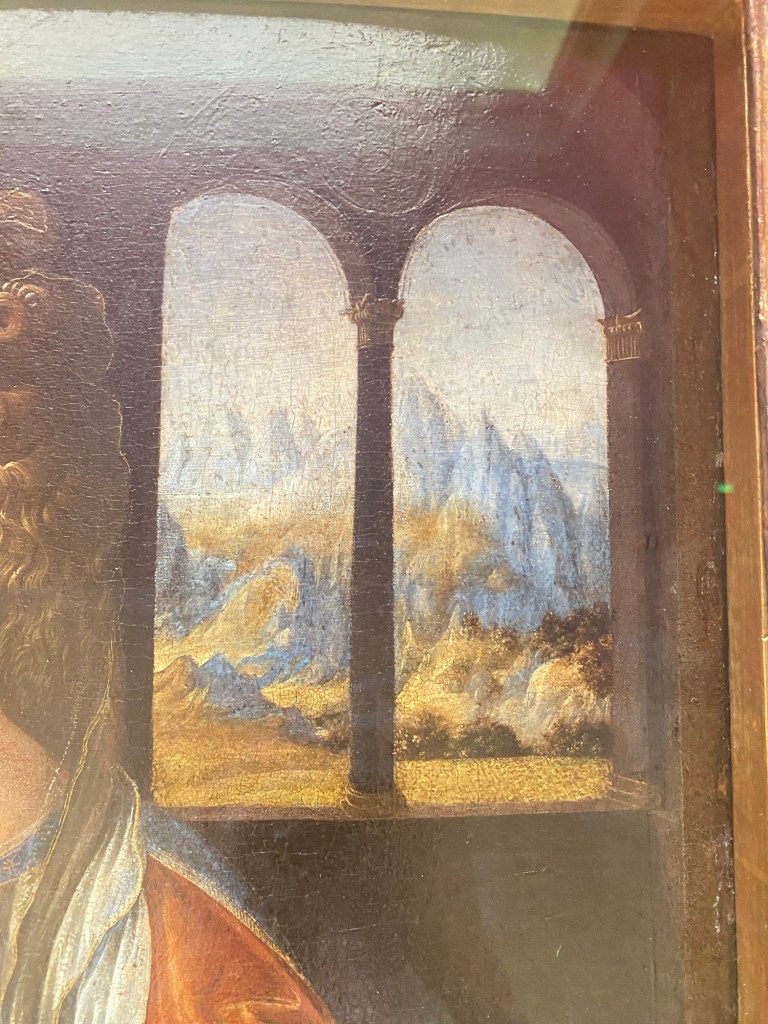
I love the subject of this painting. St Luke is the patron saint of the guilds of painting because according to legend, he painted the portrait of the Virgin Mary. This rendition is very interesting to me.
I saw this cool sight in Munich today. It was a hot summer day and I felt the coolness from the water as I stood watching from the bridge above. It was a pleasant relief, and a fun sight!
The waves on the Eisbach river at the entrance to the Englischer Garten attract surfers and onlookers from around the world. The spot is famous throughout the world for being the largest, best and most consistent city centre location for river surfing. People have been surfing here for 40 years.
By the way: in 2024, the Eisbachwelle was voted one of the top 100 most beautiful beaches in the world. This is the only ranking in Germany and ahead of Ipanema beach.
The man-made Eisbach river emerges from underground just a few steps away from the Haus der Kunst (art gallery) on Prinzregentenstrasse in the Lehel district. A stone step at the outlet generates a standing wave about half a metre tall.
The Eisbach is a 1.2-mile river that flows across the Englischer Garten, a public park located in Munich, Germany.
Despite being a small distributary of the Isar River, the Eisbach features a very fast stream, making surfing a reality in an inland city.
The Eisbach wave is a stationary, human-made wave located just 50 yards away from the Haus der Kunst modern and contemporary art museum in front of a nearby bridge.
The standing wave breaks in cold, 15-inch ( deep and 40-foot wide waters.
The surfing conditions at Eisbach vary depending on the weather and the time of the year, but it could produce a solid three-to-four-foot wave.
The best time of the year to ride Germany’s quintessential river wave is from March to November when water levels are not too high and not too low.
The average water temperature ranges from 62 °F in summer to 50 °F in winter.
Eisbach means “icy creek” or “ice brook” in English.
Although the Eisbach River wave rarely freezes due to its strong currents, it can easily reach extremely low temperatures of around 34 °F.
On August 13, 2024 I had my first chance to visit this august institution. Something happened then that in my lifetime of working in and visiting art museums all around the world has fortunately never happened. An alarm went off and the guards ushered all of the visitors down the staircases and out the door, all the while telling us not to panic.
The 100 or so of us visitors gathered in the shade of trees on the large lawn in front of the museum. It was a very hot day in Munich.
Soon firetrucks arrived and these brave men entered the building and apparently swept it, finding no real reason for the alarm, I guess, for within 15 minutes, they let us all enter the building again and continue our enjoyment of the collections.
This was a first and it made me realize how lucky we are in general to take safety for granted when visiting an art museum, no matter where in the world it is. I hope it remains that way.
As an aside, there is no country other than mine, the US or Germany, that I would hope to be in in such a situation. The museum personnel and firemen handled this situation with aplomb.
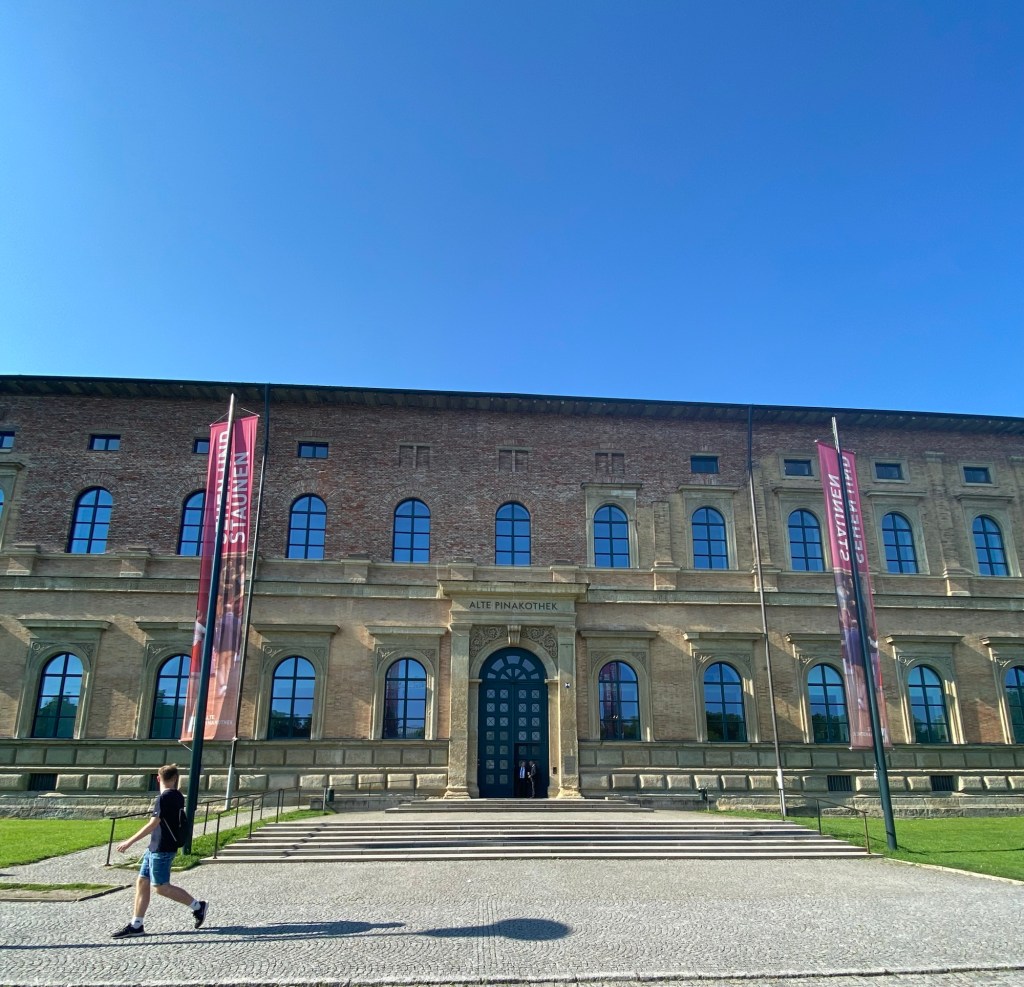
I made a beeline for this museum once I had settled into Munich. Wow oh wow, it did not disappoint!
Above, the south facade of the museum.
Before I post on the collection and what caught my eye and imagination, I want to give a little context about this great Bavarian museum. Wikipedia to the rescue as always.
The Alte Pinakothek is an art museum located in the Kunstareal area in Munich It is one of the oldest galleries in the world and houses a significant collection of Old Master paintings. The name Alte (Old) Pinakothek refers to the time period covered by the collection—from the 14th to the 18th century. The Neue Pinakothek, re-built in 1981, covers 19th-century art, and Pinakothek der Moderne, opened in 2002, exhibits modern art. All three galleries are part of the Bavarian State Painting Collections, an organization of the Free state of Bavaria.
King Ludwig I of Bavaria ordered Leo von Klenze to erect a new building for the gallery for the Wittelsbach collection in 1826. When built, the Alte Pinakothek was the largest museum in the world and structurally and conceptually advanced through the convenient accommodation of skylights for the galleries. Even the Neo-Renaissance exterior of the Pinakothek clearly stands out from the castle-like museum type common in the early 19th century. It is closely associated with the function and structure of the building as a museum. Very modern in its day, the building became exemplary for museum buildings in Germany and in Europe after its inauguration in 1836, and thus became a model for new galleries like the Hermitage Museum in Saint Petersburg, and galleries in Rome, Brussels and Kassel.
The museum building was severely damaged by bombing in World War II but was reconstructed and reopened to the public on 7 June 1957. Director Ernst Buckner oversaw the rebuilding project, ensuring that the building remained true to its original architecture. The ornate, pre-war interior, including the large loggia facing the south façade in the upper floor, was not restored.
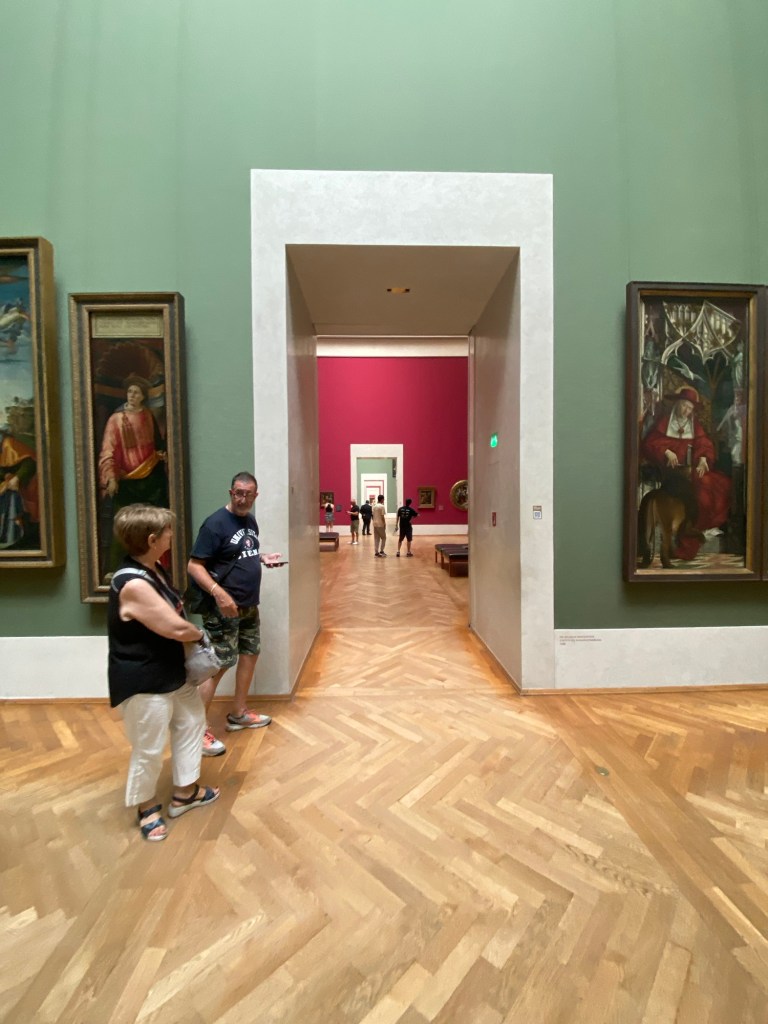
A new wall covering system was created in 2008 for the rooms on the upper floor of the museum with a woven and dyed silk from Lyon. The new color scheme of green and red draws on the design of the rooms dating back to the time of construction of the museum, and was predominant until the 20th century. Already for King Ludwig I and his architect Leo von Klenze, the use of a wall covering alternately in red and green represented the continuation of a tradition that dates back to the exhibition of the old masters of the late 16th century in many of the major art galleries of Europe (Florence, London, Madrid, St. Petersburg, Paris, Vienna).
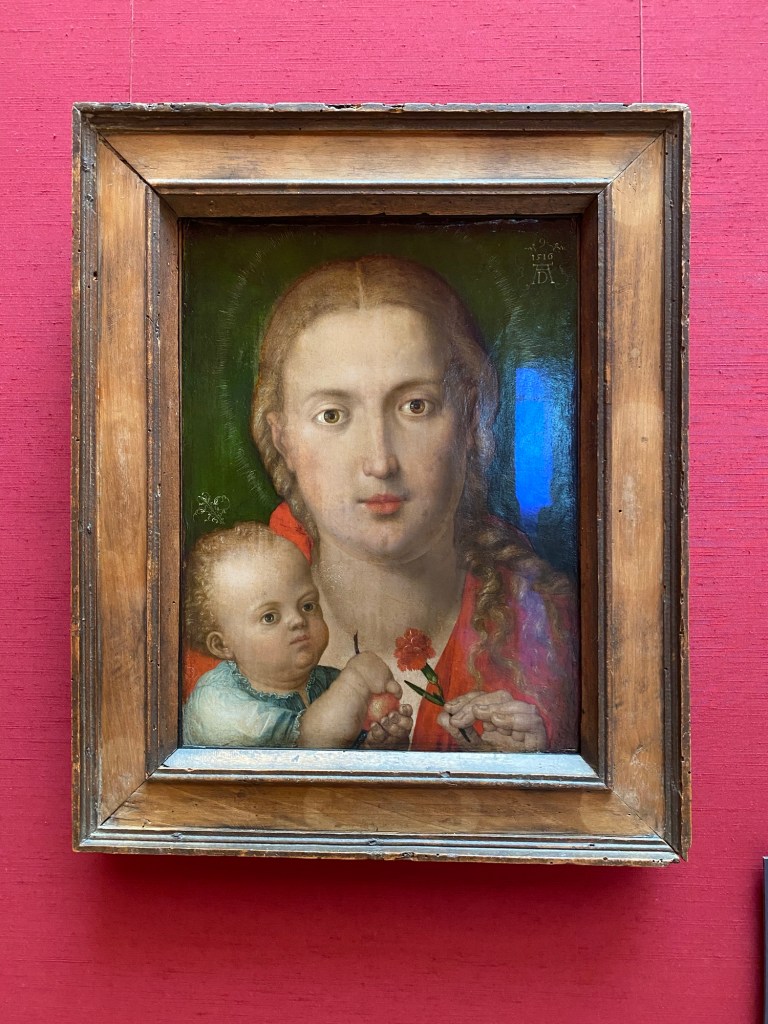
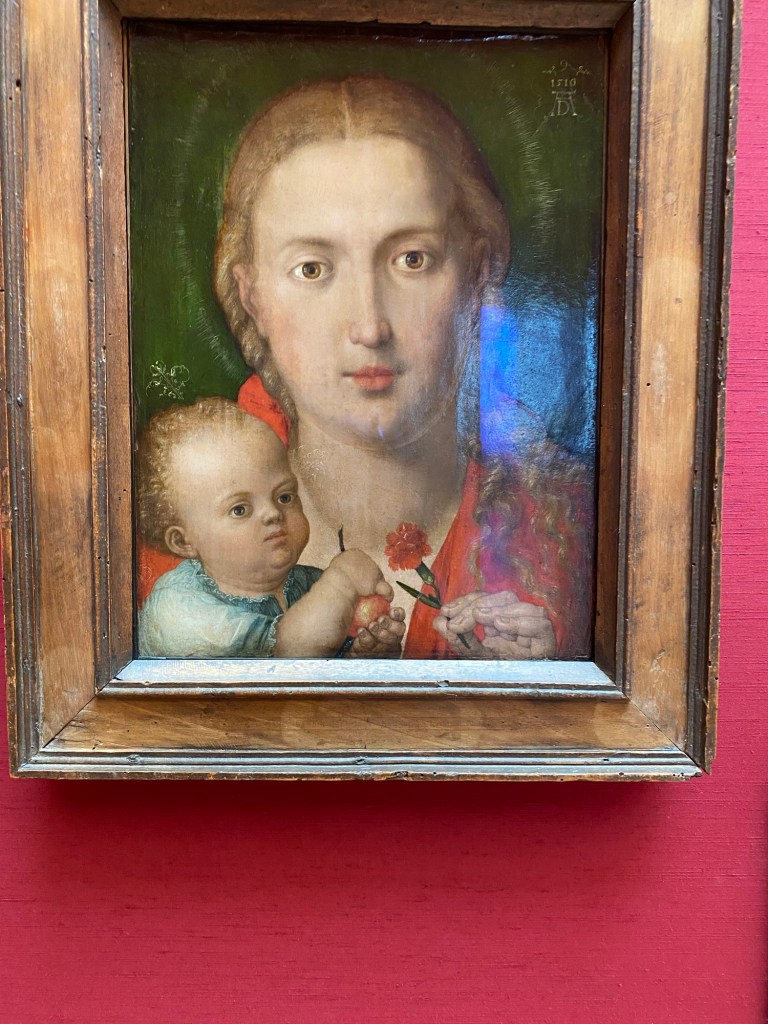
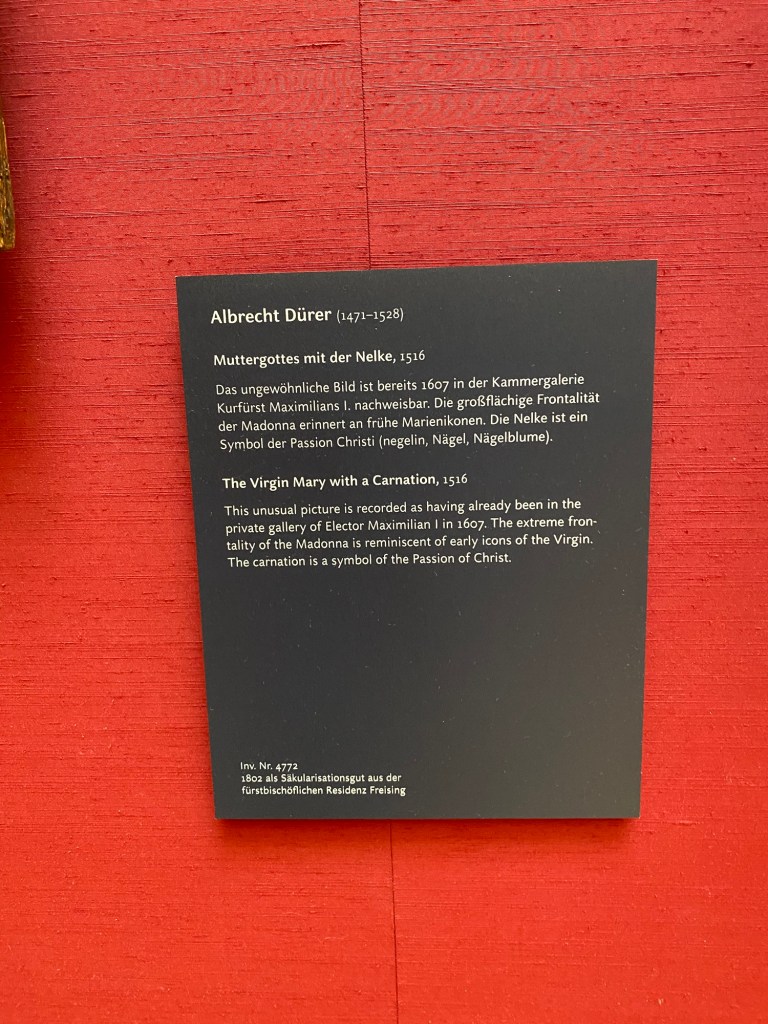
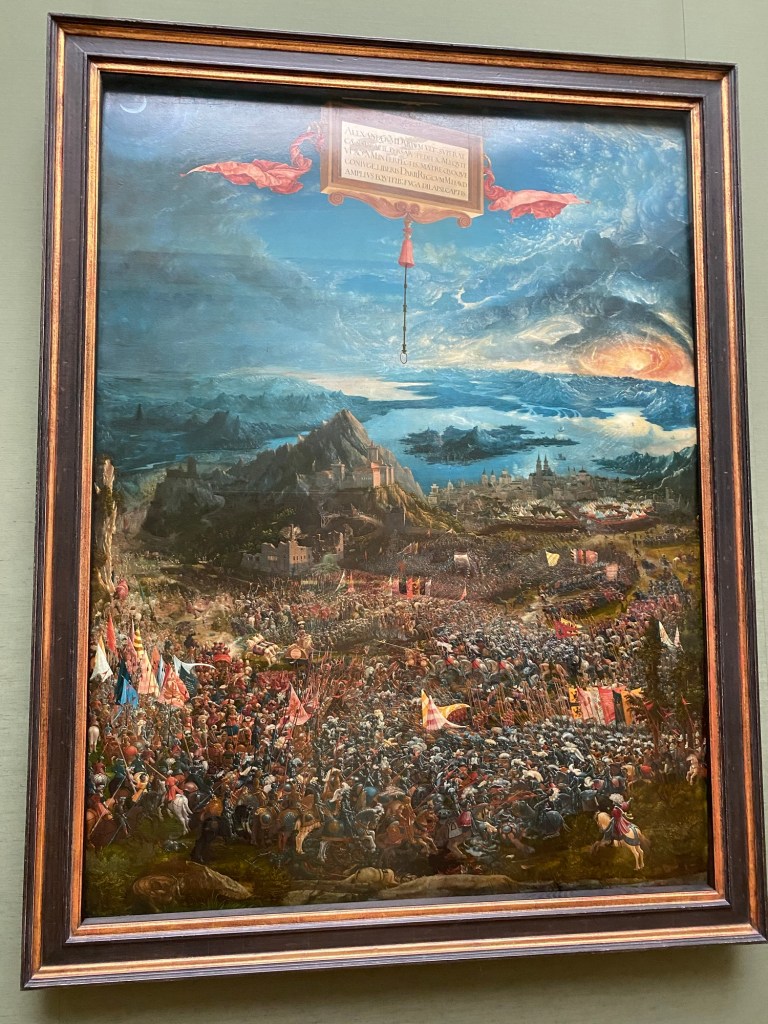
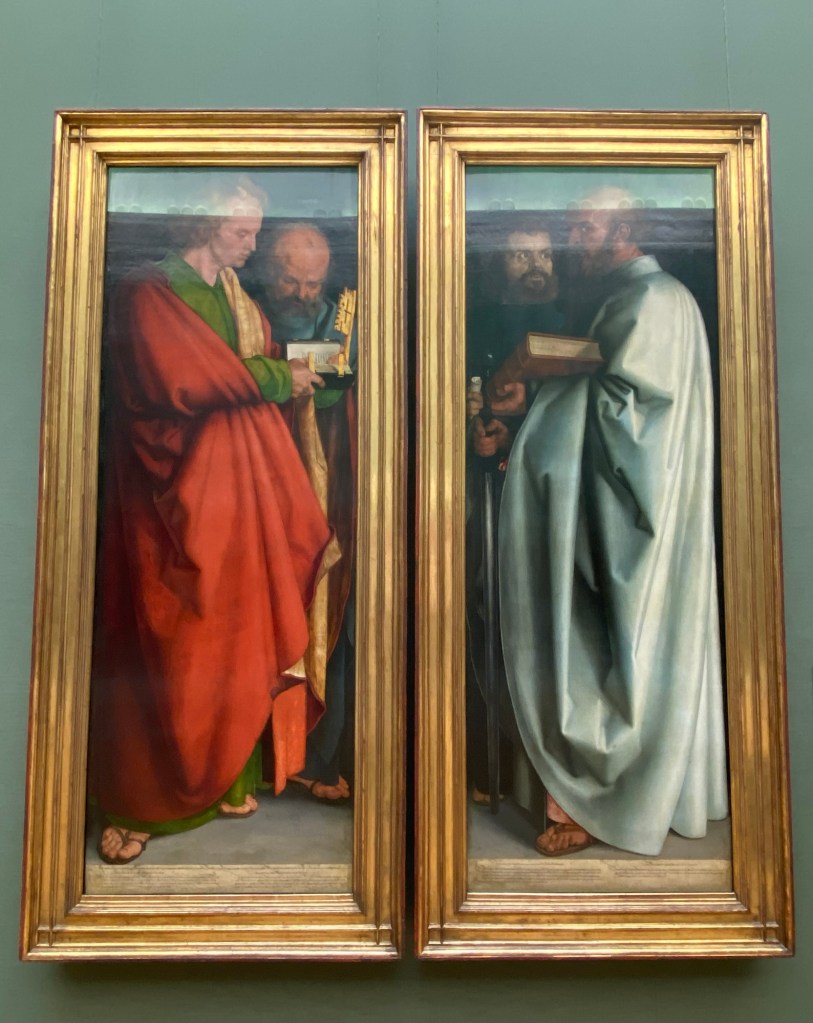
The Wittelsbach collection was begun by Duke Wilhelm IV (1508–1550) who ordered important contemporary painters to create several history paintings, including The Battle of Alexander at Issus of Albrecht Altdorfer. Elector Maximilian I (1597–1651) commissioned in 1616 four hunt paintings from Peter Paul Rubens and acquired many other paintings, especially the work of Albrecht Dürer. He even obtained The Four Apostles in the year 1627 due to pressure on the Nuremberg city fathers. A few years later however 21 paintings were confiscated and moved to Sweden during the occupation of Munich in the Thirty Years war. Maximilian’s grandson Maximilian II Emanuel (1679–1726) purchased a large number of Dutch and Flemish paintings when he was Governor of the Spanish Netherlands. He bought, for example, in 1698 from Gisbert van Colen 12 pictures of Peter Paul Rubens and 13 of Van Dyck, with the pictures of Rubens from the personal estate of the artist which the artist had never intended for to be sold.
The Elector’s cousin, Johann Wilhelm, Elector Palatine (1690–1716), collected Netherlandish paintings. He ordered from Peter Paul Rubens The Big Last Judgment and received Raphael’s Canigiani Holy Family as a dowry of his wife. Charles Theodore, Elector of Bavaria (1742–1799) had a strong preference for Netherlandish paintings as well, among other paintings he acquired Rembrandt’s The Holy Family. By the late 18th century, a large number of the paintings were displayed in Schleissheim Palace, and accessible to the public.
After the reunion of Bavaria and the Electorate of the Palatinate in 1777, the galleries of Mannheim, Düsseldorf and Zweibrücken were moved to Munich, in part to protect the collections during the wars which followed the French revolution. At least 72 paintings including The Battle of Alexander at Issus were taken to Paris in 1800 by the invading armies of Napoleon I; Napoleon was a noted admirer of Alexander the Great. The Louvre held it until 1804, when Napoleon declared himself Emperor of France and took it for his own use. When the Prussians captured the Château de Saint-Cloud in 1814 as part of the War of the Sixth Coalition, they supposedly found the painting hanging in Napoleon’s bathroom.Most of the paintings have not been returned.
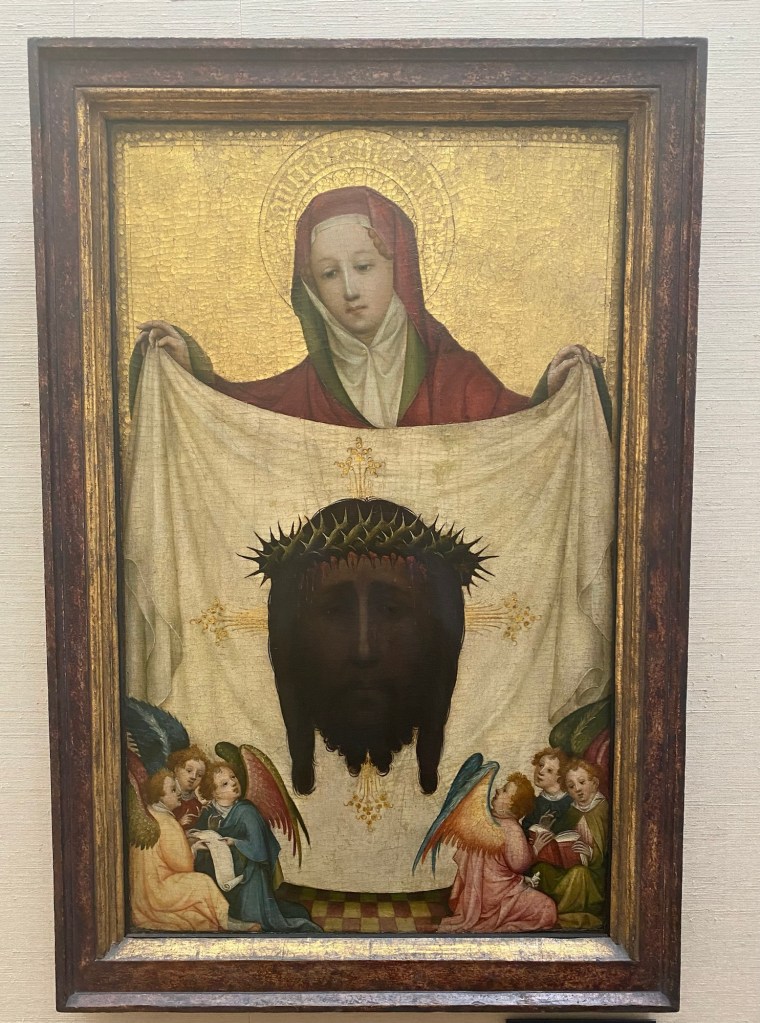
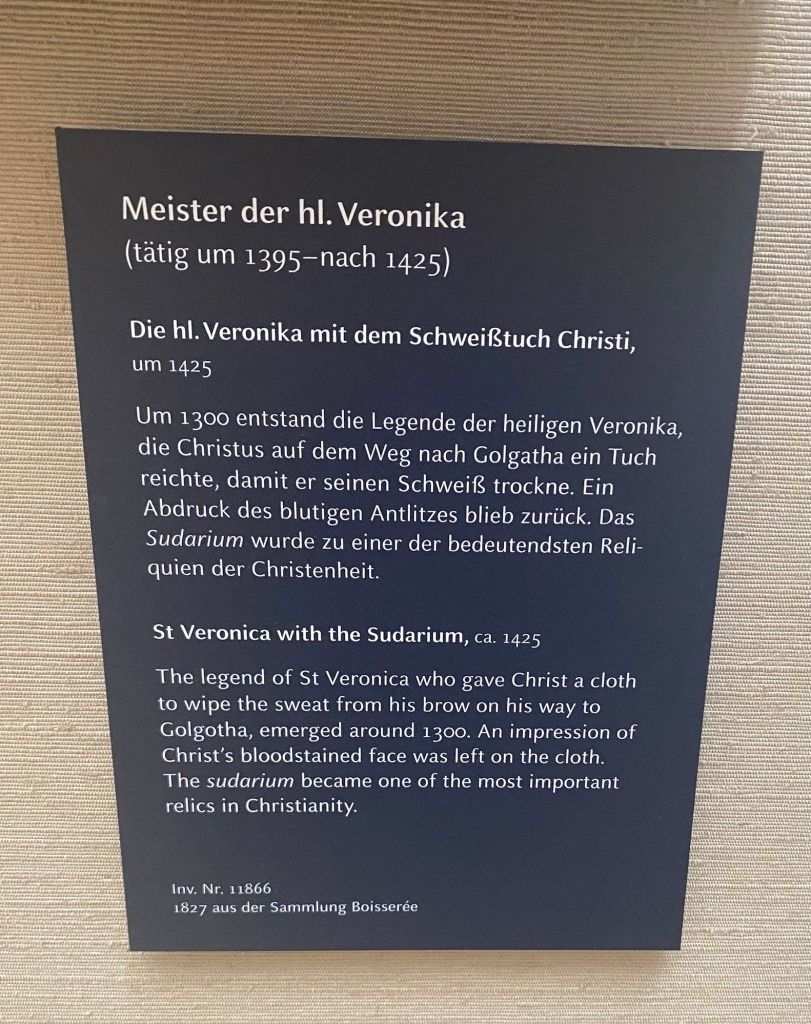
With the secularisation many paintings from churches and former monasteries entered into state hands. King Ludwig I of Bavaria collected especially Early German and Early Dutch paintings but also masterpieces of the Italian renaissance. In 1827 he acquired the collection Boisserée with 216 Old German and Old Dutch masters; in 1828, the king managed to also purchase the collection of the Prince Wallerstein, with 219 Upper German and Upper Swabian paintings. In 1838 Johann Georg von Dillis issued the first catalogue.
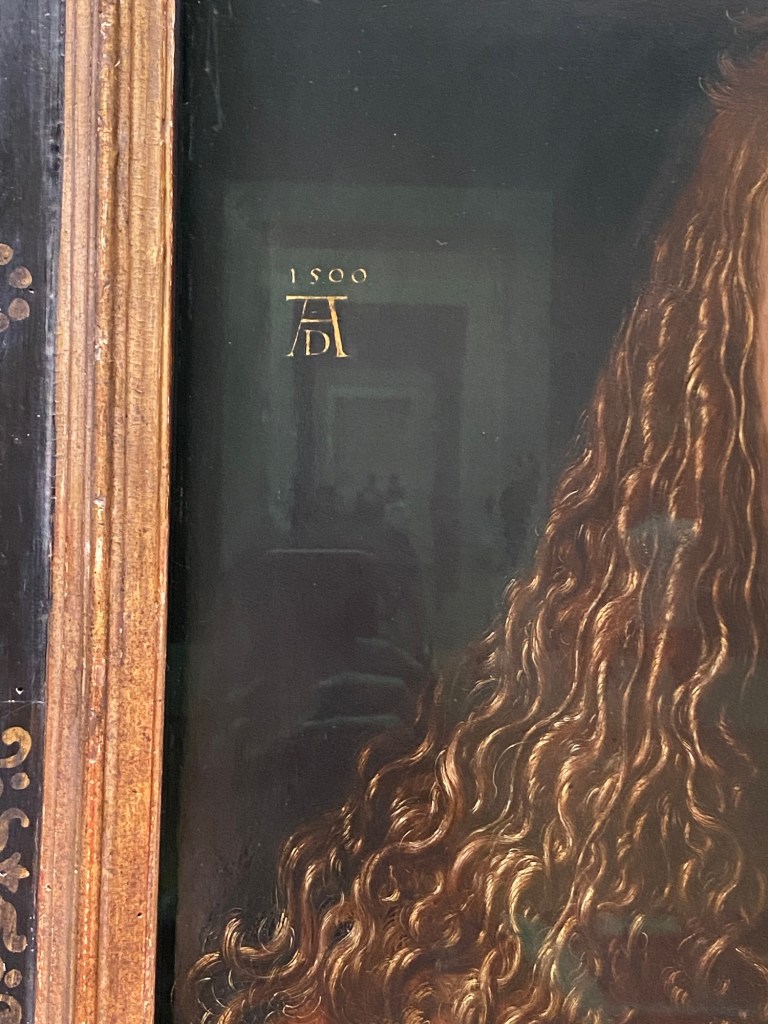
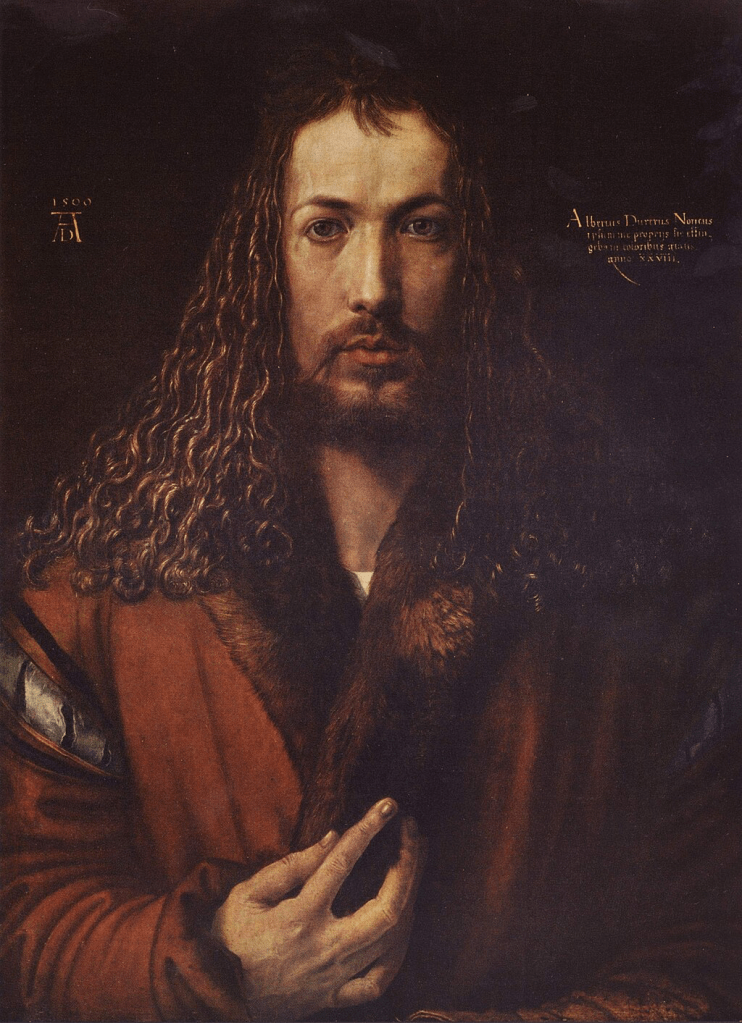
Durer’s Self-Portrait
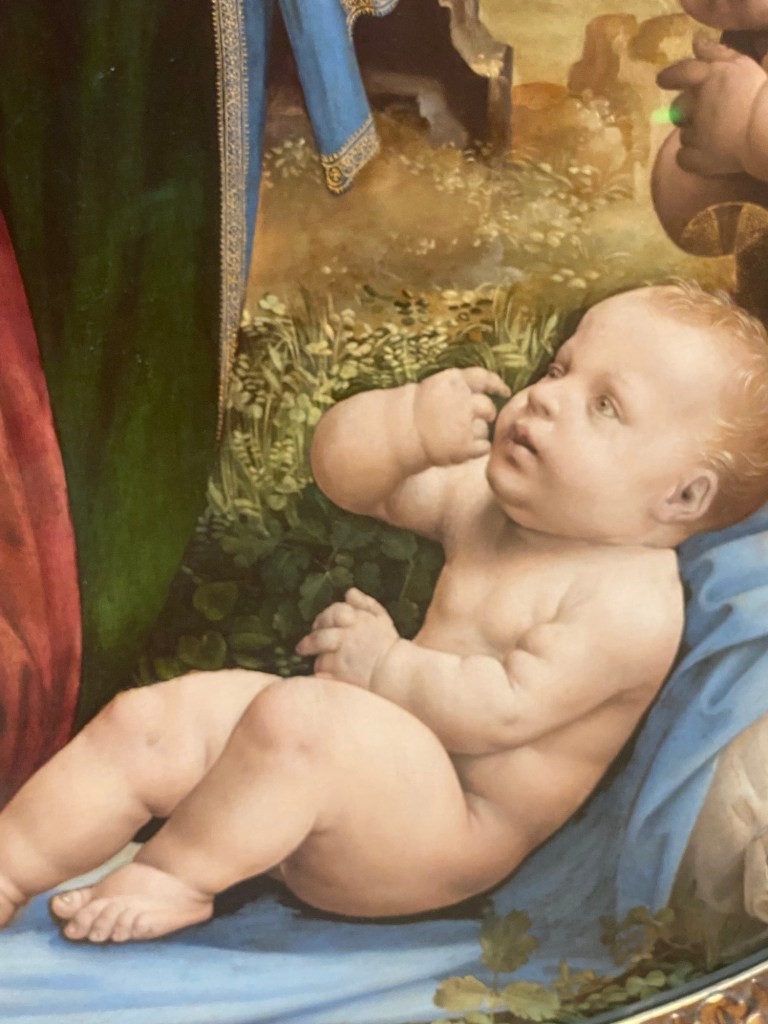
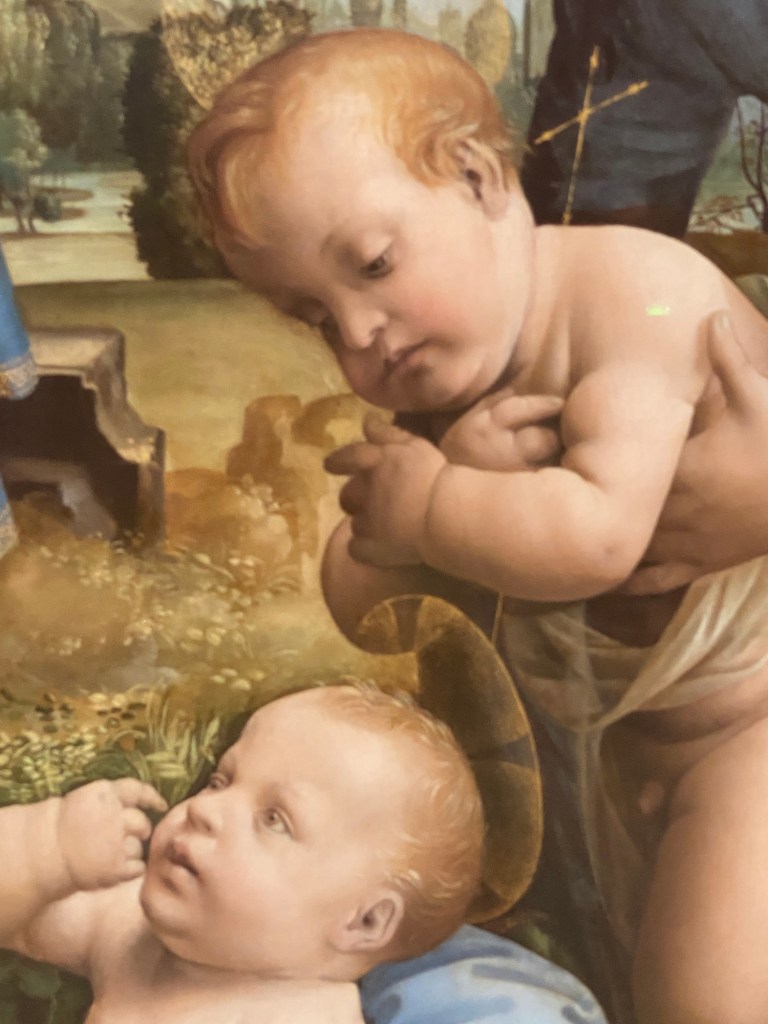
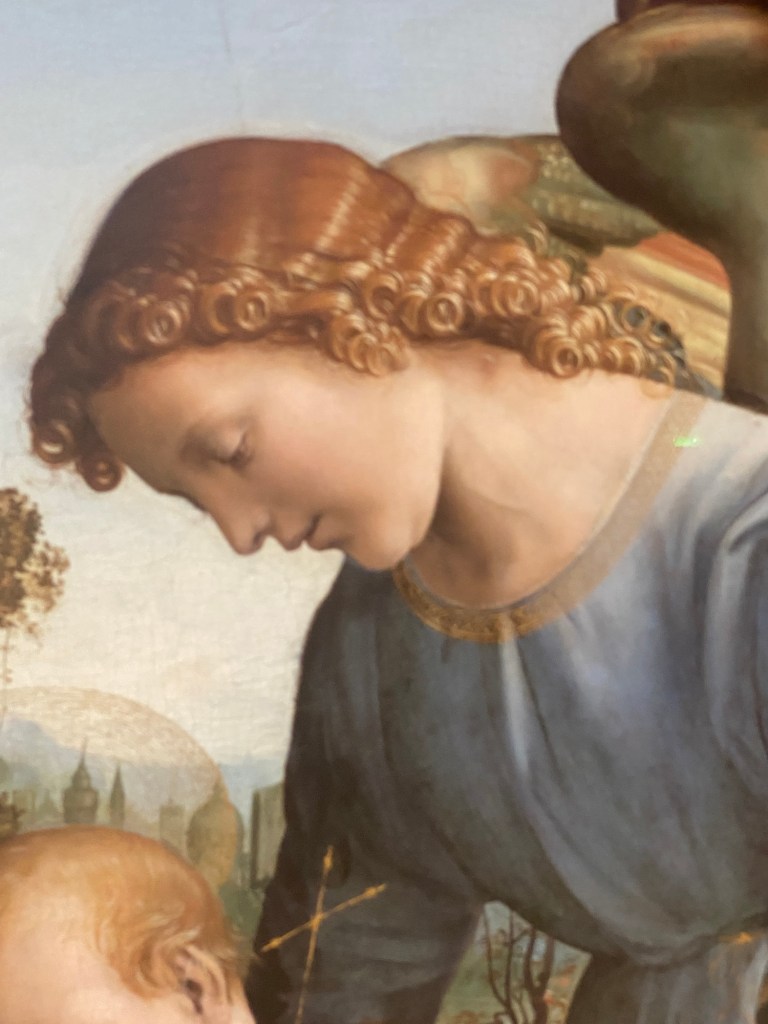
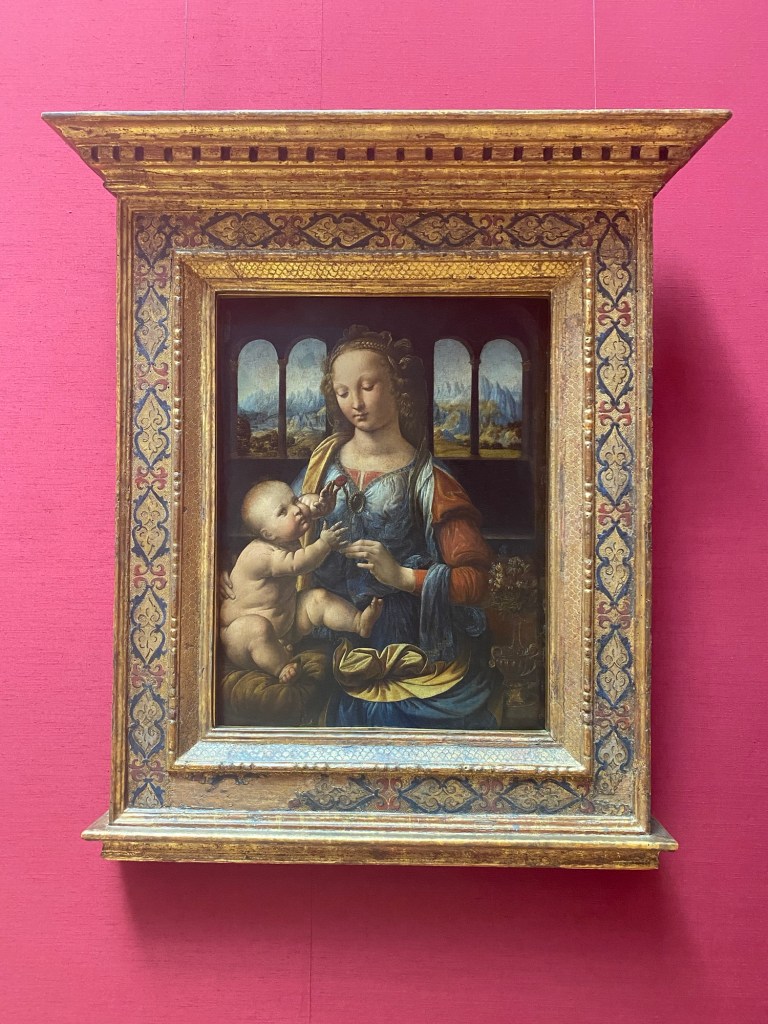
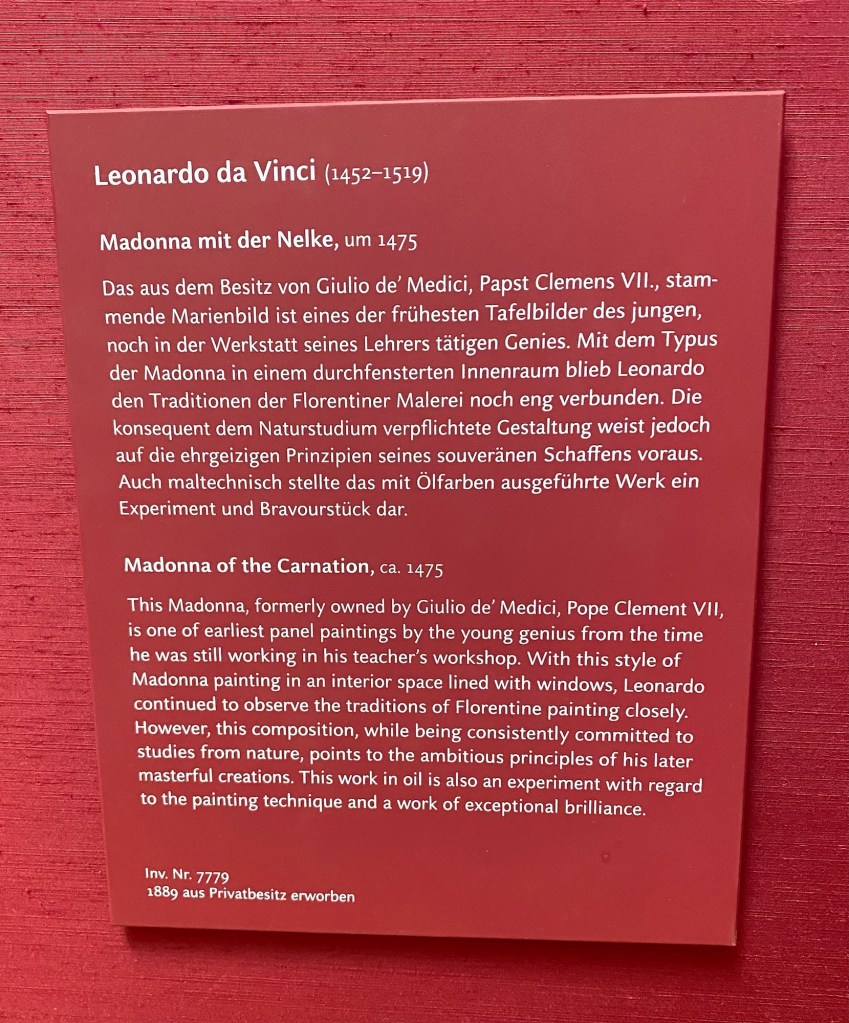
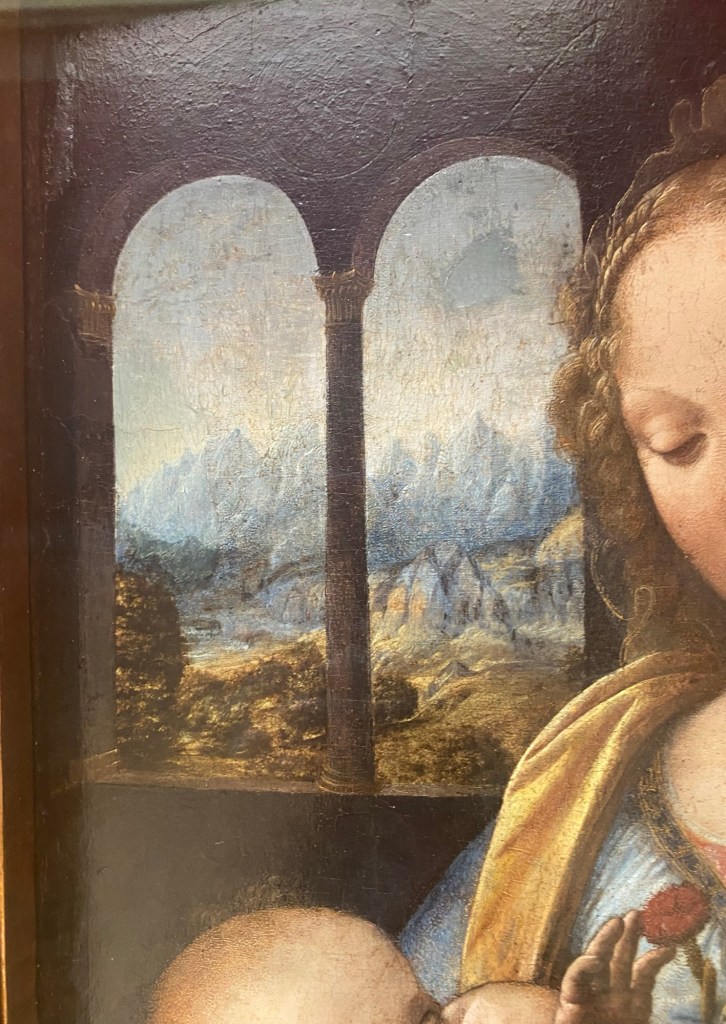
After the times of King Ludwig I the acquisitions almost ended. Only from 1875 the directors Franz von Reber and Hugo von Tschudi secured important new acquisitions, such as the Madonna of the Carnation of Leonardo da Vinci and The Disrobing of Christ of El Greco.
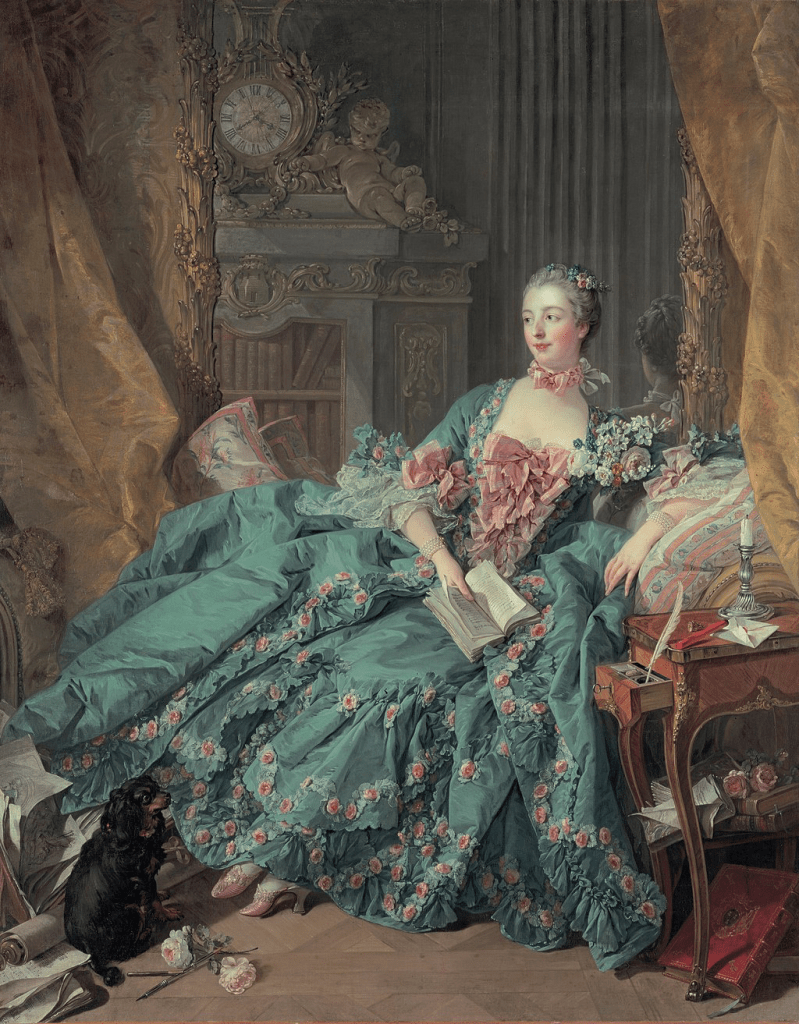
The predilection of the Wittelsbach rulers for some painters made the collection quite strong in those areas but neglected others. Since the 1960s the Pinakothek has filled some of these gaps: for example, a deficit of 18th-century paintings was addressed by the integration into the collection of works loaned from two Bavarian banks. Among these paintings were Nicolas Lancret’s The Bird Cage and François Boucher’s Madame Pompadour.
In April 1988, the serial vandal Hans-Joachim Bohlmann splashed acid on three paintings by Albrecht Dürer, namely Lamentation for Christ,Paumgartner Altar and Mater Dolarosa inflicting damage estimated at 35 million euros. In 1990 Dierick Bouts’ Ecce agnus dei was acquired.
On 5 August 2014, the museum rejected a request by a descendant of the banker Carl Hagen for the repatriation of Jacob Ochtervelt’s Das Zitronenscheibchen (The Lemon Slice) on the grounds that it had been unlawfully acquired as a result of Nazi persecution. An investigation by the museum established that it had been lawfully purchased at the time for a fair price and that the Hagen family’s interest extended only to a security on the painting.
The museum is under the supervision of the Bavarian State Painting Collections which also owns an expanded collection of several thousand European paintings from the 13th to 18th centuries. Especially its collection of Early Italian, Old German, Old Dutch and Flemish paintings is one of the most important in the world.
More than 800 of these paintings are exhibited at the Old Pinakothek. Due to limited space in the building, some associated galleries throughout Bavaria such as the baroque galleries in Schleissheim Palace and Neuburg Palace additionally have works by the Old Masters on display.
German paintings 14th–17th century: The Alte Pinakothek comes with the most comprehensive collection of German Old Masters worldwide
Early Netherlandish paintings 15th–16th century: One of the most impressive collections worldwide especially for Early Netherlandish paintings
Dutch paintings 17th–18th century: Due to the passion of the Wittelsbach rulers this section contains numerous exquisite paintings.
Flemish paintings 16th–18th century: The collection contains masterpieces of these painters
Italian paintings 13th–18th century: The Italian Gothic paintings are the oldest of the gallery and then all Schools of Italian Renaissance and Baroque Painting are represented
French paintings 16th–18th century: In spite of the close relationship of the Wittelsbachs to France it is the second smallest section of the collections
Spanish paintings, 16th–18th century: Though this is the smallest section, all major masters are represented
I’ll be posting about the incredible collections housed at the Bode soon, but I wanted to provide a little background on this fabulous museum.
As is often the case, I turned to Wikipedia for a succinct summary of the Bode Museum.
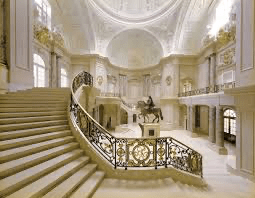
The Bode Museum, formerly called the Kaiser-Friedrich-Museum (Emperor Frederick Museum), is a listed building on the Museum Island in the historic centre of Berlin. It was built from 1898 to 1904 by order of German Emperor William II according to plans by Ernst von Ihne in Baroque Revival style. The building’s front square featured a memorial to German Emperor Frederick III, which was destroyed by the East German authorities. Currently, the Bode-Museum is home to the Skulpturensammlung, the Museum für Byzantinische Kunst and the Münzkabinett (sculpture, coins and medals, and Byzantine art). As part of the Museum Island complex, the Bode-Museum was inscribed on the UNESCO World Heritage List in 1999 because of its outstanding architecture and testimony to the development of museums as a cultural phenomenon in the late 19th and early 20th centuries. Again, not to mention it’s incredible collections.
Originally called the Kaiser-Friedrich-Museum after Emperor Frederick III, the museum was renamed in honor of its first curator, Wilhelm von Bode, in 1956.
During World War II, portions of the collection were stored in an antiaircraft tower called the Flakturm Friedrichshain for safe keeping. In May 1945, several fires destroyed some of the collections. In total, more than 400 paintings and about 300 sculptures were lost due to looting during the fire or destroyed in the fire itself.
The museum was closed for renovation from 1997 and was reopened on 18 October 2006, after a €156 million refurbishment. True to the ethos of its founding director, Wilhelm von Bode, who believed in mixing art collections, it is now the home for a collection of sculptures, Byzantine art, and coins and medals. The presentation of the collections is both geographic and chronological, with the Byzantine and Gothic art of northern and southern Europe displayed separately on the museum’s first floor and a similar regional division of Renaissance and Baroque art on its second floor.
The sculpture collection displays artwork of the Christian Orient (with an emphasis on Coptic Egypt), sculptures and mosaics from Byzantium and Ravenna, sculptures of the Middle Ages, the Italian Gothic, and the early Renaissance, including the controversial Flora attributed by Bode to Leonardo da Vinci but now widely argued to be a 19th-century work. Late German Gothic works are also represented by Tilman Riemenschneider, the south German Renaissance, and Prussian Baroque art up to the 18th century. In the future selected works of the Gemäldegalerie will be integrated into the sculpture collection. This is reminiscent of William von Bode’s concept of “style rooms,” in which sculptures, paintings, and crafts are viewed together, as was usual in upper middle-class private collections.
The Münzkabinett (“coin cabinet”) is one of the world’s largest numismatic collections. Its range spans from the beginning of minting in the 7th century BC in Asia Minor up to the present day. With approximately 500,000 items, the collection is a unique archive for historical research, while its medal collection also makes it an important art exhibition.
Writing in The Financial Times on the occasion on the museum’s reopening in 2006, Neil MacGregor, director of the British Museum, hailed “the most comprehensive display of European sculpture anywhere.” He added: “It is no exaggeration to say that in the new Bode Museum, Europe will be able for the first time to read its history — aesthetic and religious, intellectual and political — in a three-dimensional form.”


























 get back, lauretta!
You must be logged in to post a comment.