
You’ll just have to take my word for it. That was excellent panna cotta with berry sauce. :-))
You’ll just have to take my word for it. That was excellent panna cotta with berry sauce. :-))

No explanation needed for the above.
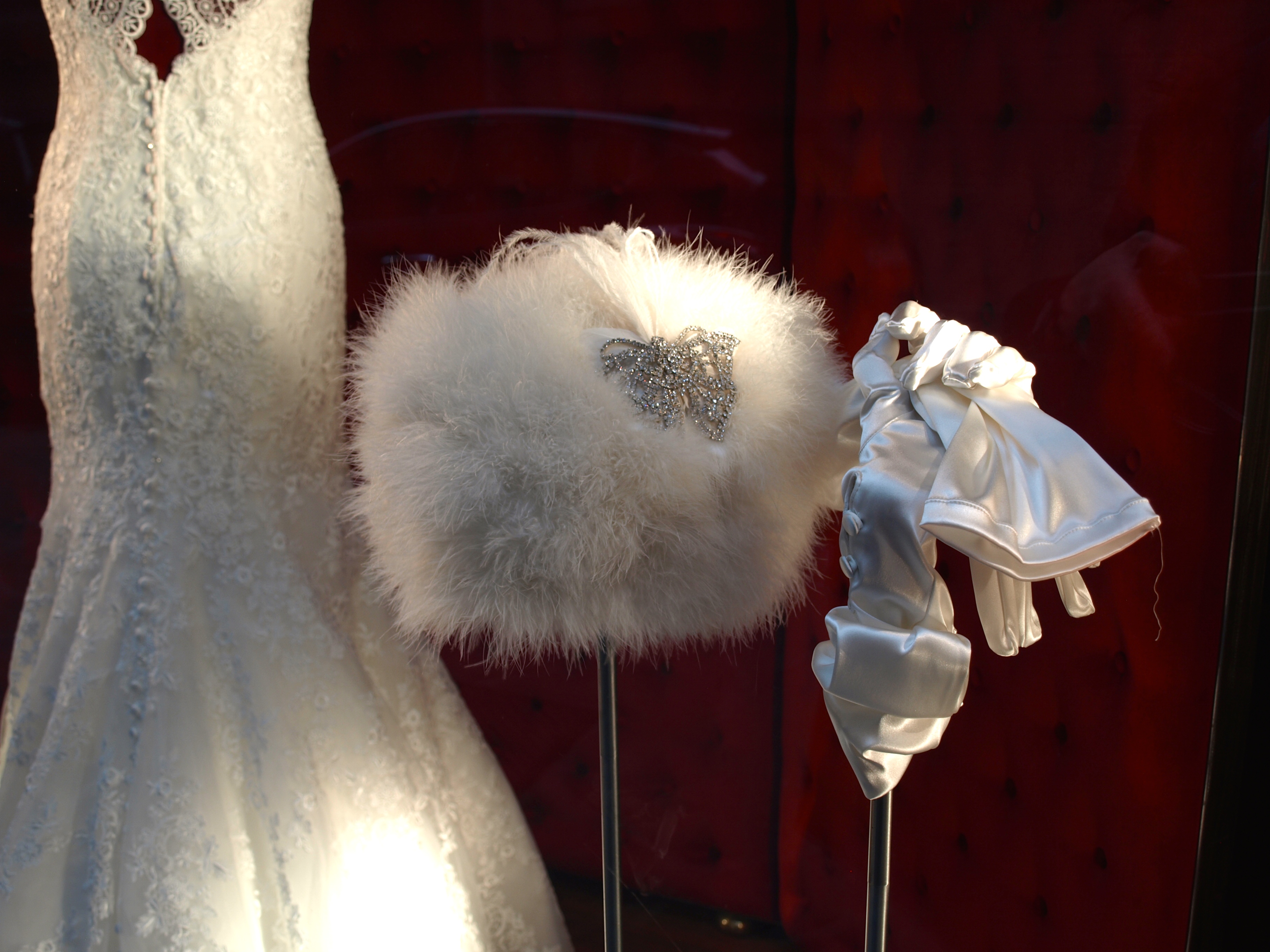

Elegant evidence of yesteryear from Florence.

These artists who dress like sculptures are all over the city. I found this one checking his phone and it was just such a funny sight, I whipped out my camera phone.

The Paperback Exchange wins my award for most creative Christmas tree. You can’t really see it clearly, but this tree is made out of books.

Luca della Robbia invented this polychromed terracotta medallion style during the High Renaissance. You can find the medallions all over Florence. This one could use a bath.
Strolling through the streets of Florence, there is no end of fascinating things to look at.


And I thought to myself how perfect these men looked and how, in the United States, you would never find mature men wearing such great, colorful shoes, and it made me happy all over again just to be in Italy!

The rest of us are just visiting.
But, we saved a good world for you.
Please take better care of it than we did.


Or, at least, that’s how it felt.
Walking along any of the major streets in Florence can be like surfing.
But it is what it is and I know that complaining about the incoming flack of Florence’s turisti is a waste of ink. No doubt it is unfolding just the way it is meant to unfold, but I can’t help feeling nostalgic for the Florence I remember from decades ago.
Back then, no store keeps spoke English. Now, no matter how try I hard to blend in and use my best Italian language skills, the storekeepers intuit immediately that I am American. If I persist and converse in Italian, these kind souls invariably praise my good Italian, which is just one more indication that the Italians are by nature a convivial and kind people because I promise you that my language skills are rudimentary at the very best!
The main reason Florence was chaotic with tourists today is because this is a major holiday weekend in Italy. Tomorrow night, the night of January 5, is Epiphany Eve, an extremely important feast day on the calendario cattolico. Although nowadays the American devotion to Santa Claus has a firm foothold in the winter holidays in Italy, traditionally it is La Befana, an old woman who rides a broom, who delivers gifts to Italian children. Many Italians have tomorrow off from work for the holiday. It’s all about the children as you can see today in the Piazza della Repubblica.
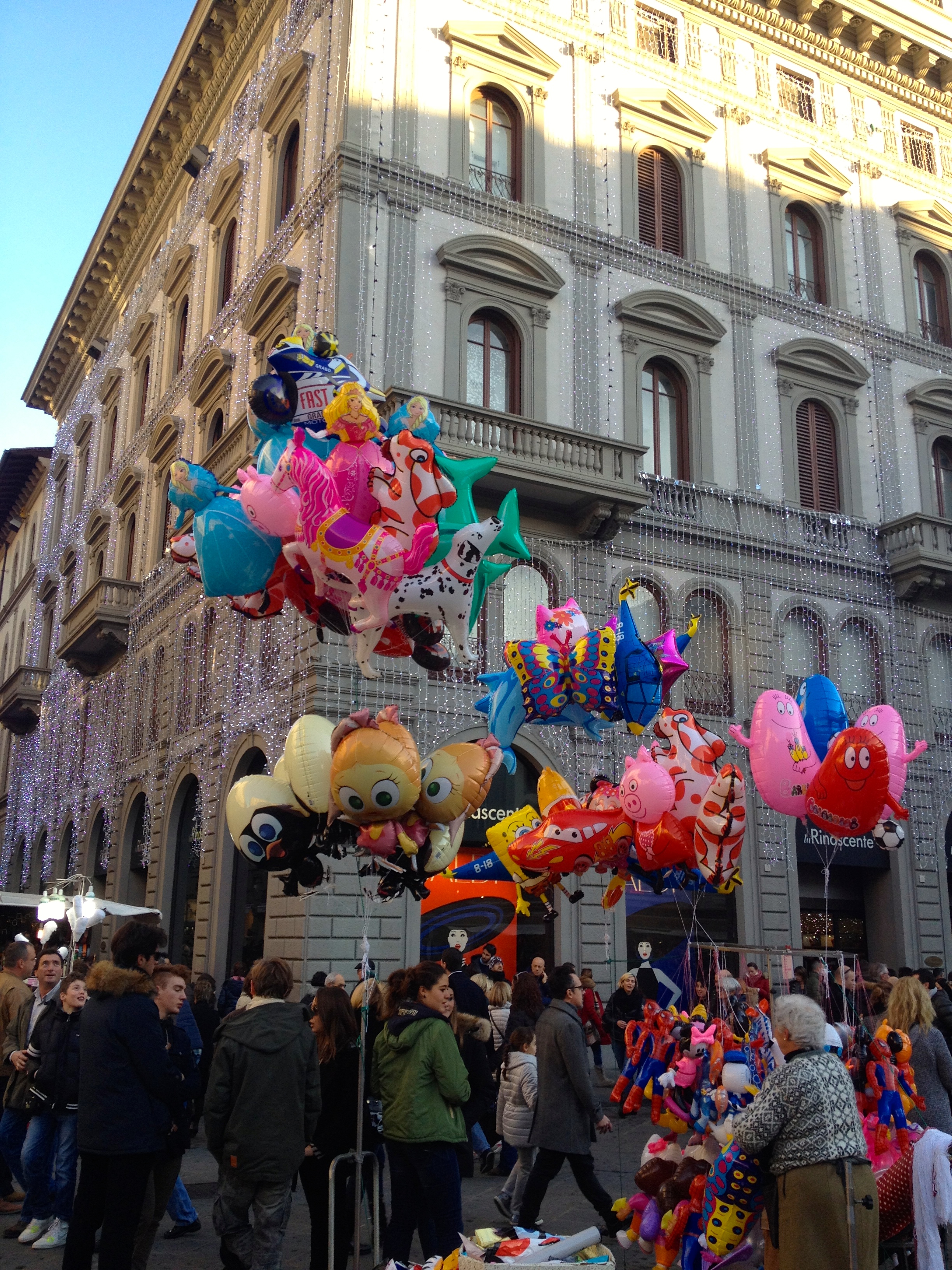
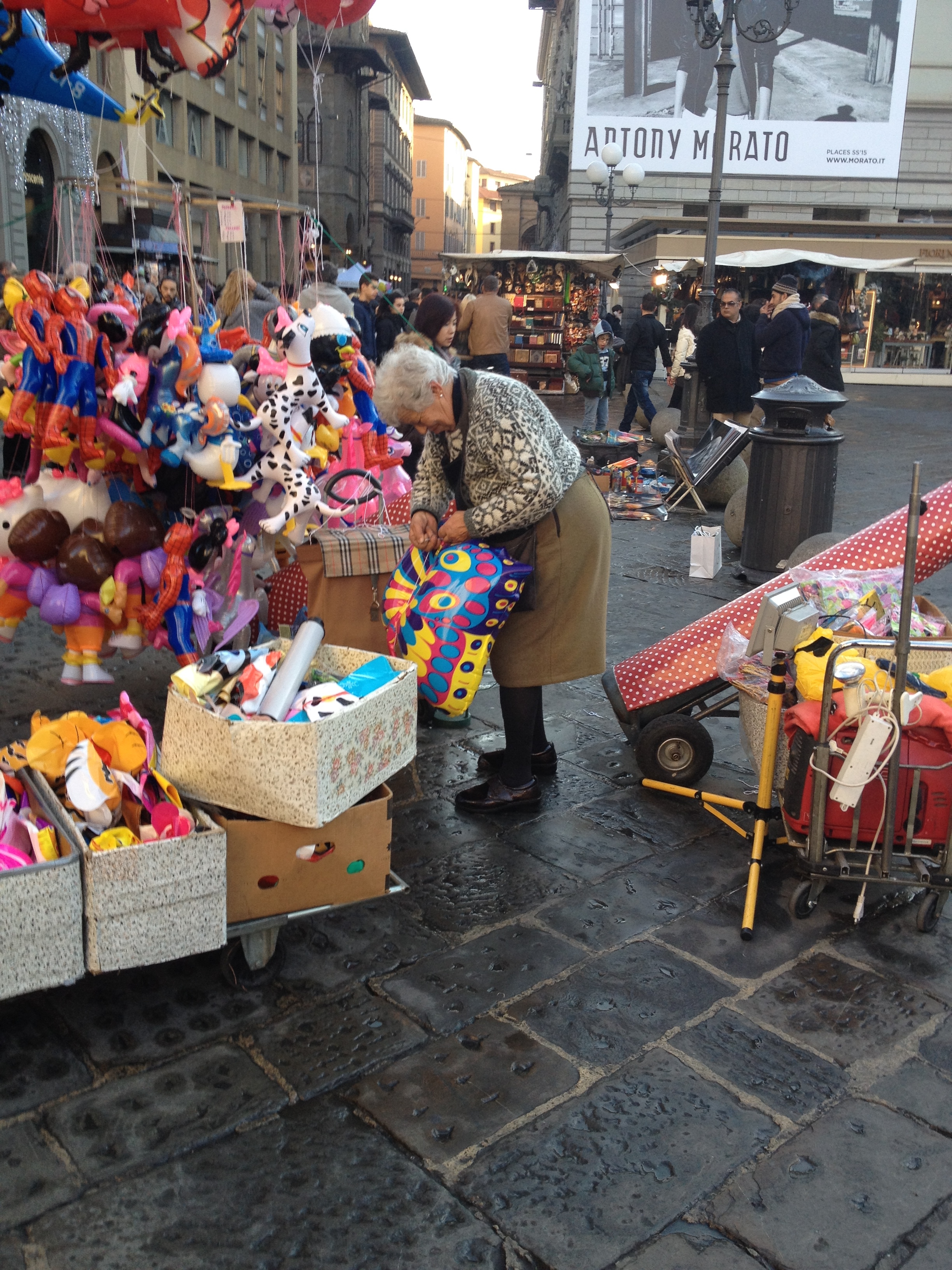
Of all the things I saw and felt on this beautiful day today in Florence, it was the vision of this nonna tying balloons to sell to the holiday makers that most captivated me.

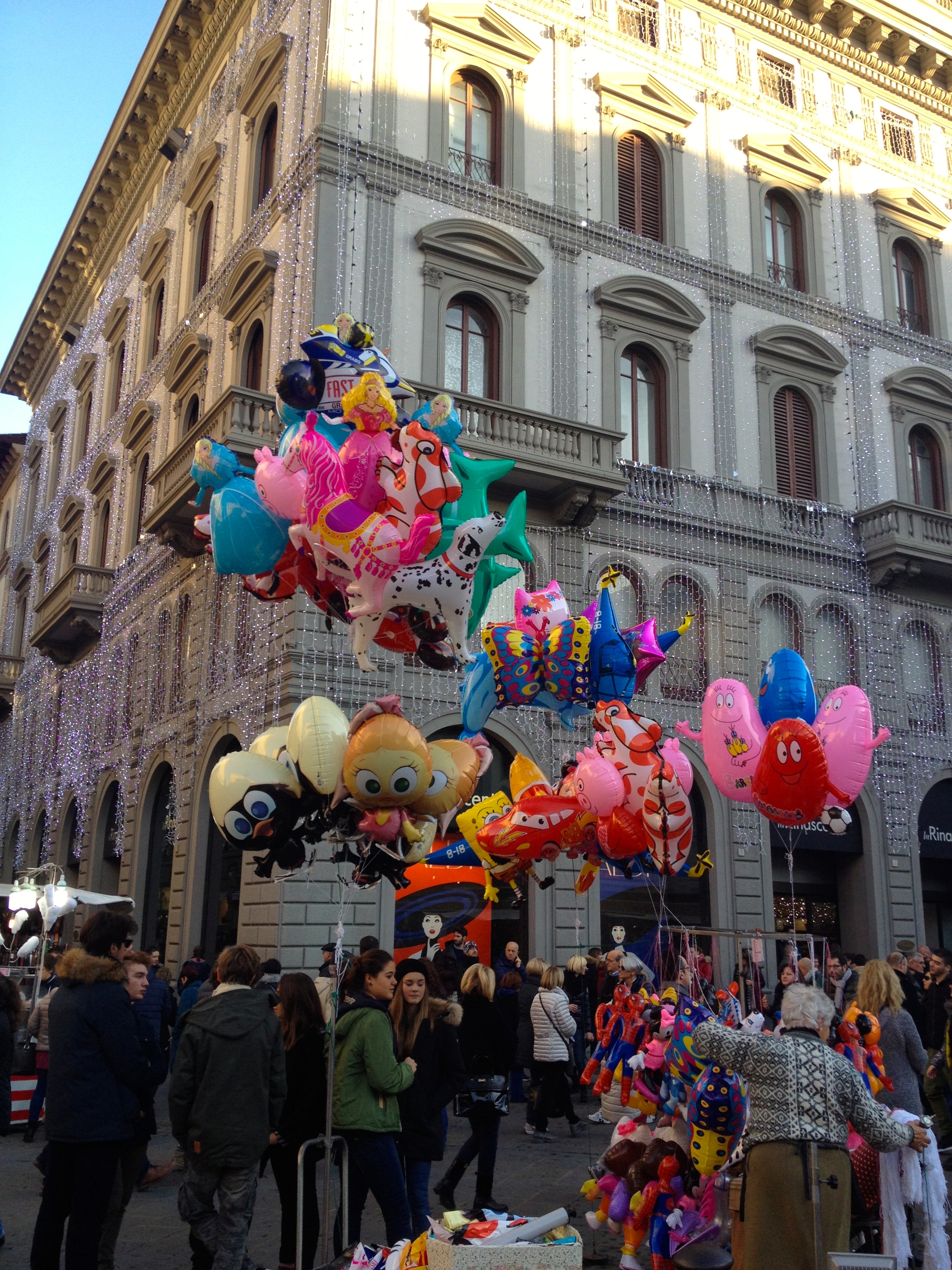 Buona befana, ragazzi! I hope you get just what you wanted!
These trees are left in their natural green, with no decorations.

While this one has flocked the trees. Which do you prefer? I like them both!

I suppose it wasn’t that much of a leap to the creative types in Florence to come up with the use of the Christmas tree, for don’t forget that Florentines have always decorated their public spaces in such a fashion: see what I mean on the famed Orsan Michele?

The picture above is an exterior wall of the church, Orsan Michele, that you walk by several times a day as you wander around Florence, and the base of the niche that houses the sculpture is right at you eye level.
And the use of the 2 dimensional tree design reminded me of the wall design in one of my luxurious hotel rooms in India 10 months ago:

Cool beans!
Uno, due, tre. Numbers the Italian way.
Let’s call it Florence 1, 2, 3 today, with 3 fun Florence-related topics.
We’ll designate numero uno as the mighty Arno. Do you know much about the Arno River besides the fact that it flows through Florence?
No? Well, come on along.
Here’s where it flows.


The Arno and the Tiber, which flows through Roma of course, are the two most important rivers in central Italy. But only the Arno is Tuscan, which makes it extra special.
Our river Arno originates on Mount Falterona in the Apennine Mountains. As you can see in the map, the river heads south and then turns to the west near the town of Arezzo and then north and then west before passing through Florence, Empoli, and Pisa, before flowing in the Tyrrhenian Sea at Pisa’s marina, as you see in the photo below.

When the Arno flows through Florence, it passes underneath several notable bridges including the Ponte Vecchio and the Santa Trinita bridge that Michelangelo inspired but was built by Bartolomeo Ammanati. Of all the bridges in town, Hitler left only the Ponte Vecchio standing, but I’ll discuss that later.
The Arno can be dangerous. Sometimes, it can devolve to almost dry. However, with heavy rainfall, the river can surge to calamitous levels and output. The river has flooded Florence regularly throughout history and the last occasion was the horrendous flood of 1966, which I wrote a bit about here. Dams have been built upstream from Florence and have, presumably, decreased the chances of Florence flooding again.
According to Wikipedia, the 1966 flood collapsed the embankment in Florence, with a loss of life numbering 40 and damaging or destroying millions of works of art and rare books. The only good thing anyone can say about the 1966 flood was that new conservation techniques for artworks were developed afterwards, but even 40 years later, hundreds of works still await restoration.
Just last January in this year of 2014, the Arno rose precipitously high. Here’s what it looked like on Jan. 31, 2014 in Pisa:
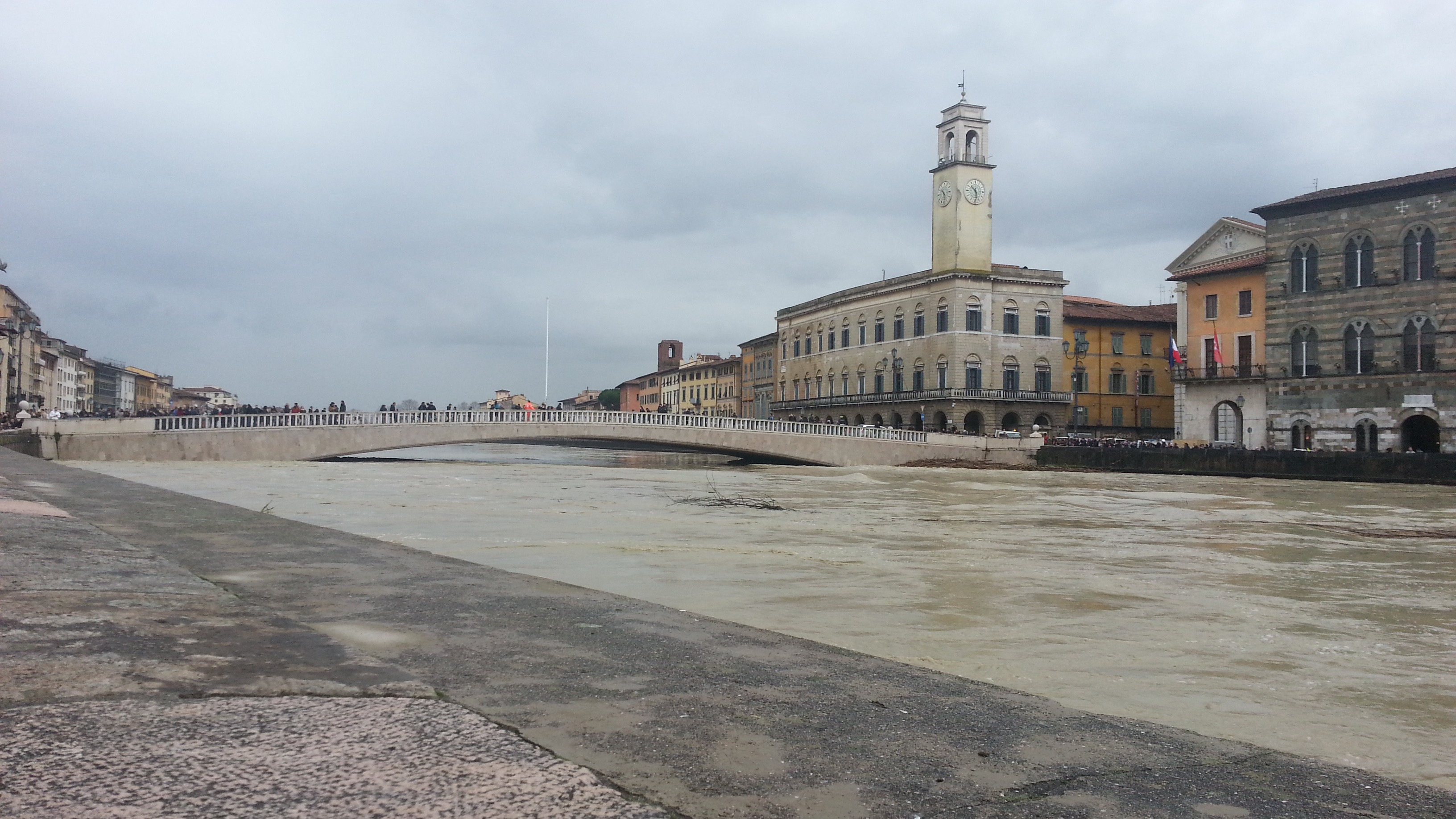
Yikes!
Topic numero due is the Ponte Vecchio, which means “Old Bridge” in Italian.


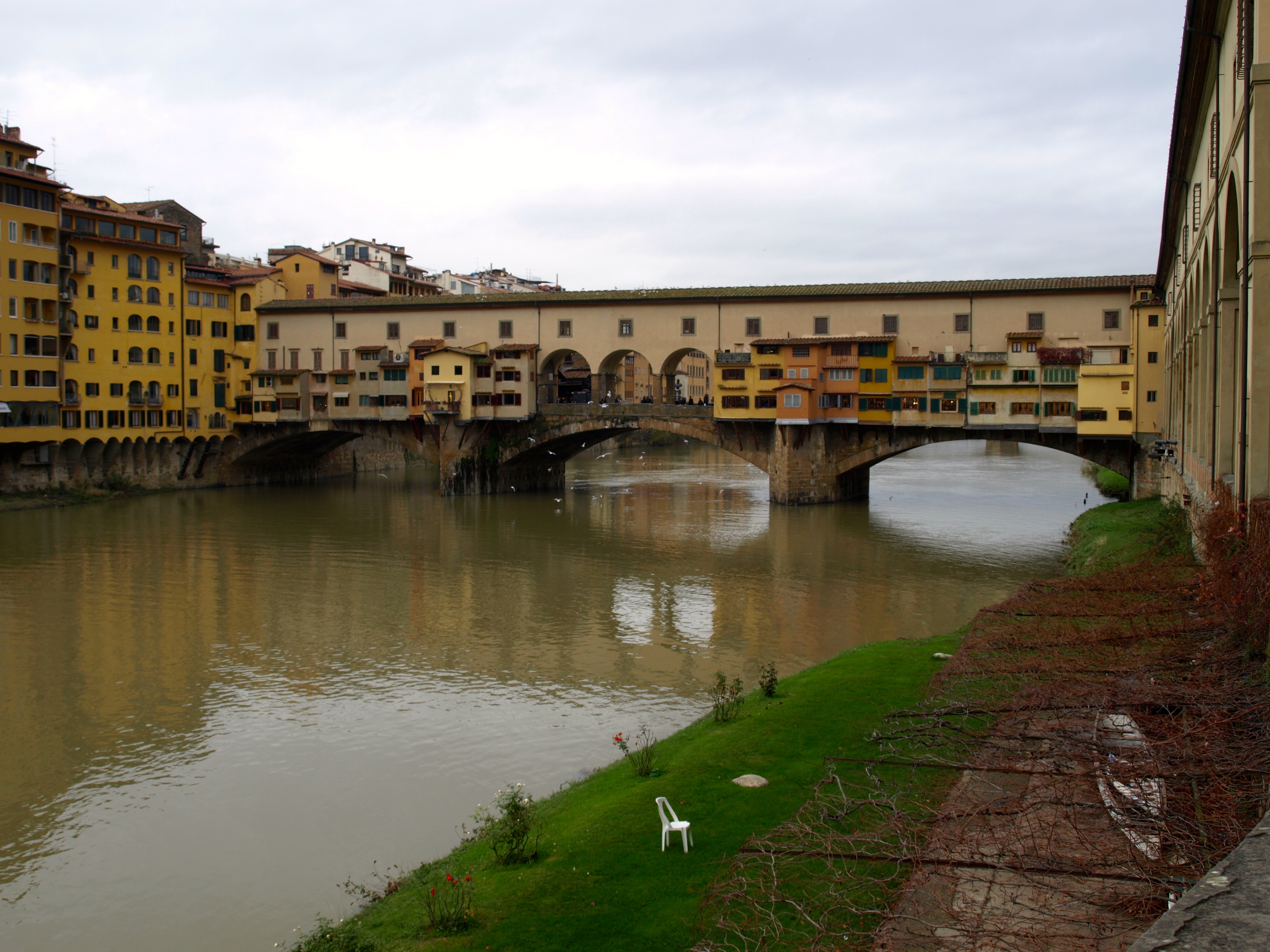

And yep, it’s pretty old alright. How about Medieval even? This landmark, Medieval, stone, pedestrian-only bridge, is noted for having ritzy shops all along it. Today jewelers and art dealers are located across the bridge, whereas originally it was butchers who occupied the shops.
The bridge spans the Arno at its narrowest point and it is believed that the very first Roman era bridge also crossed the river at this same spot. The bridge is first documented in 996. It was destroyed by a flood in 1117; reconstructed in stone but swept away by a flood again in 1333; and rebuilt in 1345 with the Torre dei Mannelli erected at its SE corner for defense.
Here’s an interesting point: The Ponte Vecchio was the only bridge the retreating Germans did not destroy on August 4, 1944. This was allegedly because of an express order by Herr Hitler himself who had visited Florence and supposedly loved the medieval Ponte Vecchio. Despite letting the Medieval bridge stand, the Germans made it all but impossible to access the Ponte Vecchio, however, because both ends of the bridge were obstructed by the destruction of the neighboring buildings. All we can say is, “thanks a lot Herr Hitler.” You’re all heart as we have always known.
In true Florentine tradition, the Ponte Vecchio was again restored and rebuilt, using a combination of original and modern design techniques.
And now for numero tre: let me see, what random fact would be fun to talk about?
How about this “what does it mean in cooking when you say something is ‘florentine?’ ”
I am so happy you asked that!

You’d probably think that it just means anything prepared in the cooking style of Florence, Italy but actually, in modern usage, it for some reason means dishes created using spinach as a main ingredient. Spinach may have become associated with Florence as a result of the influence of Catherine de Medici. According to popular folklore, in the mid 1600s, Catherine, the queen consort of King Henry II and a native of Florence, introduced spinach dishes at court and proclaimed the culinary innovation as “Florentine.”
No matter how obscure the reasons, however, the term “Florentine” is now synonymous with spinach, often in egg dishes and dishes with rich, creamy sauces.

Uh…yum!
So there you go, 1 due 3.

Just like every other place on earth, Florence has ghost stories.
First: Here’s the square. It isn’t the best-kept part of Florence, which is a shame for it is home to the wonderful Ospedale degli Innocenti designed in the “new Tuscan style” of 15th-century Florence by the master architect, Brunelleschi (he who designed the Duomo’s dome).

Below is the Ospedale, or “foundling hospital,” or orphanage.

The square sits in the center of Florence, relatively close to the city’s central heart of il Duomo. The Piazza is a 15 minute walk from my home here.
A patrician palazzo stands facing the Piazza in the furthest west position on the square is known today interchangeably as il Palazzo Grifoni o il Palazzo Budini Gattai, and this is the building attached to a romantic ghost story. It is a mystery known in Italian as
and it goes something like this:
Once upon a time, there was a rich young man who lived in this palazzo. He fell in love with a beautiful maiden and a marriage was arranged. The girl moved into the palazzo with his parents to wait for him, for he was leaving for war.
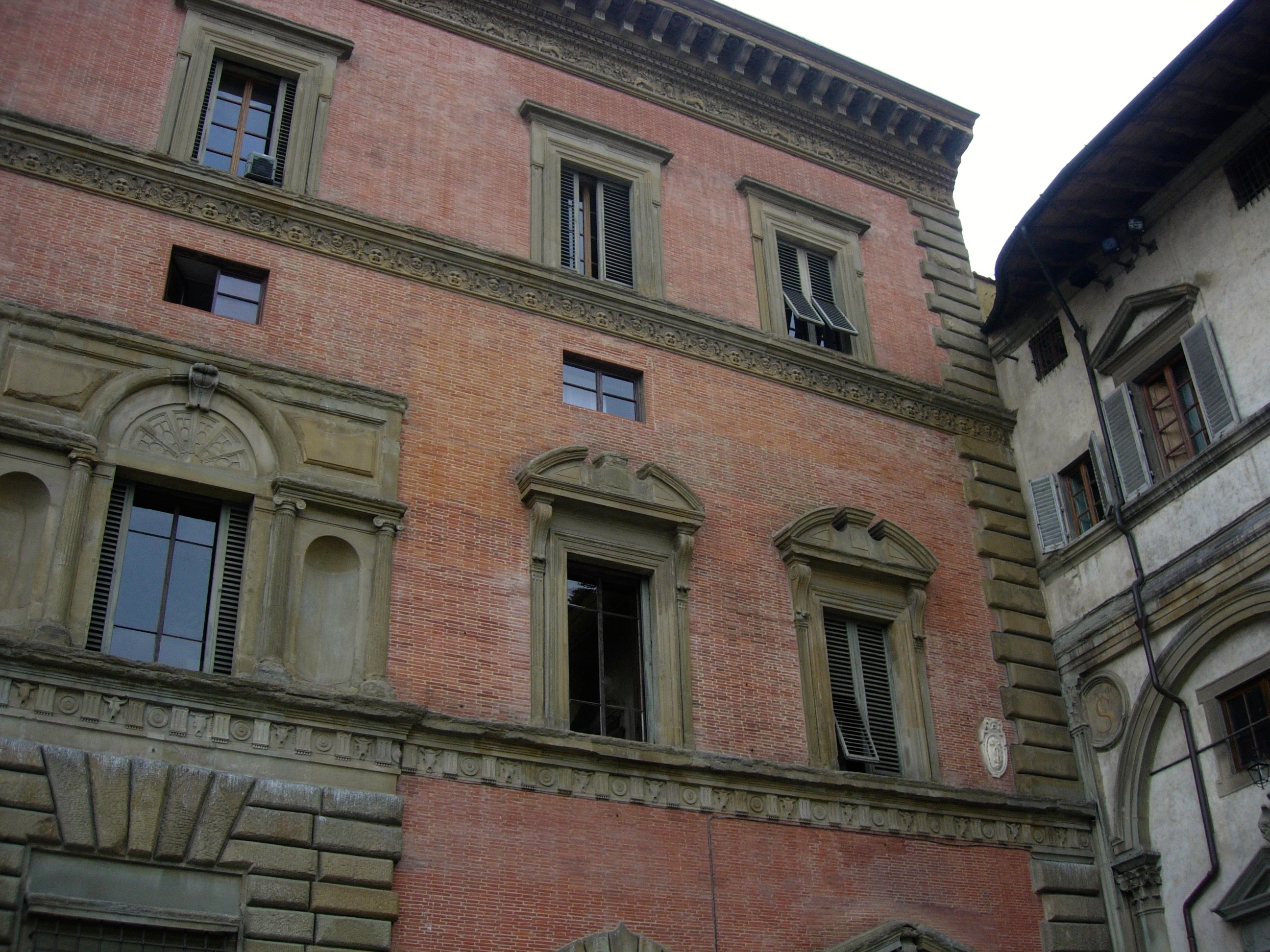
The young maiden sat embroidering in her room, day after day, year after year, looking out the window, watching for her handsome finace to return from battle. It is said that the top right window in the palazzo is the window next to which she sat.
Sadly, the young warrior never returned to his home in Florence and the girl grew into a woman and then into an old woman and she eventually died in the room near the window which she had spent her life looking out.
After her death, her room was cleared and the window was shut. But then strange things started happening. Doors and windows in the palazzo started slamming open and shut, the lights went off and on, and all manner of disruptive things kept happening. At last the window in the girl’s window blew open and the caretakers discovered that as long as that window stayed open, things in the palazzo were calm.
And that is why, so they say, that this window always remains open, as indeed you see in my pictures.

 get back, lauretta!

You must be logged in to post a comment.