My friend Marie sent me some pictures of how upper East Siders are prepped for the upcoming holiday! So creative!
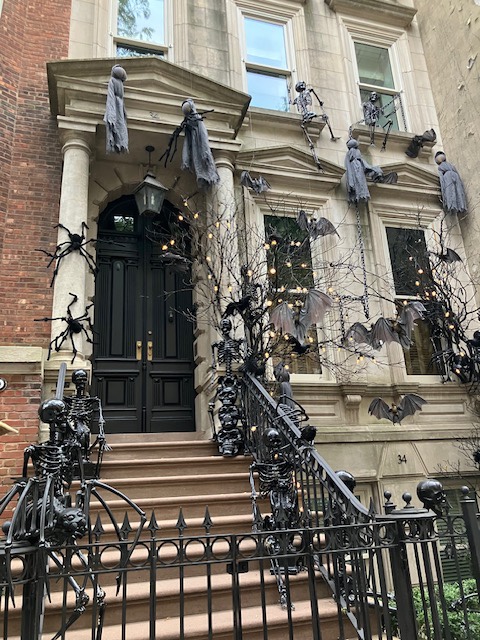


My friend Marie sent me some pictures of how upper East Siders are prepped for the upcoming holiday! So creative!
Here’s a fun sampler of what the season is like over here.
http://www.thelocal.it/galleries/culture/ten-traditions-that-make-an-italian-christmas/5
Merry Christmas, tutti! Put the baby in the manger tomorrow night! Ciao!

And found my way to the top floor where they have a terrace with incredible panoramic views of la citta.


See what I mean?!
That Duomo hovers over the city of Florence, reminding me of a very large and very Renaissancey looking space ship. A visitor from the past.
But, at any rate, I just wish Florence were more picturesque. It is such a shame that she is not. Ha ha.

Here are some more shots from the terrace. It is quite a place to view the city.


The sky seemed to be feeling all operatic, just like the singer in the Piazza.
The Rinascente is notable for a couple of other reasons as well. It’s a decent department store, though quite small. But, it has the most amazing Christmas lights.

While strolling through the city on my way back to my hood, the Santa Croce neighborhood, I passed this ambitious and talented street artist at work.

And when I came near to Santa Croce, the church was highlighted by the late afternoon sun in a very agreeable fashion.
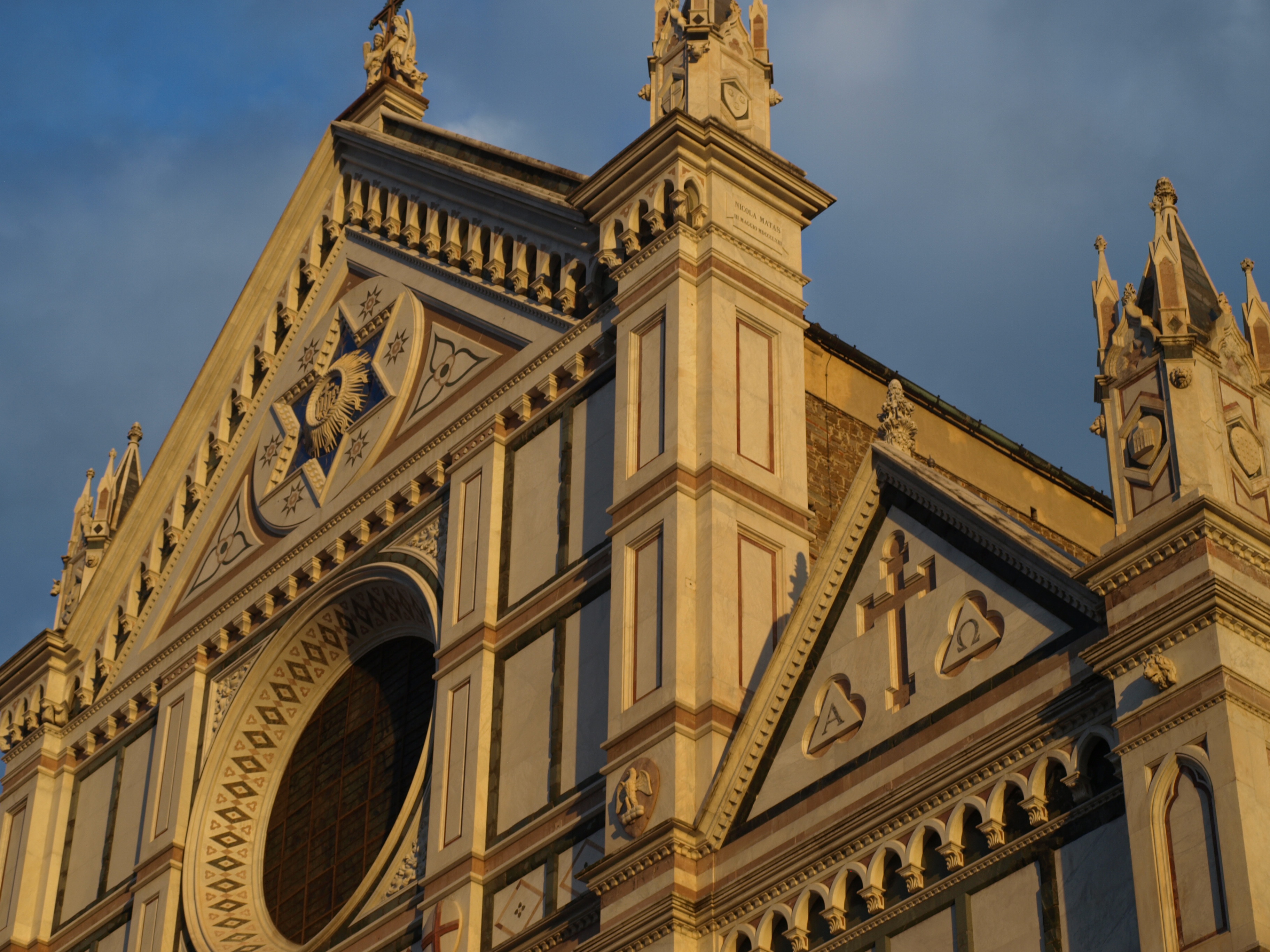
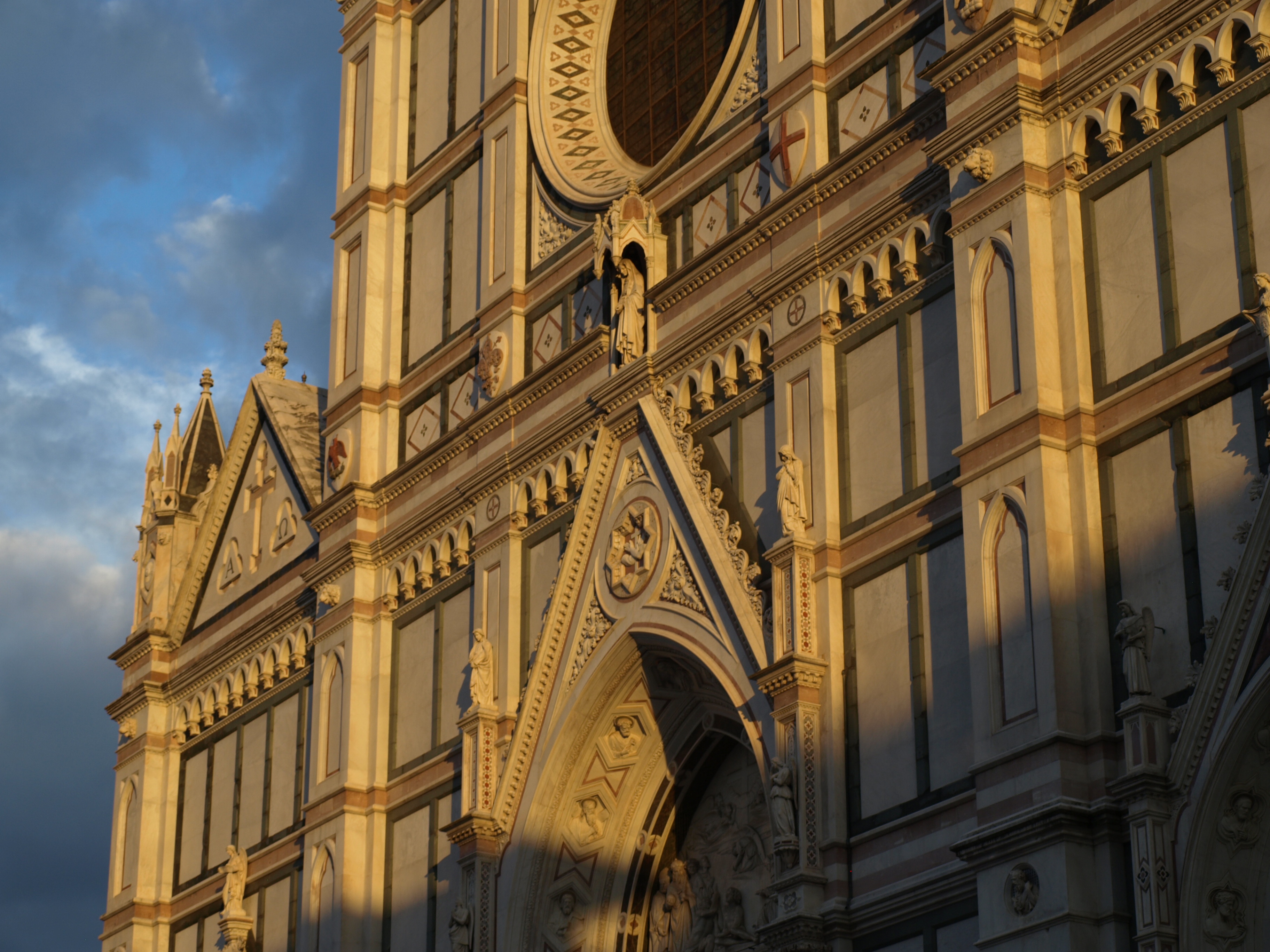
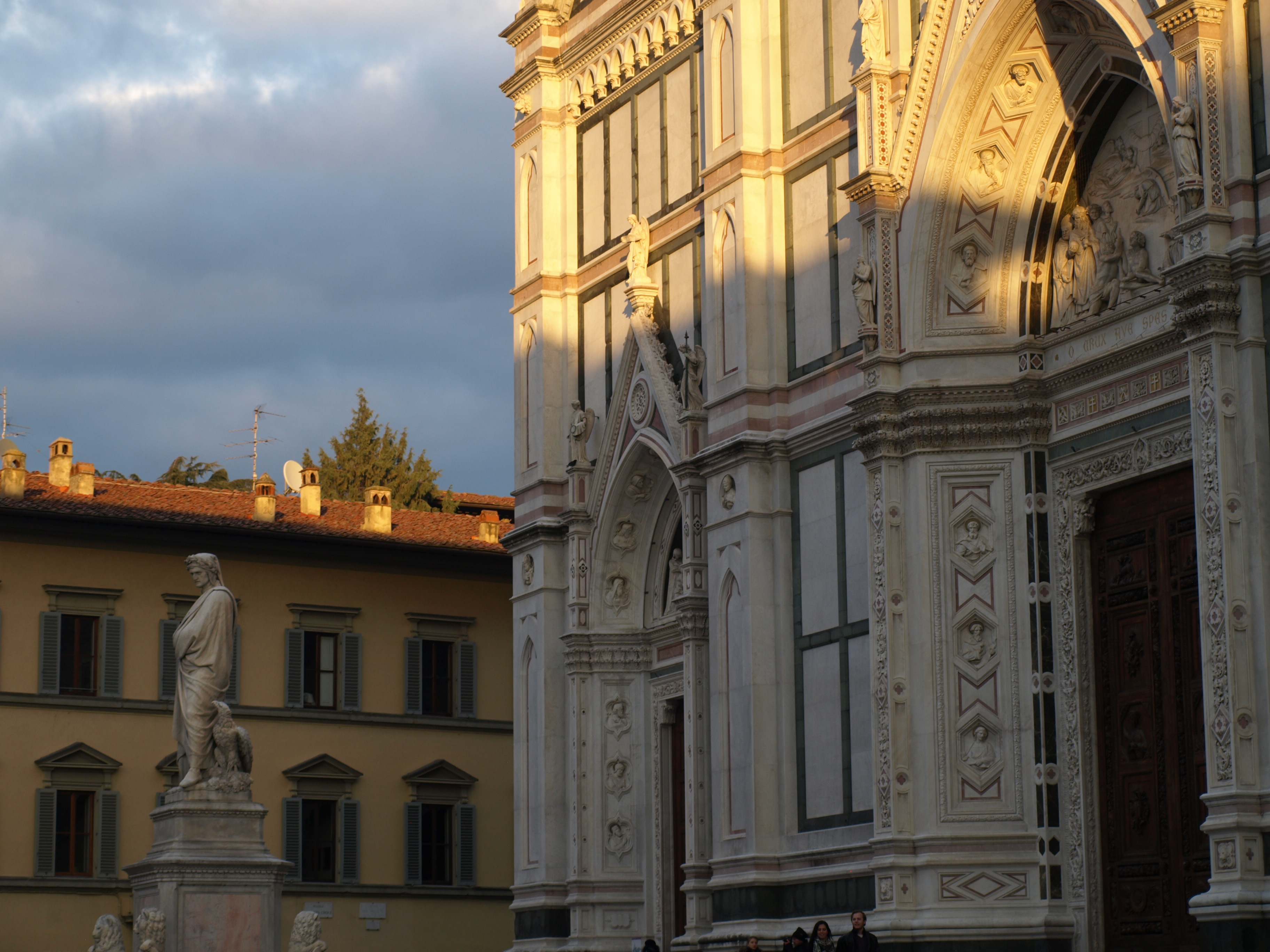
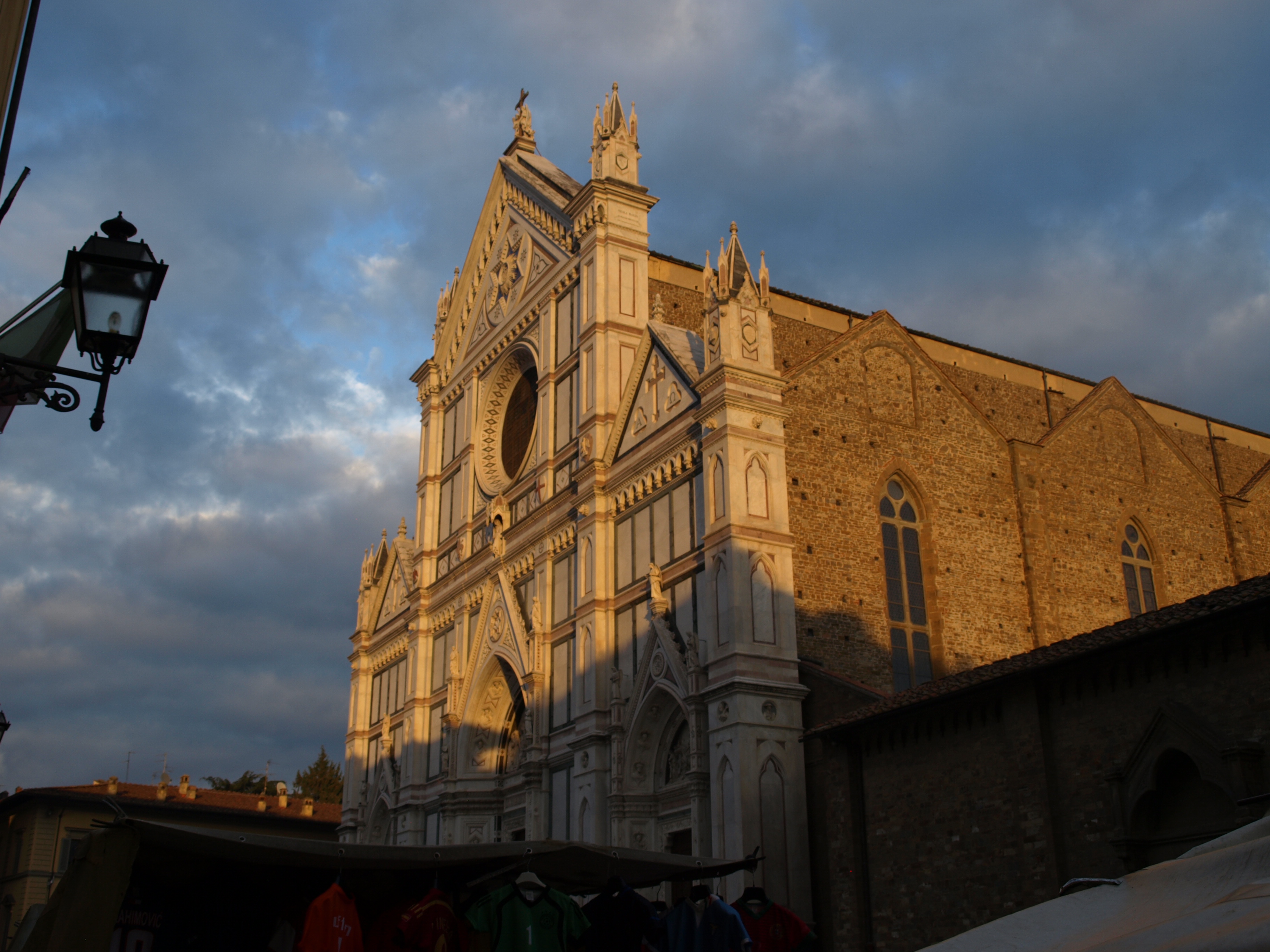
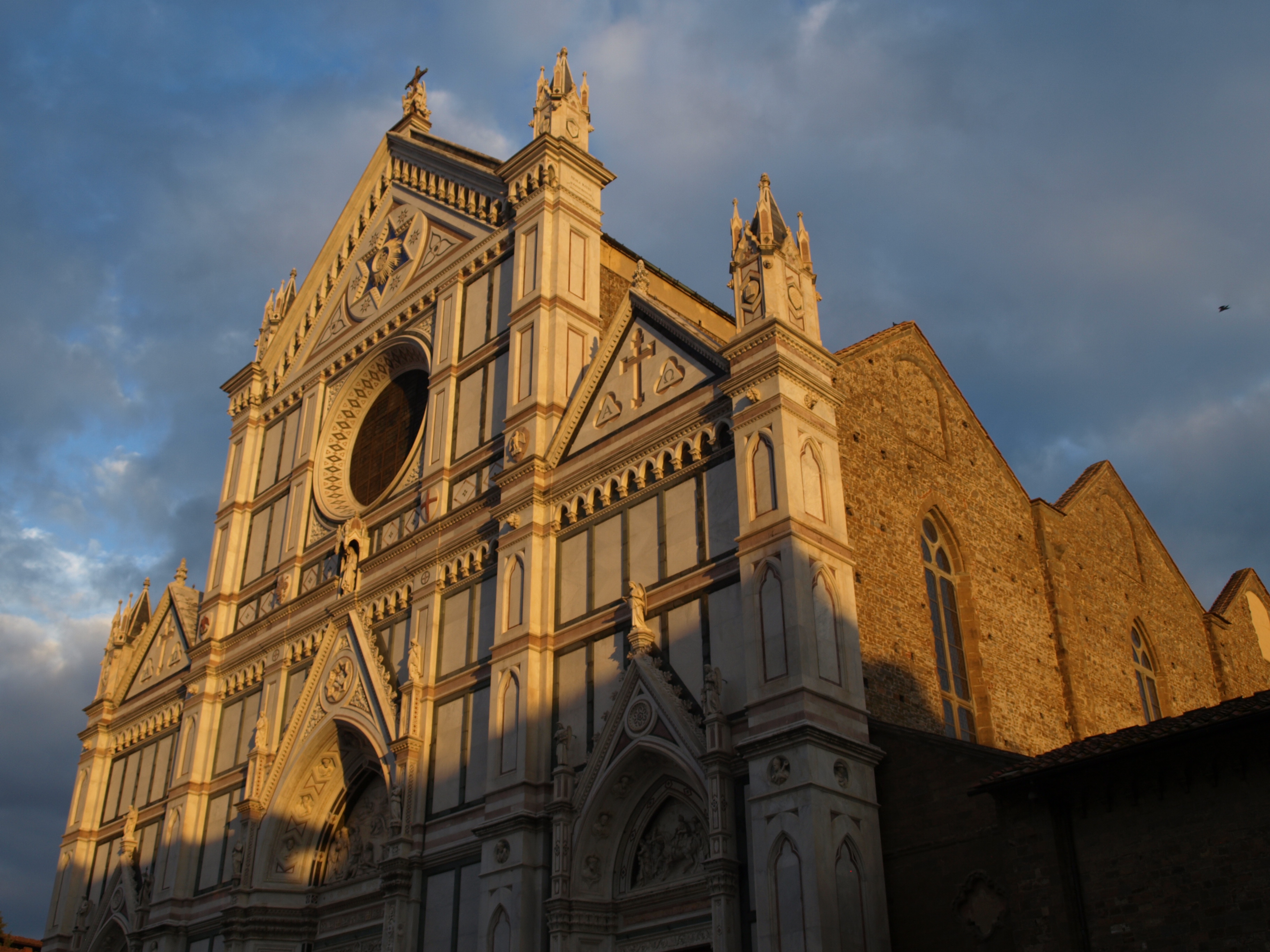
Looking good, Santa Croce!
(Note to self: nothing is making me pay attention to the ending of Italian words and matching adjectives and nouns like trying to write these posts. La mia professoressa will be mighty happy when I show her how hard I worked this weekend! Such a teacher pleaser, am I! It has always be thus. It’s always been the one place I respect authority!)
Here’s how the tree looked yesterday, very pretty with red fleur-de-lis.

And let there be lights (today), millions of tiny white LED lights:

Not so easy to capture in daylight as above.

But check out this beautiful sight at night!

It’s a stunner!


The Miu Miu shoes took my breath away. I must have the silver ones. Hear that, Santa Claus?


Did you know that December 6 is the feast day for Saint Nicholas? It sure is! And some of my readers know very well that I cannot let this day pass unnoticed.

Let’s see what Wikipedia has to say about it:
Saint Nicholas (Greek: Ἅγιος Νικόλαος, Hagios Nikólaos, Latin: Sanctus Nicolaus); (15 March 270 – 6 December 343),[3][4] also called Nikolaos of Myra, was a historic 4th-century Christian saint and Greek[5] Bishop of Myra (Demre, part of modern-day Turkey)[6] in Lycia. Because of the many miracles attributed to his intercession, he is also known as Nikolaos the Wonderworker (Νικόλαος ὁ Θαυματουργός, Nikolaos ho Thaumaturgos).

Like I said, it’s all Greek to me. Or, maybe I didn’t say it, but I thought it.

Nicholas had a reputation for secret gift-giving, such as putting coins in the shoes of those who left them out for him, a practice celebrated on his feast day―St Nicholas Day (6 December in Western Christianity and 19 December in Eastern Christianity);[7] and thus became the model for Santa Claus, whose modern name comes from the Dutch Sinterklaas, itself from a series of elisions and corruptions of the transliteration of “Saint Nikolaos”.
Goodness gracious it is so much easier to quote Wikipedia than to explain all this myself. I love living in the 21st century!

His reputation evolved among the faithful, as was common for early Christian saints.[8] In 1087, part of the relics (about half of the bones) were furtively translated to Bari, in Apulia, Italy; for this reason, he is also known as Nikolaos of Bari. The remaining bones were taken to Venice in 1100.
Hmmm…where is Bari?

Is Bari notable?
Why, yes it is, thanks for asking! Wiki, whadya say?
Bari is the capital city of the province of Bari and of the Apulia (or, in Italian, Puglia) region, on the Adriatic Sea, in Italy. It is the second most important economic centre of mainland Southern Italy after Naples, and is well known as a port and university city, as well as the city of Saint Nicholas. The city itself has a population of about 320,475, as of 2011, over 116 square kilometres (45 sq mi), while the fast-growing urban area counts 653,028 inhabitants over 203 square kilometres (78 sq mi). The metropolitan area counts 1 million inhabitants.
Bari is made up of four different urban sections. To the north is the closely built old town on the peninsula between two modern harbours, with the Basilica of Saint Nicholas, the Cathedral of San Sabino (1035–1171) and the Hohenstaufen Castle built for Frederick II, which is now also a major nightlife district. To the south is the Murat quarter (erected by Joachim Murat), the modern heart of the city, which is laid out on a rectangular grid-plan with a promenade on the sea and the major shopping district (the via Sparano and via Argiro).
And then that makes me wonder about this:
| Basilica of Saint Nicholas Basilica di San Nicola |
|
|---|---|

The Basilica di San Nicola by night.
|
|

The interior.
The Basilica di San Nicola (Basilica of Saint Nicholas) is a church in Bari, southern Italy, that holds wide religious significance throughout Europe and the Christian world. The basilica is an important pilgrimage destination both for Roman Catholics and Orthodox Christians from Eastern Europe.
The basilica was built between 1087 and 1197, during the Italo-Norman domination of Apulia, the area previously occupied by the Byzantine Catapan of which Bari was the seat. Its foundation is related to the stealing of some of the relics of St. Nicholas from the saint’s original shrine in Myra, in what is now Turkey. When Myra passed into the hands of the Saracens, some saw it as an opportunity to move the saint’s relics to a more hospitable location. According to the justifying legend, the saint, passing by the city on his way to Rome, had chosen Bari as his burial place. There was great competition for the relics between Venice and Bari. The latter won, the relics were carried off under the noses of the lawful Greek custodians and their Muslim masters, and on May 9, 1087, were safely landed at Bari. A new church was built to shelter Nicholas’ remains and Pope Urban II was present at the consecration of the crypt in 1089.
There it is again, that pesky East meets West conflict. Can’t we all just get along? Ever?
And that is all you really need to know about St. Nicholas today. Thanks for stopping by and keeping the original St. Nick’s memory alive!


Yes, the peacock was sublime!

Yes, the harlequins were a delight!

But, let’s looks at some other aspects of the extravaganza.
For example, the warring factions, on the part of the Nutcracker and the Mice, were picturesque beyond belief.


I can’t locate a good photograph of the cavalry component of this Nutcracker online, but I did find this illustration.
 I
I
You’ll have to take my word for it: the cavalry rocked! I’ve never seen anything like their spectacular horse costumes.


The ethereal dance sequence with the corps de ballet dancing in a lightly falling snow was awesome.

Can you see what I mean? It snows rarely in Seattle, so this aspect of the ballet is beloved locally. By me for sure!

I’ve run out of superlatives to describe the Nutcracker, so I just show you some random photos of some great parts. A picture is worth a thousand words anyway.


And yes, I had to sneak in the peacock again. I can’t help it. I love it so much!
So, to close, let me remind you that this is the very last year to see the Stowell-Sendak version of The Nutcracker in Seattle. So, what are you waiting for, people? Go!
First, I admit it. I love the ballet.

Second, I love a classic as much as the next person. Maybe more.

Third, I love a new twist on an old favorite. Shaking things up is almost always a good thing. Especially in the arts!

Fourth, I love rousing live music from a top notch orchestra.

Fifth, I am a sucker for the holiday season and the spectacle of falling snow.


Put all these things together, and they elicit the Pacific Northwest
Ballet Company's Nutcracker, what else? Ma oui, mesdames et messieurs!
(I have no idea why I just went all les français.
It just seemed appropriate!)

The Pacific Northwest’s is an entirely different Nutcracker than any you’ve ever seen.
And that’s because one of the company’s directors, Kent Stowell, had a brainstorm back in the 1980s. He thought a new, updated version of the Christmas classic would be nice.
As I noted in an earlier post, Kent Stowell invited famed children’s book author and illustrator, Maurice Sendak, to collaborate on a new version of the Nutcracker. Fortunately, although his initial impulse was to say no, Sendak agreed. The ballet that I enjoyed yesterday in Seattle is the carefully nurtured product of that enlightened collaboration.
Thanks to technology and the www, we can hear the late Sendak himself and see him at work.
Thank goodness they did it, for I’ve been to a few Nutcrackers (indeed I have been drug to many to watch friend’s children perform as mice and other nonsense) in my lifetime, but never one as charming as this.

I could give you the whole rundown, but you don’t need that and neither do I. So let’s jump right to my favorite parts of the Seattle spectacle.
First, let’s skip the turkey and talk all peacock. Personally, I never have liked turkey.
The illustration above is courtesy of the PNB’s website. No credit is given for the artist, but I guess we can take credit all the way back to the early 1980s and give it to Maurice Sendak, who originally envisioned all of this bravado on display at McCaw Hall at the Seattle Center for the next month.

There are hundreds of things to love about the Stowell-Sendak Nutcracker. Maybe more.

But, personally, I could not get enough of this joyous peacock who arrives on stage in her own gilded cage.

Then the gorgeous bird struts her stuff and it is a joy to behold.
The choreography, the costume, the music, the beautiful, skilled ballerina–it all comes together in this all too brief moment of peacock madness.

If you ever wondered what it is like to dance the part of the gorgeous peacock in the Sendak Nutcracker, and come on, who hasn’t?, then watch this:
But, as I often do, I have gotten way, way ahead of myself.


This light-hearted, magical stage front awaits you upon your arrival in the theater. While the orchestra tunes up and all the little sugarplums and sourpusses in the audience take their bumper chairs, your eyes and mind have much to enjoy in admiring this warm Sendak illustration. It literally sets the stage for the magical moments ahead of you. The stagefront makes you feel all warm and fuzzy, like you are sitting on your grandmother’s knee and she is about to read you one of your favorite stories with fantastically attractive illustrations for you to admire.

The curtain(s) rises and you are confronted by this whimsical nutcracker’s face and unending teeth.

Another curtain rises and we see the young protagonist of the story, our fraulein, asleep, about to have some wild REM sleep! Out come the mice, the tale’s “narrator” (he is silent, but he still narrates), and the fantastic dreaming begins.
It would take pages for me to go through the chronology and details of the ballet, and I don’t want to write for pages. So, here are some of the scenes from the dream sequence. I present them out of order, the way I would like to dream it.

Three dances in harlequin costumes present a lively interlude. I loved this part!
I’ll be back with another post on this masterpiece soon. But for now, run, don’t walk, to the Seattle Center to see this ephemeral delight while you still can.

May we all have visions of sugar plums dancing in our heads this next month!
l 

Beautiful autumn days and nights. So much to be thankful for!
 get back, lauretta!
You must be logged in to post a comment.