And for me, that meant facing my nemesis from last week, the grocery store!
So today I put on my suit of armor and headed back down the via, across the viale, into the neighborhood, and entered “my” grocery store. And today I did not have a panic attack like I did last week! Woo hoo! I am making progress!
And I will have to take my camera and take some pictures of some of the incredible produce, salami products, and the fresh mozzarella falling off the shelves so plentiful is it. This is my idea of heaven!
Because, seriously, where else in the world can you order a cappucino and when it arrives looking all artistic and lovely, and when you comment on its loveliness, the barrista flirtatiously says to you, “which is ‘bellisimo’? the coffee or me?” and you blush and laugh and say “l’uno e l’altro”. Because honestly, both the barrista and the coffee are works of art!
Lately, when I find my mind wandering when it should be conjugating Italian verbs, I like to waste time er refresh my brain by catching up on my favorite blogs. I am a big fan of Elizabeth Minchilli’s blog from Rome and culled the following images from her postings.
A few weeks back I posted a photograph showing what I believe the entrance to a heaven would look like. So, I decided to let my mind wander today into what my ideal room in a heaven would look like.
And here it is, a combination of details incorporating all the necessities with just enough and just the right style.
Of course, discerning visitors will know it is in Italy. Where else?!
First, it is always springtime so that your French doors can be open to the outdoors. Naturally, you have flowers from your garden on your desk, where you spend your days writing and reading. When your eyes tire from looking at the laptop screen you rest them with the beauty of the outdoors. Often your vision drifts to the gorgeous floor, where two tone tiles are inlaid in a Moroccan pattern.
Even though it is heaven, you still get thirsty and hungry, so you have an iced bottle of sparkling aqua minerale available at all times, as well as a plate of almonds from your orchard. The mineral water keeps your bones strong and le mandorle are full of excellent nutrients to keep your eyes sharp, your fingers ready to type, and your brain energized for thinking deep thoughts.
Sometimes you stop writing for a moment and let your eyes wander up the walls covered with tile sheets of naturally patterned marble from the area around Carrara, the same quarries where Michelangelo hand-selected the marble for his best sculpture. Up, up, up your eyes scroll, admiring the lines of gray strata swirling within the white marble. The ceiling is well worth your gaze, for it has been hand-painted with lovely colors and designs. How sweet to do nothing but look. Dolce far niente indeed! Looking is an activity too. To really look at something takes practice. It is, like everything, an acquired skill.
Later on, you take a bubble bath in your simple bathroom lined with Italian ceramic tiles that have a Spanish/Moorish flavor. While under the lavender scented suds, your mind wanders to the origins of these ceramic tiles and the eastern heritage to which they attest. Your mind is never happier than when gliding through thought like this. You have a lovely upholstered chair nearby to catch your bath towel or robe. Once again, the ceiling does not disappoint. If anything, it demands attention!
Later, you wander through your trellised garden.
You inhale the sweet scents of blooming vines like jasmine, various shrubs including roses, and fragrant perennials. Since this is paradise, everything blooms at once, so you have wisteria and dahlias, all in the same season. Perché no? You gaze happily at your limonaria and orangerie, maybe even plucking a few bergamot or Meyer lemons to wake up your taste buds. Heaven includes all of the senses, no?
Back to the room for a quick nap on this gorgeous bed. You can lose yourself in the fantastic frescoed ceiling.
Then, completely refreshed after an ideal day, you dress for the evening and meet someone at the bottom of these steps to the sea. Together you will enjoy an aperitivo aboard a nice boat on the water, watching the sun set.
In this day and age, when it seems as if no female under the age of 30 has a regularly spelled name, my first name might seem to be just one more example of the same.
However, it is not. I did not take the common name Loretta and pretty it up to make it Lauretta.
I am named after my paternal grandmother, Lauretta Belle Romjue. And, not only that, but I didn’t like my name when I was young and had, for like the first twenty years of my life, a love/hate relationship with it. Mostly I wished I could have had a more common name, something regular, like Julie. I even liked the more patrician version of that name, Julia. In first and second grade I longed for any name that was easier to write and spell.
But eventually, by the time I more or less grew up — around age 35 I’d say– I finally enjoyed my name. I thought it looked good in print and since I was publishing scholarly articles and book chapters, it was nice to have a solid, interesting, old-fashioned name. But, even then, what I did not know was that my name is Italian! Which is kind of weird, because….
I have had, for as long as I can remember, an affinity for Italy. Nothing about my association to things Italian makes logical sense. My ancestors did not come from Italy, but rather from France and England, and they were in the United States from at least the time the nation was first formed. So, why, I have often wondered, do I have this inexplicable love for all things Italian?
I still don’t have an answer for that question; I am not a believer but it does kind of make me wonder if I lived before this life and maybe I lived on the Italian peninsula? But, even though I can’t rationally explain my love for Italy, I have made a lot of trips there during my adult life, simply because I’ve always been happiest in il bel paese.
One autumn, many years ago, following a very trying summer, I made a trip to Umbria to restore my soul. While there, I spent time in Spoleto and visited the majestic Rocca Albornoziana, a fortress castle built for a cardinal in the 14th century. The Rocca was used by Spoleto’s Renaissance governors and many popes even took up residence there at various times, including Boniface IX in 1392 and Nicholas V in 1449. Even the colorful character, Lucrezia Borgia, is known to have stayed in the Rocca on several occasions.
By 1700, however, the castle began to lose importance, and from 1764 onward Spoleto’s governors no longer wanted to live in it, preferring to reside within the Spoleto city walls. In 1817, the fortress was transformed into a high security prison. How far the mighty fall!
In 1982, the prison was transferred to another location and a long, careful restoration process was begun on the castle. The Rocca was reopened in 2007 as the home of the National Museum of the Duchy of Spoleto. The fortress also houses the Cultural Heritage Diagnostic Laboratory and the European School of Preservation and Restoration (of antique books).
I took a guided tour of the Rocca one fine afternoon that restorative autumn and, while following my guide around, I almost fainted when I looked up high on the walls of the main room and there, in what looked like graffiti, was my name Lauretta. This was the first time in my entire life I had seen the correct spelling of my name outside of something connected to my grandmother or me. By the bye, I have never in my lifetime met another woman with the name Lauretta. I’ve met a handful of Lorettas, and even have one of them for a sister-in-law (how coincidental is that?), but never, ever a Lauretta.
When I had recovered myself and tuned back in to hear what the guide was saying, I asked him about the feminine names written in graffiti high up on the walls of this magnificent room. Oh yes, the guide explained, when the Rocca was used as a prison, some of the soldiers would write their sweetheart’s names as they pined away for them. One of the men apparently had a girlfriend named Laura, whom he affectionately called “little Laura” or Lauretta. Or, possibly her Christian name was Lauretta. The conservation teams uncovered the graffiti and left it as a reminder, for it gives a certain patina to the old monument, speaking as it does for its history as a prison.
I explained to the guide why I was so interested in the graffiti and he complimented me for having such a beautiful and such an “Italian” name. I was still doubtful, but he assured me that my name is a quite common Italian name. It is? I incredulously inquired, wanting to believe I had this lovely association to my favorite land on earth. When I was a very young girl, the priest of my friend’s family came for dinner on a night I was at their house. My friend’s mother introduced the priest and me and he said, “Oh Loretta, such a good, Catholic name!” Ha! I thought. What do you know? I am not Catholic. So, I was skeptical when my guide in Spoleto told me my name was Italian. Oh yes, certo, he continued. Do you not know the Puccini opera, Gianni Schicci, he asked me? Kind of, I answered. He said one of the main characters is a Lauretta and that I should check into it. I promised him I would.
Of course he was correct and Lauretta is a main character in Gianni Schicchi, a comic opera by Giacomo Puccini with an Italian libretto by Giovacchino Forzano, composed in 1917–18. The libretto is based upon an incident mentioned in Dante’s Divine Comedy. This opera includes one the maestro’s most famous, and indeed one of opera’s most beloved arias, O mio babbino caro (oh, my dear papa or daddy).
Was the aria ever performed more beautifully than by Renee Fleming? Who could answer such a silly question?, but I doubt it!
And so that is how I came to know that my unusual name is Italian. I still don’t know if that explains why I am in love with Italy, but it is a start!
So, I started researching my name and, sure enough, it was at its height of popularity as a name for girls in the United States during the very early 20th century, as you can see in the chart below. Not coincidentally, my grandmother was born in 1902, so it all begins to makes sense.
Lauretta is an Italian diminutive of Laura. Laura originates in Latin language and means “bay laurel tree”. It is taken from the name of an aromatic evergreen large shrub. In the Greco-Roman era, laurel was used as a symbol of victory, fame and honor. As a feminine given name Laura has always been one of the most popular names not only in English-speaking countries. Laura was the name of the 9th century Spanish saint, as well as the name of the woman in whom Francesco Petrarch, an Italian humanist, found inspiration.http://babynames.net/names/laurettahttp://www.at-a-site-theater.com/news/2014/7/20/at-a-site-theater-presents-a-summer-project-celebrating-birt.html
“. . . The senses reign, and reason now is dead;
from one pleasing desire comes another.
Virtue, honor, beauty, gracious bearing,
sweet words have caught me in her lovely branches
in which my heart is tenderly entangled.
In thirteen twenty-seven, and precisely
at the first hour of the sixth of April
I entered the labyrinth, and I see no way out.”
“Laura, illustrated by her virtues and well-celebrated in my verse, appeared to me for the first time during my youth in 1327, on April 6, in the Church of Saint Claire in Avignon, in the first hour of the day; and in the same city, in the same month, on the same sixth day at the same first hour in the year of 1348, withdrew from life, while I was at Verona, unconscious of my loss…. Her chaste and lovely body was interred on the evening of the same day in the church of the Minorites: her soul, as I believe, returned to heaven, whence it came.”
Dante Gabriel Rosetti: The Day Dream, 1880.
Back in the 1300’s, before card stores and chocolate manufacturers all conspired to commercialize the true spirit of love, passion, and romance, Francesco Petrarca (1304-1374) literally wrote the book. His collection of verses, Rime in vita e morta di Madonna Laura (after 1327), translated into English as Petrarch’s Sonnets, were inspired by his unrequited passion for Laura, probably Laure de Noves, a young woman he first saw in church.
Head-over-heels in love with his Laura, Petrarca wrote 365 sonnets, one passionate poem per day, over the course of a year, all dedicated to his true love. Considered the first modern poet, Petrarch perfected the sonnet form, a lyric poem of 14 lines with a formal rhyme scheme, expressing different aspects of a thought, mood, or feeling.
When Love within her lovely face appears
now and again among the other ladies,
as much as each is less lovely than she
the more my wish I love within me grows.I bless the place, the time and hour of the day
that my eyes aimed their sights at such a height,
and say: ‘My soul, you must be very grateful
that you were found worthy of such great honour.From her to you comes loving thought that leads,
as long as you pursue, to highest good,
esteeming little what all men desire;there comes from her all joyous honesty
that leads you by the straight path up to Heaven-
already I fly high upon my hope.~~~~~~~~~~~~~~~~~~~~~~~~~~~~~~~~~~~~~~~~~~~~~~~~~~~~~~~~~~~~~~~~~~~~~~~~~~~~~~~~~~~~~~Quando fra l’altre donne ad ora ad ora
Amor vien nel bel viso di costei,
quanto ciascuna è men bella di lei
tanto cresce ‘l desio che m’innamora. I’ benedico il loco e ‘l tempo et l’ora
che sí alto miraron gli occhi mei,
et dico: Anima, assai ringratiar dêi
che fosti a tanto honor degnata allora.Da lei ti vèn l’amoroso pensero,
che mentre ‘l segui al sommo ben t’invia,
pocho prezando quel ch’ogni huom desia;da lei vien l’animosa leggiadria
ch’al ciel ti scorge per destro sentero,
sí ch’i’ vo già de la speranza altero.
Back to my post:
And I made one more discovery about my name when my son was small and I was reading all the classic children’s literature out loud to him. In the charming book, Anne of Green Gables, Lauretta is one of the characters. I now have a great fondness for this sweet book as well!
To close this rambling post on where in the world my name came from, the following sentiment from Anne of Green Gables shares that awesome feeling that, just when you think the world has already revealed all of its charms to you, you can still be surprised by the most amazing things about even the closest things that you take for granted. Thanks world!
And to my great-grandmother, Estelle, I say grazie mille for giving her lovely daughter such a beautiful name filled with such happy associations to gorgeous italia! To my own mother I say thank you for your generous spirit in naming me after the woman we both admired and loved.
My sentiments exactly. Here is the beloved country at night from a satellite, so brightly lit around Napoli and Roma and all along the northern borders. Beautiful country, even in the dark!
I believe it has been firmly established among all cognoscenti that Italian is one of the world’s most musical, most lovely to the ears, most delightful languages to listen to.
There are certain expressions within Italian that are beautiful beyond belief (alliteration alert), and sogni d’oro is one of these for me. In fact, it may be my favorite.
When you are saying goodnight to someone you love you wish them sogni d’oro, which is essentially the same things as “sweet dreams” in English.
I’d never suggest any of my own imagery for anyone else’s dreams; dreaming is way too personal for any such folly.
But here are some golden backgrounds for you to think of next time you have trouble sleeping.
Ask any fairly sophisticated person you know where the two following photographs were taken, and chances are very good…
that the viewer will know instantaneously that the pictures were taken in Italy. Certo!
And that same person will also no doubt know that in Italy presenting una bella figura is one of the most important aspects of daily life. Italians, male and female, are well known for their sense of style and its major component, fashion. Italy is rightly recognized as a hub of fashion, with many eminent names such as Armani, Dolce & Gabbana, Donatella Versace, Missoni, Prada, Cavalli, Valentino, Taccini, Gucci, Garavanni and Moschino and many more in the mix. These designers are in great local and international demand. But it hasn’t always been this way.
So, how did this situation evolve?
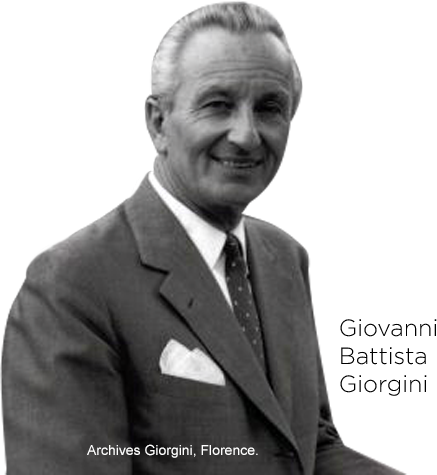
It would seem that one man had a vision to form a world of high Italian fashion to compete with the French haute couture. This new Italian high fashion incentive, first formed in the mind of Giovanni Battista Giorgini, rose like a phoenix out of the ashes of WWII and came to forefront of the world stage.
Florentine count, Giovanni Battista Giorgini (1898-1971), was perfectly poised to bring his vision to fruition, for he knew the American market very well, having been involved in exporting Italian fashion goods to North America since 1923. He had been involved in promoting Italian craftsmanship–specifically the “Made in Italy” initiative– in the United States until the 1929 Stock Market Crash and the dastardly political developments in Fascist Italy brought his efforts to a close.
Photo above from Archivio Giorgini in Florence.
Giorgini’s ambitions for Italian fashion were set aside while the world was caught up in chaos and he served in the armed forces of his country during the lead-up to WWII. During the conflict, Giorgini was in the army, in command of a brigade near Bagni di Vinadio in Piedmont.
By the time the last Allies efforts were underway to take Florence from the Germans, Giorgini and his wife and three sons were living in the Oltrarno neighborhood of the city. It was through that neighborhood that the first column of the Allied army approached Florence. The entire Giorgini family were fluent in English and Giorgini offered to make his home the Allies’ headquarters. The Allies command gratefully accepted.
In 1944, Giorgini was appointed director of the Allied Force Gift Shop, a store for the Allied Force troops. Under his management this successful operation was repeated in other Italian cities. When the War ended, Giorgini was able to return to the United States in an effort to reignite his exporting business, which had been on hold for almost twenty years.
Within a few years, Giorgini was supplying the largest American and Canadian importers and distributors with the finest of Italian products. Among his clients were well-known retailers including I. Magnin; B. Altman; Bergdorf Goodman; H. Morgan; Tiffany; Bonwit Teller and others. To these leading department stores Giorgini exported the best Italian products such as home and fashion accessories including knitted and woven textiles, leather, shoes, as well as ceramics and glass.
Giorgini was uniquely qualified in his role as a successful entrepreneur, although he always preferred the artistic end of the enterprise, not the business end. He was not always comfortable in his role as promoter of Italy to North American businesses, for he was first and foremost a passionate collector of art and antiques, as well as being himself a designer.
Despite his reluctance to operate as a businessman, he always was one step ahead of avant-garde trends. His uncanny ability allowed him to guide Italian manufacturers in modifying their products so that they could meet the ever changing new demands from the marketplace.
It was Giorgini’s brilliance that allowed him to intuit that the incredible artisan craftsmanship for which Italy was known could be brought to bear on the damaged fashion world in post war Italy. He knew that craftsmanship was vital, but was not, alone, enough on which to base the fashion renaissance he foresaw.
He rightly believed that it would take two things to launch the dream he had:
#1 the enhanced production of the high quality textiles for which Florence has always been famous
and
#2 brand new ideas from highly talented designers. Giorgini wanted to stimulate the best and brightest in Italy to create and export an entirely new field of high Italian fashion to the world. And indeed he did bring it about.
Prior to this time, Italian fashion and textile businesses were simply copying their French counterparts, but not adding anything beyond fine craftsmanship to the mix. That wasn’t good enough for Giorgini: he foresaw a world in which Italy not only held its own with its French colleagues, but Italy surpassed them. He set about making this new world happen.
Giorgini’s out-going personality coupled with his aristocratic heritage and his inherent good taste, made him ideal for his role in public relations. He knew how to capitalize on his background and interests, as well as how to enhance his orbit of acquaintances.
In the late 1940s and early 1950s, one by one, Giorgini made contact with the leading Italian producers of textiles and clothing, and convinced them to cooperate with his idea. He did the same thing with American buyers and journalists.
Giorgini would often tempt these movers and shakers in the burgeoning field of international fashion by inviting them to share in elegant evenings in his lovely home on Florence’s Via dei Serragli. His beautiful house, furnished with art and antiques, created an environment of elegance and opulence that charmed his foreign guests. There he entertained them with extravagant dinners with concerts and/or dances. It was very hard for anyone to resist. Why would anyone want to?!
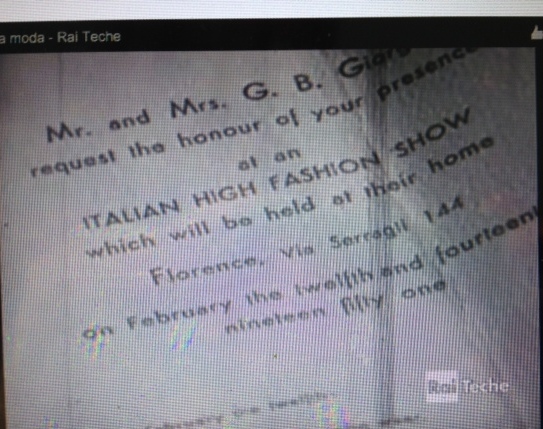
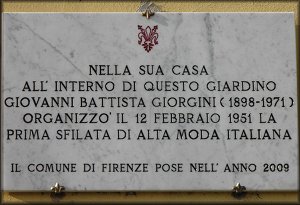
Once he had some of the fundamentals in place, Giorgini issued a carefully planned and strategic invitation to European nobility to a big event, a full day of a runway show, held on February 12, 1951 in the ballroom of his beautiful home at #144, Via dei Serragli. One might even be tempted to say that Giorgini had learned some strategies from the U.S. military, so carefully was his initiative planned!
Here’s a photo of the invitation Giorgini and his wife extended
Giorgini’s deep knowledge of the North American markets led him to set his sights on bringing the buyers for American department stores to Florence to show them a series of Italian collections for Spring/Summer 1951. He planned his event so that the American buyers could just pop down to Italy to see what was happening there, right after they had been to Paris catwalk shows. After all, he reasoned, they were already in Europe so perche no? Giovanni Giorgini was a brilliant strategist!
He gave each of his invited guests this challenge: the ladies were kindly requested to wear dresses of pure Italian inspiration. The reason for this unusual request, he further explained, was to present pure Italian fashion as something special to behold.
The first “Italian high fashion show” featured Carosa, Fabiani, Simonetta, the Fontana sisters, Schuberth, Vanna, Noberasco, Marucelli and Veneziani.
In the meantime, the Florentine marquise, Emilio Pucci, had himself already obtained a photo shoot for one of the leading American fashion magazines, Harper’s Bazaar and he invited buyers to see his own collection at Palazzo Pucci. The accessories shown with Pucci’s garments were created by Fratti, Canesi, Proyetti, Gallia & Peter from Milan, the baroness Reutern, Romagnoli, Canessa from Rome and Biancalani from Florence.
Of course Giorgini did not forget to invite the press to his event. Bettina Ballard, then a fashion editor at Vogue, wrote Giorgini a triumphant letter after the event, saying: “Everybody seems interested in Italian fashion, alongside Vogue. I am sure we will be doing something together in the short term.”
Once again, I thank the gods of fortuna for the internet and Youtube. Check out this footage of one of Giorgini’s 1951 fashion shows:
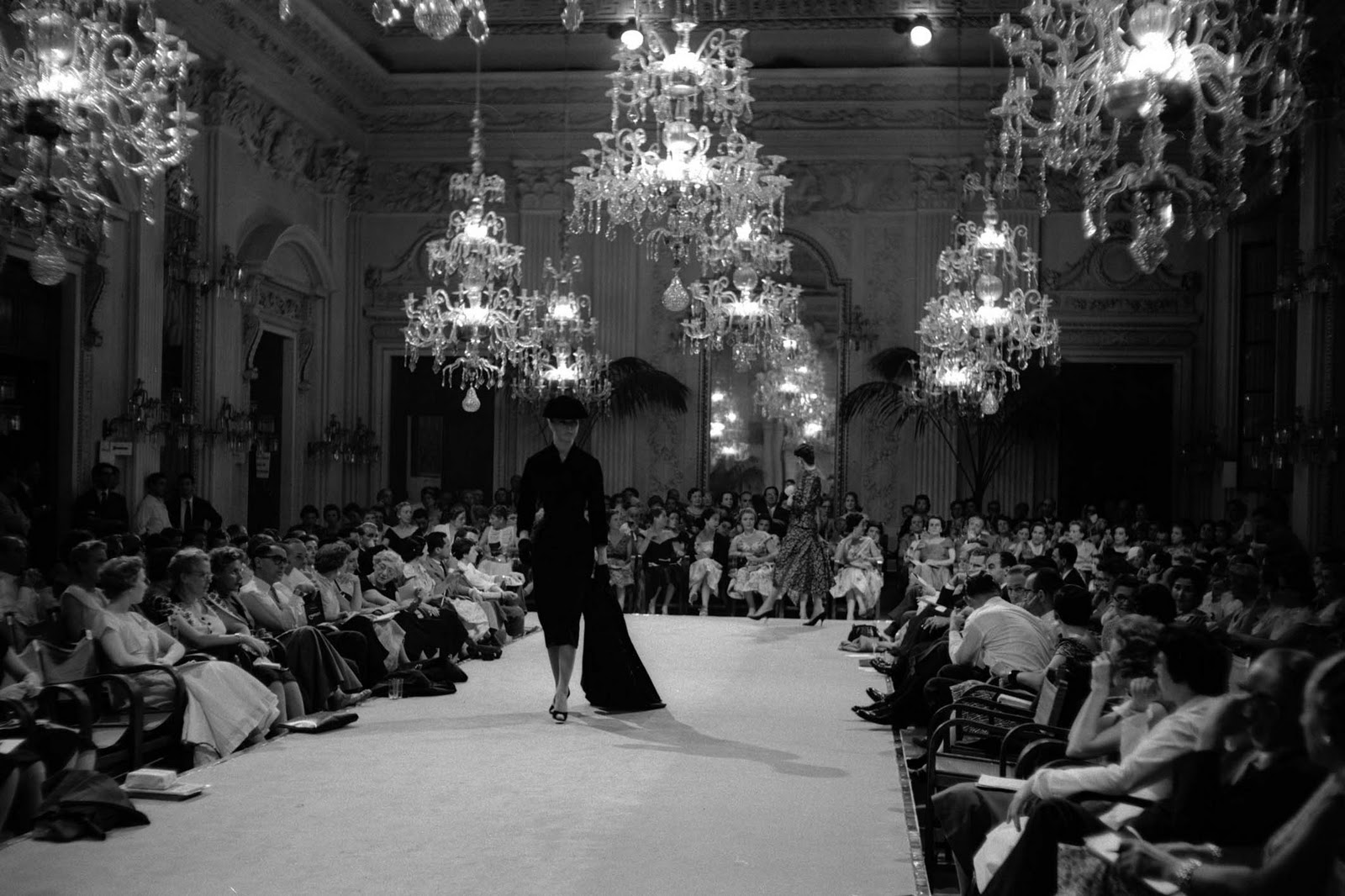
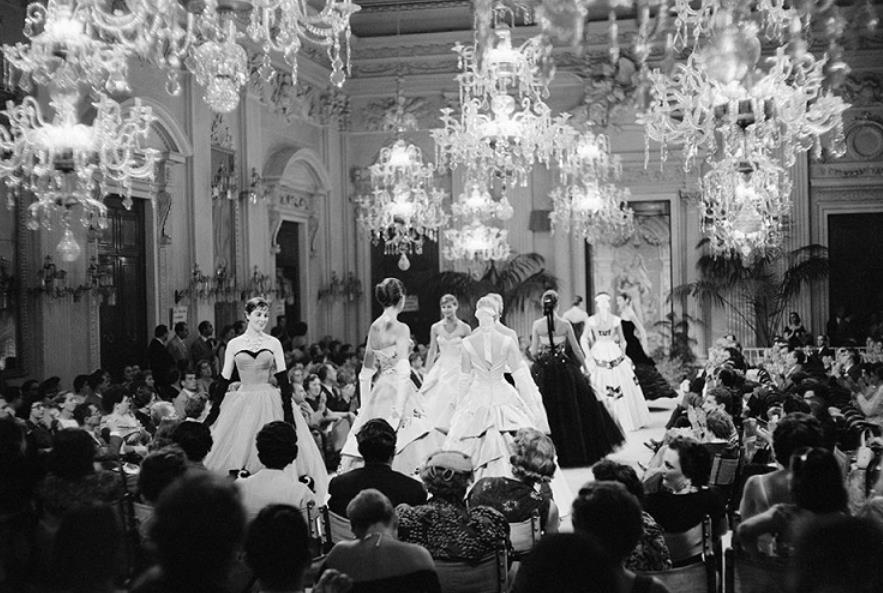
The event at Via dei Serragli was a huge success. Models wore dresses on a single catwalk from the most important Italian designers of the period. Each model carried a number in her hand so that the buyers from I. Magnin, Bergdorf Goodman, B. Altman and other high-end American department stores could identify the maker.
Savvy Giorgini had also invited journalists to his event, including the correspondent for Women’s Wear Daily. Even though the buyers and journalists had just been at the Paris catwalk shows, Italian fashion scored a big win that winter evening in 1951.
American buyers had to wire their firms in the States for increased budgets to purchase from the Italian ateliers; the ateliers themselves were slammed with so many orders that it was almost unbelievable. The American buyers were over the moon with excitement over their new discovery of a previously untapped fashion resource, but were also keen on the price factor. Italian designs at this time were about a third the cost of their Paris equivalents.
It is further said that both Emilio Pucci and Schuberth began their careers that night.
Making the most of the wind under their sales by the fabulous and successful coming-out party at Giorgini’s home, a second fashion event was held the following year at the Grand Hotel in Florence.
Due momenti della seconda sfilata di Moda Italiana, svoltasi presso il Grand Hotel di Firenze dal 19 al 21 luglio 1951 (AS di Firenze, Archivio della Moda italiana di Giovan Battista Giorgini)Image 3 of 7
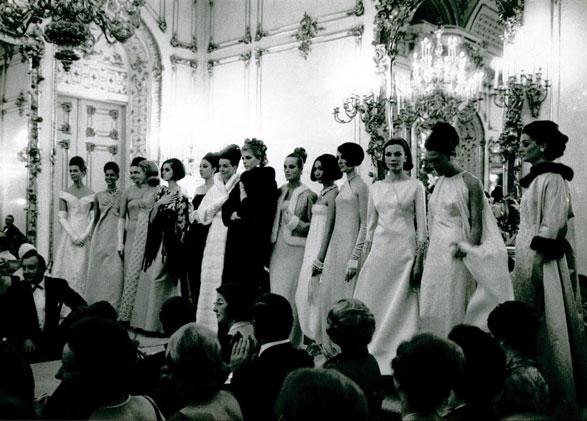
These fashion extravaganzas proved to be such a success that Florentine leaders joined the bandwagon and sought a more suitable setting. They enhanced the exhibition of Italian fashion design by hosting it in the Sala Bianca, or the chandeliered and opulently decorated white room, at the famed Palazzo Pitti.
From this beginning in February of 1951, created by Giorgini, new talents were spawned, including Capucci, Galitzine, Krizia, Valentino and Mila Schon.
The gentleman shown above with all the models is Count Giorgini.
Giorgini continued to work with these shows and each year he increased their excitement by launching new initiatives, such as one year it was all about “textile promotion”.
By 1958, Italy had overtaken France and England as leading European exporters to the US of textiles, apparel and accessories. Italian exports in women’s clothing had risen from 45 million articles in 1950 to 2 billion in 1957! Shoes alone skyrocketed from 208 million pairs exported in 1950 to almost 19 billion in 1957. (See more at: http://www.eurbanista.com/fashion-history-italy-after-ww2/)
Giorgini was also the first person to fully understand the potential of the new importance of prêt à porter, or ready-to-wear, and the so-called boutique lines. One could almost call the count a democrat. He was all over making high fashion available to regular people.
It’s a fact: Giovanni Battista Giorgini launched the world of Italian high fashion design! I am sure I speak for aficionado’s everywhere when I exclaim one big grazie a Giorgini!
This story isn’t finished, however, and I’ll be back with a second post presto. Stay tuned!
Updated: Nov. 12, 2014 I would like to thank the Director of the Archivio Giorgini in Florence, Mr. Neri Fadigati, for reading this post and making suggestions for improving it.
But in the meantime, here is a vintage video from 1959, which shows Giorgini speaking about Italian fashion at about 4 minutes in.
After posting the blog post from on the Siena Palio, I am inspired to add from my personal recollections of the race. I was incredibly fortunate to attend a Palio in the early 1990s.
My Italian boyfriend said the Palio was not to be missed and he made a lot of special arrangements for my first experience. He was assolutamente right–it was not to be missed!
We drove to Siena that day from his home in Assisi. He had used his contacts so we could watch the race from a balcony window to the left of the Palazzo Publico and I prepared to be amazed. I was indeed!
It was an unbelievable thrill to be a part of the living history of the Palio. We stood outdoors on the balcony on a warm sunny Italian pomeriggio with a perfect view of the entire race. It was an incredible experience to be there.
My favorite part of the day of the race was the banner guard that circled the race track prior to the race. Each contrada enters their own people wearing their own contrada colors. It felt like I had time traveled back to the Italian Renaissance.
I grew up with a horse-loving father and we not only rode horses but attended rodeos almost every summer Sunday. I even competed in some of the events. Sadly for my father, I am not a lover of risk-taking horseback riding, either to do or to watch. Because of that, it was hard for me to watch certain parts of the Palio, for the race is still brutal even though it is much less so than it was during its early centuries; horses and riders careen into the temporary walls set up all around the periphery and riders fall off horses and get trampled. It is all very chancy. You can see it in this video:
After the event was over, we ran around all the side streets in all the contrade (neighborhoods of old Siena), which were filled to overflowing with rabid fans (think American super bowl fan fanaticism)
all wearing their contrada colors.
Each contrada maintains a museum of sorts with all sorts of paraphernalia from years past. These museums are typically only open on the day of Palio, so it is a once-in-a-lifetime opportunity to see not only the race, but the museums as well.
The one aspect of the Palio that absolutely blew my mind is that the winning horse is brought into the Siena Cathedral! The secular and divine come together in patrioticism.
Somehow I just never thought I would live to see the day when I’d see a horse in a magnificent Italian cathedral!! But that was before I knew Italy at all!
Here are some more fun shots of the hysteria surrounding this annual event in Tuscany!










 get back, lauretta!
You must be logged in to post a comment.