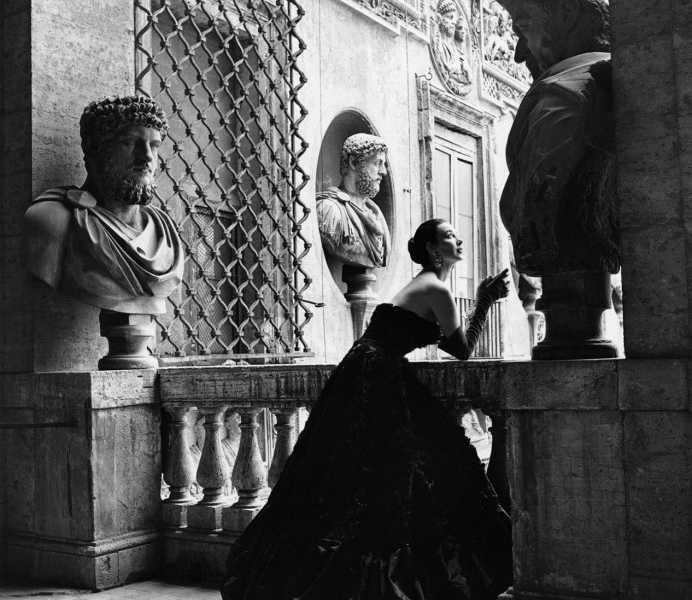
Gown above by Simonetta.
Last summer the V & A in London had an important exhibition on Italian fashion called The Glamour of Italian Fashion 1945 – 2014. Much of this post is taken from the website link, given at the bottom.
Both women’s and menswear were highlighted in the show, with an emphasis on the techniques, materials, and expertise for which Italian fashion is renowned.
The V & A included around 100 ensembles and accessories by leading Italian fashion houses including Simonetta, Pucci, Sorelle Fontana, Valentino, Gucci, Missoni, Giorgio Armani, Dolce & Gabbana, Marni, Fendi, Prada and Versace.
Here’s a video (Click on the “Vimeo” button to see it) about the opening of the show:
The Glamour of Italian Fashion 1945 – 2014 
The Glamour of Italian Fashion 1945 – 2014
Years following WWII:
Following the despair of the 1940s, Italy’s post-war government aimed to reinvigorate a country weakened in spirit and in physical and financial ruin. American aid helped Italy get back up on its feet, with support provided through the Marshall Plan.
Even the fashion world was helped by these conscious efforts to rebuild: the swift retooling of Italian factories alongside efforts by the country’s many entrepreneurs helped fashion become a cornerstone of Italy’s post-war recovery.

As clothing designers and textile manufacturers gradually resumed trading, their stylish designs responded to a hunger for glamor after years of wartime deprivation. Italian high fashion and fine tailoring became one of Italy’s most successful and popular exports.
Return to Luxury post WWII:

The fashion industry gradually built itself a luxury market. Giovanni Battista Giorgini launched Italy’s first internationally recognized fashion shows. In 1952, he secured the use of the Sala Bianca (White Hall), an opulent, chandelier-lit gallery in Florence’s famed Pitti Palace, for the landmark catwalk shows that would be held in the Renaissance city throughout the 50s. This exciting moment propelled Italian fashion onto the world stage, front and center.
Hollywood on the Tiber:
During the 1950s and 1960s, so many Hollywood films were shot on location in Italy that Rome was nicknamed “the Hollywood on the Tiber.” Movie stars like Audrey Hepburn and Elizabeth Taylor became almost ambassadors for Italian fashion, which fueled a keen international appetite for the luxe clothing fabricated in Italy. (Please see my earlier post on Roman Holiday and Funny Face; I am a huge fan of Miss Hepburn.)

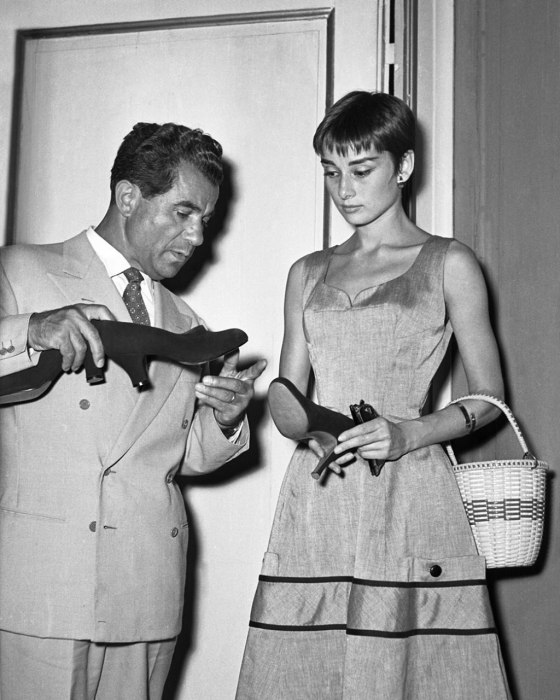
Salvatore Ferragamo discusses shoes with Audrey Hepburn


Throughout the 1950s and 1960s, Italy’s economy had grown rapidly, driven in part by the fashion and textile sectors. In the years that followed, despite social and political instability, Italy’s fashion industry blossomed. Numerous fashion and related manufacturing businesses started up, many of them family-run.

Tailoring
Italy’s reputation for tailored clothing developed internationally thanks to popular images of stylishly dressed Italian actors. Marcello Mastroianni’s trim suits in the 1960 film La Dolce Vita inspired fashion-conscious men everywhere.

That movie alone popularized the men’s Italian suit worldwide. Made to measure suits for an individual client were the launching pad for a growing international clientele, followed by the increasingly popular ready-made suits of later decades.

A well-tailored suit requires precisely cut fabric and exact fit, along with fine finishing details. The smallest design elements, such as the shape of a pocket or sleeve, often differed from region to region. A Neapolitan suit could be distinguished from one produced in Rome.
The emergence of ready to wear:
From the early 1970s, the popularity of couture gave way to enthusiasm for manufactured fashion. Milan – with its fashion press, advertising industry, and nearby clothing and textile factories – became Italy’s new fashion capital.


Made in Italy:
‘Made in Italy’ was a marketing campaign that celebrated a rainbow of premium goods: cinema, art, food, tourism, design and, chief among them, fashion. This decades-long, international promotional campaign ensured that ‘Made in Italy’ became the mark of style.
Cult of the designer:
Since the mid-1990s, fashion has become ever more international. Many more Italian designers have become celebrities in their own right and solidified their country’s reputation as a global tastemaker. These designers sell a universe of goods across continents, from clothing to furniture to hotel interiors. Some have transformed long-established family firms into international luxury brands. All have a devoted following.
The designers in this section are at varying stages on the journey to recognition. Some have the tradition of generations behind them. Others emerged onto Italy’s fashion scene only a few seasons ago. What unites them is a loyal clientele, an emphasis on Italian production, and a place at the top end of fashion, where Italy’s designers continue to find their competitive advantage.
The bright spot in Italy’s generally sober economic outlook is the limitless demand for a taste of Italian style. Italian fashion companies are still influential, even as Italy’s reputation has suffered.
What will ‘Made in Italy’ mean in future?
The years since 2000 have been marked by political scandal, immigration tensions and economic problems. Italy’s once famed networks of textile production and related industries are thinning. Its premium fashion houses are increasingly foreign-owned. Chinese factories, workers and consumers are now intertwined with the destiny of the Italian-made.
Sponsored by Bulgari:
Bulgari is proud to sponsor this exhibition. Bulgari is an emblem of Italian creativity and craftsmanship, renowned for its distinctively Italian style. From the 1960s Bulgari was acclaimed for creative designs incorporating colored gemstones. This exhibition features legendary jewels once owned by Elizabeth Taylor.


A couple of last looks from the exhibition:


The V & A exhibition also asked the question of what the future might hold for Italian fashion, including a short documentary about the future of the Italian fashion industry vis a vis competition from lower-wage markets such as India and Asia and also the marketing power of the established fashion houses, which makes it harder for newcomers to gain a foothold. Thought provoking stuff.
 get back, lauretta!
You must be logged in to post a comment.