Roman era frescoes from Trastevere

There is another amazing set of Roman era frescoes preserved at Palazzo Massimo! Their collection is simply superb!

Today’s post is centered on the antique discoveries found in Trastevere, at the incomparable Villa Doria Pamphili. While the 17th-century estate we can see today was designed as a modern Baroque escape, the villa sits directly atop and extensive ancient Roman necropolis and the ancient Via Aurelia Antica.

Frescoes from this necropolis and specifically its columbarium are the subject of today’s post. A columbarium holds funeral urns filled with the cremated ashes of deceased persons in ancient Rome. It takes its name from the Latin word for dove, columba, and is so-named because the niches look like dovecotes. The group of niches could be combined as a freestanding structure or a part of an underground burial place. They were often decorated with small paintings and might include an epitaph.

The ancient frescoes from the great columbarium discovered at Villa Doria Pamphili are now permanently displayed at Palazzo Massimo. These intricate wall paintings were recovered from the underground burial chambers that sit below the later constructed villa. This subterranean structure belonged to a wealthy Roman family or a burial society.

The frescoes feature miniature friezes that depict diverse themes, ranging from everyday life and Nilotic landscapes to exotic animals, Pygmies, and various mythological scenes painted directly above the niches meant for funerary urns. In the long walls of the burial building from the 1st century AD, landscape scenes alternate with burial niches for cinerary urns and inscriptions with the names of the dead. The walls featured detailed landscape scenes, floral motifs, exotic animals, theatrical masks, and mythical scenes such as Prometheus and the eagle. The ancient tombs were unexpectedly joyful, covered in vivid, delicate frescoes meant to resemble the interior of an elite Roman villa. 
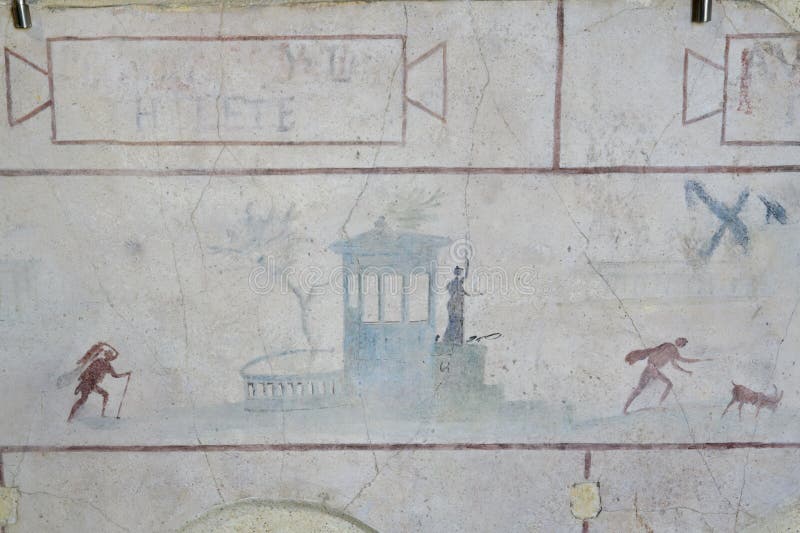
The discovery and extraction of the frescoes from the Villa’s necropolis is also a fascinating story; it spanned nearly a century, evolving from a private aristocratic excavation into a major state conservation effort.

The initial discovery in occurred in 1838 when the Great Columbarium was unearthed on the expansive grounds of the Villa estate. It was found on the slopes of the Janiculum Hill, close to the Casino del Bel Respiro. The excavation was commissioned directly by the noble family, who owned the property and often went looking for classical antiquities. This had. been a rewarding pastime for Romans since antiquity itself.

Excavators realized the columbarium was part of a vast Roman burial complex, running along the ancient Via Aurelia.  Because the building was burned underground, its vibrant early Augustan-age paintings (dating to 30-20 BC) remained exceptionally well-preserved.

To protect the delicate wall paintings from deteriorating from environmental exposure inside the subterranean chamber, a team of specialized conservers officially detached the frescoes in 1922.

Following their removal, they became part of the state collections administered under the National Roman Museum. They were meticulously transferred onto new supports so they could safely be put on public display.

The historical significance of the site was further cemented in 1984.  During the fast-tracked structural renovations of the Palazzina dell’Allgardi, (done to prepare the building to host the Italian Presidency of the Council of the European Communities (EC). Today, the building serves as an official representative office for the Italian Presidency of the Council of Ministers) on the villa grounds, architects accidentally rediscovered another beautifully pained adjacent structure, the Columbarium of Scribonius Menophilus, but Columbarium of Caius Scribonius Menophilus is a remarkably preserved tomb featuring an intricate black and white tile mosaic floor detailing the name of the freedman owner. However, that must be a subject for another day.

Today the main room of the original columbarium discovered in 1838 still stands hollowed out at the villa, but its artistic heart is fully reconstructed inside the climate-controlled rooms of wonderful Palazzo Massimo.

For a video of the site, I can recommend this: https://youtu.be/n66bqfGdbx4.
Podcast Episode #1: Rome Through Art And Flavor

Pip: Rome in late spring, where even a nondescript building hides a courtyard full of sarcophagi, and the gelato is technically a health food.

Mara: blogger Lauretta Dimmick, who writes the blog Get Back Lauretta, has been moving through Rome at full tilt — palaces, piazzas, baroque staircases, fresh tuna, and a new pope making headlines. Let’s start with the streets and landmarks that frame the whole visit.

Rome Landmarks And Streets

Pip: Rome rewards the wanderer — the post “Rome! Endless variety” is essentially a love letter to the city’s capacity to surprise, block by block.

Mara: The line that stays with me: “Almost every day I see something that makes me say: I have never seen that before!”

Pip: That’s the whole premise, isn’t it — Rome as a place that keeps outpacing expectation, no matter how many times you’ve been.

Mara: Concretely, that means jasmine trained up the side of a villa, acanthus plants blooming just outside the Roman Forum — plants whose leaves appear on every Corinthian capital in the ancient city. The fit is almost too perfect.

Pip: And then a stop at Neve di Latte for natural gelato, though Francesco remained unconvinced it was worth the calories.

Mara: The Piazza di Spagna post rounds out the street-level picture with a video tour of one of Rome’s most iconic squares. From the piazza, we move indoors — deep indoors.

Palazzo Barberini And Baroque Splendor

Pip: Palazzo Barberini is the kind of place where even the staircase gets a superlative — and the post on part two makes the case directly.

Mara: The title itself is the argument: “The most lovely marble stairway ever? I think YES!” And embedded in those Doric columns are the Barberini bees, the family’s symbol, carved right into the stone.

Pip: The bee motif runs through everything — ceiling frescoes, ironwork, the whole building is essentially branded.

Mara: Part one slows down for the paintings, and the writing is genuinely attentive. On Fra Filippo Lippi’s Annunciation, it notes the transparent scarf wrapping Mary’s wrist: “to use it as a compositional element” leading the eye between Gabriel’s lily and the top of the canvas.

Pip: Noticing the servants on the hidden staircase rather than the kneeling donors — that’s a particular way of looking at art.

Mara: Part three closes the visit with Corradini’s famous statue and one last reminder: the bees appear “throughout the building — and indeed the city.” From baroque splendor to something more immediate — what’s on the table.

Food Coffee And Daily Pleasures

Pip: Two very different pleasures anchor this stretch — one philosophical, one extremely fresh.

Mara: The coffee post is almost aphoristic: “Coffee is the balm of the soul” — attributed to Giuseppe Verdi, found on the back of an espresso machine in Montecatini. That’s the whole post, and it lands.

Pip: Short, correct, no notes.

Mara: The tuna post is the opposite — vivid and specific. A fishmonger in Rome who “begged” them to buy an outstanding tuna, two enormous steaks, red shrimp, squid for calamari. The calamari, reportedly, was “quasi sweet” and unlike anything before. The only regret: no photos of the finished dishes. From the table, to something more public.

Papal Respect And Public Witness

Mara: Pope Leo XIV appears in the title of a post here — “Pope Leo XIV again shows what respect looks like” — framing a moment of public witness worth marking.

Pip: The word “again” is doing real work in that title. It implies a pattern, a posture, not just a single gesture.

Mara: And that consistency — the idea that respect is demonstrated repeatedly, not announced once — is what the post points toward.


Pip: Streets, staircases, espresso philosophy, and a pope setting a standard — Rome contains multitudes.

Mara: More of it next time, apparently. The sign-off is always “alla prossima” — until next time.

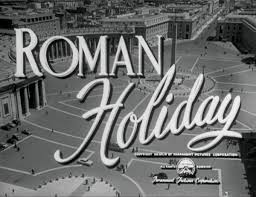
Roman Holiday

Oh, how I love this movie!  It is my favorite single film of all time.

images

It was released in 1953, which was a very good year! It was Miss Hepburn’s first starring role in an American film, even though the whole thing was set in Rome.  It has a fantastic story which is as moving as it is comedic.

cropped-audrey_hepburn_and_gregory_peck_on_vespa_in_roman_holiday_trailer1.jpg

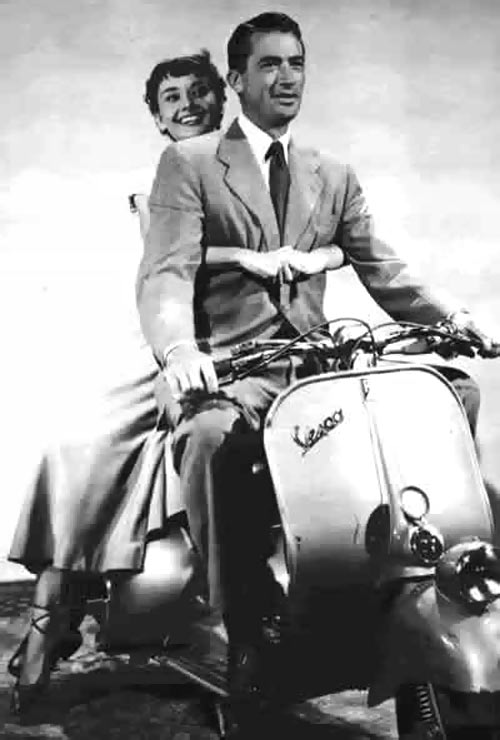
Audrey Hepburn and Gregory Peck on a Vespa (bzzzz, bzzzz, vespa means hornet in Italian) with Rome as a backdrop.  It doesn’t get any better than that!  All of my favorites in one shot.

images-3

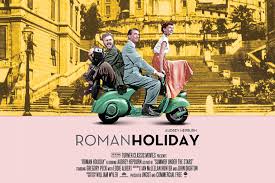
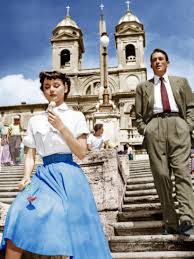
Here the actors appear on the iconic Spanish Steps.  Miss Hepburn was the perfect age to play a European princess and Mr. Peck was completely believable as a seasoned American journalist looking to get a scoop on a story.  (This is an important distinction, for not every American leading man will be a believable love interest for the amazing Miss Hepburn in her future films.)

27sd-vespa-scooters-2

A publicity still.

roman_holiday manifesto

I didn’t discover this movie until I was an adult, but it didn’t matter, I fell for it completely. And then, one time I was visiting my friend, Grayce Murabito, in her little village, Casoli di Camiore, near Lucca, and I met the very charismatic Eddie Albert who also had a major role in the film.  Grayce and Eddie had been an entertainment duo in their early professional careers.  I will write a post on them soon.

Here is a still of all 3 of the movie stars, Audrey, Gregory, and Eddie.

images

Which was turned into a great poster:

images-4

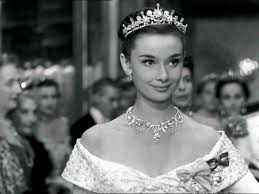
When the movie begins, we meet the character Miss Hepburn plays, Princess Ann.  She is a very miserable young royal who is stifled and bored in her constant round of official presentations, even when they are in Rome.

3292136204_f6924eb805

She wants nothing but a little fun in her life and to be released from always doing the right thing.

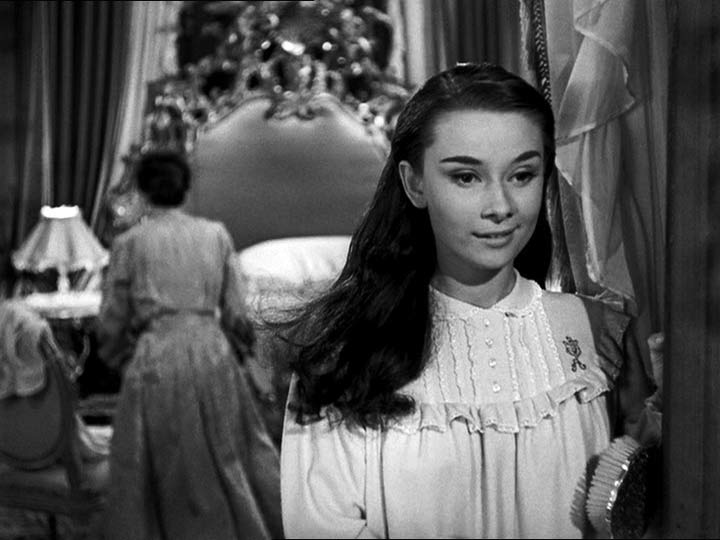
After she has been all but tucked into bed by her female attendants in her glamorous Roman chamber, she manages to break free.

?????????????

Some hi jinx ensue and she winds up in the care of an American journalist who coincidentally is in desperate need of a scoop.  For quite a while he doesn’t realize he has one.

audrey-long1

In the meantime, the princess tastes freedom.  For starters, she gets her hair cut.  She wanders around the streets of Rome, caught up in the sweet pleasure of her freedom to do just as she likes (dolce far niente), and when she strolls by a hairdresser, she can’t resist going in for a break-all-the-rules fashionable haircut.

2RomanHoliday1

audrey-hepburn-roman-holiday-18

rh220

roman_holiday_short_haircut

roman_holiday_haircut

Of course her new pixie haircut looks marvelous on her because, after all, she is still Audrey Hepburn!

So, heartened by her new hairstyle, Princess Ann does other daring things, like ride around Rome on a Vespa with an American man.

100513-01-Gregory_Peck_and_Audrey_Hepburn_on_scooter_in_Roman_Holiday

And wander the streets of Rome freely, meeting the people.

ah11

And attending an ordinary dance for ordinary people, at which she dances with her handsome journalist friend.

audreydanceswgreg

And sleeping in his tiny apartment in his pajamas.

princess

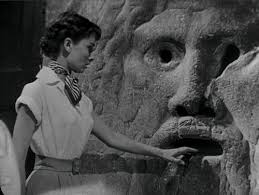
She and her journalist friend visit the famous la boca della verita (the mouth of truth) in Rome.  Joe Bradley tells her the myth, which purports that, if you put your hand into the mouth of this sculpture and tell a lie, your hand will be bitten off.

audreyandboca

Ann is apprehensive, but tests it.  Then she and Joe collapse in laughter at her silly fears.

mouth-of-truth

Along with tasting freedom, the princess also inadvertently gets a taste of love in her dashing co-conspirator.  Only she doesn’t know he knows who she is and that he is actually setting her up.

audreyhaircut

But he has fallen in love with her as well.  How could he not? The entire western world was falling in love with Audrey Hepburn right then, no matter what role she was playing.

roman-holiday-audrey-hepburn-g-peck-apt2

42_4990301671_7ba6c0088e

In the end, she goes back to her duties and you will have to watch the film to find out how Joe Bradley winds up using his scoop.

ah8

Here’s another still with some technicolor added later.  The princess has discovered gelato as well as freedom.

images-2

The critics and the public alike were captivated by Audrey and her performance in Roman Holiday and she was feted with multiple awards.  Miss H was the first actress to win an Academy Award, a Golden Globe and a BAFTA Award for a single performance.  This beautiful film set Miss H up for a series of great upcoming performances on the American screen.

AHepburn1_V_21nov11_pa_b1953 OSCAR B.A. AWARDS GIVENCHY

It is sweet to look at this candid photo of the two lead characters playing cards during a break from filming in Rome.

article-2394555-1B49CDAA000005DC-662_306x423

Sigh.  It is such a beautiful film. Run, don’t walk, to see it as soon as possible.  Ride your Vespa if you can.

Ciao a tutti!

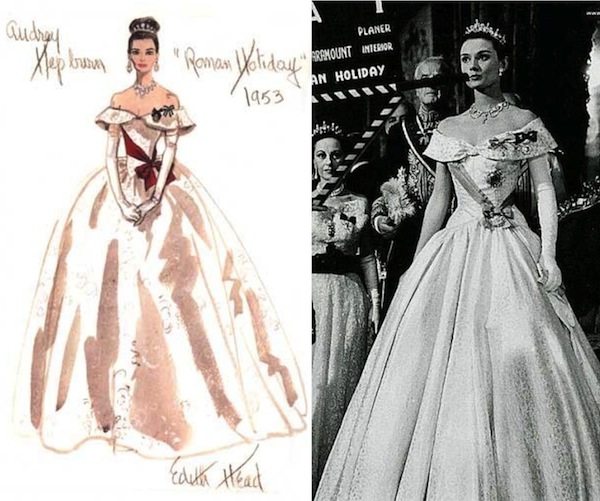
Post script: Famed Hollywood designer, Edith Head, created the looks Miss Hepburn wore. Here is Miss Head.

:6a00d8341c630a53ef01539294fef0970b

Slide2

And here is the sketch Miss Head designed for the ballgown Princess Ann wears to receive dignitaries.

romanholiday

And, finally, one last, luminous shot of Audrey Hepburn in Rome on the Spanish Steps in color from 1953, for no other reason than I can.

Here’s the vintage trailer for the movie: