Besides being on-call yesterday for the etiquette police (https://wordpress.com/post/48620893/7789/), I wandered around the Palazzo Medici-Riccardi, taking in as many of its many marvels as possible.
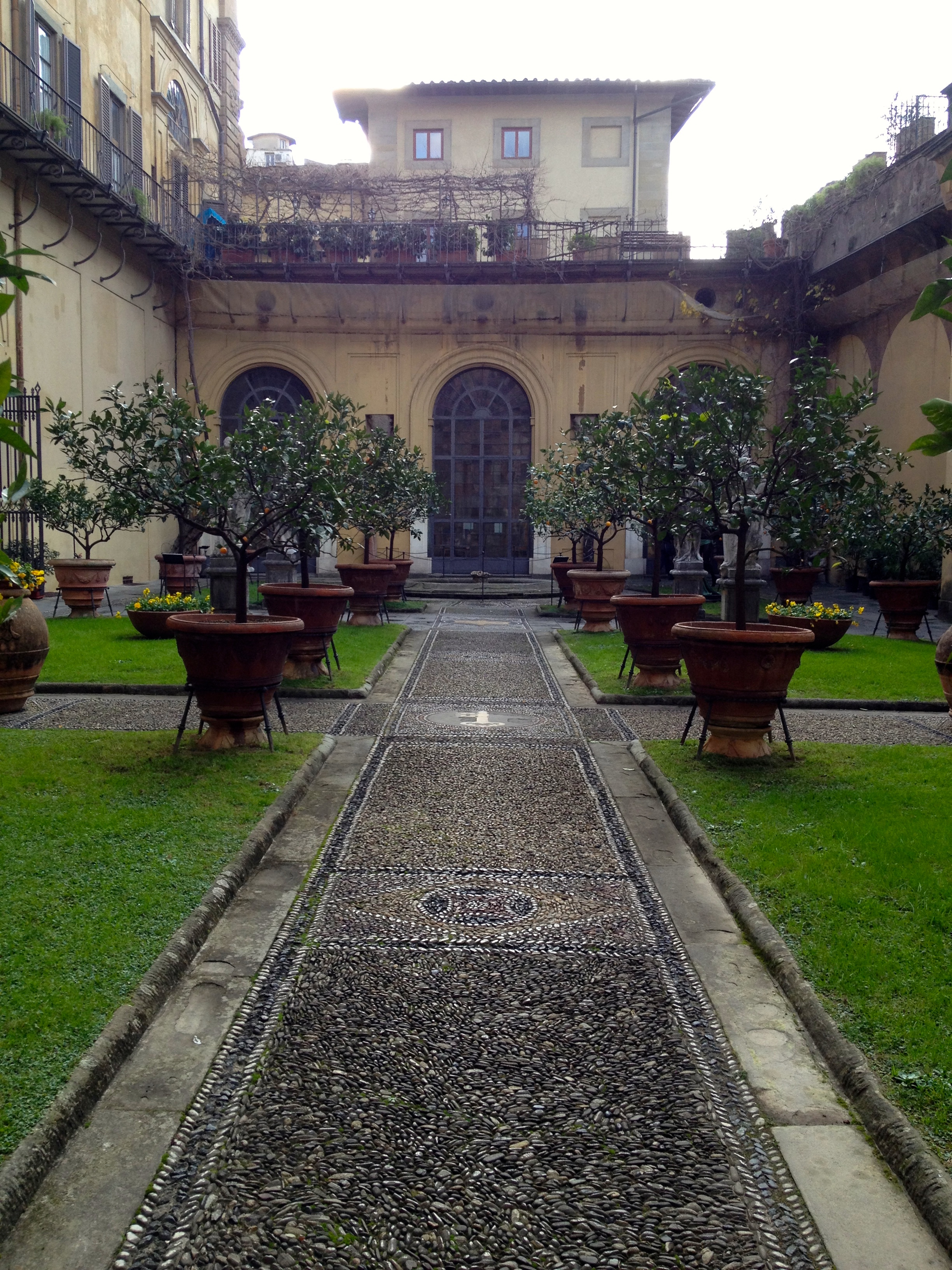
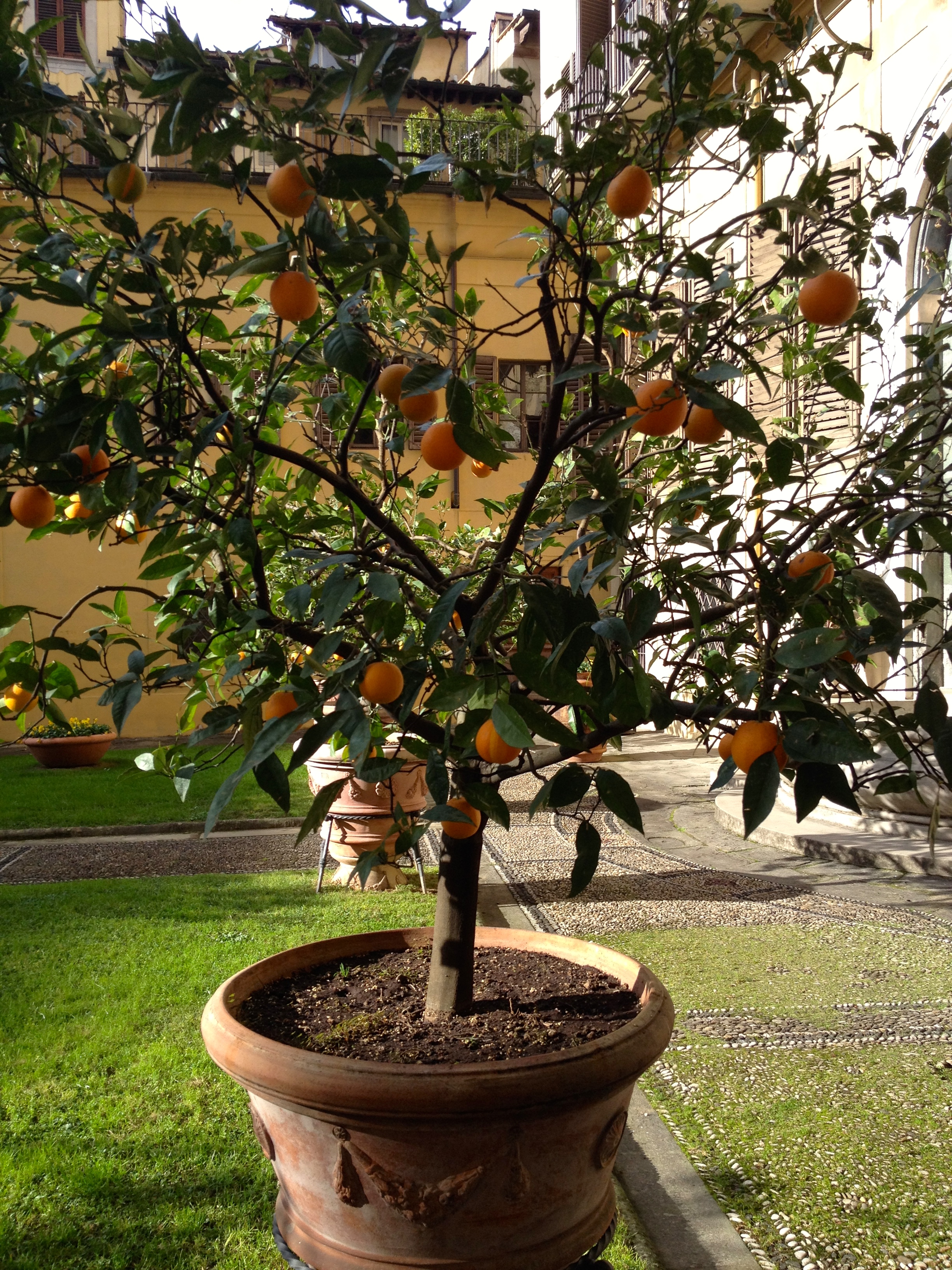
The potted orange trees were looking delightful, bearing their fruit like Christmas tree ornaments.
You know how much I love potted citrus trees in Italy in winter.
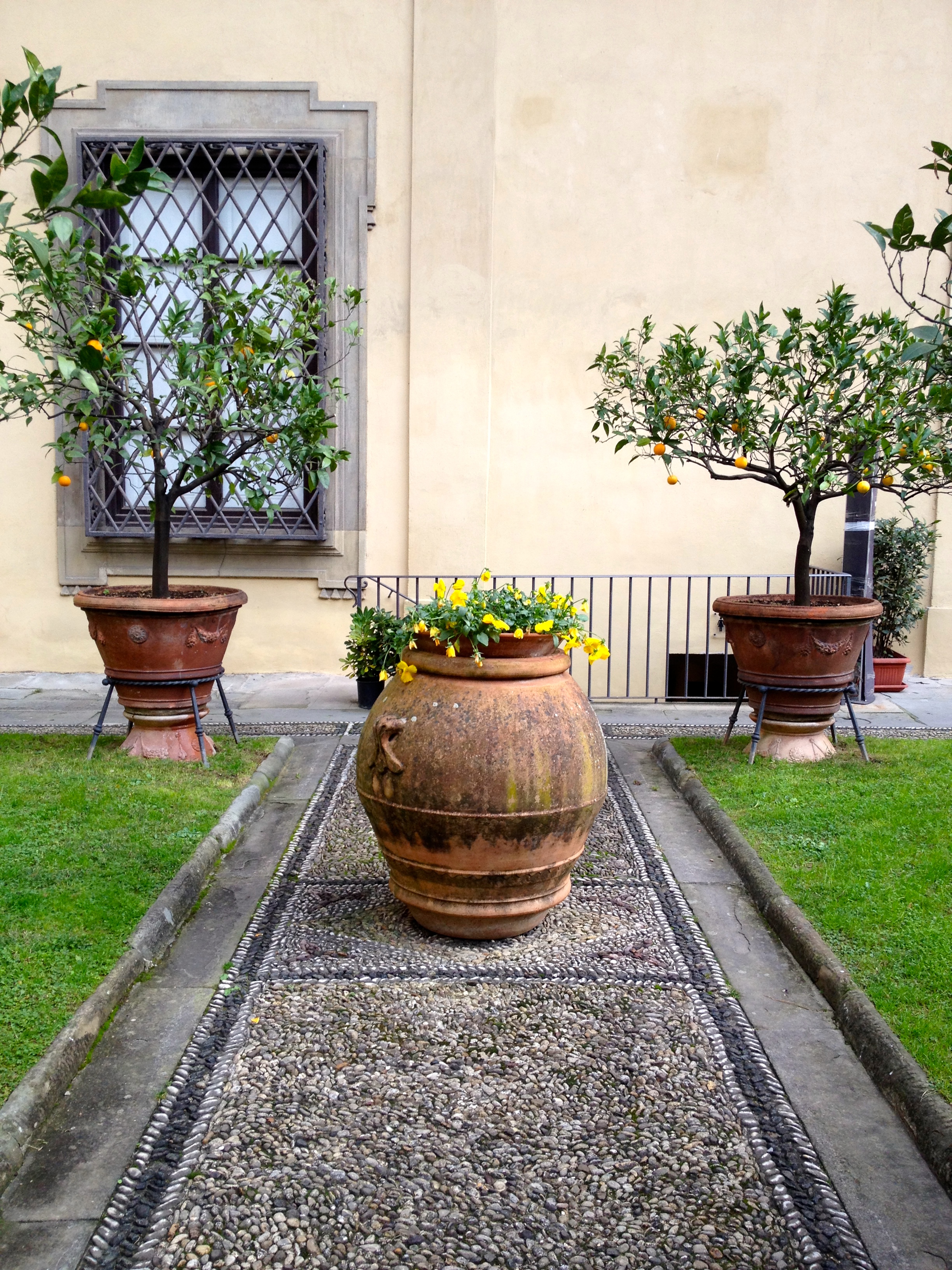
The pansies were holding their cheerful heads up very high, reaching for the warm rays of sunlight.

Much of the pathway system throughout the garden is made from these hand-set riverstones in concrete. I first saw this technique used in Japan, but obviously great cultures think alike when it comes to some things.
Hold that thought on the possible influence of Asian techniques for below.
I also like the way the moss has added its own organic modification to the image presented to us. You can really see the moss on the pavement 3 pictures up, the one of the close-up of the orange tree. Isn’t that moss wonderful! And it adds a slight earthy fragrance to the garden, and maybe a little humidity. Moss rocks!
And, at one end of the great formal garden, I noticed a very large and obviously very aged wisteria vine. It added a majestic contrast of wild nature into this otherwise very orderly landscaped space.

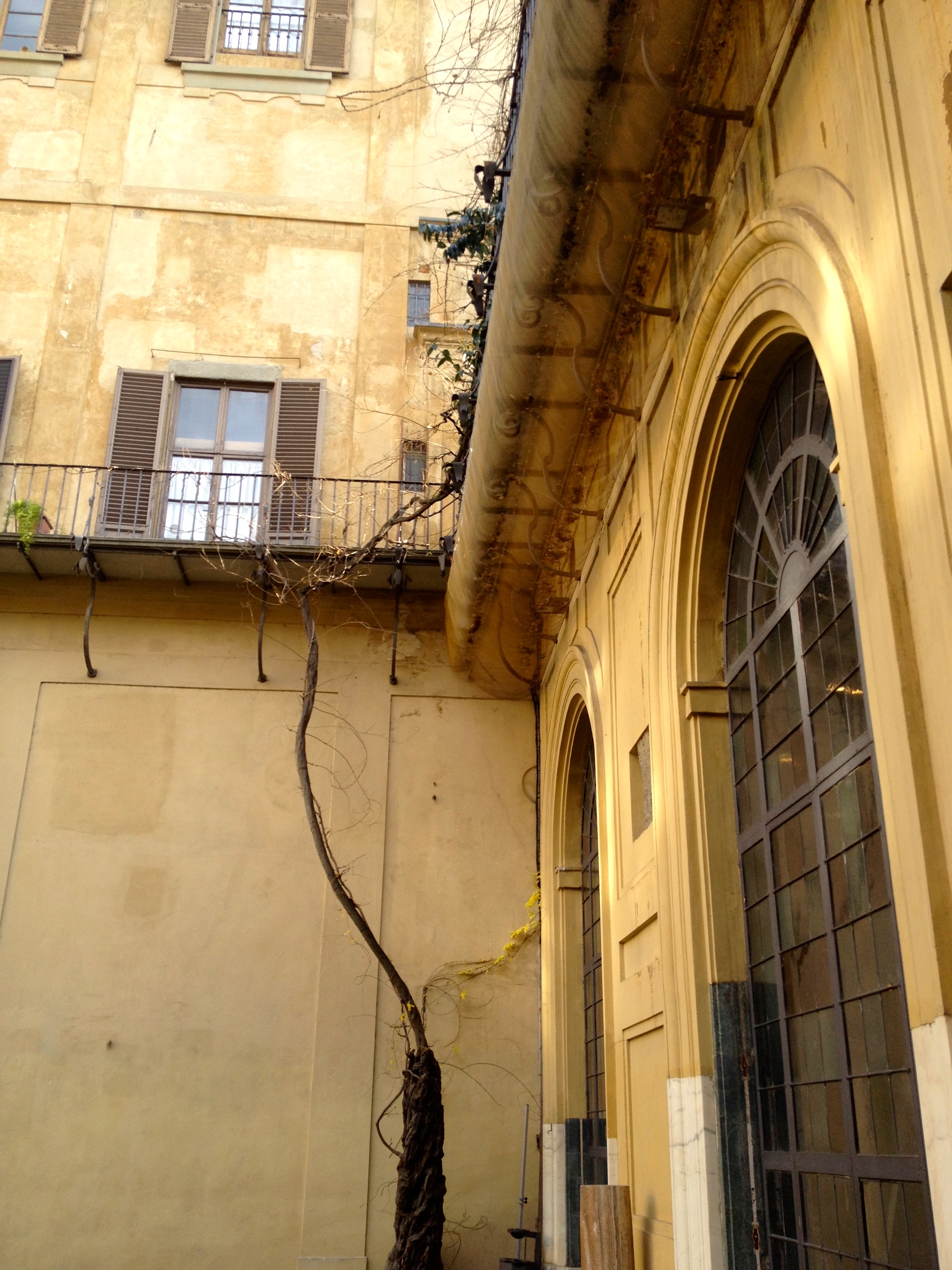
This wisteria trunk is magnificent, for its wildness and strength (wisteria can be a weed in some places). It’s being partially held up by a wire support as you can clearly see. All wisterias need supports, whether they’re in nature or in a man-made garden.
The vine has been severely pruned, obviously, over the centuries, and I couldn’t help but wonder if it were growing here when Lorenzo de Medici was living here in the quattrocento. It’s possible.
The picture below shows a younger vine trunk on the opposite side of the courtyard. The two vines are strategically placed so that they meet over one end of the courtyard, covering it with lavender colored blossoms in a manner I can only imagine for its stunning beauty.
I know an old wisteria vine in Seattle quite well. When I give tours of the Seattle Japanese Garden to visitors, I never fail to walk them by the braided trunk of that vine and challenge them to guess how old it is. I don’t have a great picture of the Seattle vine trunk available right now, but if you look at the lower right corner in the following picture, you can make out some of the trunk’s volume and shape.

This Seattle wisteria plant is about 100 years old, for it was planted in the 1960s when it was already known to be about 40 years old. The landscape architect for the Japanese Garden hand-selected most if not all of the specimen in that landscape, and it is not a coincidence that an already mature wisteria plant was placed in the Seattle garden.
So, if the Seattle wisteria is about 100, with a diameter of the trunk at about 6 inches
Just imagine how old the Florence wisteria must be with its largest diameter at about 20 inches. I think you are starting to get the picture.
So, you see, it is possible that this plant has watched 600 years of human activity in and around it. We always say, “if walls could talk.” In this case, I wish plants could talk. Think what this vine could tell us about the people who lived and plotted here. It boggles the mind.
And, as far as aesthetics: well, for a person with a vivid horticultural imagination, my mind can go wild with visions of the Florence wisteria in bloom in a few months. As a reminder of wisteria’s glory, take a quick look at the Seattle Japanese Garden vine in bloom about 8 months ago.
Love, love, love. Pendulous racemes, as heavy with flower as a hanging bunch of grapes. Lavender color. Beauty.

POW! Gets me every time. A beauty knock-out!
OK, so one last point: remember the East meets West confluence I noted above with the inlaid riverstone pavement? Well, add this to the mix. The source, as always, is my home boy, Wikipedia:
Wisteria (also spelled Wistaria or Wysteria) is a genus of flowering plants in the pea family, Fabaceae, that includes ten species of woody climbing vines native to the Eastern United States and to China, Korea, and Japan. Some species are popular ornamental plants, especially in China and Japan.
Uh-huh, that’s right, wisteria, especially the ornamental type, is native to Asia. So, we can say with confidence that just as Italy (read Europe) was importing porcelains, teas, silks and exotic spices from the East, plant collectors were hustling hither and yon all over Asia, looking for plant sources that could be grown in Europe and which European would like to grow in their gardens.
I am an art historian by training and, as surely as we study provenance as a tool for determining a painting’s authenticity, horticulturalists study when and how plant materials were introduced to other continents. It is completely plausible that the paving river stones and the use of the ornamental wisteria informed the Medici patrons who built this palazzo, or the Riccardi family who later enlarged it–or perhaps just the garden designers and workers who created this formal giardino— with layers of culture that only the well-informed–then and now–can truly appreciate. I live for those people. I am one of those people.
And, finally, a wondrous yet superficial fact: did you know that you can tell if the vines are from China or Japan by whether the vine twines itself around its support in a clock-wise or counter-clockwise pattern. The Chinese varieties twine clockwise; the Japanese counter-clockwise. Isn’t nature grand! I just love it for its complications and patterns.
Now, if your mind works like mine does, you are going to ask me which way the Florence wisteria twines.
And I am going to admit that I have no idea, because I wasn’t thinking about that yesterday when I was there, and also because the vines had been so severely pruned that there was no obvious indicator of twining direction.
Which obviously means I will have to come back to Florence in May and June to get to the bottom of this mystery.
Ha ha. Don’t I wish!


 get back, lauretta!
You must be logged in to post a comment.