
Month: December 2014
Another heavenly Florentine pharmacy
The lovely pharmacy I posted about recently has stiff competition in a country where the herbalist’s art is alive and well. Judging from the products overflowing from every actual pharmacy in the town as well as the many naturalistic products shops, the Italians place a high value on nature when composing their bath and beauty elixirs.

The Farmacia SS. Annunziata traces its beginnings to the 16th century, thus a relative newcomer compared to the Officina dells Santa Maria Novella. But, the history of the SS. Annunciata is also quite venerable. By the 16th century we can identify the first manager of the pharmacy, one Domenico di Vincenzo Brunetti, and since his time the pharmacy has maintained its special tradition of preparing medicines and herbal products for the bath and body.

The Farmacia is located in Florence at both #30 (black) and #80 (red) on the well-worn Via dei Servi which branches directly off the Duomo grounds. The pharmacy’s unusual number identifiers speak to the arcane Florentine system of giving businesses a red address number and residences a black number address. It is easy to get confused, but that is just what a trip to Italy is all about in a sense.

The pharmacy’s building dates to 1400, the street on which it is situated was paved in 1421. Florence was then one of the richest and most powerful cities in all of Europe. The pharmacy’s original name was The Domenico di Vincenzo Brunetti Apothecary, dating to 1561. Domenico himself was a member of the important Florentine guild, the Arte dei Medici e Speziali, and he opened his chemist’s shop where he could sell the many medicinal herbs and concoctions he mixed. In 1935, the pharmacy was renamed Farmacia della SS. Annunziata.

Today the pharmacy is both owned and managed by the Azzerlini family. The family takes pains to assure us that even though modern methods are used today to prepare their products, the same recipes and care are taken with each formulation.

That’s good to know because ever since 1561, this venerable pharmacy has always had a particular tradition in formulating products for the hygiene and beauty of the skin. Back in the day, products were made by hand with palette knives and mortar and pestles.

The educational leaflet that accompanies purchases from the Farmacia SS. Annunziata says the following: “The pharmacy uses only the highest quality ingredients available on the global market and preparation is done with precision using advanced, high-tech machinery. The finished product is always fresh and in accordance with all current technical and legislative standards and the psycho-physical needs of the client, as well as the needs of the skin according to the climate and/or seasonal changes, are always carefully considered in the making of both new and old products. None of the old traditions have been lost. None of the benefits of modern technology have been neglected.”

Farmacia SS Annunziata is in fact one of the oldest of all Italian apothecaries, and it is thought that it may have existed in particular for the Benedictine monastery in 15th-century Florence. Today, the mode of production is modernized, but always with an eye for the respect of the tradition and style of the house.
Farmacia SS. Annuziata currently boasts 23 perfumes, all created between 2010 and 2012. It is clear the Farmacia has endeavored to make itself relevant and profitable in today’s Florentine tourist marketplace.


I was at the pharmacy yesterday, spoke to one of the owners, and purchased some finely scented bubble bath made with marigold essence. I’ll let you know how I like it!

If only it had been 3 wise women instead of the 3 wise men…

Throwback Thursday: I’m dreaming of a white Christmas
Il Duomo: now you see it, now you don’t
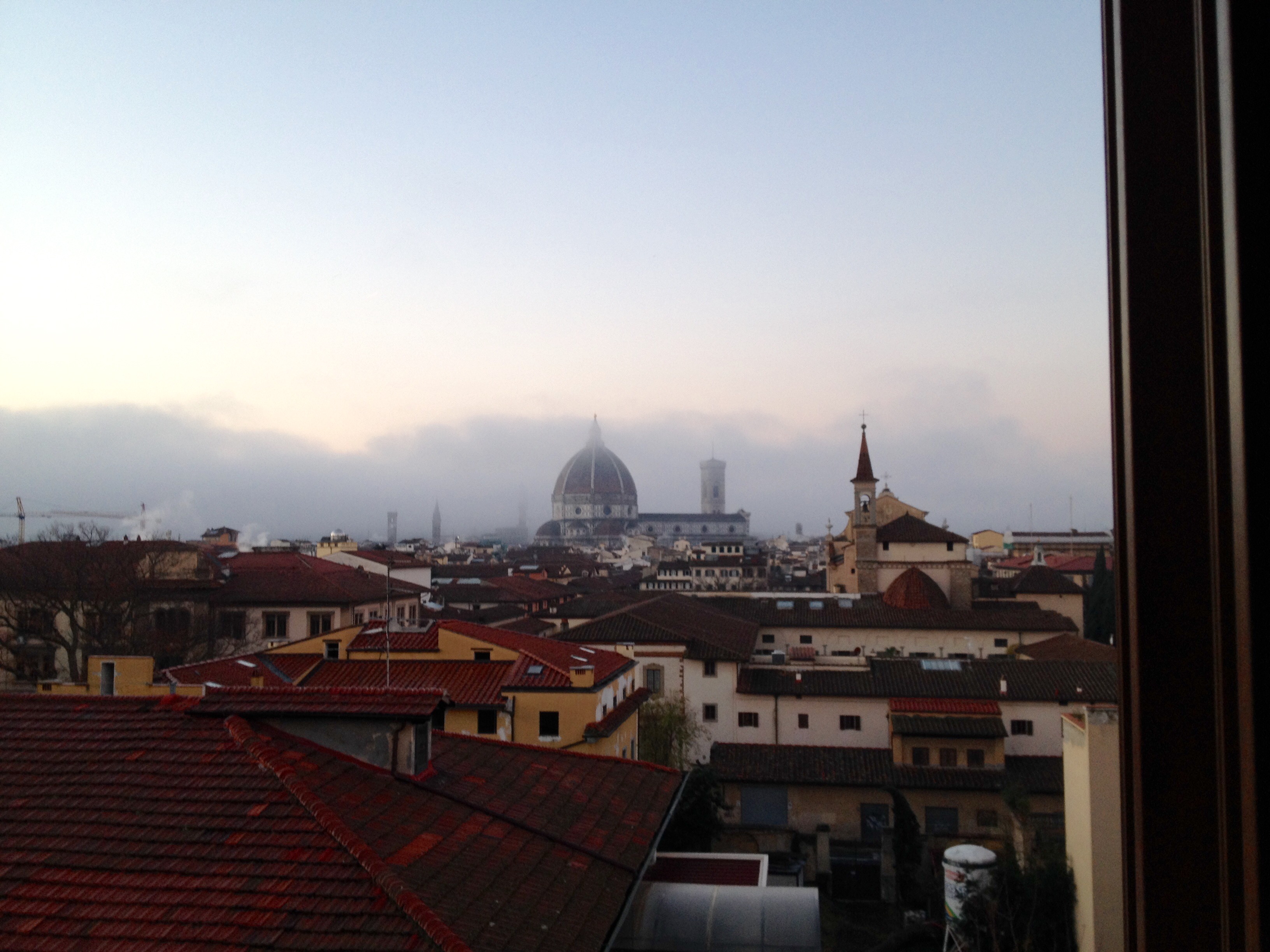
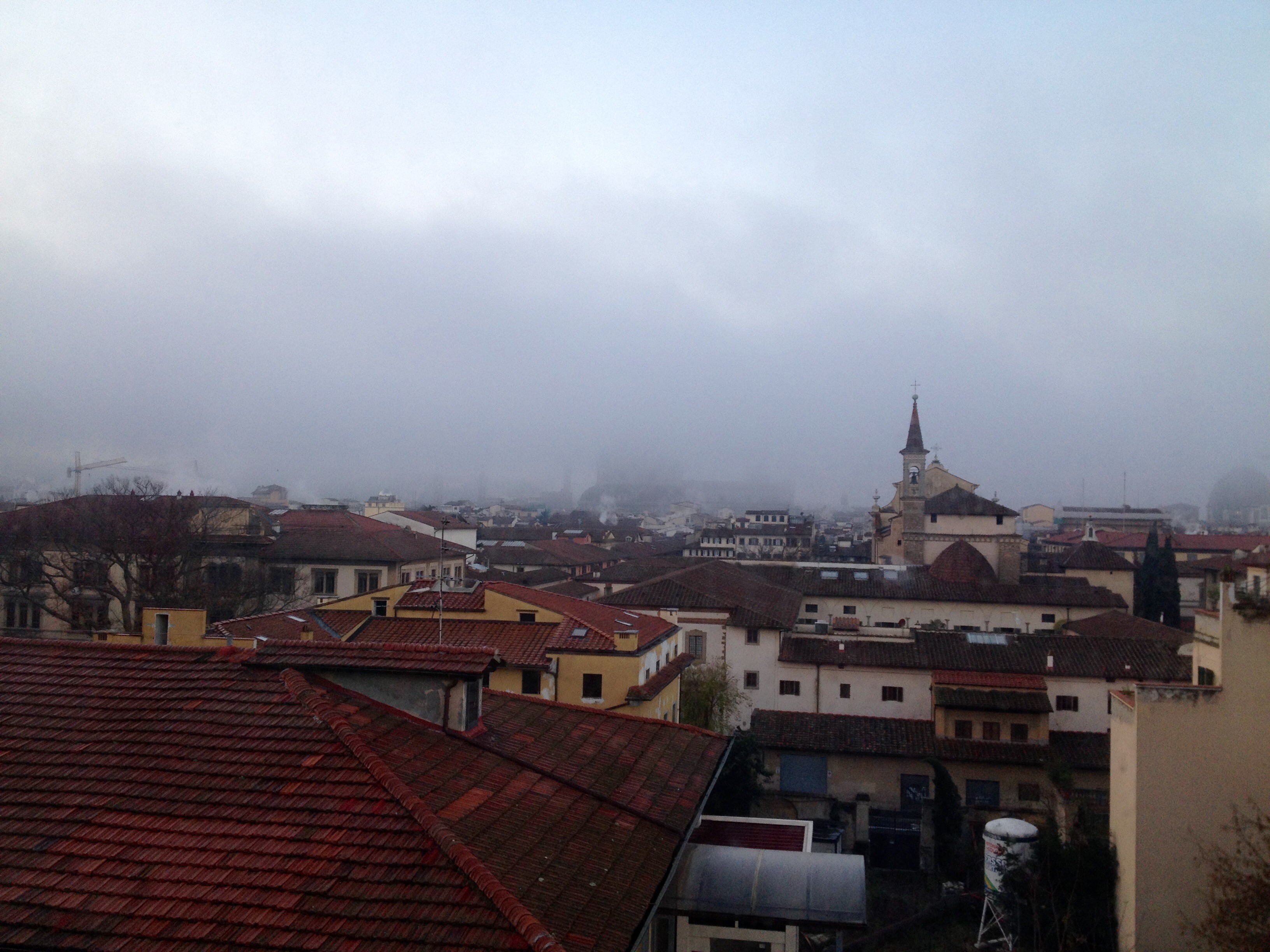
Il mio classmate italiano molto gentile (wow that is probably wrong in countless ways) captured these remarkable images of the Florentine Duomo this morning. Lucky Cristian has this view from his apartment. He said that one moment the Duomo was clearly seen and the next it was obliterated by a cloud. Thanks for sharing Cristian Ibanez!
Live and learn. Che sono ricciarelli?
The best thing ever, the thing that has made me happiest throughout my life, is learning new things.
So, when one of my readers said she prefers ricciarelli over panforte, panettone or pandoro, I wondered what ricciarelli are and I set off to find out.
Thank you, universe, for Wikipedia and the internets (I like to quote brilliant {ha ha} George Bush on this one thing). Ta da: ricciarelli are light, almond Sienese cookies. For centuries they were simply called marzipan because they make use of almond flour and/or paste. And, did you know that Siena famously produced a very special marzipan of its own? It sure enough did!
It turns out that ricciarelli are a traditional sweet treat that, like panforte, originated in Siena. According to legend, Ricciardetto della Gheradesca invented them in his castle near Volterra during the 14th-century when he returned from fighting in the Crusades. I’m going to guess that his wife’s panforte was too difficult to break apart and devour while riding his horse to battle, so he devised a more manageable size product. It just makes sense!
Ricciarelli are covered with icing sugar; they are crisp on the outside but soft on the inside and the whole bite melts in your mouth. Fresh and moist, the ricciarelli produce a burst of almond flavor on your tastebuds, along with the piercing smell of bitter almonds.
The cookies are cut and baked into an almond shape. While this may be because they are made with ingredients derived from almonds, it is also said that their shapes resemble the almond shaped eyes of many painted Renaissance images of the Virgin Mary and other saints.
Any dolci made with almond paste were reserved for the sumptuous banquet of the Lords, because they were made of precious ingredients, mainly almonds and sugar. These precious ingredients were so valuable and refined that marzipan sweets were sold in the apothecaries shops along with drugs and the most exotic spices of the time.
Today, the biscuits are made using an almond base with sugar, honey and egg white. When prepared in the traditional method, the almonds are ground with a milling machine, and the finished mix is formed into numerous oval- or lozenge-shaped cookies that are set aside for two days before baking. The rough and crackled surface is usually lightly sprinkled with confectionery sugar.

Here’s a recipe if you feel like making these lovely sweets, courtesy of http://en.julskitchen.com/dessert/ricciarelli-siena-almond-cookies, who tells us:
My recipe comes from the grocery shop Rosi in Poggibonsi (Siena), slightly revised. I love to enter their shop during the holidays because it is full of smells of spices, happy-eyed children and chocolate… but, most importantly, it is full of people talking in code: can you give me the ricciarelli dose for three? stuff for cavallucci without candied fruit, double nuts. Gimme my usual and gimme the spices, too. It’s a turnaround of numbers, doses, tips offered in a lowered voice, small pieces of written paper and puffs of icing sugar, and the result is this! Ricciarelli di Siena.
 Ingredients for about 20 ricciarelli:
- 2 egg whites
- lemon juice, 1 drop
- icing sugar, 200 g
- ground almond flour, 200 g**
- bitter almond extract, 2 tablespoons
- seeds from 1 pod of vanilla
- grated zest of 1 orange
- extra icing sugar, about 200 g
- white wafer, 1 large sheet (about as large as a A4 paper)
** can’t find almond flour? Make it at home with fresh almonds: shell them and remove the outer brown skin (to remove it quickly immerse them for about ten seconds in boiling water). Toast the almonds in the oven at 100°C for about 5 minutes and then let them cool down. Blend them with a tablespoon of icing sugar. Pulse the mixer several times using the pulse function or by pushing the “on” button, holding for a second, and releasing. The goal is not over heating the almonds, otherwise they will release the oil. Blend until you get the consistency of a medium – fine and coarse meal.
The night before. Whip the egg whites with a drop of lemon juice to stiff peaks. Fold in 200 g of icing sugar and the ground almond flour. Mix in the bitter almond extract, the grated peel of one orange and the vanilla seeds. Cover with cling-film and set aside in the fridge overnight (or at least for 4 hours).
The day after. Cut out about twenty (approximately 7 cm x 4 cm) ovals from the wafer sheet: they are meant to be the basis of ricciarelli. Place the extra icing sugar on a working surface. Roll the rough into a sausage and cut out small balls of dough. with powdered sugar a work plan. Shape the dough with your hands to cover the wafer oval. Make it about 1 cm thick and coat the shaped cookies with extra icing sugar (about 5 mm thick). Arrange them on a baking tin lined with parchment paper or a silicone sheet.
Bake in preheated oven to 160°C for about 18 minutes. They will resemble crinkle cookies. When you remove them from the oven, they will be still soft and moist, but don’t worry! they will reach the ideal texture once cooled down. Store them in an airtight container.. the day after they are even better.

Ricciarelli are typically consumed at Christmas, served with a desert wine such as Vin Santo or Moscadello di Montalcino. Buon appetitio!
Best Christmas card video ever!
Something I enjoy every day in Florence
Selfies


Parenting

 get back, lauretta!
You must be logged in to post a comment.